Consul General from Japan, S. Shimizu, found, 1895 / 2014.

With the kind help of Bishop Museum volunteer Mr. K. Suzuki, the mystery is solved. The Consul General Representative for 1895 from Japan here in Hawaii nei who appears in “Hawaii’s Story by Hawaii’s Queen” was Seizaburō Shimizu.

[As per a listing of the Japanese consul generals stationed in Honolulu, which is printed in Sōga, Yasutarō. 1953. Gojūnenkan no Hawai Kaiko. Tokyo: Kankōkai.]

More on Consul-General Shimizu, 1895.

[Found under: “KELA A ME KEIA.”]

Some well to do Japanese of Honolulu nei gave a large party outside of Sans Souci [Sana Susi], Waikiki, on the afternoon of this past Friday for the former Japanese Consul, and his secretary, Goro Narita. Also present was the new Consul-General (H. Shimamura) from Japan and his secretary.

[It seems Shimizu replaces Saburō Fujii as the Consul-General in November 1894 (although Gorō Narita was temporary Consul-General during the short period from November 1894 to January 1895), and Shimizu’s own term came to an end sometime in early November of 1895. In the 12/2/1895 issue of the same paper, there is a short three-line mention of the former Consul, Shimizu, returning to Japan on the Coptic of the past Thursday (11/28/1895).]

(Makaainana, 11/18/1895, p. 8)

Ua haawi ae kekahi mau Kepani...

Ka Makaainana, Buke IV—Ano Hou, Helu 21, Aoao 8. Novemaba 18, 1895.

On the search for the Japanese consul, F. Schmibu, 1895 / 2014.

We see in “Hawaii’s Story,” some of those present at the Queen’s trial were:

“The diplomatic corps, Mr. Albert F. Willis, minister of the United States, A. G. S. Hawes, British commissioner, Monsieur De Verlet, French commissioner, Senior Canavarro, Portuguese commissioner, and Mr. F. Schmibu, the Japanese consul…”

[According to Thrum’s Hawaiian Annual of 1895, Japan’s diplomatic representative was “F. Schimiczu, Eleve-Consul.”

In the Hawaii newspapers of the day, both English and Hawaiian-Language, there are also references to Consul-General Shimizu (Kanikela Kenerala Shimizu). But i still have yet to find any specific information on this man.

The four others are: Albert S. Willis, Albert G. S. Hawes, Henri L. Verleye, and Antonio de Souza Canavarro.]

Thrum

Thrum’s Hawaiian Annual for 1895, p. 156.

All of Hawaii was talking about Queen Liliuokalani’s 75th birthday, 1913.

HAWAII’S IMPERIAL BIRTHDAY

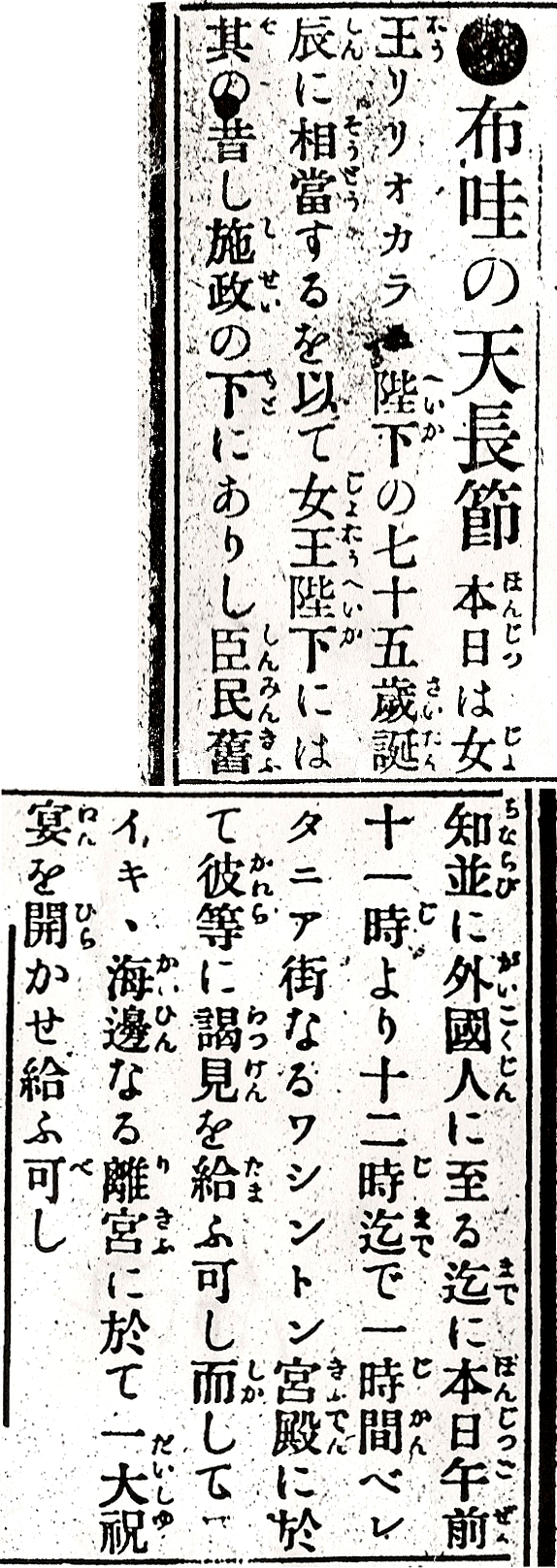
In accordance with this day being Queen Liliuokalani’s 75th birthday, her loyal subjects and old friends under her former administration, and even those of foreign birth, on this day from 11 o’clock in the morning to 12 o’clock, for 1 hour at Washington Palace on Beretania Street, they will be given audience; and at the imperial villa on the seaside of Wakiki will be held a grand celebration.

[There were many newspapers in many languages throughout the years here in Hawaii nei. In 1913, besides Hawaiian and English, there were papers in Chinese, Korean, Portuguese, and Japanese. Perhaps for research purposes we should consider not only looking at newspapers in one language, but we should see what they were saying in newspapers of other languages as well.]

(Hawaii Hochi, 9/2/1913, p. 4)

布哇の天長節

布哇報知、第213号4頁、大正2年9月2日

C. C. Moreno on missionaries, 1893.

A Misunderstood People.

MORENO ON THE MISSIONARIES.

Editor Post: For several years your public-spirited paper has published correspondence and statements submitted by me about Hawaii in which was foreshadowed the present state of affairs. The revolution which has just taken place is the inevitable result of missionary rule; the long-standing and deep-rooted cause of the unrest.

The missionaries in Hawaii, as in China, Japan, and elsewhere, consider that country as their open hunting grounds, regardless of the rights, customs, wishes, and priviliges of the natives and of stipulations.

I positively know that the self-appointed four chiefs of the Provisional Government in the Hawaiian Islands and the five commissioners coming to Washington to negotiate a treaty of annexation are, without a single exception, missionariesʻ confederates. Not a single native Hawaiian is with them, therefore, they cannot be considered as the representatives of the Hawaiian nation, of which they are aliens and enemies, but only as the emissaries of one side (or of a higher), which is not the right side.

The truth about Hawaiian affairs has never reached the State Department and that is the reason why, in the department, the knife has always been taken by the blade instead of by the handle in dealing with the Hawaiian question.

The United States always sent third rate politicians as ministers and consult to Honolulu, hence the erroneous information about Hawaii. I have on the spot studied Hawaii and the Hawaiians, their troubles with the missionaries of all creeds, and when distant from the islands I have kept an uninterrupted correspondence with the leaders of the Hawaiian nation, such as the Hons. Wilcox, Bush, Testa, Kaai, Kapena, Kaunamano, Kimo Pelekane [James I. Dowsett], and others.

My views on the Hawaiian question I explained at length to President Hayes and Secretary of State Evarts, to President Cleveland and to Assistant Secretary of State Porter: later, to Senator Morgan and to Congressman McCreary, and these are the statesmen that ought to dispose of the Hawaiian question and render justice to the weak, ill-treated, honest, and generous Hawaiian people that have been continually misrepresented, misjudged, and grossly wronged.

In accordance with the good order of things the coming self-appointed and self-styled Hawaiian commissioners, with more appearance than substance, should not be received by the United States authorities, because their self-attributed mission to Washington is based only upon selfish and malignant motives.

This will be a good opportunity for the great people of the United States to show their sentiment for fair play and generosity toward the unfortunate, harmless, friendly, and oppressed Hawaiian people, worthy of sympathy and of help in this their hour of national distress.

Celco Cæsar Moreno.

(Liberal, 2/25/1893, p. 2)

A Misunderstood People.

The Liberal, Volume I, Number 48, Page 2. February 25, 1893.

Pearls found in Heeia, 1918.

PEARLS FOUND IN OYSTERS.

According to the Japanese newspaper, Hawaii Shinpo, down in Heeia, Koolau, from six oysters [papaua] got by a Japanese who was diving in the ocean a few days ago, he found two pearls [pohaku momi].

From what was said, this is a Japanese used to diving in search of pearls, and the place he is accustomed to diving is the Seas of the South, where he spent a lot of his time searching for pearls in oysters.

When he dove at Heeia, it was not much work searching for papaua, and he found six easily; checking inside of them, two had pearls inside, and the other four did not.

In the South Seas, according to that Japanese, it is very rare to find an pearl in an oyster; from a hundred papaua, you will only find two pearls.

However he believes that the papaua here are different from the ones of the South Seas; and he is certain that if the diving for papaua continues here, a lot of pearls will be found, and this endeavor will benefit a number of people.

(Kuokoa, 2/8/1918, p. 8)

LOAA KA MOMI ILOKO O KA PAPAUA.

Ka Nupepa Kuokoa, Buke LVI, Helu 6, Aoao 8. Feberuari 8, 1918.

The children are your future! 1909 / timeless.

DON’T DECREASE THE PAY OF THE TEACHERS.

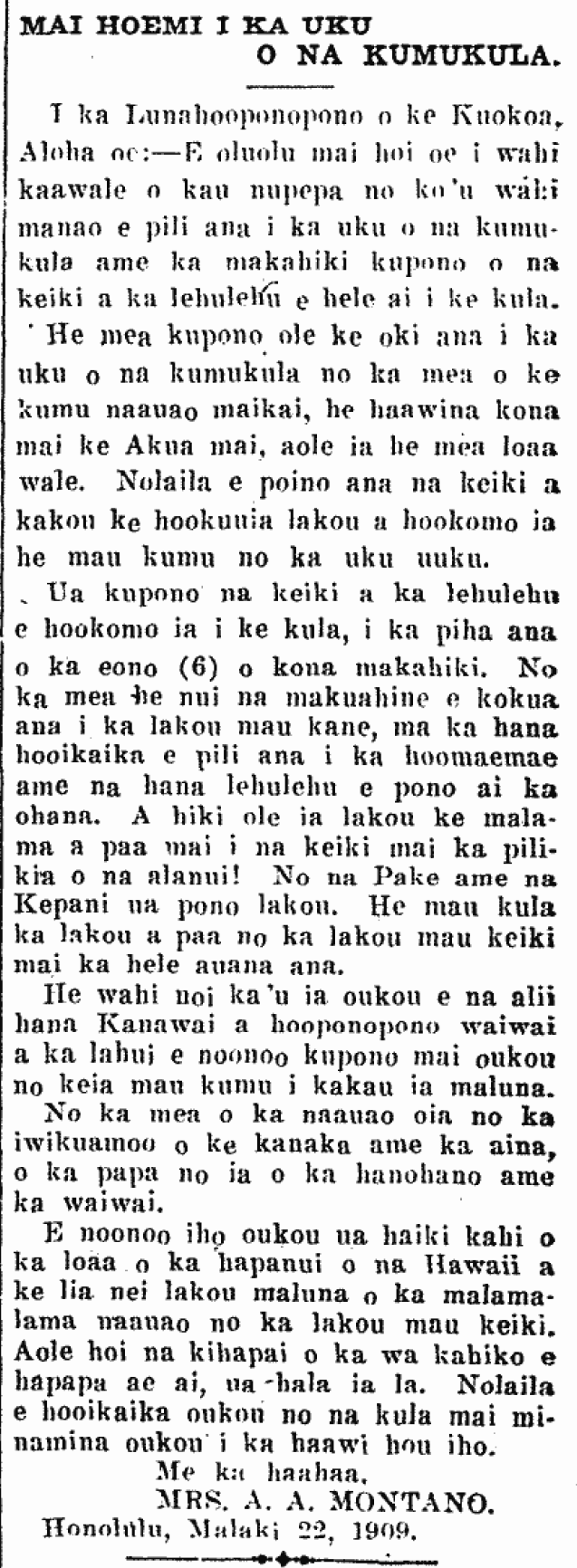
To the Editor of the Kuokoa, Aloha oe:—Please allow me some space in your newspaper for my humble thoughts dealing with the salary of teachers and the age at which children of the public should attend school.

It is wrong to cut the teachers’ pay because a well-educated teacher has a gift from God; it is not something readily gotten. And our children will be hurt should we let those teachers go and employ teachers for little pay.

The children of the people should be enrolled in school when they turn six (6) years of age. For there are many women who assist their husbands by endeavoring to take care of the many duties for the good of the family. And they are not able to care for and keep their children from the harm of the streets! As for the Chinese and the Japanese, they are fine. They have schools and their children are kept from wandering about.

I beseech all of you leaders who make Laws and who regulate public funds, do think carefully about these thoughts written above.

For knowledge is the backbone of man and his nation; it is the basis for fame and wealth.

Consider that the income of the majority of the Hawaiians is limited, and they are counting on the light of education for their children. The plantations of the old days are not to be reached out for, for those days are past. So all of you, please put effort into the schools, and don’t feel hesitant in investing more.

Sincerely,

MRS. A. A. MONTANO.

Honolulu, Malaki 22, 1909.

[Times have changed. Hopefully we learn from the past…

This letter is written by famed composer, Mary Jane Kekulani Montano.]

(Kuokoa, 3/26/1909, p. 4)

MAI HOEMI I KA UKU O NA KUMUKULA.

Ka Nupepa Kuokoa, Buke XLVI, Helu 13, Aoao 4. Maraki 26, 1909.

Hawaiian music and ukulele in Japan, 1933.

Returning Once Again to Hawaii Nei

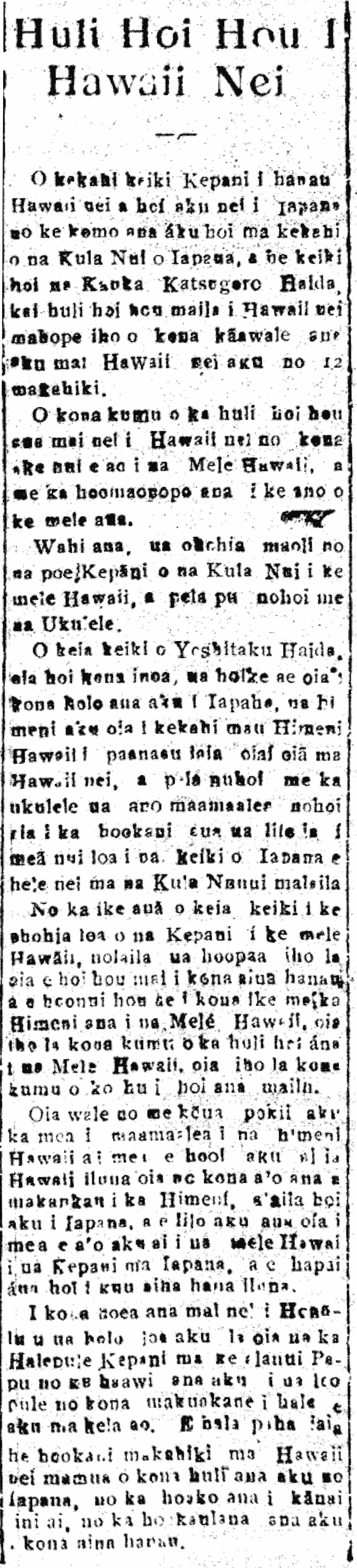
A Japanese boy born here in Hawaii and who went back to Japan to enter into a College in Japan, and who is a child of Dr. Katsugoro Haida, came back to Hawaii after being away from Hawaii for 12 years.

The reason for his return to Hawaii was because of his desire to learn Hawaiian Mele and to learn how to sing them.

According to him, the Japanese of the Universities are enthralled by Hawaiian songs, and so too of the Ukulele.

That boy, Yoshitaku Haida [Yoshikatsu Haida, aka Haruhiko Haida, aka Yukihiko Haida] is his name, said that when he went to Japan, he sang some Hawaiian Songs that he had memorized while in Hawaii nei; so also with the ukulele, he was quite skillful in playing it; and it became something big with the Japanese youth going to that University [Keio University].

Because this boy saw the great interest the Japanese had for Hawaiian music, he decided to return to the land of his birth and increase his knowledge in Singing Hawaiian Music, and that was the reason for his coming back.

It is just he and his younger brother [Katsuhiko Haida] who are skilled at Hawaiian songs, to raise up Hawaii, and that is why he is learning Singing until he is proficient, at which point he will return to Japan where he will become a teacher of Hawaiian mele to the Japanese in Japan, and raise up the land of my [his] birth.

Upon arriving in Honolulu, he went to the Japanese Church on Fort Street to say a prayer for his father who has passed to the other world. He may be here in Hawaii for perhaps a year before turning back for Japan, to fulfill his desire to bring fame to his birth land.

(Hoku o Hawaii, 2/14/1933, p. 3)

Huli Hoi Hou I Hawaii Nei

Ka Hoku o Hawaii, Buke XXVI, Helu 37, Aoao 3. Feberuari 14, 1933.

More on the landing of the Boston, 1893.

OPPOSED.

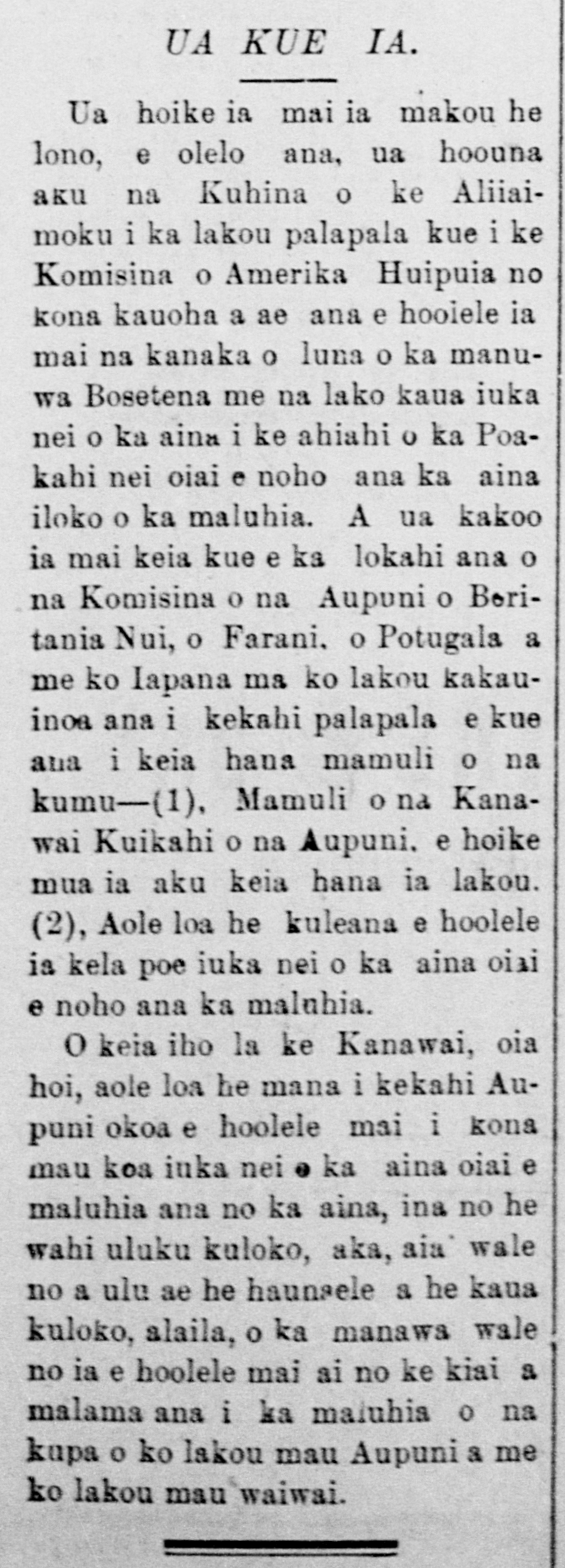
We have received news that the Ministers of the Queen sent their written protest to the Minister of the United States for his ordering the landing of the armed men from the man-of-war Boston on the evening of this Monday notwithstanding that there was peace on land. And this objection was jointly supported by the Commissioners of the Nations of Great Britain, France, Portugal, and Japan, by them signing a document opposing this action over these reasons—(1), Because of the agreement under law between the Nations to give prior notice. (2),  There was no cause to land the troops being that there was peace.

This is the Law, that being there is no other Nation that has any right to land its troops while there is peace; were there internal problems, but only if there was an uprising or a civil war, only then could there be troops landed to watch over and protect the safety of their citizens as well as their property.

(Hawaii Holomua, 1/18/1893, p. 3)

UA KUE IA.

Hawaii Holomua, Buke III, Helu 141, Aoao 3. Ianuari 18, 1893.

King Kalakaua’s Arrival in Japan, 1881.

His Majesty the King of Hawaii arrived here yesterday (Friday) morning at 8 a. m. in the Oceanic. As the steamer moved up to her anchorage, the men-of-war in harbour dressed ship and manned yards, the crews of the Russian and Japanese vessels also cheering heartily as the Oceanic passed them. His Majesty was visited on board by Mr. Hachisuka, ex-Daimiyo of Awa, Admiral Nakamura, Mr. Ishibashi, Secretary of the Foreign Office and others, as well as by the Russian Admiral and Staff. He subsequently embarked in the Emperor’s State barge and proceeded to the Port Admiral’s Office, where he was received by Mr. Daté, Ex-Daimiyo of Uwajima, Mr. Hijikata, Vice Minister of the Household Department, Mr. Sannomiya, Mr. Nagasaki and several Naval and Military officers, Mr. R. Irwin, Consul for Hawaii in Japan, and Mr. Stevens, secretary of the U. S. Legation also waited on his Majesty. From the Port Admiral’s Office His Majesty proceeded in a state carriage to the Summer Palace at Iséyama, which has been paled at his disposal by the Emperor. He was there visited by H. I. H. Prince Fushimi, Mr. Uyeno, Vice Minister of Foreign Affairs, and many other officials of high rank. To-day (Saturday) he proceeded to Tokiyo by the 12 o’clock train and was met at Shimbashi terminus by four Imperial Princes, who accompanied him first to an audience with His Majesty the Emperor and afterwards to their own houses, whence he ultimately proceeded to the Yenriyokwan, which has been prepared for his reception during the period of his sojourn here. The King’s name is Kalakauwa, which may be translated, “The day of battle.” His Majesty is nearly fifty years old, having been born in 1831. In personal appearance he is about the middle height, thickset, but of really handsome personal appearance. His complexion is not darker than that of an ordinary Japanese. When but a child he was received into the boarding school, kept for many years by Mr. and Mrs. Cook of the American Board’s Mission, for the exclusive reception of all the young chiefs of the highest blood. Here he received a good education, and being at the time he was first sent there one of the youngest received into this family of some dozen or more pupils, he had acquired, at the conclusion of his scholastic career, not only a through knowledge of English, but also an accurate pronunciation of that language. Previous to his election, in 1874, to fill the throne rendered vacant by the death of King William Lunalilo, he served as Post-Master General, and in other Government positions.

[This is an article appearing in one of Japan’s English-language newspapers of the time, The Japan Weekly Mail, which started in 1879.]

(Japan Weekly Mail, 3/5/1881, p. 1)

His Majesty the King of Hawaii arrived...

The Japan Weekly Mail, Volume V, Number 9, Page 1. March 5, 1881.