Turn in those with symptoms, 1867.

[Found under: “NU HOU KULOKO: Maui”]

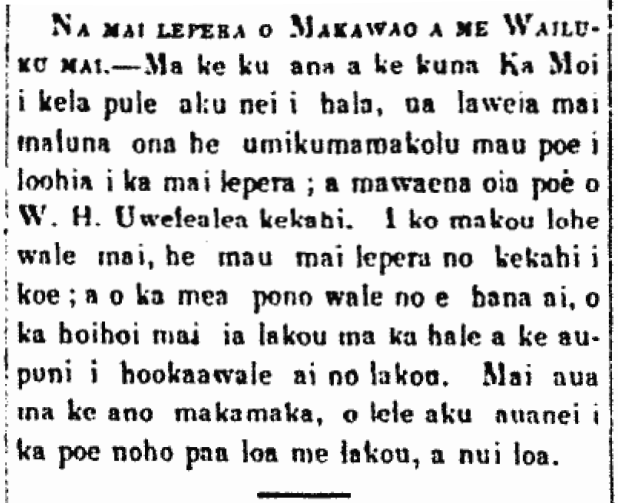
The Leprosy Patients from Makawao and Wailuku.—When Ka Moi landed this past week, taken aboard her were thirteen people suffering from leprosy; amongst them was W. H. Uwelealea. According to what we hear, there are others that remain, and the right thing to do is to send them to the building which the government has set aside for them. Don’t resist because they are your friends, lest those who live with them catch it, and it spreads.

(Kuokoa, 8/31/1867, p. 3)
Na mai lepera o Makawao a me Wailuku mai...

Ka Nupepa Kuokoa, Buke VI, Helu 35, Aoao 3. Augate 31, 1867.

List of leprosy patients sent to Molokai, continued, 1868.

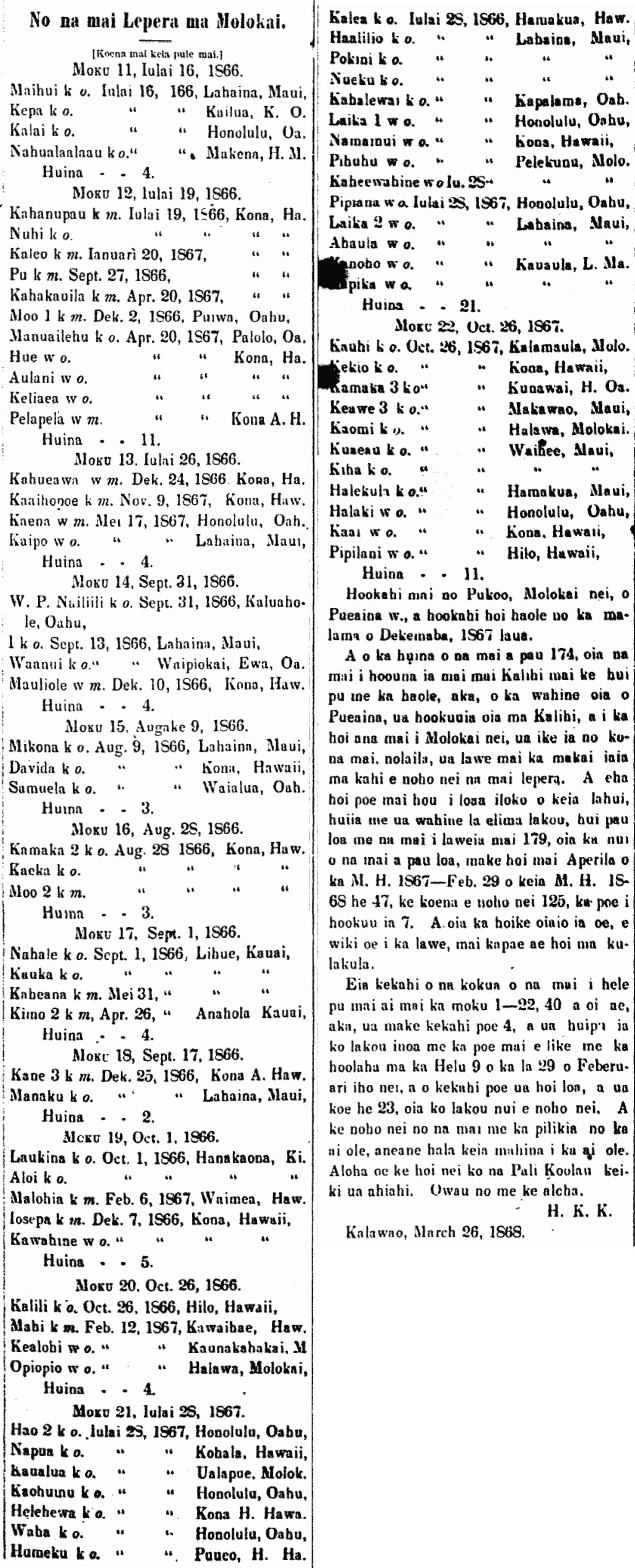
Concerning the Leprosy Patients on Molokai

(Continued from last week.)

Boat 11, July 16, 1866.
Maihui k, o. July 16, 166, Lahaina, Maui,
Kepa k, o. ” ” Kailua, K. O.
Kalai k, o. ” ” Honolulu, Oa.
Nahualaalaau k, o. ” ” Makena, H. M.
Total – – 4.
Boat 12, July 19, 1866.
Kahanupau k, m. July 19, 1866, Kona, Ha.
Nuhi k, o. ” ” ” “
Kaleo k, m. January 20, 1867, ” “
Pu k, m. Sept. 27, 1866, ” “
Kahakauila k, m. Apr. 20, 1867, ” “
Moo 1 k, m. Apr. 20, 1867, ” “
Manuailehu k, o. Apr. 20, 1867, Palolo, Oa.
Hue w, o. ” ” Kona, Ha.
Aulani w, o. ” ” ” “
Keliaea w, o. ” ” ” “
Pelapela w, m. ” ” Kona, A. H.
Total – – 11.
Boat 13, July 26, 1866.
Kahueawa w, m. Dec. 24, 1866, Kona, Ha.
Kaaihopoe k, m. Nov. 9, 1867, Kona, Haw.
Kaena w, m. May 17, 1867, Honolulu, Oah.
Kaipo w, o. ” ” Lahaina, Maui,
Total – – 4.
Boat 14, Sept. 31, 1866.
W. P. Nailiili k, o. Sept. 31, 1866, Kaluahole, Oahu,
I k, o. Sept. 13, 1866, Lahaina, Maui,
Waanui k, o. ” ” Waipiokai, Ewa, Oa.
Mauliole w, m. Dec. 10, 1866, Kona, Haw.
Total – – 4.
Boat 15, August 9, 1866.
Mikona k, o. Aug. 9, 1866, Lahaina, Maui,
Davida k, o. ” ” Kona, Hawaii,
Samuela k, o. ” ” Waialua, Oah.
Total – – 3.
Boat 16, Aug. 28, 1866.
Kamaka 2 k, o. Aug. 28, 1866, Kona, Haw.
Kaeka k, o. ” ” ” “
Moo 2 k, m. ” ” ” “
Total – – 3.
Boat 17, Sept. 1, 1866.
Nahale k, o. Sept. 1, 1866, Lihue, Kauai,
Kauka k, o. ” ” ” “
Kaheana k, m. May 31, ” ” “
Kimo 2 k, m. Apr. 26, ” Anahola, Kauai,
Total – – 4.
Boat 18, Sept. 17, 1866.
Kane 3 k, m. Dec. 25, 1866, Kona A. Haw.
Manaku k, o. ” ” Lahaina, Maui,
Total – – 2.
Boat 19, Oct. 1, 1866.
Laukina k, o. Oct. 1, 1866, Hanakaona, Ki.
Aloi k, o. ” ” ” “
Malohia k, m. Feb. 6, 1867, Waimea, Haw.
Iosepa k, m. Dec. 7, 1866, Kona, Hawaii,
Kawahine w, o. ” ” ” “
Total – – 5.
Boat 20, Oct. 26, 1866.
Kalili k, o. Oct. 26, 1866, Hilo, Hawaii,
Mahi k, m. Feb. 12, 1867, Kawaihae, Haw.
Kealohi w, o. ” ” Kaunakahakai, M.
Opiopio w, o. ” ” Halawa, Molokai,
Total – – 4.
Boat 21, July 28, 1867.
Hao 2 k, o. July 28, 1867, Honolulu, Oahu,
Napua k, o. ” ” Kohala, Hawaii,
Kaualua k, o. ” ” Ualapue, Molok.
Kaohumu k, o. ” ” Honolulu, Oahu,
Helehewa k, o. ” ” Kona, H. Hawa.
Waha k, o. ” ” Honolulu, Oahu,
Humeku k, o. ” ” Puueo, H. Ha.
Kalea k, o. July 28, 1866, Hamakua, Haw.
Haalilio k, o. ” ” Lahaina, Maui,
Pokini k, o. ” ” ” “
Nueku k, o. ” ” ” “
Kahalewai k, o. ” ” Kapalama, Oah.
Laika 1 w, o. ” ” Kona, Hawaii,
Namamui w, o. ” ” Kona, Hawaii,
Pihuhu w, o. ” ” Pelekunu, Molo.
Kaheewahine w, o. July 28, ” ” “
Pipiana w, o. July 28, 1867, Honolulu, Oahu,
Laika 2 w, o. ” ” Lahaina, Maui,
Ahaula w, o. ” ” ” “
Kanoho w, o. ” ” Kauaula, L. Ma.
??pika w, o. ” ” ” “
Total – – 21.
Boat 22, Oct. 26, 1867.
Kauhi k, o. Oct. 26, 1867, Kalamaula, Molo.
Kekio k, o. ” ” Kona, Hawaii,
Kamaka 3 k, o.  ” ” Kunawai, H. Oa.
Keawe 3 k, o. ” ” Makawao, Maui,
Kaomi k, o. ” ” Halawa, Molokai,
Kuaeau k, o. ” ” Waihee, Maui,
Kiha k, o. ” ” ” “
Halekula k, o. ” ” Hamakua, Maui,
Halaki w, o. ” ” Honolulu, Oahu,
Kaai w, o. ” ” Kona, Hawaii,
Pipilani w, o. ” ” Hilo, Hawaii,
Total – – 11.
There is one patient from Pukoo, Molokai, named Pueaina (f.), and one haole, and they are both from the month of December 1867.
The total number of patients is 174; those are the patients sent from Kalihi along with the haole; however the woman, Pueaina, she was released at Kalihi, but when she was returning to Molokai, her sickness was seen, and so she was brought by the deputy to where the patients reside. And there were four more of our people brought, and so added together with that woman, there are five of them, so all together with those patients brought in, there are 179; that is the total number of patients. The deaths from April 1867—Feb. 29 of this year, 1868, is 47; the remainder of those alive is 125; the number of them released is 7. And this is a true report to you; take this quickly, and don’t just set it aside.
One more thing; the number of helpers (kokua) who came along with the patients from ships 1–22, there are 40 or more of them, however, 4 of them have died, and their number was added with the patients as was announced in Issue 9 of the 29th of February; and some have returned home; and 23 are left, and that is the number of those that still live here. The patients are living with difficulty for lack of food; this month was almost totally spent without food. Aloha to you as this son of the Koolau Cliffs returns for it is eventide. Me, with aloha.
H. K. K.
Kalawao, March 26, 1868.
(Kuokoa, 5/16/1868, p. 4)
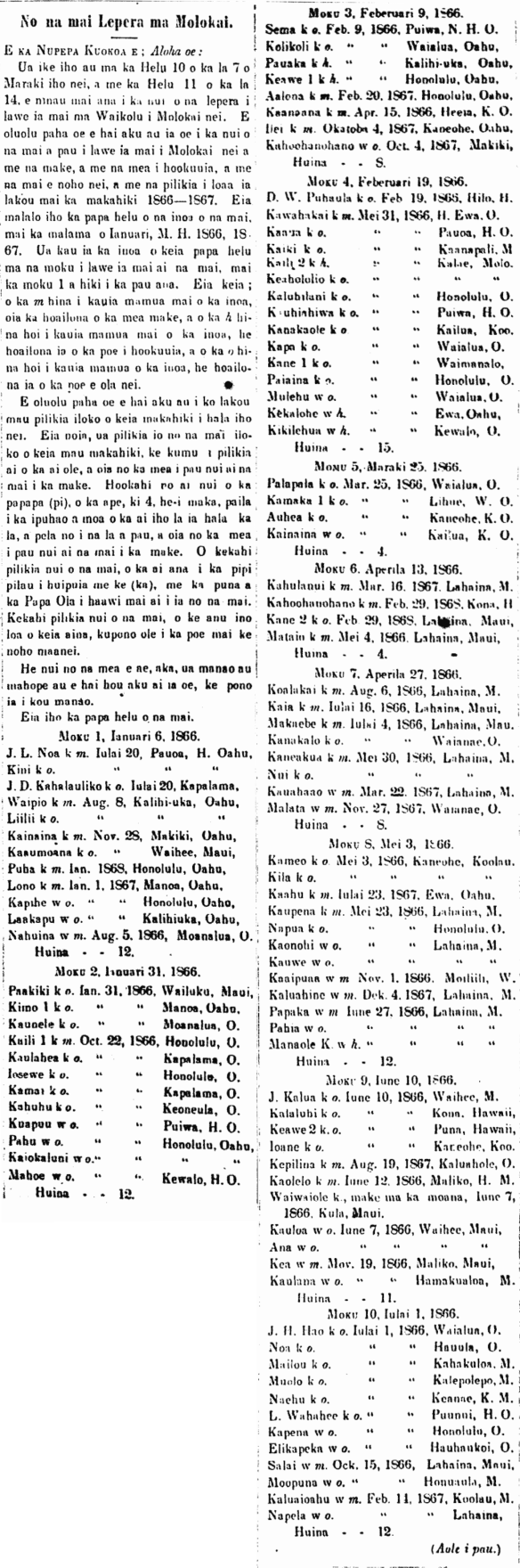
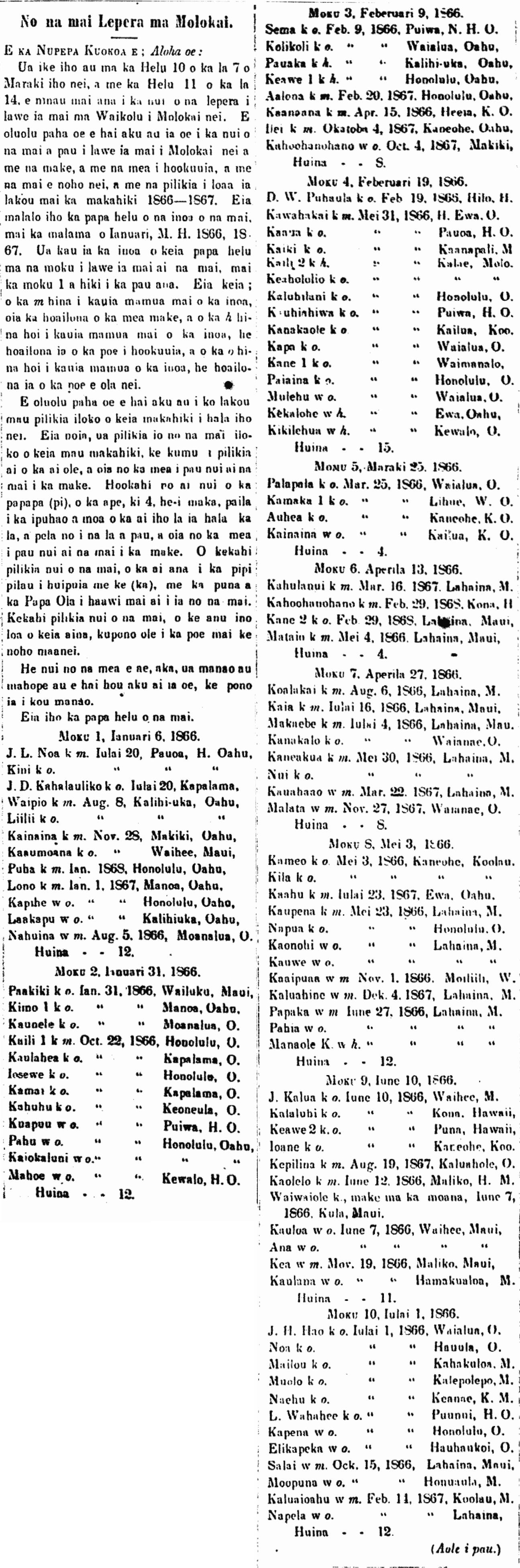
No na mai Lepera ma Molokai.

Ka Nupepa Kuokoa, Buke VII, Helu 20, Aoao 4. Mei 16, 1868.

List of leprosy patients sent to Molokai, 1868.

Concerning the Leprosy Patients on Molokai.

O Kuokoa Newspaper, Aloha oe:

I have seen in Issue 10 of March 7 and Issue 11 of the 14th, the question as to how many leprosy patients were brought to Waikolu, here in Molokai. If it pleases you, I will tell you the total number of patients brought to Molokai, along with the deaths, and those who were released, and also those patients who are still living; and also the difficulties they faced in the years 1866–1867. Here below is a list of the patients from the month of January, 1866–1867. The list is given by the boats that brought the patients, from the first boat to the last. And also, an italic “m” placed [after] the name signifies that they are deceased [“make”], and an “h” placed [after] the name signifies they were released [“hookuuia”], and an “o” placed [after] the name means they are still living here [“ola”].
I would like to speak of their difficulties during this past year. And this is it; the patients were beset with much difficulties, and that they had no food, and that is the reason that so many patients died. There is but one abundant thing to eat: peas, ape, ti-leaf root 4, and green bananas boiled up in a pot until cooked, and that is what they eat to get by; and that goes on everyday, and that is why many of the patients die. Another big problem of the patients is the consumption of the spoiled beef mixed with tar and plaster that is sent by the board of health as food for the patients. Another big problem faced by the patients is the extreme cold; it is not beneficial for the sick to live here.
There are so many other things, but I believe that I will talk about them to you later, should you deem it proper.
Here is the lists of the patients.
Boat 1, January 6, 1866.
J. L. Noa k [kane], m. July 20 [not sure what these dates are], Pauoa, H. Oahu,
Kini k, o. ” ” “
J. D. Kahalauliko k, o. July 20, Kapalama, Oahu,
Waipio k, m. Aug. 8, Kalihi-uka, Oahu,
Liilii k, o. ” ” “
Kainaina k, m. Nov. 28, Makiki, Oahu,
Kaaumoana k, o. ” Waihee, Maui,
Puha k, m. Jan. 1868, Honolulu, Oahu,
Lono k, m. Jan. 1, 1867, Manoa, Oahu,
Kapihe w [wahine], o. ” ” Honolulu, Oahu,
Laakapu w, o. ” ” Kalihiuka, Oahu,
Nahuina w, m. Aug. 5, 1866, Moanalua, O.
Total – – 12.
Boat 2, January 31, 1866.
Paakiki k, o. Jan. 31, 1866, Wailuku, Maui,
Kimo 1 [“1” indicates that there were more than one person with the same name] k, o. ” ” Manoa, Oahu,
Kaunele k, o. ” ” Moanalua, O.
Kaili 1 k, m. Oct. 22, 1866, Honolulu, O.
Kaulahea k, o. ” ” Kapalama, O.
Iosewe k, o. ” ” Honolulu, O.
Kamai k, o. ” ” Kapalama, O.
Kahuhu k, o. ” ” Keoneula, O.
Kuapuu w, o. ” ” Puiwa, H. O.
Pahu w, o. ” ” Honolulu, Oahu,
Kaiokaluni w, o. ” ” ” “
Mahoe w, o. ” ” Kewalo, H. O.
Total – – 12.
Boat 3, February 9, 1866.
Sema k, o. Feb. 9, 1866, Puiwa, N. H. O,
Kolikoli k, o. ” ” Waialua, Oahu,
Pauaka k, h. ” ” Kalihi-uka, Oahu.
Keawe 1 k, h. ” ” Honolulu, Oahu,
Aalona k, m. Feb. 20, 1867, Honolulu, Oahu,
Kaanaana k, m. Apr. 15, 1866, Heeia, K. O.
Ilei k, m. October 4, 1867, Kaneohe, Oahu,
Kahoohanohano w, o. Oct. 4, 1867, Makiki,
Total – – 8.
Boat 4, Feberuary 19, 1866.
D. W. Puhaula k, o. Feb. 19, 1868, Hilo, H.
Kawahakai k, m. May 31, 1866, H. Ewa, O.
Kaaua k, o. ” ” Pauoa, H. O.
Kaiki k, o. ” ” Kaanapali, M.
Kaili 2 k, h. ” ” Kalae, Molo.
Keahololio k, o. ” ” ” “
Kaluhilani k, o. ” ” Honolulu, O.
Kauhiahiwa k, o. ” ” Puiwa, H. O.
Kanakaole k, o. ” ” Kailua, Koo.
Kapa k, o. ” ” Waialua, O.
Kane 1 k, o. ” ” Waimanalo,
Paiaina k, o. ” ” Honolulu, O.
Mulehu w, o. ” ” Waialua, O.
Kekalohe w, h. ” ” Ewa, Oahu,
Kikilehua w, h. ” ” Kewalo, O.
Total – – 15.
Boat 5, March 25, 1866.
Palapala k, o. Mar. 25, 1866, Waialua, O.
Kamaka 1 k, o. ” ” Lihue, W. O.
Auhea k, o. ” ” Kaneohe, K. O.
Kainaina w, o. ” ” Kailua, K. O.
Total – – 4.
Boat 6, April 13, 1866.
Kahulanui k, m. Mar. 16, 1867. Lahaina, M.
Kahoohanohano k, m. Feb. 29, 1868, Kona, H.
Kane 2 k, o. Feb. 29, 1868, Lahaina, Maui,
Mataio k, m. May 4, 1866, Lahaina, Maui,
Total – – 4.
Boat 7, April 27, 1866.
Koalakai k, m. Aug. 6, 1866, Lahaina, M.
Kaia k, m. July 16, 1866, Lahaina, Maui,
Makaebe k, m. July 4, 1866, Lahaina, Mau.
Kanakalo k, o. ” ” Waianae, O.
Kaneakua k, m. May 30, 1866, Lahaina, M.
Nui k, o. ” ” ” “
Kauahaao w, m. Mar. 22, 1867, Lahaina, M.
Malata w, m. Nov. 27, 1867, Waianae, O.
Total – – 8
Boat 8, May 3, 1866.
Kameo k, o. May 3, 1866, Kaneohe, Koolau,
Kila k, o. ” ” ” “
Kaahu k, m. July 23, 1867, Ewa, Oahu.
Kaupena k, m. May 23, 1866, Lahaina, M.
Napua k, o. ” ” Honolulu, O.
Kaonohi w, o. ” ” Lahaina, M.
Kauwe w, o. ” ” ” “
Kaaipuaa w, m. Nov. 1, 1866, Moiliili, W.
Kaluahine w, m. Dec. 4, 1867, Lahaina, M.
Papaka w, m. June 27, 1866, Lahaina, M.
Pahia w, o. ” ” ” “
Manaole K. w, h. ” ” ” “
Total – – 12.
Boat 9, June 10, 1866.
J. Kalua k, o. June 10, 1866, Waihee, M.
Kalaluhi k, o. ” ” Kona, Hawaii,
Keawe 2 k, o. ” ” Puna, Hawaii,
Ioane k, o. ” ” Kaneohe, Koo.
Kepilina k, m. Aug. 19, 1867, Kaluahole, O.
Kaolelo k, m. June 12, 1866, Maliko, H. M.
Waiwaiole k., died at sea, June 7, 1866, Kula, Maui,
Kauloa w, o. June 7, 1866, Waihee, Maui,
Ana w, o. ” ” ” “
Kea w, m. Nov. 19, 1866, Maliko, Maui,
Kaulana w, o. ” ” Hamakualoa, M.
Total – – 11.
Boat 10, July 1, 1866.
J. H. Hao k, o. July 1, 1866, Waialua, O.
Noa k, o. ” ” Hauula, O.
Mailou k, o. ” ” Kahakuloa, M.
Muolo k, o. ” ” Kalepolepo, M.
Naehu k, o. ” ” Keanae, K. M.
L. Wahahee k, o. ” ” Puunui, H. O.
Kapena w, o. ” ” Honolulu, O.
Elikapeka w, o. ” ” Hauhaukoi, O.
Salai w, m. Oct. 15, 1866, Lahaina, Maui,
Moopuna w, o. ” ” Honuaula, M.
Kaluaioahu w, m. Feb. 14, 1867, Koolau, M.
Napela w, o. ” ” Lahaina,
Total – – 12.
(Not complete.)
[Anyone have an idea what the dates in the list stand for? And also the description here is interesting when compared to what was said in this morning’s newspaper: “Translations bring to light true voices of patients,” by Dan Nakaso.]
(Kuokoa, 5/9/1868, p. 4)
No na mai Lepera ma Molokai.

Ka Nupepa Kuokoa, Buke VII, Helu 19, Aoao 4. Mei 9, 1868.
One more related article on Kalaupapa, 1867.

The Leprosy Hospital on Molokai.

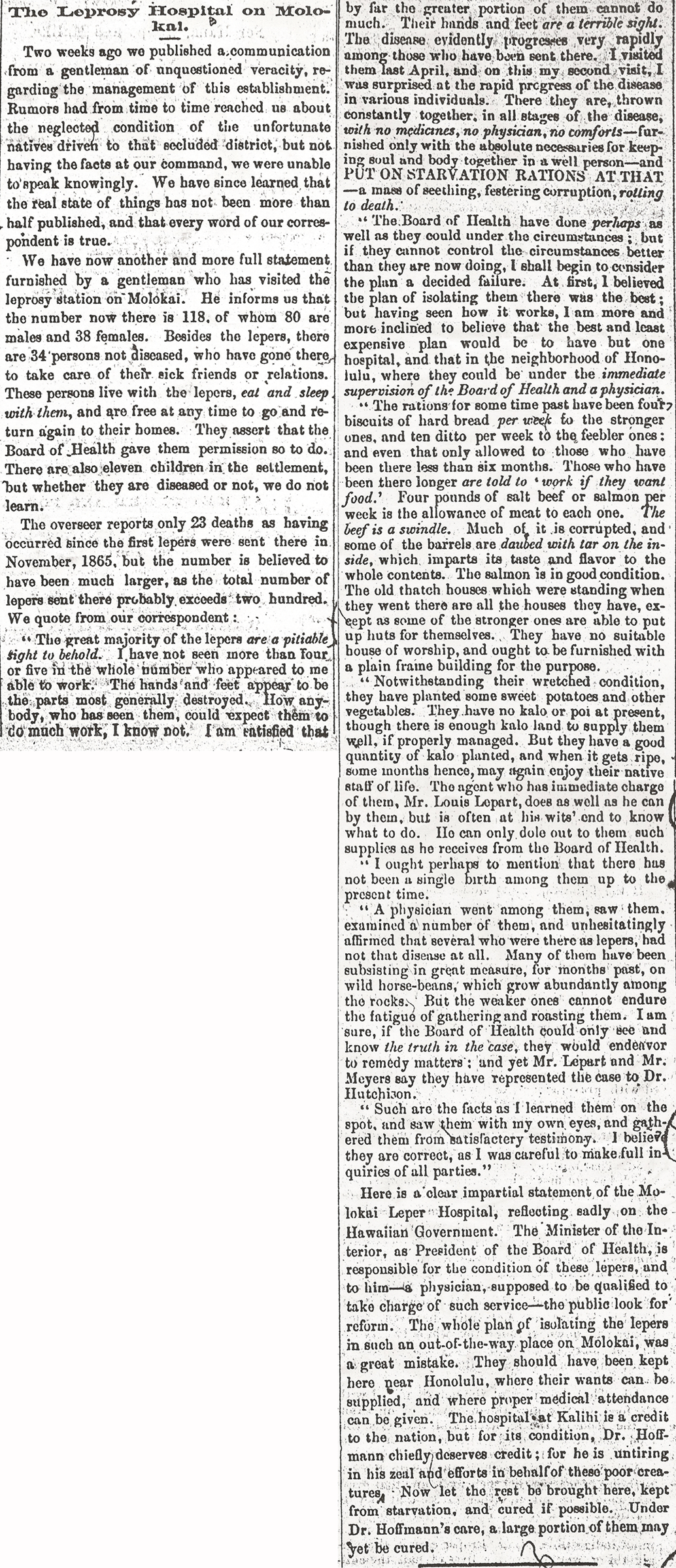
Two weeks ago we published a communication from a gentleman of unquestioned veracity, regarding the management of this establishment. Rumors had from time to time reached us about the neglected conditions of the unfortunate natives driven to that secluded district, but not having the facts at our command, we were unable to speak knowingly. We have since learned that the real state of things has not been more than half published, and that every word of our correspondent is true.

We have no another and more full statement furnished by a gentleman who has visited the leprosy station on Molokai. He informs us that the number now there is 118, of whom 80 are males and 38 females. Besides the lepers, there are 34 persons not diseased, who have gone there to take care of their sick friends or relations. These persons live with the lepers, eat and sleep with them, and are free at any time to go and return again to their homes. They assert that the Board of Health gave them permission so to do. There are also eleven children in the settlement, but whether they are diseased or not, we do not learn.

The overseer reports only 23 deaths as having occurred since the first lepers were sent there in November, 1865, but the number is believed to have been much larger, as the total number of lepers sent there probably exceeds two hundred. We quote from our correspondent:

“The great majority of the lepers are a pitiable sight to behold. I have not seen more than four or five in the whole number who appeared to me able to work. The hands and feet appear to be the parts most generally destroyed. How anybody, who has seen them, could expect them to do much work, I know not. I am satisfied that by far the greater portion of them cannot do much. Their hands and feet are a terrible sight. The disease evidently progresses very rapidly among those who have been sent there. I visited them last April, and on this my second visit, I was surprised at the rapid progress of the disease in various individuals. There they are, thrown constantly together, in all stages of the disease, with no medicines, no physicians, no comforts—furnished only with the absolute neccessaries for keeping soul and body together in a well person—and PUT ON STARVATION RATIONS AT THAT—a mass of seething, festering corruption, rotting to death.

“The Board of Health have done perhaps as well as they could under the circumstances; but if they cannot control the circumstances better than they are now doing, I shall begin to consider the plan a decided failure. At first, I believed the plan of isolating them there was the best; but having seen how it works, I am more and more inclined to believe that the best and least expensive plan would be to have but one hospital, and that in the neighborhood of Honolulu, where they could be under the immediate supervision of the Board of Health and a physician.

“The rations for some time past have been four biscuits of hard bread per week to the stronger ones, and ten ditto per week to the feebler ones: and even that only allowed to those who have been there less than six months. Those who have been there longer are told to ‘work if they want food.’ Four pounds of salt beef or salmon per week is the allowance of meat to each one. The beef is a swindle. Much of it is corrupted, and some of the barrels are daubed with tar on the inside, which imparts its taste and flavor to the whole contents. The salmon is in good condition. The old thatch houses which were standing when they went there are all the houses they have, except as some of the stronger ones are able to put up huts for themselves. They have no suitable house of worship, and ought to be furnished with a plain frame building for the purpose.

“Notwithstanding their wretched condition, they have planted some sweet potatoes and other vegetables. They have no kalo or poi at present, though there is enough kalo land to supply them well, if properly managed. But they have a a good quantity of kalo planted, and when it gets ripe, some months hence, may again enjoy their native staff of life. The agent who has immediate charge of them, Mr. Louis Lepart, does as well as he can by them, but is often at his wits’ end to know what to do. He can only dole out to them such supplies as he receives from the Board of Health.

“I ought perhaps to mention that there has not been a single birth among them up to the present time.

“A physician went among them, saw them, examined a number of them, and unhesitatingly affirmed that several who were there as lepers, had not that disease at all. Many of them have been subsisting in great measure, for months past, on wild horse-beans, which grow abundantly among the rocks. But the weaker ones cannot endure the fatigue of gathering and roasting them. I am sure, if the Board of Health could only see and know the truth in the case, they would endeavor to remedy matters; and yet Mr. Lepart and Mr. Meyers say they have represented the case to Dr. Hutchison.

“Such are the facts as I learned them on the spot, and saw them with my own eyes, and gathered them from satisfactery testimony. I believe they are correct, as I was careful to make full inquiries of all parties.”

Here is a clear impartial statement of the Molokai Leper Hospital, reflecting sadly on the Hawaiian Government. The Minister of the Interior, as President of the Board of Health, is responsible for the condition of these lepers, and to him—a physician, supposed to be qualified to take charge of such a service—the public look for reform. The whole plan of isolating the lepers in such an out-of-the-way place on Molokai, was a great mistake. They should have been kept here near Honolulu, where their wants can be supplied, and where proper medical attendance can be given. The hospital at Kalihi is a credit to the nation, but for its condition, Dr. Hoffmann chiefly deserves credit; for he is untiring in his zeal and efforts in behalf of these poo creatures. Now let the rest be brought here, kept from starvation, and cured if possible. Under Dr. Hoffmann’s care, a large portion of them may yet be cured.

(Pacific Commercial Advertiser, 1/12/1867, p. 3)

The Leprosy Hospital on Molokai.

The Pacific Commercial Advertiser, Volume XI, Number 28, Page 3. January 12, 1867.

Critique of Government Policy to Isolate Leprosy Patients, 1867.

[Found under: “English Column.: Island News.”]

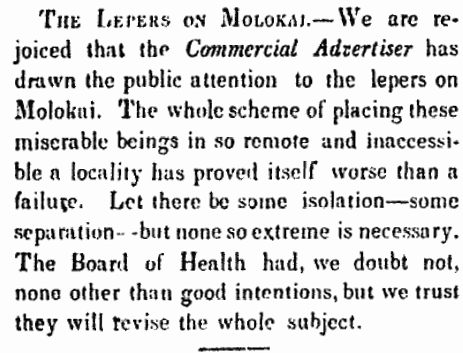
The Lepers on Molokai.—We are rejoiced that the Commercial Advertiser has drawn the public attention to the lepers on Molokai. The whole scheme of placing these miserable beings in so remote and inaccessible locality has proved itself worse than a failure. Let there be some isolation—some separation—but none so extreme is necessary. The Board of Health had, we doubt not, none other than good intentions, but we trust they will revise the whole subject.

[This article comes out soon after the policy to isolate the patients in Kalawao and Kalaupapa. It is a response to articles appearing in the Pacific Commercial Advertiser (predecessor of the Honolulu Advertiser). See following two posts.]

(Kuokoa, 1/19/1867, p. 2)

The Lepers on Molokai...

Ka Nupepa Kuokoa, Buke VI, Helu 3, Aoao 2. Ianuari 19, 1867.

Where did all of these treasures from the Kingdom go? 1922.

THERE ARE MANY OLD THINGS PLACED ON DISPLAY.

There are many old things from the monarchial period saved as memorabilia on display in the window of the business of Hawaiian News Co., which is headed by John H. Soper, the first General of the Hawaiian National Guards [Pualikoa Kiai Lahui Hawaii]; and amongst the old things is the sword of King Kalakaua, memorabilia from the P. G. [Provisional Government; aupuni kuikawa], and many various documents.

There also is a ticket signed by G. E. Smithies of the treasury office, for the receipt of the crown and sword of Kalakaua and many other items within Iolani Palace at the time, and now the Executive Building [Hale Mana Hooko].

Near the sword is a written document, explaining that it was presented to Colonel Soper (that being Soper’s rank at the time) from James W. Robertson, the first chamberlain of the King, by order of Sanford B. Dole, and it was written on the 18th of January, 1893, the day after Queen Liliuokalani was driven from the throne.

There are also proclamations signed by President Dole and the ministers of the P. G. giving authority to John H. Soper, the one who was appointed as marshal of the republic of Hawaii, to proclaim martial law. There are also several documents sent to Marshal Soper from President Dole ordering Soper to circulate the proclamations should the troops of the Provisional Government be waged war upon.

There is also an order giving authority to Marshal Soper to arrest some men here in Honolulu, should they defy the government. In the list of names of those people are: Charles J. McCarthy, former mayor of Hawaii; also C. B. Wilson, marshal of the kingdom under Queen Liliuokalani; Samuel Parker and some other former ministers; along with other important people of the time amongst the Hawaiians.

Also in the window is a portrait painted of President Dole and also of General Soper in full dress, in the role of General of the Republic of Hawaii; and so too with other important people during the time of the overthrow of 1893.

All of the appointment documents of General Soper as a marshal [ilamuku] for the kingdom signed by King Kalakaua from 1884 to 1886, and also the appointment as marshal by President Dole for the republic of Hawaii, and the appointments as colonel and brigadier general for the National Guards, can all be seen in the window.

[Speaking of treasures and swords and auctions… Why is this sword up for auction?]

(Kuokoa, 9/22/1922, p. 1)

LEHULEHU NA MEA KAHIKO I KAUIA NO KA HOIKEIKE ANA.

Ka Nupepa Kuokoa, Buke LXI, Helu 39, Aoao 1. Sepatemaba 28, 1922.

Even more from Ka Nonanona, August 8, 1843.

TRAITORS.

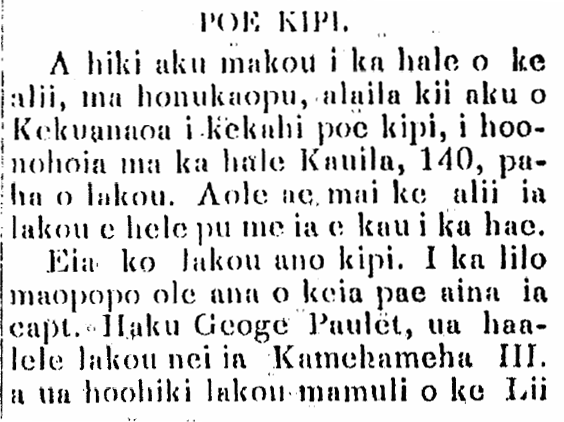
When we reached the residence of the king, at Honukaopu [Honokaupu ?], Kekuanaoa fetched some traitors who were kept at Hale Kauila; perhaps there were 140 of them. The king did not allow them to accompany him to raise the flag.

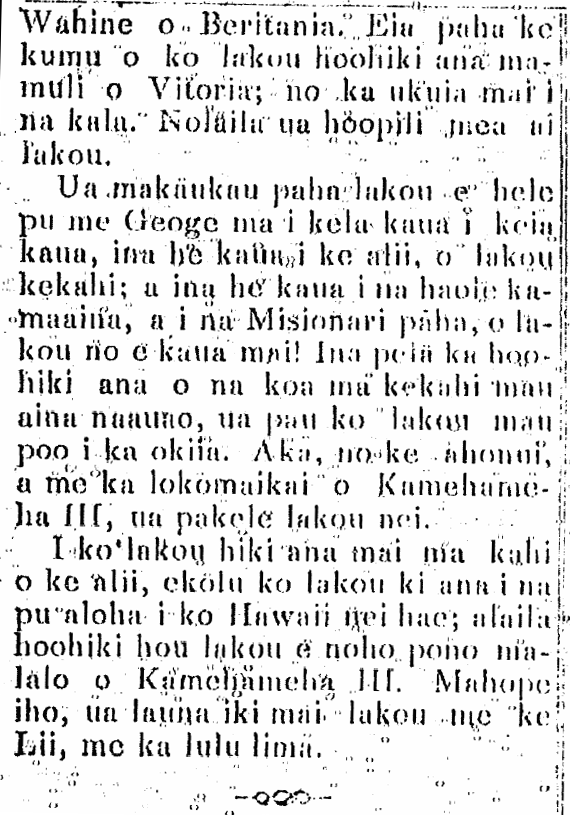
This is the nature of their treason. When this archipelago was not clearly under Capt. Lord George Paulet, they left Kamehameha III, and they swore allegiance to the Queen of Britain. This is probably the reason they swore allegiance to Victoria; because they were paid money. They therefore curried his favor [hoopilimeaai].

They were probably prepared to go with George to this war and that; if he warred against the king, so too would they; and if he went to war against the local haole or the Missionaries, they would fight as well! If soldiers of enlightened lands took an oath in this fashion, their heads would fall. But because of the patience and goodness of Kamehameha III, they were saved.

When they came in the presence of the king, they gave a three gun salute to Hawaii’s flag; and they swore once again to live obediently beneath Kamehameha III. After that, they spent time with the King, and shook hands.

(Nonanona, 8/8/1843, pp. 25 & 26.)

POE KIPI.

Ka Nonanona, Buke 3, Pepa 6, Aoao 25. Augate 8, 1843.

Wahine o Beritania...

Ka Nonanona, Buke 3, Pepa 6, Aoao 26. Augate 8, 1843.

Law banning the killing of imported birds, 1870.

HE KANAWAI

E HOOLOLI ANA I KA PAUKU 3 A ME KA PAUKU 7, A E HOOPAU ANA I KA PAUKU 5, O KA MOKUNA LXXXV O KE KANAWAI HOOPAI KARAIMA.

E hooholoia e ka Moi a me ka Hale Ahaolelo o ko Hawaii Pae Aina i akoakoa iloko o ka Ahaolelo Kaukanawai o ke Aupuni:

PAUKU 1. E hoololiia a ma keia ke hoololiia nei ka Pauku 3, o ka Mokuna LXXXV o ke Kanawai Hoopai Karaima, a penei e heluheluia ai:

“PAUKU 3. Ina e pepehi a hoomake paha kekahi kanaka ma ke ki ana i ka pu, ma ke kipukaahele a ma kekahi ano e ae paha, i kekahi manu i laweia mai mai na aina e mai i mea e laha ai kona ano manu ma keia Pae Aina, a i kekahi puka ana o ia ano manu mai na aina e mai i hookuu wale ia maloko o keia Aupuni, a ina hoi e lawe wale i na hua, a i na punana paha o ia mau ano manu, alaila, e hoopaiia oia, ke ku ka hewa ma ka hookolokoloia ana imua o kekahi Lunakanawai Hoomalu a Apana paha, aole emi malalo iho o na dala he umi, aole hoi e oi mamua o na dala he iwakalua no kela hewa keia hewa, a ina aole i hookaaia, alaila e noho oia ma ka Hale Paahao a kaa ia dala hoopai.”

PAUKU 2. E hoololiia ka Pauku 7, o ia Mokuna a ma keia, ua hoololiia, a penei ka heluhelu ana:

“PAUKU 7. Aole no e kipu, aole e pepehi ma kekahi ano e ae, kekahi mea i na holoholona holo wale i laweia mai, mai na aina e mai, a o kekahi puka ana mai o ia holoholona, iloko o na makahiki he umi mahope o ia lawe ana mai, malalo o ka hoopai aole e oi aku mamua o ke kanalima dala no ka hana ana pela.”

PAUKU 3. Ma keia e hoopauia ka Pauku 5 o ia Mokuna i oleloia.

PAUKU 4. E lilo keia i Kanawai i kona la e hooholoia ai.

Aponoia i keia la 8 o Iulai, M. H. 1870.

KAMEHAMEHA R.

(Au Okoa, 8/4/1870, p. 4)

HE KANAWAI, E HOOLOLI ANA I KA PAUKU 3 A ME KA PAUKU 7...

Ke Au Okoa, Buke VI, Helu 16, Aoao 4. Augate 4, 1870.

AN ACT

TO AMEND SECTION 3 and 7 AND REPEAL SECTION 5 OF CHAPTER LXXXV OF THE PENAL CODE.

Be it Enacted by the King and the Legislative Assembly of the Hawaiian Islands, in the Legislature of the Kingdom assembled:

SECTION 1. That Section 3 of Chapter LXXXV of the Penal Code, be and hereby is amended to read as follows:

Section 3. Any person who shall shoot, snare or otherwise destroy any bird, brought from a foreign country for the purpose of propagating its species within this Kingdom, or any of the progeny of such imported bird; or who shall disturb the eggs and nests of such birds, shall, on conviction, before any Police or District Justice, be fined not less than ten dollars, nor more than twenty dollars, for each offense, and in default of payment, be imprisoned until such fine is paid.

SECTION 2. That Section 7 of the said Chapter be, and hereby is amended to read as follows:

“SECTION 7. No person shall shoot or otherwise destroy any animals ‘Feræ Naturæ,’ which shall have been introduced into this Kingdom, within ten years, nor the progeny of such animals, under a penalty of not more than fifty dollars for each offense.”

SECTION 3. That Section 5 of said Chapter, is hereby repealed.

SECTION 4. This Act shall take effect and become a law from and after the date of its passage.

Approved this 8th day of July, A. D. 1870.

KAMEHAMEHA R.

(Hawaiian Gazette, 7/27/1870, p. 4)

AN ACT, TO AMEND SECTION 3 and 7 AND REPEAL SECTION 5...

Hawaiian Gazette, Volume VI, Number 28, Page 4. July 27, 1870.

On the decline of native birds, 1871.

Locals of the Tuahine Rain are no more.

O Ke Au Okoa:—Aloha to you:

I am sending you a small gift atop your outstretched foundation, should your captain and Editor be so kind, and it will be for you to take it to the shores of these islands so that my newspaper-reading companions may see it, it being the letters placed above: “Some Locals of the Tuahine Rain¹ are no more,” and it has been ten or more years which they have not been seen.

And my friends are probably puzzled about these locals that have gone missing, and you, our old-timers, are all likely saying, not them, here they are, and some people have passed away, but we knew of their passing; but the departure of these kamaaina which I speak of was not witnessed. And this is it, the kamaaina birds of our uplands: the Iwi, the O-u, the Akakane, the Amakihi, the Oolomao, the Elepaio; these are the native birds of these uplands who have disappeared.

And some of you may be questioning, what is the reason for this disappearance? I tell you, it is because of the spread of the evil birds from foreign lands, in our plains, mountains, ridges, valleys, cliffs, forests, terraced taro patches, seashores, and rivers; that is why these kamaaina have gone, because of the spreading of these evil birds among us, and they are damaging the crops, and the food from the forests; rice planted by some are being eaten by these evil birds; and the bananas of the forests are all eaten up by these birds.

What do we gain from these evil birds being spread in Hawaii, and protecting them so that they are not killed? I say that we gain nothing from these evil birds which are hurting our native birds and crops and foods from the forests; because in the past, before the spread of these birds, if a kamaaina of this land wanted to go into the mountains to get thatching or some shrimp, or some oopu, they did not pack food with them, because they thought that there was food in the mountains, like banana, hawane fruit, and uhi; banana would ripen on the plant and then fall, without anything damaging them, but now, the bananas don’t ripen on the plant; they are eaten by these banana-eating mu [mu ai maia] of the forest; bananas don’t ripen, and [now] when you go into the mountains, there is just the oka-i [blossom container of bananas] left and the bananas are lost to these birds; and the kamaaina birds are gone. Where to? Perhaps they all went to Hawaii island.

And I say without any hypocrisy, the decrease of this people was because the arrival of the evil haole to Hawaii nei; it was they who spread the evil sicknesses: gonorrhea [pala] and syphilis [kaokao]. Smallpox [hepera] and leprosy [mai pake] are the reasons that our lahui was decimated, because of the arrival of the evil haole; if all the people who came to Hawaii were like the people who brought the light [missionaries],  then this lahui would not have decreased in number; so too with the arrival of the evil birds to Hawaii nei, which hurt our native birds and plants; this is like the decrease of our lahui with the arrival of the evil haole who spread gonorrhea and syphilis and similar diseases.

Therefore, I feel aloha for the kamaaina birds of my beloved land because they are all gone, and the youngsters of these days question, what are those birds like? They are tiny birds with beautiful voices, and their feathers as well, and they were an enjoyment in our childhood; when times of strong winds arrived, all the birds of the mountains would alight and show up at the doors of the houses which was entertaining for us to watch them flitting amongst the leaves of the ilima in our childhood and they were a playmate in our youth.

Before the arrival of these birds, there was a great abundance of Iwi, Amakihi, Akakane, O-u, Oolokela, and Elepaio, right here above us, atop the clumps of aliipoe, bushes of hau, noni trees, and more upland, the number of birds was amazing, atop the flowers of lehua of the mountain apples, and on the Ahihi and the Lehua Kumakua;  those uplands were so enjoyable but these days, they have all vanished, maybe because there were aggravated by these evil birds.

Here is another thing; if only the coming session of the Legislature could revise the law pertaining to birds from foreign lands, for there are destructive birds that have been imported as well from foreign lands.

And this is a supplication to you, O Ke Au Okoa. With aloha to the one who steers you, and also to the boys of the Government Printing Press. The boy from the uplands is turning back for the Tuahine rain of the land is spreading about.

T. N. Penukahi.

Manoa, June 24, 1871.

¹Tuahine [Kuahine] is the famous rain of Manoa.

(Au Okoa, 6/29/1871, p. 3)

He mau wahi kamaaina no ka ua Tuahine, ua nalowale.

Ke Au Okoa, Buke VII, Helu 11, Aoao 3. Iune 29, 1871.

We still haven’t learned today what they knew a hundred years ago?

Remember the article on snakes we posted just a couple of weeks ago? Out today is a current related article…

How sad is it when Hawaii already had the answer a hundred years ago, that today, the State of Hawaii doesn’t think keeping alien pests out of Hawaii is important enough to fund! See this article out today by Audrey McAvoy: Alien pests risk fewer inspectors upon entry.