More on ’93 KS graduate, Abraham Pihi, 1898.

MY DEAR SWEETHEART HAS JUST PASSED, AND MY EMOTIONAL SUPPORT HAS BEEN TAKEN AWAY.

Mr. Editor.

Aloha oe:

Should it be satisfactory to you and your workers, here is my bundle of olive leaves that is placed above, so that our many loved ones living all the way from Haehae where the sun rises to the pleasant base of Lehua where the sun sets may see it.

My beloved has gone, my companion who I would talk with in days gone by, that is my beloved man, Mr. Aprahama Pihi, who is a native and a familiar one of the land famous for the “Kanilehua” [Hilo] and the fragrant bowers of hala of Puna, and the land of the Haao Rains [Kaʻū], that is the roots of my dear husband who left me, his companion, his wife, grieving at the side of his grave. Auwe! How dreadful. Abraham Pihi was born in Puueo, Hilo, Hawaii on the 5th of January, 1872, of E. P. Hoaai (m) and Lilia Palapala (f), and the two of them had 7 children: 5 daughters and 2 sons; and 2 of them went off in search of the footprints of their parents, and 5 remain mourning on this side: 4 girls and one boy.

He was educated at the Hilo Boarding School under the principal, Rev. W. R. Oleson [W. R. Olesona]¹. After he was done there, he entered Kamehameha School in 1893. He was at that school for 1 year, but because it was learned that he had the disease that separates families, he asked the principal, that being the Rev. W. R. Oleson, to release him. He returned to Wailuku, Maui, where his mother was living with his new father, the Rev. S. Kapu; he lived with his parents until he was taken in by the disease that separates families; he was taken from his parents and his younger siblings. He was taken away to this land of no friends in 1895. The number of years he had in this world was 24 and eleven months and 13 days, when his last breath was released. Continue reading

And more on the passing of John G. M. Sheldon, 1914.

JOHN KAHIKINA KELEKONA HAS PASSED.

At nine o’clock in the morning of this past Friday, the life breath of John Kahikina Kelekona left forever at his home; he was a very famous historian, and an old newspaperman in this town in years past, and his famous works will become an unforgettable monument to him.

He left behind many children, six daughters and two sons. The girls are: Mrs. I. Cockett; Mrs. J. R. Francis; Mrs. Ernest Kaai; Mrs. Joseph Namea; Mrs. M. Dutro, of Wailuku, Maui; Miss Emma Sheldon; and the boys are: D. K. Sheldon and Henry Sheldon, who work as clerks on inter-island steamships.

He left also two brothers [hoahanau]: William J. Sheldon, one of the esteemed members of the legislature some sessions ago, and Lawrence K. Sheldon who is with the law enforcement office in Honolulu. Continue reading

Bonine brings movies to Kalawao and Kalaupapa, 1909.

FIRST MOVING PICTURE SHOW TAKES SETTLEMENT BY STORM

On Thursday evening last a new miracle happened at Kalaupapa. On that evening R. K. Bonine, the moving-picture expert, threw his first picture on the screen before an audience of a thousand lepers, and there was a great gasp of awed astonishment and keen delight when the pictures really moved and did things. Cheers, tears, gasps and soul-satisfying laughter greeted the pictures in turn, and when the reels put aside for the first entertainment had been exhausted, the people of Kalaupapa and Kalawao, in a body, cheered their thanks to the man who had brought these wonders to them and to those in Honolulu who had through their contributions made these miracles possible.

It was a great day for the people of the Molokai Settlement, and it was a great day for Bonine. To the lepers had come a new marvel, greater far than the sight of the mighty White Fleet, which maneuvered past their shores last summer, greater than anything that had come to them. No place the world over have motion pictures made such a hit. Continue reading

Those afflicted with leprosy forsaken by the church? 1873.

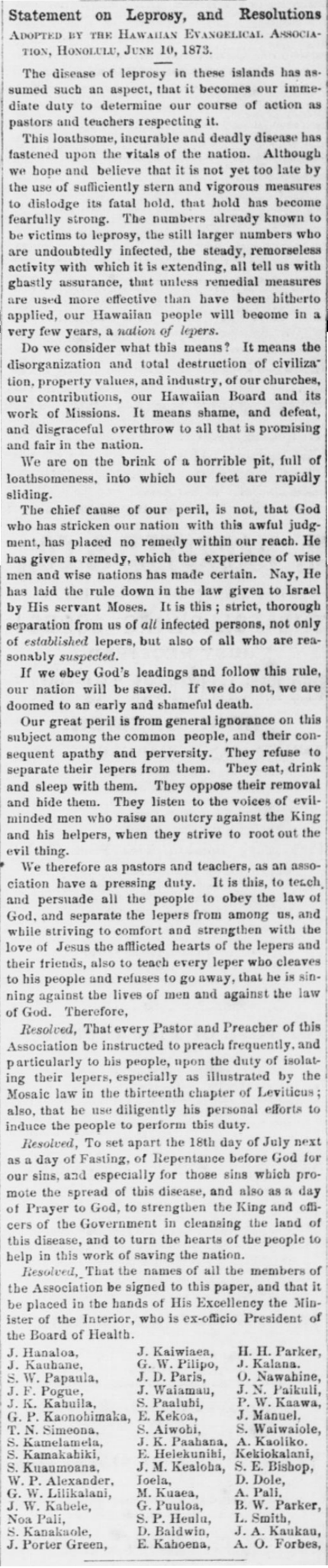
Statement on Leprosy, and Resolutions

Adopted by the Hawaiian Evangelical Association, Honolulu, June 10, 1873.

The disease of leprosy in these islands has assumed such an aspect, that it becomes our immediate duty to determine our course of action as pastors and teachers respecting it.

This loathsome, incurable and deadly disease has fastened upon the vitals of the nation. Although we hope and believe that it is not yet too late by the use of sufficiently stern and vigorous measures to dislodge its fatal hold, that hold has become fearfully strong. The numbers already known to be victims to leprosy, the still larger numbers who are undoubtedly infected, the steady, remorseless activity with which it is extending, all tell us with ghastly assurance, that unless remedial measures are used more effective than have been hitherto applied, our Hawaiian people will become in a very few years, a nation of lepers.

Do we consider what this means? It means the disorganization and total destruction of civilization, property values, and industry, of our churches, our contributions, our Hawaiian Board and its work of Missions. It means shame, and defeat, and disgraceful overthrow to all that is promising and fair in the nation.

We are on the brink of a horrible pit, full of loathsomeness, into which our feet are rapidly sliding.

The chief cause of our peril, is not, that God who has stricken our nation with this awful judgment, has placed no remedy within our reach. He has given a remedy, which the experience of wise men and wise nations has made certain. Nay, He has laid the rule down in the law given to Israel by His servant Moses. It is this; strict, thorough separation from us of all infected persons, not only of established lepers, but also of all who are reasonably suspected.

If we obey God’s leadings and follow this rule, our nation will be saved. If we do not, we are doomed to an early and shameful death.

Our great peril is from general ignorance on this subject among the common people, and their consequent apathy and perversity. They refuse to separate their lepers from them. They eat, drink and sleep with them. They oppose their removal and hide them. They listen to the voices of evil-minded men who raise an outcry against the King and his helpers, when they strive to root out the evil thing.

We therefore as pastors and teachers, as an association have a pressing duty. It is this, to teach and persuade all the people to obey the law of God, and separate the lepers from among us, and while striving to comfort and strengthen with the love of Jesus the afflicted hearts of the lepers and their friends, also to teach every leper who cleaves to his people and refuses to go away, that he is sinning against the lives of men and against the law of God. Therefore,

Resolved, That every Pastor and Preacher of this Association be instructed to preach frequently, and particularly to his people, upon the duty of isolating their lepers, especially as illustrated by the Mosaic law in the thirteenth chapter of Leviticus; also, that he use diligently his personal efforts to induce the people to perform this duty.

Resolved, To set apart the 18th day of July next as a day of Fasting, of Repentance before God for our sins, and especially for those sins which promote the spread of this disease, and also as a day of Prayer to God, to strengthen the King and officers of the Government in cleansing the land of this disease, and to turn the hearts of the people to help in this work of saving the nation.

Resolved, That the names of all the members of the Association be signed to this paper, and that it be placed in the hands of His Excellency the Minister of the Interior, who is ex-officio President of the Board of Health.

J. Hanaloa,  J. Kaiwiaea, H. H. Parker,
J. Kauhane,  G. W. Pilipo,  J. Kalana,
S. W. Papaula,  J. D. Paris,  O. Nawahine,
J. F. Pogue,  J. Waiamau,  J. N. Paikuli,
J. K. Kahuila,  S. Paaluhi,  P. W. Kaawa,
G. P. Kaonohimaka,  E. Kekoa,  J. Manuel,
T. N. Simeona,  S. Aiwohi,  S. Waiwaiole,
S. Kamelamela,  J. K. Paahana,  A. Kaoliko,
S. Kamakahiki,  E. Helekunihi,  Kekiokalani,
S. Kuaumoana,  J. M. Kealoha,  S. E. Bishop,
W. P. Alexander,  Ioela,  D. Dole,
G. W. Lilikalani,  M. Kuaea,  A. Pali,
J. W. Kahele,  G. Puuloa,  B. W. Parker,
Noa Pali,  S. P. Heulu,  L. Smith,
S. Kanakaole,  D. Baldwin,  J. A. Kaukau,
J. Porter Green,  E. Kahoena,  A. O. Forbes.

[How have things changed today? How have things remained the same? Find the Hawaiian-Language version printed in the Kuokoa, 6/18/1873, p. 3, here.]

(Pacific Commercial Advertiser, 6/14/1873, p. 3)

Statement on Leprosy, and Resolutions

The Pacific Commercial Advertiser, Volume XVII, Number 50, Page 3. June 14, 1873.

Missing newspapers leave holes in histories, 1881.

[Found under: “LOCAL NEWS”]

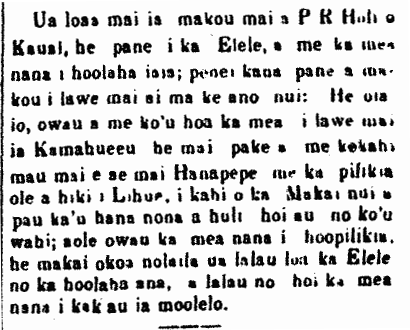
We have received from P. R. Holi of Kauai, a response to the Elele, and what it published about him; this is his response which we accepted with great import: It is true, it was my friend and I who brought Kamahueeu, a person inflicted with leprosy [mai pake], and some other sick ones from Hanapepe without any problem to Lihue to the Sheriff [Makai nui], and then after completing this duty for him, I returned home; it was not me who caused him harm, it was some other officer; therefore, the Elele was totally misdirected in its publishing this, and the one who wrote the story was mistaken.

[Hopefully the missing years of the newspaper “Ka Nupepa Elele” (1879–1885), which includes the year the article referred to here appears, will not be missing forever! Might anyone have any ideas where these might be found?

It also should be noted that responding to a news article appearing in one newspaper in another paper like the response above, was a very common practice.]

(Kuokoa, 11/26/1881, p. 3)

Ua loaa mai ia makou mai a P. R. Holi...

Ka Nupepa Kuokoa, Buke XX, Helu 48, Aoao 3. Novemaba 26, 1881.

New Perspectives on the History of Kalaupapa, 2013.

[This talk by Anwei Skinsnes Law should be put on your calendar. There is so much more to discover about those sent to Kalaupapa and Kalawao, and also about those who were left behind. Much of the first and second-hand accounts can be found within the pages of the Hawaiian-Language Newspapers!]

Kokua being sent out of Kalawao and Kalaupapa, 1894.

To be Discharged.

Here below is the list of assistants [kokua] living in Kalawao and Kalaupapa who are being sent away.

Kaaihue (m), Kawika (m), Kalaeloa (m), Keliikipi (m), Makakoa (m), they are from Kohala, Hawaii. Nailima (m), Ku (m), S. Keanu, Kekua (m), Kaaikauna (m), Manua (m), Manua, Jr. (m), Kaoo (f), Kealohanui (f), Malia (f), and Kaia (f), they are from Maui along with Mele Paulina. Pukooku (m), Nailima 2 (m), Kamakau (m), Kalehua (f), and Umi (f), from Kona, Hawaii. C. Kopena, Hokela (f), and Keonaona (f), they are from Honolulu. Mihi (f) and Pahukoa (m), from Niihau. Alaala (m) and Hamea (f), from Kauai. Kanuha ka, from Ewa. Maiuli (m), from Molokai. Kahananui (m), Kamaka (m), Auau (m), Pookela (f), Maleka (f), it is not known where they are from. Kapoi (f) and Kaiakonui (f), from Kalaupapa. Hanaloa (m), from Hilo. Kapeka (f), from Waipio. Apikaila (f) and Kekuni (f), from Kohala.

Here are the kokua that are married. Kaaihue (m) to Kaoo (f), Kanua (m) to Pookela (f), Kamaka (m) to Kapoi (f), Keliikipi (m) to Kaleiolono (f), C. Kopena to Keonaona (f), Kaaikauna (m) to Apikaila (f), Alaala (m) to Hamea (f).

Here are the kokua who are married to a patient: Nailima (m) to Kealoha (f), Pahukoa (m) to Keoho (f), S. Keanu to Maikini (f), Manua, Jr. to Kaiwaokalani (f), Hanaloa (m) to Kalehua (f), Hokela (f) to Lopaka (m), Mihi (f) to Haili (m), Malia (f) to Punohu (m), Umi (f) to Punilio (m), Mele Paulina to Huelo Poki, Kekuni (f) to Kane (m). Most of the kokua live mixed in with the patients. As for Kaiakonui (f), she is married to A. Hutchison, the current Superintendent.

(Makaainana, 2/5/1894, p. 2)

E Kaiehuia aku ana.

Ka Makaainana, Buke I—-Ano Hou, Helu 6, Aoao 2. Feberuari 5, 1894.

Detailed list of patients being examined at Kalawao, 1909.

THE PATIENTS OF MOLOKAI ARE EXAMINED.

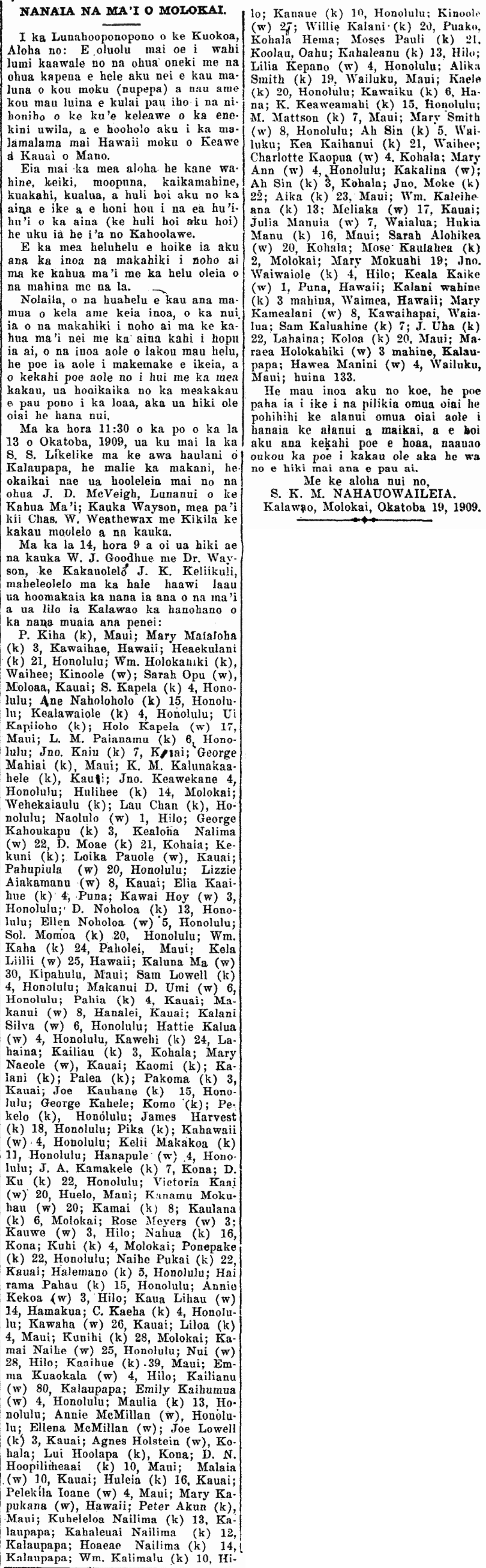
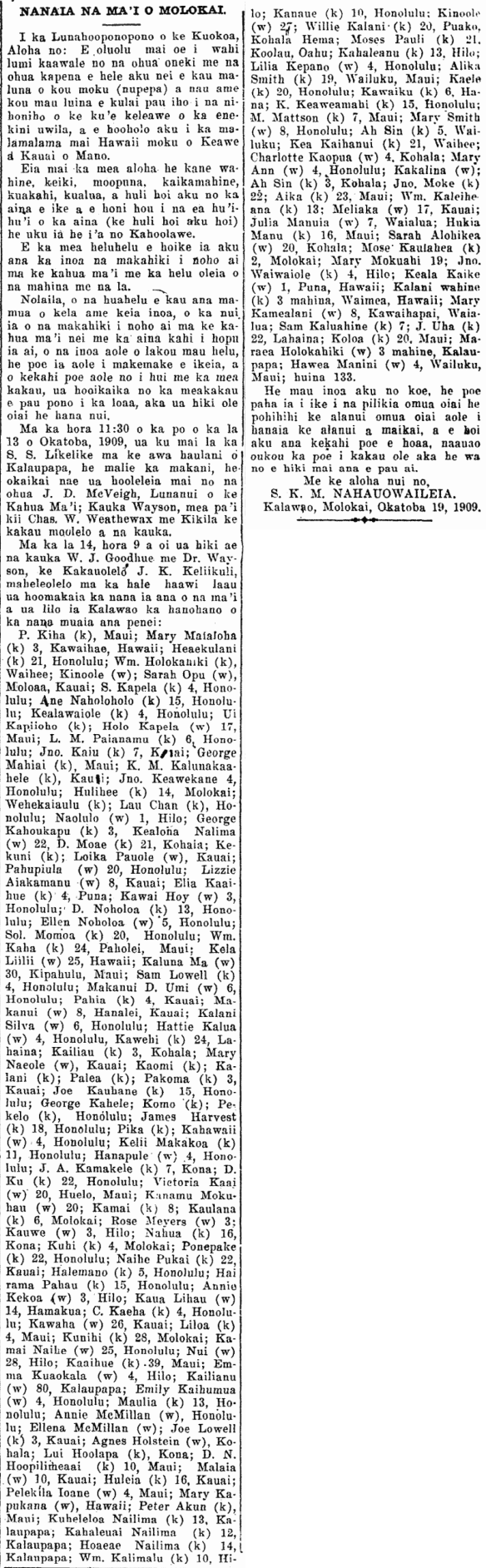
To the Editor of the Kuokoa, Aloha no: Please allow me some space on your deck along with the captain’s passengers travelling aboard your ship (newspaper) and it is for you and your sailors to [anybody care to offer insight into this nautical allusion? “a nau ame kou mau luina e kulai pau iho i na nihoniho o ke ku’e keleawe o ka enekini uwila…”] and to send knowledge from Hawaii, the island of Keawe, all the way to Kauai of Manokalanipo.

Here are your loved ones, a husband, a wife, a child, a grandchild, a daughter, a grand, a great grand; and they turn towards home, to see and to smell once again the cool air of the land (should they return); the fish is an uku, a fish of Kahoolawe.¹

O Reader, shown will be the names and the years they have lived here in the land of the sick without counting the months and days.

Therefore, the number placed before [after] each name is the total years lived here in the land of the sick and the land where they were taken from; for the names without numbers, they don’t want it to be known, and some have not met with the writer; the writer put great effort into completing it, but he could not for it was a big task.

At 11:30 at night on the 13th of October, 1909, the S. S. Likelike arrived at the restless harbor of Kalaupapa; the wind was calm, but the disembarking of the passengers was still rough, they being J. D. McVeigh, Superintendent of the Leprosy Colony; Dr. Wayson; photographer Charles W. Weatherwax and Kikila the secretary of the doctors.

On the 14th, at 9 or so, the doctors W. J. Goodhue and Wayson arrived with the Secretary J. K. Keliikuli, interpreter at the dispensary; and the examination of the patients began; and to Kalawao went the honor of the first examination, as follows:

P. Kiha (m), Maui; Mary Maialoha (m), 3, Kawaihae, Hawaii; Heaekulani (m) 21, Honolulu; William Holokahiki (m), Waihee; Kinoole (f); Sarah Opu (f), Moloaa, Kauai; S. Kapela (m) 4, Honolulu; Ane Naholoholo (m) 15, Honolulu; Kealawaiole (m) 4, Honolulu; Ui Kapiioho (m); Holo Kapela (f) 17, Maui; L. M. Paianamu (m) 6, Honolulu; John Kaiu (m) 7, Kauai; George Mahiai (m), Maui; K. M. Kalunakaahele (m), Kauai; John Keawekane 4, Honolulu; Hulihee (m) 14, Molokai; Wehekaiaulu (m); Lau Chan (m), Honolulu; Naolulo (f) 1, Hilo; George Kahoukapu (m) 3; Kealoha Nalima (f) 22; D. Moae (m) 21, Kohala; Kekuni (m); Loika Pauole (f), Kauai; Pahupiula (f) 20, Honolulu; Lizzie Aiakamanu (f) 8, Kauai; Elia Kaaihue (m) 4, Puna; Kawai Hoy (f) 3, Honolulu; D. Noholoa (m) 13, Honolulu; Ellen Noholoa (f) 5, Honolulu; Solomon Momoa (m) 20, Honolulu; William Kaha (m) 24, Paholei, Maui; Kela Liilii (f) 25, Hawaii; Kaluna Ma (f) 30, Kipahulu, Maui; Sam Lowell (m) 4, Honolulu; Makanui D. Umi (f) 6, Honolulu; Pahia (m) 4, Kauai; Makanui (f) 8, Hanalei, Kauai; Kalani Silva (f) 6, Honolulu; Hattie Kalua (f) 4, Honolulu; Kawehi (m) 24, Lahaina; Kailiau (m) 3, Kohala; Mary Naeole (f), Kauai; Kaomi (m); Kalani (m); Palea (m); Pakoma (m) 3, Kauai; Joe Kauhane (m) 15, Honolulu; George Kahele; Komo (m); Pekelo (m), Honolulu; James Harvest (m) 18, Honolulu; Pika (m); Kahawaii (f) 4, Honolulu; Kelii Makakoa (m) 11, Honolulu; Hanapule (f) 4, Honolulu; J. A. Kamakele (m) 7, Kona; D. Ku (m) 22, Honolulu; Victoria Kaai (f) 20, Huelo, Maui; Kanamu Mokuhau (f) 20; Kamai (m) 8; Kaulana (m) 6, Molokai; Rose Meyers (f) 3; Kauwe (f) 3, Hilo; Nahua (m) 16, Kona; Kuhi (m) 4, Molokai; Ponepake (m) 22, Honolulu; Naihe Pukai (m) 22, Kauai; Halemano (m) 5, Honolulu; Hairama Pahau (m) 15, Honolulu; Annie Kekoa (f) 3, Hilo; Kaua Lihau (f) 14, Hamakua; C. Kaeha (m) 4, Honolulu; Kawaha (f) 26, Kauai; Liloa (m) 4, Maui; Kunihi (m) 28, Molokai; Kamai Naihe (f) 25, Honolulu; Nui (f) 28, Hilo; Kaaihue (m) 39, Maui; Emma Kuaokala (f) 4, Hilo; Kailianu (f) 80, Kalaupapa; Emily Kaihumua (f) 4, Honolulu; Maulia (m) 13, Honolulu; Annie McMillan (f), Honolulu; Ellena McMillan (f); Joe Lowell (m) 3, Kauai; Agnes Holstein (f), Kohala; Lui Hoolapa (m), Kona; D. N. Hoopilimeaai (m) 10, Maui; Malaia (f) 10, Kauai; Huleia (m) 16, Kauai; Pelekila Ioane (f) 4, Maui; Mary Kapukana (f), Hawaii; Peter Akua (m), Maui; Kuheleloa Nailima (m) 13, Kalaupapa; Kahaleuai Nailima (m) 12, Kalaupapa; Hoaeae Nailima (m) 14, Kalaupapa; William Kalimalu (m) 10, Hilo; Kanaue (m) 10, Honolulu; Kinoole (f) 27; Willie Kalani (m) 20, Puako, South Kohala; Moses Pauli (m) 21, Koolau, Oahu; Kahaleanu (m) 13, Hilo; Lilia Kepano (f) 4, Honolulu; Alika Smith (m) 19, Wailuku, Maui; Kaele (m) 20, Honolulu; Kawaiku (m) 6, Hana; K. Keaweamahi (m) 15, Honolulu; M. Mattson (m) 7, Maui; Mary Smith (f) 8, Honolulu; Ah Sin (m) 5, Wailuku; Kea Kaihanui (m) 21, Waihee; Charlotte Kaopua (f) 4, Kohala; Mary Ann (f) 4, Honolulu; Kakalina (f); Ah Sin (m) 3, Kohala; John Moke (m) 22; Alika (m) 23, Maui; William Kaleiheana (m) 13; Meliaka (f) 17, Kauai; Julia Manuia (f) 7, Waialua; Hukia Manu (m) 16, Maui; Sarah Alohikea (f) 20, Kohala; Mose Kaulahea (m) 2, Molokai; Mary Mokuahi 19; John Waiwaiole (m) 4, Hilo; Keala Kaike (f) 1, Puna, Hawaii; Kalani wahine (m) 3 months, Waimea, Hawaii; Mary Kamealani (f) 8, Kawaihapai, Waialua; Sam Kaluahine (m) 7; J. Uha (m) 22, Lahaina; Koloa (m) 20, Maui; Maraea Holokahiki (f) 3 months, Kalaupapa; Hawea Manini (f) 4, Wailuku, Maui; total 133.

There are names left; perhaps they are those who knew the troubles ahead, for the road ahead is unclear, as the path is not laid out well, and some will return in confusion; wise are those who did not sign, but there will come a time when this will end.

With great aloha,

S. K. M. NAHAUOWAILEIA.

Kalawao, Molokai, October 19, 1909.

¹”He uku ia he i’a no Kahoolawe.” A traditional saying playing off the word “uku “which is a type of fish, but also means reward or recompense.

[Wow… this took a long time, but i think it is an awesome document well worth the time put in. My aloha goes out to S. K. M. Nahauowaileia and the type-setting boys of the Kuokoa!!]

(Kuokoa, 10/29/1909, p. 6)
NANAIA NA MA'I O MOLOKAI.

Ka Nupepa Kuokoa, Buke XLVI, Helu 44, Aoao 6. Okatoba 29, 1909.

More on patients being examined at Kalaupapa, 1909.

LIST OF THE LEPROSY PATIENTS.

To the Editor of the Messenger of the Lahui, the Kuokoa Newspaper, Aloha no: Please allow me some space of your light body, and it will be for you to carry it away so that the many friends may see, here are their parents, children, grandparents, grandchildren, and great grands turning towards home. All of the names below will probably not be released from this grave; perhaps some.

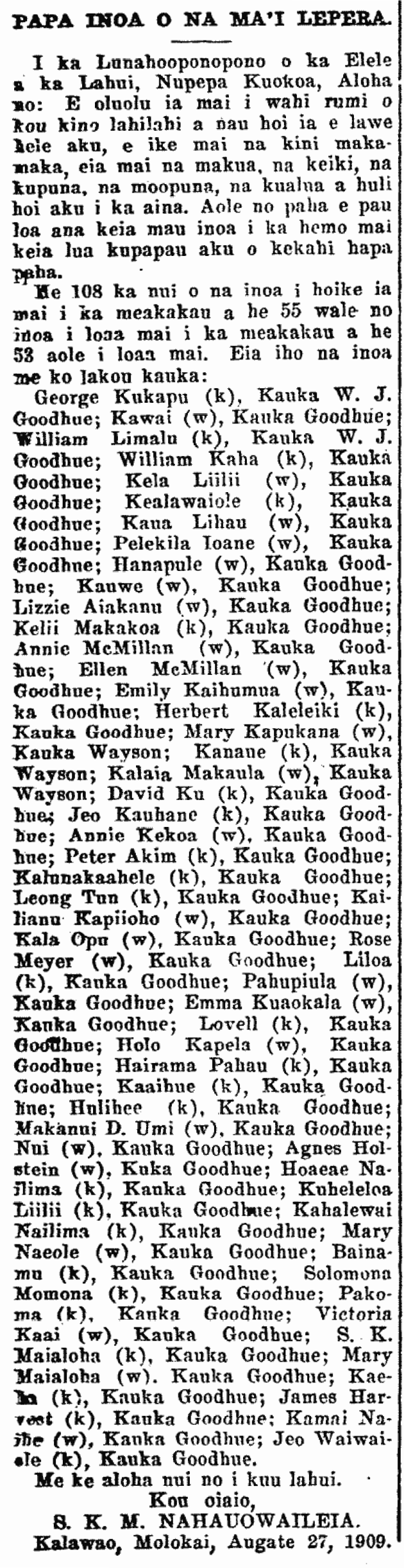
There are a total of 108 names were shown to the writer and he has 55 of the names, but not 53. Here are the names and their doctor:

George Kukapu (m), Dr. W. J. Goodhue; Kawai (f), Dr. Goodhue; William Limalu (m), Dr. W. J. Goodhue; William Kaha (m), Dr. Goodhue; Kela Liilii (f), Dr. Goodhue; Kealawaiole (m), Dr. Goodhue; Kaua Lihau (f), Dr. Goodhue; Pelekila Ioane (f), Dr. Goodhue; Hanapule (f), Dr. Goodhue; Kauwe (f), Dr. Goodhue; Lizzie Aiakanu (f), Dr. Goodhue; Kelii Makakoa (m), Dr. Goodhue; Annie McMillan (f), Dr. Goodhue; Ellen McMillan (f), Dr. Goodhue; Emily Kaihumua (f), Dr. Goodhue; Herbert Kaleleiki (m), Dr. Goodhue; Mary Kapukana (f), Dr. Wayson; Kanaue (m), Dr. Wayson; Kalaia Makaula (f), Dr. Wayson; David Ku (m), Dr. Goodhue; Jeo Kauhane [? Joe Kauhane] (m), Dr. Goodhue; Annie Kekoa (f), Dr. Goodhue; Peter Akim (m), Dr. Goodhue; Kalunakaahele (m), Dr. Goodhue; Leong Tun (m), Dr. Goodhue; Kailianu Kapiioho (f), Dr. Goodhue, Kala Opu (f), Dr. Goodhue; Rose Meyer (f), Dr. Goodhue; Liloa (m), Dr. Goodhue; Pahupiula (f), Dr. Goodhue; Emma Kuaokala (f), Dr. Goodhue; Lovell (m), Dr. Goodhue; Holo Kapela (f), Dr. Goodhue; Hairama Pahau (m), Dr. Goodhue; Kaaihue (m), Dr. Goodhue; Hulihee (m), Dr. Goodhue; Makanui D. Umi (f), Dr. Goodhue; Nui (f), Dr. Goodhue; Agnes Holstein (f), Dr. Goodhue; Hoaeae Nailima (m), Dr. Goodhue; Kuheleloa Liilii (m), Dr. Goodhue; Kahalewai Nailima (m), Dr. Goodhue; Mary Naeole (f), Dr. Goodhue; Bainamu (m), Dr. Goodhue; Solomona Momona (m), Dr. Goodhue; Pakoma (m), Dr. Goodhue; Victoria Kaai (f), Dr. Goodhue; S. K. Maialoha (m), Dr. Goodhue; Mary Maialoha (f), Dr. Goodhue; Kaeha (m), Dr. Goodhue; James Harvest (m), Dr. Goodhue; Kamai Naihe (m), Dr. Goodhue; Jeo Waiwaiole [? Jon Waiwaiole] (m), Dr. Goodhue.

With my great aloha to my beloved lahui.

Sincerely,

S. K. M. NAHAUOWAILEIA.

Kalawao, Molokai, August 27, 1909.

[See the very bad image of a similar article printed in the newspaper Ke Aloha Aina which I posted last year.]

(Kuokoa, 9/3/1909, p. 6)

PAPA INOA O NA MA'I LEPERA.

Ka Nupepa Kuokoa, Buke XLVI, Helu 36, Aoao 6. Sepatemaba 3, 1909.