Liliuokalani and the Anglican Church, 1896.

Liliuokalani Becomes a Member of the Anglican Church.

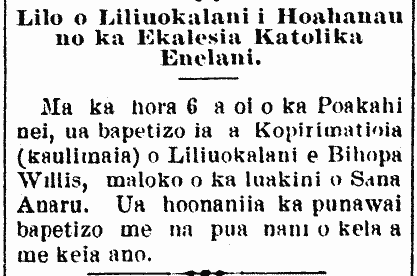
At 6 o’clock or so on this Monday, Liliuokalani was baptized and there was a laying on of hands (Kopirimatio) by Bishop Willis, in St. Andrew’s Cathedral. The font was festooned with flowers of all sorts.

[We found this small mention about Liliuokalani’s baptism because of response by Corrine Chun Fujimoto on yesterday’s post about the Anglican Church in Hawaii!

Also, can help me with the word that “Kopirimatio” comes from?]

(Kuokoa, 5/22/1896, p. 2)

Lilo o Liliuokalani i Hoahanau no ka Ekalesia Katolika Enelani.

Ka Nupepa Kuokoa, Buke XXXV, Helu 21, Aoao 2. Mei 22, 1896.

Beginnings of the Anglican Church in Hawaii, 1862.

Pertaining to the 28th of November¹

This day known to everyone, the day of the return of independence to the Islands and the day chosen by the Monarchs as a day for the two of them to join the new faith which has recently arrived.

On the morning of that day, at the hour of 10½, the Alii arrived at the Church and the National troops [koa o ke Aupuni], the Honolulu Rifles [koa Rifles?], the Hawaii Kiai [?], and the Cavalry [Puali Kaua Lio] were all lined up.

When the Alii arrived and passed through the entrance, the Bishop came and layed his hand and blessed them. They then entered within and sat down; following them was a procession, and they entered while chanting one of the psalms. After this was done, the laying on of hands began, and they were confirmed as brethren of the new church.

The beauty that is imbued in all creatures of the earth is what left all of their subjects who went there awe-stricken. Some wept, some fled [hoonaholoholopoo?], some were downcast, and some shuddered in awe, appearing as if the spirit from the heavens was accepted in the Monarchs joining into the circle of eternal life.

Present was Her Highness Princess V. K. Kaahumanu, the Honorable M. Kekuanaoa, the Honorable R. C. Wyllie, the Honorable Chief Justice E. H. Allen, the Honorable C. R. Bishop and his wife, the Honorable C. Kapaakea, the Honorable Colonel D. Kalakaua, Colonel McKibbin Jr., Colonel W. C. Lunalilo, Major Hasslocher, Kekaaniau, the Dowager Queen K. Hakaleleponi, Mrs. Haalelea, the wives of the Supreme Court Judges, and the Honorable Ii. There also was W. W. F. Synge and his wife, along with the Consuls of Foreign Nations.

The building was filled with those wanting to witness the joining of the Monarchs as brethren, and everyone felt much appreciation for the beauty of the Royals, the Alii, and the ceremony performed. God save the King.

¹La Kuokoa [Hawaiian Independence Day]

(Hoku o ka Pakipika, 12/4/1862, p. 2)

No ka la 28 o Novemaba.

Ka Hoku o ka Pakipika, Buke 2, Helu 8, Aoao 2. Dekemaba 4, 1862.

50 Years of the Anglican Church in Hawaii, 1912.

A JUBILEE CELEBRATION.

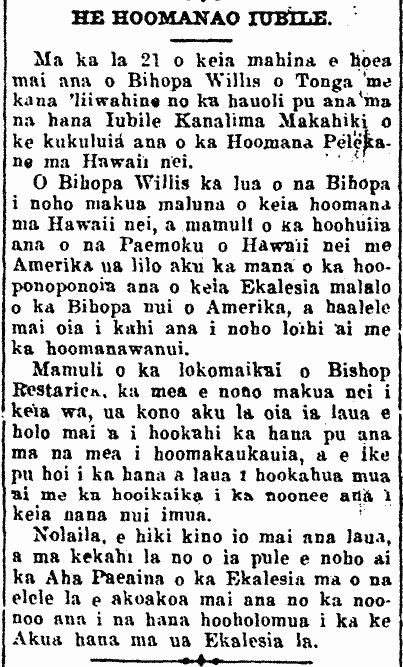
On the 21st of this month, Bishop Willis of Tonga will arrive along with his queen, to join in rejoicing over the Fiftieth Year Jubilee since the establishment of the Anglican Faith here in Hawaii.

Bishop Willis is the second Bishop who headed this faith in Hawaii nei, and as a result of Hawaii being annexed to America, the administration of the Church has transferred to the Bishop of America and he left the position he held for a long time with patience.

Because of the kindness of Bishop Restarick, who is currently the head, he invited the two of them to come and to perform together in the ceremonies prepared, and to witness the works that they established, putting much effort into moving these great endeavors forward.

Therefore, they will indeed arrive, and on one of the days of that week, the Church Convention of the Islands will be held with representatives coming together to consider ways to advance the works of God through this Faith.

[That makes this year 150 years!]

(Kuokoa, 5/10/1912, p. 8)

HE HOOMANAO IUBILE.

Ka Nupepa Kuokoa, Buke XLVIII, Helu 19, Aoao 8. Mei 10, 1912.

Another Wooden Kii found, 1868.

Akua Kii of Kalia.

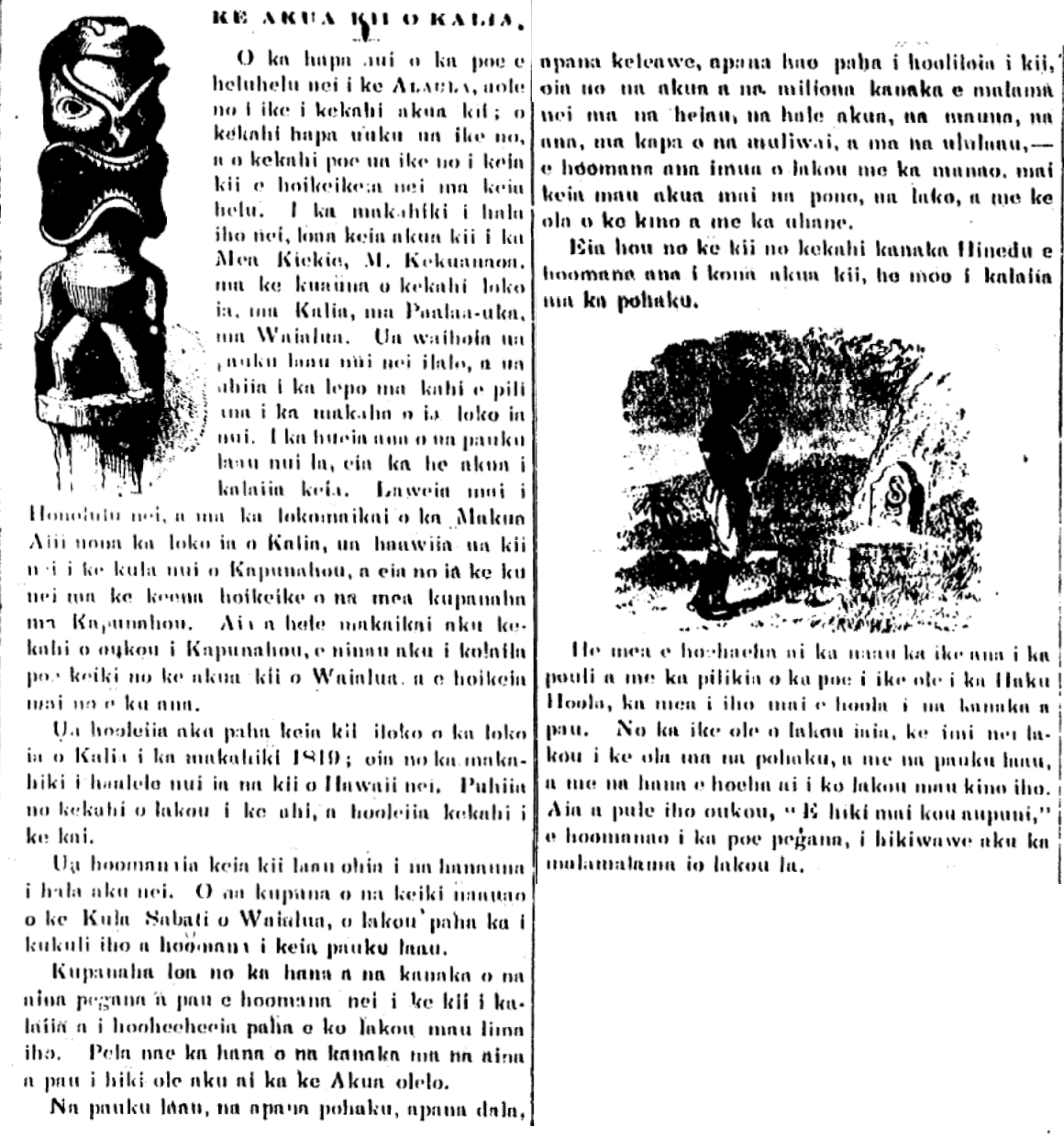
Most of the people reading Ke Alaula have not seen an akua kii, but a small fraction have seen one, and some of you saw this image that is shown here in this issue. Last year, this god idol was found by the Honorable M. Kekuanaoa on the banks of a fish pond at Kalia in Paalaa Uka in Waialua. That large piece of wood was set down and covered with soil near the sluice gate of that large fish pond. When that big piece of wood was unearthed, lo and behold, it was a carved god. It was brought to Honolulu nei, and through the goodwill of the Alii Elder who owns Kalia fishpond, that kii was given to the college of Kapunahou [Punahou], and there it stands in the exhibition room of curiosities at Kapunahou. When some of you go to visit Kapunahou, ask the children there about the kii from Waialua, and it will be shown to you where it stands.

This kii was probably thrown into the pond of Kalia in the year 1819; that is the year when there was the kii of Hawaii nei were greatly abandoned. Some of them were burnt in fire and some were thrown into the sea.

These ohia wood images were worshiped by previous generations. The kupuna of the educated children of Waialua Sunday School were probably those that knelt down and worshiped this piece of wood.

How astonishing are the actions of the people of all of the pagan lands, who worship idols that are carved or molded by their own hands. That is how all lands are where the word of God has not reached.

Pieces of wood, fragments of rock, chunks of silver, chunks of metal, or perhaps chunks of iron turned into images—those are the gods cared for by millions of people, in heiau, houses of god, mountains, caves, banks of rivers, and in forests; they worship before them thinking that from these gods come well being, wealth, and life in body and spirit.

Here also is a picture of a Hindu man worshiping his godly image; it is a snake carved into a rock.

This is something that pains the heart to see the darkness and trouble of those that don’t know of the God the Savior, the one who came down to save all man. Because they don’t know him, they seek salvation from rocks and pieces of wood and from actions that hurt their very own bodies. When you pray, “Thy kingdom come,” remember the pagans so that the light reaches them quickly.

[Could this Akua Kii be the one now at the Bishop Museum which was found in Waialua and presented to Punahou?]

(Alaula, 1/1868, p. 39)

KE AKUA KII O KALIA.

Ke Alaula, Buke II, Helu 10, Aoao 39. Ianuari, 1868.

Wooden Kii found in Haleiwa, 1906.

[Found under: “This and That”]

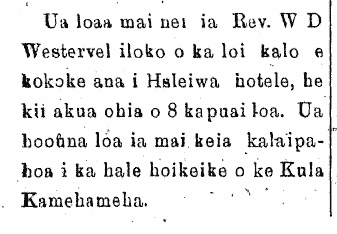
Rev. W. D. Westervelt found a wooden akua image made of ohia that was 8 feet in length in a taro patch near the Haleiwa Hotel. This kalaipahoa was sent was sent to the museum of Kamehameha School.

(Na’i Aupuni, 8/30/1906, p. 3)

Ua loaa mai nei ia Rev W D Westervel...

Ka Na'i Aupuni, Buke II, Helu 76, Aoao 3. Augate 30, 1906.

Here you’d be looking at a long strings of @@@@@@@@@ instead of information on Queen Kapiolani and Puna. 1876.

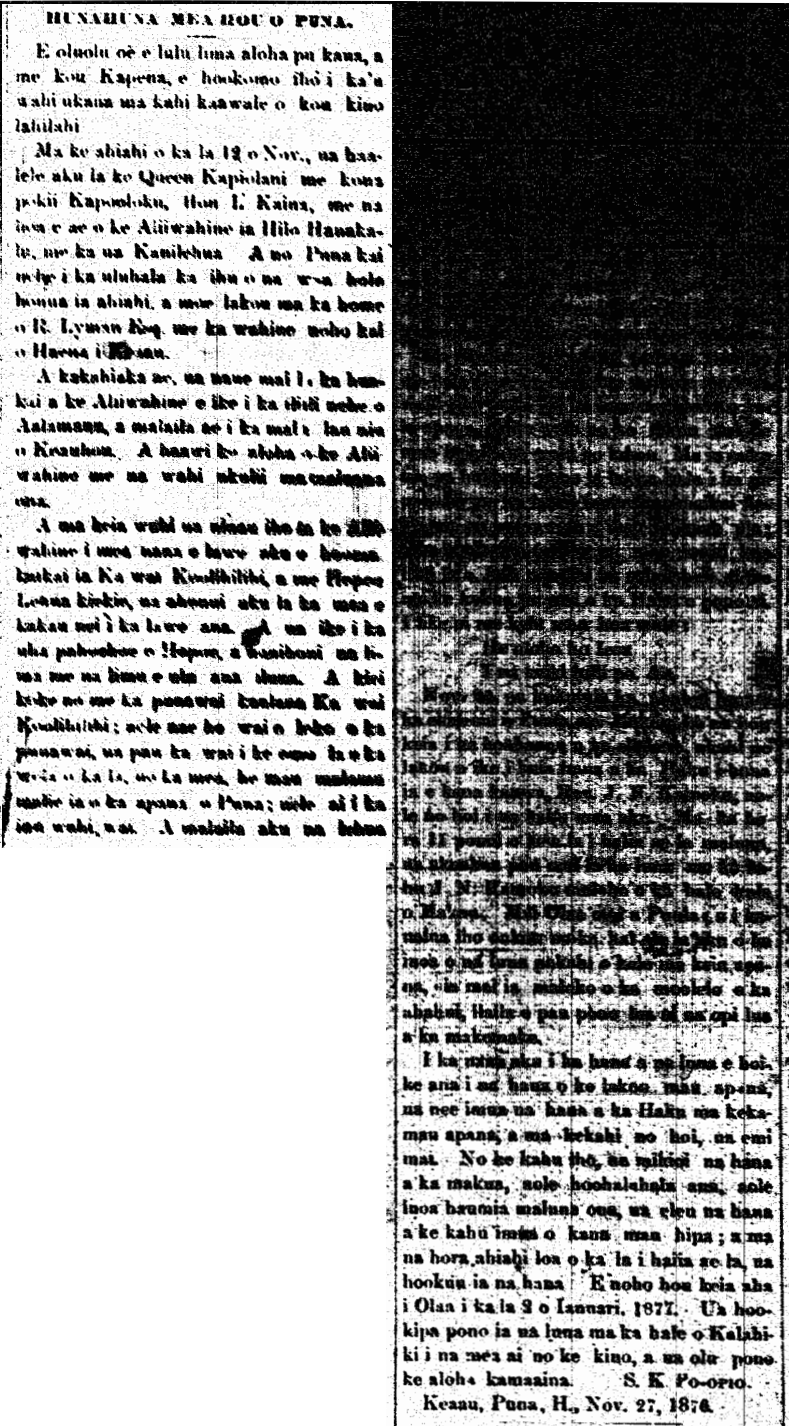
NEWS ITEMS FROM PUNA.

Please let us shake hands, your Captain and I, and insert my small contribution in an empty space of your delicate body.

On the evening of the 12th of Nov., Queen Kapiolani and her younger sister Kapooloku, Hon. L. Kaina, and the other companions of the Queen left Hilo Hanakahi and the Kanilehua rain. And the land travelling canoes that evening were pointed towards the seas of the rustling pandanus groves, and they reposed at the home of R. Lyman, Esq., along with the woman who lives in the sea of Haena in Keaau.

And the next morning, the entourage of the Queen travelled on to see the sounding pebbles of Aalamanu, and from there, to Keauhou and the shelter of coconut fronds. And aloha was shown between the Queen and her humble subjects.

And here the Queen asked for someone to take them to see the Waikoolihilihi and and the tall Hopoe Lehua, and the writer of this article patiently took them. We saw the hollow pahoehoe [uha pahoehoe?] of Hopoe, and inhaled the lima [?] and the seaweed growing upon it. And we soon looked upon the famous pool Ka Wai Koolihilihi; but there was no water in the pool as it was sucked up by the heat of the sun, for it has been months of nice weather here in Puna; there was no water to drink. There too were the lehua @@@@
@@@@@@@@@@@@@@@@@@@@@@@@@@@@@@@@@@@@@@
@@@@@@@@@@@@@@@@@@@@@@@@@@@@@@@@@@@@@@
@@@@@@@@@@@@@@@@@@@@@@@@@@@@@@@@@@@@@@
@@@@@@@@@@@@@@@@@@@@@@@@@@@@@@@@@@@@@@
@@@@@@@@@@@@@@@@@@@@@@@@@@@@@@@@@@@@@@
@@@@@@@@@@@@@@@@@@@@@@@@@@@@@@@@@@@@@@
@@@@@@@@@@@@@@@@@@@@@@@@@@@@@@@@@@@@@@
@@@@@@@@@@@@@@@@@@@@@@@@@@@@@@@@@@@@@@
@@@@@@@@@@@@@@@@@@@@@@@@@@@@@@@@@@@@@@
@@@@@@@@@@@@@@@@@@@@@@@@@@@@@@@@@@@@@@

@@@@@@@@@@@

@@@@@@@@@@@

@@@@@@@@@@@@@@@@@@@@@@@@@@@@@@@@@@@@@@
@@@@@@@@@@@@@@@@@@@@@@@@@@@@@@@@@@@@@@
@@@@@@@@@@@@@@@@@@@@@@@@@@@@@@@@@@@@@@
@@@@@@@@@@@@@@@@@@@@@@@@@@@@@@@@@@@@@@
@@@@@@@@@@@@@@@@@@@@@@@@@@@@@@@@@@@@@@
@@@@@@@@@@@@@@@@@@@@@@@@@@@@@@@@@@@@@@

When you look at the works reported by the church officials accomplished in their districts, the work of the Lord has progressed in some places but regressed in others. As for the pastor himself, the father’s work has been deft, there is nothing to fault, there is no obscene names to apply, his actions before his flock has been lively; and during the late evening hours of the day mentioned above, the meeting was adjourned. This group will meet again at Olaa on the 2nd of January, 1877. The church officials were hosted well at the home of Kalahiki with food for the body, and the aloha given by the locals was splendid. S. K. Po-opio

Keaau, Puna, H., Nov. 27, 1876.

[This paper was not typed from the unclear images available online, but from the originals. So luckily, all of those @@@@@@@@@@ portions have been transcribed and are available online. Still, it would still be worth getting the best images even of these pages, so that the typescript can be compared to the original for questionable phrases.

Now consider all of thousands of pages of newspaper with bad images that are being typescripted today. Now is the time to take clear images of them. Before typescripts are done. Why do double or triple the work? And perhaps more important, why risk having the pages touched again and again by people wanting to know what this @@@@ and that @@@@ are… Once the papers fall apart, it will be too late.]

(Lahui Hawaii, 12/21/1876, p. 2)

HUNAHUNA MEA HOU O PUNA.

Ka Lahui Hawaii, Buke II, Helu 52, Aoao 2. Dekemaba 21, 1876

Heiau descriptions, lost for now, 1883.

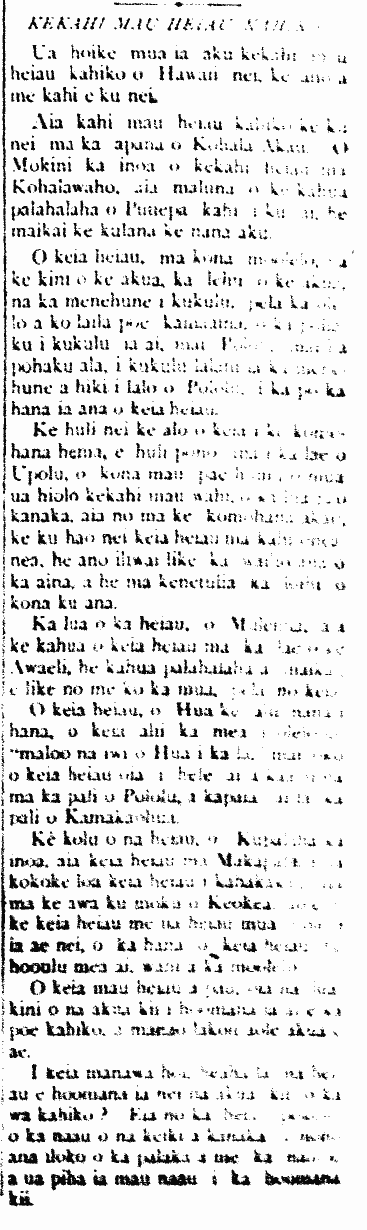
SOME HEIAU OF OLD.

Earlier, some old temples of Hawaii were introduced: their description, and where they stand.

There are a number of old heiau standing in North Kohala. Mokini [Mookini] is the name of one of them in Kohala Waho, standing atop a flat base in Puuepa; it is a beautiful structure.

This heiau, according to its history, was built by the many and multitudes of gods and the menehune, that according to the natives who live there; the stones used to build it are from Pololu, and the menehune stood in a line all the way to Pololu; this heiau was built at night.

It faces the southwest, facing directly at the point of Upolu; some parts of the front enclosure have fallen, [???] are at the northwest, this heiau stands alone in a bare area, the land is level, and it has stood for centuries.

The second heiau is [Muleiula?], this heiau is located [???] Awaeli, its base is very flat like that of the earlier one, so too is the base of this one.

This heiau was erected by Hua, the one for whom is said, “The bones of Hua are dried in the sun,” [???] this heiau when he went [???] in the cliffs of Pololu, and [???] is called the cliffs of Kamakaohua.

The third heiau is named [Ku???], it is at [Maka???]; this heiau is very near to [???] at the harbor of Keokea; this heiau is like the earlier ones spoken of before, the purpose of this heiau was for agriculture, according to its history.

These heiau [???] multitudes of idol gods worshiped by the people of old, and they believed there was no other god.

In these modern days, [???] who are worshiping the idol gods of the old days? Here [???] children of men [???] in [???] and those hearts are full of idolatry.

[There are so many articles like these that are partially or totally illegible without going back to the original newspapers.

If made “word searchable” as is:

Ke kolu o na heiau, o Ku@@@@ ka inoa, aia keia heiau ma Maka@@@@@@@@ kokoke loa keia heiau i kanaka@@@@@@@@ ma ke awa ku moku o Keokea @@@@@@@@ ke keia heiau me na @@@@@ mua @@@@@@@ ia ae nei, o ka hana o keia heiau @@@@@ hooulu mea ai, wahi a ka moolelo.

The most logical thing to do would be to take new and clear images of the papers all together, so that each time someone is interested in a partial article like this one, they will not need to flip through the fragile originals just so they can see one page.]

(Kuokoa, 11/4/1883, p. 1)

KEKAHI MAU HEIAU KAHIKO.

Ka Nupepa Kuokoa, Buke XXII, Helu 44, Aoao 1. Novemaba 4, 1883.

The royal mausoleum converted into a chapel, 1922.

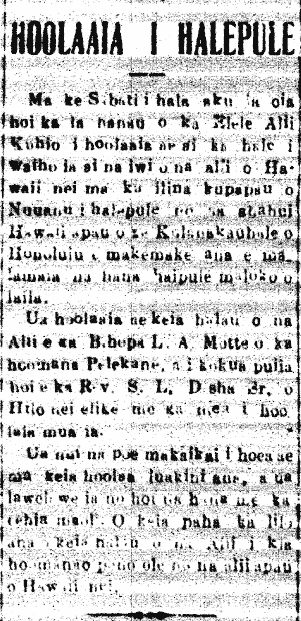
DEDICATED AS A CHAPEL

On this past Sunday, that being the birthday of the Royal Representative Kuhio, the mausoleum that holds the bones of the alii of Hawaii nei in the cemetery of Nuuanu was made into a chapel for all the Hawaiian societies of Honolulu who wish to hold services there.

This house of the Chiefs was consecrated by the Bishop L. A. Motte [John D. LaMothe] of the Anglican Church [hoomana Pelekane] and assisted by Rev. S. L. Desha, Sr. of Hilo, as was planned earlier.

There were many people who came to see the consecration, and the ceremony was done with much reverence. This will likely make this house of the Alii a unforgettable [?] monument to all the alii of Hawaii.

[Much of the Hilo newspaper, Hoku o Hawaii, is digitized badly, and can hardly be read. This particular article is one of the better ones. I hope all of the illegible articles are not important ones!]

(Hoku o Hawaii, 3/30/1922, p. 3)

HOOLAAIA I HALEPULE

Ka Hoku o Hawaii, Buke XV, Helu 44, Aoao 3. Maraki 30, 1922.

Kapihe and his prophecy. 1862.

The Story of Kapihe.

When Kamehameha I was ruler over only Hawaii Island, and not all of the islands were his, and while the eating kapu was still enforced, and while he was living in Kohala, Kona, Hawaii, it was there that a certain man lived named Kapihe, and his god was called Kaonohiokala.

This man named Kapihe went before Kamehameha I and before the alii of Kona, and he said these words, “Listen, O Chiefs, a malo will stand, forty in length, as a path for the god; the god will come down and live with man, and what is down here will rise up above, and the archipelago from Kahiki* all the way to Hawaii will be joined as one. This is the sign that will come before this: there will be forty days of darkness and then rain will fall and thunder will crash and lightning will flash and seven rainbows will arch; there we will see the dead rise from the graves and all people will see their parents and hoa hanau [siblings, cousins] who died earlier.” And that is what Kapihe said to the King, alii, and makaainana. The chiefs and commoners were astounded at these shocking words spoken by Kapihe, and they called him crazy. This perhaps is the truth, for some of his predictions came true and others were denied.

This is how people are mistaken, they say, the heavens and earth will come together, and Hawaii and Maui will join together, and so too with Kahiki. And if that is the case, according to the mistaken ones, then God is not in heaven, and there is but one God, and that is Kapihe; that is what they said, and because all of the lands did not merge together as the they were saying, Kapihe was called a lying, crazed person.

Perhaps that is so, perhaps he was a liar, and perhaps not; it might be thought that Kapihe’s was a riddle and the land would not literally join together, and that he was a prophet. Perhaps his words were not his alone, but from God. Someone might ask, how did Kapihe’s words come from God, and here is the answer. What of Isaiah, that prophet, in Matthew 3:3? For this is what was spoken by the prophet Isaiah, ‘The voice of the one crying in the wilderness: ‘Prepare ye the way of Jehovah, make his paths straight.'” Here is the question there. Is it a real road, and is it a path that will be tread on by feet? It is believed not, but that it was a riddle from God through the mouth of his prophet. Maybe so too it was of Kapihe, the prophet of Hawaii; God gave the words for his mouth to speak, and Kapihe spoke what God of the heavens gave to us. And the nations of man joined as one, from America, and the other inhabited lands, they are here together with us. And the souls of the righteous are the same up above. The alii of whom Kapihe predicted was Kamehameha I, who was victorious over Maui and Oahu, and Kauai was left, and his grandchildren now rule over his Kingdom. This is the nature of Kapihe’s words. J. D. Kauakoiawe

Honolulu, March 15, 1862.

*Kahiki usually refers to foreign lands.

(Hoku o ka Pakipika, 3/20/1862, p. 1)
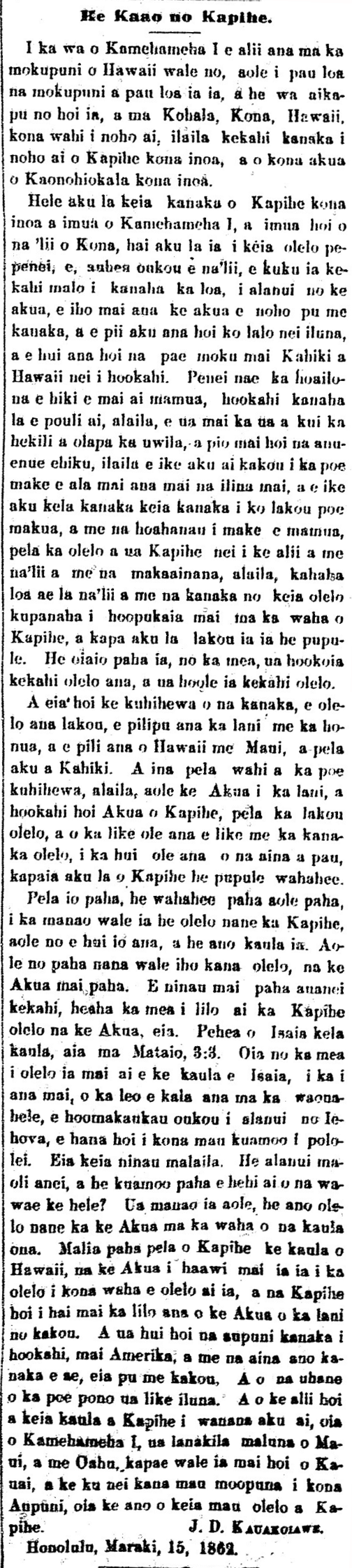
Ke Kaao no Kapihe.

Ka Hoku o ka Pakipika, Buke I, Helu 26, Aoao 1. Maraki 20, 1862.