Ahuimanu College exam information, 1871.

Ahuimanu College.

We had the pleasure of attending the public examination of Ahuimanu College last Wednesday, July 5. The location of the College is healthy and romantic, being situated on a plain at the foot of the mountains, and commanding a fine view of the ocean to the north and of the mountain range east and west.

The institution is under the charge of the Rev. Father Lievin, who is distinguished for his affability and kindness as much as for his many scholarly attainments. He has made improvements in the grounds and buildings during the past year: notably, in the students’ dormitory, each one having to himself a latticed apartment opening on a long corridor, all freely ventilated. The students are, even during the night, under his immediate supervision.

We were much pleased with the correct spelling and distinct reading of the primary classes. Young native boys who, a year ago, could not speak a word of English, read fluently and with a very good pronunciation. It occurred to us to ask ourselves how we could read French or German, after only one year’s study.

The examination of the classes in Grammar, Geography, Arithmetic, History, and Elementary Astronomy, was conducted by the President, and after him by the visitors. The questions asked by the latter were not the routine ones of textbooks. They were intended to draw forth the real knowledge of the students. This rather severe examination showed a proficiency in the various branches that is truly commendable. Our expectations were surpassed at the knowledge of English Grammar and Analysis evinced by that class. The study of Music and Oratory seems to be pursued con amore. The spcimens of Penmanship showed a marked improvement—those of the last and present year being side by side. It is only just to mention the Joseph Poepoe, Victor Kapule, Eddy Morgan, John K. Loio, Zachariah Kapule, and John Spencer, were the most distinguished in their several departments.

We learned that the school year commences on the 20th of August, and ends about the 4th of July. The fees for board, lodging and tuition are from $60 to $100 per year; some poor boys are received gratis. These figures are so low that the institution can not be self-sustaining. Bishop Maigret gives $300 a year towards its support. We hope that it will prosper, and continue to extend its usefulness.

(Hawaiian Gazette, 7/12/1871, p. 2)

HawaiianGazette_7_12_1871_2.png

Hawaiian Gazette, Volume VII, Number 26, Page 2. July 12, 1871.
Ahuimanu College and St. Louis College, 1882.

ST. LOUIS COLLEGE

Is our leading Roman Catholic educational institution for boys. It is an old institution called by a new name and located in a new place. The same institution long existed and prosecuted its mission at Koolau, on the other side of this island, and was there and then known as Ahuimanu College. Although delightfully situated, and having many advantages in its favor, it was felt to be too far from the centre of population, to answer fully the purpose of its existence. Consequently, it was decided, a short time ago, to remove the institution to the neighborhood of Honolulu.

For this purpose the church authorities purchased a splendid piece of property from Mr. Roth, at the north end of Beretania street, not far from Smith’s bridge, where they have erected suitable buildings, and established the old Ahuimanu College under the new name of St. Louis College.

The College grounds measure about two acres, allowing abundance of space for recreative exercise, and are planted with all kinds of tropical trees, some of which are fruit-producing, while others simply afford shade and ornamentation. It is truly a lovely spot, and being free from noisy surroundings, is peculiarly adapted to the purpose for which it is now used.

The College building is a substantial two storey brick structure, 60×20 feet in the clear. The ground floor is divided into three class rooms of equal size, by wooden partitions. Each of these rooms is nicely furnished with new school furniture of the most approved modern style. They are also well lighted and ventillated, ventillation being greatly assisted by the wooden partitions not extending the whole way to the ceiling, which latter is fourteen feet from the floor. Continue reading

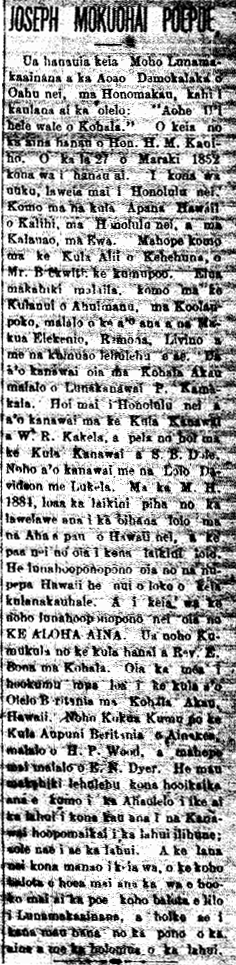
Short biography of the great Joseph Mokuohai Poepoe, 1912.

JOSEPH MOKUOHAI POEPOE

This candidate for the legislature in the Democratic party of Oahu nei was born at Honomakau, which is famous for the saying: “No youth of Kohala goes out unprepared” [“Aohe u’i hele wale o Kohala”]. This also is the birthplace of the Hon. H. M. Kaniho. He was born on the 27th of March, 1852. When he was small, he was brought to Honolulu. He entered into the districts schools [kula apana] here in Honolulu, and also in Kalauao, Ewa. And thereafter he attended the Royal School at Kehehuna, and its head Instructor was Mr. Beckwith. After two years there, he entered Ahuimanu College in Koolaupoko, under the instruction of the Fathers Elekenio, Remona, Livino, and the many other teachers. He was taught law in North Kohala under Judge P. Kamakaia. He returned here to Honolulu and studied law at the law school of W. R. Castle [W. R. Kakela], as well as at the law school of S. B. Dole. He studied law with lawyers Davidson and Lukela. In 1884, he received his full license to practice law in all Courts of Hawaii nei, and he still retains his law license. He was an editor for many of the Hawaiian-language newspapers in this town. Currently, he is the editor for KE ALOHA AINA. He was a teacher at the boarding school of Rev. E. Bond [Rev. E. Bona] in Kohala. He was the first to establish an English language school in North Kohala, Hawaii. He was an assistant teacher at the British Government School at Ainakea, under H. P. Wood, and thereafter under E. N. Dyer. For many years he tried to join the Legislature, so that the lahui would see him pass laws that would benefit the lahui in need; but the people did not assent. Now his hope is that it will be in the upcoming election that the voters will come through, making him a Representative, whereupon he will show his works for the good of the land and for the advancement of the lahui.

[Poepoe played a huge part in the history of the Hawaiian-Language Newspapers! I was happy to find this. Also, I just saw this morning more on the Catholic school at Ahuimanu on Nanea Armstrong-Wassel’s instagram page. Go check it out. There is a picture of the school as well!]

(Aloha Aina, 10/26/1912, p. 1)

AlohaAina_10_26_1912_1.png

Ke Aloha Aina, Buke XVII, Helu 43, Aoao 1. Okatoba 26, 1912.

A mele for Jack, the son of Tarzan, 1920.

HOOHENO NO JACK TAZANA.

Anoai ke aloha nou e Keaka,
Ka hanau kahi a Tazana:
Ka opu rose i mohala ae,
I kupu a ulu i Enelani.
Ua like a like me ka papa,
Ka lima wikani pukonakona:
Hoohihi li’aloko no Akuta,
Ike nae i ka aina malihini.
Pau ka manaolana no ka hoi mai,
E ike i ka nani a o ka makua:
Nau i olali hookahi aku,
Ia kula mehameha he kanaka ole.
Hookahi pailaka a o Akuta,
A loaa Miriama me ka enemi;
Aole i hopo iho hoi o Keaka,
Kaukani enemi ke ku mai.
Oniu ko pahi ma ka lima hema,
Olapa ka uwila i ka enemi:
Kokua Akuta me ka maalahi,
Ola ai ka nohona o ia aina.
Hu ae ke aloha no ka aina,
Me ka poli pumehana a o ka makua;
Haina ia mai ana ka puana,
Ka lima hei o ka oniu pahi.

JOHN H. MAMALA.

Ahukini Landing, Kauai.

[The Tarzan stories were extensively translated in the Hawaiian Language Newspapers!]

(Kuokoa, 2/13/1920, p. 4)

Kuokoa_2_13_1920_4

Ka Nupepa Kuokoa, Buke LVIII, Helu 7, Aoao 4. Feberuari 13, 1920.

The beginnings of Kamehameha Schools, 1884.

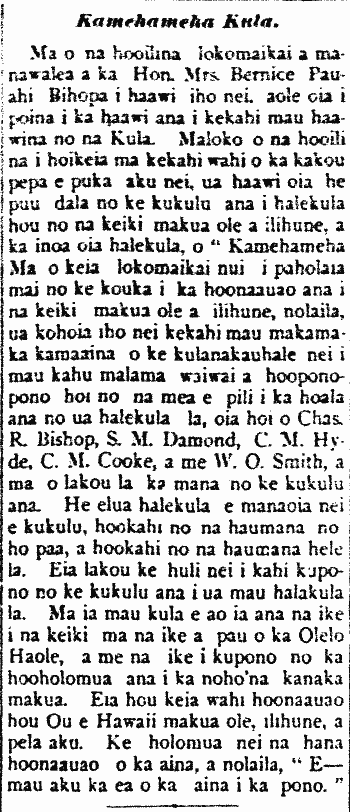
Kamehameha School.

By way of the kind and generous endowment given by the Hon. Mrs. Bernice Pauahi Bishop, she did not forget to make contributions for Schools. Amongst the heirs shown in one of our papers published earlier, she gave a sum of money to build a new schoolhouse for children with no parents or who are indigent, and the name of the school is to be Kamehameha. By this great kindness extended to help in the education of orphan and indigent children, several familiar friends of this town were recently selected as trustees and administrators pertaining to the establishing of said school, that being Charles R. Bishop, S. M. Damon, C. M. Hyde, C. M. Cooke, and W. O. Smith; and with them lies the power to build. Two schools houses are being considered to be built: one for the boarders, and one for the day school students. They are now searching for a suitable place to build the buildings. In those schools, knowledge will be taught to the children in all facets of the English language, as well as learning that will be helpful for advancement in their adult life. Here is your new place of learning, O Hawaiians who are without parents, who are indigent, and so forth. Education in this land is progressing, and therefore, “Let the life of the land live on in righteousness.”

(Kuokoa, 11/8/1884, p. 2)

Kuokoa_11_8_1884_2.png

Ka Nupepa Kuokoa, Buke XXIII, Helu 45, Aoao 2. Novemaba 8, 1884.


Historian J. D. B. Kuakahela dies at sea, 1899.

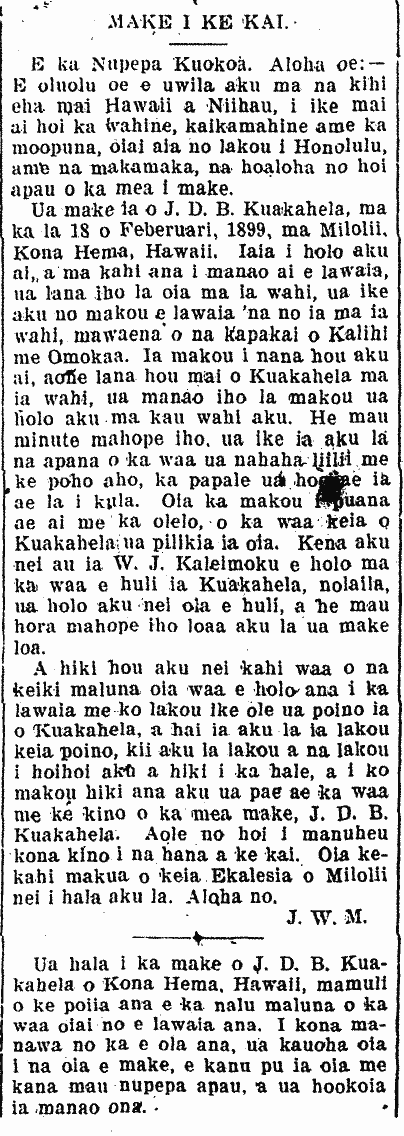
DIED AT SEA.

O Kuokoa Newspaper. Aloha oe:—Please flash across the four corners of Hawaii to Niihau, so that the wife, children and grandchildren see, being that they are in Honolulu, and also all of the friends and fellows of the one who died.

J. D. B. Kuakahela died on the 18th of February 1899 at Milolii, South Kona, Hawaii. When he went and was in the area where he wanted to fish, he was floating; we saw him fishing in that area, between the coast of Kalihi and Omokaa. When we looked once more, Kuakahela was no longer floating in that area, and we thought he sailed to some other place. Some minutes later, pieces of the canoe were seen broken into small bits, his fishing line container [poho aho], and his hat floated upon the shore. That is when we said, that is the canoe of Kuakahela; he is in trouble. I instructed W. J. Kaleimoku to go by canoe to search for Kuakahela, so he went to go look, and a number of hours later, he was found dead.

And thereafter a canoe arrived, and the boys aboard that waa were going fishing without knowing that Kuakahela met with disaster; they were told of the calamity and they went to bring him to the house, and when we got there, the waa with the body of the deceased, J. D. B. Kuakahela aboard, landed. His body was not bruised by the action of the ocean. He was one of the elders of this Church of Miloliii who passed on. Aloha no.

J. W. M.

—–

J. D. B. Kuakahela of South Kona, Hawaii, has died because a wave crashed onto his canoe while he was fishing. While he was living, he instructed that at his death, that he is to be buried with all of his newspapers, and this wish of his was carried out.

[That last comment is awesome. I bet I would have liked this man!]

(Kuokoa, 2/24/1899, p. 2)

Kuokoa_2_24_1899_2

Ka Nupepa Kuokoa, Buke XXXVIII, Helu 8, Aoao 2. Feberuari 24, 1899.

Question on Puea Cemetery, 2016.

One of our readers posted a question:

Guy L. Campbell says:

I am searching for information on Puea Cemetery’s undertaker services in 1953. My brother is buried there and there is no grave marker to locate the site. Does anyone know if there was a document of burial plot division and location with names?

[Might any of you out there be able to help?]

Chorus at Kamehameha, 1889.

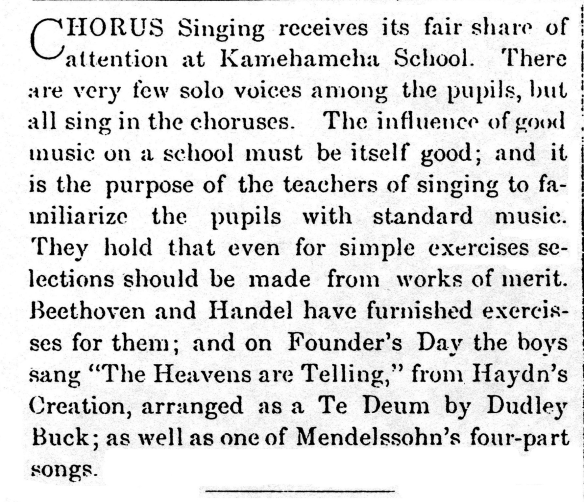
Chorus Singing receives its fair share of attention at Kamehameha School. There are very few solo voices among the pupils, but all sing in the choruses. The influence of good music on a school must be itself good; and it is the purpose of the teachers of singing to familiarize the pupils with standard music. They hold that even for simple exercises selections should be made from works of merit. Beethoven and Handel have furnished exercises for them; and on Founder’s Day the boys sand “The Heavens are Telling,” from Hayden’s Creation, arranged as a Te Deum by Dudley Buck; as well as one of Mendelssohn’s four-part songs.

(Handicraft, 1/1883, p. 3)

Handicraft_1_1889_3.png

Handicraft, Volume 1, Number 1, Page 3. January 1889.

American sailors are taught Hawaiian history, 1925.

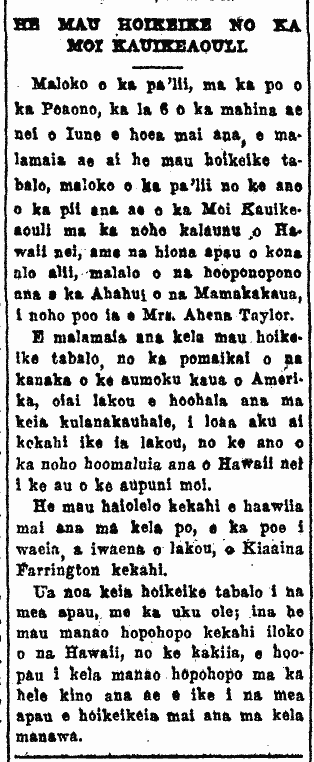
PLAYS ABOUT KING KAUIKEAOULI.

In the grounds of the palace on the night of Saturday, the 6th of this coming June, there will be pageants put on in the palace grounds pertaining to the rise of King Kauikeaouli  to the throne of Hawaii nei along with the appearance of his entire royal court; this will be arranged by the Mamakakaua Society headed by Mrs. Ahuena Taylor.

The pageant will be held for the benefit of the men of the fleet of American warships while they are spending time in this town, so that they obtain some knowledge of the nature of the governing of Hawaii nei i the time of the kingdom.

There will also be speeches presented that night by selected people, and amongst them is Governor Farrington.

This performance will be open to all, without charge; and if there are concerns amongst the Hawaiians that they will be charged, put an end to your worries by going down and witness everything that will be shown at that time.

(Kuokoa, 5/28/1925, p. 2)

Kuokoa_5_28_1925_2

Ka Nupepa Kuokoa, Buke LXIV, Helu 22, Aoao 2. Mei 28, 1925.

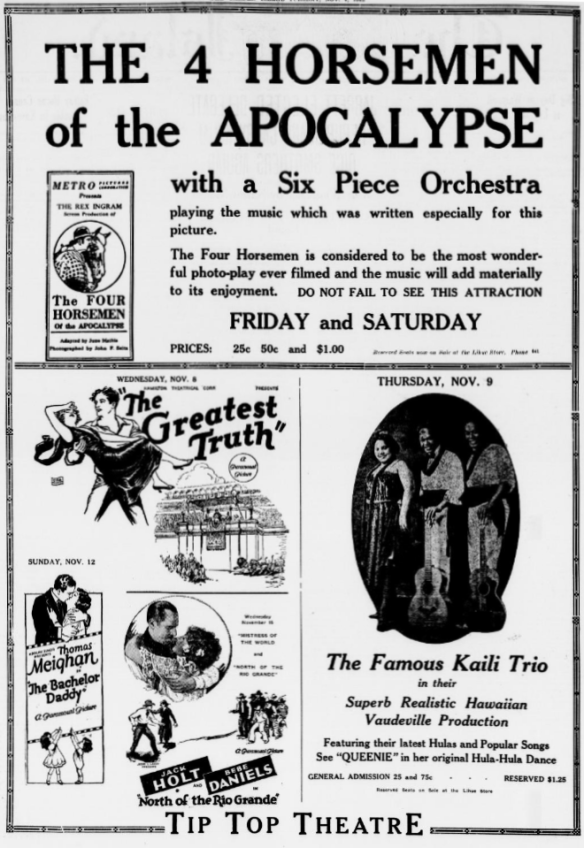
Kaili Trio performing at Kauai’s Tip Top Theatre, 1922.

THE 4 HORSEMEN of the APOCALYPSE

with a Six Piece Orchestra

playing the music which was written especially for this picture.

The Four Horsemen is considered to be the most wonderful photo-play ever filmed and the music will add materially to its enjoyment. DO NOT FAIL TO SEE THIS ATTRACTION

FRIDAY and SATURDAY

PRICES: 25c 50c and $1.00 Reserved Seats now on Sale at the Lihue Store, Phone 641

WEDNESDAY, NOV. 8

HAMILTON THEATRICAL CORP. PRESENTS

“The Greatest Truth”

A Paramount Picture

SUNDAY, NOV. 12

ADOLPH ZUKOR PRESENTS

Thomas Meighan in “The Bachelor Daddy”

A Paramount Picture

Wednesday

November 15

“MISTRESS OF THE WORLD

and

“NORTH OF THE RIO GRANDE”

JACK HOLT AND BEBE DANIELS

in

“North of the Rio Grande”

THURSDAY, NOV. 9

The Famous Kaili Trio

in their

Superb Realistic Hawaiian
Vaudeville Production

Featuring their latest Hulas and Popular Songs
See “QUEENIE” in her original Hula-Hula Dance

GENERAL ADMISSION 25 and 75c – – – RESERVED $1.25

Reserved Seats on Sale at the Lihue Store

TIP TOP THEATRE

(Garden Island, 11/7/1922, p. 2)

GardenIsland_11_7_1922_2.png

The Garden Island, Volume 18, Number 45, Page 2. November 7, 1922.