Mele for the Claudine, the vessel that carried the commission of annexationists to Washington DC, 1893.

KELAUDINA SONG.

Kaulana mai nei Kelaudina
Ahailono o ka poe pakaha
Nau i lawe aku na komisina
O ke aupuni kuloko o Hawaii
Hopuhopualulu e ka hele’na
A na elele o ua aupuni nei
E ake ana e hookoia
Ka iini pakaha aina
Halawai aku nei lakou
Me kahi paele a Kalivilana Continue reading

Queen Emma in New York, 1866.

THE DISTINGUISHED VISITOR.

Emma, the Queen Dowager of the Sandwich Islands, Visits Brooklyn, the Navy Yard, and Sails Down the Bay—Callers at Her Hotel Yesterday, &c.

Her Majesty of the Sandwich Islands, Emma, is determined, it would appear, to see the lions of the famed city of New York while she has the opportunity, and yesterday she extended the pardonable curiosity, which it is not scandalum magnatum to say her Majesty shares with the rest of her sex, to the sister city of Brooklyn. At half-past nine in the morning Queen Emma left her hotel, accompanied by Miss Grinnell, Miss Spurgeon, Major Hopkins, and lady-in-waiting, and drove down Broadway, to the Fulton ferry, whence Her Majesty and suite crossed to Brooklyn. The first place visited was Greenwood cemetery, with the beautiful scenery around which the party was much delighted. On the way back, they stopped at the photographic gallery in Fulton street, where the Queen sat for her portrait.

VISIT TO THE BROOKLYN NAVY YARD.

Pursuant to the announcement made in yesterday’s Herald the entire party then paid a visit to the Brooklyn Navy Yard. The hour appointed for her arrival was half-past one o’clock, and for one hour an assemblage of the citizens of Brooklyn and elsewhere commenced collecting until the mass numbered upwards of three thousand persons. The gates of the yard were closed to all persons except those who had passes signed by the chief officers. Half-past one arrived, but no tidings were received of the Queen. The crowd commenced to get impatient, jokes were passed to and fro to the parties on both sides of the street, when at length, at twenty minutes to two, two open carriages appeared in sight, containing the Queen, suite and attendants. It was observed as the carriages entered the yard that the first one contained her Majesty, Miss Spurgen, maid of honor; Mr. and Miss Odell; and the second Major C. Gordon Hopkins, of the Hawaiian army, and Miss Grinnell, maid of honor. As the party entered the gates the marine guard were formed in line and received her Majesty at “present arms.” She returned the compliment with a polite bow, the carriages proceeding to Admiral Bell’s quarters, in the Lyceum building. Arriving at this point the honored guest was received and assisted from her carriage by Captain Alexander M. Pennock, chief executive officer of the Navy Yard, who in turn introduced her to Rear Admiral Charles H. Bell, the commandant. The Admiral tendered his arm to the Queen, who promptly accepted it, and the party proceeded to the portico on the second story of the Lyceum. When Queen Emma alighted, the Marine battalion, commanded by Captain Collier, were drawn up in line, presented arms, while the Navy Yard band played the air of “Hail Columbia.” A detachment of the crew of the United States ship Vermont fired a salute of twenty-one guns from the Cob deck battery, and the Hawaiian flag was displayed at the main topgallant masthead. Continue reading

Thomas De Witt Talmage on the overthrow, 1894.

A TWO SIDED CASE.

DR. TALMAGE INVESTIGATES THE TROUBLE IN HAWAII.

The American Traveler Also Enjoys the Hospitality of the Ex-Queen and the New President—The Wife of the Latter a Most Delightful and Talented Lady.

[Copyright, Louis Kiopesch, 1894.]

Honolulu, June 18.—The chamberlain, come to invite us to the residence of the ex-queen, had suggested 11 o’clock that morning as the best hour for our visit. We approached the wide open doors through a yard of palm trees and bananas and cocoanut, and amid flowers that dyed the yard with all the colors that a tropical sun can paint. We were ushered into the royal lady’s reception room, where, surrounded by a group of distinguished persons, she arose to greet us with a cordial grasp of the hand. The pictures of her hardly convey an accurate idea of her dignity of bearing. She has all the ease of one born to high position. Her political mis-…

EX-QUEEN LILIUOKALANI.

fortunes seem in nowise to have saddened her. She spoke freely of the brightness of life to any one disposed to meet all obligations, and at my suggestion that we found in life chiefly what we look for, and if we look for flowers we find flowers, and if we look for thorns we find thorns, she remarked: “I have found in the path of life chiefly flowers. I do not see how any one surrounded by as many blessings as many of us possess could be so ungrateful as to complain.” She said it was something to be remembered thankfully that for 50 years there was no revolution in the islands. She has full faith that the provisional government is only a temporary affair, and that she will again occupy the throne.

She asked her servant to show me, as something I had not seen before, a royal adornment made up from the small bird with a large name—the Melithreptes pacifica [mamo; Drepanis pacifica]. This bird, I had read, had under its wing a single feather of very exquisite color. The queen corrected my information by saying that it was not a single feather, but a tuft of feathers from under the wing of the bird from which the adornment was fashioned into a chain of beauty for the neck. She spoke of her visit to New York, but said that prolonged illness hindered her from seeing much of the city. She talked freely and intelligently on many subjects pertaining to the present and the future.

I was delighted with her appearance and manner and do not believe one word of the wretched stuff that has been written concerning her immoralities. Defamation is so easy, and there is so much cynicism aboard, which would rather believe evil than good, that it is not to be thought strange that this queen, like all the other rulers of the earth, has been beaten with storms of obloquy and misrepresentation. George Washington was called by Tom Paine a lying impostor. Thomas Jefferson was styled an infidel, and since those times we are said to have had in the United States presidency a bloodthirsty man, a drunkard and at least two libertines, and if anybody in prominent place and effective work has escaped “let him speak, for him have I offended.” After an exchange of autographs on that day in Honolulu we parted. Continue reading

Hawaii Holomua, January 18, 1893.

ALOHA

Liliuokalanionamoku.

THE POWER OF THE GOVERNMENT HAS BEEN USURPED!

The Protest Proclamation of the Queen!

“My dear homeland,
It is for thee that I sing.”¹

This past Tuesday, the 17th of January, 1893, will seemingly be notorious forever in our land of birth, for it is the day that a new Nation in the form of a provisional government under thirteen haole was proclaimed.

GUARDS POSTED.

On Monday night, was when many places in town were put under the watch of armed soldiers from the American warship Boston, and on the following Tuesday morning, they were seen going around, and the members of the Honolulu Rifles began to join in and surrounded several places with their weapons, and the appearance of town was terrifying.

NEWS OF THE OVERTHROW.

In the early morning, the rumor was spread on the sides of the streets of town, saying that there is craving to overthrow the kingdom and to make a new government. This news flew on the tips of the winds and reached the countryside, and because of that, the citizens of the Queen gathered in great numbers in the streets, and the greatest number was in the groups in and outside of the Palace Grounds; and right outside Kalakaua Hale there were thousands of people standing and waiting, prepared for orders, should there be orders.

DISCUSSION

At this time, the people were in a state of astonishment, going around the sides of the streets and standing here and there in crowds, discussing and responding. This conditions continue while the peaceful state is preserved, except for the seeing of the soldiers with their guns.

GUN FIRE.

But between the hours of 2 and 3 in the afternoon, the people were shocked at the news spread that Leialoha, an government police officer, was shot and and hit by a haole, while he was carrying out his duties under the power of the law of the land. A disturbance soon started, and it was feared that there would be a riot, but as is our usual nature, we were patient, and held back our ire.

In a short time, Leialoha arrived at the Station [Halewai] held on this side and that with helping  hands, and it was realized that he had actually been shot right in front of his chest below the joint of the collarbone. Immediately he was transported to the Queen’s Hospital.

HIS CONDITION. Continue reading

Invasion, 1893.

The American Troops Landed.

Without knowledge of the Government, and with agreement from the American Minister [Stevens] not to land the troops from the warship while the Government is prepared to keep peace; the American Minister nonetheless ordered the troops of the Boston to be  put in service. This would appear as if it is an attack, and should the government [provisional government] listen to the truth of these actions by its official, this will be something that it will condemn.

(Leo o ka Lahui, 1/17/1893, p. 2)

LeookaLahui_1_17_1893_2

Ka Leo o ka Lahui, Buke II, Helu 624, Aoao 2. Ianuari 17, 1893.

Atomic bomb destroys Hiroshima, 1945.

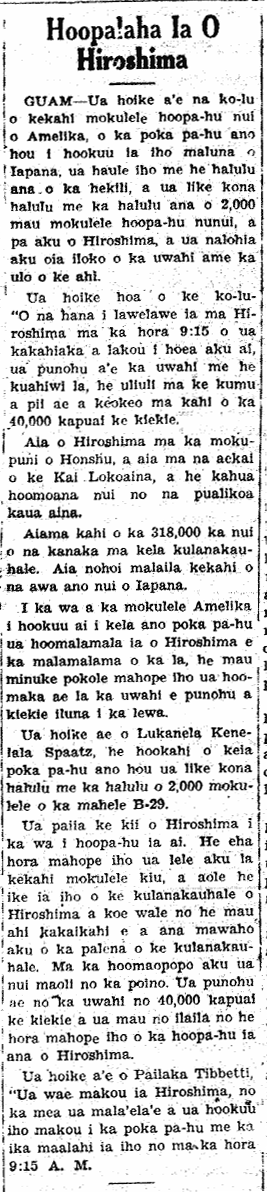
Hiroshima is Leveled

GUAM—The crew of a large American bomber reported of a new type of bomb released above Japan; it fell with the rumbling of thunder, and it was like the strength of 2,00 large bombers; and it hit Hiroshima which disappeared in smoke and the red of fire.

The crew also stated, “The action taken upon Hiroshima at 9:15 in the morning when they arrived, the smoke rose like a mountain, dark at the base and rose to white, reaching about 40,000 feet in height.

Hiroshima is on the island of Honshu, and is on the shore of the Inland Sea [Kai Lokoaina], and it is a large camp for the soldiers of the army.

The population of that city was 318,000. And also one of the major ports of Japan is located there.

When the American aircraft released the bomb, Hiroshima was lit up with the light of the sun, and a few minutes later, smoke began to billow high into the sky.

Lieutenant General Spaatz said the strength of one of those new bombs was equal to the strength of 2,000 B-29 planes.

A picture of Hiroshima was taken when it was bombed. Four hours later, a spy plane flew over, and the city of Hiroshima could not be seen except for a few fires burning outside of the city limits. The great destruction was clear. The smoke billowed up 40,000 feet high, and it remained for hours after the bombing of Hiroshima.

The Pilot Tibbett said, “Hiroshima was chosen because it was clear, and we released the bomb with clear vision at 9:15 A. M.

[70 years ago… Let’s learn from history.]

(Hoku o Hawaii, 8/15/1845, p. 1)

Hoopalaha Ia O Hiroshima

Ka Hoku o Hawaii, Volume XL, Number 16, Aoao 1. Augate 15, 1845.

The U. S. S. Boston, John L. Stevens, and the Hawaiian flag, 1893.

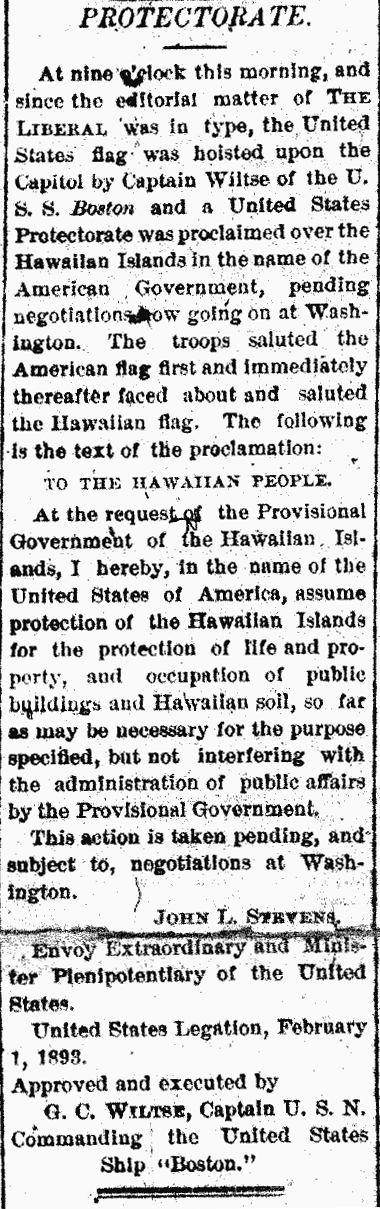
PROTECTORATE.

At nine o’clock this morning, and since the editorial matter of The Liberal was in type, the United States flag was hoisted upon the Capitol by Captain Wiltse of the U. S. S. Boston and a United States Protectorate was proclaimed over the Hawaiian Islands in the name of the American Government, pending negotiations now going on at Washington. The troops saluted the American flag first and immediately thereafter faced about and saluted the Hawaiian flag. The following is the text of the proclamation:

TO THE HAWAIIAN PEOPLE.

At the request of the Provisional Government of the Hawaiian Islands, I hereby, in the name of the United States of America, assume the protection of the Hawaiian Islands for the protection of life and property, and occupation of the public buildings and Hawaiian soil, so far as may be necessary for the purpose of specified, but not interfering with the administration of public affairs by the Provisional Government.

This action is taken pending, and subject to, negotiations at Washington.

John L. Stevens,

Envoy Extraordinary and Minister Plenipotentiary of the United States.

United States Legation, February 1, 1893.

Approved and executed by

G. C. Wiltse, Captain U. S. N.

Commanding the United States Ship “Boston.”

(Liberal, 2/1/1893, p. 2)

PROTECTORATE.

The Liberal, Volume I, Number 41, Page 2. February 1, 1893.

A protest by the United States of America, 1843.

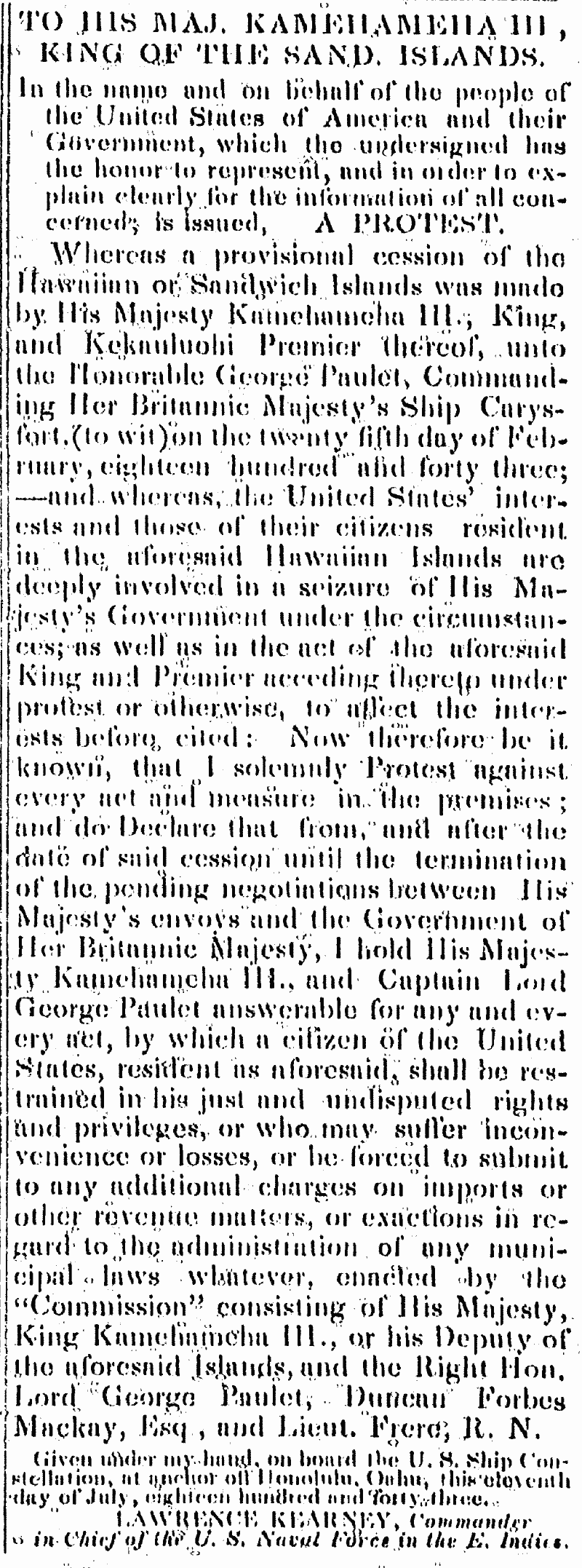
TO HIS MAJ. KAMEHAMEHA III, KING OF THE SAND. ISLANDS.

In the name and on behalf of the people of the United States of America and their Government, which the undersigned has the honor to represent, and in order to explain clearly for the information of all concerned, is issued, A PROTEST.

Whereas a provisional cession of the Hawaiian or Sandwich Islands was made by His Majesty Kamehameha III., King, and Kekauluohi Premier thereof, unto the Honorable George Paulet, Commanding Her Britannic Majesty’s Ship Carysfort, (to wit) on the twenty fifth day of February, eighteen hundred and forty three;—and whereas, the United States’ interests and those of their citizens resident in the aforesaid Hawaiian Islands are deeply involved in a seizure of His Majesty’s Government under the circumstances; as well as in the act of the aforesaid King and Premier acceding thereto under protest or otherwise, to affect the interests before cited: Now therefore be it known, that I solemnly Protest against every act and measure in the premises; and do Declare that from, and after the date of said cession until the termination of the pending negotiations between His Majesty’s envoys and the Government of Her Britannic Majesty, I hold His Majesty Kamehameha III., and Captain Lord George Paulet answerable for any and every act, by which a citizen of the United States, resident as aforesaid, shall be restrained in his just and undisputed rights and privileges, or who may suffer inconvenience or losses, or be forced to submit to any additional charges on imports or other revenue matters, or exactions in regard to the administration of any municipal laws whatever, enacted by the “Commission” consisting of His Majesty, King Kamehameha III., or his Deputy of the aforesaid Islands, and the Right Hon. Lord George Paulet, Duncan Forbes Mackay, Esq., and Lieut. Frere, R. N.

Given under my hand, on board the U. S. Ship Constellation, at anchor off Honolulu, Oahu, this eleventh day of July, eighteen hundred and forty three.

LAWRENCE KEARNEY, Commander in Chief of the U. S. Naval Force in the E. Indies.

(Nonanona, 7/25/1843, p. 21)

TO HIS MAJ. KAMEHAMEHA III., KING OF THE SAND. ISLANDS.

Ka Nonanona, Buke 3, Pepa 5, Aoao 21. Iulai 25, 1843.

Palapala hoole na Amerika Huipuia, 1843.

NA KAMEHAMEHA III., KE LII O KO HAWAII NEI PAE AINA.

Ma ka inoa, a ma ka aoao hoi o na kanaka o Amerika Huipuia a me ko lakou aupuni, (owau, ka mea i kakauia ka inoa malalo, he luna au no ia aupuni) a i mea hoi e hoakaka aku i na kanaka a pau i kuleana ma keia mea, ua hoopukaia’ku nei,

KEIA PALAPALA HOOLE.

No ka hoolilo ana o Kamehameha III, ke alii, a me Kekauluohi ke kuhina, i keia pae aina o Hawaii nei ia George Paulet, kapena o ka moku Beritania, Carysfort, ma ka la 25 o Feberuari, 1843; a no ka owiliia hoi o ka waiwai a me na hana a ko Amerika poe noho maanei, i loko o ia kaili ana o keia aupuni, a iloko hoi o ia hana a ke alii, a me ke kuhina, ma ia hoolilo ana, (me ka hoole paha, me ka ole paha)—

Nolaila, ke hoike aku nei au i keia: Ke hoole ikaika aku nei au i keia mau hana a pau.

Eia hoi ka’u e hai aku ai: Mai ka la ma i lilo ai keia aupuni a hiki i ka wa e pau ai ka hana pu ana a na luna o Kamehameha III, me ko Beritania aupuni, maluna o Kamehameha III, a me Kapena Haku George Paulet e kau ai ka hewa o kela hana, keia hana e poho ai ka pono akaka o ko Amerika poe e noho nei i keia pae aina. [O laua no ke hewa] ina paha e keakeaia ke kahi kanaka o Amerika Huipuia, a ina paha e poho ko lakou waiwai, a ina paha e koiia lakou e uku i dute hooi ma ka waiwai i laweia mai, a ma na mea e paha o ke aupuni, a ina paha e hooukuia lakou ma ka hooko ana i kekahi o na kanawai a pau i hanaia e “ka poe luna Beritania,” oia hoi ke alii, Kamehameha III, a o kona pani hakahaka paha, a me Haku George Paulet, a me Duncan Forbes Mackay Esquire, a me Lieutenant Frere, no ka manuwa Beritania.

Hanaia keia ma kuu lima maluna o ka moku manuwa o Amerika Huipuia, o Constellation ka inoa, a ke ku nei ia mawaho, ma Honolulu (Oahu.) i keia la umikumamakahi o Iulai, 1843.

LAWRENCE KEARNY, aliii nui maluna o na manuwa a pau o Amerika Huipuia ma Asia.

(Nonanona, 7/25/1843, p. 21)
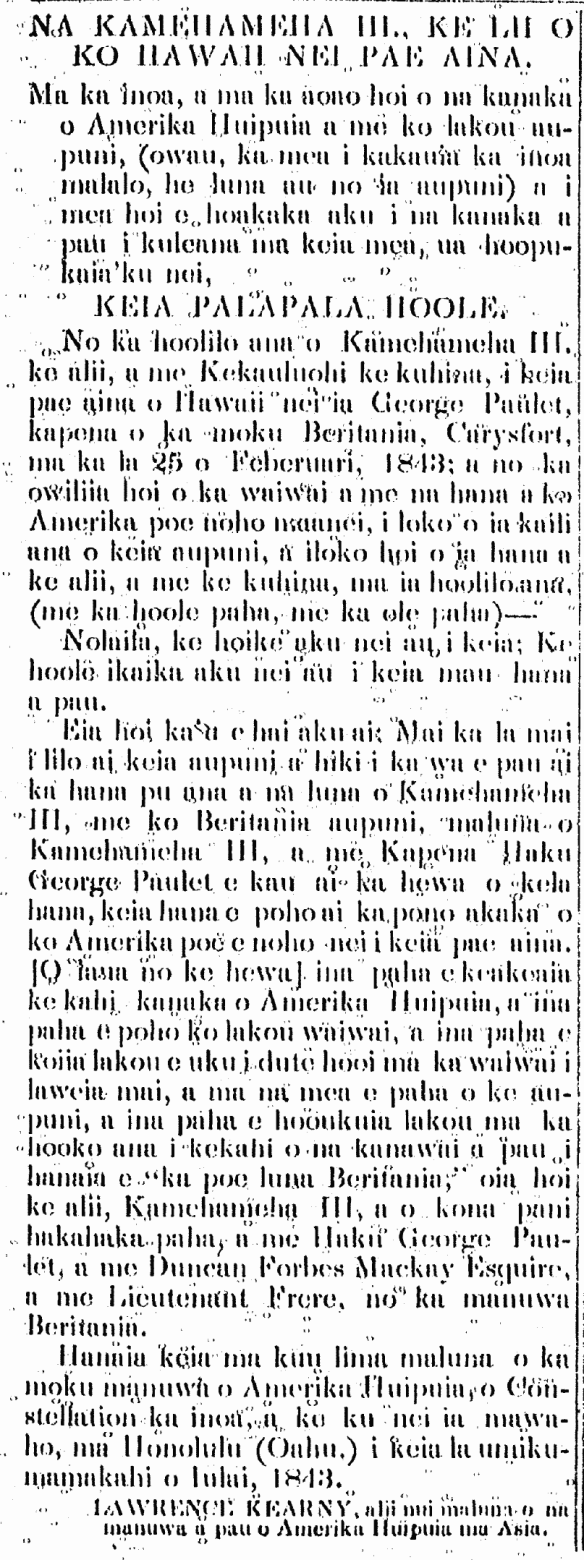
NA KAMEHAMEHA III., KE LII O KO HAWAII NEI PAE AINA.

Ka Nonanona, Buke 3, Pepa 3, Aoao 21. Iulai 25, 1843.
Name song for David Kawananakoa, 1893.

HE INOA NO KAWANANAKOA.

He inoa nou e Kalani Kawika
No ka pua i mohala i Makanoni,
Nau i hoolana me ka wiwo ole
Ka manao haaheo i ka puuwai
Hoouna ia oe maka mikiona
I wahaolelo no ka Lahui
Haulani aku oe a oia loa
Na kai ehuheu o ka Moana
Na kilihune ua o ka Hooilo
Hau iniki ili a o Kaleponi
Ka makani hui koni o ka Akau
O ka noe halii ma ka Hikina;
Mea ole wale no i ka uilani
Ka uwila hoohana a o Hawaii
E ake no a hookoia
Na kikoni wela a ka puuwai
I ka hapai mai a ke aloha
O ka ewe hanau o ka Aina
Aia ka palena o Wakinekona
Kapikala kaulana a o Nu Ioka
Ike i ka nani a o Amerika
I ka uluwehi o ka Hale Keokeo
Ilaila olu pono kahi manao
Lana malie iho me he wai ala
Launa oluolu me ke aloha
Me ka manao lana o ka lanakila
Ninau mai e ka Pelekikena
Pehea Hawaii Nui o Keawe
Oia mau no o ke onaona
Ka pua nani o ka Pakipika
E popohe ana ia me ka nohea
E hooheno ia ai e ka malihini
Ina no oe a e ike ana
I ka lihilihi ula o ka Lehua
Aole e nele kou awihi
I ka ui kaulana o ke Ao nei
A oia no hoi Ko’u manao
A i alo mai nei o ke Kai loa
Eia ka Elele o ke Kuini
Puuwai Hao Kila Makeneki
Ua ino na hana a ke Koae
Kahi manu aea pili pohaku
E ake ana no a hoopunana
Malalo o ka malu lau laau
I malumalu ai kana punua
I manao ai e hoolaukoa
A piha i ka hulu owala mai
Kapapa hewa ana ma ke kuono
I ka ono i ka hua Ohelopapa
O ke kihapai o Elenale
Hookaha i ka nani o ka Aina
Ke Gula hu wala a o Hawaii
Pehea la ia i kou manao
Me nei oe la noonoo mai
E wiki oiai ka manawa pono
Aia Enelani ua enaena
Kulou ke poo o ka Aeko
I ka ea ana mai puua ka waha
Ua hewa na hua a ke Koae
Aohe moneka nana e kala
Ua pono kou manao e Kalani
E hoi no oe me ka hanohano
Lawe ae no oe a kiekie
He loaa mai na kupuna mai
Me oe ke aloha o ke Kahikolu
E ka Iwakiani o Hawaii
A he lei Mokihana onaona Oe
I pilia me ka Lauae o Makana
E o e Kalani pua laha ole
O Kawananakoa kou inoa.

Miss. Kekoaohiwaikalani

Puahaulani Hale

Honolulu, March 1, 1893.

(Leo o ka Lahui, 3/7/1893, p. 3)

HE INOA NO KAWANANAKOA.

Ka Leo o ka Lahui, Buke II, Helu 656, Aoao 3. Maraki 7, 1893.