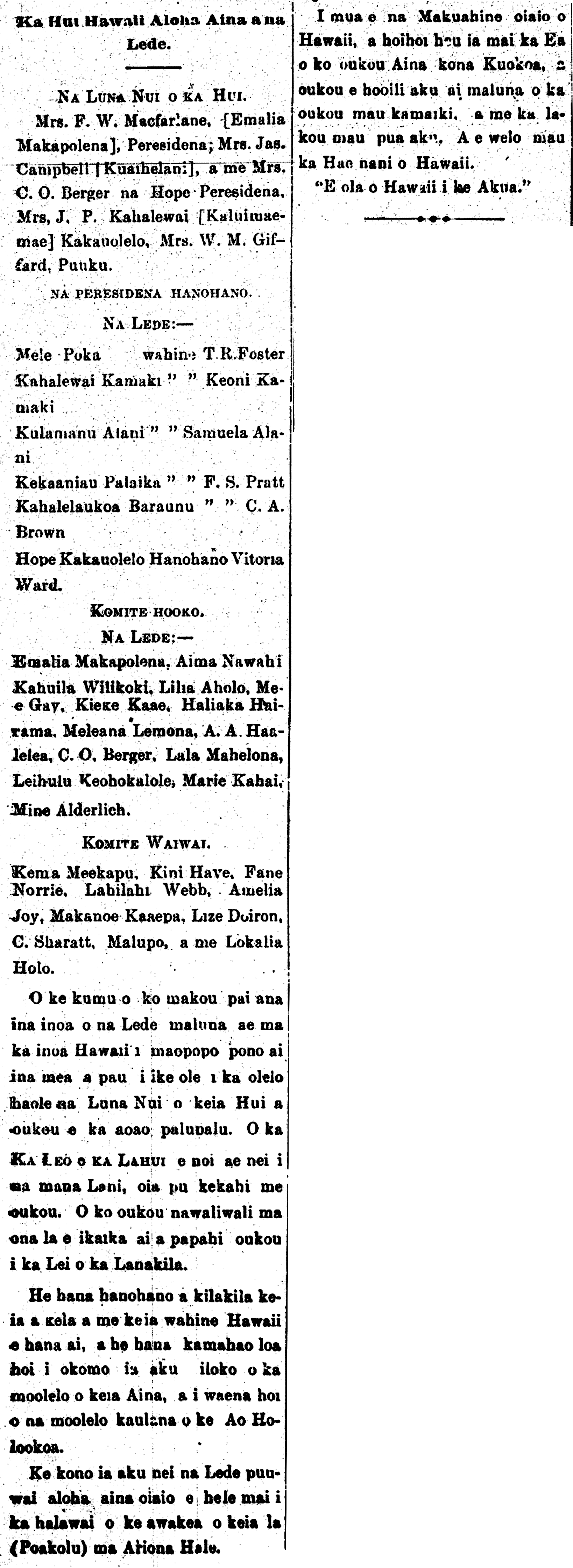
Woman’s Hawaiian Patriotic League members, 1893.

Hui Hawaii Aloha Aina of the Ladies.

The Officers of the Association.

Mrs. F. W. Macfarlane (Emalia Makapolena), President; Mrs. James Campbell (Kuaihelani), and Mrs. C. O. Berger, Vice Presidents; Mrs. J. P. Kahalewai (Kaluimaemae), Secretary; Mrs. W. M. Giffard, Treasurer.

HONORARY PRESIDENTS

The Ladies:—

Mele Poka [Mary Foster], wife of T. R. Foster

Kahalewai Kamaki ” ” Keoni Kamaki [John A. Cummins]

Kulamanu Alani ” ” Samuel Alani [Samuel Allen]

Kekaaniau Palaika ” ” F. S. Pratt

Kahalelaukoa Baraunu ” ” C. A. Brown

Honorary Vice Secretary Vitoria Ward [Victoria Ward]

Executive Committee.

The Ladies:—

Emalia Makapolena, Aima Nawahi, Kahuila Wilikoki, Lilia Aholo, Mere Gay, Kieke Kaae, Haliaka Hairama, Meleana Lemona, A. A. Haalelea, C. O. Berger, Lala Mahelona, Leihulu Keohokalole, Marie Kahai, Mine Alderlich.

Finance Committee.

Kema Meekapu, Kini Have, Fane Norrie, Lahilahi Webb, Amelia Joy, Makanoe Kaaepa, Lize Doiron [Lizzie Doiron], C. Sharatt, Malupo, and Lokalia Holo.

The reason that we printed the names of the Ladies above by their Hawaiian names is so that those who don’t know English will clearly know the Officers of this Organization of you, the weaker sex. The Leo o ka Lahui ask the Heavenly powers to be with you all. Your weaknesses will be strengthened through him, and you will be adorned with the Lei of Victory.

This is an great and admirable effort to be participated in by every Hawaiian woman, and an amazing thing to include into the history of this Aina, and amongst the famous history of the Entire World.

All Ladies with truly patriotic hearts are invited to come to the meeting this evening (Wednesday) at Ariona Hale.

Onwards O True Hawaiian Mothers and let the Independence of your Aina be restored, which you will pass down to your children, and their offspring after them. And let the beautiful Flag of Hawaii always wave.

“Long live Hawaii in God.”

(Leo o ka Lahui, 3/30/1893, p. 3)

Ka Hui Hawaii Aloha Aina a na Lede

Ka Leo o ka Lahui, Buke II, Helu 673, Aoao 3. Maraki 30, 1893.

Helen H. Roberts, ethnomusicologist, collecting mele from across the islands, 1923.

SOMETHING WORTHWHILE HELPING

In this past Legislative session, $5,000 was set aside for the cost to prepare a book of “Ancient Hawaiian Music”. This endeavor has been given to Kamehameha School, and they are now utilizing this to preserve the “old mele olioli” of Hawaii nei. Miss Helen H. Roberts has been sent by the Trustees of the Kamehameha School to go amongst the Hawaiians and to search out ancient mele of Hawaii nei.

She is accompanied by a phonograph [ponotalapa (ipu malama olelo)], and is looking to have people chant ancient mele into the phonograph and to record and save it for generations to come. Not only mele olioli are being sought after, but also wanted are mele hula hoaeae of the Hawaiians. Many years from now the people who know these old mele will be gone, but these mele olioli and mele hoaeae will become something to look back to the history of the Hawaiian Lahui.

This will be something that will look for where the Hawaiians came from, whereas also being sought are mele of other Polynesians while comparing these ancient mele with the ancient mele of Hawaii.

This is something that the old people who are fluent for instance in the old mele hoaeae of Hawaii nei should assist in.

This is not being done for monetary profit, but to seek the ancient things of the beloved Kupuna of this Lahui; and for all Hawaiians who have pride in the fame of their Lahui, there is no reason for them to withhold these ancient things of the Kupuna and to go to the grave without leaving these blessings for those coming after them. We ask Rev. W. M. Kalaiwaa and Rev. William Kamau of the Kohala districts to support this great endeavor for the acclaim of the Hawaiian Lahui. We are also helping to move this project along with what little we have, being that this will help to perpetuate the great Moolelo of the Hawaiian People.

[The opening to the book “Ancient Hawaiian Music” reads:

A survey of ancient Hawaiian music was conducted, 1923–24, by Miss Helen H. Roberts under the auspices of the Hawaiian Folk-Lore Commission represented by John R. Galt, chairman; Edna J. Hill, secretary; Mrs. Emma Ahuena Taylor, Hawaiian member. In cooperation with the Commission, manuscripts resulting from the survey are published by Bernice P. Bishop Museum.]

(Hoku o Hawaii, 12/6/1923, p. 2)

HE HANA MAIKAI E KOKUA IA

Ka Hoku o Hawaii, Buke XVII, Helu 28, Aoao 2. Dekemaba 6, 1923.

Changing values and the sad end to Kahaulelio’s Fishing Traditions, 1902.

With the death of David Kaukaha Kanewanui (Kamehameha class of ’94), editor of the Kuokoa and great advocate of traditions, and the rise of the young inexperienced editor, David Laanui A-i (Kamehameha class of ’93), the treatise on traditional fishing techniques by Daniela Kahaulelio was found no longer important. It came to an abrupt end without being completed. This short blurb was all that I could find explaining its demise.

 Mamuli o ka nui o na mea hou, ua waihoia kekahi mau moolelo kumau a o na mea hou ka i okomoia aku ma ko lakou wahi.

Because of the great amount of news, several regular moolelo were put aside, and replaced with other new material.

[See more here from Nanea Armstrong-Wassel. See more here as well from a previous post on Kahaulelio’s fishing treatise.]

(Kuokoa, 7/11/1902, p. 6)

Mamuli o ka nui o na mea hou...

Ka Nupepa Kuokoa, Buke XL, Helu 28, Aoao 6. Iulai 11, 1902.

Anna Berry, daughter of Kentucky congressman, speaks on annexation, 1898.

THE INJUSTICE OF ANNEXATION

As Viewed by an American Woman Miss Anna E Berry of Newport—The Kentucky Congressman’s Daughter Writes Entertainingly of the Native Hawaiians—A Petition to the President.

[Among the ladies who accompanied the congressional party to Hawaii in September was Miss Anna Berry, daughter of Congressman Berry of Kentucky, who has written charmingly of the islands. She brought back many souvenirs of her visit, which are to be seen in her Newport home. The best of all is the Royal Hawaiian standard, the flag which was floating over Queen Liliuokalani when she was deposed. It is to be noted that Miss Berry returned to America with a woman’s sense of the injustice of annexation, from the viewpoint of the native Hawaiian, while the men of the party came back a unit for annexation. The Hawaiian minister to whom Miss Berry refers as a descendant of a Kentucky Governor is Rev. Desha, of Hilo. His grandfather was Governor Desha, of Kentucky, and his father was Isaac B. Desha, who committed a sensational murder at Doggett’s Tavern, a well-known inn of early Kentucky days on the Licking River. The murderer was sentenced to death, and saved by his own father’s pardoning power. The case was one of the most remarkable in American criminal history. He fled to Hawaii where one of his half-native sons is a leading Kanaka minister, and the other is a postal employee.—The Editor of the Kentucky Post.

The recent visit of Senator Morgan and four members of the United States House of Representatives to the Hawaiian Islands aroused among the various peoples of the “Paradise of the Pacific” sentiments and feelings as opposite as the poles. There are indeed various peoples in Hawaii—a very scrapbag of a population—the good with the bad. Here Portuguese and Chinese, Japanese and Germans, Americans and natives jostle one another. Continue reading

On Hoolulu Park, the recycling of pictures, the Kohala-Hilo R.R. Co., and the 4th of July, 1903.

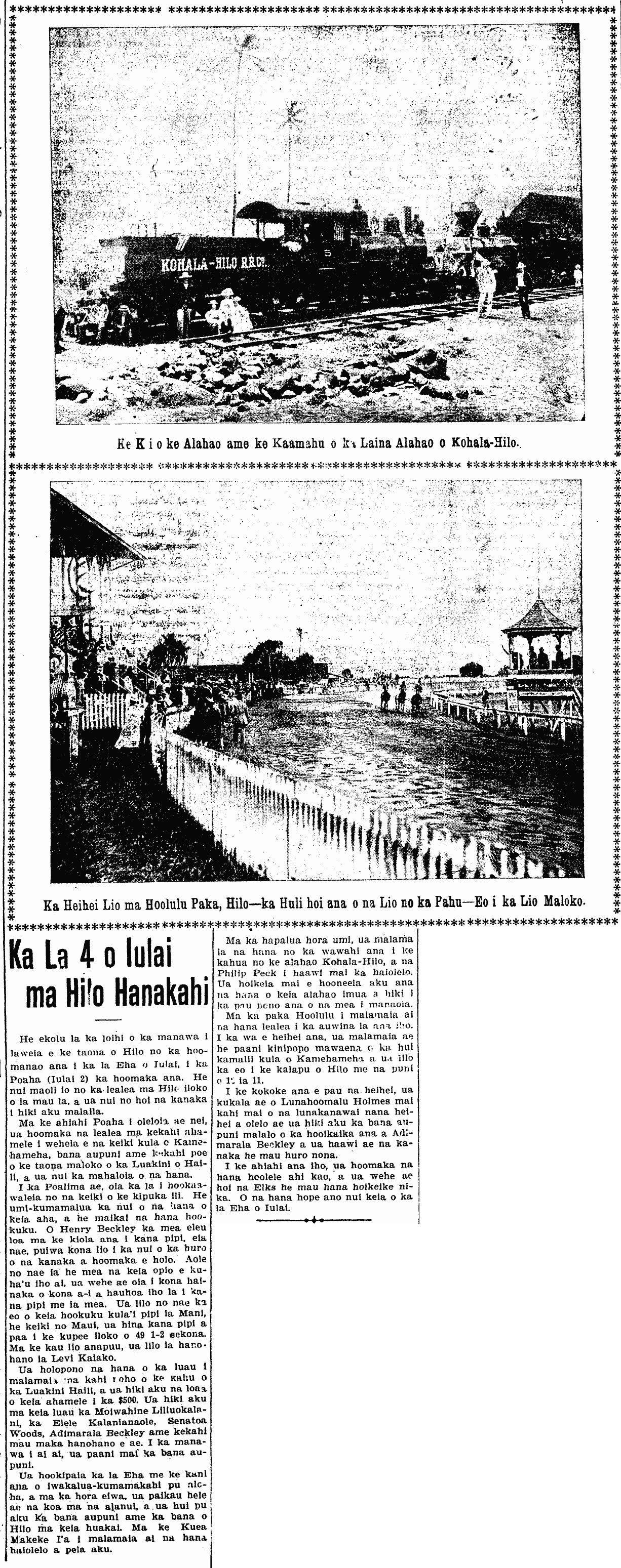
A Picture of the Railroad [Alahao] and Steam Engine [Kaamahu] of the Kohala-Hilo Railway Line.

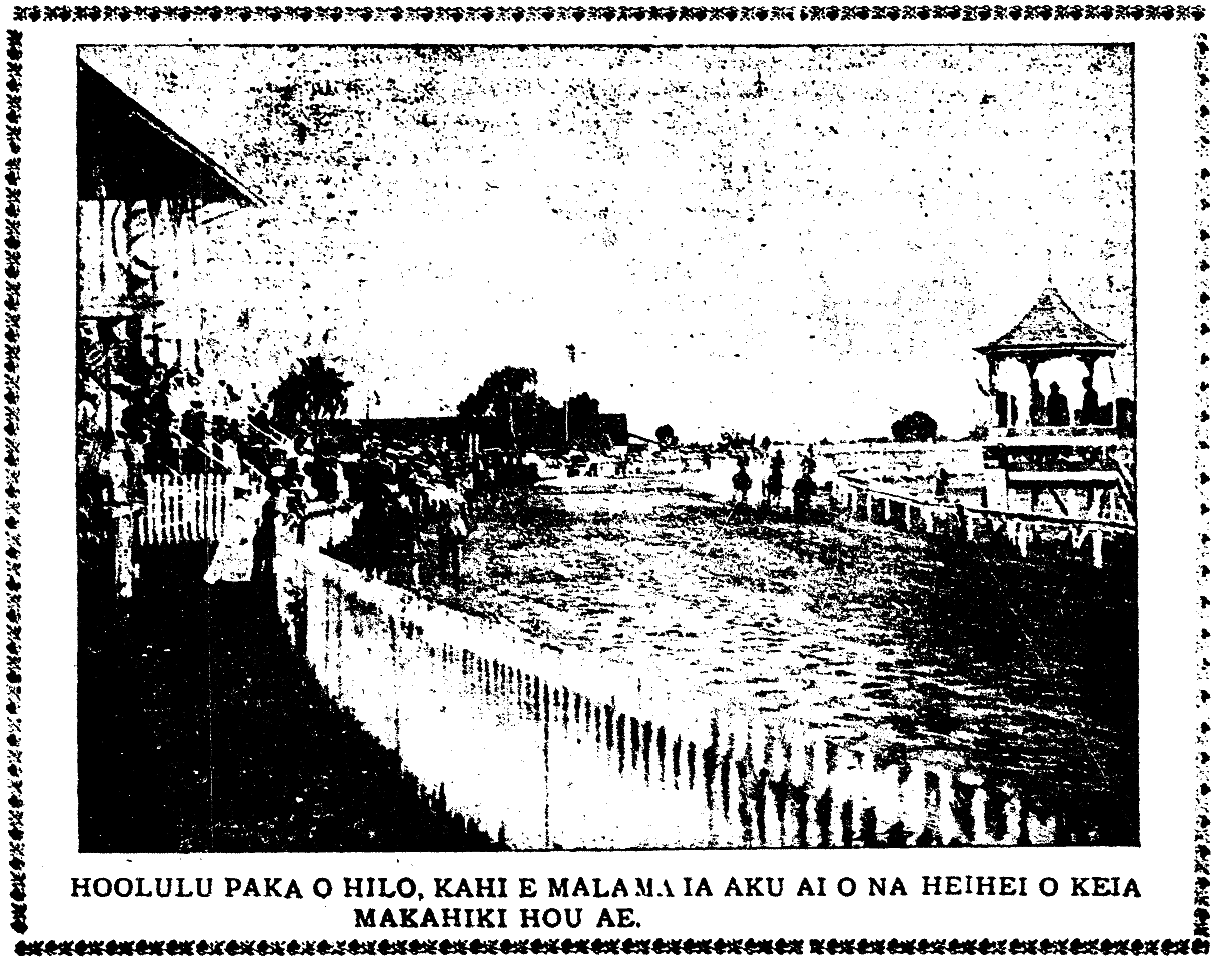
Horse Race at Hoolulu Park, Hilo—The Turning of the Horses for the Goal—The Horse on the Inside Wins.

The 4th of July in Hilo Hanakahi

The town of Hilo celebrated the Fourth of July for three days, beginning on Thursday (July 2). There truly was great joy in Hilo during those days, and there were many people who came.

In the evening of the said Thursday, the festivities began with a concert put on by the students of Kamehameha School, the government band, and some people of the town, in Haili Church, and it was greatly appreciated.

On the following Friday, that is the day set aside for the lassoing boys. There were twelve events of this meet, and there was good competition. Henry Beckley was the liveliest one at throwing his bull, however, his horse was alarmed at all of the cheering of the people, and began to run. But this was not something that made this youth falter; he removed his handkerchief from his neck and tied his bull with it. The victory for the contest to throw down the steer went to Mani, a Maui boy, and his steer was thrown down and tied in 49 1-2 seconds. For bronc riding, that honor went to Levi Kalako.

The luau went well, held at the residence of the kahu of Haili Church, and the proceeds of this concert came to $500. Appearing at this luau were Queen Liliuokalani, Representative Kalanianaole, Senator Woods, Admiral Beckley, and other distinguished people. When the eating began, the government band played.

The Fourth was greeted with the salute of twenty-one guns, and at nine o’clock, the soldiers marched on the streets, and the government band and the Hilo Band joined in this parade. At the Fish Market Square [Kuea Makeke I’a], speeches were held, and so forth.

At half after ten o’clock, the breaking ground for the Kohala-Hilo Railroad was held, and Philip Peck gave the speech. It was said that the work of this railroad will move forward until what was planned is completed.

At Hoolulu Park was held the festivities of that afternoon. When the races were going on, a ballgame went on with the school boys of Kamehameha, and the victory went to the Hilo club with the score of 12 to 11.

When the races were almost done, Chairman Holmes announced from the area of the race judges that the government band had arrived by the efforts of Admiral Beckley, and the people gave him a cheer.

Later that evening, fireworks were shot off, and the Elks put on a “nigger show [hoikeike nika].”¹ These were the last major events of this Fourth of July.

[This is the same picture of Hoolulu Park found later in the Kuokoa three years later, on 12/7/1906. This kind of recycling of pictures happened back in the day, just as we see it happening today, therefore sometimes it is difficult to date a picture that appears in the newspapers.]

¹This type of entertainment here can be seen spoken of in the Hawaiian newspapers from the mid-1800s to the early 1900s.

(Kuokoa, 7/10/1903, p. 1)

Ka La 4 o Iulai ma Hilo Hanakahi

Ka Nupepa Kuokoa, Buke XLI, Helu 28, Aoao 1. Iulai 10, 1903.

Plans for the building to commemorate the 100th anniversary of the coming of the missionaries, 1914.

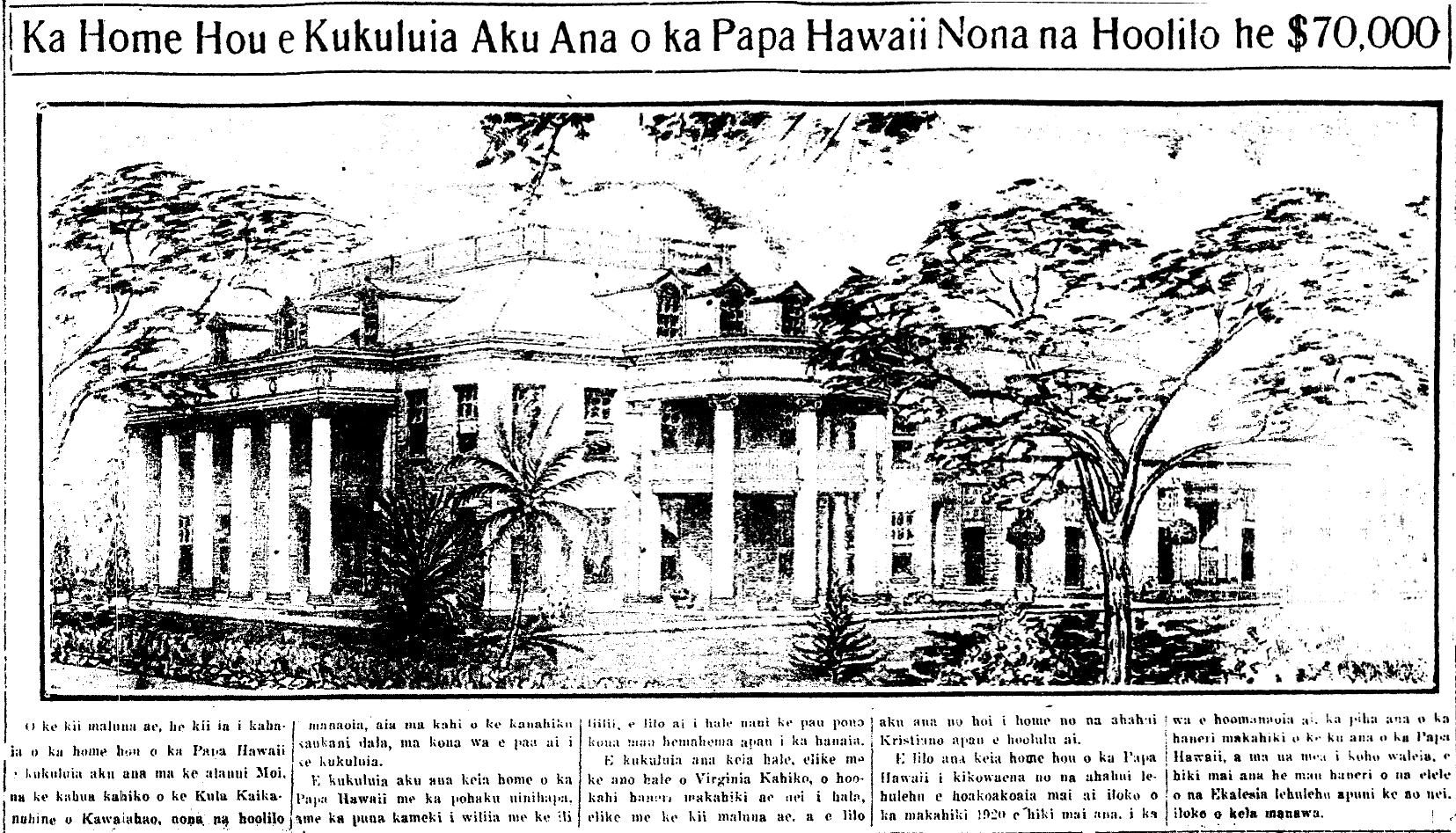
New Home Being Built by the Hawaiian Evangelical Association to Cost $70,000

The picture above is a sketch drawn of the new home of the Hawaiian Evangelical Association [Papa Hawaii] to be built on King Street on the old site of the Kawaiahao Girls’ School [Kula Kaikamahine o Kawaiahao], that is estimated to cost about seventy thousand dollars at its completion.

This home of the Papa Hawaii will be built using brick and concrete, and it will be a beautiful house once all the finishing touches are completed.

This house will be build in the style of those of old Virginia of a hundred years ago, like the image above, and it will become a home for all the Christian associations at where to gather.

This new home of the Papa Hawaii will be a center for the many groups to gather during the coming year 1920 when the 100th anniversary of the Papa Hawaii is celebrated, and it is imagined several hundred representatives of the many Churches from around the world will come them.

(Kuokoa, 10/2/1914, p. 1)

Ka Home Hou e Kukuluia Aku Ana o ka Papa Hawaii Nona na Hoolilo he $70,000

Ka Nupepa Kuokoa, Buke LII, Helu 41, Aoao 1. Okatoba 2, 1914.

More on the 11th of June in Kalaupapa, 1904.

11th of June

Sports at Kalaupapa

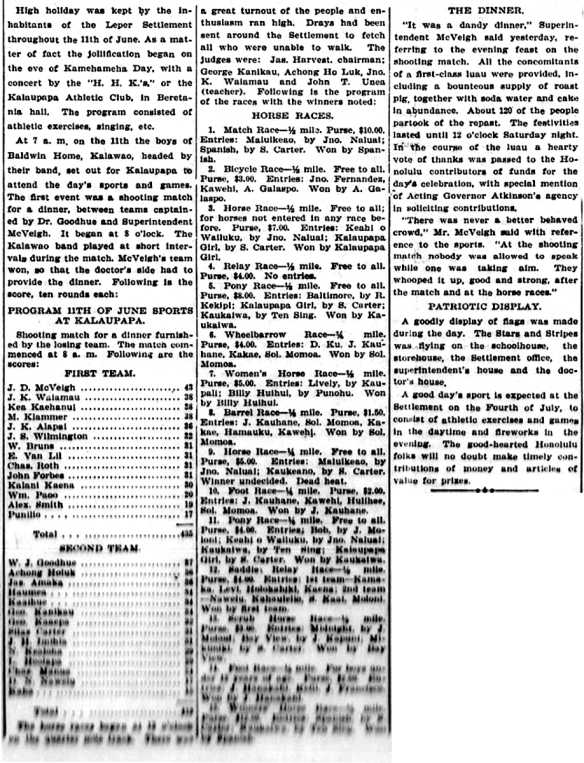
High holiday [Kamehameha Day] was kept by the inhabitants of the Leper Settlement throughout the 11th of June. As a matter of fact the jollification began on the eve of Kamehameha Day, with a concert by the “H. H. K.’s” [Hui Hooikaika Kino] or the Kalaupapa Athletic Club, in Beretania hall. The program consisted of athletic exercises, singing, etc.

At 7 a. m., on the 11th the boys of Baldwin Home, Kalawao, headed by their band, set out for Kalaupapa to attend the day’s sports and games. The first event was a shooting match for a dinner, between teams captained by Dr. Goodhue and Superintendent McVeigh. It began at 8 o’clock. The Kalawao band played at short intervals during the match. McVeigh’s team won, so that the doctor’s side had to provide the dinner. Following is the score, ten rounds each:

PROGRAM 11TH OF JUNE SPORTS AT KALAUPAPA.

Shooting match for a dinner furnished by the losing team. The match commenced at 8 a. m. Following are the scores:

FIRST TEAM.

J. D. McVeigh ….. 43
J. K. Waiamau ….. 38
Kea Kaehanui ….. 38
M. Klammer ….. 38
J. K. Alapai ….. 36
J. S. Wilmington ….. 32
W. Bruns ….. 31
E. Van Lil ….. 31
Chas. Roth ….. 31
John Forbes ….. 31
Kalani Kaena ….. 30
Wm. Paoo ….. 20
Alex. Smith ….. 19
Punilio ….. 17
Total ….. 435

SECOND TEAM.

W. J. Goodhue …. 37
Achong Holuk ….. 36
Jas. Amaka ….. 36
Haumea ….. 34
Kaaihue ….. 34
Geo. Kanikau ….. 34
Geo. Kaaepa ….. 32
Silas Carter ….. 31
J. H. Imihia ….. 31
N. Kealoha ….. 29
I. Hoolapa ….. 29
Chas. Manua ….. 24
D. N. Nawelu ….. 17
Kaha ….. 15
Total ….. 119

The horse races began at 12 o’clock on the quarter mile track. There was a great turnout of the people and enthusiasm ran high. Drays had been sent around the Settlement to fetch all who were unable to walk. The judges were: Jas. Harvest, chairman; George Kanikau, Achong Ho Luk, Jno. K. Waiamau and John T. Unea (teacher). Following is the program of the races with the winners noted:

HORSE RACES.

1. Match Race—½ mile. Purse, $10.00. Entries: Maluikeao, by Jno. Naluai; Spanish, by S. Carter. Won by Spanish.
2. Bicycle Race—½ mile. Free to all. Purse, $3.00. Entries: Jno. Fernandez, Kawehi, A. Galaspo. Won by A. Galespo.
3. Horse Race—½ mile. Free to all; for horses not entered in any race before. Purse, $7.00. Entries: Keahi o Wailuku, by Jno. Naluai; Kalaupapa Girl, by S. Carter. Won by Kalaupapa Girl.
4. Relay Race—½ mile. Free to all. Purse, $4.00. No entries.
5. Pony Race—½ mile. Free to all. Purse, $8.00. Entries: Baltimore, by R. Kekipi; Kalaupapa Girl, by S. Carter; Kaukaiwa, by Ten Sing. Won by Kaukaiwa.
6. Wheelbarrow Race—¼ mile. Purse, $4.00. Entries: D. Ku, J. Kauhane, Kakae, Sol. Momoa. Won by Sol. Momoa.
7. Women’s Horse Race—½ mile. Purse, $5.00. Entries: Lively, by Kaupali; Billy Huihui, by Punohu. Won by Billy Huihui.
8. Barrel Race—¼ mile. Purse, $1.50. Entries: J. Kauhane, Sol. Momoa, Kakae, Hamauku, Kawehi. Won by Sol. Momoa.
9. Horse Race—¼ mile. Free to all. Purse, $5.00. Entries: Maluikeao, by Jno. Naluai; Kaukeano, by S. Carter. Winner undecided. Dead heat.
10. Foot Race—¼ mile. Purse, $2.00. Entries: J. Kauhane, Kawehi, Hulihee, Sol. Momoa. Won by J. Kauhane.
11. Pony Race—¼ mile. Free to all. Purse, $4.00. Entries: Bob, by J. Moloni; Keahi o Wailuku, by Jno. Naluai; Kaukaiwa, by Ten Sing; Kalaupapa Girl, by S. Carter. Won by Kaukaiwa.
12. Saddle Relay Race—½ mile. Purse, $4.00. Entries: 1st team—Kamaka, Levi, Holokahiki, Kaena; 2nd team—Nawelu, Kahaulelio, S. Kaai, Moloni. Won by first team.
13. Scrub Horse Race—½ mile. Purse, $3.00. Entries: Midnight, by J. Moloni; Bay View, by J. Kapuni; Mikimiki, by S. Carter. Won by Bay View.
14. Foot Race—½ mile. For boys under 13 years of age. Purse, $2.00. Entries: J. Hanakahi, Kelii, J. Francisco. Won by J. Hanakahi.
15. Winners’ Horse Race—½ mile. Purse, $12.00. Entries: Spanish, by S. Carter; Kaukaiwa, by Ten Sing. Won by Spanish.

THE DINNER.

“It was a dandy dinner,” Superintendent McVeigh said yesterday, referring to the evening feast on the shooting match. All the concomitants of a first-class luau were provided, including a bounteous supply of roast pig, together with soda water and cake in abundance. About 120 of the people partook of the repast. The festivities lasted until 12 o’clock Saturday night. In the course of the luau a hearty vote of thanks was passed to the Honolulu contributors of funds for the day’s celebration, with special mention of Acting Governor Atkinson’s agency in soliciting contributions.

“There was never a better behaved crowd,” Mr. McVeigh said with reference to the sports. “At the shooting match nobody was allowed to speak while one was taking aim. They whooped it up, good and strong, after the match and at the horse races.”

PATRIOTIC DISPLAY.

A goodly display of flags was made during the day. The Stars and Stripes was flying on the schoolhouse, the storehouse, the Settlement office, the superintendent’s house and the doctor’s house.

A good day’s sport is expected at the Settlement on the Fourth of July, to consist of athletic exercises and games in the daytime and fireworks in the evening. The good-hearted Honolulu folks will no doubt make timely contributions of money and articles of values for prizes.

[This article followed the illustration by John K. Waiamau posted earlier today.]

(Hawaiian Gazette, 6/17/1904, p. 5)
11th of June

Hawaiian Gazette, Volume XXXIX, Number 49, Page 5. June 17,
Dogs and the Leprosy Colony, 1903.

DOGS TO BE TAKEN

The Board of Health [Papa Ola] released a new rule which was approved by Governor S. B. Dole, ordering each and every leprosy patient and kokua of the leprosy colony of Molokai, that they may not keep more than one dog. The supervisor will enforce these new rules of the Board of Health.

(Aloha Aina, 4/25/1903, p. 6)

HOPU IA NA ILIO

Ke Aloha Aina, Buke IX, Helu 17, Aoao 6. Aperila 25, 1903.