Question put out to the public, 1843.

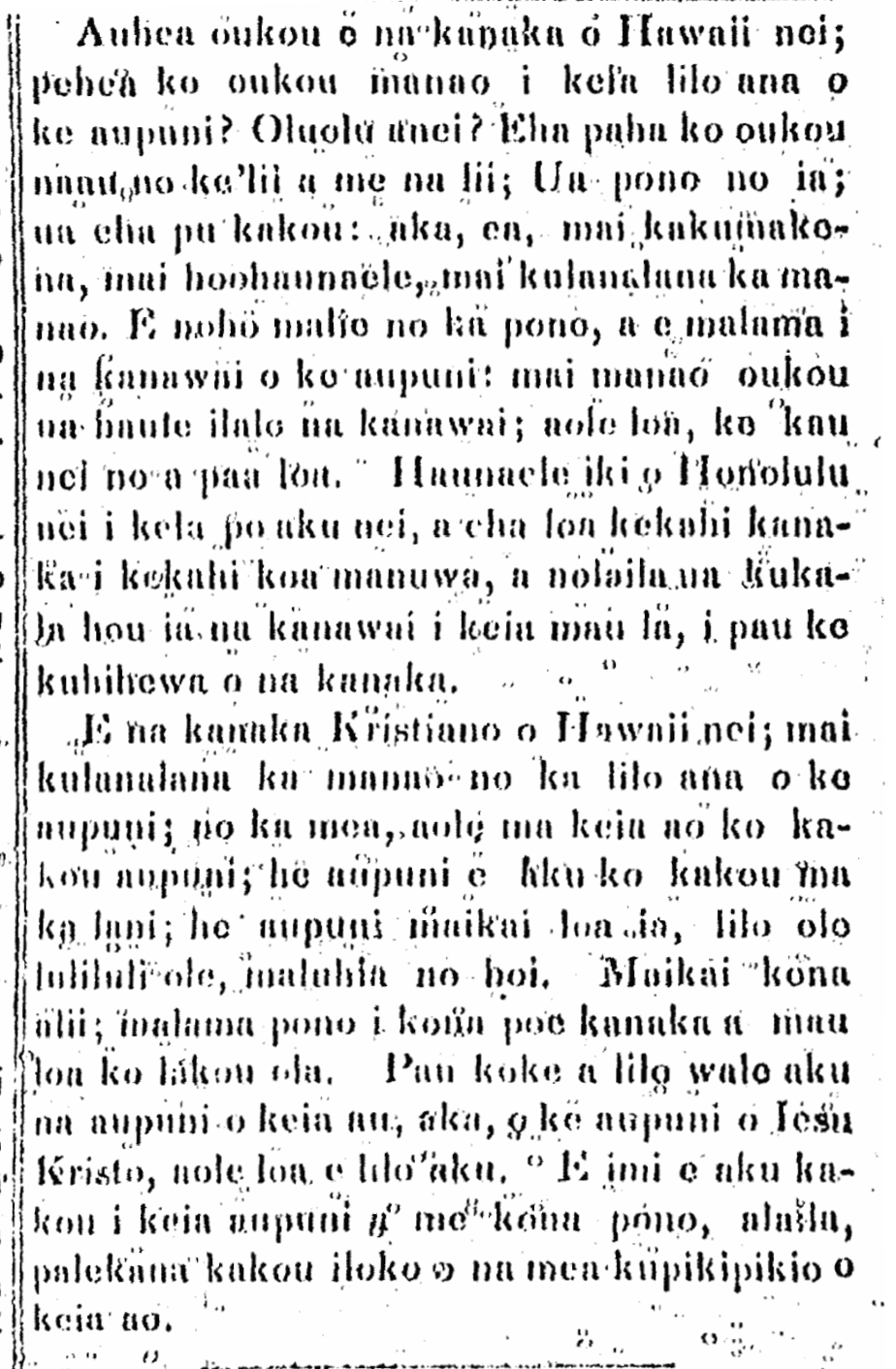
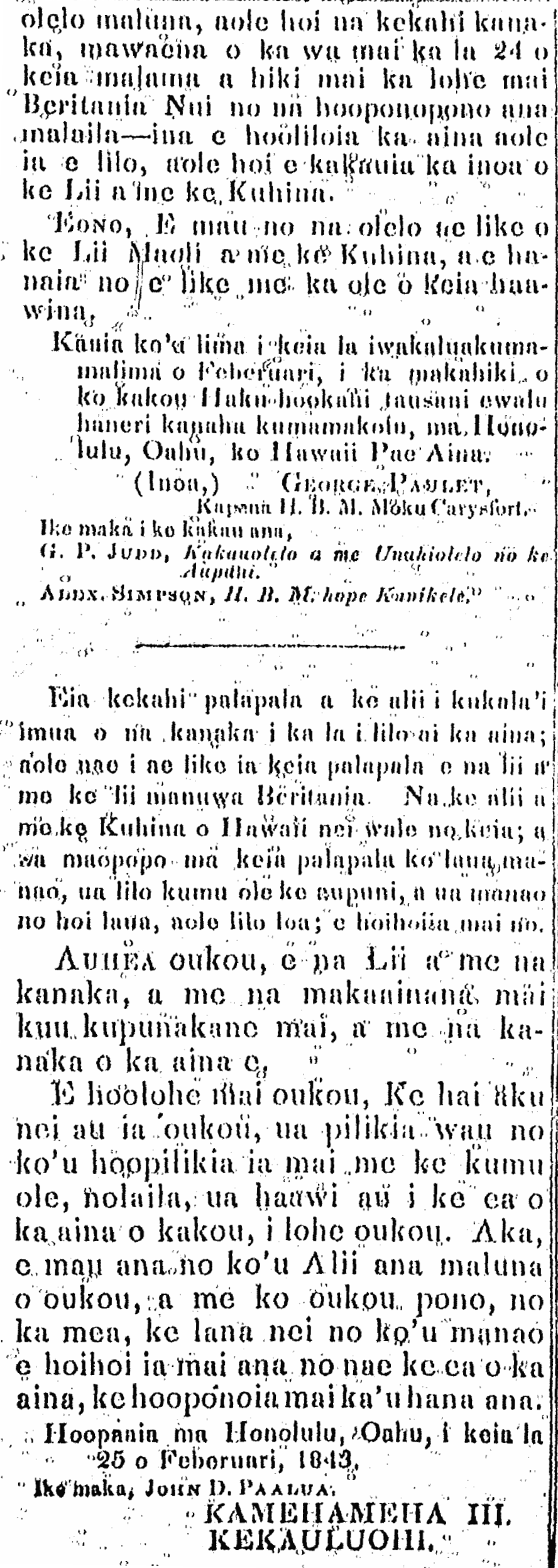
Here me O People of Hawaii nei; what do you all think of this cession of the kingdom? Is it fine? Your heart probably aches for the king and all the alii; That is how it should be; we are all hurting; however, do not grieve, do not revolt, do not let your resolve waver. We must remain calm and abide by the laws; don’t think that the laws have fallen, not at all, they are still totally in effect. There was a small disturbance in Honolulu the other night, and some men severely injured some of the sailors from the warship, and therefore the laws are being announced once again these days, so that the confusion of the people will end.

O Christian people of Hawaii nei, do not feel uncertain over the cession of the nation; our kingdom does not lie in this world, we have a different kingdom in the heavens; it is a great kingdom which is permanent, and unshakeable, and peaceful. Its king is good; he watches over his people, and they live forever. The nations of this world end quickly and are gone forever, but the kingdom of Jesus Christ will never end. Let us search after this kingdom and its righteousness, and we will be saved from the turbulence of this world.

[This editorial is probably by Richard Armstrong (Limaikaika), missionary and editor of Ka Nonanona.]

(Nonanona, 3/7/1843, p. 100)

Auhea oukou e na kanaka o Hawaii nei...

Ka Nonanona, Buke 2, Pepa 20, Aoao 100. Maraki 7, 1843.

Correspondences between Paulet and the Hawaiian Government. 1843.

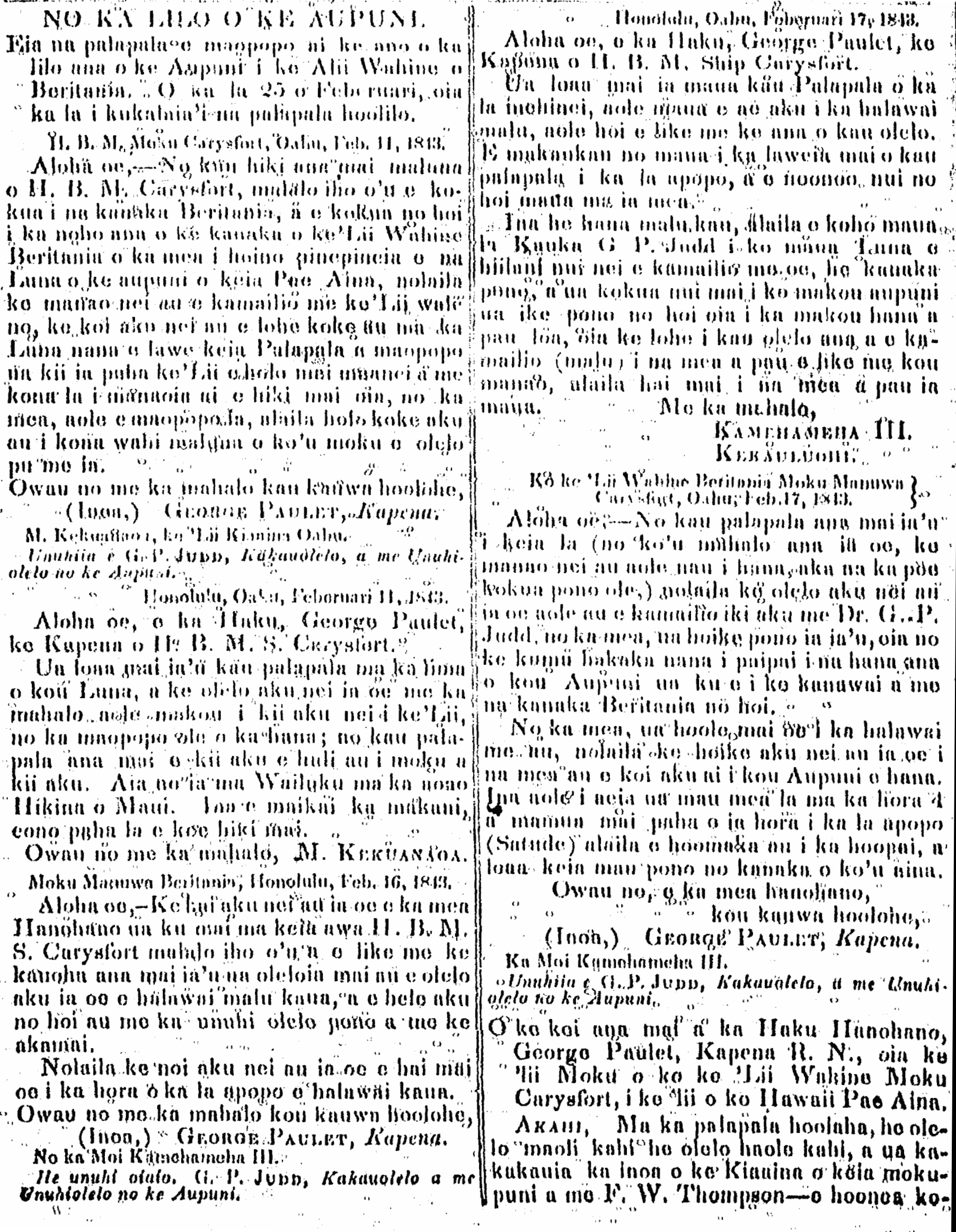
ON THE LOSS OF THE KINGDOM.

Here are the documents illuminating how the Kingdom was lost to the Queen of Britain. The 25th of February was the day the cession was proclaimed.

[See on Google Books: British and Foreign State Papers, starting on page 1023. These correspondences were translated from English into Hawaiian, and from Hawaiian into English by Gerrit Parmele Judd (Kauka), the Secretary and Translator of the Kingdom.]

(Nonanona, 3/7/1843, pp. 97–100.)

NO KA LILO O KE AUPUNI.

Ka Nonanona, Buke 2, Pepa 20, Aoao 97. Maraki 7, 1843.

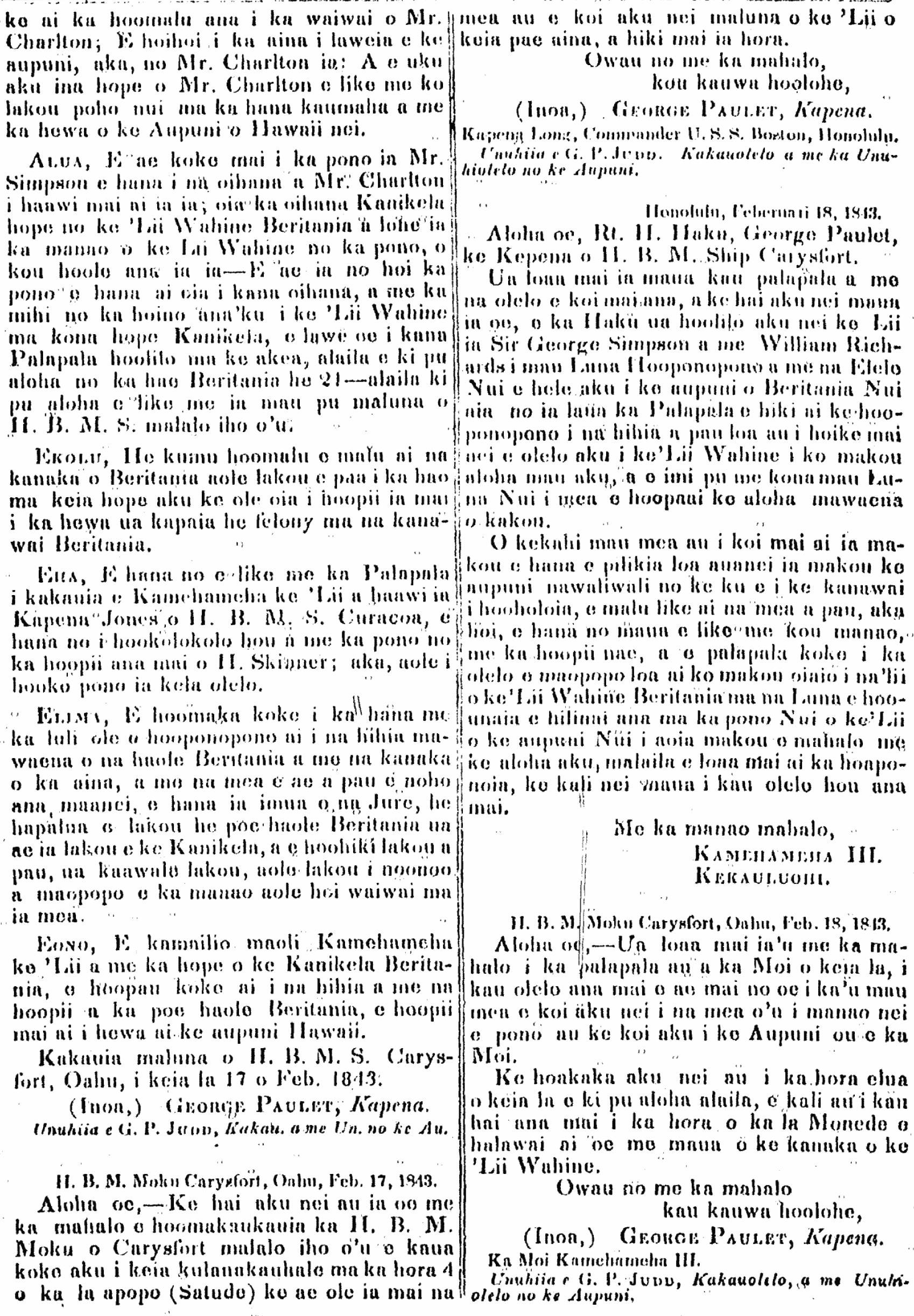
ke ai ka hoomalu ana...

Ka Nonanona, Buke 2, Pepa 20, Aoao 98. Maraki 7, 1843.

Honolulu, Oahu, Feb. 18, 1843.

Ka Nonanona, Buke 2, Pepa 20, Aoao 99. Maraki 7, 1843.

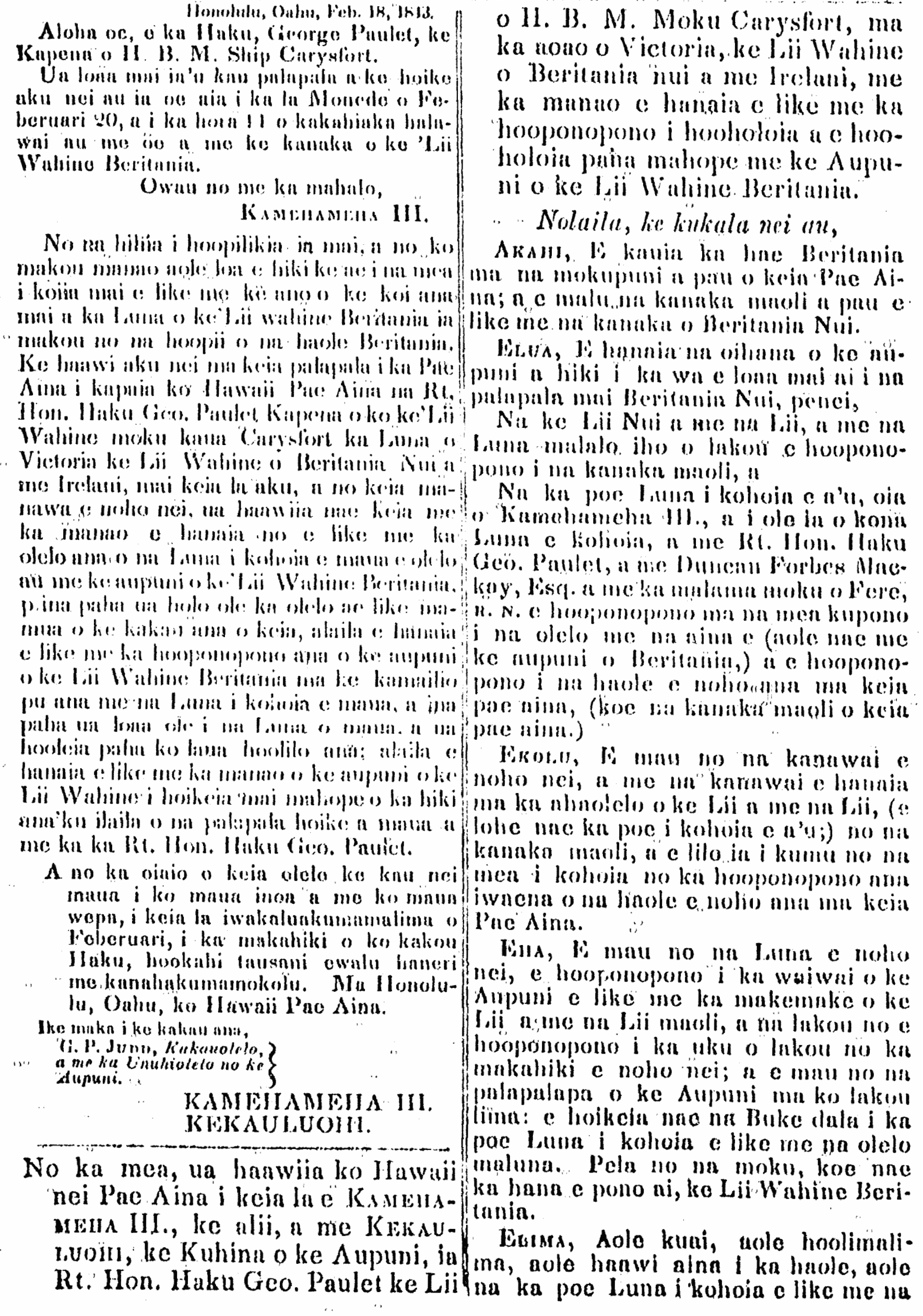
olelo maluna, aole hoi na kekahi kanaka...

Ka Nonanona, Buke 2, Pepa 20, Aoao 100. Maraki 7, 1843.

Paulet arrives. 1843.

WARSHIPS.

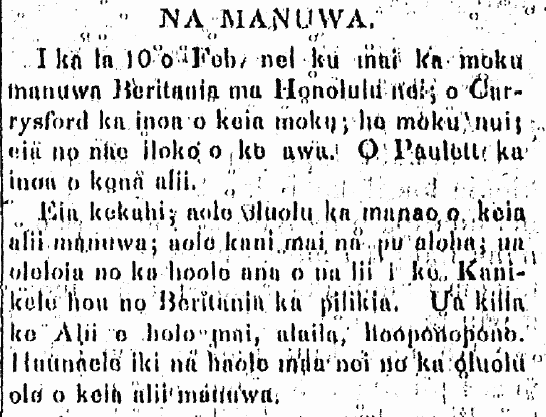
On the 10th of this Feb., the British man-of-war arrived here in Honolulu; the name of the ship is Carysfort; it is a large ship and yet is here in the harbor. Paulet is the name of its captain.

Here is another thing; the captain of this warship is not here with good intent; he did not fire his guns in salute; it is said that the problem is because of the denial of the new British Consul by the king. The King was sent for to come, and then they’d work it out. The haole here are having minor demonstrations in response to the ill will of the warship captain.

(Nonanona, 2/14/1843, p. 96)

NA MANUWA.

Ka Nonanona, Buke 2, Pepa 19, Aoao 96. Feberuari 14, 1843.

La Hoihoi Ea, 1912.

DAY NOT TO BE FORGOTTEN BY TRUE HAWAIIANS.

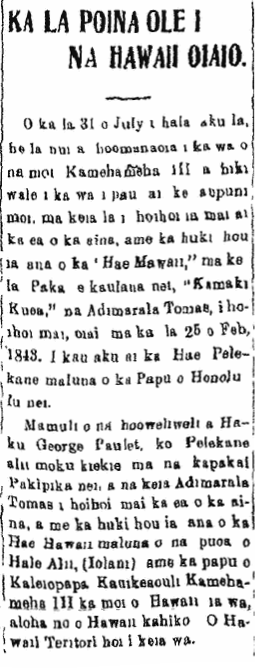
The past 31st of July was a great day celebrated in days of the monarchs, from Kamehameha III all the way until the end of the monarchy; on this day sovereignty was restored and the Hawaiian Flag was raised at that famous park, “Thomas Square,” by Admiral Thomas [Adimarala Tomas], who did the restoration, being that on the 25th of February, 1843, the British Flag was raised over the Fort of Honolulu.

As a result of the threats by Lord George Paulet; Britain’s high officer on the Pacific Ocean, it was Admiral Thomas who restored the sovereignty of the land, and re-raised the Hawaiian Flag on the flag staffs at the Palace (Iolani) and the fort of Kaleiopapa Kauikeaouli Kamehameha III, the king of Hawaii at the time; Aloha to Hawaii of old, which is the Territory of Hawaii now.

(Kuokoa Home Rula, 8/1/1912, p. 1)

KA LA POINA OLE I NA HAWAII OIAIO.

Kuokoa Home Rula, Buke X, Helu 31, Aoao 1. Augate 1, 1912.

Even more from Ka Nonanona, August 8, 1843.

TRAITORS.

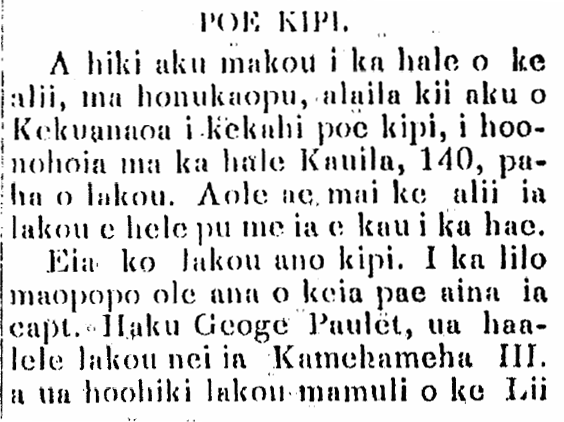
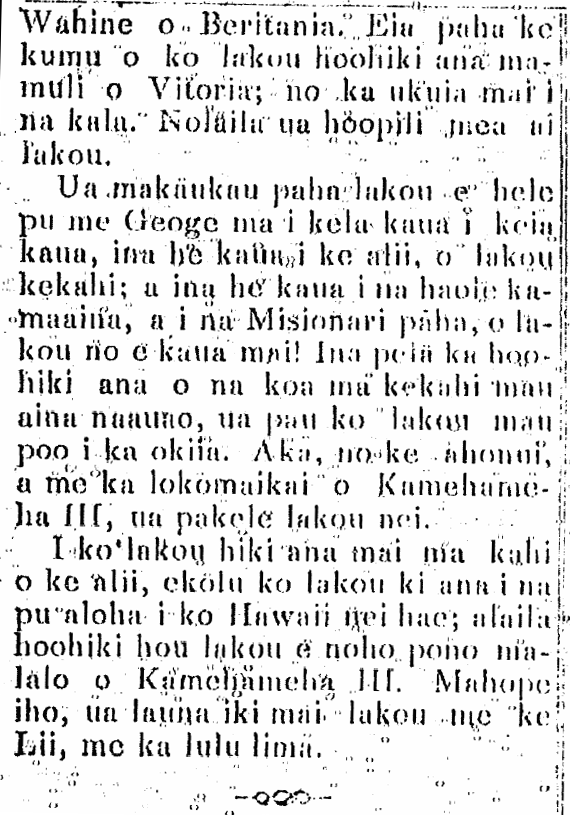
When we reached the residence of the king, at Honukaopu [Honokaupu ?], Kekuanaoa fetched some traitors who were kept at Hale Kauila; perhaps there were 140 of them. The king did not allow them to accompany him to raise the flag.

This is the nature of their treason. When this archipelago was not clearly under Capt. Lord George Paulet, they left Kamehameha III, and they swore allegiance to the Queen of Britain. This is probably the reason they swore allegiance to Victoria; because they were paid money. They therefore curried his favor [hoopilimeaai].

They were probably prepared to go with George to this war and that; if he warred against the king, so too would they; and if he went to war against the local haole or the Missionaries, they would fight as well! If soldiers of enlightened lands took an oath in this fashion, their heads would fall. But because of the patience and goodness of Kamehameha III, they were saved.

When they came in the presence of the king, they gave a three gun salute to Hawaii’s flag; and they swore once again to live obediently beneath Kamehameha III. After that, they spent time with the King, and shook hands.

(Nonanona, 8/8/1843, pp. 25 & 26.)

POE KIPI.

Ka Nonanona, Buke 3, Pepa 6, Aoao 25. Augate 8, 1843.

Wahine o Beritania...

Ka Nonanona, Buke 3, Pepa 6, Aoao 26. Augate 8, 1843.

More from Ka Nonanona, August 8, 1843.

THE RESTORATION OF THE KINGDOM.

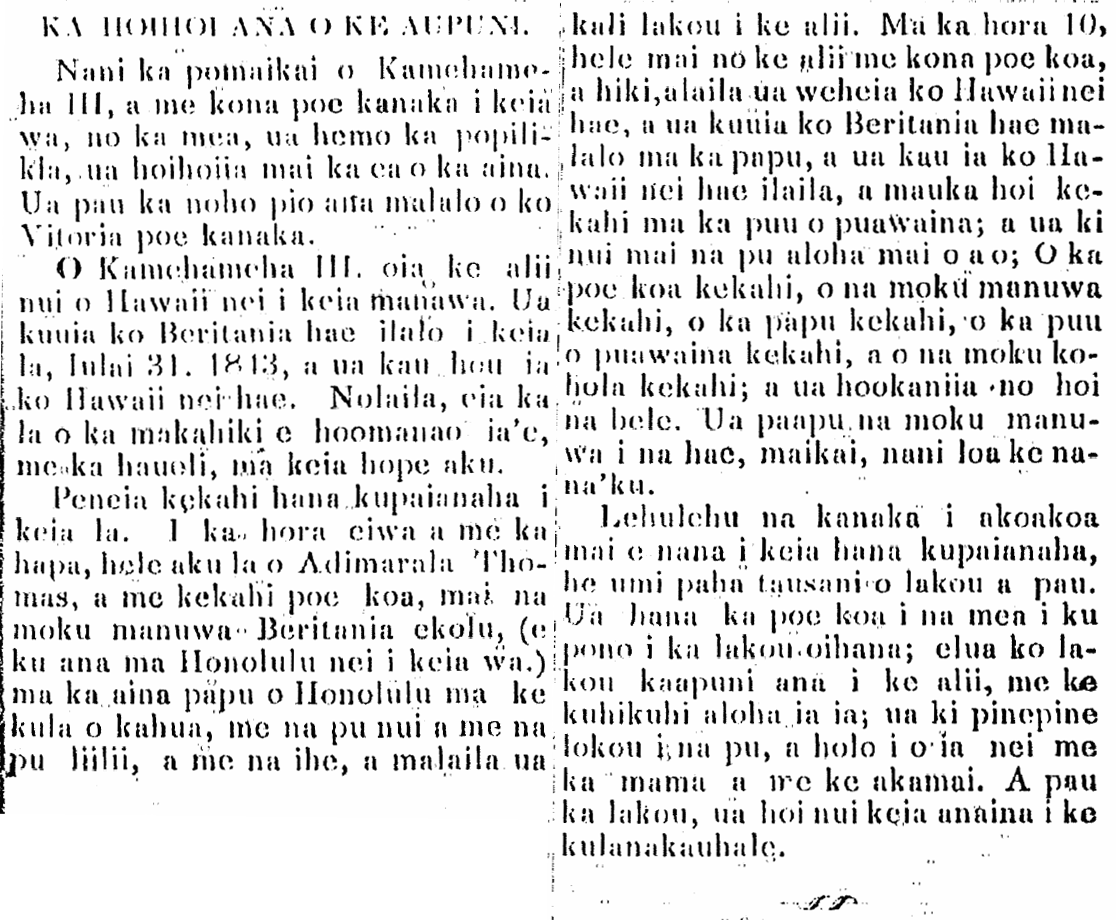
How great are the blessings of Kamehameha III and his subjects now, for the difficulties have subsided and the sovereignty of the land has been restored. No more is the living as subjects under the men of Victoria.

Kamehameha III is now the monarch of Hawaii nei. The British flag has been taken down on this day, July 31, 1843, and Hawaii’s flag has been raised once more. Therefore, this will be the day of the year that will be commemorated with joy from here forth.

Here is an awesome event that happened today. At half past eight, Admiral Thomas went along with some sailors, from the three British ships (anchored at Honolulu now) to the fort of Honolulu at Kulaokahua, with large and small firearms, and spears, and there he awaited the king. At 10 o’clock, the king went with his soldiers, and arrived; the Hawaiian flag was unfurled, the British flag was taken down from the fort, and there the Hawaiian flag was raised, and so too in uplands, on the hill of Puawaina [Punchbowl]; many guns were shot off in salute all over: The soldiers did it, the warships as well, the forts as well, and the hill of Puawaina as well, and the whaling ships as well; and the bells were rung. The warships were festooned with flags; it was a fine and beautiful sight to see.

There were many people gathered to witness this amazing event, perhaps there were ten thousand in total. The soldiers carried out their duties well; they circled the king twice, while saluting him; they shot off their guns many times and marched here and there quickly and smartly. And when they were done, the crowd all returned to town.

(Nonanona, 8/8/1843, p. 25)

KA HOIHOI ANA O KE AUPUNI.

Ka Nonanona, Buke 3, Pepa 6, Aoao 25. Augate 8, 1843.

The first newspaper article printed following July 31, 1843.

BATTLESHIP.

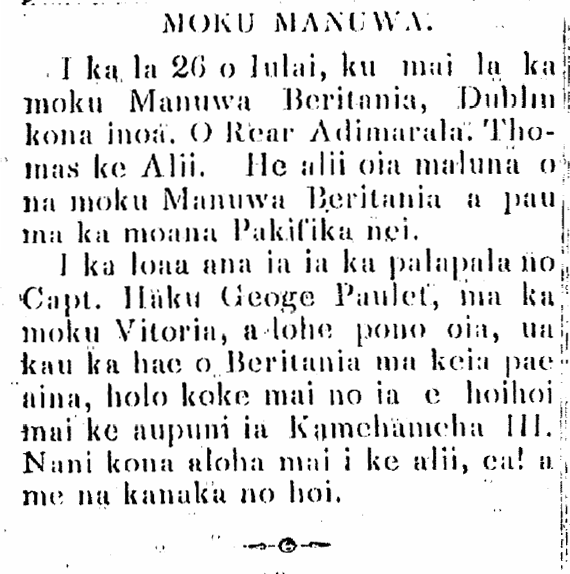
On the 26th of July, the British Warship named Dublin arrived. Rear Admiral Thomas is the Captain. He is the officer in charge of all of the British warships in the Pacific Ocean.

When he received documents pertaining to Capt. Lord George Paulet aboard Victoria’s ship, and he heard clearly that the British flag was raised over these islands, he came quickly to restore the government to Kamehameha III. How fine is his aloha for the king, isn’t it! and for the citizens as well.

(Nonanona, 8/8/1843, p. 25)

MOKU MANUWA.

Ka Nonanona, Buke 3, Pepa 6, Aoao 25. Augate 8, 1843.

And yet more on Aberahama Kaikioewa Palekaluhi, 1912.

THE ALII HAS GONE, A. K. PELEKALUHI KAIKIOEWA KAMEHAMEHANUI

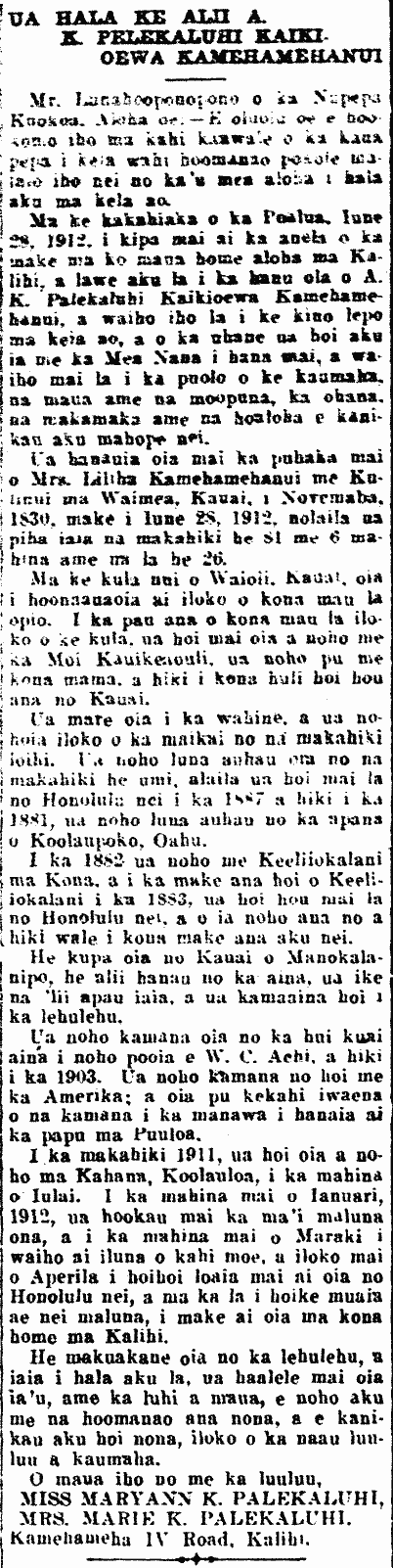
Mr. Editor of the Newspaper Kuokoa. Aloha to you:—Please be so kind as to insert in some open space in our paper, this short remembrance below for my beloved who passed over to that world.

On the morning of Tuesday, June 28 [?], 1912, the angel of death visited our beloved home in Kalihi, and took the living breath of A. K. Palekaluhi Kaikioewa Kamehamehanui, and left his earthly body here in this world, and his soul returned to the One who created it, leaving the bundle of sadness behind for us and the grandchildren, the family, the intimates, and friends to grieve over.

He was born from the loins of Mrs. Liliha Kamehamehanui and Kulinui at Waimea, Kauai, on the 1st of November, 1830, and died on June 28, 1912; therefore, he was 81 years and 6 months, and 26 days old.

He was educated at the college of Waioli, Kauai, in his youth. After his days at that school were over, he returned to live with the King Kauikeaouli; he lived with his mother until he went back to Kauai.

He married his wife, and they lived well for a great many years. He was employed as a tax assessor for ten years and then returned to Honolulu in 1887 [?] until 1881, and was the tax assessor for the district of Koolaupoko, Oahu.

In 1882, he resided with Keelikolani in Kona, and at her death in 1883, he came back to Honolulu and remained there until his recent death.

He was a native of Kauai of Manokalanipo, and a hereditary chief which all the alii knew of and also the general public was familiar with him.

He worked as a carpenter for the real estate company headed by W. C. Achi until 1903. He worked as a carpenter for America, and he was one of the carpenters when the fort at Puuloa was being built.

In 1911, he went back to live at Kahana, Koolauloa, in the month of July. From January 1912, he became ill and in March he was bedridden, and then in April he was brought back to Honolulu, and on the day shown above he died at his home in Kalihi.

He was a father for the multitudes, and with his passing, he leaves me and our child with memories of him, and grieving for him, with a sad and heavy heart.

We with grief,

MISS MARYANN K. PALEKALUHI,

MRS. MARIE K. PALEKALUHI.

Kamehameha IV Road, Kalihi.

(Kuokoa, 7/12/1912, p. 6)

UA HALA KE ALII A. K. PELEKALUHI KAIKIOEWA KAMEHAMEHANUI

Ka Nupepa Kuokoa, Buke XLVIII, Helu 28, Aoao 6. Iulai 12, 1912.

Kamehameha III, Kauikeaouli’s birthday, a little late. 1907.

Day of Remembrance

of the

King Kauikeaouli

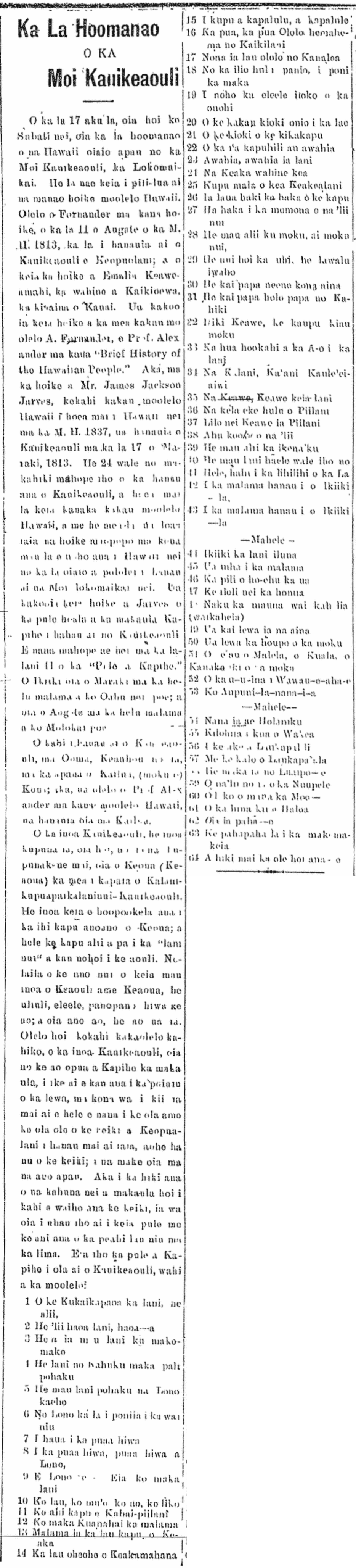
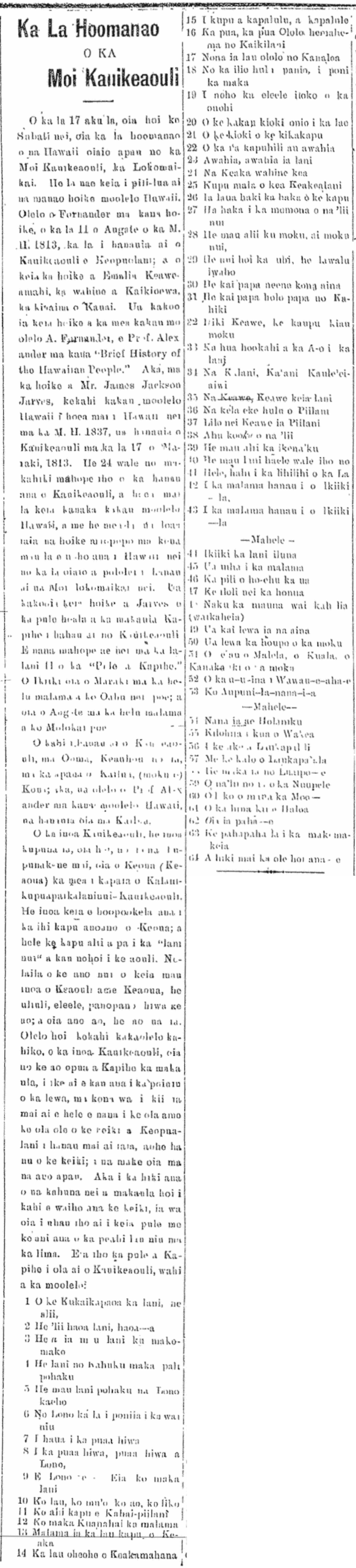
This past 17th, Sunday, was the day of remembrance for all true Hawaiians, of the King Kauikeaouli, the Benevolent one. There are two different historical accounts of this day. Fornander states in his account that Kauikeaouli was born of Keopuolani on 11 August 1813, and that this information was from Emalia Keaweamahi, the wahine of Kaikioewa, the governor of Kauai. This date of A. Fornander is supported by Prof. Alexander in his “Brief History of the Hawaiian People.” However, in the account of Mr. James Jackson Jarves, a scholar of Hawaiian history who arrived here in Hawaii nei in 1837, Kauikeaouli was born on 17 March 1813. This historian arrived here but 24 years after the birth of Kauikeaouli, and it would seem that he obtained clear information about the true birth date of the Benevolent King, while he was living here. This statement by Jarves is supported by the reviving prayer that Kapihe offered for Kauikeaouli. Look below at line 11 [42?] in the “Pule a Kapihe.” Ikiiki is the month of March according to the reckoning of Oahu people, and according to Molokai people it is August.

Kauikeaouli was born at Ooma, Keauhou, in Kailua, in the moku of Kona. However, Prof. Alexander, in his history of Hawaii, says Kauikeaouli was born in Kailua.

The name Kauikeaouli is a name from his ancestors, that being the name of his grandfather, Keoua (Keaoua), the one called Kalanikupuapaikalaninui Kauikeaouli. This name puts on high the sacred kapu of Keoua–his chiefly kapu extends above and touches the great heavens, and rests upon the dark clouds. So therefore, the importance of the names Keaouli and Keaoua, is the dark, black, thick, esteemed cloud. This cloud is a rain cloud. A Orator of the old times said that the name Kauikeaouli is the bank of clouds that Kapihe, the prophet, saw spread high in the heavens when he was called to go to see if the child that Keopualani gave birth to was alive or not alive. He was not breathing and was totally lifeless. However, when this kahuna and prophet arrived to where the child was placed, he offered this prayer while waving a coconut frond in his hand. This is the prayer by which Kapihe made Kauikeaouli live, according to the story:

1 O ke Kukaikapaoa ka lani, ae alii,

2 He ‘lii haoa lani, haoa—a

3 He a ia m u lani ku makomako

4 He lani no Kahuku maka pali pohaku

5 He mau lani pohaku na Lono kaeho

6 No Lono ka la i poniia i ka wai niu

7 I haua i ka puaa hiwa

8 I ka puaa hiwa, puaa hiwa a Lono,

9 E Lono—e. Eia ko maka lani

10 Ko lau, ko mu’o, ko ao, ko liko

11 Ko alii kapu e Kahai-piilani

12 Ko maka Kuanahai ka malama

13 Malama ia ka lau kapu o Keaka

14 Ka lau oheohe o Keakamahana

15 I kupu a kapalulu, a kapalule

16 Ka pua, ka pua Ololo hemahema no Kaikilani

17 Nona ia lau ololo no Kanaloa

18 No ka ilio hulu panio, i poni ka maka

19 I noho ka eleele iloko o ka onohi

20 O ke kakau kioki onio i ka lae

21 O ke kioki o ke kikakapu

22 O ka i’a kapuhili au awahia

23 Awahia, awahia ia lani

24 Na Keaka wahine kea

25 Kupu mala o kea Keakealani

26 Ia laua haki ka haka o ke kapu

27 He haka i ka momona o na ‘lii nui

28 He mau alii ku moku, ai moku nui,

29 He nui hoi ka uhi, ka lawalu iwaho

30 He kai papa neenekona aina

31 He kai papa holo papa no Kahiki

32 I iki Keawe, ke kaupu kiau moku

33 Ka hua hookahi a ka A-o i ka lani

34 Na Kalani Ka’ani Kauleleiaiwi

35 Na Keawe, Keawe keia lani

36 Na kela eke hulu o Piilani

37 Lilo nei Keawe ia Piilani

38 Ahu kooka o na ‘lii

39 He mau alii ka ikena ‘ku

40 He mau lani haele wale iho no

41 Hele, hahi i ka lihilihi o ka La

42 I ka malama hanau i o Ikiiki—la

43 I ka malama hanau i o Ikiiki—la

—Mahele—

44 Ikiiki ka lani iluna

45 Ua uiha i ka malama

46 Ka pili o ho-ehu ka ua

47 Ke iloli nei ka honua

48 Naku ka mauna wai kali lia (waikaheia)

49 Ua kai lewa ia na aina

50 Ua lewa ka houpo o ka moku

51 O e au o Malela, o Kuala, o Kanaka ki o a moku

52 O ka u-u-ina i Wawau-e-aha-o

53 Ko Aupuni-la-nana-i-a

—Mahele—

54 Nana ia ae Holaniku

55 Kilohiia i kua o Wakea

56 I ke ake a Laukapalili

57 Me ke kalo o Laukapalala

58 He maka ia no Luaipo—e

59 O na ‘lii no ia o ka Nuupele

60 O I ko o maua ka Moo—

61 O ka hina kai o Haloa

62 Oia ia paha—e

63 Ke pahapaha la i ka makemakeia

64 A hiki mai ka ole hoi ana—e

[Amazingly, this is the only issue of this entire year that seems to have survived! If this newspaper could be reshot nicely, we could get a clear/clearer reading of this important mele!

And I put up the mele as is (although the image is not clear in some areas, so there are some questionable lines), so that words and phrases will be searchable on this blog or on google right now, instead of having to wait for some time in the future…]

(Kuokoa Home Rula, 3/22/1907, p. 4)
Ka La Hoomanao O KA Moi Kauikeaouli

Kuokoa Home Rula, Buke V, Helu 12, Aoao 4. Maraki 22, 1907.
Personal Lands of Kamehameha III, and Government Lands, 1848.

By the Government.

A LAW FOR THE PERSONAL LANDS OF THE KING,
AND THE LANDS OF THE NATION.

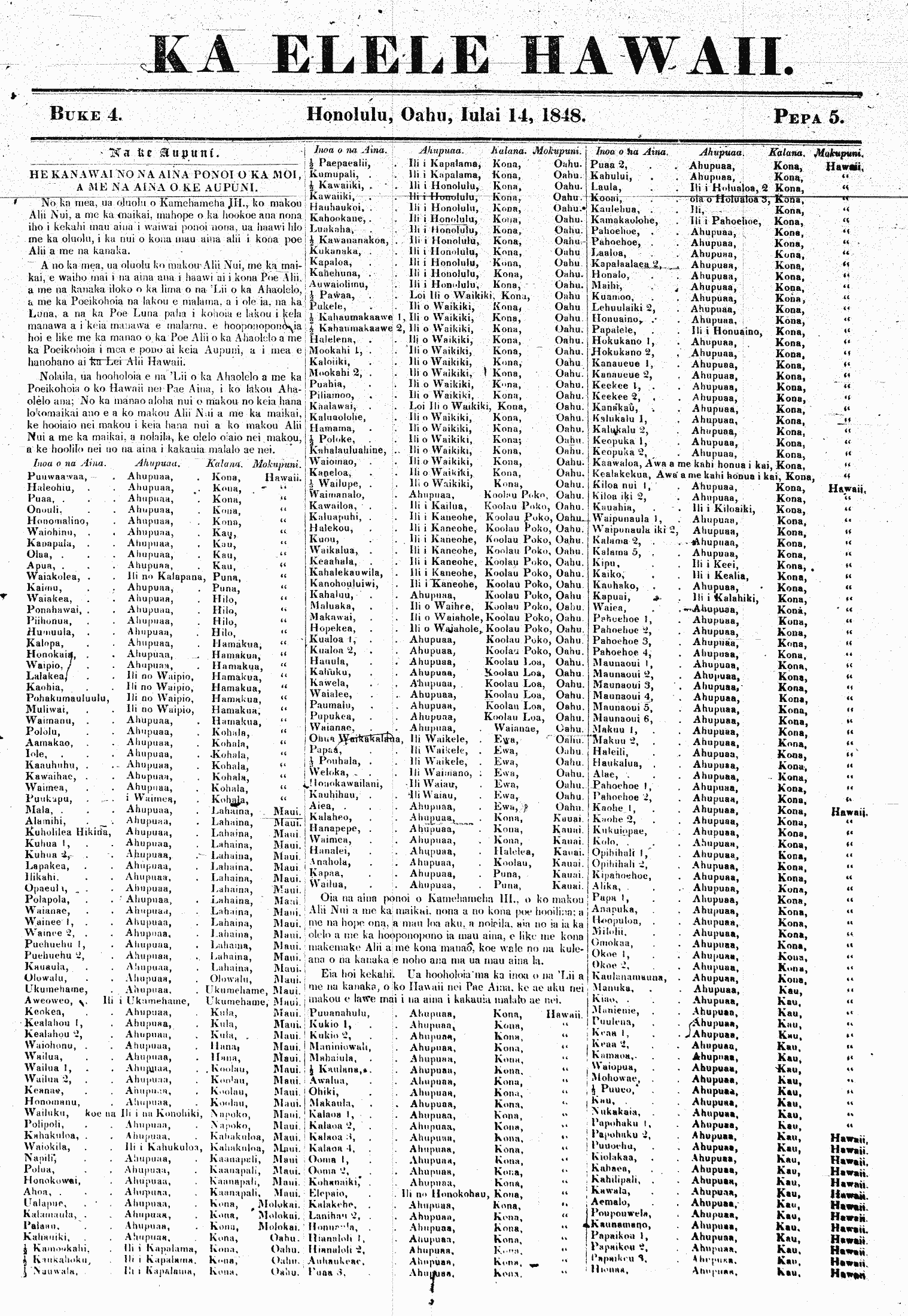
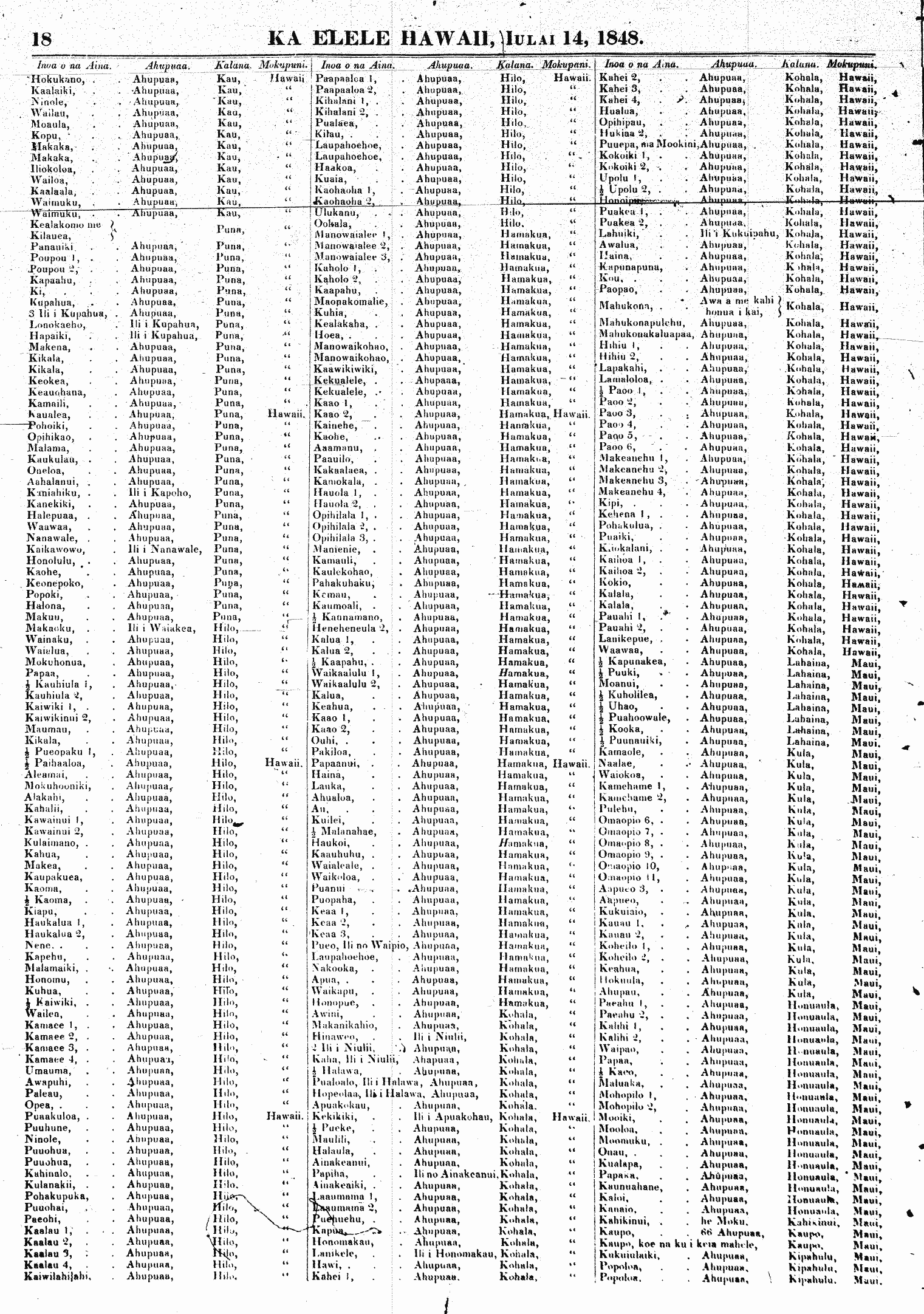
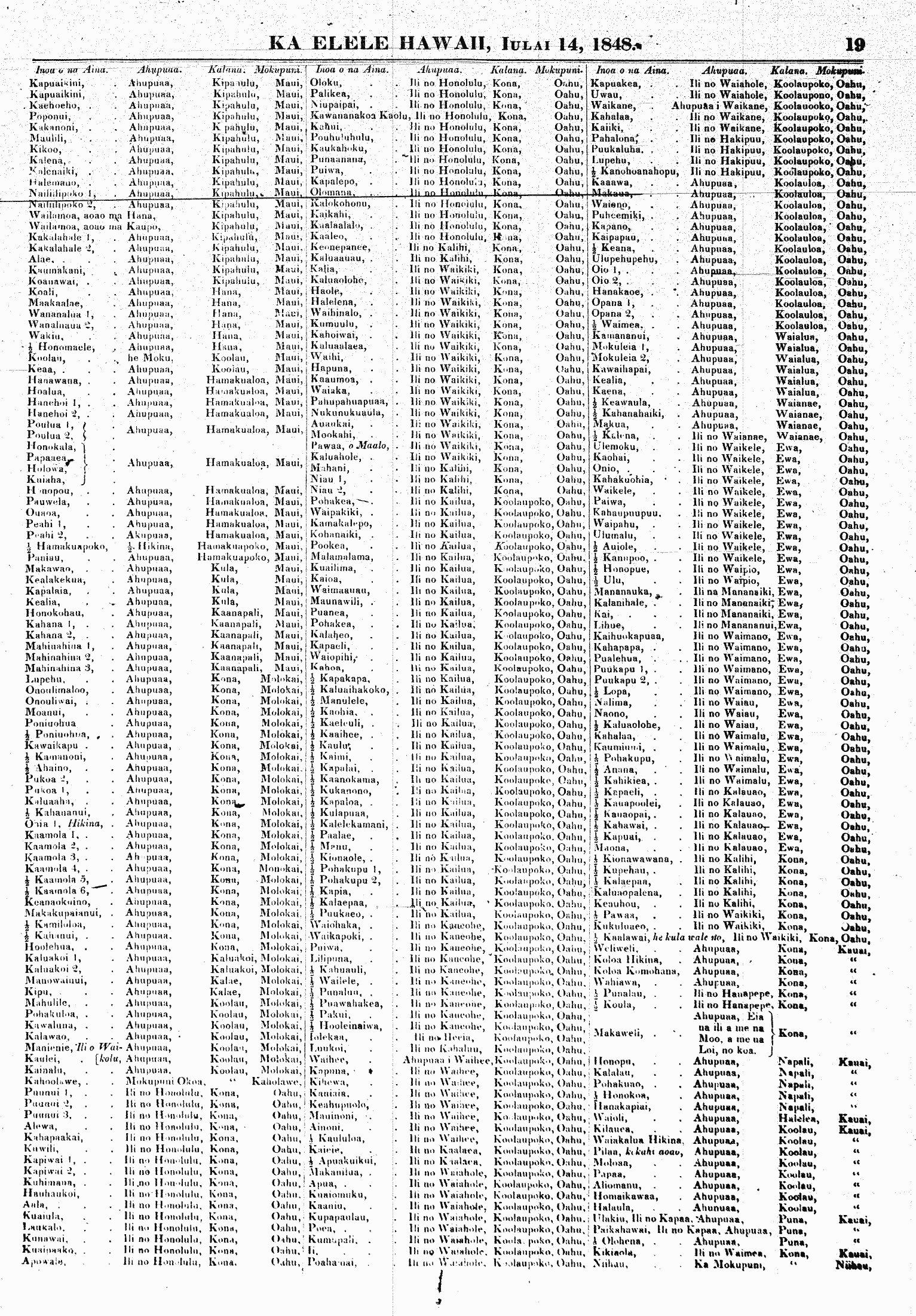
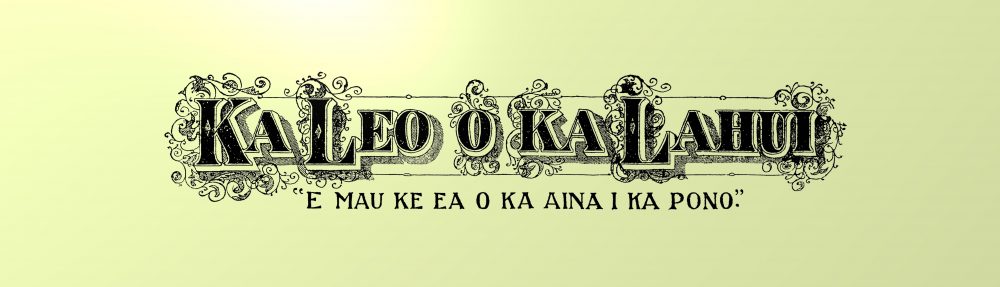
[Here is a newly passed law of the land appearing in the newspaper Elele Hawaii. One of the functions of the newspapers was to inform the nation’s citizens of new laws and proclamations from the government. This particular law establishes the Crown Lands (and Government Lands) which still holds much importance to this day.

For a translation see “A Supplement to the Statute Laws of His Majesty, Kamehameha III., King of the Hawaiian Islands, … 1848.” pp. 22–43.

What is also valuable about this listing is that it describes in 1848 what ahupuaa a certain land belonged to, and so forth.]

(Elele Hawaii, 7/14/1848, pp. 17–20.)

HE KANAWAI NO NA AINA PONOI O KA MOI, A ME NA AINA O KE AUPUNI.

Ka Elele Hawaii, Buke 4, Pepa 5, Aoao 17. Iulai 14, 1848.


HE KANAWAI NO NA AINA PONOI O KA MOI, A ME NA AINA O KE AUPUNI.

Ka Elele Hawaii, Buke 4, Pepa 5, Aoao 18. Iulai 14, 1848.

HE KANAWAI NO NA AINA PONOI O KA MOI, A ME NA AINA O KE AUPUNI.

Ka Elele Hawaii, Buke 4, Pepa 5, Aoao 19. Iulai 14, 1848.

HE KANAWAI NO NA AINA PONOI O KA MOI, A ME NA AINA O KE AUPUNI.

Ka Elele Hawaii, Buke 4, Pepa 5, Aoao 20. Iulai 14, 1848.