“Kaua i ka Nani o Hilo” and finding things where you might not expect. 1895.

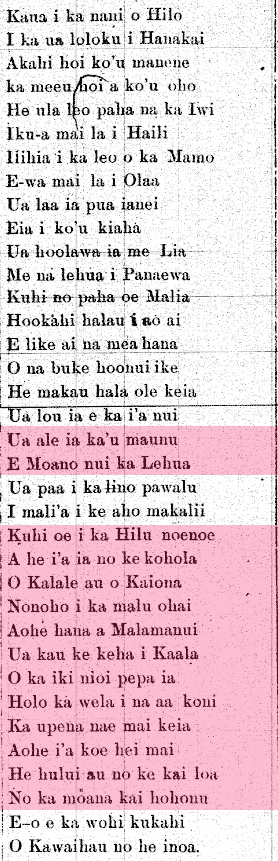
“Kaua i ka Nani o Hilo”

[This mele for Kalakaua is taken from an article entitled “OWAI LA O J. L. KUKAHI, KA IHEPA NUI O KA WAA PAE E PEE NEI?”, which is a scathing criticism by D. M. Punini, Jr. over an ongoing argument concerning the naming of Hawaiian traditional months. But here, I wanted to show once again, that you never know what you will find and where.

The version of “Kaua i ka Nani o Hilo” most widely known today is probably the one from the Roberts Collection at the Bishop Museum, which is quoted here. The Museum’s Mele Index can be searched online here. But notice that the Punini version has additional verses (highlighted in red).

Also note that “Kawaihau” is one of the names for Kalakaua.]

Kaua i ka nani o Hilo

I ka ua loloku i Hanakahi

Akahi hoi ko’u manene

ka meeu hoi a ko’u oho

He ula leo paha na ka Iwi

Iku-a mai la i Haili

Ilihia i ka leo o ka Mamo

E-wa mai la i Olaa

Ua laa ia pua ianei

Eia i ko’u kiaha

Ua hoolawa ia me Lia

Me na lehua i Panaewa

Kuhi no paha oe Malia

Hookahi halau i ao ai

E like ai na mea hana

O na buke hoonui ike

He makau hala ole keia

Ua lou ia e ka i’a nui

Ua ale ia ka’u maunu

E Moano nui ka Lehua

Ua paa i ka lino pawalu

I mali’a i ke aho makalii

Kuhi oe i ka Hilu noenoe

A he i’a ia no ke kohola

O Kalale au o Kaiona

Nonoho i ka malu ohai

Aohe hana a Malamanui

Ua kau ke keha i Kaala

O ka iki nioi pepa ia

Holo ka wela i na aa koni

Ka upena nae mai keia

Aohe i’a koe hei mai

He hului au no ke kai loa

No ka moana kai hohonu

E—o e ka wohi kukahi

O Kawaihau no he inoa.

(Leo o ka Lahui, 4/2/1895, p. 3)

OWAI LA O J. L. KUKAHI, KA IHEPA NUI O KA WAA PAE E PEE NEI?

Ka Leo o ka Lahui, Buke II, Helu 1078, Aoao 3. Aperila 2, 1895.

Hawaiian Ethnological Notes, Bishop Museum.

This is a priceless resource left to us mainly by Mary Kawena Pukui. There are translations (in all stages) of all kinds of material. For more information on the body as well as online search access, see below. (Note that not all of the HEN is listed online.):

http://data.bishopmuseum.org/HEN/index.php

The reason I am bringing this up now is because one of the translations in the collection is of those Moanalua articles! So for a much better translation of the previous article as well as the whole series, check it out at the Museum. Its is available under the call number: HEN Newspapers, 2/17/1922 – 8/31/1922.

One more thing. Although that Moanalua series translation (and those like it) found in HEN does not appear in any publication as a whole, information extracted from it appears in a great number of publications we are all most likely familiar with!

Aina and description in the Hawaiian-Language Newspapers.

There are so many descriptions of land (along with things related to it, like kamaaina who reside there, its wind/rain names, famous stories of the area, etc.) in the Hawaiian-Language Newspapers. They appear in all types of articles: from travelogues (like Thomas K. Maunupau’s “Huakai Makaikai a Kaupo, Maui”), to church meeting descriptions (it seems as if there was a church meeting going on at all times of the year somewhere), to pieces done specifically about a certain place (like the Moanalua one just shown), to random articles not focused on the place but that just happen to mention important information found nowhere else. And something else that is remarkable is that there are descriptions of places through the years, so you can see how they change over time…

All this is in the papers. Once all of the pages of newspaper are shot clearly and word-searchable, so so many awesome things will come to the light of day once more.

Speaking of place, check out the new series “Wahi Ko’iko’i” on Oiwi TV! The story of Queen Emma’s circuit of the islands and her riding horseback up to Waiau is documented beautifully in the newspapers!

Perhaps even the Hawaii Tourism Authority might consider the importance of the Hawaiian-Language Newspapers and all the benefits they could enjoy if all of the information contained in them were easily accessed!

Moanalua, then and now, 1922.

MOANALUA PAST AND MOANALUA PRESENT.

(Written by J. K. Mokumaia)

(Continued)

[This is from a serial column on stories about Moanalua. At the close of the previous installment, Mokumaia is speaking about Waiapuka and evidence of a large population…]

So too a well-built rock platform, it is like a heiau; and so too a huge cave large enough for a hundred people to live; and so too perhaps a small cave enough for a single person to live as a lookout, looking out at Moanalua, where the oncoming enemies would be plain in sight.

In my estimation, its height above sea level is 500 and a half feet, and this valley was an important one to the people, and was called Kamanaiki, and there is the famous hill Puukapu.

It is said that this was a place where the alii and people got together to discuss an important problem, and it will be be clear through your writer, those things integrally related to this hill and why it is famous; being that this hill is very close to where passing travellers were waylaid at night.

Therefore, dear readers of my fond Kilohana (a frequently used appellation for the newspaper Kuokoa, coming from its subtitle “Ke Kilohana Pookela no ka Lahui Hawaii” [The Greatest Prize of the Hawaiian Nation]), I am taking this little entertainment back to the time when Kaleiluhiole was ruling as konohiki, where this story gets its basis.

Kaleiluhiole’s total area of management went all the way to Makua, Waianae and back, when he made his tour, he would start at Moanalua and take a respite at Makua, staying there for some anahulu (a period of 10 days), and then turn back; going along on these tours were his workers as well as those who entertained on the trips so that everyone amongst his travelling companions was filled with the constant promise of merriment.

When the konohiki stayed there, items from the seaside were prepared by the natives, and so too the fruits of the land; being that his word had power, it was necessary to prepare all these things; and the important man during those times as heard by your writer was the one called Kihikihi; this gentleman was lame, but his  mind however was filled with all sorts of ideas that benefited him.

He owned a number of schooners, and from amongst his servants, there is one still alive in Waianae, that being Mr. Hui; they went around with the father of your writer, being that my father was a captain of the vessels belonging to Kihikihi, who was also the grandfather of your writer.

The basis for this discussion was that when the Konohiki stayed in Makua it was a regular thing that entertainment was provided for him; and from amongst these entertainments, was a hula troupe headed by Mahoe; this hula leader was from Kauai,  and when he was joined by the beauty of Makua, that hula performance of his—the hips of that hula leader were pressed by that beauty of Makua; quiet your breathing at the whispering seas of that land, as your eyes will  grow dizzy watching [?].

My father was also one who belonged to this hula troupe, and when the konohiki made his return, until reaching his usual lands, that being Moanalua, it was customary for him, were it extremely long, for everyone to be filled with happiness, and this happiness was what was witnessed when that hula troupe was joined by Moanalua’s, which was headed by Keoni Paakaula, and hula students got together, and thus appeared your writer; from what is known, this travelling was the foundation from which a brought forth its garden and came the year spoken previously of by the writer, when thought first came to him.

Looking at how the konohiki and people lived, it was quite fun; this was a land of people and food aplenty.

(To be continued.)

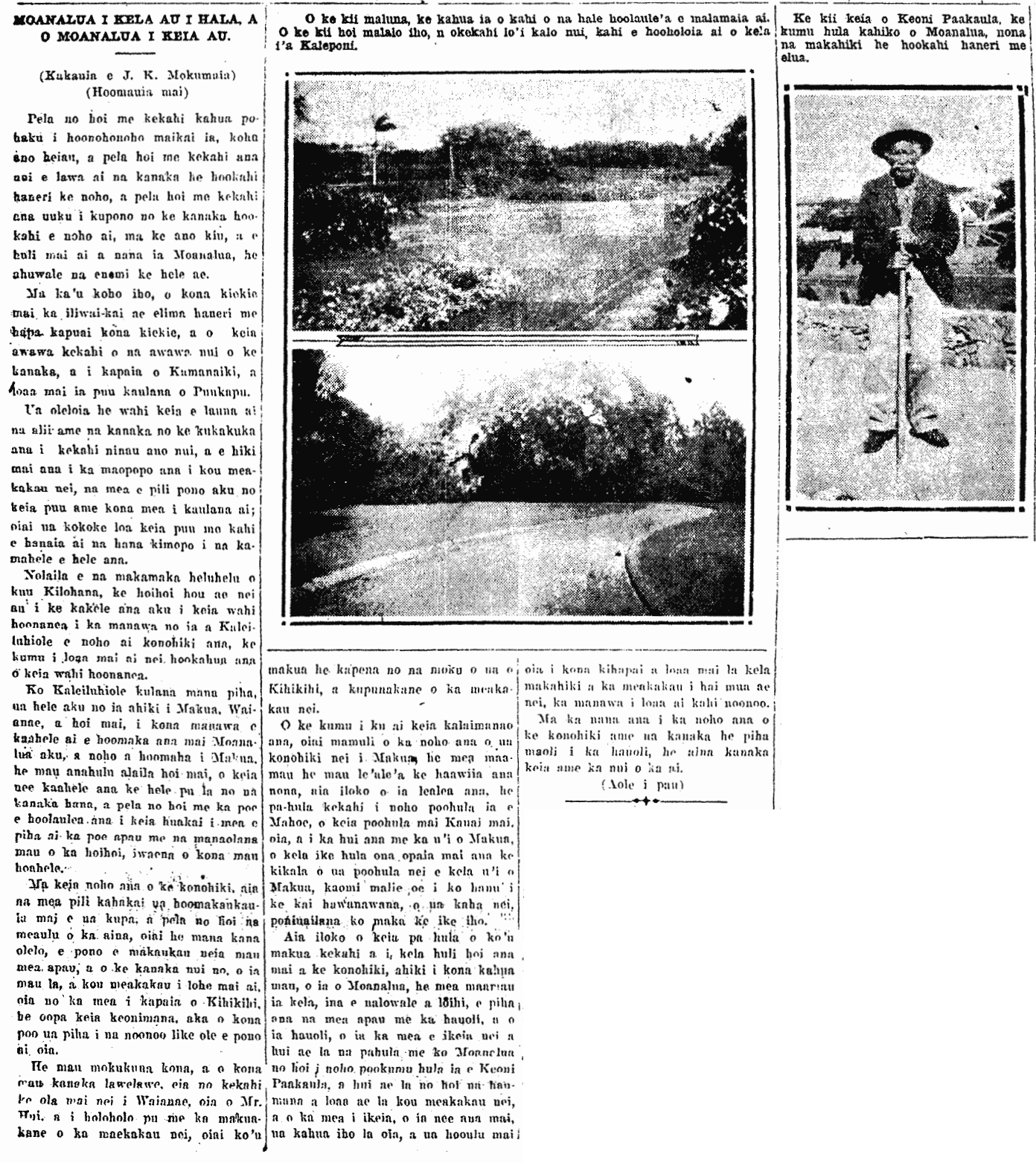
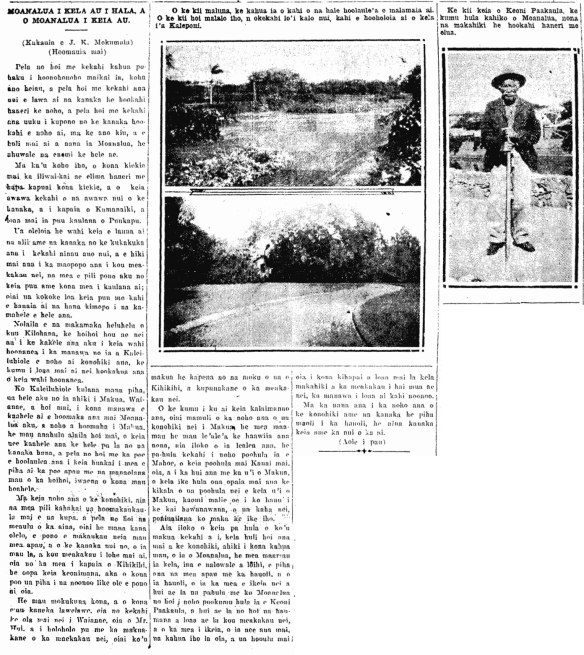
The picture above is the grounds on which was the structure where festivities were held. The picture below is of a great taro patch where the fish from California [i’a Kaleponi?] was set loose.

This is a picture of Keoni Paakaula, the old kumu hula of Moanalua, who is 102 years old.

[This serial by J. K. Mokumaia begins on 2/17/1922 and might end on 8/31/1922 (although there is indication that it is not completed).]

(Kuokoa, 3/10/1922, p. 6)
MOANALUA I KELA AU I HALA, A O MOANALUA I KEIA AU.

Ka Nupepa Kuokoa, Buke LXI, Helu 10, Aoao 6. Maraki 10, 1922.

Bishop Museum Library and Archives accessible by appointment only, 2012.

From the museum website:

“In alignment with Bishop Museum’s new strategic plan, the Library and Archives collections have been identified as an area of priority in the effort to develop increased access to Museum resources for our community. Effective March 1, 2012, the Library and Archives will temporarily suspend public reference hours and provide limited, by-appointment access to its collections. This temporary closure will allow staff the necessary time to support a museum and community effort to plan and implement a new model of operation for this area. ”

see: http://www.bishopmuseum.org/research/library/libarch.html

Hawaiian-Language Newspapers and the past and the future, 1906.

The History of Your Native Land.

As we contemplate the main reason for the falling far behind of the Hawaiian people in matters dealing with the history of their homeland, their lahui, and the alii of the land, we are all racked with intense pain at the haphazard and total lack of knowledge in this terribly important study; and it would not be wrong for us to say that it should be one of the first subjects that should be taught to the students at schools of higher education across the world; and it is said by the Orators that being knowledgeable in the History of your Motherland is the first step in Politics where you’d be able to fight for the good of the Rule of the Nation.

And understanding the histories of all Nations is what will prepare you to fight intelligently on legal grounds for the benefit of your lahui. In the teachings of the Great Book, in Jeremiah 6:16, Jehovah says to us:

“Stand ye in the ways and see and ask for the old paths. Where is the good way?”

O Lahui, how will we be able to ask of the right way if we do not know the old history of our Beloved Aina?

This lack of knowledge of the history of this people comes from not consistently reading the Hawaiian newspapers. Something frequently seen is one person buying a paper and reading it before his friends. They hear it but they don’t retain it like one who subscribes to the paper, who can re-read it at his leisure and thus commit to memory the information.

Learn from this instruction, and do as the haole, who buys his very own newspapers to educate himself in current events.

[The Hawaiian-Language Newspapers is a massive history book—a history on the most part told by Hawaiians living while the “history” was happening. As it was argued more than a hundred years ago, in order to fight for things like Sovereignty, Land, and Water, shouldn’t we know the history as told by Hawaiians? Perhaps we shouldn’t focus solely on what is written down in law books, but also on what Hawaiians actually said and did about these laws, about water rights, about land ownership, about fishing bans, etc., etc. etc.?

For sure this is no easy task. The original newspapers aren’t going to last forever. The current images for many of them are not totally clear (if there are images at all). They need to be word-searchable so that if you search for something, you will find it. There needs to be more people doing translations of them. But then again, Kamehameha Paiea didn’t exclaim, “Forward my younger brothers and drink of the sweet waters”…]

(Na’i Aupuni, 1/17/1906, p. 2)

Ka Moolelo o Kou Aina Oiwi.

Ka Na'i Aupuni, Buke I, Helu 44, Aoao 2. Ianuari 17, 1906.

Another death announcement for John Kaaeae, 1912.

A CARRIER OF TEARS,
MY HUSBAND IS GONE.

[Here is another death announcement for John Kaaeae, but this one is written by his wife. There is added biographical information in the prose as well as the mele.

From the prose portion we see that John Kaaeae died at 6 a. m. He was a member of the Kalihi Church [Ekalesia o Kalihi?]. He belonged to the organizations, Hui Alumni [?] and Hui Lunalilo. Here it says he was born on July 13, 1877. They were married on August 15, 1896…

The mele seems like a chronology of their lives together.]

My husband in the calm of Kihalani

Where we were together

There we were joined

In the sacred covenant of marriage

My husband at the bow of the ship

My husband on the Alenuihaha Channel

My husband at the shores of Lahaina

Beloved is the home of the parents

Turned back to the calm of Kona

My kane on the Alenuihaha Channel

My kane on the sands of Kailua

Aloha to that sand upon which my kane travelled

Left Kona

Turned back to Honolulu

On the restless prow of the steamship Maunaloa

Beloved are those seas

My husband employed as a stevedore at the docks

My husband working a pickaxe for the Government

Became a delegate to choose a candidate

For the Republican party

My kane, a voting inspector

For three terms

&c., &c., &c.

(Aloha Aina, 2/17/1912, p. 4)

HE UKANA NA KA WAIMAKA, KUU KANE UA HALA.

Ke Aloha Aina, Buke XVI, Helu 7, Aoao 4. Feberuari 17, 1912.

John K. Kaaeae passes away, 1912.

JOHN K. KAAEAE PASSED AWAY.

My dear Kuokoa, Aloha oe:—Please announce to the public of the passing from this life of my dear younger brother, John K. Kaaeae, on the 31st of this past month, January.

He died of tuberculosis, at his sister’s place, and glided off alone on that path of no return, auwe! aloha to our younger sibling who left us.

He was educated at the Chiefs’ Children’s School at Kahehuna, and was employed at the post office in Honolulu; and it was his illness which took him away from his work and family for all times.

His place of birth was Haukoi, Hamakua, and he came forth from the loins of his parents, T. K. Kaaeae and Nawahinelua, on the 13th of March, 1873. He survived by a wife and three sisters, who are in grief and mourning for him.

With sincerity,

Jason Matoon.

[The Vital Statistics columns are not the only place where information about deaths (and births and marriages) appear. There are often entire articles or letters to the editor announcing a single death, birth, or marriage, with greater detail than what usually appears in the vital statistics column!]

(Kuokoa, 2/16/1912, p. 8)

O JOHN K. KAAEAE UA HALA.

Ka Nupepa Kuokoa, Buke XLVIII, Helu 7, Aoao 8. Feberuari 16, 1912.

Vital Statistics. 1912.

MARRIAGES.

Nelson Spencer to Rose Wright Kaululaau, Feb. 3, 1912.
Manuel C. Silva to Evon Bertelman, Feb. 3.
Daniel Kaonohi Kalai to Julia Camacho, Feb. 3.
Samuel Kalani to Victoria Silva, Feb. 5.
Makaila Kaai to Rebecca Silva, Feb. 5.
William K. Kua to Luka Edwards, Feb. 6.
Louis Steinberg to Lena Kaleikini, Feb. 6.

BIRTHS.

To Samuel Upa and Kaleo Koo, a son, Jan. 10.
To Mr. and Mrs. Kahalewai Ke, a son, Jan. 18.
To Ernest Enos and Alice Sabaru, a son, Jan. 22.
To Paul Kaahanui and Helen Keawekane, a daughter, Jan. 30.
To Pang See Hang ande Annie Robinson, a son, Jan. 31.
To Willie Asing and Adeline K. Akaka, a daughter, Feb. 5.
To Joseph Kaiapoepoe and Martha Hano, a son, Feb. 6.
To David Hakuole and Annie Kawai, a son, Feb. 9.
To Enos A. Foster and Malia Kaai, a son, Feb. 11.
To John Schley and Adelaide Rawson, a son, Jan. 13.

DEATHS.

F. K. Leoiki, at Buckley Lane, Feb. 6.
Uhiuhi Mahi, at the Insane Asylum, Feb. 7.
Herbert Enos, on Luso Street, Feb. 7.
Kealoha, at Lunalilo Home, Feb. 8.
Helen Kaakau, on Liliha Street, Feb. 8.
William Buffandeau, on Kewalo Street, Feb. 8.
D. C. Paukele, at the Children’s Hospital, Feb. 8.
P. Kane, Jr., on School Street, Feb. 9.
A baby of Kaehuokawai, on Brokaw Street, Feb. 10.
Hattie Lonokai, on Kawaiahao Street, Feb. 11.
David P. Nahupu, on the corner of Punchbowl and Queen Streets, Feb. 12.

(Kuokoa, 2/16/1912, p. 8)

NA MARE / NA HANAU / NA MAKE

Ka Nupepa Kuokoa, Buke XLVIII, Helu 7, Aoao 8. Feberuari 16, 1912.

The magazine “Ke Au Hou.” 1912.

[Found under, “Local News”]

We have heard that the Book, “Ke Au Hou,” will be taken over by some Republicans and its name will change to “Ka Holomua.” Perhaps that is just gossip here in Honolulu: groaning this way and that.

[See Papakilo Database for online issues: “Ke Au Hou” and “Hawaii Holomua”. I am not sure what changes were made with the name change, but the heads of the paper seem to stay the same: John H. Wise, Gulstan K. Poepoe, and Daniel K. Hoolapa…

These publications are more like literary magazines than newspapers. There are many more extant issues of “Hawaii Holomua” neither microfilmed nor available online to this day!]

(Kuokoa Home Rula, 2/16/1912, p. 2)

Ua lohe mai makou...

Kuokoa Home Rula, Buke X, Helu 7, Aoao 2. Feberuari 16, 1912.