Probably the earliest known version of a song well known today, 1894.

ALOHA O HAWAII.

He aloha Hawaii moku o Keawe
Aina a ka nani me ka maluhia
Hookuku au me Kaleponi
Hawaii ka oi o na Ailana
Na Ausekulia i kono mai ia’u
E naue i ka aina malihini
Aina kamahao i ka’u ike
Ua uhi paapu ia e ka noe
Ike i ka hau hookuakea i ka ili
Hoopumehana i ke ahi kapuahi
Ka iniki a ke anu me he ipo ala
E koi mai ana ia’u e hoi
Ilaila hoi hope ko’u manao
He kaukani mile ko’u mamao
Hu mai ke aloha no ka aina
No ka poi uouo kaohi puu
Haina ia mai ana ka puana
Ke aloha aina ko’u lei ia

Emalia Kaihumua.

Hale Hoikeike Hawaii. Kapalakiko

[This was written while Emalia Kaihumua was performing at the Hawaiian Exhibit [Hale Hoikeike Hawaii] at the California Midwinter International Exposition held in San Francisco. Looking back at was happening at the time in her homeland while she was “a thousand miles away”, it is very heart wrenching to see the many references to home and returning and finally the haina: “Let the refrain be told, Patriotism is my lei.”]

(Leo o ka Lahui, 4/27/1894, p. 3)

ALOHA O HAWAII.

Ka Leo o ka Lahui, Buke II, Helu 929, Aoao 3. Aperila 27, 1894.

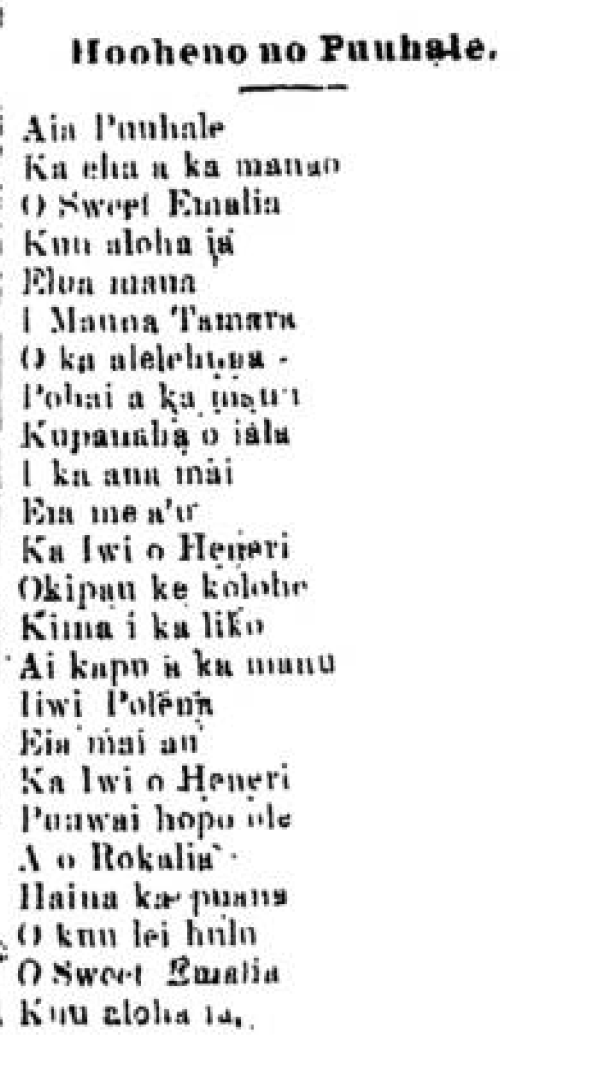
Sweet Emalia in Puuhale, 1894.

[Just as an aside, here is a notice for unclaimed mail put out by the postmaster general (Luna Leta Nui), J. M. Oat. These were the days when you had to pick up your mail at the closest post office. Notice that Emalia Kaihumua is listed in the section for Kalihi and Puuhale.]

Na Leta e waiho nei iloko o ka Hale Leta a hiki i ka la 31 o Augate 1894.

Ka Nupepa Kuokoa, Buke XXXIII, Helu 36, Aoao 3. Sepatemaba 8, 1894.

A mele for Sweet Emalia, 1893.

Hooheno no Puuhale.

Aia i Puuhale
Ka eha a ka manao
O Sweet Emalia
Kuu aloha ia
Elua maua
I Mauna Tamara
O ka alelehuna [?]
Pohai a ka manu
Kupanaha o iala
I ka ana mai
Eia me a’u
Ka Iwi o Heneri
Okipau ke kolohe
Kiina i ka liko
Ai kapu a ka manu
Iiwi Polena
Eia mai au
Ka Iwi o Heneri
Puuwai hopo ole
A o Rokalia
Haina ka puana
O kuu lei hulu
O  Sweet Emalia
Kuu aloha ia.

[This mele for Sweet Emalia, Emalia Kaihumua, Emily Kaihumua, might sound more familiar to you if you switched out “Aia i Puuhale” with “Aia i Hilo One”. And yes, this is yet another example of why the original newspapers need to be rescanned clearly!]

(Lei Momi, 7/5/1893, p. 3)

Hooheno no Puuhale.

Ka Lei Momi, Buke I, Helu 11, Aoao 3. Iulai 5, 1893.

Ahuula and priceless treasures gone up in smoke, 1901.

THE AHUULA WAS DESTROYED BY FIRE

This Possession Belonged to Keaumoku.

S. L. Peleiholani claims $500 in damages
for this Feather Cloak.

Before the fire inspection Commissioner, seen was the relationship of S. L. Peleiholani to Kamehameha I, the conqueror of the nation [Ka Naʻi Aupuni], and also seen was the destruction of a very valuable ahuula in the bubonic fire. Peleiholani claimed $500 damages for this ahuula, and he said that he was urged to sell the ahuula for $1,000, which he absolutely refused to do. This is an ahuula that was cared for by his grandparents on down to him, and for this reason, he refused money which kept appearing before him until the cloak was consumed by fire.

Peleioholani added a claim of $2,140.05, and the majority of the assets were inherited from his kupuna. He is the child of Peleiholani and Pukeau. His grandfather was a child of Kalanuilumoku [Kalaniulumoku], a grandchild of Kamehameha I. His grandfather married Kahana, a daughter of Keaumoku, the one to whom belonged this ahuula. This Keaumoku was a high chief, and an minister [kuhina] of Kamehameha I, and he received may greatly valuable gifts from the conqueror of the nation. Peleiholani cared for this ahuula for a long time, and showed it to the many people who came before him to buy this cloak. The sum of money desired to offer him reached a thousand, and some ministers of Kalakaua came before him wanting the ahuula for the King. He refused all of these urging, and said to them that there was no way money could buy this ahuula while he was alive. Some men came from the alii Kalakaua bringing wine and money and put it at his side, intending to get him to drink until drunk when he would agree to giving this ahuula to the alii, however they left without.

There is but one other ahuula like it, and that is the ahuula cared for in the Kamehameha Museum [Bernice Pauahi Bishop Museum]. When people ask for the actual monetary value of that ahuula, they say Peleiholani’s claim is right, but the actual truth is that the true value of this ahuula reaches $2,000. Mrs. Mary Ailau was a witness called to testify as to the truth of the claim, and according to her testimony, it was correct; and she went before this man many a time and urged him to sell to her this ahuula for $500 and her request was refused. She felt that the true value of the ahuula reached all the way to two thousand dollars. When she was asked if the ahuula was auctioned off, how much would she offer, Mrs. Ailau answered that she would bid as much as one thousand dollars, and if she had a lot of money, she would bid up to two thousand dollars for this ahuula.

In this claim by Peleiholani, it is seen the great amount of valuable antiquities he was caring for and that was destroyed in the bubonic fires. If these treasures were not burned in the fire, and they were bought off of him, he would have gained a large amount of money. This is an example to we Hawaiians, showing the great value of some antiquities which we are just selling off or discarding. Take care of them and find out their value before throwing them away.

[I am guessing not only were there priceless objects in Peleioholani’s collection, but also manuscripts, as he is well known for his writings!]

(Kuokoa, 10/18/1901, p. 6)

PAU KA AHUULA I KE AHI

Ka Nupepa Kuokoa, Buke XXXIX, Helu 16, Aoao 6. Okatoba 18, 1901.

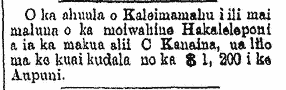
Kaleimamahu’s ahuula, 1882.

[Found under: “HAWAII NEWS”]

The feather cape of Kaleimamahu which was inherited by the queen, Hakaleleponi, and then to the alii father, C. Kanaina, was purchased at auction by the Government for $1,200.

[Anyone know what became of this ahuula?]

(Ko Hawaii Pae Aina, 8/5/1882, p. 3)

O ka ahuula o Kaleimamahu...

Ko Hawaii Pae Aina, Buke V, Helu 31, Aoao 3. Augate 5, 1882.

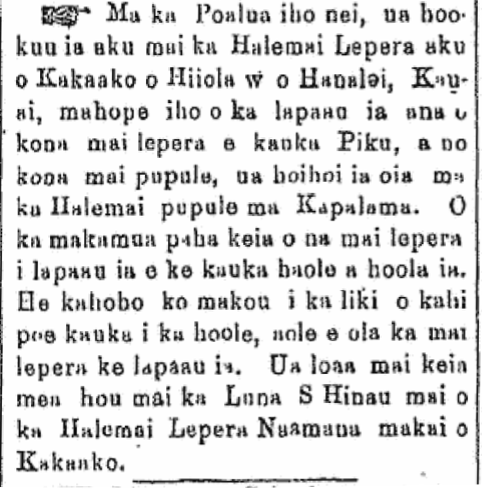
Leprosy patient treated and cured, 1881.

[Found under: “HAWAII NEWS”]

This past Tuesday, released from the Leprosy Hospital of Kakaako was Hiiola (f) of Hanaeli, Kauai, after her leprosy was treated by Dr. Fitch [Piku], and because of her insanity, she was taken to the insane asylum in Kapalama. This is perhaps the first leprosy patient treated by a haole doctor and cured. We are astounded by the those doctors who vehemently deny this, saying that a leprosy patient cannot be cured by medicine. This news was received from the Supervisor [?], S. Hinau, of the Naaman Leprosy Hospital seaside of Kakaako.

(Ko Hawaii Pae Aina, 12/24/1881, p. 3)

Ma ka Poalua iho nei...

Ko Hawaii Pae Aina, Buke IV, Helu 52, Aoao 3. Dekemaba 24, 1881.

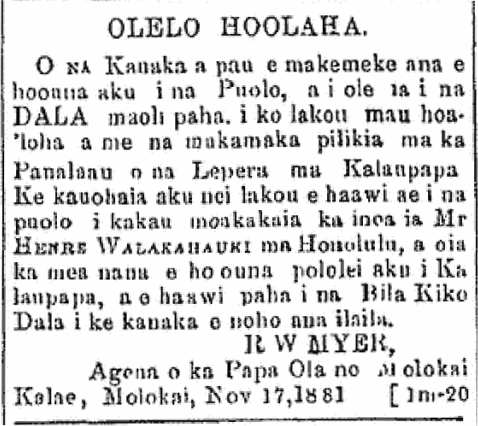
Packages to go to Kalaupapa, 1881.

ANNOUNCEMENT.

All who desire to send Packages, or Cash perhaps to their suffering friends and intimates in the Leprosy Colony in Kalaupapa, They are ordered to give their packages with the name clearly written on it, to Mr. Henry Waterhouse [Henre Walakahauki] in Honolulu, and it is he that will send it direct to Kalaupapa, or give a Check [Bila Kikoo Dala] to the one living there.

R. W. MYER [MEYER],

Agent of the Board of Health for Molokai.

Kalae, Molokai, Nov. 17, 1881.

(Ko Hawaii Pae Aina, 12/24/1881, p. 3)

OLELO HOOLAHA.

Ko Hawaii Pae Aina, Buke IV, Helu 52, Aoao 3. Dekemaba 24, 1881.

Kakaako and the Leprosy hospital, 1881.

THE “CHINESE DISEASE” PATIENTS AT KAKAAKO.

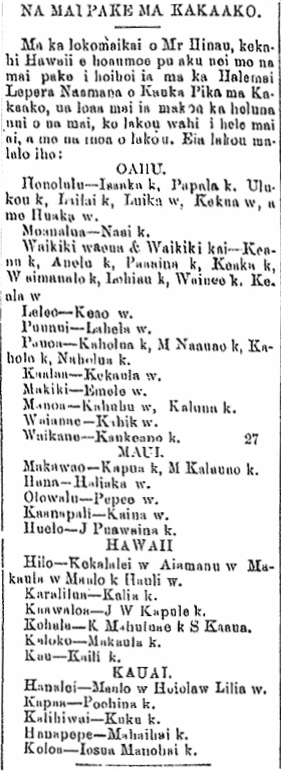
Thanks to the kindness of Mr. Hinau, a Hawaiian who who sleeps along with the leprosy patients taken to the Naaman Leprosy Hospital [Halemai Lepera Naamana] of Doctor Fitch [Pika] in Kakaako, we have received the total number of patients, where they came from, and their names. These are they below:

OAHU.

Honolulu—Isaaka (m), Papala (m), Ulukou (m), Lailai (m), Luika (f), Kekua (f), and Huaka (f).

Moanalua—Naai (m).

Waikiki waena & Waikiki kai—Keana (m), Anelu (m), Paaaina (m), Keaka (m), Waimanalo (m), Lohiau (m), Wainee (m), Keala (f).

Leleo—Keao (f).

Puunui—Lahela (f).

Pauoa—Kaholua (m), M. Naauao (m), Kaholo (m), Naholua (m).

Kaalaa—Kekaula (f).

Makiki—Emele (f).

Manoa—Kahuhu (f), Kaluna (m).

Waianae—Kahik [? Kahiki] (f).

Waikane—Kaukeano (m).  27

MAUI.

Makawao—Kapua (m), M. Kalauao (m).

Hana—Haliaka (f).

Olowalu—Pepee (f).

Kaanapali—Kaina (f).

Huelo—J. Puawaina (m).

HAWAII.

Hilo—Kekalalei (f), Aiamanu (f), Makaula (f), Maalo (m), Hauli (f).

Kapalilua—Kalia (m).

Kaawaloa—J. W. Kapule (m).

Kohala—K. Mahuluae (m), S. Kaaua.

Kaloko—Makaula (m).

Kau—Kaili (m).

KAUAI.

Hanalei—Maalo (f), Hoiolaw Lilia (f).

Kapaa—Poohina (m).

Kalihiwai—Kuku (m).

Hanapepe—Mahaihai (m).

Koloa—Iosua Manohai (m).

(Ko Hawaii Pae Aina, 12/4/1881, p. 3)

NA MAI PAKE MA KAKAAKO.

Ko Hawaii Pae Aina, Buke IV, Helu 52, Aoao 3. Dekemaba 24, 1881.

Astronomy, 1909.

The Hawaiian Astronomy.

It is a great pity that David Malo, the Hawaiian Historian and Antiquarian, did not preserve in his “Moolelo Hawaii” or Hawaiian Antiquities, some account on Ancient Hawaiian Astronomy. S. M. Kamakau, a contemporary of David Malo, and also a writer on the Ancient History of Hawaii nei, is little better off, about this matter than his colleague. He wrote an article on “Instructions in Ancient Hawaiian Astronomy” and was published in the Nupepa Kuokoa of Aug. 5th, 1865. It was translated into English by Prof. W. D. Alexander for Maile Wreath (Lei Maile), and was republished by Mr. Thos. G. Thrum, in his “Hawaiian Annual” for 1890.

In the year 1885, we found in the monthly newspaper, “Ka Hoku o ke Kai,” that subject was treated again, only to last a very short time. And about twelve or thirteen years ago we again found certain very valuable statements pertaining to the Ancient History of Hawaii by Kanalu, said to be the priestly ancestor of the priesthood or order of Kanalu.

We saw in “The Journal of the Polynesian Society,” Vol. XVI, No. 2, an article on “Tahitian Astronomy” by Miss Teuira Henry. It treats the “Birth of the Heavenly Bodies.” It is very interesting.

In order to preserve these accounts relating to Hawaiian Astronomy, we give our English translation here, starting first from the account in Ka Hoku o ke Kai (1885).

In ancient times, the class of people studying the positions of the moon, the rising and setting of certain fixed stars and constellations, and also of the sun, are called the kilo-hoku or astrologers. Their observations of these heavenly bodies might well be called the study of astronomy. The use of astrology anciently, was to predict certain events of fortunes and misfortunes, victory or defeat of a battle, death of king or queen, or any high chief; it also foretells of pestilence, famine, fine or stormy weather and so forth.

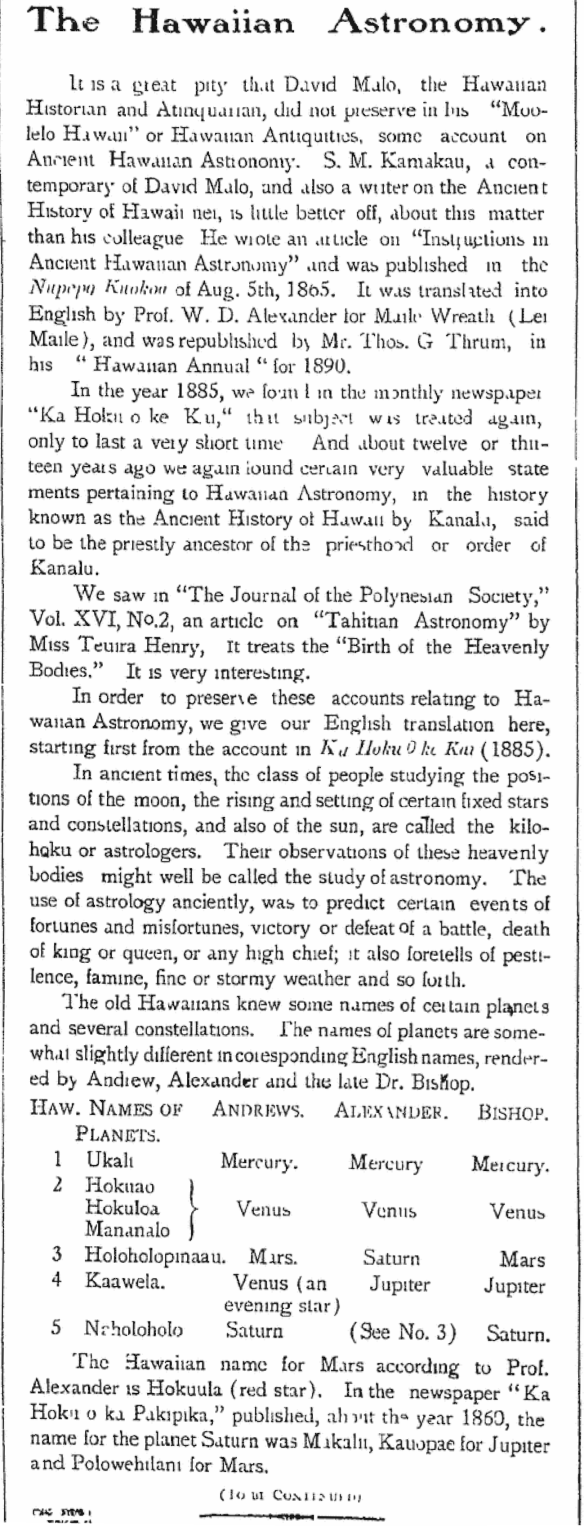
The old Hawaiians knew some names of certain planets and several constellations. The names of planets are somewhat slightly different in corresponding English names, rendered by Andrews, Alexander and the late Dr. Bishop.

HAW. NAMES OF PLANETS ANDREWS. ALEXANDER. BISHOP.
1 Ukali Mercury Mercury Mercury
2 Hokuao
Hokuloa Venus Venus Venus
Mananalo
3 Holoholopinaau Mars Saturn Mars
4 Kaawela Venus (an evening star) Jupiter Jupiter
5 Naholoholo Saturn (See No. 3) Saturn

The Hawaiian name for Mars according to Prof. Alexander is Hokuula (red star). In the newspaper “Ka Hoku o ka Pakipika,” published about the year 1860, the name for the planet Saturn was Makalii, Kauopae for Jupiter and Polowehilani for Mars.

(To be Continued)

(Kuokoa Home Rula, 4/2/1909, p. 2)
The Hawaiian Astronomy.

Kuokoa Home Rula, Buke VII, Helu 14, Aoao 2. Aperila 2, 1909.
Comet reappears, 1901.

A COMET.

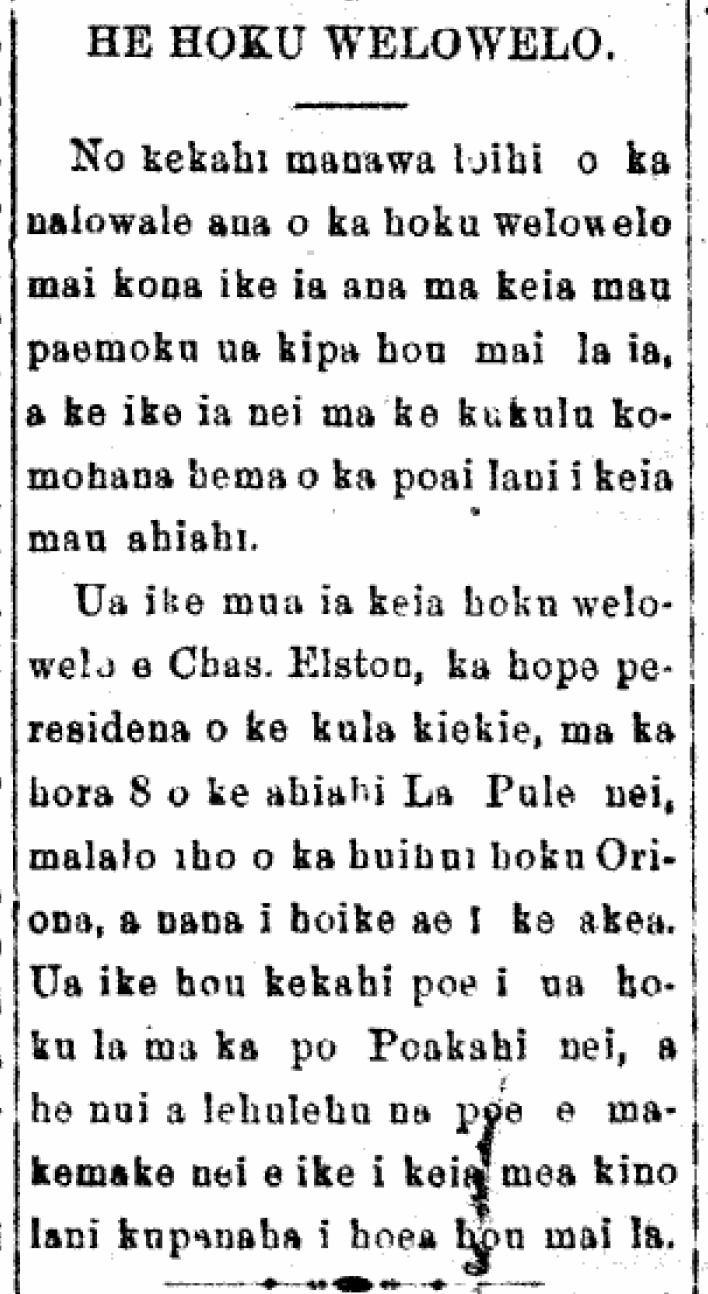
After a long period of being gone from these islands, a comet [hoku welowelo] came back, and it can be seen in the south-western side of the skies this coming evenings.

This comet was first spotted by Charles Elston, the vice-president of the high school, at 8 in the evening of this past Sunday, under the Orion constellation, and it was he that announced it to the public. That star was seen again by other on the night of this Monday, and there are great number of people who want to see this awesome heavenly body which has reappeared.

[“The High School”, or “Honolulu High School” would become what we know today to be McKinley High School.]

(Aloha Aina, 5/18/1901, p. 6)

HE HOKU WELOWELO.

Ke Aloha Aina, Buke VII, Helu 20, Aoao 6. Mei 18, 1901.