Unknown's avatar

About nupepa

Just another place that posts random articles from the Hawaiian Newspapers! It would be awesome if this should become a space where open discussions happen on all topics written about in those papers!! And please note that these are definitely not polished translations, but are just drafts!!! [This blog is not affiliated with any organization and receives no funding. Statements made here should in now way be seen as a reflection on other organizations or people. All errors in interpretation are my own.]

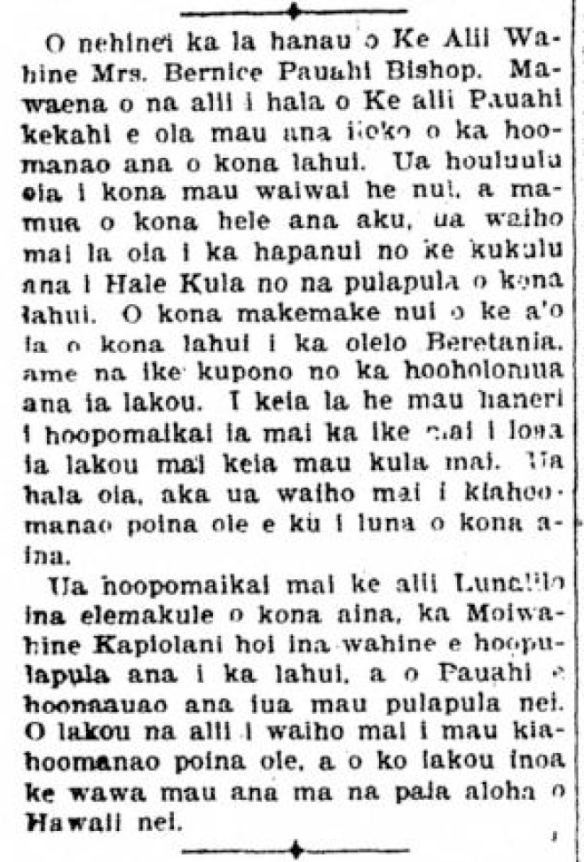
Birthday of Pauahi Lani, 1901.

Yesterday was the birthday of the Chiefess Mrs. Bernice Pauahi Bishop. Amongst the alii who have passed on, the alii Pauahi is one who will always live in the memories of her lahui. She accumulated her great wealth, and before her passing, she left most of it for the establishment of the School for the descendants of her people. Her fervent desire was for her lahui to be educated in English and knowledge necessary to  move them forward. Today there are hundreds who have been blessed by the knowledge gained from the schools. She has gone, but has left an unforgettable memorial which stands on her lands.

The chief Lunalilo has blessed the oldsters of his land; Queen Kapiolani, the women who are increasing her people, and Pauahi educates those offspring. Those are the chiefs who left unforgettable monuments, and their names will forever more echo upon the beloved walls of Hawaii nei.

(Kuokoa, 12/20/1901, p. 2)
Kuokoa_12_20_1901_2.png

Ka Nupepa Kuokoa, Buke XXXIX, Helu 25, Aoao 2. Dekemaba 20, 1901.
Euginia Keohokalani Maluhi Pilipo and Manuel Reis married 50 years, 1929.

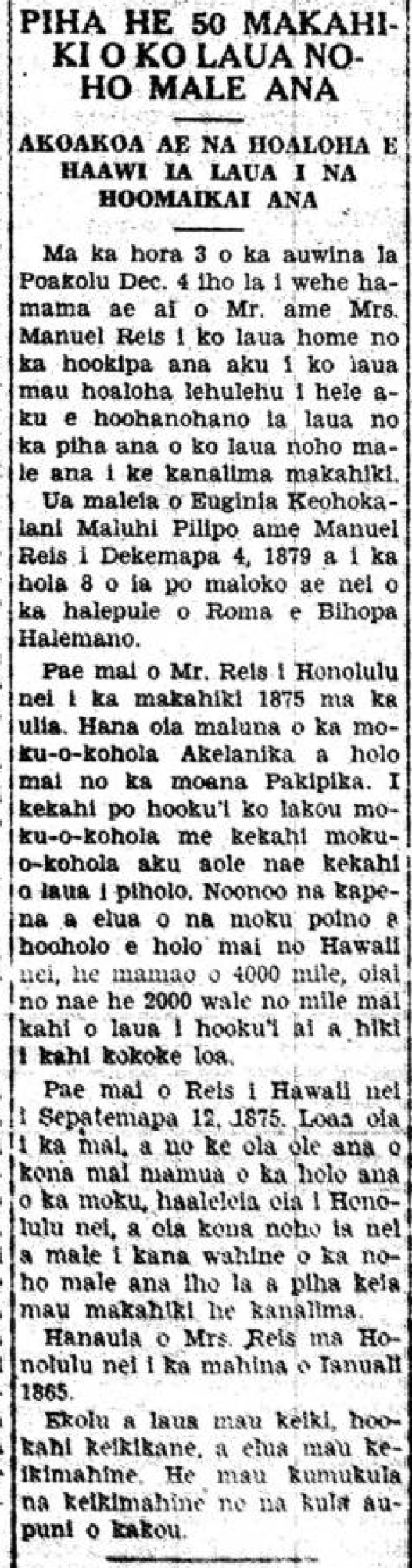
TWO OF THEM MARRIED FOR 50 YEARS

FRIENDS GATHER TO GIVE THEIR CONGRATULATIONS

At the hour of 3 in the afternoon, of this past Wednesday, Dec. 4, Mr. and Mrs. Manuel Reis opened their home to welcome their many friends who went to honor them for their fifty years of marriage.

Euginia Keohokalani Maluhi Pilipo and Manuel Reis were married on December 4, 1879, at 8 o’clock that night in the Roman Catholic Church by Bishop Halemano.

Mr. Reis arrived in Honolulu nei in 1875 as the result of an accident. He was working aboard the whaler Atlantic [moku-o-kohola Akelanika] and sailed here to the Pacific Ocean. One night their whaler crashed into another whaler, but neither sank. Both captains of the damaged ships decided to sail for Hawaii, 4000 miles away, whereas from where they crashed it was only 2000 miles away from the closest land.

Reis landed in Hawaii nei on September 12, 1875. He became sick, and because he did not get well before the ship left, he was left behind here in Honolulu, and that is why he lived here and married his wife of fifty years of marriage.

Mrs. Reis was born in Honolulu nei in January 1865.

They have three children; one boy and two girls. The girls are school teachers for our government schools.

(Alakai o Hawaii, 12/12/1929, p. 1)

AlakaioHawaii_12_12_1929_1.png

Ke Alakai o Hawaii, Buke 1, Helu 33, Aoao 1. Dekemapa 12, 1929.

One year after Pearl Harbor, 1942.

This Makes a Full Year

Monday last was a year since the bombing of Puuloa by the those who carried out the coup and stole the lives of people thinking that is what will give them victory.

The 7th of December is a day we probably will never forget for all times, for while the navy and the land of America were enjoying their time, the raider carried out his work which was planned ahead of time, to fly to America to the path of Puuloa, and let down messengers of destruction to cripple the condition of the military of the United States of America.

With America being secretly attacked, that served as a needle poking at the side of the Americans like a spur [kui ke-pa] being thrust into the underside of a horse.

In response to these actions by the raider and assassin, the one who stirred the coals that are burning in the hearts of true Americans, and it became something that inflamed the thoughts of Americans. Continue reading

Less than four months before Pearl Harbor, 1941.

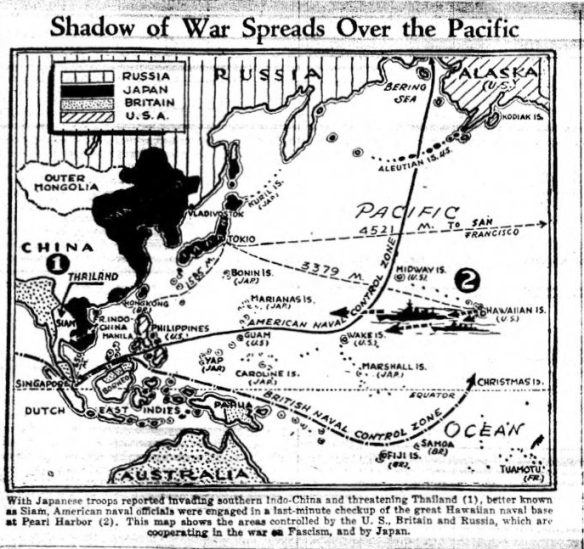
Shadow of War Spreads Over the Pacific

With Japanese troops reported invading southern Indo-China and threatening Thailand (1), better known as Siam, American naval officials engage in a last-minute checkup of the great Hawaiian Naval base at Pearl Harbor (2). This map shows the areas controoled by the U. S., Britain and Russia, which are cooperating in the war on Fascism, and by Japan.

(Hoku o Hawaii, 8/20/1941, p. 6)

HokuoHawaii_8_20_1941_6.png

The Star of Hawaii, Volume XXXVI, Number 17, Page 6. August 20, 1941.

Road to hell is paved with gold, 1915.

GIVES UP PLAN TO RESTORE OLD HAWAII TEMPLES

C. R. Forbes Warned from Undertaking by John G. Stokes; Will Put Up Markers

Plans that Charles R. Forbes, superintendent of public works, has had for the restoration of the heiaus on Hawaii will probably be abandoned as a result of a letter received by him recently from John G. Stokes, curator at the Bishop museum.

Mr. Stokes objects to having the heiaus built up again to a semblance of their original shape, as was the plan proposed by Superintendent Forbes, by taking rock that had fallen and resetting it in its old position. Mr. Stokes’ contention is that this would be an unwise thing to do, even in the interest of preserving the old relics. His statement is made after a careful study of them. Continue reading

Hannah Baker in Hilo starting Hawaiian quilting clubs, 1941.

A FINE THING FOR HAWAIIAN MOTHERS

Here in Hilo is Mrs. Hannah Baker now, and she established some Hawaiian Quilting Associations. The first of her Associations was established at the YWCA Building and the second in Keaukaha.

From what was said, there are many who joined these clubs because they were interested in how to quilt Hawaiian blankets, and others perhaps because they wanted to obtain the knowledge of how to cut patterns of all sorts. Continue reading

S. K. Maialoha sent to Kalaupapa, 1905.

LEAVES THE LAND

SEES THE LAND OF SUFFERING AS A STRANGER.

O Swift Messenger of the communities of Hawaii, floating all the way foreign lands, Ke Aloha Aina Newspaper. Greetings:—

On the 12th of this September, in the morning hours, there was crying as people walked outside of the grounds of that hallowed castle, and at 8 o’clock or so was when our belongings were readied. The wailing was heard of women for their husbands, men for their wives, parents for their children, children for their parents, family for family.

And at 11 o’clock, the patients were called to board the car; a veil was spread, and people could no more see us; the cars left the grounds, and great mourning was heard; your writer saw his dear mama and our child for the last time; and the writer heard the calling of my beloved Ape, “O Papa, come back to me.” Continue reading

Jules Tavernier, 1885

[Found under: “NA NU HOU HAWAII”]

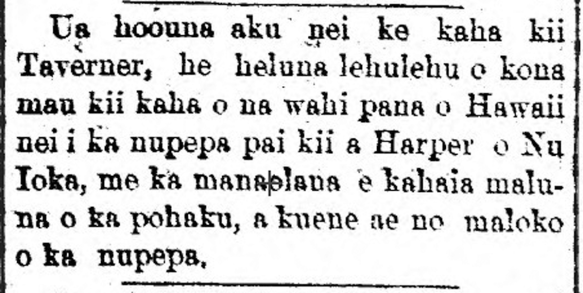
Illustrations by Tavernier were sent, a great many of his drawings of the storied places [wahi pana] of Hawaii nei, to the illustrated newspaper Harper’s of New York, with the hopes that they will be engraved in stone and arranged in the newspaper.

[Jules Tavernier not only did these illustrations for Harper’s Magazine, but he did spectacular paintings as well. Click here for the latest post from Nanea Armstrong-Wassel on a painting by Tavernier.]

(Ko Hawaii Paeaina, 3/21/1885, p. 2)

KHPA_3_21_1885_2.png

Ko Hawaii Paeaina, Buke VIII, Helu 12, Aoao 2. Maraki 21, 1885.

Timoteo Haalilio, 1845.

SOME THINGS PERTAINING TO HAALILIO.

Koolau, Oahu, was where he was born; his parents were prominent people. His father died when he was a youth, and thereafter his mother (that being Eseka who is still living) became Governor of Molokai. When he was 8 years old, he joined the family of the King, Kamehameha III, and lived with them. They were at Hilo at this time. When he was 13, Haalilio entered the school of Bingham [Binamu] in Honolulu, and he studied English and…

(Elele, 4/25/1845, p. 13)

Elele_4_25_1845_13.png

Ka Elele, Buke I, Pepa 2, Aoao 13, Aperila 25, 1845.

Continue reading

Remarks on the state of the United States.

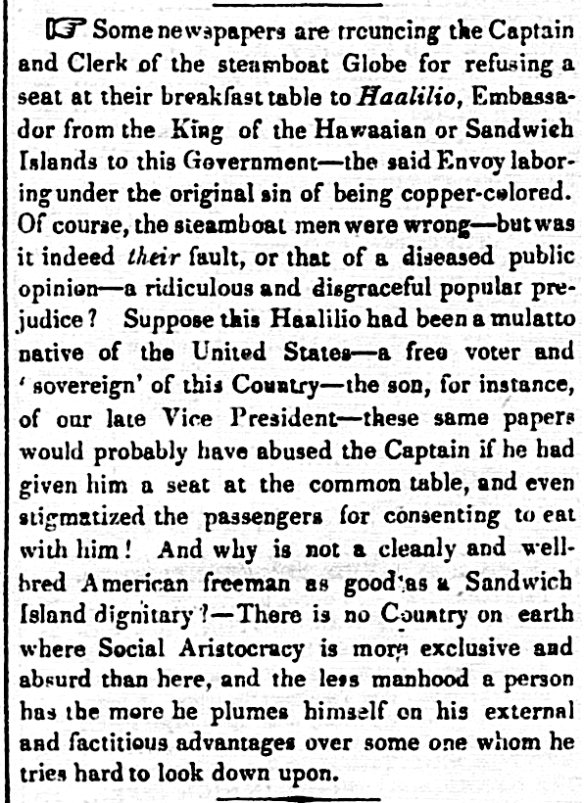
Some newspapers are trouncing the Captain and Clerk of the steamboat Globe for refusing a seat at their breakfast table to Haalilio, Embassador from the King of the Hawaiian or Sandwich Islands to this Government—the said Envoy laboring under the original sin of being copper-colored. Of course, the steamboat men were wrong—but was it indeed their fault, or that of a diseased public opinion—a ridiculous and disgraceful popular prejudice? Suppose this Haalilio had been a mulatto native of the United States—a free voter and ‘sovereign’ of this Country—the son, for instance, of our late Vice President—these same papers would probably have abused the Captain if he had given him a seat at the common table, and even stigmatized the passengers for consenting to eat with him! And why is not a cleanly and well-bred American freeman as good as a Sandwich Island dignitary?—There is no Country on earth where Social Aristocracy is more exclusive and absurd than here, and the less manhood a person has the more he plumes himself on his external and factitious advantages over some one whom he tries hard to look down upon.

[It sounds like things really have not changed so much.]

(New York Daily Tribune, 1/28/1843, p. 2)

NYDailyTribune_1_28_1843_2.png

The New York Daily Tribune, Volume II, Number 250, Page 2. January 28, 1843.