Unknown's avatar

About nupepa

Just another place that posts random articles from the Hawaiian Newspapers! It would be awesome if this should become a space where open discussions happen on all topics written about in those papers!! And please note that these are definitely not polished translations, but are just drafts!!! [This blog is not affiliated with any organization and receives no funding. Statements made here should in now way be seen as a reflection on other organizations or people. All errors in interpretation are my own.]

On Aloha Aina, 1893.

“Breathes there a man with soul so dead,
Who never to himself hath said,
This is my own my native land.”
(Scott.)

Many of those who support honestly the present state of affairs, have done so in the full hope and belief, that thereby the flag of their country—the Stars and Stripes—will float over the land in perpetuity. Not a single Hawaiian, however, even those few whose signatures to annexation petitions (not 200 in number and mostly convicts.) have been bought or forced by necessity from them, desires to see any foreign flag replace his own. Continue reading →

Liliuokalani’s horse riding association, 1892.

[Found under: “NU HOU KULOKO.”]

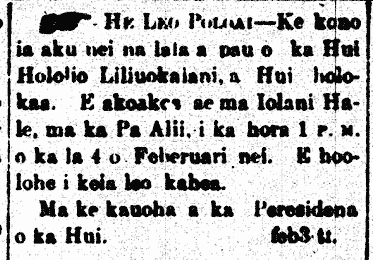
A Summons—All the members of the Liliuokalani Horse Riding Association and Carriage Riding Association are invited. To gather at Iolani Palace, on the Palace Grounds, at 1 p. m. on the 4th of February. Heed this call.

By the orders of the President of the Association.

(Leo o ka Lahui, 2/3/1892, p. 3)

He Leo Poloai

Ka Leo o ka Lahui, Buke II, Helu 382, Aoao 3. Feberuari 3, 1892.


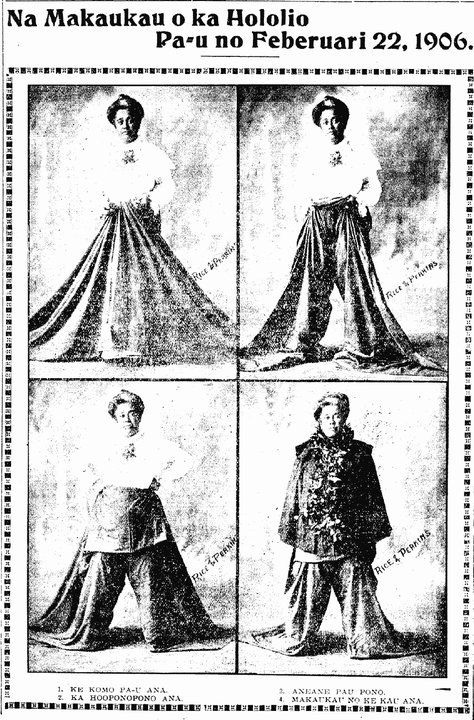
Putting on a Pāʻū, 1906.

Preparations for the Pa-u Riding of February 22, 1906.

1. Putting on a pa-u.
2. The adjusting.
3. Almost done.
4. Ready to ride.

[This was for the parade on Washington’s birthday. An article describing these steps was printed in the 2/4/1906 issue of the Sunday Advertiser.]

(Kuokoa, 2/9/1906, p. 4)

Na Makaukau o ka Hololio Pa-u no Feberuari 22, 1906.

Ka Nupepa Kuokoa, Buke XLIV, Helu 6, Aoao 4. Feberuari 9, 1906.

“The Value of Hawaiʻi 2,” 2014 and beyond.

The last post reminded me of this newly released must read, The Value of Hawaiʻi 2: Ancestral Roots, Oceanic Visions, edited by Aiko Yamashiro and Noelani Goodyear-Kaʻōpua. This is a book of essays all of us should sit down with, and let it allow us to ask of ourselves now what we think is important for our island community and what it is we want to leave behind for the future and what then we must do in order to achieve this…

How can more of us protect and create waiwai, value, for coming generations?

Culturally-rich education. Holistic health systems. Organic farming and aquaculture. Creative and conscious urban development. Caring for one another across difference. Telling our stories.

Continuing the conversation of The Value of Hawai‘i: Knowing the Past, Shaping the Future, this new collection offers passionate and poignant visions for our shared futures in these islands. The fresh voices gathered in this book share their inspiring work and ideas for creating value, addressing a wide range of topics: community health, agriculture, public education, local business, energy, gender, rural lifestyles, sacred community, activism, storytelling, mo‘olelo, migration, voyaging, visual art, music, and the ‘āina we continue to love and mālama. By exploring connections to those who have come before and those who will follow after, the contributors to this volume recenter Hawai‘i in our watery Pacific world. Their autobiographical essays will inspire readers to live consciously and lead as island people.

Essay contributors: Jeffrey Tangonan Acido, Kamana Beamer, Makena Coffman, Sean Connelly, Elise Leimomi Dela Cruz-Talbert, Noelani Goodyear-Ka‘ōpua, Consuelo Agarpao Gouveia, Tina Grandinetti, John “Prime” Hina, Sania Fa‘amaile Betty P. Ickes, Bonnie Kahapea-Tanner, Joseph Keawe‘aimoku Kaholokula, Kainani Kahaunaele, Hi‘ilei Kawelo, Keone Kealoha, Dawn Mahi, Ryan Oishi, Jamaica Heolimeleikalani Osorio, Eri Oura, Mark Kawika Patterson, Hawane Rios, Cheryse Julitta Kauikeolani Sana, Dean Itsuji Saranillio, Lyz Soto, Cade Watanabe, Aiko Yamashiro, Matt N. Yamashita, and Aubrey Morgan Yee.


The Value of Hawaiʻi 2

The Value of Hawaiʻi 2

Winona Kapuailohia Desha Beamer, 1943.

[Found under: “News From Boys, Girls Kamehameha Schools”]

By Pilialoha Hopkins

Miss Winona Kapuailohia Desha Beamer, a graduate of the Kamehameha Schools for Girls, class of ’41, returned from Barnard college, New York.

While she was there Winona was studying in the fields of ethnology and anthropology.

Because of health condition Miss Beamer will remain in the islands for some time. She hopes to continue her study after the war.

While a student at Kamehameha, Winona was engaged in various activities some being, class president, a member of Hui Kumolipo [Kumulipo], a piano and organ pupil, a member of the choir, silver and gold pin student, and was awarded upon graduation a scholarship to Colorado Women’s college. While in school she also won the Clarke-English award and was interested a great deal in relationship and study of the early Hawaiians and Polynesians.

Winona is the daughter of Mr. and Mrs. Francis Pono Beamer of Waikiki, Oahu. She is the granddaughter of Mr. and Mrs. Peter Carl Beamer of Hilo, Hawaii.

At present, Winona has two brothers Francis and Cleighton and a sister Flora attending Kamehameha. Also at Kam she has four cousins, Milton, Edwin, and Helen Beamer, and Helen Walker.

[This was a regular column on the happenings at Kamehameha Schools in the Hoku o Hawaii, and the articles were composed by the students, sometimes in English, and sometimes in Hawaiian.]

(Hoku o Hawaii, 4/14/1943, p. 2)

By Pilialoha Hopkins

Ka Hoku o Hawaii, Volume XXXVII, Number 51, Aoao 2. Apelila 14, 1943.

More Hawaiian-Language in English newspapers, 1922.

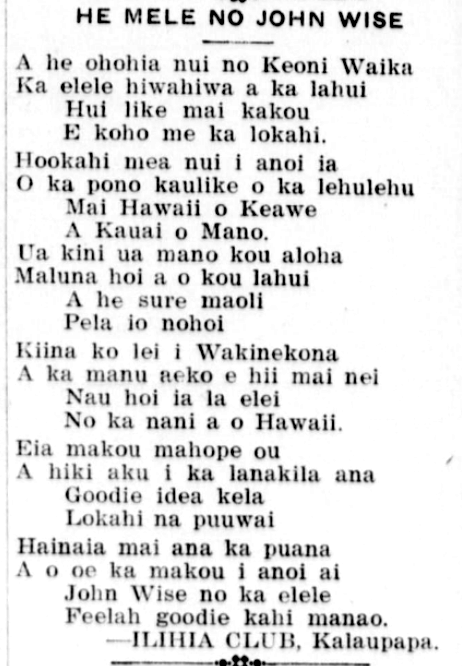
HE MELE NO JOHN WISE

A he ohohia nui no Keoni Waika
Ka elele hiwahiwa a ka lahui
Hui like mai kakou
E koho me ka lokahi.

Hookahi mea nui i anoi ia
O ka pono kaulike o ka lehulehu
Mai Hawaii o Keawe
A Kauai o Mano.

Ua kini ua mano kou aloha
Maluna hoi a o kou lahui
A he sure maoli
Pela io nohoi.

Kiina ko lei i Wakinekona
A ka manu aeko e hii mai nei
Nau hoi ia la elei
No ka nani a o Hawaii.

Eia makou mahope ou
A hiki aku i ka lanakila ana
Goodie idea kela
Lokahi na puuwai.

Hainaia mai ana ka puana
A o oe ka makou i anoi ai
John Wise no ka elele
Feelah goodie kahi manao.

—ILIHIA CLUB, Kalaupapa.

[Chronicling America only has newspapers up to 1922. I am not sure how much longer Hawaiian-Language articles appear in the Maui News, but it is pretty interesting to see that they did appear until at least 1922. Here is a political song written for Keoni Waika, the renaissance man, John Wise.]

(Maui News, 11/3/1922, p. 8)

HE MELE NO JOHN WISE

Semi-Weekly Maui News, 22nd. Year, Number 1215, Page 8. November 3, 1922.

Bilingual law announcements in English-language newspapers, 1902.

BY AUTHORITY.

REGULATIONS
FOR
HACK AND FOR PASSENGER VEHICLES
AND
RATES OF FARE.

By virtue of the authority in me vested and under the provisions of Section 794 of Chapter 55, of the Penal Laws of 1897, I, James H. Boyd, Superintendent of Public Works of the Territory of Hawaii, do make and declare the following Rules and Regulations to be observed by Licensed Carriers of Passenger Vehicles, in the District of Honolulu:

1st. Every licensed carriage, dray or vehicle must be numbered, and this number must be placed on a conspicuous part of the carriage, dray or vehicle.

2d. Every licensed carriage running at night must exhibit two lights, and the number of such carriage plainly shown on the glass of each lantern, in black figures, not less than one and one-half (1½) inches in height.

3d. Drivers of licensed vehicles must obey the orders of the Police.

4th. On all stands set apart for licensed carriages the horses must be headed parallel to the street, and close to the sidewalk.

5th. No horse harnessed to a licensed vehicle must be left on any stand unless properly secured by a hitching rope to an iron hitching weight.

6th. No licensed carriage will be allowed to be left on the street over night. Continue reading →

G. W. Kahiolo / G. W. Poepoe, feminist of his day, 1864.

The Value of Girls

SEEKING KNOWLEDGE EARNESTLY.

O Kuokoa Newspaper; Aloha oe.—We see the words placed proudly above, “the value of girls seeking knowledge earnestly.”

Teaching girls knowledge is something not important for Hawaiian parents, who say, “When boys are educated, they can go on to Lahainaluna, and return and find a job and get riches.” But educating girls is a waste of their parents efforts, and so forth.

Come now! look at this that makes clear the truth of the words above. The Law was passed that boys would be segregated in separate schools where possible, and men teachers would be selected for the boy students, and women teachers for the girl students.

And the Principal of our District, J. S. Low, has put this into practice, selecting women teachers in this past September, as per his Announcement: D. Kaholua (f), as teacher for Kapalama; Emaria Kalauli (f), teacher for Kawaiahao; and so forth; the number of female teachers in our District is six; they have reaped the wealth from their seeking education.

However, the majority of women teachers are from Molokai; they are intelligent and educated, they were taught well by Mr. Hitchcock [Hikikoke] and Mr. Dwight [Duaika], the teachers of Molokai.

What about you all, indifferent ones, skeptics, and the foolish? Stop this; put effort into education; the Law has allowed knowledgeable women to become Teachers, like these women that we see these days.

G. W. Kahiolo.

(Kuokoa, 1/16/1864, p. 3)
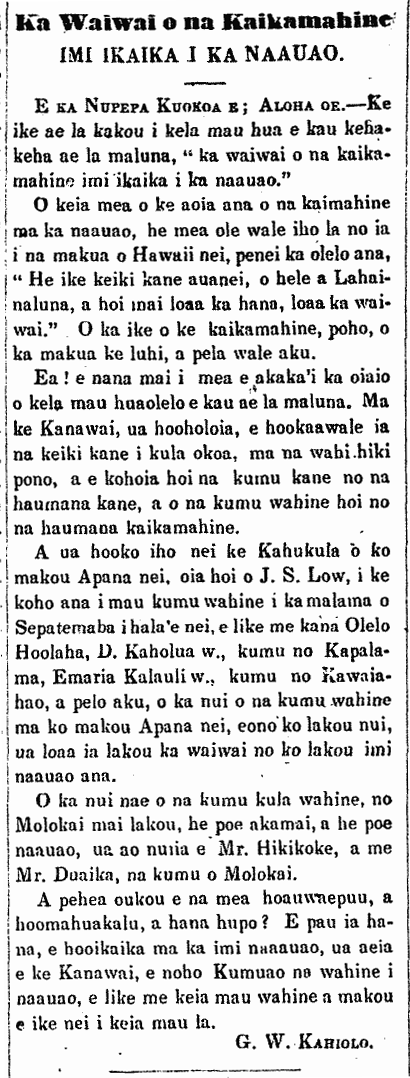
Ka Waiwai o na Kaikamahine

Ka Nupepa Kuokoa, Buke III, Helu 4, Aoao 3. Ianuari 16, 1864.

G. W. Kahiolo is G. W. Poepoe, the father of Joseph Mokuohai Poepoe, 1861.

Death announcements are not only death announcements, they are often histories and genealogical records and more!

From the last post for instance, we discover G. W. Kahiolo, the mysterious writer who is known as the writer of a few newspaper articles and most widely known for the story of Kamapuaa, is G. W. Poepoe, and therefore the father of not only Ben Poepoe, but also the father of Joseph Mokuohai Poepoe, the great historian, translator, newspaper editor, lawyer, politician, &c., &c…

Story of Kamapuaa by G. W. Kahiolo, 1861.

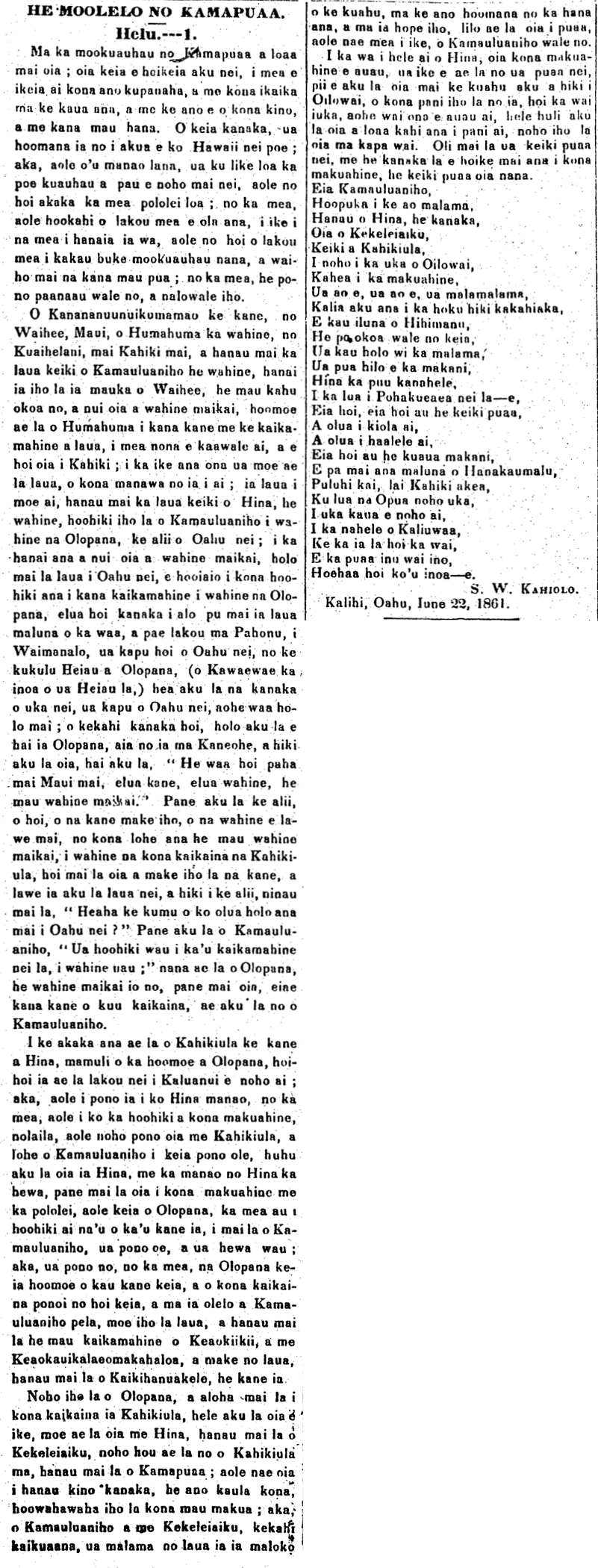
HE MOOLELO NO KAMAPUAA.

Helu.—1.

Ma ka mookuauhau no Kamapuaa a loaa mai oia; oia keia e hoikeia aku nei, i mea e ikeia ai kona ano kupanaha, a me kona ikaika ma ke kaua ana, a me ke ano e o kona kino, a me kana mau hana. O keia kanaka, ua hoomana ia no i akua e ko Hawaii nei poe; aka, aole o’u manao lana, ua ku like loa ka poe kuauhau a pau e noho mai nei, aole no hoi akaka ka mea pololei loa; no ka mea, aole hookahi o lakou mea e ola ana, i ike i na mea i hanaia ia wa, aole no hoi o lakou mea i kakau buke mookuauhau nana, a waiho mai na kana mau pua; no ka mea, he pono paanaau wale no, a nalowale iho.

….

[This is the opening of the Kamapuaa story by G. W. Kahiolo [aka G. W. Poepoe]. It ran as a serial in the newspaper Hae Hawaii from 6/26 to 9/25/1861. This story was translated by Esther T. Mookini and Erin C. Neizmen with the assistance of David Tom, and put out by the University of Hawaii at Manoa Hawaiian Studies Program in 1978. In it, they say of Kahiolo:

The author G. W. Kahiolo, is not known otherwise to us. For other materials written by him, see Kukini ‘Aha’ilono, edited by Rubellite K. Johnson, Topgallant Publishing Col., Ltd., Honolulu, 1976: page 150, “Inoa o na Laau,” a list of names of plants, and pages 187–188, “He Mele no ka Nupepa Kuokoa,” a song in celebration of the start of the Hawaiian language newspaper, Ka Nupepa Kuokoa. We were unable to find any biographical material on him. However, because Ka Hae Hawaii was the official organ of the Department of Instruction (Mookini 9), Kahiolo may have been a Protestant educator as his tale is given a prominent place in the layout of the paper.]

(Hae Hawaii, 6/26/1861, p. 52)

HE MOOLELO NO KAMAPUAA.

Ka Hae Hawaii, Buke 6, Ano Hou—Helu 13, Aoao 52. Iune 26, 1861.