Unknown's avatar

About nupepa

Just another place that posts random articles from the Hawaiian Newspapers! It would be awesome if this should become a space where open discussions happen on all topics written about in those papers!! And please note that these are definitely not polished translations, but are just drafts!!! [This blog is not affiliated with any organization and receives no funding. Statements made here should in now way be seen as a reflection on other organizations or people. All errors in interpretation are my own.]

Another Wooden Kii found, 1868.

Akua Kii of Kalia.

Most of the people reading Ke Alaula have not seen an akua kii, but a small fraction have seen one, and some of you saw this image that is shown here in this issue. Last year, this god idol was found by the Honorable M. Kekuanaoa on the banks of a fish pond at Kalia in Paalaa Uka in Waialua. That large piece of wood was set down and covered with soil near the sluice gate of that large fish pond. When that big piece of wood was unearthed, lo and behold, it was a carved god. It was brought to Honolulu nei, and through the goodwill of the Alii Elder who owns Kalia fishpond, that kii was given to the college of Kapunahou [Punahou], and there it stands in the exhibition room of curiosities at Kapunahou. When some of you go to visit Kapunahou, ask the children there about the kii from Waialua, and it will be shown to you where it stands.

This kii was probably thrown into the pond of Kalia in the year 1819; that is the year when there was the kii of Hawaii nei were greatly abandoned. Some of them were burnt in fire and some were thrown into the sea.

These ohia wood images were worshiped by previous generations. The kupuna of the educated children of Waialua Sunday School were probably those that knelt down and worshiped this piece of wood.

How astonishing are the actions of the people of all of the pagan lands, who worship idols that are carved or molded by their own hands. That is how all lands are where the word of God has not reached.

Pieces of wood, fragments of rock, chunks of silver, chunks of metal, or perhaps chunks of iron turned into images—those are the gods cared for by millions of people, in heiau, houses of god, mountains, caves, banks of rivers, and in forests; they worship before them thinking that from these gods come well being, wealth, and life in body and spirit.

Here also is a picture of a Hindu man worshiping his godly image; it is a snake carved into a rock.

This is something that pains the heart to see the darkness and trouble of those that don’t know of the God the Savior, the one who came down to save all man. Because they don’t know him, they seek salvation from rocks and pieces of wood and from actions that hurt their very own bodies. When you pray, “Thy kingdom come,” remember the pagans so that the light reaches them quickly.

[Could this Akua Kii be the one now at the Bishop Museum which was found in Waialua and presented to Punahou?]

(Alaula, 1/1868, p. 39)
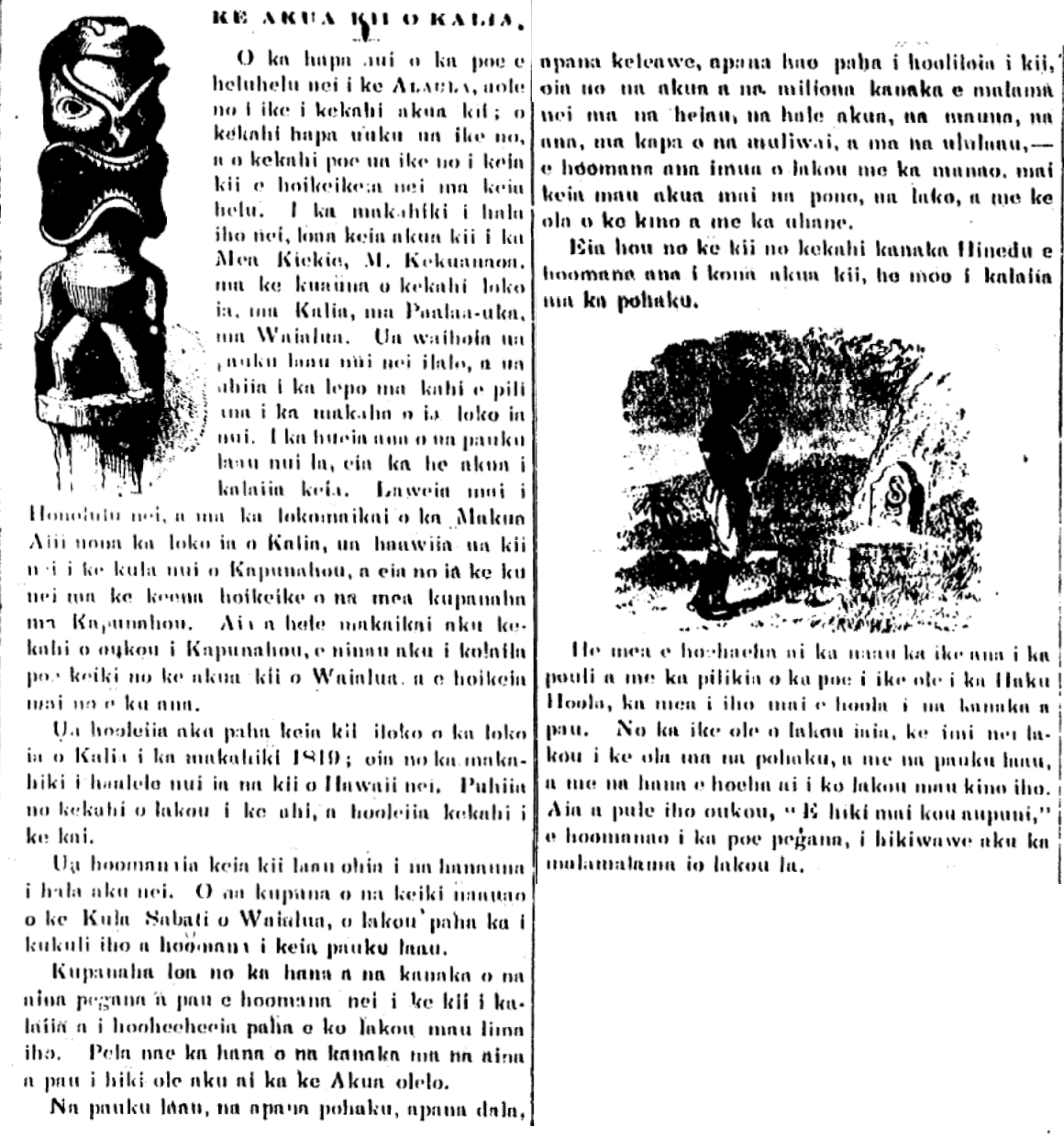
KE AKUA KII O KALIA.

Ke Alaula, Buke II, Helu 10, Aoao 39. Ianuari, 1868.
Wooden Kii found in Haleiwa, 1906.

[Found under: “This and That”]

Rev. W. D. Westervelt found a wooden akua image made of ohia that was 8 feet in length in a taro patch near the Haleiwa Hotel. This kalaipahoa was sent was sent to the museum of Kamehameha School.

(Na’i Aupuni, 8/30/1906, p. 3)

Ua loaa mai nei ia Rev W D Westervel...

Ka Na'i Aupuni, Buke II, Helu 76, Aoao 3. Augate 30, 1906.

We still haven’t learned today what they knew a hundred years ago?

Remember the article on snakes we posted just a couple of weeks ago? Out today is a current related article…

How sad is it when Hawaii already had the answer a hundred years ago, that today, the State of Hawaii doesn’t think keeping alien pests out of Hawaii is important enough to fund! See this article out today by Audrey McAvoy: Alien pests risk fewer inspectors upon entry.

Here you’d be looking at a long strings of @@@@@@@@@ instead of information on Queen Kapiolani and Puna. 1876.

NEWS ITEMS FROM PUNA.

Please let us shake hands, your Captain and I, and insert my small contribution in an empty space of your delicate body.

On the evening of the 12th of Nov., Queen Kapiolani and her younger sister Kapooloku, Hon. L. Kaina, and the other companions of the Queen left Hilo Hanakahi and the Kanilehua rain. And the land travelling canoes that evening were pointed towards the seas of the rustling pandanus groves, and they reposed at the home of R. Lyman, Esq., along with the woman who lives in the sea of Haena in Keaau.

And the next morning, the entourage of the Queen travelled on to see the sounding pebbles of Aalamanu, and from there, to Keauhou and the shelter of coconut fronds. And aloha was shown between the Queen and her humble subjects.

And here the Queen asked for someone to take them to see the Waikoolihilihi and and the tall Hopoe Lehua, and the writer of this article patiently took them. We saw the hollow pahoehoe [uha pahoehoe?] of Hopoe, and inhaled the lima [?] and the seaweed growing upon it. And we soon looked upon the famous pool Ka Wai Koolihilihi; but there was no water in the pool as it was sucked up by the heat of the sun, for it has been months of nice weather here in Puna; there was no water to drink. There too were the lehua @@@@
@@@@@@@@@@@@@@@@@@@@@@@@@@@@@@@@@@@@@@
@@@@@@@@@@@@@@@@@@@@@@@@@@@@@@@@@@@@@@
@@@@@@@@@@@@@@@@@@@@@@@@@@@@@@@@@@@@@@
@@@@@@@@@@@@@@@@@@@@@@@@@@@@@@@@@@@@@@
@@@@@@@@@@@@@@@@@@@@@@@@@@@@@@@@@@@@@@
@@@@@@@@@@@@@@@@@@@@@@@@@@@@@@@@@@@@@@
@@@@@@@@@@@@@@@@@@@@@@@@@@@@@@@@@@@@@@
@@@@@@@@@@@@@@@@@@@@@@@@@@@@@@@@@@@@@@
@@@@@@@@@@@@@@@@@@@@@@@@@@@@@@@@@@@@@@
@@@@@@@@@@@@@@@@@@@@@@@@@@@@@@@@@@@@@@

@@@@@@@@@@@

@@@@@@@@@@@

@@@@@@@@@@@@@@@@@@@@@@@@@@@@@@@@@@@@@@
@@@@@@@@@@@@@@@@@@@@@@@@@@@@@@@@@@@@@@
@@@@@@@@@@@@@@@@@@@@@@@@@@@@@@@@@@@@@@
@@@@@@@@@@@@@@@@@@@@@@@@@@@@@@@@@@@@@@
@@@@@@@@@@@@@@@@@@@@@@@@@@@@@@@@@@@@@@
@@@@@@@@@@@@@@@@@@@@@@@@@@@@@@@@@@@@@@

When you look at the works reported by the church officials accomplished in their districts, the work of the Lord has progressed in some places but regressed in others. As for the pastor himself, the father’s work has been deft, there is nothing to fault, there is no obscene names to apply, his actions before his flock has been lively; and during the late evening hours of the day mentioned above, the meeting was adjourned. This group will meet again at Olaa on the 2nd of January, 1877. The church officials were hosted well at the home of Kalahiki with food for the body, and the aloha given by the locals was splendid. S. K. Po-opio

Keaau, Puna, H., Nov. 27, 1876.

[This paper was not typed from the unclear images available online, but from the originals. So luckily, all of those @@@@@@@@@@ portions have been transcribed and are available online. Still, it would still be worth getting the best images even of these pages, so that the typescript can be compared to the original for questionable phrases.

Now consider all of thousands of pages of newspaper with bad images that are being typescripted today. Now is the time to take clear images of them. Before typescripts are done. Why do double or triple the work? And perhaps more important, why risk having the pages touched again and again by people wanting to know what this @@@@ and that @@@@ are… Once the papers fall apart, it will be too late.]

(Lahui Hawaii, 12/21/1876, p. 2)

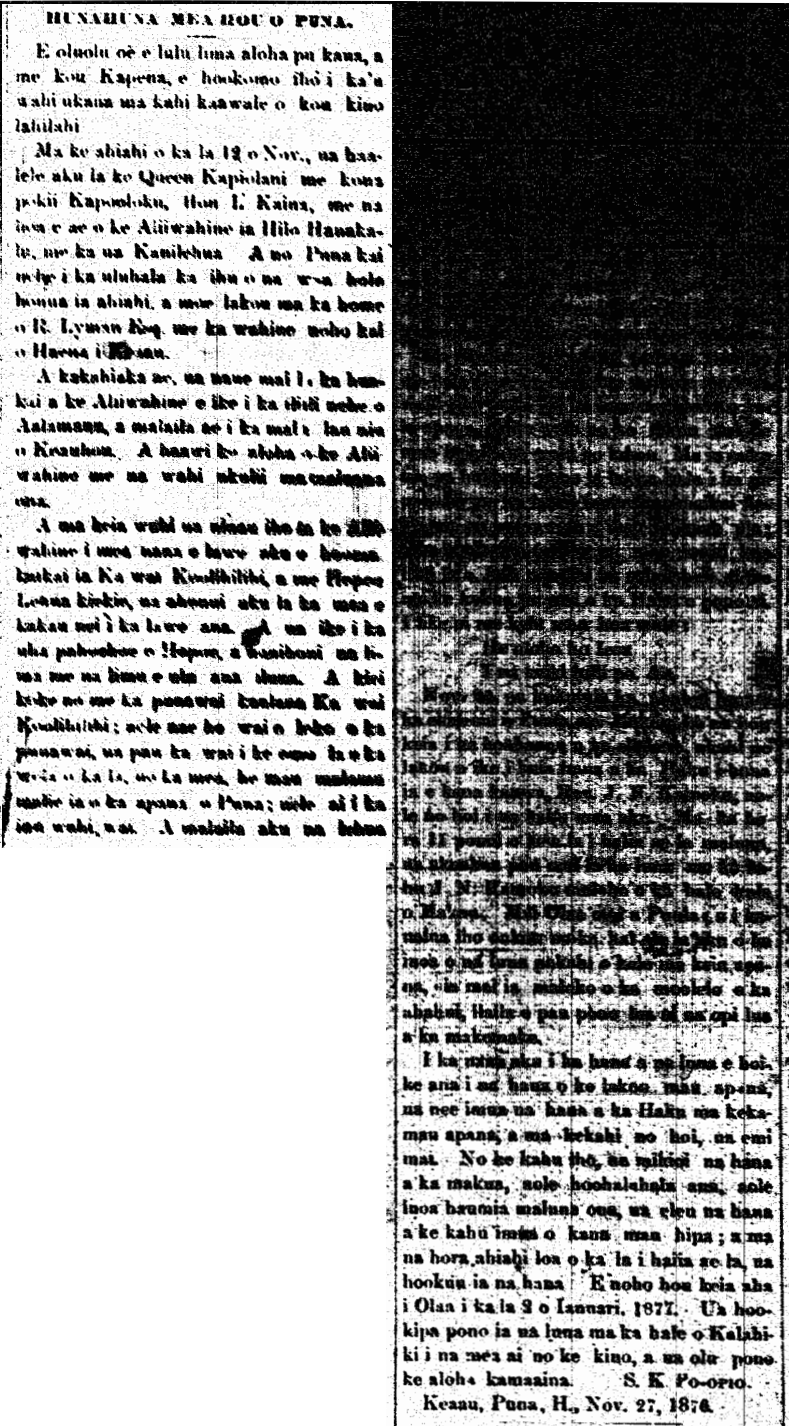
HUNAHUNA MEA HOU O PUNA.

Ka Lahui Hawaii, Buke II, Helu 52, Aoao 2. Dekemaba 21, 1876

News of the Titanic reaches Hawaii. 1912.

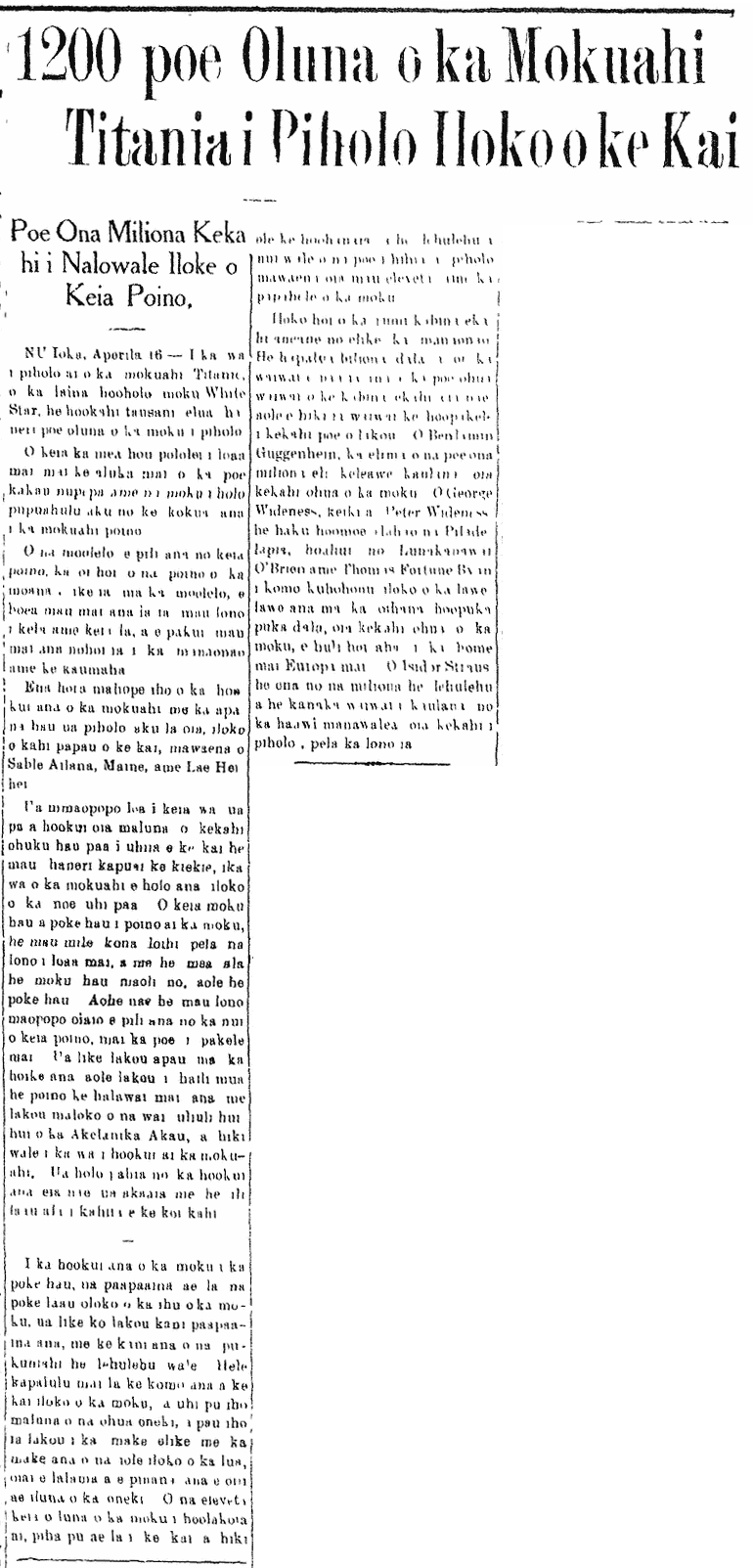
1200 People Aboard the Steamship Titanic Drown in the Sea

Amongst the Missing of This Tragedy are Millionaires

New York, April 16—When the steamship Titanic of the White Star Line went down in the sea, there were a thousand and two hundred people on board who drowned.

This is the true account from the crowd of newspaper writers as well as those on the ships what scurried to assist the vessel.

The story of this tragedy is the worse of all maritime disasters know in history; news keeps arriving daily adding to the horror and sadness.

Two hours after the ship collided with the piece of ice, it sank in a shallow part of the ocean between Sable Island and Cape Race.

It is now known that it ran on top of a solid mass of ice that was blanketed by the sea, and some hundreds of feet tall, while the steamship was travelling through dense fog. This chunk of ice which damaged the ship was a mile across, according to reports received, and it was like an island made of ice, and not a chunk of ice. There was no definitive word on the massiveness of this calamity from the people who were rescued. They all stated that they had no clue that they’d meet with tragedy in the dark, frigid waters of the North Atlantic, until the steamship collided. The hit was at an angle, but it was peeled off like the bark of a tree is shaved off by a plane.

When the ship ran in to the mass of ice, the boards in the bow of the ship snapped, and this snapping sounded like many cannons going off. The sea water rushed into the ship and washed over the deck passengers, who were all done for like rats dying in their holes, while they reached about and climbed to get to the top of the deck. The elevators that the ship was equipped with were filled with water and were not functional; and there were many who were trapped and drowned in them between floors of the ship.

In the first-class cabins, the horror was almost the same. The first-class passengers had a half billion dollars or more between them, and yet that wealth could not save any one of them. Benjamin Guggenheim, the fifth of the famous copper millionaires was on the ship. George Wideness [Widener], the son of Peter Wideness [Widener], the head of railroad track laying in Philadelphia, and partner of O’Brien and Thomas Fortune Ryan, deep in their money making schemes, was a passenger on the ship, and was headed home from Europe. Isidor Straus, a multimillionaire and a wealthy man famous for his philanthropy is one of the drowned; that is what is heard.

[This article appears to have been taken from the first page story of the Hawaiian Gazette on April 16, 1912. All three Hawaiian-Language Newspapers of the time were covering this tragic story.]

(Kuokoa Home Rula, 4/19/1912, p. 1)

1200 poe Oluna o ka Mokuahi Titania i Piholo iloko o ke Kai

Kuokoa Home Rula, Buke X, Helu 16, Aoao 1. Aperila 19, 1912.

Charles K. Shaw marries Indian princess, 1912.

THAT HAWAIIAN MARRIES AN INDIAN PRINCESS.

Seattle, Washington, Mar. 20. A princess of the Sioux Indians of Rosebud, S. D., whose name is Miss Indeta Lapollette [Lafollette], married this evening by the Rev. A. Sandell on Seventh Avenue, Number 313, to Charles K. Shaw, a Hawaiian boy. With the marriage of this half-Indian lady, she left J. H. Magoon, the one who has a theater in the Hawaiian Islands. This beautiful young lady is half French and half Indian. Her mother is a Sioux Indian. Her father is a chief of the Sioux Indians, and when he died, his wealth was inherited by his daughter.

Because her mother saw the decrease in the Indian race, she thought it would not be useful for her daughters to continue the traditional ways of the Indians, so she told her daughter to learn the ideas and knowledge of Europe. Her education began in school on their reservation. She is fluent in the English language.

The marriage of these two was a marvelous. The woman wore full Indian dress, and the man, he wore a black suit. The words of Rev. A. Sandell spoke when the two were wed were short. Her husband is training her in Hawaiian song and dance. When the ceremony was over, Miss Lapollette stated:

“I’ve not stepped at all on the stage of a theater, but my husband is trying hard to teach me so that I learn Hawaiian hula. I have some singing ability, and if I am with a group of four or five friends from Hawaii, I believe I can be of assistance to them.

When the groom’s mother, Mrs. Esther Shaw, who lives at Number 3618 Fifth Avenue, Portland, heard that her son was getting married to a woman, she immediately sent a telegram to Claude Gage, the issuer of marriage licenses, for her son, being that he only 19 years old at the time, but the license granter was already told that Mr. Shaw was 21 years old. The mother’s telegram was received too late.

(Aloha Aina, 4/13/1912, p. 2)

MARE IA HAWAII I KEKAHI KAIKAMAHINE ALII ILIKINI

Ke Aloha Aina, Buke XVI, Helu 15, Aoao 2. Aperila 13, 1912.

Titanic survivor comes through Hawaii. 1912

[Found under: “Local News”]

One of the passengers who escaped from the steamship Titanic, Hosono, a Japanese, arrived here in Honolulu aboard the Shinyo Maru [Shun’yō Maru] and left for Japan.

[Monday (4/16/2012) marks the 100th year since the tragedy heard all over the world. Who knew the only Japanese aboard the Titanic, Masabumi Hosono, spent some time in Hawaii nei.]

(Kuokoa, 5/31/1912, p. 8)

O kekahi o na ohua...

Ka Nupepa Kuokoa, Buke XLVIII, Helu 22, Aoao 8. Mei 31, 1912.

Vital Statistics, 1912.

MARRIAGES.

William Naehu to Kealoha Molena, March 15.
Charles K. Heulu to Haehae H. Mitchell, March 23.
Robert S. Lono to Hattie Akana, March 27.
Young San to Josephine Kama, March 30.
Joseph Haiha to Margaret Liwai, March 30.
Edward K. Lilikalani to Ruth Keoholiko, April 3.
Manuel A. Fernandez to Kepola Mana, April 3.
Peter N. Kahokuoluna to Alice L. Rosehill, April 4.

BIRTHS.

To Kiu Wo and Julia Aki, a daughter, April 2.
To David Kakalia and Kalaniimi, a son, April 2.
To Manuel South and Hattie Keohohou, a daughter, April 4.
To Pulu Helenihi and Phoebe Cockett, a daughter, April 6.

DEATHS.

Apiki, at Lunalilo Home, April 3.
Baby Smith, at Puuhale, April 4.
Kailianu Kalilikane, on Waiakamilo Street, April 6.
Jonah Keliiaa, on Ellen Street, April 7.

(Kuokoa, 4/12/1912, p. 8)

MARE. / HANAU. / MAKE.

Ka Nupepa Kuokoa, Buke XLVIII, Helu 15, Aoao 8. Aperila 12, 1912.

More on Liliuokalani and her support of education. 1895.

HYPOCRITICAL REMEMBRANCE.

The celebrating and remembering of the birthday of someone is not a bad thing, or something to criticize. And this applies when the person whose birthday that is being remembered has died, it is a good thing, should that person have done a famous deed or left an important legacy for her trustees to carry out, like the Alii, Pauahi-a-Paki.

We are not opposing the remembrance of her trustees and the heads of the Kamehameha Schools, like what was done this past Thursday, on the birthday of this Alii of this land, who showed her true aloha for her lahui by leaving her great estate for the good and welfare of the new generations of her own people, so that the their thoughts and actions are bettered. We do however oppose and criticize the attempt to deify, and it is almost to the point where the missionaries and teachers of those places of learning are making her, the deceased Alii, into a god [akua? ahua?] to be worshiped. In the presentations on that day mentioned, the girls performed before a huge audience of all sorts of people who attended, where they all knelt before an image of the Alii, and thereafter placed lei and flowers upon that picture. This is not a good lesson for the children.

Pauahi has died, she has gone, she is no more in body, but she still lives through her glorious deeds, perhaps the greatest amongst the Hawaiian Chiefs who left on the “Dark Path of Kane”. It is for her trustees and her representatives that were empowered in her will, which the Supreme Court will fill should there be a vacancy amongst those people, they are they ones carrying out these remembrances without her knowledge of what is being done, and that is why we call it—a hypocritical remembrance.

For here is the Queen, still living, and she is not honored by those missionaries for her good works that are exemplary for the benefit of her people, before and since her ascending the throne. She took up the Liliuokalani Educational Society, with its two divisions, and greatly assisted its funds from her own earnings and property. There were many girls who received an education because of this society, and the girls’ school of Kawaiahao, that grounds of learning of the missionaries, saw benefits, and this cannot be denied in the least.

She is sill living and has followed through on her good works which were established under her very own leadership, not by other like with the late Pauahi. And yet these haughty missionaries of her days don’t at all remember her great deeds which show her true aloha for her lahui while she is alive and not after her death. Aye, she is still living, and we see the fruits of her good labors, and perhaps she mistakenly put her faith in her weak fellow lahui for whom she felt much aloha, and she fell from her position on high; and now she sees clearly those who are steadfastly loyal to her and those who are traitorous, abusive, and speak badly about her.

The missionaries themselves are the true witnesses to her good deeds. They have no words for Pauahi, hers were seen before. They go to her [Liliuokalani] and ask for money from her, and they are not given just a trifle, but they are given great amounts. And yet, those people do not think a bit of her, or thank her, not at all; they instead abuse and fling and besmear her with filth, in return for the good that was done, and given to, and received by them. This is a time to tell tales, to rouse, ask for rudely, to beg, to abuse, to curse, to insult, and that list goes on and on, just filled with indolence.

[How sad that even today, her namesake, Queen Lydia Liliuokalani Elementary School has been shut down. Today there was a celebration of the 100th anniversary of the laying of the cornerstone of the school on the grounds of Liliuokalani Elementary School! Let us remember her always along with her great love for her people!]

(Makaainana, 12/23/1895, pp. 4 & 5.)

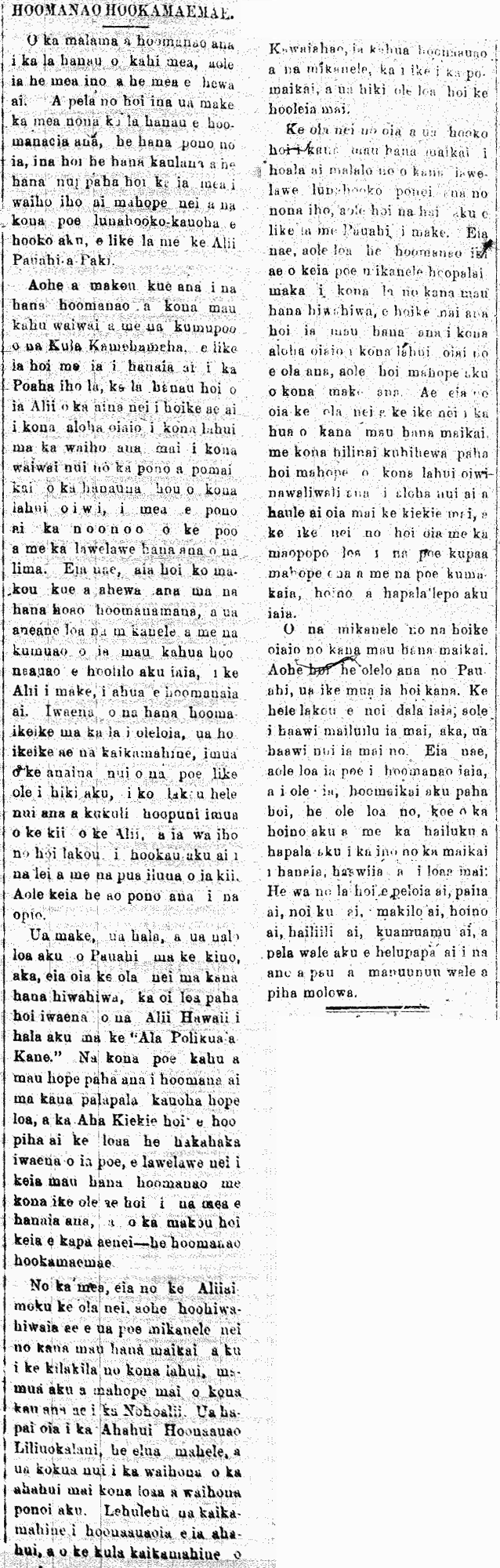
HOOMANAO HOOKAMAEMAE.

Ka Makaainana, Buke IV----Ano Hou., Helu 26, Aoao 4 & 5. Dekemaba 23, 1895.

Speaking of immigration… 2012.

Tradition and Transition: Stories of Hawai‘i Immigrants

Tradition and Transition

Fall 2011 – Summer 2013

Castle Hall’s second floor gallery features special treasured stories in focus cases, a timeline of Hawaiian history, video stations, and significant artifacts and document to relay the history of Japanese in Hawai‘i.

Inspiring stories abound when the discussion centers on the challenges faced by immigrants coming to a new homeland. Tradition and Transition, Stories of Hawai‘i Immigrants presents these and celebrates the diversity brought by all ethnic groups who contribute to the economic strength and cultural multiplicity of Hawai‘i.

Tradition and Transition, Stories of Hawai‘i’s Immigrants celebrates the stories of challenge and victory, tales of hardship matched with those of success. It is a story that focuses on the strength of human spirit and the power of change.

For children, a Pā‘ani Place is forfor kids to learn about multi-ethnic playthings and pastimes.

The hallway adjacent to the main exhibition gallery is Ho‘olaule‘a Hall, filled with large photomurals, hanging celebratory items, and smaller exhibit cases that focus on multiethnic celebrations.

At the end of the Ho‘olaule‘a Hall, will be Ho‘okipa Parlor, a recreation of the interior of a plantation home living room, welcoming visitors who wish to sit a while and browse books on various local ethnic traditions or watch some old news reels of plantation-era Hawai‘i.

Tradition and Transition: Stories of Hawai‘i’s Immigrants is funded by generous gifts from the Atsuhiko & Ina Goodwin Tateuchi Foundation and Hawai‘i Imin Shiryō Hozon Kai.

Tateuchi Foundation

[Don’t forget to check out this ongoing exhibit at the Bishop Museum! The description is taken from the Bishop Museum page.]