Unknown's avatar

About nupepa

Just another place that posts random articles from the Hawaiian Newspapers! It would be awesome if this should become a space where open discussions happen on all topics written about in those papers!! And please note that these are definitely not polished translations, but are just drafts!!! [This blog is not affiliated with any organization and receives no funding. Statements made here should in now way be seen as a reflection on other organizations or people. All errors in interpretation are my own.]

More from David Keaweamahi on Japanese contract laborers, 1890.

From Japan!

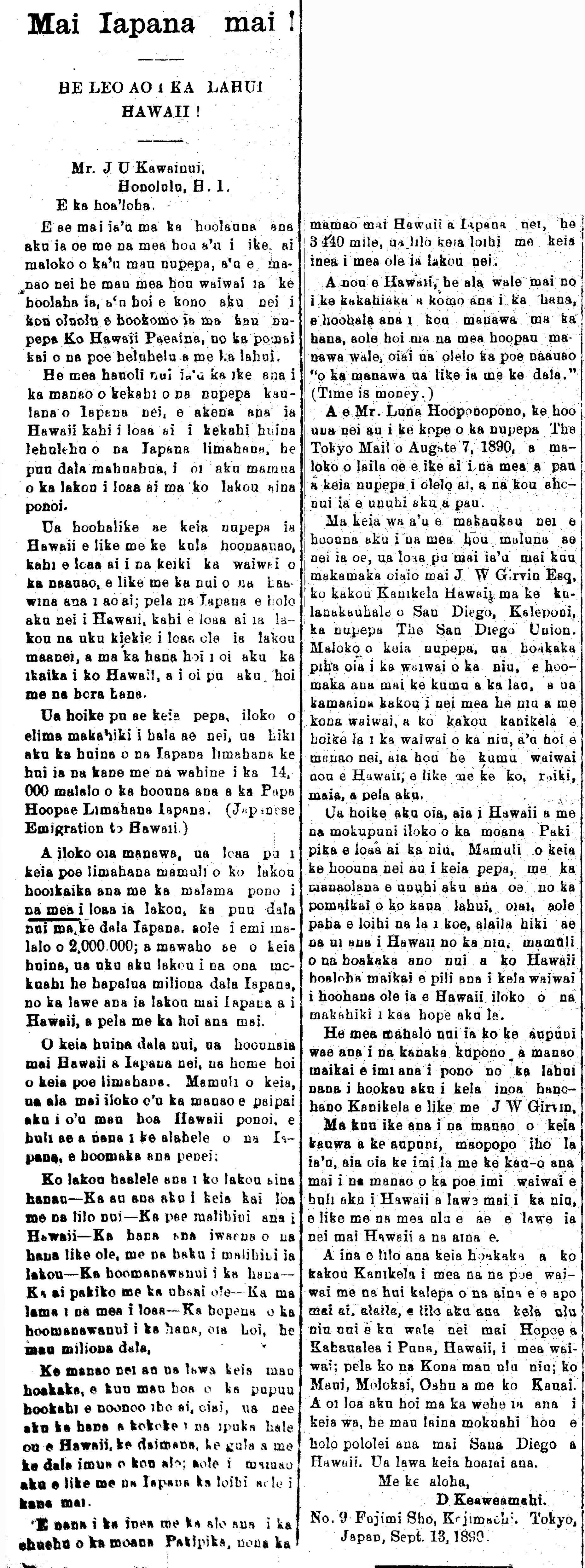
INFORMATION FOR THE HAWAIIAN PEOPLE!

Mr. J. U. Kawainui,

Honolulu, H. I.

O Friend,

Please allow me to introduce you to the new things I have seen in my newspaper which I believe are new information important to spread; which I invite you to kindly insert into your newspaper, Ko Hawaii Pae Aina, for the benefit of the readers and the nation.

I was pleased to see the thoughts of a famous newspaper of Japan, praising Hawaii as the place where a great number of Japanese laborers obtained a big sum of money, more than they’d receive in their homeland.

This newspaper likened Hawaii to a school of education, where a child receives the wealth of knowledge, equal to the amount of lessons he studies; so too with the Japanese who are going to Hawaii, where they get high salaries that they’d not get here, and for more intense work than in Hawaii, along with more hours.

This paper also stated that within the past five years, the total number of Japanese laborers including men and women has reached 14,000, sent by the Board for Emigration of Japanese Laborers.

And within this period, these laborers, as a result of their effort and their saving of what they earned, made a great amount in Japanese money, not less than 2,000,000 yen; and not included with this, they paid the ship owners half a million yen to take them from Japan to Hawaii and return.

This great sum of money was sent from Hawaii to here in Japan, the home of these laborers. As a result, there rose within me the desire to encourage my own Hawaiian friends to take a look at the path taken by the Japanese, starting like this:

Their departure from the land of their birth—Their travelling across the great ocean at great expense—The landing as strangers in Hawaii—Working all sorts of jobs for a boss who is a stranger—Enduring the work—Eating only a little without wasting—Caring for what they have—The results of their putting up with the work, that being millions of dollars.

I believe that this is ample explanation, O Friends of the same womb, for you to think about; for the work has come to your door O Hawaiians—diamonds, gold, and money, right before your eyes; it is not far away like for the Japanese for whom it is far, far away.

Look at the hardships and the facing of the spray of the Pacific Ocean whose distance from Hawaii to Japan is 3,440 miles; this distance and hardships became nothing to them.

And you, O Hawaiians, you wake up in the morning and take up your work, and put in your time working, and not with things that waste your time, as goes the saying of the educated people: “Time is like money.”

And O Mr. Editor, I am sending a copy of the newspaper, “The Tokyo Mail” of August 7th, 1890, and within it you will see all of what this paper has said, and it is for you to patiently translate it all.

As I am preparing to send to you the news above, I have also received from my true friend, J. W. Girvin, Esq., our Hawaiian Consul in the city of San Diego, California, the newspaper “The San Diego Union”. Within this paper, he explained fully the value of coconuts, starting from the trunk to the leaves; we are familiar with coconuts and its value; and with our consul explaining the value of the coconut, I am thinking that there are also other sources of wealth for you, O Hawaiians, like sugarcane, rice, bananas, and so forth.

He explains that coconuts can be found in Hawaii and the islands of the Pacific Ocean. Therefore, I am sending this paper with hopes that you will translate it for the good of our people, being that it should not be long before Hawaii starts receiving inquiries for coconuts because of this important description of Hawaii’s good friend dealing with the asset not put to use by Hawaiians in the past years.

It is a very admirable thing that the government selects good people with good ideas to search after the well being of the people that conferred upon him that honorable title, Consul, like J. W. Girvin.

When I look at the ideas of this servant of the nation, I know that he is searching while pulling along the minds of entrepreneurs to look to Hawaii to export coconuts, like the other produce exported from Hawaii to other lands.

And should this description of our Consul become something that the wealthy people and trade companies of foreign lands latch on to, then those great fields of coconut from Hopoe until Kahaualea in Puna, Hawaii will become a source of wealth; so too the stands of coconut in the Kona districts, along with those of Maui, Molokai, Oahu and Kauai. And even more so, with the opening these days of new steamship lines which go directly from San Diego to Hawaii. This clarification should be sufficient.

With aloha,

D. Keaweamahi.

No. 9 Fujimi Sho [Fujimi-cho], Kojimachi, Tokyo, Japan, Sept. 13, 1890.

[As we celebrate Merrie Monarch week, Japanese contract laborers is one of Kalakaua’s many legacies…]

(Ko Hawaii Pae Aina, 9/27/1890, p. 2)
Mai Iapana mai!

Ko Hawaii Pae Aina, Buke XIII, Helu 39, Aoao 2. Sepatemaba 27, 1890.
David Keaweamahi living in Japan, 1890.

[Found under: “News of Hawaii”]

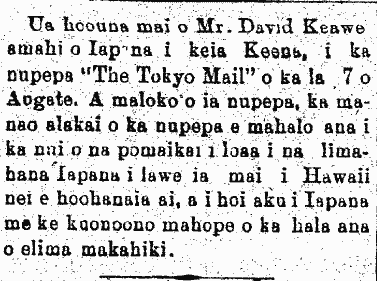
Mr. David Keaweamahi of Japan sent the newspaper, “The Tokyo Mail” of the 7th of August. Within that paper, an editorial expressed appreciation at the great benefits gained by the Japanese laborers brought to Hawaii nei to be put to work and then returned well off to Japan after five years.

(Ko Hawaii Pae Aina, 9/27/1890, p. 2)

Ua hoouna mai o Mr. David Keaweamahi...

Ko Hawaii Pae Aina, Buke XIII, Helu 39, Aoao 2. Sepatemaba 27, 1890.

Two interesting testimonials appearing in the same issue, 1892.

VERIFICATION OF THE TRUTH.

Honolulu, April 4, 1892.

I hereby attest, I am the one whose name appears below; in order to verify the miraculous works of Mr. Marcus W. Lowell, and so that the public knows, he treated my wife in 1886 after she contracted the disease known as the sickness that separates families [ma’i hookaawale ohana]; he treated her and she got much better than with the doctors who treated her. She suffered for ten years from this sickness, and within a month, Mr. Lowell saved her because of his aloha he had for my wife during that time.

To attest to this, I place my name here.

John Kahikina Kelekona.

(Leo o ka Lahui, 4/8/1892, p. 2)

HE HOIKE AKU I KA OIAIO.

Ka Leo o ka Lahui, Buke II, Helu 428, Aoao 2. Aperila 8, 1892.

CURE FOR CANCER.

Honolulu, March 24, 1892.

I, George Campton, carpenter, have been a resident of these Islands for the last 14 years. In the last year 1891 I suffered from cancer in the leg, and through the advice of a friend I had Mr. Lowell to see it. I suffered the most excruciating pain and has confined to my bed for weeks, when Mr. Lowel saw me and told me he thought he could cure it, and to my utter astonishment, in one month from the time Mr. Lowell first saw it it was cured. It is now nearly three months since and has all the appearance of a complete cure. In three weeks from the time Mr. Lowell first saw me I was able to go about my dusiness. Any one desiring further information can call on me at 36 King St.

(Leo o ka Lahui, 4/8/1892, p. 4)

CURE FOR CANCER.

Ka Leo o ka Lahui, Buke II, Helu 428, Aoao 4. Aperila 8, 1892.

Import of Snakes to Hawaii? 1902.

Snakes are Allowed to be Imported to Hawaii.

THIS NEWS WAS REPORTED TO THE HEAD CUSTOMS INSPECTOR OF HAWAII.

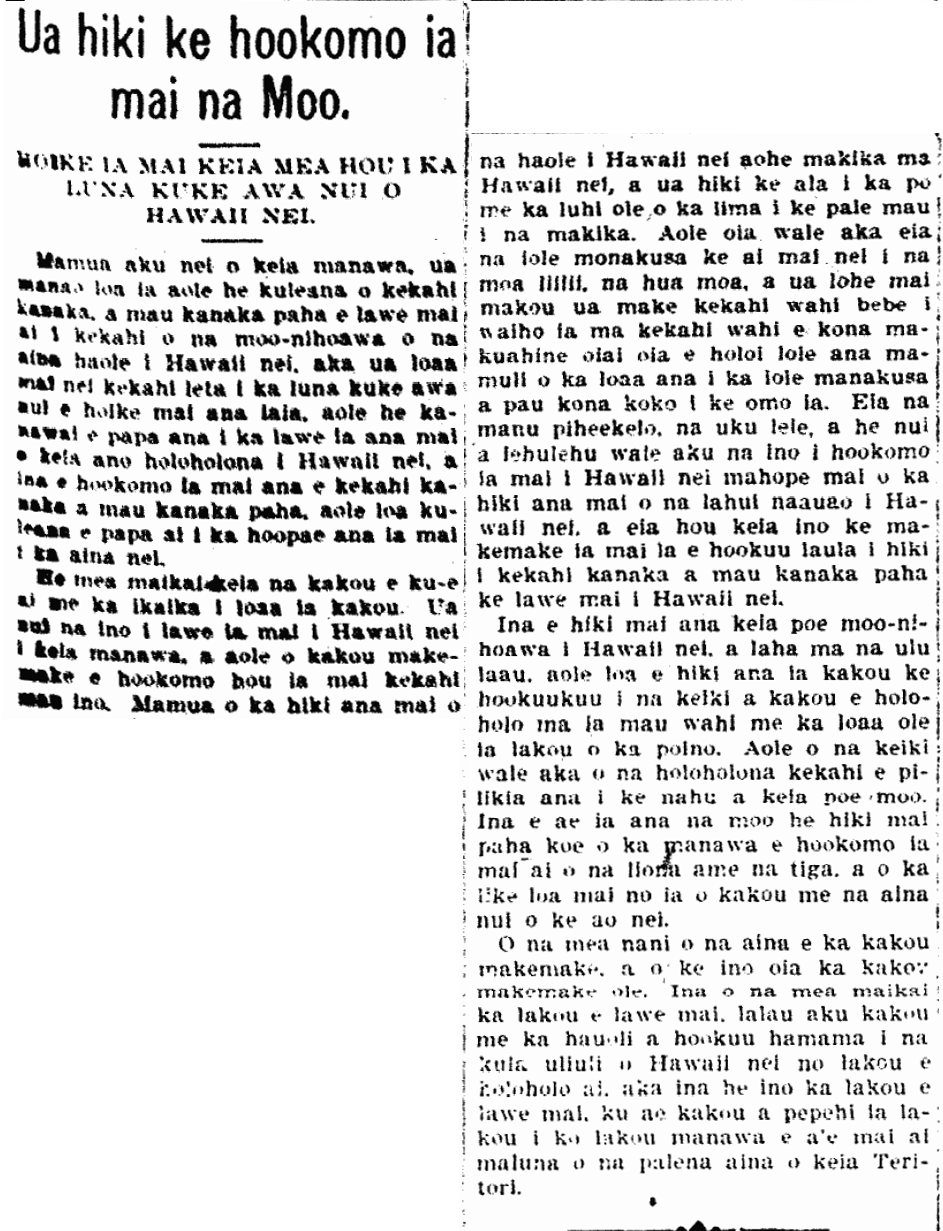
It was thoroughly believed that a person or persons could not bring in snakes from foreign lands into Hawaii, but the head custom inspector received a letter telling him that there is no law prohibiting the import of this type of animal into Hawaii, and should it be brought in by a person or persons, he has not right to prevent the bringing of it ashore.

It is right for us to oppose this with what power we have. There are many pests currently brought into Hawaii, and we do not want to bring in others. Before the arrival to Hawaii nei, there were no mosquitoes here, and they could be up at night without their hands tiring out from constantly waving them off. That isn’t all, there is the mongoose that are eating chicks, and eggs, and we hear that a baby left somewhere by its mother while she was washing clothes, died because it was got by a mongoose which sucked all of its blood. There are also mynah birds, fleas, and many, many other pests brought into Hawaii after the arrival of the enlightened races into Hawaii, and here is another thing that is wanted to be open to a person or persons to bring into Hawaii.

If these snakes come into Hawaii nei, and they spread in the forests, we will not be able to let our children go out to those places without facing calamity. Not just the children, but animals will be in danger of being bit by these snakes. If the snakes are allowed, the time will perhaps come when lions and tigers will be imported, and we will be just like most of the lands of the world.

We want the beautiful things of the other lands, but the problems are what we don’t want. If they import beneficial things, we will happily take them let them free in our verdant fields of Hawaii nei for them to run about; however, if they are to bring in pests, we will stand and exterminate them when they step within the borders of this Territory.

[That was a close one! But lately, with all the budget cuts and the resulting lack of inspectors doing inspections, who knows what is being brought into Hawaii nei. Some things are too important to let fall to the side…]

(Kuokoa, 4/11/1902, p. 1)

Ua hiki ke hookomo ia mai na Moo.

Ka Nupepa Kuokoa, Buke XL, Helu 15, Aoao 1. Aperila 11, 1902.

Bathing Pool of Kamehameha V on Molokai filled in? 1922.

Honolulu, Apr. 4. George P. Cooke reported that a Hawaiian of Molokai recalls [???] the large bathing pool of King Kamehameha V, while the king was living in Kaunakahakai, and this pool is filled with dirt now; and that Hawaiian recalls some springs near that pool of Kamehameha V. There are reservoirs being dug in the area near where that man spoke of, and [???]; the water from these places is well suited for the growing crops. There is a water pump pumping [??] thousand gallons of water every 24 hours. This is a great help [?] to Molokai.

[More potentially @-filled information …]

(Hoku o Hawaii, 4/6/1922, p. 3)

Honolulu, Apr. 4...

Ka Hoku o Hawaii, Buke XV, Helu 45, Aoao 3, Aperila 6, 1922.

Night fishing violations, 1932.

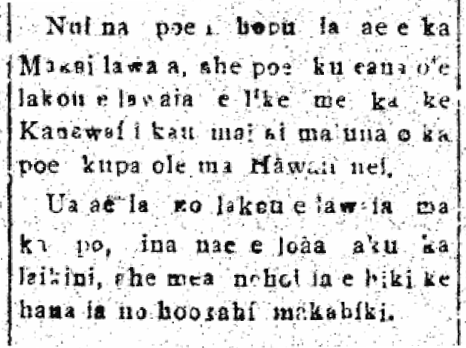
There were many who were arrested by the Fishing Warden; these were people who had no rights to fish as per the Law dealing with people who are not natives [citizens?] of Hawaii.

They are allowed to fish at night, only if they get a license, which can be used for a year.

[I wonder if this gets typescripted by someone who has no Hawaiian language knowledge, if any of the key words will be found doing a word search (lawaia, kanawai, …) Or, will it look more like this:

Nui na poe i hoou la ae e ka Makai lawa a, ahe poe ku eana o’e lakou e la@aia e like me ka ke Kauewai i kau mai ai ma una o ka poe kupa ole ma Hawaii nei.

Ua ae la eo lakau e law@ia ma ka po, ina nac e loaa aku ka laikini, ahe mca nohoi ia e @iki ke haua ia no hookahi makahiki.

This is actually one of the articles that aren’t as bad as many…]

(Hoku o Hawaii, 4/5/1932, p. 3)

Nui na poe i hopu ia...

Ka Hoku o Hawaii, Buke XXV, Helu 43, Aoao 3. Aperila 5, 1932.

Heiau descriptions, lost for now, 1883.

SOME HEIAU OF OLD.

Earlier, some old temples of Hawaii were introduced: their description, and where they stand.

There are a number of old heiau standing in North Kohala. Mokini [Mookini] is the name of one of them in Kohala Waho, standing atop a flat base in Puuepa; it is a beautiful structure.

This heiau, according to its history, was built by the many and multitudes of gods and the menehune, that according to the natives who live there; the stones used to build it are from Pololu, and the menehune stood in a line all the way to Pololu; this heiau was built at night.

It faces the southwest, facing directly at the point of Upolu; some parts of the front enclosure have fallen, [???] are at the northwest, this heiau stands alone in a bare area, the land is level, and it has stood for centuries.

The second heiau is [Muleiula?], this heiau is located [???] Awaeli, its base is very flat like that of the earlier one, so too is the base of this one.

This heiau was erected by Hua, the one for whom is said, “The bones of Hua are dried in the sun,” [???] this heiau when he went [???] in the cliffs of Pololu, and [???] is called the cliffs of Kamakaohua.

The third heiau is named [Ku???], it is at [Maka???]; this heiau is very near to [???] at the harbor of Keokea; this heiau is like the earlier ones spoken of before, the purpose of this heiau was for agriculture, according to its history.

These heiau [???] multitudes of idol gods worshiped by the people of old, and they believed there was no other god.

In these modern days, [???] who are worshiping the idol gods of the old days? Here [???] children of men [???] in [???] and those hearts are full of idolatry.

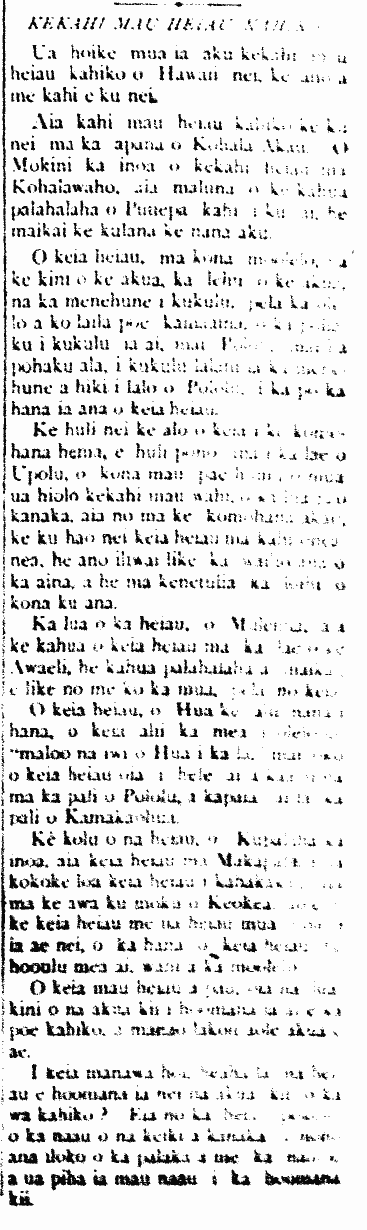
[There are so many articles like these that are partially or totally illegible without going back to the original newspapers.

If made “word searchable” as is:

Ke kolu o na heiau, o Ku@@@@ ka inoa, aia keia heiau ma Maka@@@@@@@@ kokoke loa keia heiau i kanaka@@@@@@@@ ma ke awa ku moku o Keokea @@@@@@@@ ke keia heiau me na @@@@@ mua @@@@@@@ ia ae nei, o ka hana o keia heiau @@@@@ hooulu mea ai, wahi a ka moolelo.

The most logical thing to do would be to take new and clear images of the papers all together, so that each time someone is interested in a partial article like this one, they will not need to flip through the fragile originals just so they can see one page.]

(Kuokoa, 11/4/1883, p. 1)

KEKAHI MAU HEIAU KAHIKO.

Ka Nupepa Kuokoa, Buke XXII, Helu 44, Aoao 1. Novemaba 4, 1883.

Crown Lands and Government Lands, 1896.

GOVERNMENT LANDS.

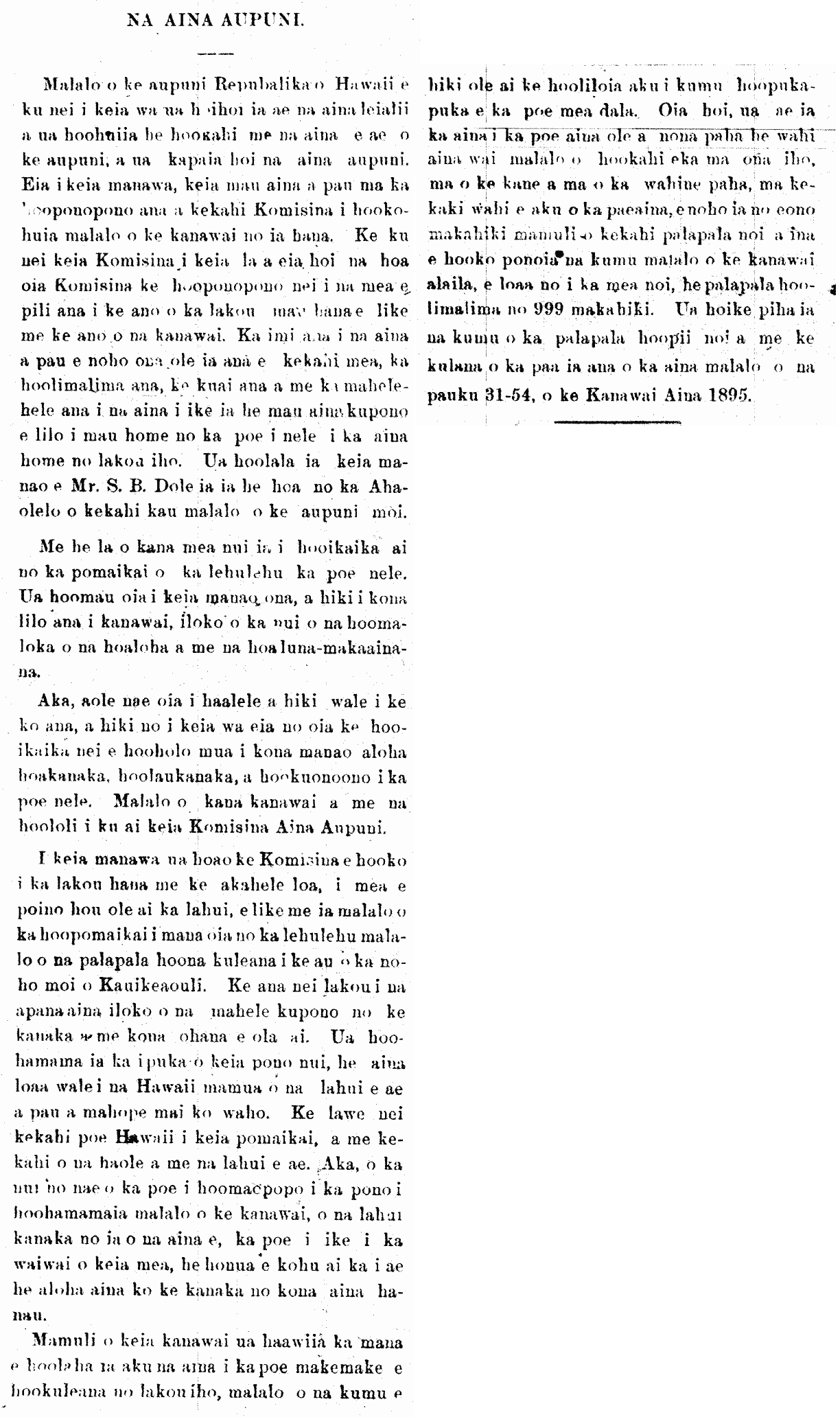
Under the Republic of Hawaii that stands now, the crown lands have been returned and added with the other lands of the government, and are referred to as government lands. Currently, the entirety of these lands are under the authority of a Commission appointed for that purpose under the law. The Commission is active today and its members are putting into order matters that pertain to their duties as per the laws. The finding of all lands that are not to be owned by someone, as well as the leasing, selling, and dividing of lands that are recognized as lands fitting to be homes for people without homesteads for themselves. This idea was devised by Mr. S. B. Dole while he was a member of the Legislature for a session under the monarchy.

It seems that this was what he focused on, for the good of those without. He kept at this idea until it became law, amidst much skepticism by friends and fellow representatives.

But he did not relent until he succeeded, and now he is working to move forward his loving idea for his fellow man, to increase, and to make prosperous, the poor people. Under his law and its revisions, this Government Lands Commission was created.

At this time, the Commission is trying to carefully carry out their duties so that the lahui will not once again be hurt like under the benefits intended for the masses with the quiet land titles in the time of Kauikeaouli’s rule. They are surveying parcels from areas suited for a man and his family to live. The doors to this great right is opened and Hawaiians will receive land before all other ethnicities and then thereafter those from the outside. There are some Hawaiians taking advantage of this opportunity, along with some haole and other ethnicities. But the majority of those that know of the good offered up by this law are the people of foreign lands, the ones who know the value of land for which one is able to say that he is patriotic to the land of his birth.

By this law, power is give to advertise land to those who claim land for themselves, under the condition that they cannot use it for profit. The land is available to those without land or those with wetlands of less than an acre under his name, or under the husband or wife in some other area of the archipelago; they will live on the land for six years after the request for land and should they meet the qualifications under the law, the applicant will receive a lease or 999 years. The requirements for the application and stipulations of the lease are shown in full in sections 31–54 of the Land Act of 1895.

[Just as it is today, it was back then. Different newspapers and sources had different stances. It is perhaps not best thing to base your opinions on a single article or the words of a single person. It is important to try and see all that was written and handed down in other ways (for ink and paper is not necessarily the best way that information is passed down), and then decide what you think on the subject…

Oh, and see here for the Land Act of 1895.]

(Oiaio Puka La, 4/3/1896, p. 2)

NA AINA AUPUNI.

Ka Oiaio Puka La, Buke I, Helu 67, Aoao 2. Aperila 3, 1896.

Ara, the Maori Wizard, 1912.

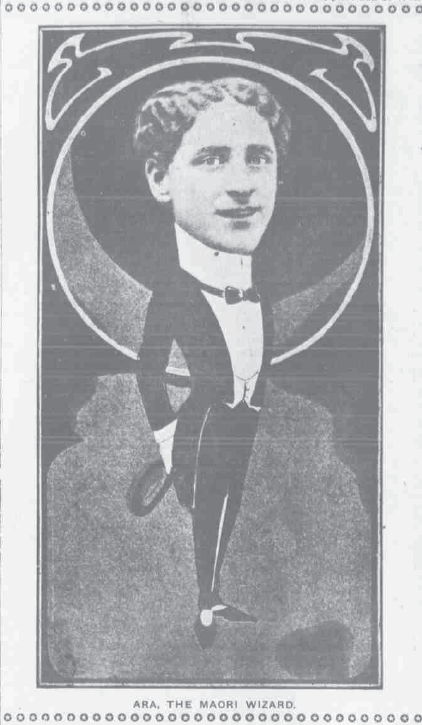
ARA, THE MAORI WIZARD

[Here is an image of Ara, mentioned in the previous post. See the rest of the article here: A Trip Around the World.

Also see more English-language coverage in Chronicling America!]

(Hawaiian Star, 2/10/1912, p. 12)

ARA, THE MAORI WIZARD

The Hawaiian Star, Volume XIX, Number 6198, Page 12. February 10, 1912.