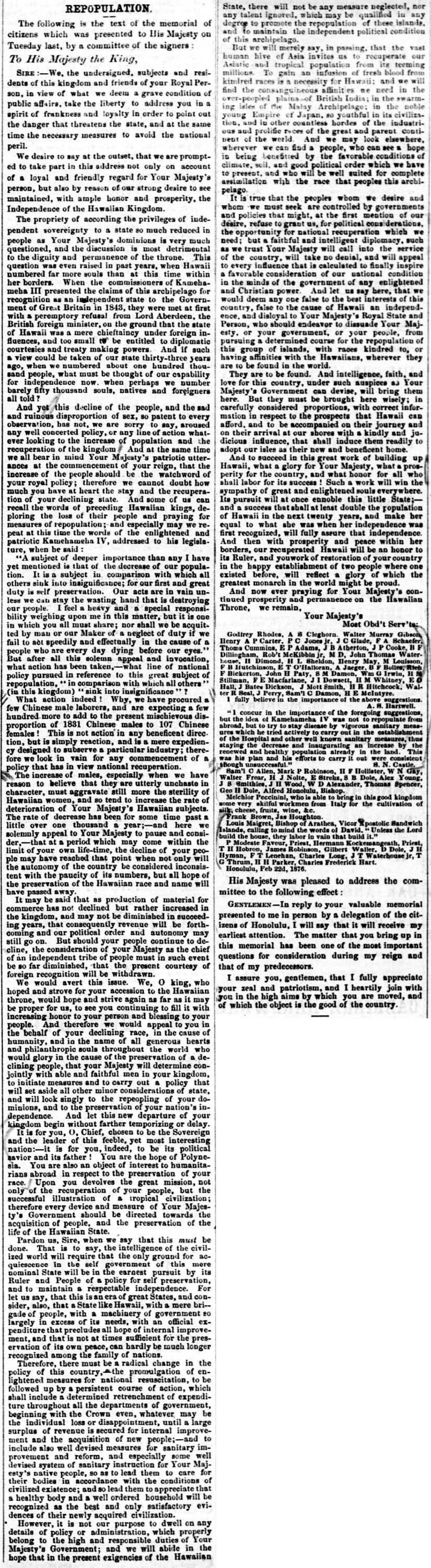
REPOPULATION.
The following is the text of the memorial of citizens which was presented to His Majesty on Tuesday last, by a committee of the signers:
To His Majesty the King,
Sire:—We, the undersigned, subjects and residents of this kingdom and friends of your Royal Person, in view of what we deem a grave condition of public affairs, take the liberty to address you in a spirit of frankness and loyalty in order to point out the danger that threatens the state, and at the same time the necessary measures to avoid the national peril.
We desire to say at the outset, that we are prompted to take part in this address not only on account of a loyal and friendly regard for Your Majesty’s person, but also by reason of our strong desire to see maintained, with ample honor and prosperity, the Independence of the Hawaiian Kingdom.
The propriety of according the privileges of independent sovereignty to a state so much reduced in people as Your Majesty’s dominions is very much questioned, and the discussion is most detrimental to the dignity and permanence of the throne. This question was even raised in past years, when Hawaii numbered far more souls than at this time within her borders. When the commissioners of Kamehameha III presented the claims of this archipelago for recognition as an independent state to the Government of Great Britain in 1843, they were met at first with a peremptory refusal from Lord Aberdeen, the British foreign minister, on the ground that the state of Hawaii was a mere chieftaincy under foreign influences, and too small to be entitled to diplomatic courtesies and treaty making powers. And if such a view could be taken of our state thirty-three years ago, when we numbered about one hundred thousand people, what must be thought of our capability for independence now, when perhaps we number barely fifty thousand souls, natives and foreigners all told?
And yet this decline of the people, and the sad and ruinous disproportion of sex, so patent to every observation, has not, we are sorry to say, aroused any well concerted policy, or any line of action whatever looking to the increase of population and the recuperation of the kingdom. And at the same time we all bear in mind Your Majesty’s patriotic utterances at the commencement of your reign, that the increase of the people should be the watchword of your royal policy; therefore we cannot doubt how much you have at heart the stay and the recuperation of your declining state. And some of us can recall the words of preceding Hawaiian kings, deploring the loss of their people and praying for measures of repopulation; and especially may we repeat at this time the words of the enlightened and patriotic Kamehameha IV, addressed to this legislature, when he said:
“A subject of deeper importance than any I have yet mentioned is that of the decrease of our population. It is a subject in comparison with which all others sink into insignificance; for our first and great duty is self preservation. Our acts are in vain unless we can stay the wasting hand that is destroying our people. I feel a heavy and a special responsibility weighing upon me in this matter, but it is one in which you all must share; nor shall we be acquitted by man or our Maker of a neglect of duty if we fail to act speedily and effectually in the cause of a people who are every day dying before our eyes.” But after all this solemn appeal and invocation, what action has been taken,—what line of national policy pursued in reference to this great subject of repopulation, “in comparison with which all others” (in this kingdom) “sink into insignificance”?
What action indeed! Why, we have procured a few Chinese male laborers, and are expecting a few hundred more to add to the present mischievous disproportion of 1831 Chinese males to 107 Chinese females! This is not action in any beneficent direction, but is simply reaction, and is a mere expediency designed to subserve a particular industry; therefore we look in vain for any commencement of a policy that has in view national recuperation.
The increase of males, especially when we have reason to believe that they are utterly unchaste in character, must aggravate still more the sterility of Hawaiian women, and so tend to increase the rate of deterioration of Your Majesty’s Hawaiian subjects. The rate of decrease has been for some time past a little over one thousand a year;—and here we solemnly appeal to Your Majesty to pause and consider,—that at a period which may come within the limit of your own life-time, the decline of your people may have reached that point when not only will the autonomy of the country be considered inconsistent with the paucity of its numbers, but all hope of the preservation of the Hawaiian race and name will have passed away.
It may be said that as production of material for commerce has not declined but rather increased in the kingdom, and may not be diminished in succeeding years, that consequently revenue will be forthcoming and our political order and autonomy may still go on. But should your people continue to decline, the consideration of your Majesty as the chief of an independent tribe of people must in such event be so far diminished, that the present courtesy of foreign recognition will be withdrawn.
We would avert this issue. We. O king, who hoped and strove for your accession to the Hawaiian throne, would hope and strive again as far as it may be proper for us, to see you continuing to fill it with increasing honor to your person and blessing to your people. And therefore we would appeal to you in the behalf of your declining race, in the cause of humanity, and in the name of all generous hearts and philanthropic souls throughout the world who would glory in the cause of the preservation of a declining people, that your Majesty will determine conjointly with able and faithful men in your kingdom, to inititate measures and to carry out a policy that will set aside all other minor considerations of state, and will look singly to the repeopling of your dominions, and to the preservation of your nation’s independence. And let this new departure of your kingdom begin without farther temporizing or delay.
It is for you, O, Chief, chosen to be the Sovereign and the leader of this feeble, yet most interesting nation:—it is for you, indeed, to be its political savior and its father! You are the hope of Polynesia. You are also an object of interest to humanitarians abroad in respect to the preservation of your race. upon you devolves the great mission, not only of the recuperation of your people, but the successful illustration of a tropical civilization; therefore every device and measure of Your Majesty’s Government should be directed towards the acquisition of people, and the preservation of the life of the Hawaiian State.
Pardon us, Sire, when we say that this must be done. That is to say, the intelligence of the civilized world will require that the only ground for acquiescence in the self government of this mere nominal State will be in the earnest pursuit by its Ruler and People of a policy for self preservation, and to maintain a respectable independence. For let us say, that this is an era of great States, and consider, also, that a State like Hawaii, with a mere brigade of people, with a machinery of government so largely in excess of its needs, with an official expenditure that precludes all hope of internal improvement, and that is not at times sufficient for the preservation of its own peace, can hardly be much longer recognized among the family of nations.
Therefore, there must be a radical change in the policy of this country,—the promulgation of enlightened measures for national resuscitation, to be followed up by a persistent course of action, which shall include a determined retrenchment of expenditure throughout all the departments of government, beginning with the Crown even, whatever may be the individual loss or disappointment, until a large surplus of revenue is secured for internal improvement and the acquisition of a new people;—and to include also well devised measures for sanitary improvement and reform, and especially some well devised system of sanitary instruction for Your Majesty’s native people, so as to lead them to appreciate that a healthy body and a well ordered household will be recognized as the best and only satisfactory evidences of their newly acquired civilization.
However, it is not our purpose to dwell on any details of policy or administration, which properly belong to the high and responsible duties of Your Majesty’s Government; and we will abide in the hope that in the present exigencies of the Hawaiian State, there will not be any measure neglected, nor any talent ignored, which may be qualified in any degree to promote the repopulation of these islands, and to maintain the independent political condition of this archipelago.
But we will merely say, in passing, that the vast human hive of Asia invites us to recuperate our Asiatic and tropical population from its teeming millions. To gain an infusion of fresh blood from kindred races is a necessity for Hawaii; and we will find the consanguineous affinities we need in the over-peopled plains—of British India; in the swarming isles of the Malay Archipelago; in the noble young Empire of Japan, so youthful in its civilization, and in other countless hordes of the industrious and prolific races of the great and parent continent of the world. And we may look elsewhere, wherever we can find a people, who can see a hope in being benefitted by the favorable conditions of climate, soil, and good political order which we have to present, and who will be well suited for complete assimilation with the race that peoples this archipelago.
It is true that the peoples whom we desire and whom we must seek are controlled by governments and policies that might, at the first mention of our desire, refuse to grant us, for political considerations, the opportunity for national recuperation which we need; but a faithful and intelligent diplomacy, such as we trust Your Majesty will call into the service of the country, will take no denial, and will appeal to every influence that is calculated to finally inspire a favorable consideration of our national condition in the minds of the government of any enlightened and Christian power. And let us say here, that we would deem any one false to the best interests of this country, false to the cause of Hawaii an independence, and disloyal to Your Majesty’s Royal State and Person, who should endeavor to dissuade Your Majesty, or your government, or your people, from pursuing a determined course for the repopulation of this group of islands, with races kindred to, or having affinities with the Hawaiians, wherever they are to be found in the world.
They are to be found. And intelligence, faith, and love for this country, under such auspices as Your Majesty’s Government can devise, will bring them here. But they must be brought here wisely; in carefully considered proportions, with correct information in respect to the prospects that Hawaii can afford, and to be accompanied on their journey and on their arrival at our shores with a kindly and judicious influence, that shall induce them readily to adopt our isles as their new and beneficent home.
And to succeed in this great work of building up Hawaii, what a glory for Your Majesty, what a prosperity for the country, and what honor for all who shall labor for its success! Such a work will win the sumpathy of great and enlightened souls everywhere. Its pursuit will at once ennoble this little State;—and a success that shall at least double the population of Hawaii in the next twenty years, and make her equal to what she was when her independence was first recognized, will fully assure that independence. And then with prosperity and peace within her borders, our recuperated Hawaii will be an honor to its Ruler, and youwork of restoration of your country in the happy establishment of two people where one existed before, will reflect a glory of which the greatest monarch in the world might be proud.
And now every praying for Your Majesty’s continued prosperity and permanence on the Hawaiian Throne, we remain,
Your Majesty’s
Most Obd’t Serv’ts:
Godfrey Rhodes, A. S. Cleghorn, Walter Murray Gibson, Henry A. P. Carter, P. C. Jones jr, J. C. Glade, F. A. Schaefer, Thomas Cummins, E. P. Adams, J. B. Atherton, J. P. Cooke, B. F. Dillingham, Robert McKibbin jr, M. D., John Thomas Waterhouse, H. Dimond, H. L. Sheldon, Henry May, M. Louisson, F. B. Hutchinson, E.T. O’Halloran, A. Jaeger, B. F. Bolles, Richard F. Bickerton, John H. Paty, S. M.Damon, William G. Irwin, H. M. Stillman, F. E. Macfarlane, J. I Dowsett, H. M. Whitney, E. O. Hall, J. Bates Dickson, J. Mott Smith, H. R. Hitchcock, Walter R. Seal, J. Perry, Samuel C. Damon, H. E. McIntyre.
I fully believe in the importance of the above suggestion.
A. S. Hartwell.
“I concur in the importance of the foregoing suggestions, but the idea of Kamehameha IV was not to repopulate from abroad, but to try to stay disease by vigorous sanitary measures which he tried actively to carry out in the establishment of the Hospital and other well known sanitary measures, thus staying the decrease and inaugurating an increase by the renewed and healthy population already in the land. This was his plan and his efforts to carry it out were consistent through unsuccessful.” S. N.Castle.
Samuel C. Allen, Mark P. Robinson, H. F. Hollister, W. N. Gay, Walter Frear, H. J. Nolte, E. Strehz, S. B. Dole, Alex Young, J. S. Smithies, J. H. Wood, W. D Alexander, Thomas Spencer, George H. Dole, Alfred Honolulu, Bishop.
Melchior Peccinini, who is able to bring in this good kingdom some very skillful workmen from Italy for the cultivation of silk, cheese, fruits, wine, &c.
Frank Brown, James Houghton.
Louis Maigret, Bishop of Arathea, Vicor Apostollic Sandwich Islands, calling to mind the words of David, “Unless the Lord build the house, they labor in vain that builds it.”
P. Modeste Faveur, Priest, Hermann Kockemangeath, Priest, T. H. Hobron, James Robinson, Gilbert Waller, D. Dole, J.H. Hyman, F. T. Lenehan, Charles Long, J. T. Waterhouse jr, T. G. Thrum, H. H. Parker, Charles Frederick Hart.
Honolulu, Feb 22d, 1876.
His Majesty was pleased to address the committee to the following effect:
Gentlemen—In reply to your valuable memorial presented tome in person by a delegation of the citizens of Honolulu, I will say that it will receive my earliest attention. The matter that you bring up in this memorial has been one of the most important questions for consideration during my reign and that of my predecessors.
I assure you, gentlemen, that I fully appreciate your zeal and patriotism, and I heartily join with you in the high aims by which you are moved, and of which the object is the good of the country.
(Pacific Commercial Advertiser, 3/4/1876, p. 3)

The Pacific Commercial Advertiser, Volume XX, Number 36, Page 3. March 4, 1876.


 nupepa