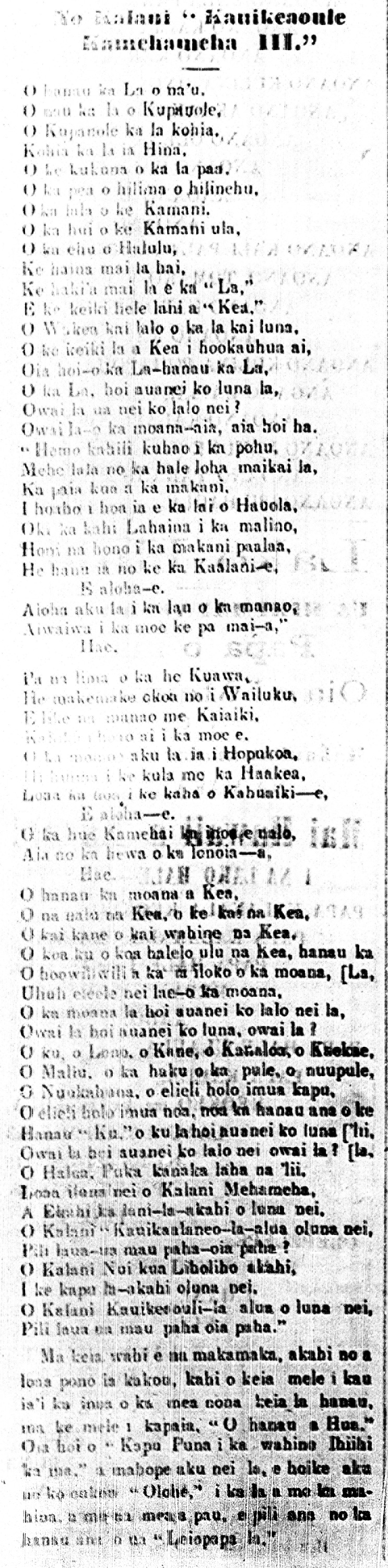
A patriotic mele criticizing the Rev. Joseph S. Emerson, 1893.

THE KAPUUKOLO CHURCH SCANDAL.

There is a saintly son of a gun,
Whose name is J. S. Emerson,
Who goes about in pious style,
To ease his anti-monarch bile.
And enters with his devout brother,
Hawaiian’s meeting: tries to smother,
All aloha for their Queen and land,
By fairy tales of witchcraft brand.
And sweetly says: “My christian friends,
“In order now to gain our ends,
“Will you ally yourselves with one,
“Who being but a native son.
“Has dared to infringe the haole’s plan
“And makes himself (deceitful man)
“The priest of God and Baal too?
“Shall such associate with you?
“Perish the thought! No! brethren dear,
“Not though my father’s sons, ’tis clear,
“Have robbed you of your lands and living,
“And taught you not that way to heaven.
“We’ll sweetly sing, in chorus clear
“The haole takes the government here
“Having taken all else, and let your Queen,
“Rely on none who here are seen.
“Associate she with heathens foul,
“Pig, kahunas, chickens, awa bowl!
“Shall such be helped with christian prayer,
“And our God asked for her to care.”
He stayed his speech and called for votes,
The answer from indignant throats,
Came fast and furious on his ears:
“Take out from here your lying sneers.
“Hypocrite! usurper! rebel! beast!
“Such words become your family least,
“Who live on what the royal hand,
“Gave bounteous of Waialua’s land.
“As pay for early prayer and praise,
“Raised by your father in those days,
“When missionaries first came here,
“And taught us a new God to fear.
“Go, hound! unto your wealthy home,
“Reflect on whence your creature comforts come,
“Think if you can what doom will be,
“Ingratitude’s God will bring to thee.
“Hide your grey locks in deepest shame
“Let another take your father’s name,
“Go, and ne’er again pollute,
“This sacred place with your foul boot.”
They went: None blessed their homeward way:
All seemed relieved: Arose the lay,
Of praise to God: and all agree,
To pray for Queen and Hawaii.

[Here is an article with descriptions of what led to this mele.]

(Hawaii Holomua, 2/11/1893, p. 4)

THE KAPUUKOLO CHURCH SCANDAL.

Hawaii Holomua, Buke III, Helu 7, Aoao 4. Feberuari 11, 1893.

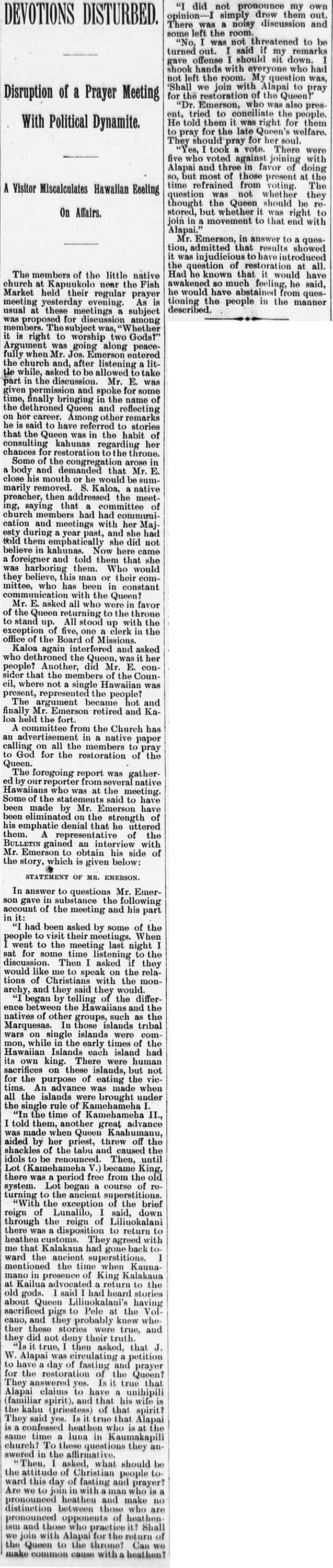
Joseph Emerson interrupts meeting at the Kapuukolo Church, 1893.

DEVOTIONS DISTURBED.

Disruption of a Prayer Meeting With Political Dynamite.

A Visitor Miscalculates Hawaiian Feeling On Affairs.

The members of the little native church at Kapuukolo near the Fish Market held their regular prayer meeting yesterday evening. As is usual at these meetings a subject was proposed for discussion among members. The subject was, “Whether it is right to worship two Gods?” Argument was going along peacefully when Mr. Jos. Emerson entered the church and, after listening a little while, asked to be allowed to take part in the discussion. Mr. E. was given permission and spoke for some time, finally bringing in the name of the dethroned Queen and reflecting on her career. Among other remarks he is said to have referred to stories that the Queen was in the habit of consulting kahunas regarding her chances for restoration to the throne.

 Some of the congregation arose in a body and demanded that Mr. E. close his mouth or he would be summarily removed. S. Kaloa, a native preacher, then addressed the meeting, saying that a committee of church members had had communication and meetings with her Majesty during a year past, and she had told them emphatically she did not believe in kahunas. Now here came a foreigner and told them that she was harboring them. Who would they believe, this man or their committee, who has been in constant communication with the Queen?

Mr. E. asked all who were in favor of the Queen returning to the throne to stand up. All stood up with the exception of five, one a clerk in the office of the Board of Missions.

Kaloa again interfered and asked who dethroned the Queen, was it her people? Another, did Mr. E. consider that the members of the Council, where not a single Hawaiian was present, represented the people?

The argument became hot and finally Mr. Emerson retired and Kaloa held the fort.

A committee from the Church has an advertisement in a native paper calling on all the members to pray to God for the restoration of the Queen.

The foregoing report was gathered by our reporter from several native Hawaiians who was at the meeting. Some of the statements said to have been made by Mr. Emerson have been eliminated on the strength of his emphatic denial that he uttered them. A representative of the Bulletin gained an interview with Mr. Emerson to obtain his side of the story, which is given below:

STATEMENT OF MR. EMERSON.

In answer to questions Mr. Emerson gave in substance the following account of the meeting and his part in it:

 “I had been asked by some of the people to visit their meetings. When I went to the meeting last night I sat for some time listening to the discussion. Then I asked if they would like me to speak on the relations of Christianity with the monarchy, and they said they would.

“I began by telling of the difference between the Hawaiians and the natives of other groups, such as the Marquesas. In those islands tribal wars on single islands were common, while in the early times of the Hawaiian Islands each island had its own king. There were human sacrifices on these islands, but not for the purpose of eating the victims. An advance was made when all the islands were brought under the single rule of Kamehameha I.

“In the time of Kamehameha II., I told them, another great advance was made when Queen Kaahumanu, aided by her priest, threw off the shackles of the tabu and caused the idols to be renounced. Then, until Lot (Kamehameha V.) became King, there was a period free from the old system. Lot began a course of returning to the ancient superstitions.

“With the exception of the brief reign of Lunalilo, I said, down through the reign of Liliuokalani there was a disposition to return to heathen customs. They agreed with me that Kalakaua had gone back toward the ancient superstitions. I mentioned the time when Kaunamano in the presence of King Kalakaua at Kailua advocated a return to the old gods. I said I had heard stories about Queen Liliuokalani’s having sacrificed pigs to Pele at the Volcano, and they probably knew whether these stories were true, and they did not deny their truth.

“Is it true, I then asked, that J. W. Alapai was circulating a petition to have a day of fasting and prayer for the restoration of the Queen? They answered yes. Is it true that Alapai claims to have a unihipili (familiar spirit), and that his wife is the kahu (priestess) of that spirit? They said yes. Is it tre that Alapai is a confessed heathen who is at the same time a luna in Kaumakapili church? To these questions they answered in the affirmative.

“Then, I asked, what should be the attitude of Christian people toward this day of fasting and prayer? Are we to join in with a man who is a pronounced heathen and make no distinction between those who are pronounced opponents of heathenism and those who practice it? Shall we join with Alapai for the return of the Queen to the throne? Can we make common cause with a heathen?

“I did not pronounce my own opinion—I simply drew them out. There was a noisy discussion and some left the room.

“No, I was not threatened to be turned out. I said if my remarks gave offense I should sit down. I shook hands with everyone who had not left the room. My question was, ‘Shall we join with Alapai to pray for the restoration of the Queen?’

“Dr. Emerson, who was also present, tried to conciliate the people. He told them it was right for them to pray for the late Queen’s welfare. They should pray for her soul.

“Yes, I took a vote. There were five who voted against joining with Alapai and three in favor of doing so, but most of those present at the time refrained from voting. The question was not whether they thought the Queen should be restored, but whether it was right to join in a movement to that end with Alapai.”

Mr. Emerson, in answer to a question, admitted that results showed it was injudicious to have introduced the question of restoration at all. Had he known that it would have awakened so much feeling, he said, he would have abstained from questioning the people in the manner described.

[This article was translated in Leo o ka Lahui, 2/9/1893, p. 2. It is interesting that there is a note appended to the end of the translated article that they did not have time to translate Emerson’s response.]

(Daily Bulletin, 2/7/1893, p. 3)

DEVOTIONS DISTURBED.

The Daily Bulletin, Volume V, Number 644, Page 3. February 7, 1893.

Henry Berger’s 50th birthday, and commentary on eating stones, 1894.

Celebrating Fifty Years

This past Saturday, at 7:30, a joint concert was held with the Hawaiian Republic band and the band of the Philadelphia, on the grounds of the Hawaiian Hotel to commemorate the birthday of the bandmaster of the Government, who is 50 years old. That night was the 4664th time he gave concerts in various locations, and this is his 500th at that place. The Government band went first, and when they were through, then there were singers of haole songs chosen from a non-Hawaiian singing group from the uplands of Leiolono, and then came the boys of the sea [from the Philadelphia]. When that was over, the two groups joined together for the ending, and that was the conclusion of the activities of the night. The band stage was illuminated by electric lights and all sorts of Japanese lanterns under tree branches. Continue reading

On eating stones, 1894.

[Found under: “KELA A ME KEIA.”]

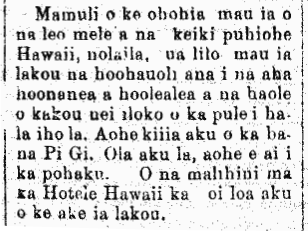
Because of the music of the boys of the Hawaiian band is constantly being of much acclaim, so to them went the jobs of entertaining parties of the haole of ours this past week. The P. G. band was not called for. They live, and do not have to eat stones. The visitors at the Hawaiian Hotel are those who want them the most.

[It was said that when the members of the Royal Hawaiian Band refused to sign an oath of allegiance to the P. G. The bandmaster Henry Berger told them they would end up eating stones… I cannot find a quote from the time. Does anyone know of one?]

(Makaainana, 10/15/1894, p. 8)

Mamuli o ke ohohia...

Ka Makaainana, Buke II—Ano Hou, Helu 16, Aoao 8. Okatoba 15, 1894.

Royal Hawaiian Band and “Kaulana na Pua,” 1893.

NIGHT OF GREAT ENTERTAINMENT.¹

There were many people who arrived at the Night of Entertainment by the Royal Hawaiian Band [Bana Lahui Hawaii], at the Hawaiian Hotel on the evening of this past Tuesday. There were perhaps 5,000 people of all ethnicities who showed up to listen to those beautiful singers of Hawaii. Because of your fine work, O Patriots, therefore the lahui showed its appreciation to you all, with them always filling the audiences of all the performances you give. The singing voices were sweet, and the most acclaimed was your “Mele Ai Pohaku.” The audience went home with happy hearts because of the mele that were played, along with the singing. When will the next performance be? Send in a notice in advance, and we will inform the multitudes and the friends of the occasion.

¹”Ka Po Lea o Halalii.”

(Leo o ka Lahui, 10/12/1893, p. 2)

KA PO LEA O HALALII.

Ka Leo o ka Lahui, Buke II, Helu 789, Aoao 3. Okatoba 12, 1893.

More awesome patriotic mele by Eleanor Prendergast, 1893.

HE WEHI NO KA LAHUI.

He inoa keia no ka lahui
Na ewe hanau o ka aina
Na pua na mamo na oiwi
A ka I a ka Mahi me ka Palena
E ala e lohe i ka welina
Ka’u kanaenae no Hawaii
Lahui malama i ka maluhia
Kupaa i ka pono o ke Kalaunu
Palekaua ia o ka manaoio
A he kolopa nana e une
Na pali kapu a o Kilauea
Ua paa i ke ahi a ka Wahine
I ke aiwaiwa o ke ao nei
Nana e hooni puni ka honua
Ike ia Hawaii a he moku nui
I ke o-i ana iho paa i ka mole
Keehi kulana i Ainaike
Ike ia kaua he hoa kanaka
Hookahi puuwai o ke aloha
Kakoo i kuu one hanau
Kihapai ia no Edena
Ua piha i ka ono me ke kuhinia
Nawai e ole a e makahehi
Na manu Aiko o ka Hikina mai
I ka ike i ka nani me ka hemolele
Aina o ka meli me ka waiu
E kahe ana ia me ke aliali
Me he wai hau ala no Helemona
Kona mau kuahiwi a he kilakila
He molale i ka maka ke ike aku
Ka makani kupa hoi a he aheahe
Kona mau kapakai a he malie
Na ulu laau a he uliuli
O kona mau pua e popohe ana
A he waianuahea kona aala [A he waianuhea kona aala]
E poina ole ai ke hoomanao
Mukiki ana i ka pua lehua
Ahe nani hiehie kona hiona
He nohea me he manu Nunu ala
Ka opua ua hoi ua haaheo
O ke anuenue e pipio ana
O ka oi no ia i ka’u ike
Aole ona lua e like ai
Kaena ana au me ka haaheo
No kuu aina i hanau ai
He momi i loaa mailuna mai
A he lei kaimana no ka lahui
E ola kakou a pau loa
Ma ka inoa o ka Haku Mana Loa
Haina e ka wehi i kaulana
He mele lahui no Hawaii.

Composed for the patriots

Miss Kekoaohiwaikalani,

Puahaulani Hale.

Honolulu, Feb. 10, 1893.

(Leo o ka Lahui, 2/16/1893, p. 3)

HE WEHI NO KA LAHUI.

Ka Leo o ka Lahui, Buke II, Helu 643, Aoao 3. Feberuari 16, 1893.

More patriotic mele composed by Eleanor Prendergast, 1893.

HE WEHI KAULANA NO KA LAHUI.

Eia Hawaii ua Lanakila,
Aina kaulana i ka hanohano,
Haaheo na Pua me na Mamo
A ka I a ka Mahi me ka Palena.
Lahui pookela o ke ao nei
Hookipa oluolu i ka malihini;
Puuwai hamama me ke aloha
Lokomaikai piha he manawalea.
Kui ai e ka lono puni ka honua
No ka hana kaulana a ka Lahui,
Malama maluhia me ka hoopono,
He manao kupaa me ka wiwoole.
Aohe puni wale i ka Lilelile,
I ka mali leo mai a ke Kolea.
Oiai ua kila ia ua paa
Ke aloha aina i ka puuwai.
Ua ewe, ua mole, ua onipaa.
Ua ku i ka piko kapu o Wakea.
Hookahi mea nui a ka manao
A e ake nei a e hookoia;
O ke Alii Aimoku i ke Aupuni
O ka aina hoi a e maluhia,
O ka Hae Kalaunu e welo ana
Haaheo mai ana i kona nani.
Hoike mai ana i ka Lahui
Ua hoi hou e ka Ea o ka Aina.
Lanakila mau loa aku Hawaii,
Me kona Hae nani oi kelakela.
Haina e ka wehi i kaulana
Na Pua i Aloha i ka Aina.

Miss Keko’aohiwaikalani

Puahaulani Hale.

Kawaiiki, Nov. 8th, 1893.

(Leo o ka Lahui, 11/10/1893, p. 3)

HE WEHI KAULANA NO KA LAHUI.

Ka Leo o ka Lahui, Buke II, Helu 810, Aoao 3. Novemaba 10, 1893.

Another patriotic mele by Eleanor Prendergast, 1893.

KE ALOHA AINA.

1st.  Kahiko ka ohu i Nuuanu
I ka hoku a ka lau Kawelu
Ua lupea ia e ka moani
Hoope aala oia uka.

Hui:  He halia he aloha keia
No kuu aina hanau
A’u e hiipoi mau nei
No ka lanakila o Hawaii.

2nd.  Ua nani ka pua o ka Ilima
I pilia mai me ka Maile
I wehi hoohie no ke kino
Kahiko mau no Hawaii.

3rd.  Kamahao ka ike’na i ka nani
I ka wai Lehua a na manu
Manu inu wai pua Ohelo
Iiwipolena o ke Kuahiwi.

Miss Kekoaohiwaikalani.

Puahaulani Hale.

Honolulu, Mar. 25, 1893.

(Leo o ka Lahui, 4/24/1893, p. 1)

KE ALOHA AINA.

Ka Leo o ka Lahui, Buke II, Helu 690, Aoao 1. Aperila 24, 1893.

PETITION OF THE PEOPLE PROTESTING AGAINST ANNEXATION, 1897.

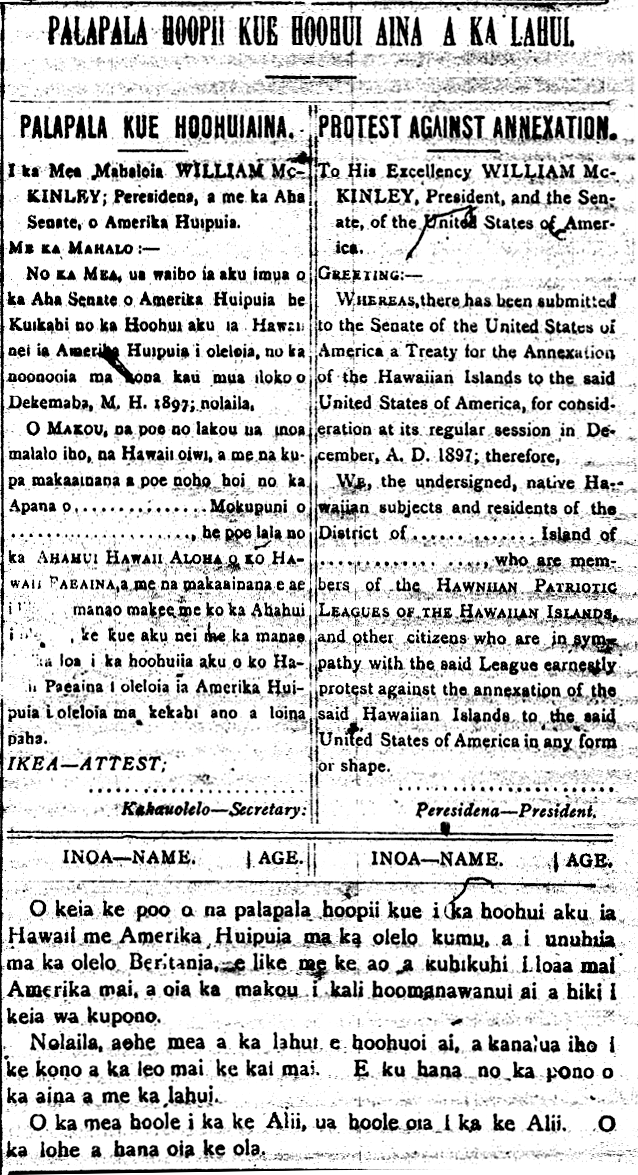
PALAPALA HOOPII KUE HOOHUI AINA A KA LAHUI.

PALAPALA KUE HOOHUIAINA.

I ka Mea Mahaloia WILLIAM McKINLEY; Peresidena, a me ka Aha Senate, o Amerika Huipuia.

Me ka Mahalo:—

No ka Mea, ua waiho ia aku imua o ka Aha Senate o Amerika Huipuia he Kuikahi no ka Hoohui aku ia Hawaii nei ia Amerika Huipuia i oleloia, no ka noonoooia ma kona kau mua iloko o Dekemaba, M. H. 1897; nolaila,

O Makou, na poe no lakou na inoa malalo iho, na Hawaii oiwi, a me na kupa makaainana a poe nooho hoi no ka Apana o …………………….Mokupuni o ……………………., he poe lala no ka Ahahui Hawaii Aloha o ko Hawaii Paeaina, a me na makaainana e ae i like ka manao makee me ko ka Ahahui i oleloia, ke kue aku nei me ka manao ikaika loa i ka hoohuiia aku o ko Hawaii Paeaina i oleloia ia Amerika Huipuia i oleloia ma kekahi ano a loina paha.

IKEA—ATTEST:

…………………….

Kakauolelo—Secretary:

INOA—NAME.     Ι AGE.

PROTEST AGAINST ANNEXATION.

To His Excellency WILLIAM McKINLEY, President, and the Senate, of the United States of America.

Greeting:—

Whereas, there has been submitted to the Senate of the United States of America a Treaty for the Annexation of the Hawaiian Islands to the said United States of America, for consideration at its regular session in December, A. D. 1897; therefore,

We, the undersigned, native Hawaiian subjects and residents of the District of …………………… Island of ……………………., who are members of the Hawaiian Patriotic Leagues of the Hawaiian Islands, and other citizens who are in sympathy with the said League earnestly protest against the annexation of the said Hawaiian Islands to the said United States of America in any form or shape.

…………………….

Presidena—President.

INOA—NAME.     Ι  AGE.

This is the heading of the petitions protesting the annexation of Hawaii to the United States of America in the original language, and translated into English, and as per the instruction and direction coming from America, we waited patiently until this proper time.

Therefore, there is nothing for the lahui to be suspicious about, or to be wary when the voice from the sea beckons. Stand up and do what is pono for the land and the people.

The person who denies that of the Alii denies that of the Alii [this is probably a typo that should have read, “O ka mea hoole i ka ke Alii, ua hoole oia i ka ke Akua,” The person who denies that of the Alii denies that of God]. Listening and acting is the way to survival.

[Check here for the images of the anti-annexation petitions put up by the University of Hawaii, Hamilton Library, Hawaiian Collection.]

(Aloha Aina, 9/18/1897, p. 5)

PALAPALA HOOPII KUE HOOHUI AINA A KA LAHUI.

Ke Aloha Aina, Buke III, Helu 38, Aoao 5. Sepatemaba 18, 1897.

Mauna a Kea, Moana a Kea: Hawaii nei is sacred in its entirety, from the sun above to the land and ocean below. 1866 / today and the future.

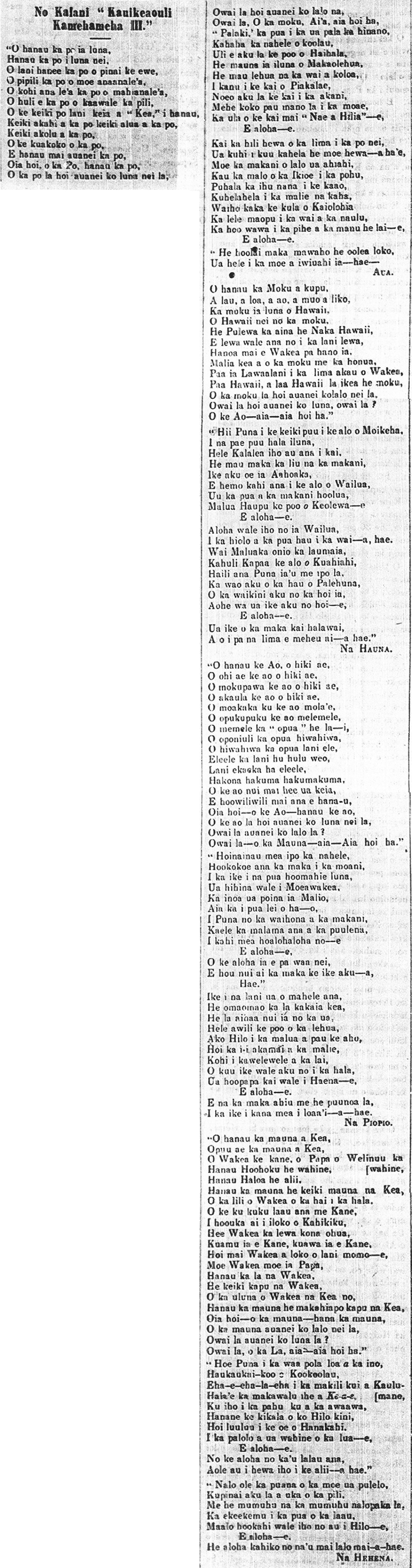
No Kalani “Kauikeaouli Kamehameha III.”

“O hanau ka po ia luna,
Hanau ka po i luna nei,
O lani hanee ka po o pinai ke ewe,
O pipili ka po o moe anaanale’a,
O kohi ana le’a ka po o mahianale’a,
O huli e ka po o kaawale ka pili,
O ke keiki po lani keia a “Kea,” i hanau,
Keiki akahi a ka po keiki alua a ka po,
Keiki akolu a ka po,
O ke kuakoko o ka po,
E hanau mai auanei ka po,
Oia hoi, o ka Po, hanau ka po,
O ka po la hoi auanei ko luna nei la,
Owai la hoi auanei ko lalo na,
Owai la, O ka moku, Ai’a, aia hoi ha,
“Palaki,” ka pua i ka ua pala ka hinano,
Kahaha ka nahele o koolau,
Uli e aku la ke poo o Haihala,
He mauna ia iluna o Makaolehua,
He mau lehua na ka wai a koloa,
I kanu i ke kai o Piakalae,
Noeo aku la ke kai i ka akani,
Mehe koko pau mano la i ka moae,
Ka ula o ke kai mai “Nae a Hilia”—e,
E aloha—e.

Kai ka hili hewa o ka lima i ka po nei,
Ua kuhi i kuu kahela he moe hewa—a ha’e,
Moe ka makani o lalo ua ahiahi,
Kau ka malo o ka Ikioe i ka pohu,
Puhala ka ihu nana i ke kaao,
Kuhelahela i ka malie na kaha,
Waiho kaka ke kula o Kaiolohia,
Ka lele maopu i ka wai a ka naulu,
Ka hoo wawa i ka piha a ka manu he lai—e,
E aloha—e.

[Na] AUA.

O hanau ka Moku a kupu,
A lau, a loa, a ao, a muo a lilo,
Ka moku ia luna o Hawaii,
O Hawaii nei no ka moku,
He Pulewa ka aina he Naka Hawaii,
E lewa wale ana no i ka lani lewa,
Hanoa mai e Wakea pa hano ia,
Malia kea a o ka moku me ka honua,
Paa ia lawaalani i ka lima akau o Wakea,
Paa Hawaii, a laa Hawaii la ikea he moku,
O ka moku la hoi auanei kolalo nei la,
Owai la hoi auanei ko luna, owai la?
O ke Ao—aia—aia hoi ha.”

“Hii Puna i ke keiki puu i ke alo o Moikeha,
I na pae puu hala iluna,
Hele Kalalea iho au ana i kai,
He mau maka ka liu na ka makani,
Ike akuu oe ia Aahoaka,
E hemo kahi ana i ke alo o Wailua,
Uu ka pua a ka makani hoolua,
Malua Haupu ke poo o Keolewa—e
E aloha—e.

Aloha wale iho no ia Wailua,
I ka hiolo a ka pua hau i ka wai—a, hae,
Wai Maluaka onio ka laumania,
Kahuli Kapaa ke alo o Kuahiahi,
Haili ana Puna ia’u me ipo la,
Ka wao aku o ka hau o Palehuna,
O ka waikini aku no ka hoi ia,
Aohe wa ua ike aku no hoi—e,
E aloha—e.
Ua ike o ka maka kai halawai,
A o i pa na lima e meheu ai—a hae.”

Na HAUNA.

“O hanau ke Ao, o hiki ae,
O ohi ae ke ao o hiki ae,
O mokupawa ke ao o hiki ae,
O akaula ke ao o hiki ae,
O moakaka ku ke ao mola’e,
O opukupuku ke ao melemele,
O memele ka “opua” he la—i,
O oponiuli ka opua hiwahiwa,
O hiwahiwa ka opua lani ele,
Eleele ka lani hu hulu weo,
Lani ekaeka ha eleele,
Hakona hakuma hakumakuma,
O ke ao nui mai hee ua keia,
E hoowiliwili mai ana e hana-u,
Oia hoi—o ke Ao—hanau ke ao,
O ke ao la hoi auanei ko luna nei la,
Owai la auanei ko lalo la?
Owai la—o ka Mauna—aia—Aia hoi ha.”

“Hoinainau mea ipo ka nahele,
Hookokoe ana ka maka i ka moani,
I ka ike i na pua hoomahie luna,
Ua hihina wale i Moeawakea,
Ka inoa ua poina ia Malio,
Aia ka i pua lei o ha—o,
I Puna no ka waihona a ka makani,
Kaele ka malama ana a ka puulena,
I kahi mea hoalohaloha no—e,
E aloha—e,
O ke aloha ia e pa waa nei,
E hou nui ai ka maka ke ike aku—a,
Hae.”

Ike i na lani ua o mahele ana,
He omaomao ka la kakaia kea,
He la aihaa nui ia no ka ua,
Hele awili ke poo o ka lehua,
Ako Hilo i ka malua a pau ke aho,
Hoi ka i-i akamai a ka malie,
Kohi i kawelewele a ka lai,
O kuu ike wale aku no i ka hala,
Ua hoopapa kai wale i Haena—e,
E aloha—e.
E na ka maka ahiu me he puunoa la,
I ka ike i kana mea i loaa’i—a—hae.

Na PIOPIO.

“O hanau ka mauna a Kea,
Opuu ae ka mauna a Kea,
O Wakea ke kane, o Papa o Welinuu ka wahine,
Hanau Hoohoku he wahine,
Hanau Haloa he alii,
Hanau ka mauna he keiki mauna na Kea,
O ka lili o Wakea o ka hai i ka hala,
O ke ku kuku laau ana me Kane,
I hoouka ai i iloko o Kahikiku,
Hee Wakea ka lewa kona ohua,
Kuamu ia e Kane, kuawa ia e Kane,
Hoi mai Wakea a loko o lani momo—e,
Moe Wakea moe ia Papa,
Hanau ka la na Wakea,
He keiki kapu na Wakea,
O ka uluna o Wakea na Kea no,
Hanau ka mauna he makahiapo kapu na Kea,
Oia hoi—o ka mauna—hana ka mauna,
O ka mauna auanei ko lalo nei la,
Owai la auanei ko luna la?
Owai la, o ka La, aia—aia hoi ha.”

“Hoe Puna i ka waa pola loa a ka ino,
Haukaukai—koo o Kookoolau,
Eha—e—eha—la—eha i ka makili kui a Kaulumano,
Hala’e ka makawalu ihe a Ko-a-e,
Ku iho i ka pahu ku a ka awaawa,
Hanane ke kikala o ko Hilo kini,
Hoi luuluu i ke oe o Hanakahi,
I ka palolo a ua wahine o ka lua—e,
E aloha—e.
No ke aloha no ka’u lalau ana,
Aole au i hewa iho i ke alii—a hae.”

“Nalo ole ka puana o ka moe ua pulelo,
Kupinai aku la a uka o ka pili,
Me he mumuhu na ka mumuhu nalopaka la,
Ka ekeekemu i ka pua o ka laau,
Maalo hookahi wale iho no au i Hilo—e,
E aloha—e.
He aloha kahiko no na’u mai lalo mai—a—hae.

Na HEHENA.

(Kuokoa, 3/24/1866, p. 4)

No Kalani "Kauikeaouli Kamehameha III."

Ka Nupepa Kuokoa, Buke V, Helu 12, Aoao 4. Maraki 24, 1866.

No Kalani “Kauikeaoule Kamehameha III.” [No Kalani “Kauikeaouli Kamehameha III.”]

O hanau ka La o na’u,
O nau ka la o Kupauole,
O Kupauole ka la kohia,
Kohia ka la ia Hina,
O ke kukuna o ka la paa,
O ka pea o hilima o hilinehu,
O ka lala o ke Kamani,
O ka hui o ke Kamani ula,
O ka ehu o Halulu,
Ke haina mai la hai,
Ke haki’a mai la e ka “La,”
E ke keiki hele lani a “Kea,”
O Wakea kai lalo o ka la kai luna,
O ke keiki la a Kea i hookauhua ai,
Oia hoi—o ka La—hanau ka La,
O ka La, hoi auanei ko luna la,
Owai la ua nei ko lalo nei?
Owai la—o ka moana—aia, aia hoi ha,
“Hemo kahili kuhao i ka pohu,
Mehe lala no ka hale loha maikai la,
Ka paia kua a ka makani,
I hoaho i hoa ia e ka lai o Hauola,
Oki ka kahi Lahaina i ka malino,
Honi na hono i ka makani paalaa,
He hanu ia no ke ka Kaalani—e,
E aloha—e.
Aloha aku la i ka lau o ka manao,
Aiwaiwa i ka moe ke pa mai—a,”
Hae.

Pa na lima o ka he Kuawa,
He makemake okoa no i Wailuku,
E like na manao me Kaiaiki,
Kahiko i hoao ai i ka moe e,
O ka momoe aku la ia i Hopukoa,
Hi hininu i ke kula me ka Haakea,
Loaa ka hoa i ke kaha o Kahuaiki—e,
E aloha—e.
O ka hue Kamehai ka inoa e nalo,
Aia no ka hewa o ka lonoia—a,
Hae.

O hanau ka moana a Kea,
O na nalu na Kea, o ke kai na Kea,
O kai kane o kai wahine na Kea,
O koa ku o koa halelo ulu na Kea, hanau ka La,
O hoowiliwili a ka ia iloko o ka moana,
Uliuli eleele nei lae—o ka moana,
O ka moana la hoi auanei ko lalo nei la,
Owai la hoi auanei ko luna, owai la?
O ku, o Lono, o Kane, o Kanalua, o Kaekae,
O Maliu, o ka haku o ka pule, o nuupule,
O Nuukahana, o elieli holo imua kapu,
O elieli holo imua noa, noa ka hanau ana o ke ‘lii,
Hanau “Ku” o ku la hoi auanei ko luna,
Owai la hoi auanei ko lalo nei owai la?
O Haloa, Puka kanaka laha na ‘liii,
Loaa iluna nei o Kalani Mehameha,
A Ekahi ka lani—la—akahi o luna nei,
O Kalani “Kauikaalaneo—la—alua oluna nei,
Pili laua—ua mau paha—oia paha?
O Kalani Nui kua Liholiho akahi,
I ke kapu la—akahi oluna nei,
O Kalani Kauikeaouli—la alua o luna nei,
Pili laua ua mau paha oia paha.”

Here O Friends is the first time we actually have the part of this mele in which is the name of the one whose birthday it is, in the mele called, “O hanau a Hua.” That being “Kapu Puna i ka wahine Ihiihi ka ma,” and after that, I, your “Expert,” will tell you of the day, and the months, and everything pertaining to the birthday of that “Leiopapa.”

[This genealogical mele for Kamehameha III was printed a number of times over the years in various Hawaiian-Language Newspapers. It was important enough back then, and it is just as important for us today, if not more so. The gods gave birth to all above and all below—it is all sacred. Let us treat all our land and ocean with that in mind.

Unfortunately much of the columns in which these appear are not digitized clearly, and are hard to read…]

(Kuokoa, 3/31/1866, p. 4)
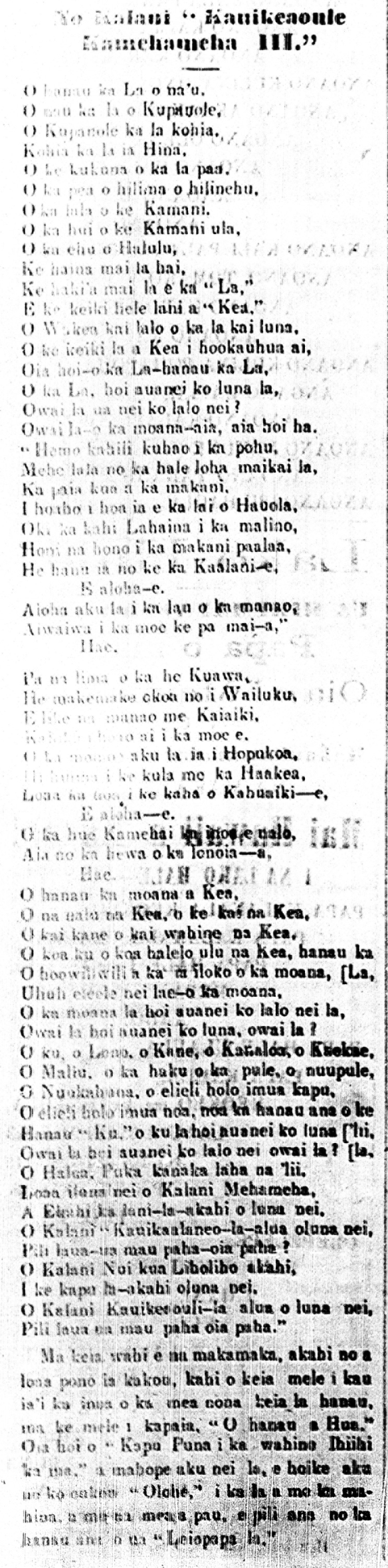
No Kalani Kauikeaoule Kamehameha III."

Ka Nupepa Kuokoa, Buke V, Helu 13, Aoao 4. Maraki 31, 1866.