Duke runs for reelection as sheriff of the city and county of Honolulu, 1936.

Duke Kahanamoku Asks Sheriff Re-election On Basis of Present Record

Kahanamoku, scion of one of the few remaining full-blooded Hawaiian families in the islands, was responsible for returning the sheriff’s office, for the first 25 years of city and county government always held by a Democrat, to the Democratic fold after it had lapsed momentarily into the hands of the Republicans with results that are too well known and too well remembered by every resident of Hawaii to repeat here.

Perhaps the most famous living exponent of the Hawaiian race is Duke P. Kahanamoku, who first spread the name of the Territory over the newspapers and magazines of the world by his swimming prowess and is now seeking re-election as sheriff of the city and county of Honolulu on the Democratic ticket.

For Sheriff

DUKE P. KAHANAMOKU

The Duke first took the world by storm when, and absolutely unknown, he went to the quadrennial Olympic games as one of the American team and made a clean sweep of all the swimming events in which he was entered, establishing several world’s records that stood for many years. He repeated this performance in the following Olympic games and ruled supreme in acquatic affairs until his voluntary retirement from active competition.

On his return to Hawaii the gratitude of the citizens of the Territory was expressed in the form of a public fund which was used to provide a residence for the Kahanamoku family.

The Duke declares in his speeches that he carries on the duties of sheriff of the city and county in the clean and sportsmanlike manner which distinguished his athletic career.

Despite inadequate appropriations provided for the greatly needed new construction at the city and county jail, which is under the jurisdiction of the sheriff’s office, Kahanamoku has established an efficient record in the conduct of this institution—a record on which he is asking renomination at re-election.

“I am a man of few words,” the Duke declares. “When I was representing Hawaii against the best swimmers in the world, I never predicted that I would win any particular race—but I think I won my share. It is the same with the present race for the sheriff’s office.”

[Duke seems to have followed in the footsteps of his father. Duke P. Kahanamoku’s father, Duke K. Kahanamoku served in various positions in the police department, ultimately reaching the rank of captain.]

(Alakai o Hawaii, 9/24/1936, p. 1)

Duke Kahanamoku Asks Sheriff Re-election On Basis of Present Record

The Hawaii Democrat, Volume 9, Number 24, Page 1. September 24, 1936.
More news from Kamehameha Schools as reported by the students, 1944.

[Found under: “News From Boys, Girls Kamehameha School”]

By BARRY ONTAI

———

Ilona Momilani, a baby girl was welcomed into the family of Mr. and Mrs. Folinga Faufata on March 10.

The baby’s father, a graduate of Kamehameha with the class of 1935, is now an engineer at a power plant in Pearl Harbor.

The Fafatas reside on Kaunaoa Street in Kapahulu. Barbara, the eldest daughter, attends the Kamehameha kindergarten.

———

The Saturday night activities for the student body on April 22, were calling and movies.

The senior division enjoyed dancing and a social gathering which began at 7:30 o’clock in the common room of Lunalilo hall.

Two color movies were shown to the junior division at the school for boys’ assembly hall.

“A Victory”, a picture filmed for the Junior Police Officers on the K.S.B. campus, featured Samuel Fontaine, brother of David Fontaine, low-eleventh student at K.S.B., and James Noa, a ninth grader at the school for boys.

In the second feature, “Make Way for Victory”, two boys of the Preparatory department, Kealoha Coleman and Kui Lee, had leading roles. There were also dances by the preparatory pupils directed by Mrs. Mary K. Pukui and Mrs. Lei Hapai.

These pictures were filmed in color by George Tahara, a student at the University of Hawaii. He has also made two previous showings to Kamehameha audiences. Continue reading

Let everyday be Mother’s Day, but… 1941.

[Found under: “Na Hunahuna Mea Hou o Maui.”]

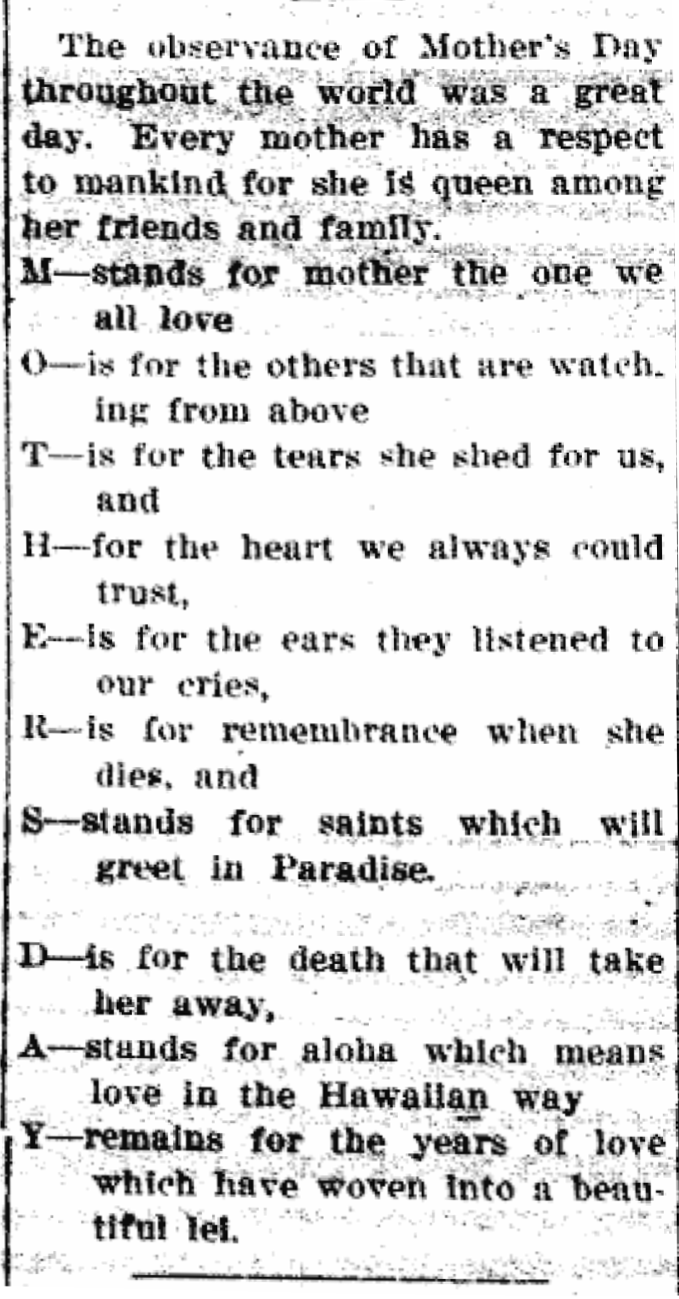
The observance of Mother’s Day throughout the world was a great day. Every mother has a respect to mankind for she is queen among her friends and family.

M—stands for mother the one we all love

O—is for the others that are watching from above

T—is for the tears she shed for us, and

H—for the heart we always could trust,

E—is for the ears they listened to our cries,

R—is for remembrance when she dies, and

S—stands for saints which will greet in Paradise.

D—is for the death that will take her away,

A—stands for aloha which means love in the Hawaiian way

Y—remains for the years of love which have woven into a beautiful lei.

[This appears in Mrs. Banham’s regular column on news items from Maui. Acrostics also appear in Hawaiian-Language Newspapers in the Hawaiian Language from very early on.]

(Hoku o Hawaii, 5/14/1941, p. 1)

The observance of Mother's Day...

Ka Hoku o Hawaii, Volume XXXVI, Number 3, Aoao 1. Mei 14, 1941.

“Ka Leialii o Hawaii,” another paper to keep your eyes out for! 1892 / Today.

KA LEIALII O HAWAII.

On Monday last another Hawaiian daily was issued, named as above, meaning in English “The Crown of Hawaii.” It flies for its motto of love of Sovereign, Country and People. It is evidently a Tory of the rankest kind, from its motto, and from royal patronage displayed in its columns, and the names of royalists on its stock subscription. We have had on intimation, ever since the election of February last, that something of the kind was to be inaugurated in defense of sovereignty; and the causes that produced the sand-bag scare, has succeeded in giving birth to a full fledged Tory fledgling. We congratulate the Queen, in having her admirers start a paper in her interest, though evidently scared out of them.

[I do not know of any extant copies of this paper. Has anyone seen or heard of it?]

(Leo o ka Lahui, 4/19/1892, p. 4)

KA LEIALII O HAWAII.

Ka Leo o ka Lahui, Buke II, Helu 435, Aoao 4. Aperila 19, 1892.

A patriotic mele criticizing the Rev. Joseph S. Emerson, 1893.

THE KAPUUKOLO CHURCH SCANDAL.

There is a saintly son of a gun,
Whose name is J. S. Emerson,
Who goes about in pious style,
To ease his anti-monarch bile.
And enters with his devout brother,
Hawaiian’s meeting: tries to smother,
All aloha for their Queen and land,
By fairy tales of witchcraft brand.
And sweetly says: “My christian friends,
“In order now to gain our ends,
“Will you ally yourselves with one,
“Who being but a native son.
“Has dared to infringe the haole’s plan
“And makes himself (deceitful man)
“The priest of God and Baal too?
“Shall such associate with you?
“Perish the thought! No! brethren dear,
“Not though my father’s sons, ’tis clear,
“Have robbed you of your lands and living,
“And taught you not that way to heaven.
“We’ll sweetly sing, in chorus clear
“The haole takes the government here
“Having taken all else, and let your Queen,
“Rely on none who here are seen.
“Associate she with heathens foul,
“Pig, kahunas, chickens, awa bowl!
“Shall such be helped with christian prayer,
“And our God asked for her to care.”
He stayed his speech and called for votes,
The answer from indignant throats,
Came fast and furious on his ears:
“Take out from here your lying sneers.
“Hypocrite! usurper! rebel! beast!
“Such words become your family least,
“Who live on what the royal hand,
“Gave bounteous of Waialua’s land.
“As pay for early prayer and praise,
“Raised by your father in those days,
“When missionaries first came here,
“And taught us a new God to fear.
“Go, hound! unto your wealthy home,
“Reflect on whence your creature comforts come,
“Think if you can what doom will be,
“Ingratitude’s God will bring to thee.
“Hide your grey locks in deepest shame
“Let another take your father’s name,
“Go, and ne’er again pollute,
“This sacred place with your foul boot.”
They went: None blessed their homeward way:
All seemed relieved: Arose the lay,
Of praise to God: and all agree,
To pray for Queen and Hawaii.

[Here is an article with descriptions of what led to this mele.]

(Hawaii Holomua, 2/11/1893, p. 4)

THE KAPUUKOLO CHURCH SCANDAL.

Hawaii Holomua, Buke III, Helu 7, Aoao 4. Feberuari 11, 1893.

More on the “King of the Cannibal Islands,” 1873.

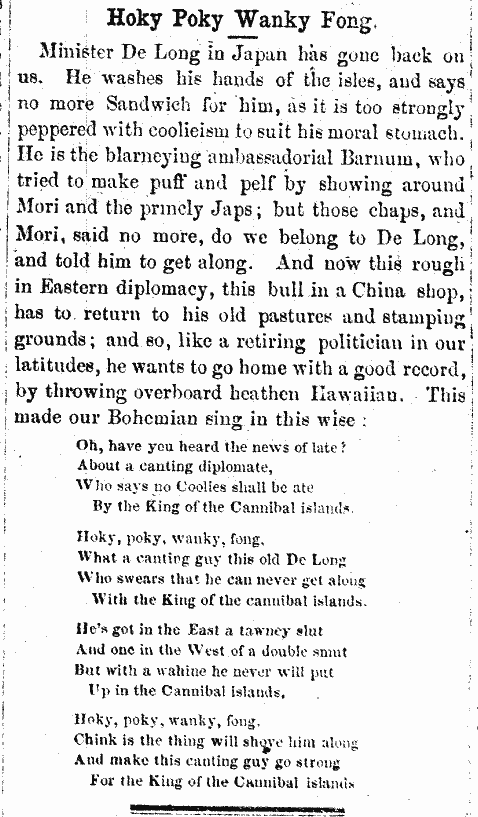
Hoky Poky Wanky Fong.

Minister De Long in Japan has gone back on us. He washes his hands of the isles, and says no more Sandwich for him, as it is too strongly peppered with coolieism to suit his moral stomach. He is the blarneying ambassadorial Barnum, who tried to make a puff and pelf by showing around Mori and the princly Japs; but those chaps, and Mori said no more, do we belong to De Long, and told him to get along. And now this rough in Eastern diplomacy, this bull in a China shop, has to return to his old pastures and stamping grounds; and so, like a retiring politician in our latitudes, he wants to go home with a good record, by throwing overboard heathen Hawaiian. This made our Bohemian sing in this wise:

Oh, have you heard the news of late?
About a canting diplomate,
Who says no Coolies shall be ate
By the King of the Cannibal islands.

Hoky, poky, wanky, fong,
What a canting guy this old De Long
Who swears that he can never get along
With the King of the cannibal islands.

He’s got in the East a tawney slut
And one in the West of a double smut
But with a wahine he never will put
Up in the Cannibal islands.

Hoky, poky, wanky, fong,
Chink is the thing will shove him along
And make this canting guy go strong
For the King of the Cannibal islands.

(Nuhou, 4/15/1873, p. 3)

Hoky Poky Wanky Fong.

Nuhou, Volume I, Number 15, Aoao 3. Aperila 15, 1873.

Lauhala weaving revival, 1936.

ANCIENT HAWAII ART REVIVAL

Kona District to Supply Lauhala Articles to Hawaiian Village At Waikiki

George P. Mossman, of the Hawaiian Village at Waikiki, who has been spending some time on the Big Island, has succeeded in making arrangements through which the Kona districts will supply the village with lauhala, mats and other articles.

Mr. Mossman reported that he found three grades of lauhala articles produced. the First grade, which is the cheaper grade, is turned out as a medium of exchange for which the family obtains clothing, groceries and other articles for home use. Continue reading

Tourism and the revival of lauhala, 1936.

Tourist Business In Hawaii Booms As Result Of Publicity

An influx of visitors to the Hawaiian islands during the past few years has revived many of the interesting traditions and practices of Old Hawaii.

This paradox was recently pointed out by Percy A. Swift, manager of the merchandise department of American Factors, Ltd., in a discussion of Hawaii’s tourist industry.

“An interesting sidelight of the travel business here has been the way it has encouraged Island customs and activities,” he said. “The nourishing influence of tourist interest has given added impetus to the lei tradition, for example; and it has revived native sports such as surfing and outrigger canoe riding, which were on the point of dying out 15 years ago.” Continue reading

Greatest Mariners, 1938 / 2015.

POLYNESIANS AS MARINERS SEEN

Dr. Buck Terms Early Polynesians Greatest Mariners World Has Ever Known

HONOLULU, Nov. 29—Dr. Peter Buck, director of the Bishop Museum, last night termed the early Polynesians the greatest mariners the world has ever known.

Dr. Buck, who will leaves soon for Yale University to lecture on primitive religions, spoke at a dinner in his honor attended by almost 200 persons. He was introduced by Frank Atherton.

He said it was probable that some of the early Polynesians reached the shores of America. He traced the possibility in similarity of certain words, such as that for sweet potato itself was brought into the South Seas from the American continent. Continue reading

Keaukaha lauhala house, 1936.

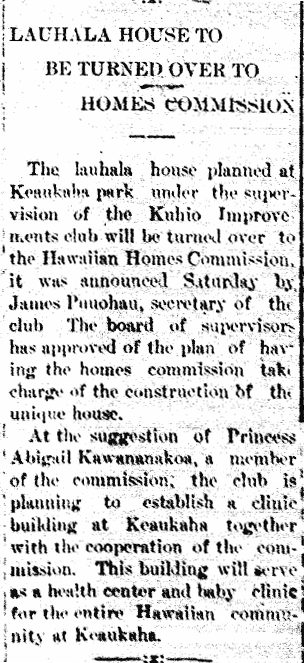
LAUHALA HOUSE TO BE TURNED OVER TO HOMES COMMISSION

The lauhala house planned at Keaukaha park under the supervision of the Kuhio Improvements club will be turned over to the Hawaiian Homes Commission, it was announced Saturday by James Puuohau, secretary of the club. The board of supervisors has approved of the plan of having the homes commission take charge of the construction of the unique house.

At the suggestion of Princess Abigail Kawananakoa, a member of the commission, the club is planning to establish a clinic building at Keaukaha together with the cooperation of the commission. This building will serve as a health center and baby clinic for the entire Hawaiian community at Keaukaha.

(Hoku o Hawaii, 11/25/1936, p. 1)

LAUHALA HOUSE TO BE TURNED OVER TO HOMES COMMISSION

Ka Hoku o Hawaii, Volume XXXI, Number 30, Aoao 1. November 25, 1936.