Musicians travel to Japan and China, 1912.

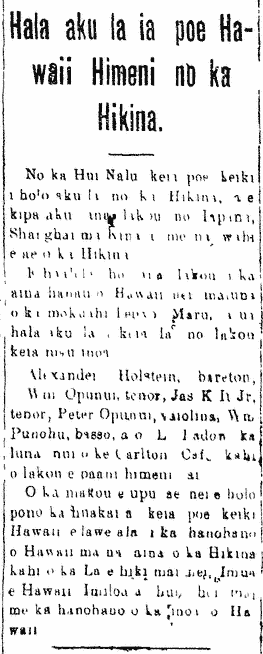
Those Hawaiian Singers Leave for the East.

These youths are from the Hui Nalu [Singing Club] who left for the East; and they will visit Japan and Shanghai in China and other locations in the East.

They will leave the land of their birth aboard the steamship Tenyo Maru [?], and they left this day, their names being:

Alexander Holstein, baritone,

William Opunui, tenor, James K. Ii, Jr., tenor, Peter Opunui, violin, William Punohu, bass, and L. Ladon [Louis Ladow] the head of the Carlton Cafe, where they are to perform.

Our hope is that the journey of these Hawaii boys carrying with them the pride of Hawaii to East, to the land of the rising Sun, goes well. Go forward, go forward O Great-Travelling Hawaiians and return with glory in the name of Hawaii.

(Kuokoa Home Rula, 12/19/1912, p. 1)

Hala aku la ia poe Hawaii Himeni no ka Hikina

Kuokoa Home Rula, Buke X, Helu 51, Aoao 1. Dekemaba 19, 1912.

Smuggled goods, 1912.

SMUGGLED GOODS AUCTIONED OFF

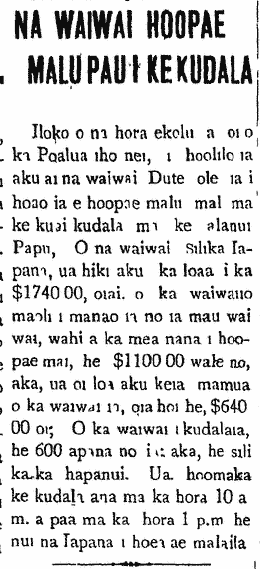
In three hours or so this past Tuesday, items attempted to be smuggled in without paying Duty were auctioned off on Fort Street. Japanese Silk goods made $1,740.00 whereas the actual value of the items is believed to be only $1,100.00 according to the person who imported them; and so it was much more than the real value, being that it was $640.00. There were 600 items that were auctioned and the majority was silk goods. The auction began at 10 a. m. and closed at 1 p. m.; there were many Japanese who showed up.

(Kuokoa Home Rula, 12/19/1912, p. 1)

NA WAIWAI HOOPAE MALU PAU I KE KUDALA

Kuokoa Home Rula, Buke X, Helu 51, Aoao 1. Dekemaba 19, 1912.

Fish market affected by weather, 1929.

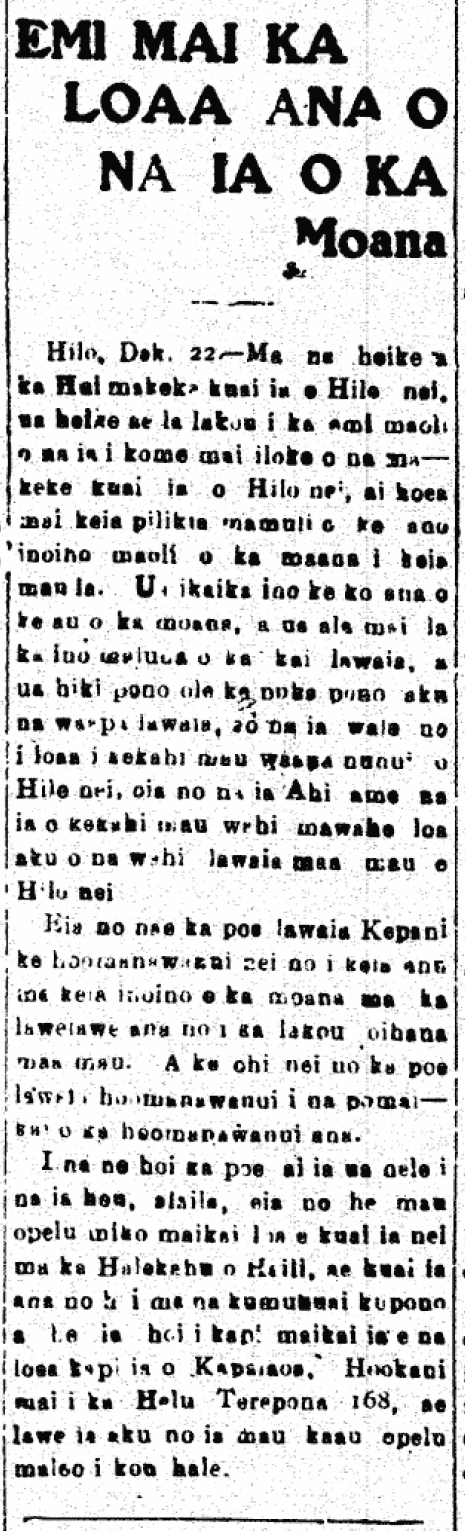
DECREASE IN THE CATCH OF OCEAN FISH

Hilo, Dec. 22—According to a report by the fish market association of Hilo, they said that there is a marked decrease in the amount of fish brought in to the fish markets of Hilo nei, and this is a result of the difficulty brought on by the very stormy seas these days. The pull of the currents is very strong, and this occurs in the fishing waters, so the fishing boats cannot head straight for them; the only fish caught by the large fishing vessels of Hilo are Ahi and other fish from far outside of the normal fishing areas of Hilo.

Here however are the Japanese, still persevering these stormy conditions of the sea by carrying out their regular work. And the determined fishermen are reaping the benefits of their persistence.

If those who eat fish are without fresh fish, here are nicely-salted opelu being sold at the pastor’s residence of Haili and it is being sold for a good price; it is fish salted well by the expert fish salters of Kapalaoa. Ring the Telephone Number 168, and the dried opelu in forties [kaau] will be delivered to your house.

(Hoku o Hawaii, 12/24/1929, p. 2)

EMI MAI KA LOAA ANA O NA IA O KA Moana

Ka Hoku o Hawaii, Buke XXIII, Helu 28, Aoao 2. Dekemaba 24, 1929.

Different type of vital statistics, 1888.

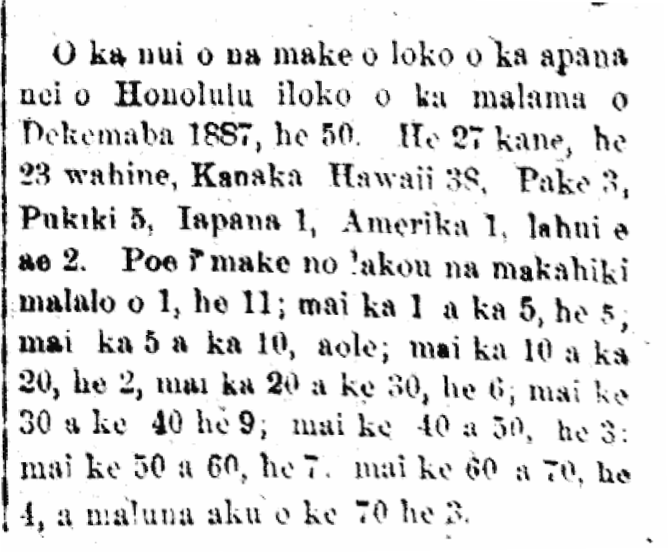
The number of deaths in the area of Honolulu, in the month of December 1887, is 50. There were 27 males and 23 females; 38 were Hawaiians, 3 Chinese, 5 Portuguese, 1 Japanese, 1 American, other ethnicities 2. Those who died under the age of 1 were 11, from 1 to 5 were 5, from 5 to 10 were none, from 10 to 20 were 2, from 20 to 30 were 6, from 30 to 40 were 9, from 40 to 50 were 3, from 50 to 60 were 7, from 60 to 70 were 4, and over 70 were 3.

(Alakai o Hawaii, 1/7/1888, p. 2)

O ka nui o ka make...

Ke Alakai o Hawaii, Buke 1, Helu 1, Aoao 2. Ianuari 7,1888.

Japanese swarming like bees, 1893.

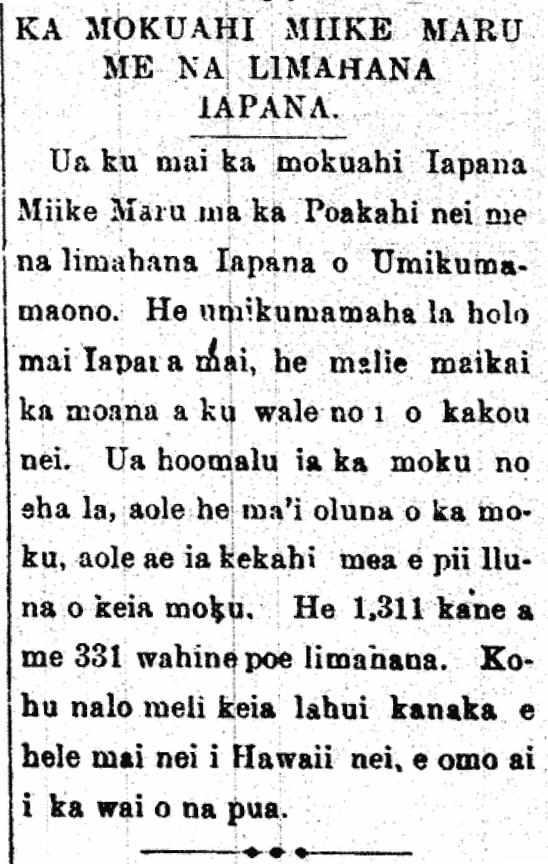
THE STEAMER MIIKE MARU AND THE JAPANESE LABORERS.

The Japanese Steamship Miike Maru docked this Monday with the Sixteenth [group of] Japanese laborers. It travelled fourteen days from Japan, and it was smooth sailing until arriving amongst us. The ship was quarantined for four days, and there were no sick aboard the ship and no one was allowed aboard. There are 1,311 men and 331 women laborers. These people are like honey bees coming to Hawaii, sucking from the nectar of the flowers.

(Leo o ka Lahui, 10/25/1893, p. 2)

KA MOKUAHI MIIKE MARU ME NA LIMAHANA IAPANA.

Ka Leo o ka Lahui, Buke II, Helu 798, Aoao 2. Okatoba 25, 1893.

Always important to look at sources. 1893 / 2012.

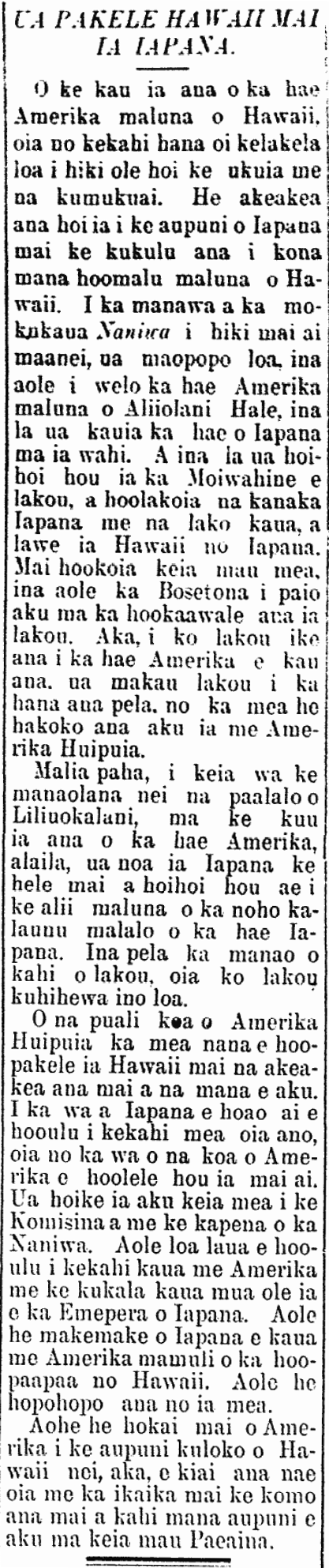
HAWAII ESCAPES FROM JAPAN.

The raising of the American flag over Hawaii is one of the greatest things done that cannot be repaid. It blocks the nation of Japan from establishing its rule over Hawaii. When the warship Naniwa arrived here, it was clear that if the American flag was not waving over Aliiolani Hale, then the Japanese flag would have been put in its place. And then they would have returned the Queen and the Japanese would have been supplied with weapons and took Hawaii for Japan. It all would have happened if the Boston did not hold them off. But when they saw the American flag raised, they were afraid to do this, for it would be fighting with the United States of America.

Perhaps now Liliuokalani’s attendants are hoping that by the taking down of the American flag, the Japanese will be free to come and return the alii to the throne under the Japanese flag. Should that be the thought of some of them, they are gravely mistaken.

The American troops will save Hawaii from the interference by the other powers. When Japan tries to foment something of that sort, that will be when the soldiers of America will be deployed again. This has been announced to the Commissioner and the captain of the Naniwa. They will not start a war with America without it being proclaimed in advance by the Emperor of Japan. Japan has no desire to war against America because of the dispute over Hawaii. There is nothing to fear.

America will not interfere in the local government of Hawaii nei, however it will guard Hawaii with force against the entering of other national powers into this Archipelago.

[It is always important to look at what newspaper an article comes from. Also, long-running newspapers (and people for that matter) don’t necessarily keep their same ideologies throughout their entire life…]

(Kuokoa, 4/8/1893, p. 2)

UA PAKELE HAWAII MAI IA IAPANA.

Ka Nupepa Kuokoa, Buke XXXII, Helu 14, Aoao 2. Aperila 8, 1893.

Deer of Kamehameha V., 1867.

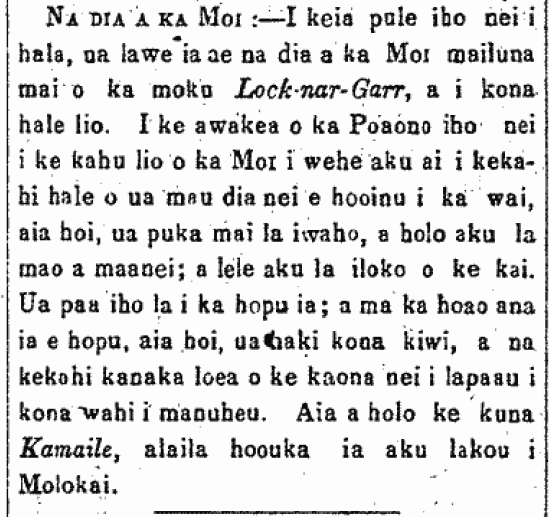
The King’s Deer:—This last week, the King’s deer were taken aboard the ship Lock-nar-Garr [Lochnagar ?] to his stables. At midday on this past Saturday, when the King’s stableman opened a stall where the deer were kept to give them water, come to find out, they got out and ran here and there and jumped into the ocean. They were caught; but while they were being caught, its antler was broken, and someone skilled from town tended to its injury. When the schooner Kamaile sails, they will be taken to Molokai.

(Au Okoa, 12/26/1867, p. 2)

Na dia a ka Moi...

Ke Au Okoa, Buke III, Helu 36, Aoao 2. Dekemaba 26, 1867.

Board of Health and leprosy, 1906.

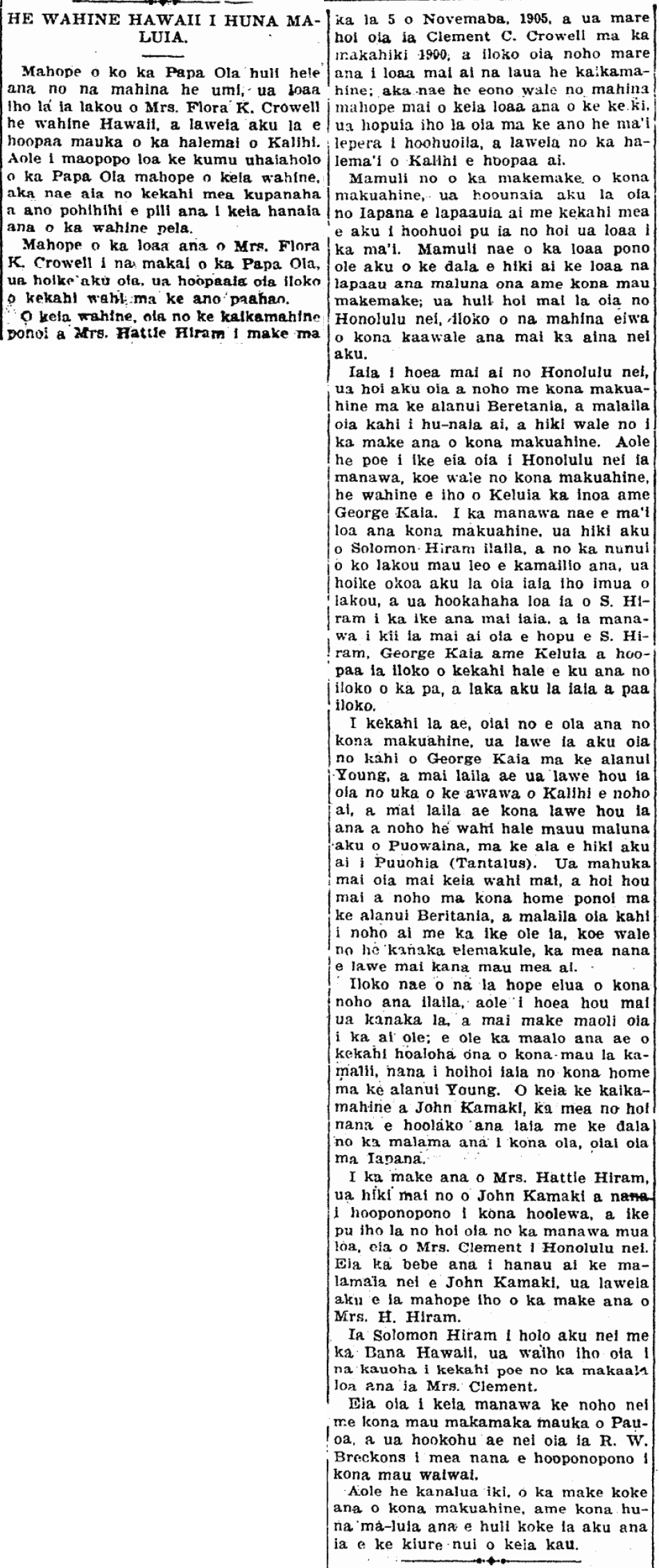
A HAWAIIAN WOMAN HIDDEN AWAY.

After the Board of Health [Papa Ola] searched for ten months, they found Mrs. Flora K. Crowell, a Hawaiian woman, and she was taken and detained mauka of the Kalihi Hospital. It is not clear why the Board of Health chased after that woman, but there is something astonishing and unclear about what was done to this woman.

After Mrs. Flora K. Crowell was found by the officers of the Board of Health, she said she was locked away like a prisoner.

This wahine is the birth daughter of Mrs. Hattie Hiram who died on the 5th of November 1905, and she married Clement C. Crowell in the year 1900, and by this marriage the two of them had a daughter; but just six months after they had the girl, she [Flora Crowell] was suspected of having leprosy and taken away to be held at the Kalihi Hospital.

According to the wishes of her mother [Hattie Hiram], she was sent to Japan to be treated along with others who were suspected of having the illness. Being that she did not have the funds to be treated and per her wishes, she came back to Honolulu nei after nine months of being away from here.

When she arrived in Honolulu, she went to live with her mother on Beritania Street, and she was hidden there until the death of her mother. There was no one who knew she was here in Honolulu at the time, except her mother along with another woman named Keluia and George Kaia. However, when her mother was extremely ill, Solomon Hiram came, and because they were speaking so loudly, he showed himself before them; S. Hiram was shocked at seeing her; and it was then that she was subdued by S. Hiram along with George Kaia and Keluia and detained in a building on the grounds, and she was locked inside.

A few days later, while her mother was still alive, she [Flora Crowell] was taken to the place of George Kaia on Young Street, and from there she was then taken to the uplands of Kalihi Valley to live, and from there she was taken to a grass house atop Puowaina, on the road that goes up to Puuohia (Tantalus). She escaped from this place and returned to live at her own home on Beritania Street, and it was there she lived unbeknownst to others, all except an old man who brought her food.

But during her last two days there, that man did not come back, and she almost starved for lack of food; it was only because of the passing by of one of her friends from her youth, that she was brought to that friend’s home on Young Street. This was the daughter of John Kamaki, the one who gave Flora Crowell money to care for herself while in Japan.

At the death of Mrs. Hattie Hiram, John Kamaki came and took care of her funeral, and saw for the first time that here was Mrs. Clement in Honolulu nei. Her baby was being cared for by John Kamaki, who took her after the death of Mrs. H. Hiram.

When Solomon Hiram just left with the Royal Hawaiian Band [Bana Hawaii], he left instructions for some people to keep good watch over Mrs. Clement.

She is now living with her friends mauka of Pauoa, and she has chosen R. W. Breckons as the executor of her estate.

There is no doubt, the quick death of her mother and her being hidden away, will be investigated immediately by the grand jury of this session.

(Kuokoa, 11/2/1906, p. 8)

HE WAHINE HAWAII I HUNA MA-LUIA.

Ka Nupepa Kuokoa, Buke XLV, Helu 44, Aoao 8. Novemaba 2, 1906.
On the perpetuation of the Hawaiian Language, 1911.

THE HAWAIIAN LANGUAGE

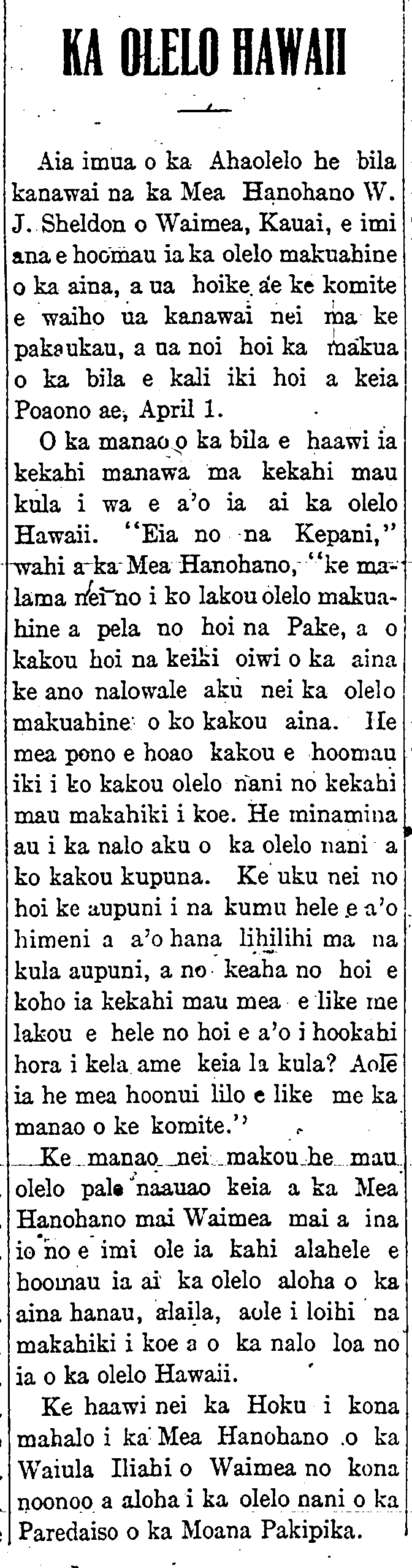
Before the Legislature is a bill put forth by the Honorable W. J. Sheldon of Waimea, Kauai, which seeks to perpetuate the mother tongue of this land; but the committee announced that the bill will be tabled; to which the father of the bill asked that they wait for a bit until the following Saturday, April 1.

The intent of the bill is to allow for time in some schools to teach the Hawaiian language. “Here are the Japanese,” said the Honorable One, “they are caring for their mother tongue, and so too of the Chinese; but we, the native children of this land, our native language is disappearing from our own land. It is imperative that we try to perpetuate our beautiful language even just a little longer. I feel remorse in letting the beautiful language of our ancestors go. The government pays for travelling instructors to teach singing and lace making [hana lihilihi ?] in public schools, so why not choose people like that to go and teach for one hour every school day? It will not be a great expense like what is imagined by the committee.”

We believe that these are very wise responses by the Honorable One of Waimea, and if indeed means are not sought to perpetuate the beloved language of our birth land, then it will not be long before the Hawaiian language will disappear completely.

The Hoku gives its mahalo to the Honorable One of the Waiula Iliahi¹ of Waimea for his consideration and aloha for the beautiful language of the Paradise of the Pacific Ocean.

¹Waiula Iliahi is one of the two branches of the Waimea River, and the other being Waikea, and they merge at Kikiaola.

(Hoku o Hawaii, 3/30/1911, p. 2)

KA OLELO HAWAII

Ka Hoku o Hawaii, Buke 5, Helu 47, Aoao 2. Maraki 30, 1911.

Bernice Pauahi Bishop Museum rules for patrons, 1903.

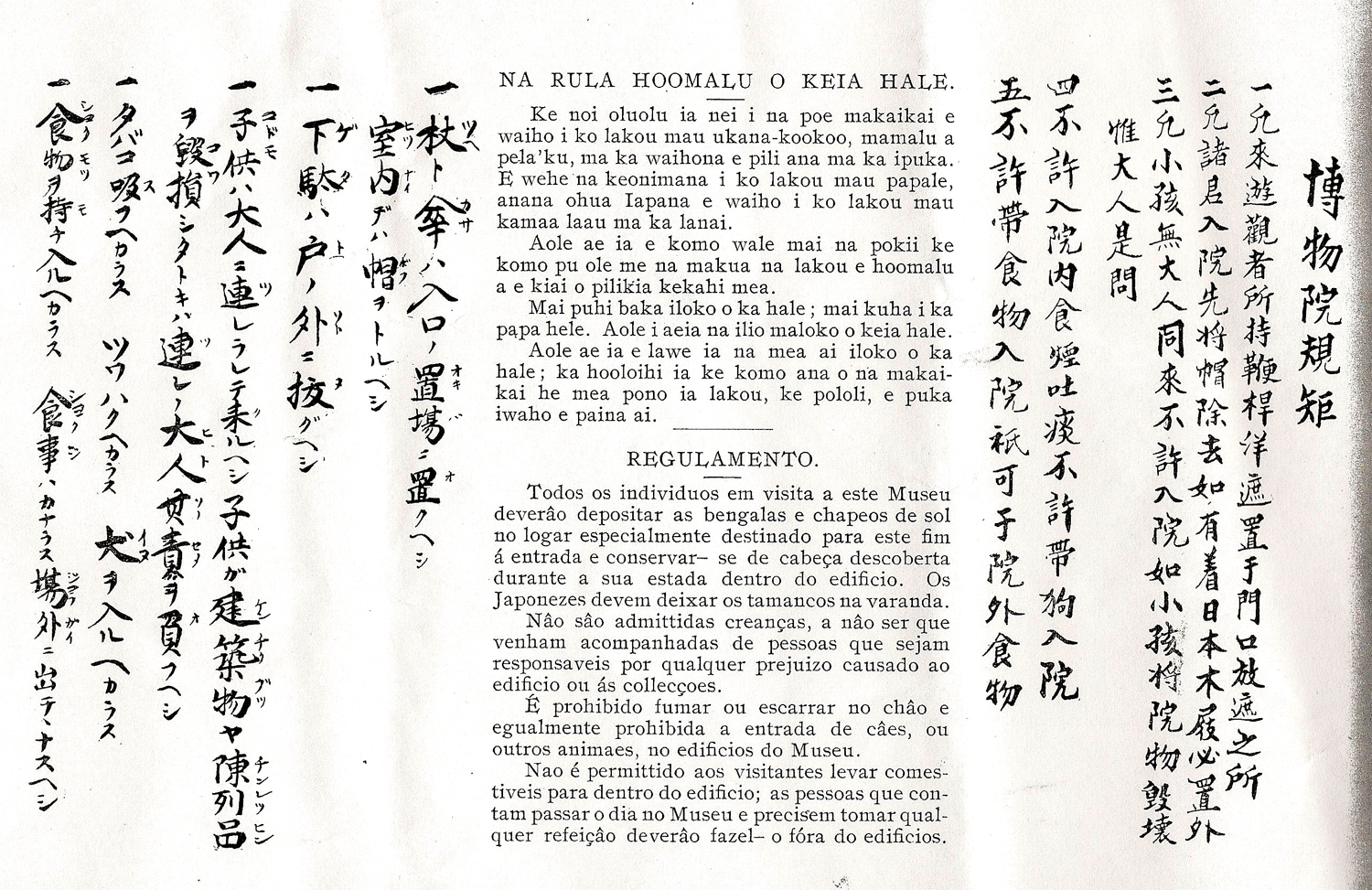
THE RULES OF ORDER OF THIS ESTABLISHMENT.

We kindly request of the visitors to leave their bags, canes, umbrellas, and so forth at the place to leave them by the entrance. Gentlemen are to remove their hats, and the Japanese guests are to leave their “wooden shoes” on the lanai.

Children are not allowed to enter unsupervised by adults who are to keep them in control and to watch them lest something gets damaged.

Do not smoke withing the building; do not spit on the floors. Dogs are not permitted in the building.

The bringing in of food into the building is not allowed; if here for an extended period, they must, if hungry, go outside to eat.

[This came from “A Handbook for Visitors to the Bernice Pauahi Bishop Museum of Polynesian Ethnography and Natural History” Honolulu 1903. I just came across this today and thought it was interesting.

In Japanese, the only big difference seems to be that it says if a child damages the building or one of the exhibits, then the accompanying adult must take responsibility. And those “wooden shoes” must have been troublesome, because it appears to be talked about in all four other languages as well!]

(“A Handbook for Visitors to the Bernice Pauahi Bishop Museum of Polynesian Ethnography and Natural History” Honolulu 1903.)

"A Handbook for Visitors to the Bernice Pauahi Bishop Museum of Polynesian Ethnography and Natural History" Honolulu 1903. Prepared by William T. Brigham, Director of the Museum.

“A Handbook for Visitors to the Bernice Pauahi Bishop Museum of Polynesian Ethnography and Natural History” Honolulu 1903. Prepared by William T. Brigham, Director of the Museum.