Hawaiian Music, an editorial, 1911.

How Hawaiian Music is Being Misconstrued!

Perhaps the thoughts of the Kuokoa may not be the same as those of others about the way Hawaiian music is being sung these days, but because we hold dear listening to the beauty and the sweet sounds along with the joy of the voices, therefore the Kuokoa takes up this matter.

It is not something that we Hawaiians should criticize, that singing is something we are proud of, and something that makes this race famous all around the world, by tourists who visit Hawaii nei and hear us singing our enjoyable and entertaining songs, as well as by singing groups being seen travelling about America.

If we were to turn back in time, to many years past, when the Kawaihau Glee Club and many other groups were famous for singing, we will see when comparing them to those performing today, the differences between them; our admiration will be taken by the singing of the old days, which many groups in some places around Hawaii nei still practice that way of singing Hawaiian songs.

Our Hawaiian mele are composed with their many kaona, and it is by how they are sung, if it is not made clear by the lyrics, that give appreciation and admiration to the listener, from Hawaiians to those that don’t know our language, because it is only through the melody of the song that that listener is entertained.

These days however, our singers are following haole style singing; and when songs that we are used to hearing along with their tunes which fill us with energy and enthrallment are changed, when listening to that it is like ridicule, for we are not used to hearing that kind of melody, and Hawaiian songs are not famous for that style of singing.

Our people, from the men to the women are talented with fine singing voices; it is a talent not widely spread amongst other people of the world, but it is not by the the way some people now are singing, but by singing songs as they were sung in years past.

Perhaps the vibrato and the slow and drawn out of singing matches haole songs of this age, but by changing the way Hawaiian songs are sung in this way, we at the Kuokoa are not mistaken when we say that it is insulting to the listener.

We don’t wish to call this person or that one not a good singers, but should we want our goal to be to preserve this fame through song, there is only one arena for us to stand before the other races, that is through expressing what God has given to every Hawaiian man and woman, without mimicking or emulating what other people are doing; lest what is seen by us as good becomes something that is not good.

We have nothing to say to those who are studying music in books; that will be a great benefit to some, but the good seen in one aspect will not get better by changing another aspect; so it is with our Hawaiian music, by changing how they are sung, it will not make them better.

Each and every Hawaiian is the true witness, and they are the perfect judge to weigh what we now discuss, not to criticize or to assail upon someone with words of persecution, but for our affection of the grandeur and true beauty of Hawaiian mele which each and every one of us all love and cherish.

[On a somewhat related topic about tradition and kuleana and mele, there is a very thought-provoking essay for composers and non-composers alike, by Kainani Kahaunaele, printed in The Value of Hawaii 2: Ancestral Roots, Oceanic Visions, just recently out. In fact, if you haven’t got your copy yet, there are many stories by a wide range of writers in there that we should look at, and perhaps the many moolelo within the collection will then push us into thinking what we ourselves feel the value of Hawaii nei is and where we should be headed and what it is we need to do to get us there.]

(Kuokoa, 9/8/1911, p. 4)

PEHEA E HOOHEPAIA MAI NEI NA HIMENI HAWAII!

Ka Nupepa Kuokoa, Buke XLVII, Helu 36, Aoao 4. Sepatemaba 8, 1911.
More on ’93 KS graduate, Abraham Pihi, 1898.

MY DEAR SWEETHEART HAS JUST PASSED, AND MY EMOTIONAL SUPPORT HAS BEEN TAKEN AWAY.

Mr. Editor.

Aloha oe:

Should it be satisfactory to you and your workers, here is my bundle of olive leaves that is placed above, so that our many loved ones living all the way from Haehae where the sun rises to the pleasant base of Lehua where the sun sets may see it.

My beloved has gone, my companion who I would talk with in days gone by, that is my beloved man, Mr. Aprahama Pihi, who is a native and a familiar one of the land famous for the “Kanilehua” [Hilo] and the fragrant bowers of hala of Puna, and the land of the Haao Rains [Kaʻū], that is the roots of my dear husband who left me, his companion, his wife, grieving at the side of his grave. Auwe! How dreadful. Abraham Pihi was born in Puueo, Hilo, Hawaii on the 5th of January, 1872, of E. P. Hoaai (m) and Lilia Palapala (f), and the two of them had 7 children: 5 daughters and 2 sons; and 2 of them went off in search of the footprints of their parents, and 5 remain mourning on this side: 4 girls and one boy.

He was educated at the Hilo Boarding School under the principal, Rev. W. R. Oleson [W. R. Olesona]¹. After he was done there, he entered Kamehameha School in 1893. He was at that school for 1 year, but because it was learned that he had the disease that separates families, he asked the principal, that being the Rev. W. R. Oleson, to release him. He returned to Wailuku, Maui, where his mother was living with his new father, the Rev. S. Kapu; he lived with his parents until he was taken in by the disease that separates families; he was taken from his parents and his younger siblings. He was taken away to this land of no friends in 1895. The number of years he had in this world was 24 and eleven months and 13 days, when his last breath was released. Continue reading

Mele about news heard over the telephone wires, 1921.

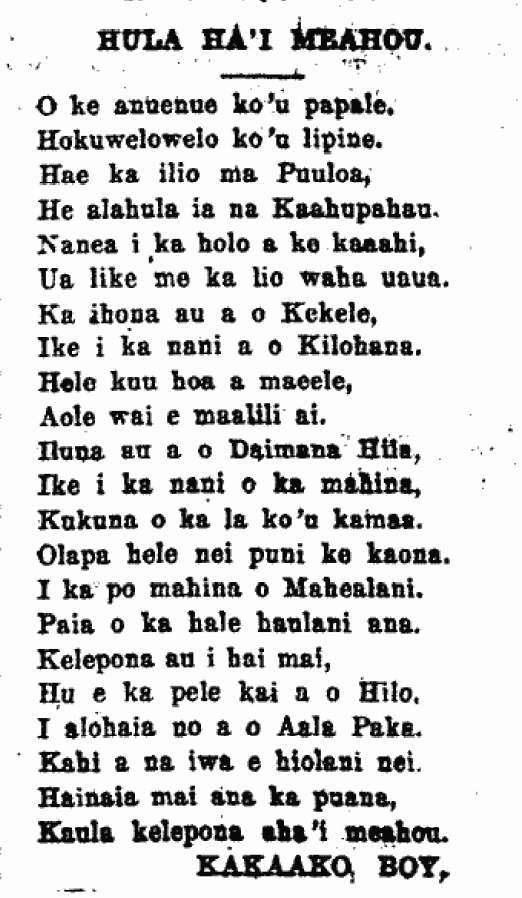
HULA HA’I MEAHOU.

O ke anuenue ko’u papale,
Hokuwelowelo ko’u lipine,
Hae ka ilio ma Puuloa,
He alahula ia na Kaahupahau,
Nanea i ka holo a ke kaaahi,
Ua like me ka lio waha uaua,
Ka ihona au a o Kekele,
Ike i ka nani a o Kilohana.
Hele kuu hoa a maeele,
Aole wai e maalili ai.
Iluna au a o Daimana Hila,
Ike i ka nani o ka mahina.
Kukuna o ka la ko’u kamaa,
Olapa hele nei puni ke kaona.
I ka po mahina o Mahealani,
Paia o ka hale haulani ana.
Kelepona au i hai mai,
Hu e ka pele kai a o Hilo.
I alohaia no a o Aala Paka,
Kahi a na iwa e hiolani nei.
Hainaia mai ana ka puana,
Kaula kelepona aha’i meahou.

KAKAAKO BOY.

[I wonder if this mele preceded or followed the song we know today as “Kukuna o ka La”.]

(Kuokoa, 11/11/1921, Section 2, p. 1)

HULA HA'I MEAHOU.

Ka Nupepa Kuokoa, Buke LIX, Helu 45, Mahele Elua, Aoao 1. Novemaba 11, 1921.

Restoration Anthem, 1843.

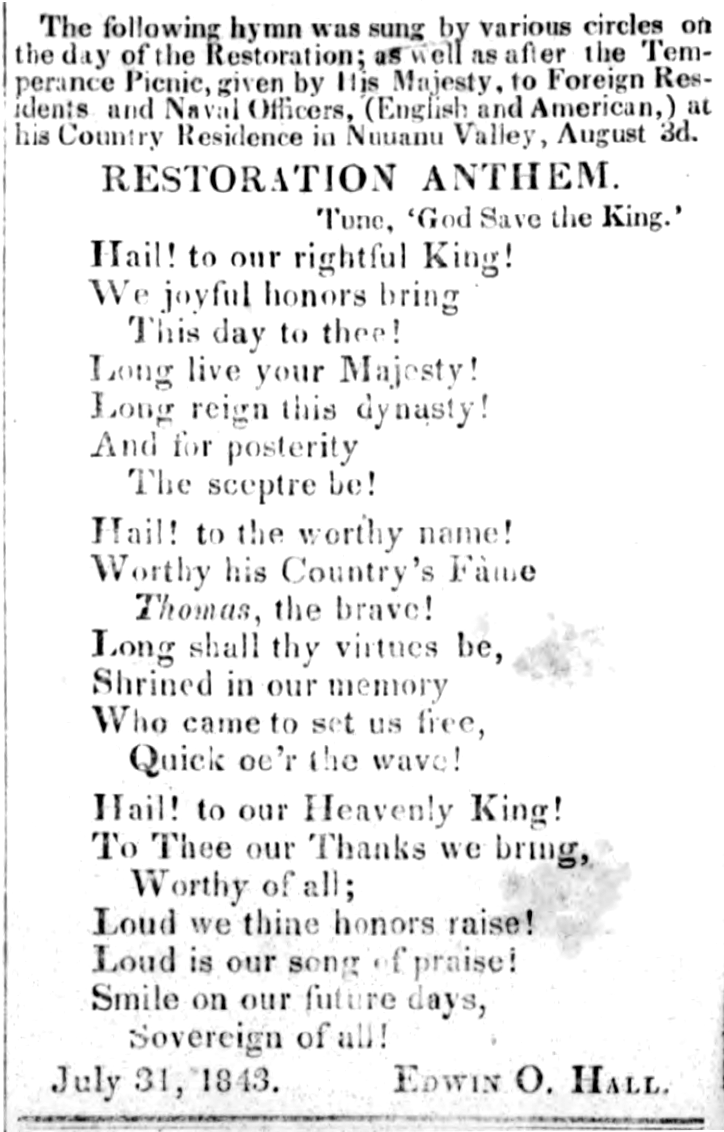
The following hymn was sung by various circles on the day of the Restoration; as well as after the Temperance Picnic, given by His Majesty, to Foreign Residents and Naval Officers, (English and American,) at his Country Residence in Nuuanu Valley, August 3d.

RESTORATION ANTHEM.

Tune, ‘God Save the King.’

Hail! to our rightful King!
We joyful honors bring
This day to thee!
Long live your Majesty!
Long reign this dynasty!
And for posterity
The sceptre be!

Hail! to the worthy name!
Worthy his Country’s Fame
Thomas, the brave!
Long shall they virtues be,
Shrined in our memory
Who came to set us free,
Quick oe’r the wave!

Hail! to our Heavenly King!
To Thee our Thanks we bring,
Worthy of all;
Loud we thine honors raise!
Loud is our song of praise!
Smile on our future days,
Sovereign of all!

July 31, 1843.  Edwin O. Hall.

[This post may be just a little early this year, but it is good to not just remember momentous events like Ka La Hoihoi Ea just one day of the year. Last year, the Hawaiian Historical Society put up handwritten lyrics of this mele on their Facebook page on the 27th of July. Here we find it in print, just a few days following its being penned by Edwin O. Hall!]

(Temperance Advocate and Seamen’s Friend, 8/11/1843, p. 42)

RESTORATION ANTHEM.

Temperance Advocate and Seamen’s Friend, Volume I, Number VIII, Page 42. August 11, 1843.

More on Don Blanding, 1939.

About Don Blanding

Don Blanding

Moses Company, Limited announced the arrival of plates decorated by this famous poet, Don Blanding, a they are being displayed in their store and are placed in one of their show windows. You can see the true value of his recollections. His abilities in painting is incomparable.

You can begin your collection of plates for $8.80. They are beautiful to look at, and can be used everyday.

Should you desire to see some of those plates, go to the book store of the Moses Company. Continue reading

Don Blanding poem in English, 1939.

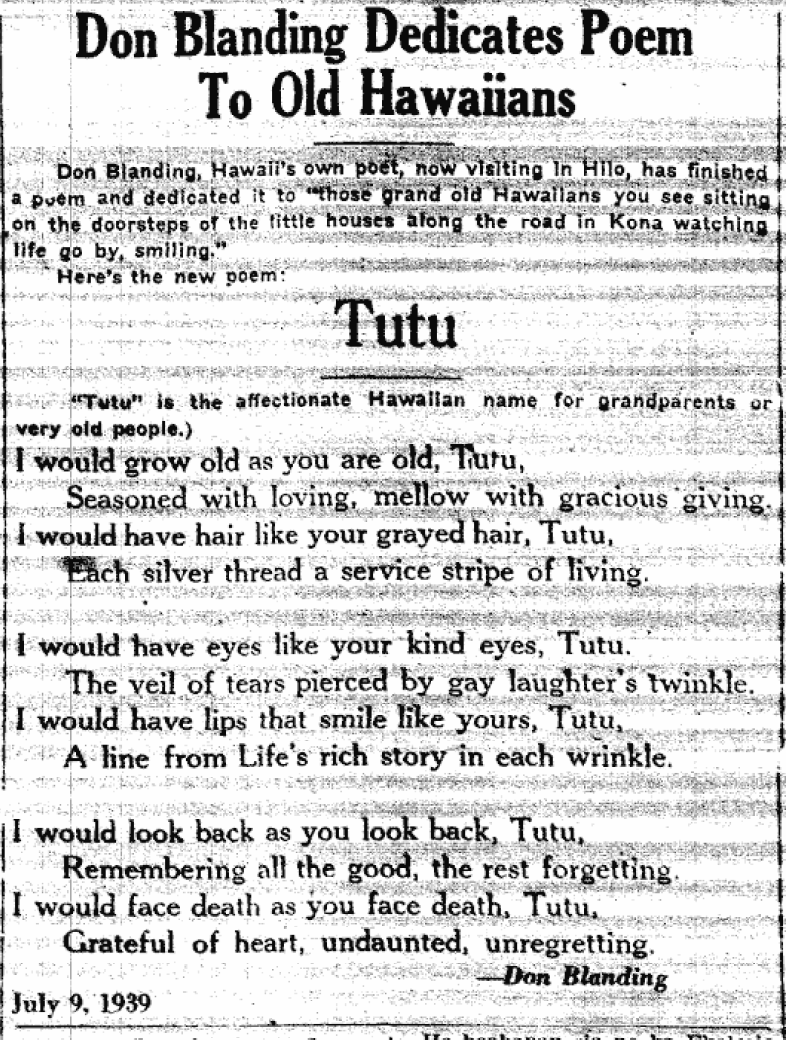
Don Blanding Dedicates Poem To Old Hawaiians

Don Blanding, Hawaii’s own poet, now visiting in Hilo, has finished a poem and dedicated it to “those grand old Hawaiians you see sitting on the doorsteps of the little houses along the road in Kona watching life go by, smiling.”

Here’s the new poem:

Tutu

“Tutu” is the affectionate Hawaiian name for grandparents or very old people.)

I would grow old as you are old, Tutu,
Seasoned with loving, mellow with gracious giving,
I would have hair like your grayed hair, Tutu,
Each silver thread a service stripe of living.

I would have eyes like your kind eyes, Tutu,
The veil of tears pierced by gay laughter’s twinkle,
I would have lips that smile like yours, Tutu,
A line from Life’s rich story in each wrinkle.

I would look back as you look back, Tutu,
Remembering all the good, the rest forgetting,
I would face death as you face death, Tutu,
Grateful of heart, undaunted, unregretting.

—Don Blanding

July 9, 1939

(Hoku o Hawaii, 7/12/1939, p. 6)

Don Blanding Dedicates Poem To Old Hawaiians

Ka Hoku o Hawaii, Volume XXXIV, Number 11, Aoao 6. July 12, 1939.

More on the originator of Lei Day, Don Blanding, 1939.

Don Blanding Dedicates this poem to the oldsters of Hawaii

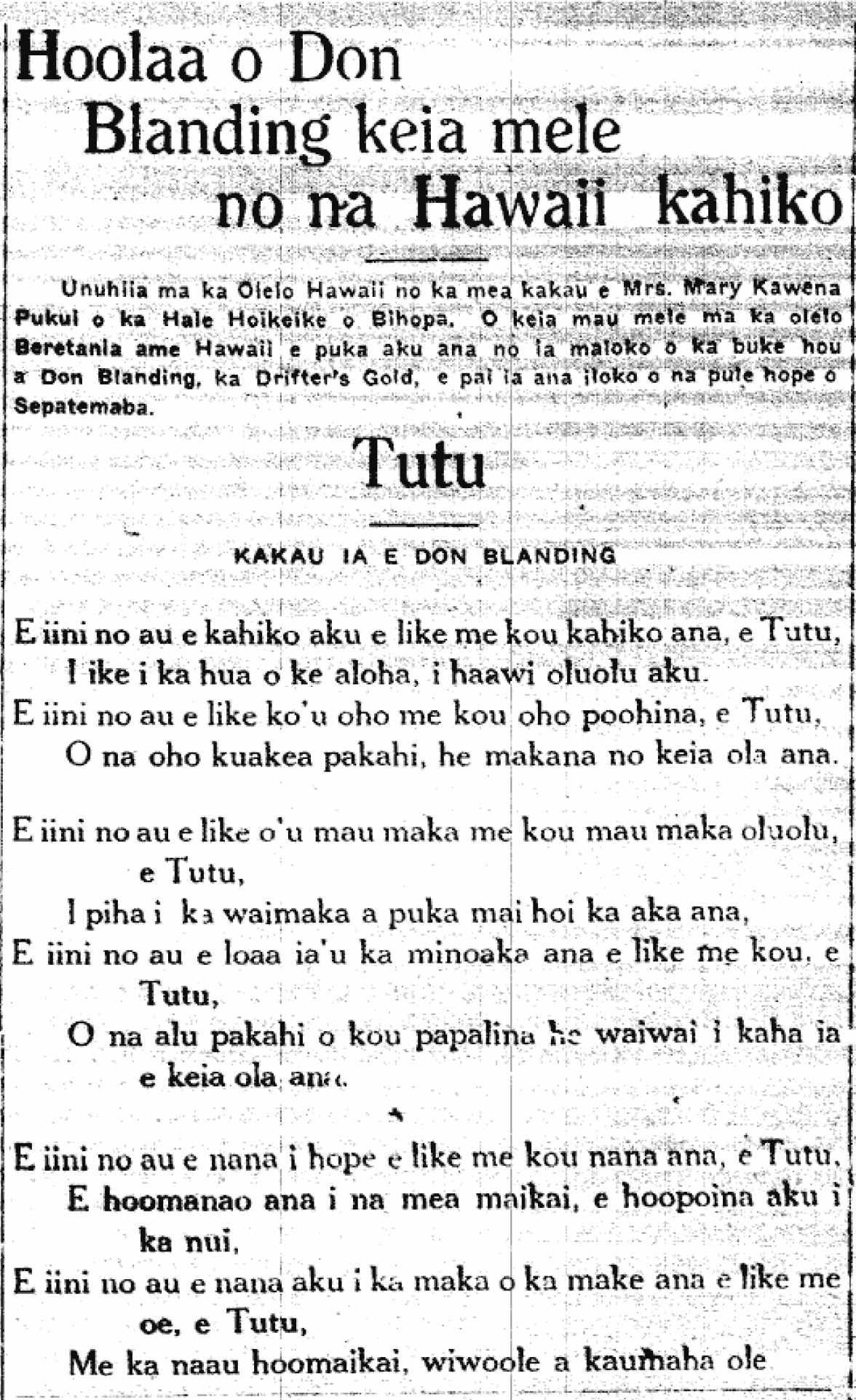
This was translated into Hawaiian for the writer by Mrs. Mary Kawena Pukui of the Bishop Museum. These mele in English and Hawaiian will come out in the new book by Don Blanding, Drifter’s Gold, which will be published in the last week of September.

Tutu

WRITTEN BY DON BLANDING

E iini no au e kahiko aku e like me kou kahiko ana, e Tutu,
I ike i ka hua o ke aloha, i haawi oluolu aku,
E iini no au e like ko’u oho me kou oho poohina, e Tutu,
O na oho kuakea pakahi, he makana no keia ola ana.

E iini no au e like o’u mau maka me kou mau maka oluolu, e Tutu
I piha i ka waimaka a puka mai hoi ka aka ana,
E iini no au e loaa ia’u ka minoaka ana e like me kou, e Tutu,
O na alu pakahi o kou papalina, he waiwai i kaha ia e keia ola ana.

E iini no au e nana i hope e like me kou nana ana, e Tutu,
E hoomanao ana i na mea maikai, e hoopoina aku i ka nui,
E iini no au e nana aku i ka maka o ka make ana e like me oe, e Tutu,
Me ka naau hoomaikai, wiwoole a kaumaha ole.

(Hoku o Hawaii, 7/12/1939, p. 1)

Hoolaa o Don Blanding keia mele no na Hawaii kahiko

Ka Hoku o Hawaii, Volume XXXIV, Nuimber 11, Aoao 1. Iulai 12, 1939.

Newspapers, Mary Robins, mele, and connections, 1919.

HE HULA NO E. E. ROBINS.

Kaulana mai nei o Honolulu Harbor,
O ka ipukukui malamalama,
He nani no oe ua ikeia,
A na manu e pohai nei;
Ku mai o Robins me ka hiehie,
He ui ninau ia Henry Au,
E uleu kaua a e pono ai,
I loaa ka makana mailuna mai,
Hoike piha oe i kou ike,
Noii nowelo a ke akamai;
O ka paia keleawe e hulali ana,
Opuu kaimana alohilohi;
Ua hana noeau ia e Palanai,
Ke pipi’o nei e ke anuenue;
O ka pipiio no ia Honolulu Harbor,
A welo e ka hae helu ekahi.
Lohe aku Kaleponi he aina nani,
Ua kau ka hoku i waenakonu.
O ka pine kohu ana ko umauma,
E owaka e ka nani i Kilauea,
Ka moena weleweka ka moena ia,
Opuu kaimana kau umauma;
Imua kaua a lanakila,
Ke Akua mau loa kou kokua;
Hea aku au e o mai oe,
E o e Robins i kou inoa.

Hakuia e
MRS. MARY ROBINS. Continue reading

Hula, mele, and tradition, 1928.

IN SEARCH OF HULA, OLIOLI HOAEAE, AND HAWAIIAN SONGS

There are some people here trying to find once more the hula, chants, and songs of old Hawaii.

Some people believe that it would be good to perpetuate the hula and olioli hoaeae of the the old. Some believe strongly that it is a waste of time or that type of endeavor would be old fashioned [olopaikini].

Some people think that it is very good for Hawaiian things to be fostered, and they are attempting to put an end to improper things like the kind of hula olapa of some people done in public. Continue reading

Newspapers, translation, and a mele for the Merrie Monarch, 1913 / Timeless.

You can find various translations for the beautiful song, “Kaipoleimanu” in the archives of the Bernice Pauahi Bishop Museum, online, and on liner notes. None however seems to acknowledge that Kaipoleimanu itself was a wahi pana, along with its neighboring hau of Maihi, ulu of Weli [also seen as Wehi], and hala of Mapuana.

There is a priceless church meeting report/travelogue appearing in the Kuokoa from 12/5/1913 to 2/6/1914: Ka Ike Hou ana o ke Kamahele i ka Mokupuni o Kauai [The Traveler Sees Once More the Island of Kauai], signed, Kamahele. Amongst all the fascinating information found in this report is a description of the places hearkened to in the mele Kaipoleimanu, to which the traveller is taken by his guide, the Deputy Sheriff of Hanalei, William Werner. He says: Continue reading