Hula fought against by the church, 1917.

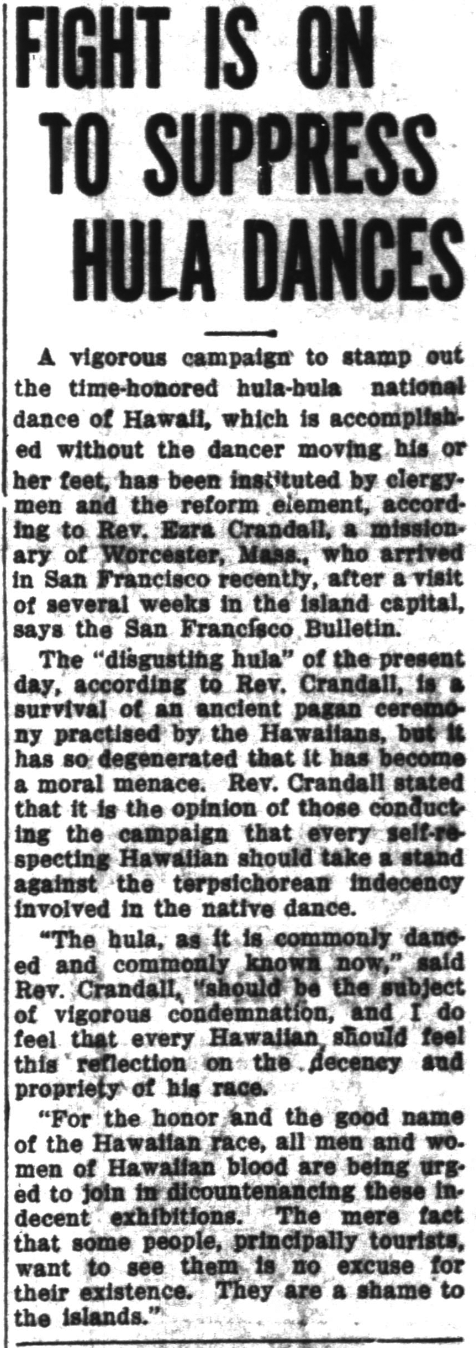
FIGHT IS ON TO SUPPRESS HULA DANCES

A vigorous campaign to stamp out the time-honored hula-hula national dance of Hawaii, which is accomplished without the dancer moving his or her feet, has been instituted by clergymen and the reform element, according to Rev. Ezra Crandall, a missionary of Worcester, Mass., who arrived in San Francisco recently, after a visit of several weeks in the island capital, says the San Francisco Bulletin.

The “disgusting hula” of the present day, according to Rev. Crandall, is a survival of an ancient pagan ceremony practiced by the Hawaiians, but is has so degenerated that it has become a moral menace. Rev. Crandall stated that it is the opinion of those conducting the campaign that every self-respecting Hawaiian should take a stand against the terpsichorean indecency involved in the native dance.

“The hula, as it is commonly danced and commonly know now,” said Rev. Crandall, “should be the subject of vigorous condemnation, and I do feel that every Hawaiian should feel this reflection on the decency and propriety of his race.

“For the honor and the good name of the Hawaiian race, all men and women of Hawaiian blood are being urged to join in discountenancing these indecent exhibitions. The mere fact that some people, principally tourists, want to see them is no excuse for their existence. They are a shame to the islands.”

(Star-Bulletin, 6/15/1917, p. 14)
StarBulletin_6_15_1917_14

Honolulu Star-Bulletin, Volume XXIV, Number 7854, Page 14. June 15, 1917.
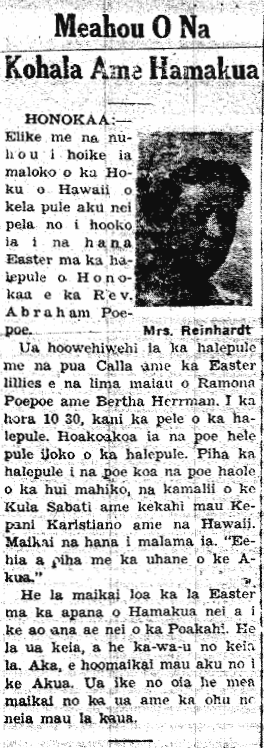
Easter Sunday in Honokaa, 1942.

News of the Kohala Districts and Hamakua

HONOKAA:—Just like the news announced last week in the Hoku o Hawaii, the Easter events were carried out at the church of Honokaa by the Rev. Abraham Poepoe.

The church was decorated with Calla and Easter lily flowers by the meticulous hands of Ramona Poepoe and Bertha Herrman. At the hour of 10:30, the church bell rang. The church goers gathered in the church. It was filled with soldiers, haole from the sugarcane plantations, the children of the Sunday School, and some Japanese Christians as well as Hawaiians. The services held that day were beautiful. “Awe inspiring and filled with the spirit of God.”

Easter day was a very nice day here in the Hamakua district and the dawning of this Monday. This is a rainy day, and this is a humid day. However, praised always is God. He knows that it is good for there to be rain and fog these days of war.

(Hoku o Hawaii, 4/8/1942, p. 1)

HokuoHawaii_4_8_1942_1

Ka Hoku o Hawaii, Volume XXXVI, Number 42, Aoao 1. Aperila 8, 1942.

Ahuimanu College Examinations, 1871.

Ahuimanu College.

Ahuimanu College is under the administration of the Roman Catholics; the students had their examinations last week Wednesday. We very much wanted to see firsthand the progress made by this school, but we did not know ahead of time, and its examination date was not advertised. And therefore, we perhaps can take word of their progress from people who were there and who weighed for themselves. This school, many years ago, was under the leadership of Rev. Walsh, and these days, it is being taught and lead by Rev. Father Lievin, the one who is known for his abilities, kindness, and some other good traits for the proper administering in the advancement of the school.

We were informed that the visitors enjoyed the spelling and clear reading of the students of the lower classes. The young students who could not speak English they ear before, could now pronounce clearly what they were reading. This was a testament to the strength and competence of their teaching and their guidance; giving hope that if they continue to progress in that fashion, they will not fail to make advancements in the future. The teaching and making clear to the students about reading clearly is very important in the knowledge of reading that is to be ingrained in our youngsters; whereas studying hurriedly will be worthless in the end; that kind of learning is nothing more than a horse race. Continue reading

Ahuimanu College and St. Louis College, 1882.

ST. LOUIS COLLEGE

Is our leading Roman Catholic educational institution for boys. It is an old institution called by a new name and located in a new place. The same institution long existed and prosecuted its mission at Koolau, on the other side of this island, and was there and then known as Ahuimanu College. Although delightfully situated, and having many advantages in its favor, it was felt to be too far from the centre of population, to answer fully the purpose of its existence. Consequently, it was decided, a short time ago, to remove the institution to the neighborhood of Honolulu.

For this purpose the church authorities purchased a splendid piece of property from Mr. Roth, at the north end of Beretania street, not far from Smith’s bridge, where they have erected suitable buildings, and established the old Ahuimanu College under the new name of St. Louis College.

The College grounds measure about two acres, allowing abundance of space for recreative exercise, and are planted with all kinds of tropical trees, some of which are fruit-producing, while others simply afford shade and ornamentation. It is truly a lovely spot, and being free from noisy surroundings, is peculiarly adapted to the purpose for which it is now used.

The College building is a substantial two storey brick structure, 60×20 feet in the clear. The ground floor is divided into three class rooms of equal size, by wooden partitions. Each of these rooms is nicely furnished with new school furniture of the most approved modern style. They are also well lighted and ventillated, ventillation being greatly assisted by the wooden partitions not extending the whole way to the ceiling, which latter is fourteen feet from the floor. Continue reading

J. E. Chamberlain, collector for the Hawaiian National Museum, 1876.

Curios for the Government Museum.

The Morning Star brought up for the Hawaiian Government the following curios, corals, &c. Two sets Gilbert Island armor complete with helmets; also shark teeth sword and spear, mats and native dresses; eel basket; common fish basket; umbrella coral, three feet six inches in diameter, perfect, from Apian by Mr. Randolph.

From Marshall Island: Spears, Male fringe petticoats and woman’s mat dress; carved figure-head; model of canoe fully rigged; paddles; red coral; black coral; platter coral, bone adzes from Strong’s Island. Continue reading

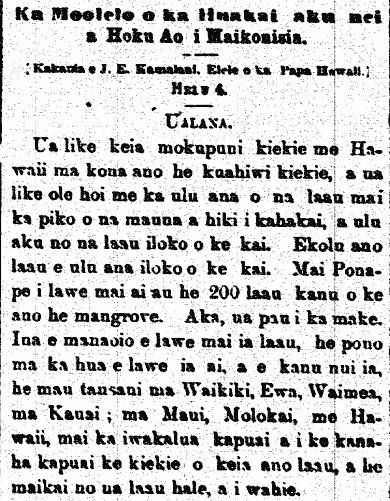
Mangrove for Hawaii? 1876.

[Found under: “Ka Moolelo o ka Huakai aku nei a Hoku Ao i Maikonisia.”]

Ualana.

This high island is similar to Hawaii being that it is a high mountain, but it is different in that there are trees that grow from the mountain peaks all the way to the ocean, and there are trees that grow in the ocean. There are three kinds of trees growing in the ocean. I brought from Ponape 200 mangrove plants. But they all died. If we really want to bring in that plant, it should be brought in by seed, and planted extensively; thousands in Waikiki, Ewa, Waimea on Kauai, on Maui, Molokai, and Hawaii; this tree reaches from twenty to forty feet high, and is good as lumber for house building and for firewood.

[This appears in a description of travels of the Morning Star to Micronesia, written by Jeremiah E. Chamberlain, the representative of the Board of Hawaiian Missions.]

(Lahui Hawaii, 4/6/1876, p. 2)

LahuiHawaii_4_6_1876_2.png

Ka Lahui Hawaii, Buke II, Helu 15, Aoao 2. Aperila 6, 1876.

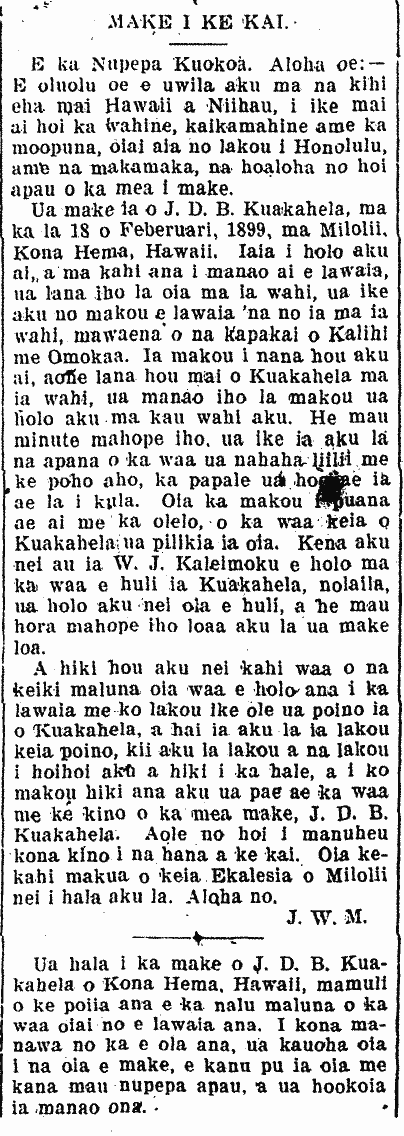
Historian J. D. B. Kuakahela dies at sea, 1899.

DIED AT SEA.

O Kuokoa Newspaper. Aloha oe:—Please flash across the four corners of Hawaii to Niihau, so that the wife, children and grandchildren see, being that they are in Honolulu, and also all of the friends and fellows of the one who died.

J. D. B. Kuakahela died on the 18th of February 1899 at Milolii, South Kona, Hawaii. When he went and was in the area where he wanted to fish, he was floating; we saw him fishing in that area, between the coast of Kalihi and Omokaa. When we looked once more, Kuakahela was no longer floating in that area, and we thought he sailed to some other place. Some minutes later, pieces of the canoe were seen broken into small bits, his fishing line container [poho aho], and his hat floated upon the shore. That is when we said, that is the canoe of Kuakahela; he is in trouble. I instructed W. J. Kaleimoku to go by canoe to search for Kuakahela, so he went to go look, and a number of hours later, he was found dead.

And thereafter a canoe arrived, and the boys aboard that waa were going fishing without knowing that Kuakahela met with disaster; they were told of the calamity and they went to bring him to the house, and when we got there, the waa with the body of the deceased, J. D. B. Kuakahela aboard, landed. His body was not bruised by the action of the ocean. He was one of the elders of this Church of Miloliii who passed on. Aloha no.

J. W. M.

—–

J. D. B. Kuakahela of South Kona, Hawaii, has died because a wave crashed onto his canoe while he was fishing. While he was living, he instructed that at his death, that he is to be buried with all of his newspapers, and this wish of his was carried out.

[That last comment is awesome. I bet I would have liked this man!]

(Kuokoa, 2/24/1899, p. 2)

Kuokoa_2_24_1899_2

Ka Nupepa Kuokoa, Buke XXXVIII, Helu 8, Aoao 2. Feberuari 24, 1899.

Hiram Kaaha dies, 1923.

MY BELOVED FATHER, MR. HIRAM KAAHA, HAS PASSED.

MR. HIRAM KAAHA.

Iluna i ke ao,
Kuu home mau,
He malihini au,
Ma keia ao,
He waoakua nei,
He pilikia e,
Ka lani iluna ae,
Kuu home mau.

[Above in the clouds,
Is my home for all times,
I am a stranger,
In this world,
A desert,
A place of troubles,
The heavens above,
Is my home for all times.]

Mr. Solomon Hanohano: Aloha nui kaua:—Please insert this loving bundle of tears in an open space in the Kuokoa so that the fellow workers in the church, family, and friends of my dearly beloved father see that he has left this life.

My beloved papa was born at Kamoiliili, Waikiki Waena, Honolulu, Oahu, on Oct. 18, 1854 from the loins of Kawela (m) and Kahoiwai (f). Continue reading

Recalling the death of James Cook, 1896.

[Found under: “He Moolelo no ka HOOKUMUIA ANA O HAWAII”]

PERTAINING TO THE DEATH OF LONO.

On the 24th of January 1779, Kalaniopuu returned from Maui; Lono was at Kealakekua in Kona, and Kalaniopuu met with Lono, and Kalaniopuu the chief treated Lono kindly and donned a ahu ula upon Lono, with kahili, and Kalaniopuu did a great many good things for Lono.

And on the 4th of February 1779, Lono leaves Kealakekua and his ship sails directly outside of Kawaihae and Kohala; it is noticed that one of the masts of his ship is rotten, so he returns to Kealakekua to build a new mast for his ship. Continue reading

Fount of knowledge, H. B. Nalimu, turns 96! 1931.

GOOD NEWS

On the eleventh of November, 1835, Henry Benjamin Nalimu was born, at Papaaloa, North Hilo, Hawaii, the land of birth of his parents.

On November, he became ninety-six years old at “Kamaluokaohai,” at 1536 Alewa Drive, the home of his grandchildren.

Nalimu is a descendant of his ancestor I, who was a famed strategist of Kamehameha ka Na’i Aupuni.

The I, the Mahi, and the Palena, were famous troops of Kamehameha, and leaders of Kamehameha, and I commanded the troops of I.

In 1840, Nalimu left Papaaloa and lived in Pi’opi’o, Hilo, until 1847.

At that time, Kamehameha began to give land to the makaainana.

In 1852, Nalimu entered into the Hilo Boarding School.

D. B. Lyman was the principal at the time, and it was he who built that college on land given by the alii for that school.

In 1857, Nalimu became the assistant kahu of the church of Hilo, under the old Missionary Coan [Koana, Titus Coan].

He accompanied Coan to the cliffs of Hilo, climbing up and going down into the rivers. There were no bridges and no good roads at the time. The walked the trails until Kalapana. The shoes they wore were ti-leaf sandals [kamaa la’i], and pandanus root sandals [kamaa aahala], so that their feet would not be harmed by the rocks. Continue reading