Changing Hawaiian Language, 1844.

February 20, 1844.

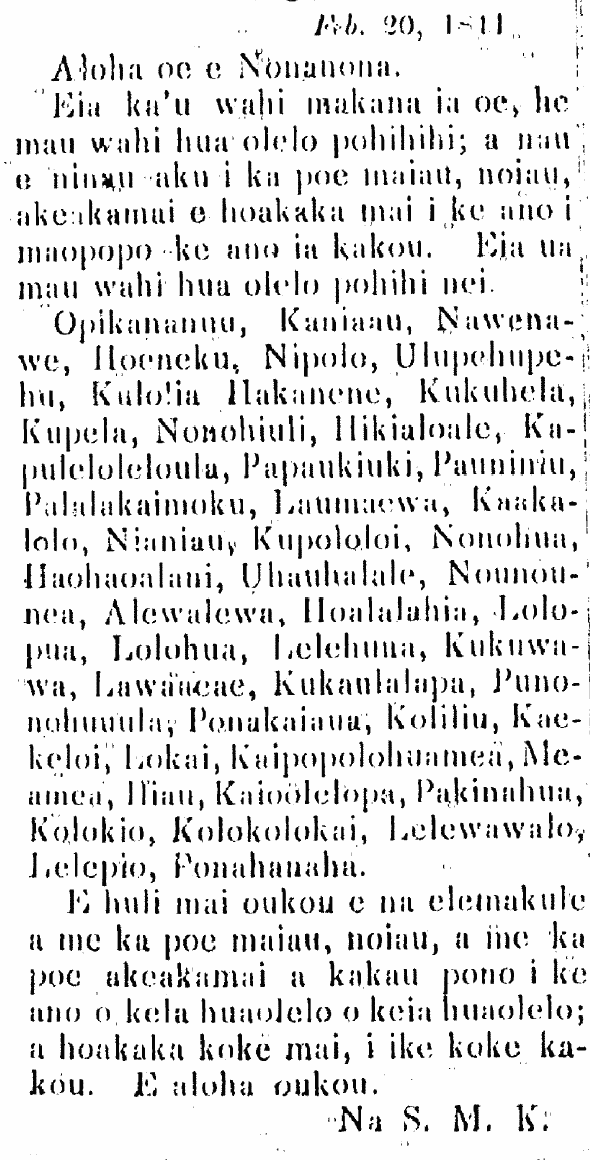
Aloha to you, O Nonanona.

This is my gift to you, some unclear words; and it is for you to asks the skilled, the wise, the seekers of knowledge to clarify their nature, so that it is understood by us. And here are those unclear words.

Opikananuu, Kaniaau, Nawenawe, Hoeneku, Nipolo, Ulupehupehu, Kulolia, Hakanene, Kukuhela, Kupela, Nonohiuli, Hikialoale, Kapuleloleloula, Papaukiuki, Pauniniu, Palalakaimoku, Laumaewa, Kaakalolo, Nianiau, Kupololoi, Nonohua, Haohaoalani, Uhauhalale, Nounounea, Alewalewa, Hoalalahia, Lolopua, Lolohua, Lelehuna, Kukuwawa, Lawaaeae, Kukaulalapa, Punonohuuula, Ponakaiaua, Koliliu, Kaekeloi, Lokai, Kaipopolohuamea, Meamea, Iliau, Kaioolelopa, Pakinahua, Kolokio, Kolokolokai, Lelewawalo, Lelepio, Ponahanaha.

All you oldsters, and the skilled, the wise, and the seekers of knowledge, set down in writing the meanings of each word, and clarify them soon so that we may quickly know. Aloha to you all.

By S. M. K. [Samuel Manaiakalani Kamakau]

[It is only 1844, and the young Kamakau is asking for clarification of vocabulary. The Hawaiian language apparently is already changing quickly, and Kamakau has already began collecting. He will be printing many traditional mele in the papers and does his famous history in the 1860s…]

(Nonanona, 3/5/1844, p. 109.)

Feb. 20, 1844...

Ka Nonanona, Buke 3, Pepa 21, Aoao 109. Maraki 5, 1844.

The changing Hawaiian language, 1880.

SOME THOUGHTS ON THE HAWAIIAN LANGUAGE.

Before the arrival of the teachers and the educated haole from foreign lands, documents were not written in the Hawaiian language. But not long after the teachers began living here, they sought to write down this language, and in the year 1822, the first book was printed in Hawaiian. From that time until this day, the progress of book printing has been quick.

In the year 1834, the first Hawaiian-language newspaper was published. These days, newspaper publishing has become a big industry, and the nation is enriched by the spreading of knowledge and enlightenment by reading the newspapers.

This blessing described above has been accompanied by a problem, and I would like to express some thoughts on the subject. Therefore, O Readers, please be kind as I explain to you some things on the topic.

If we observe a newborn child, he comes into the world not knowing how to speak; but after a few months, he takes up this new task and attempts speaking a few words.

When a child gets new ideas and learns new things, he searches for new words, and along with the increase in his knowledge and awareness, so too does his number of words he can properly produce; and should he later become enlightened, he will be very well equipped with words for all of his thoughts.

By this, we understand that words are manifestations of thought.

Just as a child searches for new words, so too does a people when they acquire a new idea, or new things; they want to search for new fitting words to represent those new ideas or things. With the spreading of knowledge in this land, Hawaiians have come to know many new things which they did not think of before, like animals, plants, food, clothing, tools, usable electricity, iron, copper, silver, gold, and names for foreign lands, as well as descriptions for many new ideas. If the new vocabulary added to the Hawaiian language by educated foreigners and by Hawaiians searching for knowledge were counted, they probably would total no less than a thousand, or a number of thousands. The majority of these words are valuable words for the people, valuable for those who ponder and search for knowledge; however, a small fraction of these words are useless, and has been included in our language in error; and as a result of this mistaken inclusion, the true nature of the Hawaiian language has nearly been altered, and it has become strange and confusing. When the Bible was translated into Hawaiian, it was not possible without also introducing new words into the Hawaiian language.

Here are some words we gained through this translation: anela [angel], liona [lion], berita [covenant (from Hebrew, b’rith)], kumumanao [subject], and there are many new words of that sort.These words were not introduced into the language without thought, it was done with careful consideration with much thought as to the nature of the word being translated.

But during the years gone by, many words have crawled into the language and are being printed in the newspaper that are very strange, not at all akin to how the old people of Hawaii really spoke.

The majority of these improper new words are spread through the newspapers; they are holes always left wide open where may enter, if not watched over, foreign words not understood in the language of Hawaii nei.

I should perhaps tell you some of these worthless words which I have seen, lest someone asks, “Where are these words which you have decided to criticize? We don’t know them.”

Here are some of those words: duke [duke], visakauna [viscount], baroneti [baroness]. What in the world are these things? Who will answer? These words were seen and continue to be seen in some newspapers printed in Honolulu.

Here is one more: kakela. In my mind, as I understand it, the word kakela is not a Hawaiian word, but a recently acquired word. The haole word that was altered and became that which was written above is castle.

What it is, is a fortified structure solidly built to fend off robbers or enemies [it is interesting that the word “enemi” is used here, because it is also one of those Hawaiianized English words of which he speaks]. Who would understand the meaning of this word if he didn’t speak English? Here is yet another: bateri [battery]. It is a brand new word. Who can say what it means? Only after perhaps agreeing on a loan of a million dollars, with which they would purchase a number of huge cannons, would Hawaiians understand the meaning of bateri.

The word hokele (English, hotel) has perhaps become a Hawaiian word, so I suppose I can’t criticize it. But what is a coroneta [coronet]? Let one who knows answer.

As for the word kanikela [consul], I guess I can’t criticize it much, for it has almost become a fixed word that is understood in Hawaiian.

Here however is a word that has only just entered recently which I thought over with consternation, that is fea (fair in English). Only the kamaaina here in Honolulu will most likely know the meaning of this word, and not the general public.

These are some atrocious words: Regimana (English, regiment), a thousand soldiers; kaina, “all sorts of kaina” (English, kind); this is really bad; materemonio (English, matrimony), marriage; uko ole (English, useless). These words should be discarded for good.

In the consideration of those knowledgeable and skilled in the subject of the appropriateness of words, it is clear that these are words that should be allowed into the Hawaiian language, for if they are allowed to be included, then this language will be a thing that is scorned. There are many other words that I can give, but those were maybe sufficient.

Here is another problem with allowing these words in, because good, clear words from the past will be forced out.

These new words which I criticize resemble shadows, or a gust of wind, because it is just a wind or dust without substance within.

For a word is a manifestation of thought, and void of thought, a word becomes nothing.

This critique does not apply to all words, as was said earlier. Because like a child, when he has a new idea or ideas, he desires new words as representations for his thoughts, and so too must a people that are progressing search for and acquire new vocabulary—good representations for the new ideas that come up and are incorporated. However, before taking up these new representations, it is necessary to consider it carefully, for we may already have in the gracious, native Hawaiian language, a representation very similar to this new word, this malihini that we are about to welcome.

It is a fact that the Hawaiian people have discarded their blunt stone chisels of the olden days, because they are no longer valued now that we have sharp metal chisels; but that is no reason to set aside the stone poi pounder, or even the ulu maika stone—these are still valuable to this day, and if these were abandoned, then the lahui would be made poor. This is can be well applied to the vocabulary of Hawaii nei. For it is true that the Hawaiian language has acquired many words from the outside, and thus the language has benefited and been enriched. But for this reason, if important words from the past were abandoned, and these new words not understood by the many were grabbed haphazardly, the Hawaiian language would become a thing worthless, emaciated and castrated.

Regular old words taken and used regularly by people from the old times to this day, those are the blood, the breath, the prize of the true language of the Hawaiian Archipelago. And the abandoning, the leaving to the side, and the forgetting of these familiar words that were sanctified by Hawaii’s kupuna from ancient times, would be wrong in my mind; and the taking up of brand new inappropriate words as replacement for the old words that were abandoned—the foolishness of this is like abandoning fish and poi and instead filling the stomach with just haole food, snacks that are no good.

“A lahui that takes up another language and forgets their own, that lahui will live conquered and defeated.” That is what was said by an educated man.

This being said, it is not my desire to criticize the educated search in the English language or perhaps other foreign languages; it is a good and much appreciated thing.

I do however want to raise an emphatic voice and to ward off the speedy acceptance without proper consideration of strange new words with no worth, making the Hawaiian language a mixed up and unclear thing.

For this reason, the heads of newspapers; the translators of stories from foreign languages into Hawaiian; and all knowledgeable ones wanting the well being, the steadfastness, and the independence of Hawaii nei; must all be vigilant and guard against the improper inclusion of words that are ill-fitting and ill-suited to the inherent nature of the fine, melodic [palale?] language of the Hawaiian Islands.

N. B. Emerson.

Honolulu, April 26, 1880.

(Ko Hawaii Pae Aina, 7/31/1880, p. 4)

HE MAU MANAO NO KA OLELO HAWAII.

Ko Hawaii Pae Aina, Buke III, Helu 31, Aoao 4. Iulai 31, 1880.

More Ernest Kaai—meeting a Hawaiian living in Australia, 1925.

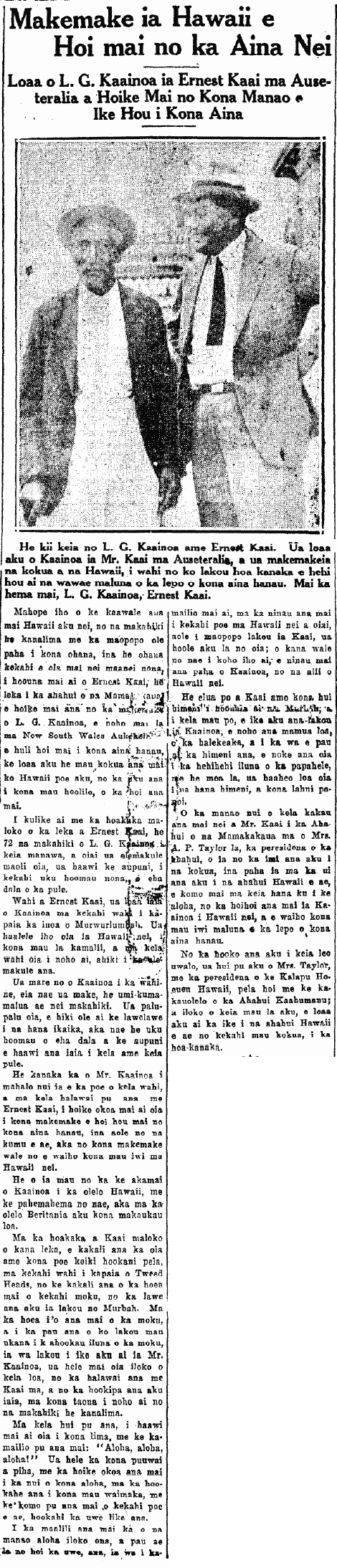
That Hawaiian Wants to Come Back Here

Ernest Kaai Finds L. G. Kaainoa in Australia, and He Tells of His Desire to See Once Again His Land

This is a picture of L. G. Kaainoa and Ernest Kaai. Mr. Kaai found Kaainoa in Australia, and he wants the help from Hawaiians to provide him a means for him to once again tread upon the land of his birth. From the left, L. G. Kaainoa, Ernest Kaai.

L. G. Kaainoa has been away from Hawaii for 50 years now without his family’s knowledge, or knowing even if he has ohana left alive here; Ernest Kaai sent a letter to the Ahahui Mamakakaua [Sons and Daughters of Hawaiian Warriors] telling them of the desire of Kaainoa (who now lives in New South Wales, Australia), to return to his homeland were he to receive assistance from Hawaii’s people to pay his expenses for the return.

According to the explanation in the letter of Ernest Kaai, L. G. Kaainoa is now 72 years old, and being that he is very old, the government provides him a pension of 4 dollars a week.

Ernest Kaai says he found Kaainoa at a place called Murwillumbah. He left Hawaii nei in his youth and it is there that he lived until his old age.

He married a woman, but she died 12 years earlier. He is infirm and cannot do hard labor. But he is given benefits by the government of 4 dollars every week.

Kaainoa is well liked by the people there, and when he met with Ernest Kaai, he made clear his hope to return to his homeland, if not for any other reason, but for his desire to leave his bones in Hawaii nei.

He is still very good at Hawaiian, yet is somewhat clumsy, but he is most fluent in English.

According to Kaai in his letter, he was staying along with his fellow musicians at a place called Tweed Heads, where they were waiting for the arrival of a ship to take them to Murbah. When the ship arrived, and after they loaded their belongings aboard, it was then they saw Mr. Kaainoa. He came all the way to meet with Kaai folk, and to welcome him to his town where he has lived for 50 years.

At their meeting, Kaainoa gave his hand, saying, “Aloha, aloha, aloha!” His heart was full while he expressed his great aloha as his tears flowed, while some others joined in with him.

After those feelings of aloha calmed within him, and his crying stopped, it was then that he began to speak, asking about some people in Hawaii nei. And as Kaai did not know them, he told him so. All he could think of that Kaainoa could ask of was the alii of Hawaii nei.

Kaai and his musical group spent two nights at Murbah, and on those two nights, they saw Kaainoa sitting way up front of the theater house. And when the singing was over, he continued to stomp on the floor as if he was so proud of this singing of his very own people.

The main reason Mr. Kaai wrote to the Ahahui Mamakakaua by way of Mrs. A. P. Taylor, the president of the Association, was to look for assistance; if she could ask the other Hawaiian associations to join in on this charitable endeavor to bring Kaainoa back to Hawaii nei for him to leave his bones in the soil of his homeland.

To follow through on this plea, Mrs. Taylor met with the president of the Hawaiian Civic Club [Kalapu Hoeueu Hawaii], and the secretary of the Kaahumanu Society; and in the upcoming days, the other Hawaiian organizations will learn about this assistance of their fellow Hawaiian.

(Kuokoa 3/5/1925, p. 1)

Makemake ia Hawaii e Hoi mai no ka Aina Nei

Ka Nupepa Kuokoa, Buke LXIV, Helu 10, Aoao 1. Maraki 5, 1925.

Excerpts of “Strangling Hands…” appearing in the Hawaiian-Language Newspaper. 1897.

NA LIMA KAKAUHA MALUNA O KA PUA-I O KEKAHI LAHUI.

[This article is taken from the famed “Strangling Hands upon a Nation’s Throat” article by Miriam Michelson, which appears in the San Francisco Call, 9/30/1897, pp. 1–3. The introductory paragraphs go:]

For the benefit of our readers, we are taking some ideas printed in the newspaper San Francisco Call, written by the pen of Miss Miriam Michelson, on the deck of the ship, Australia, on the 22nd of September.

Remember that this woman newspaper reporter was the woman reporter present at the meeting of the Patriotic League of Hilo held at the meeting house of the Salvation Army in Hilo Town, and this is what she reported: . . .

(Aloha Aina, 10/16/1897, pp. 6 & 7.)

NA LIMA KAKAUHA MALUNA O KA PUA-I O KEKAHI LAHUI.

Ke Aloha Aina, Buke III, Helu 42, Aoao 6. Okatoba 16, 1897.

Mai ka aoao eono mai.

Ke Aloha Aina, Buke III, Helu 42, Aoao 7. Okatoba 16, 1897.

More on the lowering of the flag, 1898.

WHO HATH EARS TO HEAR, LET HIM HEAR.*

Being that in time that news reported of earlier will come, about the raising of the American Flag above Hawaii, from the authority of the Republic of America; and in regard to this, word is being sent out to my beloved nation of Patriots.

DECLARATION TO THE LAHUI.

To all Patriots, we pray [ke Ka o ia aku nei? ke Kalo ia aku nei?] that you will not visit nor approach the area where the American Flag will be raised; let everyone remain at their own Home, kneel and look to the almighty one to ask for his help for the Hawaiian Nation, Land, and Kingdom.

All heads and leaders of the men’s and women’s Ahahui Aloha Aina [Hawaiian Patriotic League] and Hui Kalaiaina [Hawaiian Political Association], are directed to heed this as well.

JAMES K. KAULIA.

President.

*Mataio (Matthew) 13:9.

(Aloha Aina, 8/6/1898, p. 4)

O KA MEA PEPEIAO LOHE E HOOLOHE IA.

Ke Aloha Aina, Buke IV, Helu 32, Aoao 4. Augate 6, 1898.

Hawaiians and the lowering of the flag, 1898.

WILL THE ONE WHO LOWERS THE FLAG BE A HAWAIIAN?

There is much talk going around these days about this disturbing subject, that some native Hawaiians are being asked to carry out this deed when the time comes, that being the 12th of this month.

The kanaka Hawaii maoli who agrees to do this vile act, betraying the Beloved Flag of his homeland, should think carefully, and set his eyes upon the Beautiful Hawaiian Flag as the wafts of breeze softly unfurls the Hawaiian Flag upon its throne, that being top of the flag pole, before he rushes to carry out the traitorous orders of the cowards who are full of evil.

Let us leave to the American haole and the American descendants the carrying out of this act, so that the consequences fall on the haole and not on the Hawaiians.

Remember this: “It is not upon the chief priests of the Jews of those days past that befell the bitter end for their pushing Judas Iscariot to betray the Lord Jesus. But the horrible end fell upon Judas for that deed of the chief priests, and not upon them. It was Judas’ bowels that gushed out, and not that of the people who urged him on.

This will be the same, O Beloved Hawaiian people, and the haole is taking by force from you Beloved Hawaii.

Leave it to the haole to take down the Beloved Flag of Hawaii.

Edward Kekoa.

(Aloha Aina, 8/13/1893, p. 2)

HE KANAKA HAWAII ANA ANEI KA MEA NANA E HUKI KA HAE HAWAII ILALO

Ke Aloha Aina, Buke IV, Helu 33, Aoao 2. Augate 13, 1898.

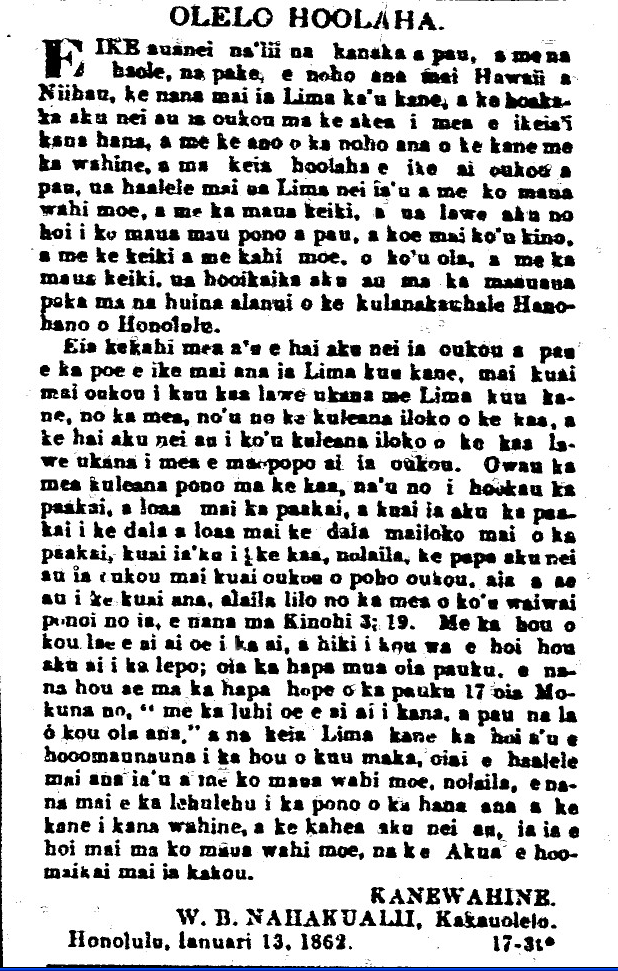
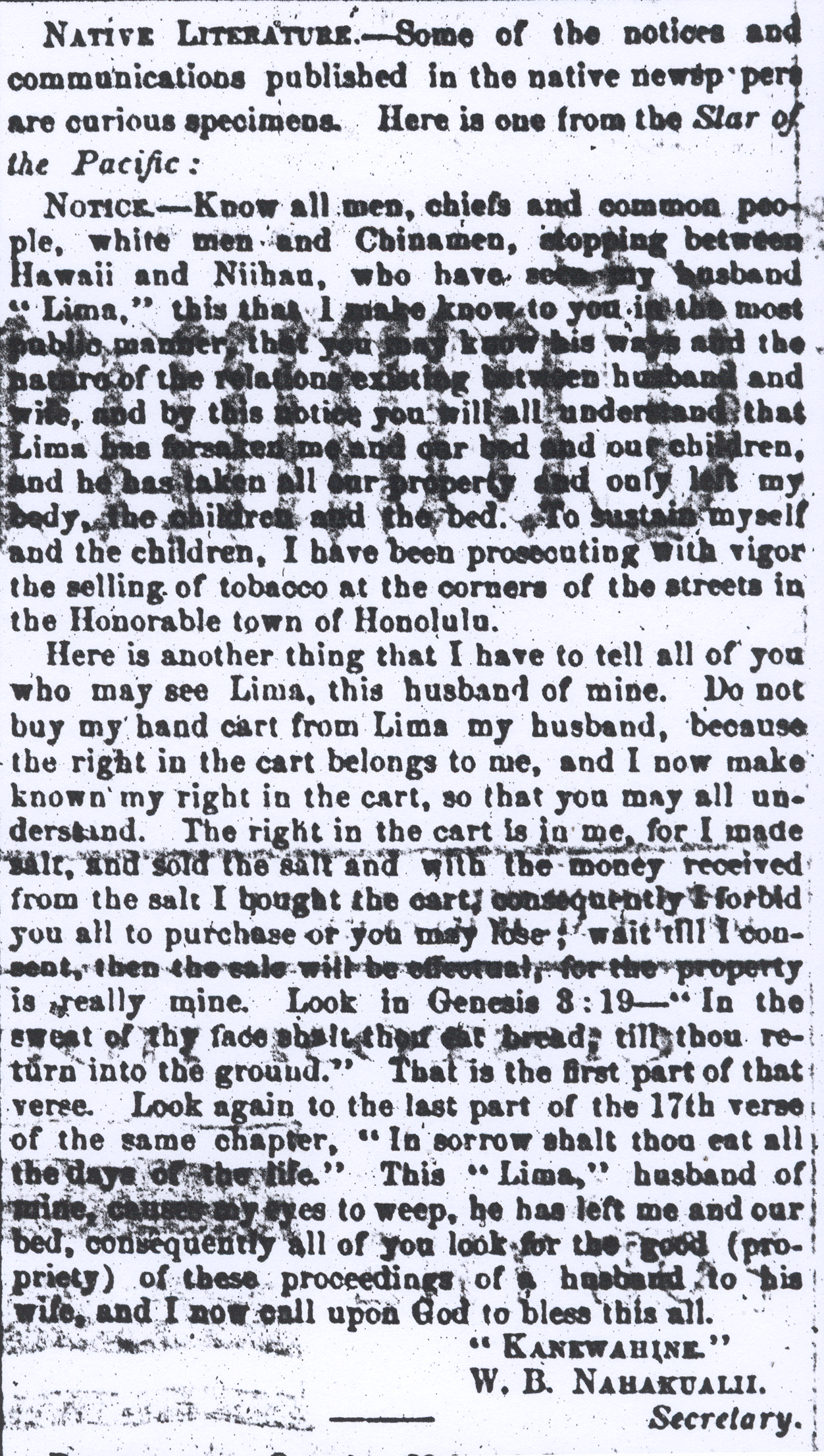
Mockery? by the Pacific Commercial Advertiser over personal ads in the Hawaiian-Language Newspapers, 1862.

NATIVE LITERATURE—Some of the notices and communications published in the native newspapers are curious specimens. Here is one from the Star of the Pacific [Ka Hoku o ka Pakipika]:

NOTICE.—Know all men, chiefs, and common people, white men and Chinamen, stopping between Hawaii and Niihau [residing from Hawaii to Niihau], who have seen my husband “Lima,” this that I make know to you in the most public manner that you may know his ways and the nature of the relations existing between husband and wife, and by this notice you will all understand that Lima has forsaken me and our bed and our children, and he has taken all our property and only left my body, the children and the bed. To sustain myself and the children, I have been prosecuting with vigor the selling of tobacco at the corners of the streets in the Honorable town of Honolulu.

Here is another thing that I have to tell all of you who may see Lima, this husband of mine. Do not buy my hand cart from Lima my husband, because the right in the cart belongs to me, and I now make know my right in the cart, so that you may all understand. The right in the cart is in me, for I made salt, and sold the salt and with the money received from the salt I bought the cart, consequently I forbid you all to purchase or you may lose [or it will be your loss]; wait till i consent, then the sale will be effectual [only should I consent will the sale be effectual], for the property is really mine. Look in Genesis 3:19—”In the sweat of thy face shalt thou eat bread; till thou return into the ground.” That is the first part of that verse. Look again to the last part of the 17th verse of the same chapter, “In sorrow shalt thou eat all the days of the [thy] life.” This “Lima,” husband of mine, causes my eyes to weep [It is because of this Lima that I waste the sweat of my face], he has left me and our bed, consequently all of you look for the good (propriety) of these proceedings of a husband to his wife [so all of you, look at the treatment by this man of his wife], and i now call upon God to bless this all [and I call out to him to return to our bed, and may God bless us all].

“Kanewahine.”

W. B. Nahakualii,

Secretary.

[The bracketed inserts are what I felt might be closer interpretations of the original…]

(Pacific Commercial Advertiser, 2/23/1862, p. ?)

Native Literature.

The Pacific Commercial Advertiser, ????. January 23, 1862.

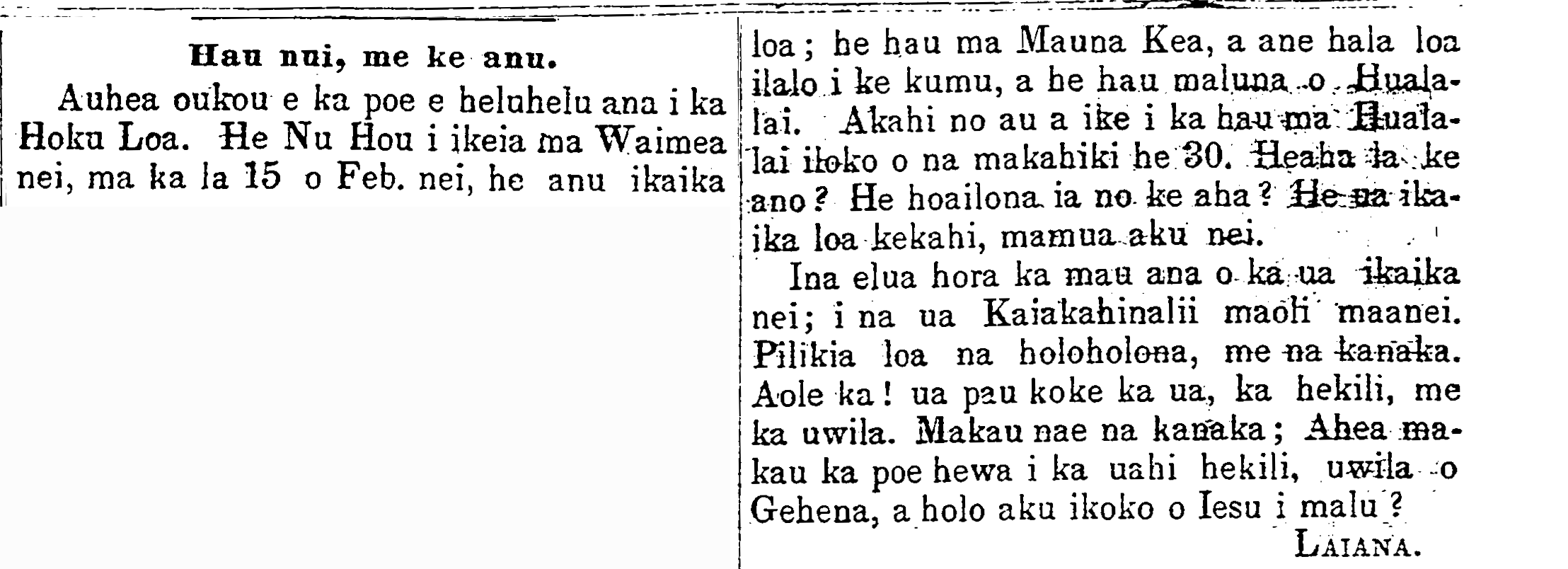
Snow on Hualalai 150 years ago. 1862.

Much Snow, and cold.

O People reading the Hoku Loa. There is News seen here in Waimea; on the 15th of February, there was extreme cold; there was snow on Mauna Kea, and it almost reached its base, and there was snow atop Hualalai. It was the first time I saw snow on Hualalai in 30 years. What is this? What is it a sign of? There was also heavy rains earlier.

If the heavy rains lasted for a couple of hours, it would have had a massive flood [Kaiakahinalii] here. The livestock and people would have been in trouble. But no! the rain, thunder, and lightning soon stopped. The people were still afraid; When will the people be afraid of the smoke, thunder, and lightning of Gehenna, and go to the protection of Jesus?

LYONS.

(Hoku Loa, 3/1862, p. 34.)

Hau nui, me ke anu.

Ka Hoku Loa, Buke III, Helu 9, Aoao 34. Maraki, 1862.

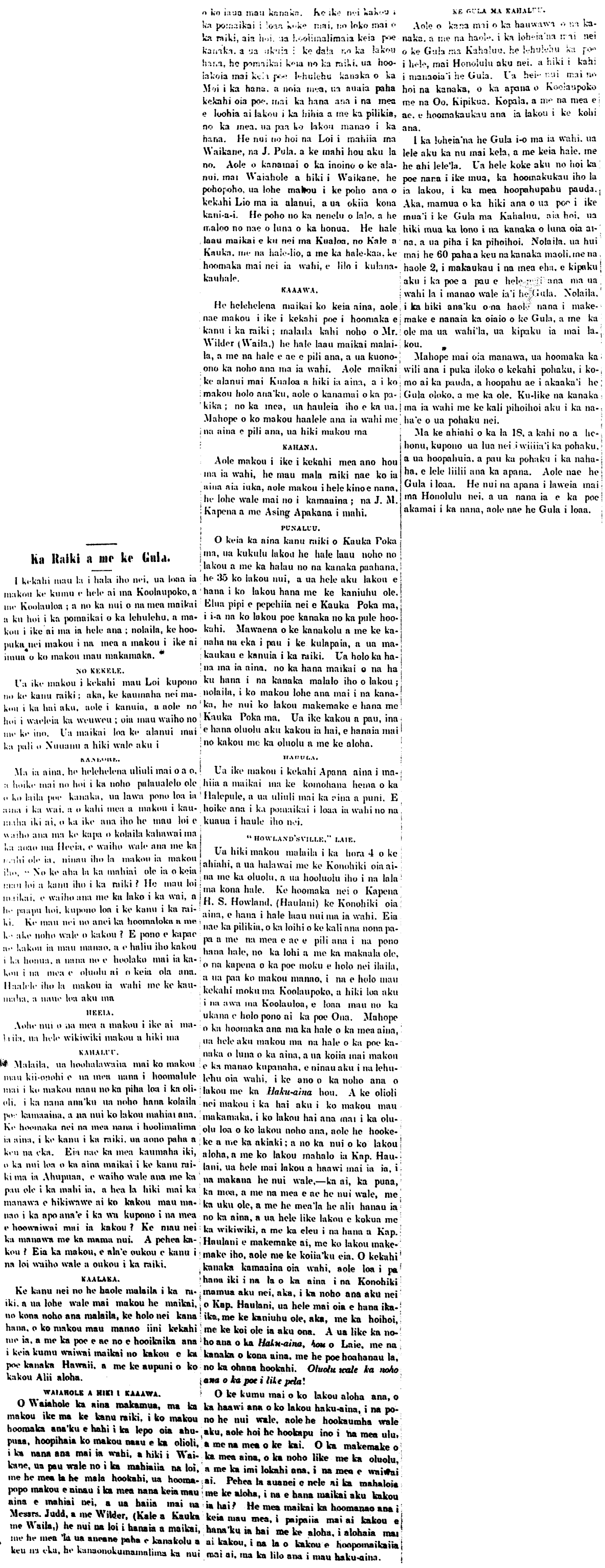
A small window into Koolauloa and Koolaupoko—150 years ago, 1862.

Rice and Gold.

Some days ago, we had reason to travel about Koolaupoko and Koolauloa, and because of the many wonderful and beneficial things for the people we witnessed in our travels, we are publishing what we saw before us.

PERTAINING TO KEKELE.

We saw some Loi perfect for growing rice; however, we are sad to state that they were fallow and it was not weeded, they were just left wild. Fine is the road from the pali of Nuuanu until

KANEOHE

In this land, it is green from one side to the other, which attests to the non-lazy lifestyle of the people there; the land has ample water, but one thing which saddened us a bit was the seeing of some loi that were left fallow next to the river there on the Heeia side, which caused us to ponder, “Why are these loi not farmed, and planted with rice? They are fine loi supplied and full of water, very good for rice growing. Does our lack of faith and our desire to while away our time still persist? We must discard those feelings, and heed the land, and it will supply us with items that will make this life pleasant. We left that place feeling sad, and travelled on to

HEEIA.

There is not much we saw there, and we went on quickly to

KAHALUU.

There, our eyes were shown things that eased our hearts because of our great joy, when we saw that the kamaaina there did work, and that they did much farming. The one who is leasing the land has started to plant rice; there are perhaps six or more acres. But the somewhat sad thing is the majority of the land suitable for rice cultivation in that Ahupuaa, are just left there without being all farmed; when will it be that if the time is right, we will quickly make up our minds to grasp opportunities to make ourselves rich? Time keeps going quickly. And what of us? Here is what we say, to wake up and to plant your unused loi with rice.

KAALAEA

A haole there is planting rice, and we hear that it is going well; because he resides there, the work is progressing, and our hopes go with him and those others that are working at this valuable endeavor for us Hawaiians and the nation of our beloved Alii.

WAIAHOLE TO KAAAWA.

Waiahole is the first place, in our knowledge, that planted rice; when we began to walk upon the soil of that ahupuaa, our hearts were filled with joy at the sights of that place, and reaching Waikane, all the loi were being farmed, as if it was just one huge farm; we thought to ask who was it that was farming the area, and we were told Messrs. Judd and Wilder (Kale of Kauka and Waila) [Kale of Kauka must be Charles Hastings Judd, the son of Kauka (Gerrit Parmele Judd); so many loi were finely built, and it seemed like almost thirty or more acres; they had thirty-five workers. We see the immediate benefits of growing rice, being that these men were hired, and got paid for their labor, and all this is because of rice; many subjects of the King were provided with jobs, and as a result, perhaps some of those people were prevented from acts which would have caused them to suffer difficulties and problems, because their minds are taken up by work. There are many Loi farmed in Waikane, by J. Fuller (J. Pula), and they are being reworked. The road from Waiahole to Waikane is horrible; it is swampy, and we hear that a horse sunk on this street and its throat was cut. The lower part is boggy, but it is dry on the surface of the earth. There is a fine wooden house standing in Kualoa belonging to Charles Hastings Judd, along with a horse shed, and a carriage house; that place is beginning to become a town.

KAAWA.

This land has a fine appearance, but we did not see a single person who started to grow rice; that is where Mr. Wilder (Waila) resides with a nice wooden house there, with other connected buildings, and life there is luxurious. The road from Kualoa until this land is not good, and in our travels, it was terribly slippery because rain had fallen upon it. After leaving that land and the adjoining lands, we arrived at

KAHANA.

We saw nothing new there, but they did have some rice fields which were located in the uplands; we did not go to see it for ourselves, we just heard of them from the kamaaina; J. M. Kapena and Asing Apakana are the ones doing the farming.

PUNALUU.

This is the rice growing lands of Dr. [Seth] Ford (Kauka Poka) them; they built a wooden house for themselves and a halau for the workers who number 35, and they work without any complaints. Dr. Ford them slaughter two cows as meat for their men for a week. The area that was plowed up is between thirty and forty acres and it is ready to be planted with rice. The work there progresses due to the good treatment by the bosses to their workers; they are anxious to work for Dr. Ford. We all know that if we treat others well, we will be treated well and with aloha.

HAUULA.

We saw some well-farmed land to the southwest of the Church, and the land all about is green. This shows the benefits of the recent showers.

“HOWLAND’SVILLE,” LAIE.

We arrived there at 4 in the evening, and met pleasantly with the Konohiki of that land, and rested our limbs at his house. Captain H. S. Howland (Haulani), the Konohiki of that land is starting to build a wooden house there. Here however is the problem, that being the long wait for the lumber and the other house building materials, because of the delay and the inattentiveness of the captains of the ships that travel there; we believe that if there was a ship that went regularly to Koolaupoko and landed at the harbor of Koolauloa, the materials needed for the Owners [of land] would always be there. After making a start at the home of the landowner, we went to the houses of those living on the land, and we were urged on by an astonishing idea, to question the people of that area about their life under their new landlord. And we are happy to report to our friends, their answer was that their life was very pleasant, without any admonishments or reproach; and because of their great aloha and appreciation for Capt. Howland, they went and gave him many gifts—taro, pig, chicken, and many other things, without pay; it was as if he was a native-born alii; also, they all went quickly to assist him, with things that Capt. Howland needed, on their own accord, without being coerced by him. One kamaaina of that area did not touch work in the least when the land was under the previous Konohiki, but with Capt. Howland, he came to work industriously without complaint, but enthusiastically, without being forced to. The new Land owner of Laie lives together with the people of his land, like brothers of the same family. How pleasant is the life of people like that!

The reason for their love is because their landlord gives them many things, and does not just burden them, or put a restriction on plants or things from the sea. The one who owns the land just wants to live together in peace, and to search for together things that will benefit them all. How could there be no appreciation and love if we treat others well? It is good to remember this, to remind us to treat others with aloha, so that we are loved, when the day comes where we will be blessed to become land owners.

GOLD IN KAHALUU.

There was so much commotion amongst the Hawaiians and haole at the news that there was Gold in Kahaluu; there were many people who came from Honolulu to the place where Gold was thought to be. Many Hawaiians from Koolaupoko came with Oo, Pickaxes, Shovels and other things, preparing them to dig.

When it was heard that there was real Gold on that land, the news flew from house to house like firebrand. Those who first spotted it went immediately, making ready with dynamite powder. However, before those people who first witnessed the Gold reached Kahaluu, the news reached the people of that land, and they were roused. Therefore, about 60 kanaka maoli and 2 haole got together with weapons to expel all those who came to that area thought to have Gold. So when the haole came that wanted to ascertain the truth or falsehood of the Gold of that place, they were sent away.

Following that time, a hole was bored into a rock to place dynamite and explode to see if there was Gold within it or not. People stood together there waiting in anticipation for the rock to break.

In the evening of the 18th, the hole dug in the rock was finally deep enough, and it was blasted, and the rock was shattered, the tiny pieces flew. There was however no Gold found. Many pieces were taken to Honolulu, and were looked at by experts, but there was no Gold found.

[Under all the disparaging comments and the obvious push for rice cultivation, you can glean some historical information of what the windward side of Oahu looked like a 150 years ago. There are followup articles in the papers speaking of how the true gold of Hawaii is found through farming the land…

For more information on the history of rice in Hawaii, see: RICE IN HAWAII: A GUIDE TO HISTORICAL RESOURCES, compiled and annotated by Karol Haraguchi.]

(Kuokoa, 2/22/1862, p. 2)

Ka Raiki a me ke Gula.

Ka Nupepa Kuokoa, Buke I, Helu 13, Aoao 2. Feberuari 22, 1862.