Hawaiian-Language Newspapers and the past and the future, 1906.

The History of Your Native Land.

As we contemplate the main reason for the falling far behind of the Hawaiian people in matters dealing with the history of their homeland, their lahui, and the alii of the land, we are all racked with intense pain at the haphazard and total lack of knowledge in this terribly important study; and it would not be wrong for us to say that it should be one of the first subjects that should be taught to the students at schools of higher education across the world; and it is said by the Orators that being knowledgeable in the History of your Motherland is the first step in Politics where you’d be able to fight for the good of the Rule of the Nation.

And understanding the histories of all Nations is what will prepare you to fight intelligently on legal grounds for the benefit of your lahui. In the teachings of the Great Book, in Jeremiah 6:16, Jehovah says to us:

“Stand ye in the ways and see and ask for the old paths. Where is the good way?”

O Lahui, how will we be able to ask of the right way if we do not know the old history of our Beloved Aina?

This lack of knowledge of the history of this people comes from not consistently reading the Hawaiian newspapers. Something frequently seen is one person buying a paper and reading it before his friends. They hear it but they don’t retain it like one who subscribes to the paper, who can re-read it at his leisure and thus commit to memory the information.

Learn from this instruction, and do as the haole, who buys his very own newspapers to educate himself in current events.

[The Hawaiian-Language Newspapers is a massive history book—a history on the most part told by Hawaiians living while the “history” was happening. As it was argued more than a hundred years ago, in order to fight for things like Sovereignty, Land, and Water, shouldn’t we know the history as told by Hawaiians? Perhaps we shouldn’t focus solely on what is written down in law books, but also on what Hawaiians actually said and did about these laws, about water rights, about land ownership, about fishing bans, etc., etc. etc.?

For sure this is no easy task. The original newspapers aren’t going to last forever. The current images for many of them are not totally clear (if there are images at all). They need to be word-searchable so that if you search for something, you will find it. There needs to be more people doing translations of them. But then again, Kamehameha Paiea didn’t exclaim, “Forward my younger brothers and drink of the sweet waters”…]

(Na’i Aupuni, 1/17/1906, p. 2)
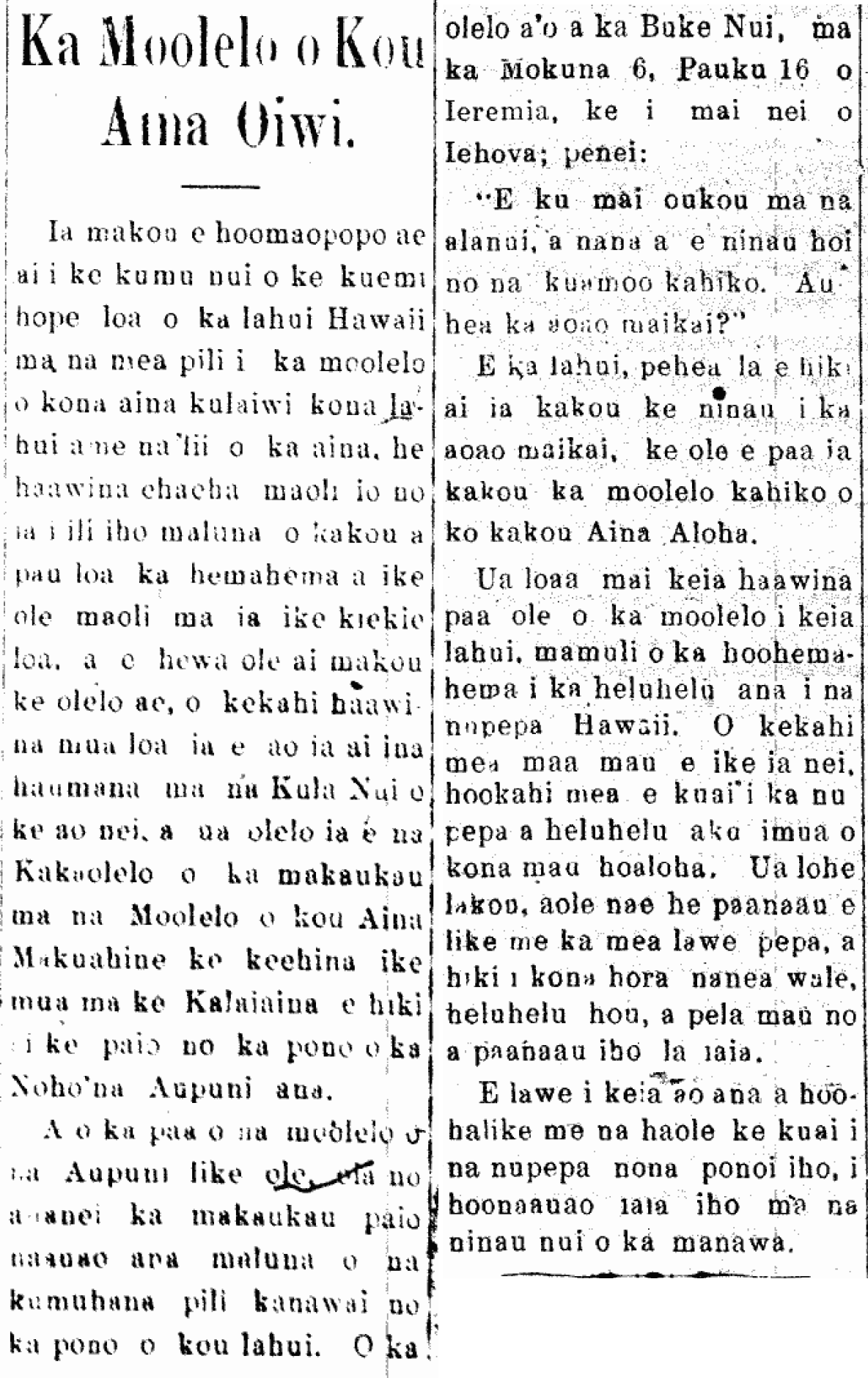
Ka Moolelo o Kou Aina Oiwi.

Ka Na'i Aupuni, Buke I, Helu 44, Aoao 2. Ianuari 17, 1906.
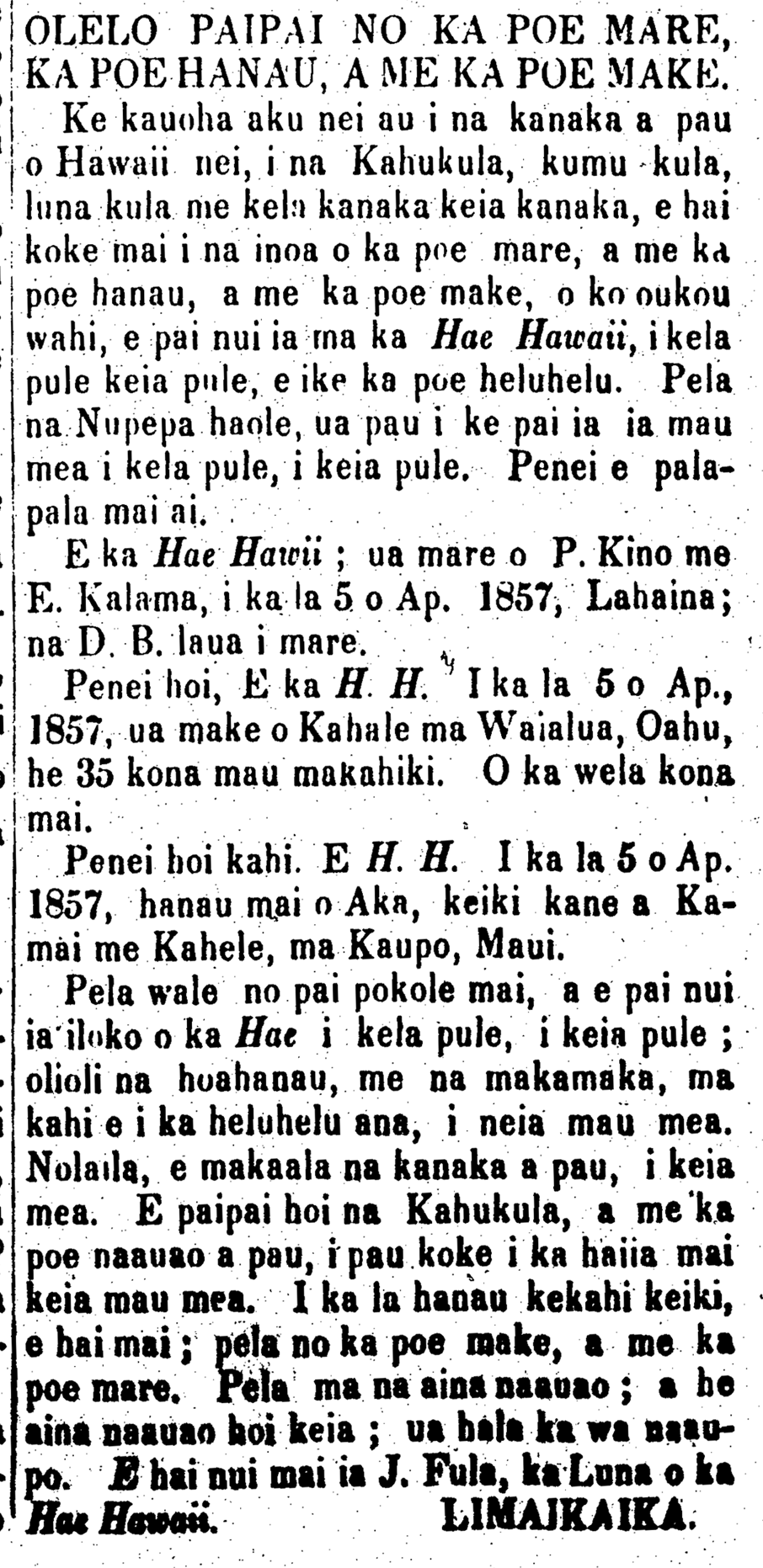
Early encouragement to send in vital statistics information, 1857.

WORDS OF ENCOURAGEMENT ABOUT THOSE THAT GET MARRIED, GIVE BIRTH, AND DIE.

I request of everyone of Hawaii nei: the Schoolmasters, teachers, school superintendents, and all people in general, to inform us immediately of the names of pe0ple who get married, and give birth, and die, in your area; they will be published together in the Hae Hawaii weekly so that the readers will see. That is how the haole papers work; those kinds of things are printed weekly. This is how to write in.

O Hae Hawaii; P. Kimo and E. Kalama were wed on the 5th of Ap. 1857, Lahaina; they were married by D. B.

Or like this. O H. H. On the 5th of Ap., 1857, Kahale died at Waialua, Oahu, at 35 years of age. He died of fever.

Or like this. O H. H. On the 5th of Ap. 1857, Aka was born, a son, to Kamai and Kahele, at Kaupo, Maui.

That is how they will be printed succinctly, and they will be published all together in the Hae every week; the church members and friends from afar will be happy to read this sort of thing. Therefore, everyone be alert to these things. Let the Schoolmasters and all educated people be encouraged so that this information is given at promptly. Inform us of when a child is born, so too when someone dies, and when people get married. That is how it is done in enlightened lands; and this indeed is an enlightened land; the time of ignorance has passed. Report it all to the Head of the Hae Hawaii, J. Fuller.

ARMSTRONG.

[Extensive listings of vital statistics followed soon after!]

(Hae Hawaii, 4/15/1857, p. 10)

OLELO PAIPAI NO KA POE MARE, KA POE HANAU, A ME KA POE MAKE.

Ka Hae Hawaii, Buke 2, Helu 3, Aoao 10. Aperila 15, 1857.

Beautiful flag story, 1893.

HAWAIIAN FLAG.

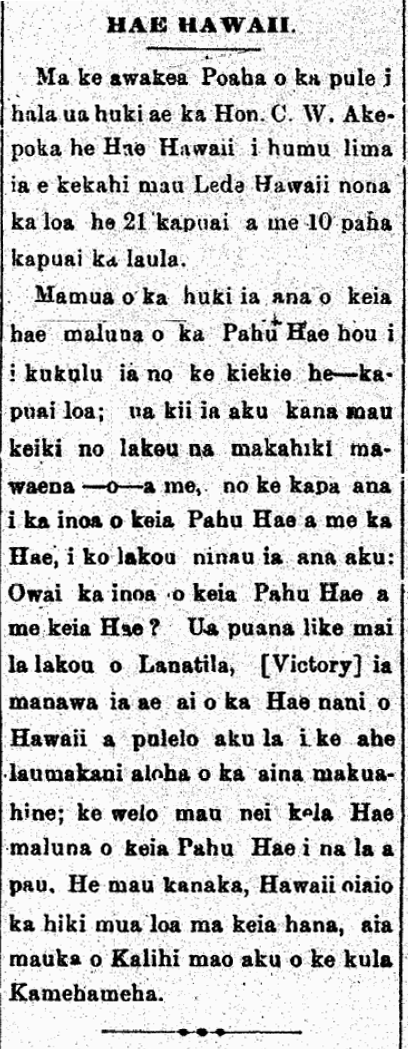
On Thursday afternoon of this last week, Hon. C. W. Ashford raised a Hawaiian Flag hand sewn by some Hawaiian Ladies, whose length was 21 feet and width was perhaps 10 feet.

Before the raising of this flag upon a new Flag Pole built ___ feet tall, his children were called, whose ages are between ___ and ___, to name this Flag Pole and the Flag; when they were asked: What is the name of this Flag Pole and this Flag? They answered together, “Lanatila [Victory];” it was then that the beautiful Flag of Hawaii rose and fluttered in the beloved soft gentle breeze of the motherland; that Flag waves continuously upon this Flag Pole everyday. These are true Hawaiians who have done this first, it is in the uplands of Kalihi past Kamehameha School.

(Leo o ka Lahui, 5/1/1893, p. 3)

HAE HAWAII.

Ka Leo o ka Lahui, Buke II, Helu 695, Aoao 3. Mei 1, 1893.

Patriotic mele of a different sort, 1893.

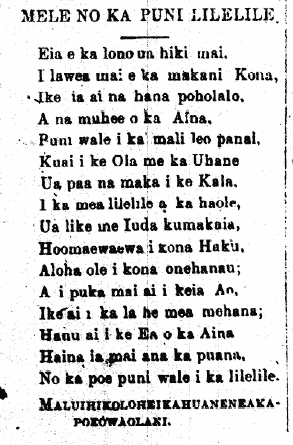
MELE NO KA PUNI LILELILE

Eia e ka lono ua hiki mai,

I lawea mai e ka makani Kona,

Ike ia ai na hana poholalo,

A na muhee o ka Aina,

Puni wale i ka mali leo panai,

Kuai i ke Ola me ka Uhane,

Ua paa na maka i ke Kala,

I ka mea lilelile a ka haole,

Ua like me Iuda kumakaia,

Hoomaewaewa i kona Haku,

Aloha ole i kona onehanau;

A i puka mai ai i keia Ao,

Ike ai i ka la he mea mehana;

Hanu ai i ke Ea o ka Aina,

Haina ia mai ana ka puana,

No ka poe puni wale i ka lilelile.

Maluihikoloheikahuaneneakapoeowaolani.

[There are not only patriotic compositions that laud and encourage, but there are also those like this one here which ridicule and disparage. This one goes something like:]

A SONG FOR THOSE WHO COVET SHINY THINGS.

The news has arrived,

Carried by the Kona breeze,

Witnessed are the deeds of deceit,

By the squids¹ of the Land,

Fawning after the sweet talk of reciprocity,

Selling away Life and Soul,

Eyes set on Riches,

That shiny thing of the haole,

Just like Judas the traitor,

Scorning his Lord,

With no aloha for his homeland;

If he’d come forth into the Light,

He’d see that the sun is a thing of warmth,

He’d breathe in the Ea² of the Land.

Let the story be told,

Of those who covet shiny things.

Maluihikoloheikahuaneneakapoeowaolani.

¹A squid can swim as easily backward as forward, so you never know if it is coming or going, and is thus used to describe a two-faced person.

²Ea can be seen as a play on the idea of Air as well as Sovereignty.

(Leo o ka Lahui, 2/21/1893, p. 3)

MELE NO KA PUNI LILELILE.

Ka Leo o ka Lahui, Buke II, Helu 646, Aoao 3. Feberuari 21, 1893.

Patriotic mele, 1893.

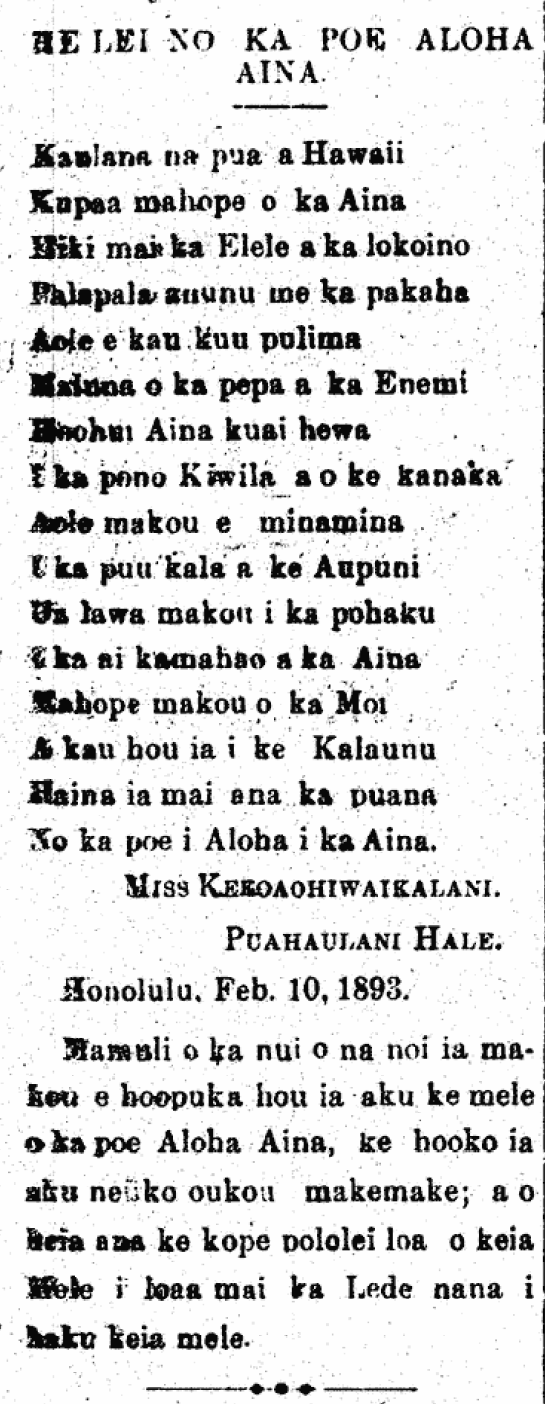
[Here is a patriotic mele famous to this day, it is also known as Mele Ai Pohaku, but familiar to most as Kaulana na Pua. This composition is published many times and in more than one Hawaiian-Language Newspaper. It is a song which both lauds and encourages.]

AN ADORNMENT FOR THE PATRIOTS.

Famous are the blossoms of Hawaii

Who stand steadfast behind the Land

When the evil Messenger arrives

With his documents of greed and plunder

I won’t affix my signature

To the papers of the Enemy

That Annex and sell wrongfully

The Civil rights of the people

We will not feel longing

For the sums of money of the Government

We are satisfied with the stones

The amazing food of the land

We stand behind the Sovereign

She will be placed back upon the Throne

Let the refrain be told

Of the people who Love the Land.

Miss Kekoaohiwaikalani.
Puahaulani Hale.
Honolulu, Feb. 10, 1893.

Because of the many requests for us to reprint the song of the Patriots, we are fulfilling your desire; and this is a correct copy of this song which we received from the Lady who composed this song.

(Leo o ka Lahui, 5/11/1893, p. 3)

HE LEI NO KA POE ALOHA AINA.

Ka Leo o ka Lahui, Buke II, Helu 703, Aoao 3. Mei 11, 1893.

Mahalo to Kamaoli Kuwada for kindly allowing us to repost this! 1905/2012.

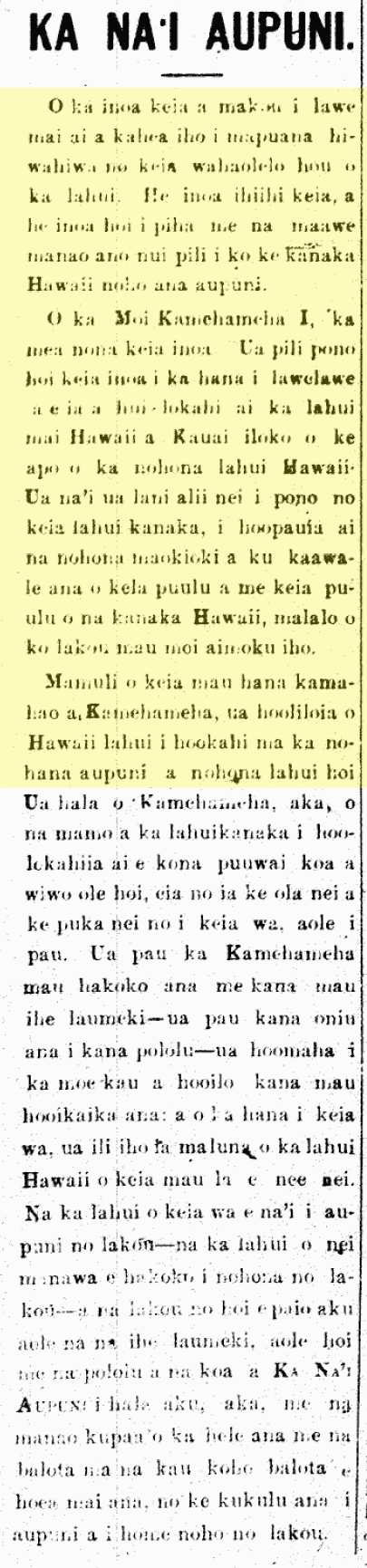
KA NA’I AUPUNI.

[Today is not only a day to mourn the events of 1893, but also to celebrate the courage, tenacity, and deep aloha of the lāhui Hawai’i for persisting and growing these past 119 years.

As the editors of the newspaper Ka Nai Aupuni said in an editorial published alongside Ka Moolelo o Kamehameha I:]

. . .

Kamehameha has passed on, but as for the descendants of the race of people united by his brave and fearless heart, they still live on and emerge in this time; they are not gone. Kamehameha’s fighting with his ihe, his barbed spears, is finished; the whirling of his pololū, his long spears, is ended; his struggles have retired to the sleep of ages; and the work of this time has been inherited by the Hawaiian nation of this progressive era. It is the people of this era who shall conquer a nation for themselves; it is the people of this era who will wrestle for a lifestyle of their own; it is they who will fight, not with barbed ihe, not with the long spears of the warriors of the Conqueror who has passed on, but with the firm conviction to go with ballots to the coming elections in order to build a government and a home for themselves.

(Na’i Aupuni, 11/27/1905, p. 2)

KA NA'I AUPUNI

Ka Na'i Aupuni, Buke I, Helu 1, Aoao 2. Novemaba 27, 1905.

Poi and Kalo and a self sufficient Hawaii, 1915.

THE TIME WILL COME WHEN POI WILL BE SCARCE.

It would appear that the days are numbered, and 5 pounds of poi will go for a quarter, that is five cents per pound. This rise in price of poi is due to the lack of kalo, and perhaps because Hawaiians just don’t care to plant kalo in their fields.

These days in Honolulu, there are but few places that plant kalo. Places that loi kalo were seen are now dried out because the lands were accrued by other groups of people, and they dried the fields out; whereas it would be more beneficial if those back turners continued the planting of kalo. It has been almost two years since this spokesperson [the newspaper Ke Aloha Aina] first advised those with lands to farm them, for the time will come when there will be food shortages, at that time, America will declare war against Germany, which will intensify the problem, and that time we spoke of has come indeed. As proof of what we say, look to the issues of A. D. 1915–16, and you will find our words of advice, strongly encouraging Hawaiians to plant kalo and other crops, because the time will come when there will be hardships, and it will come, without fail.

Something terribly astonishing to us is that it as if kalo is being made into poi outside of Hawaii, for the cost is rising like goods imported here.

Why is this so? Because there is so little kalo being farmed, and there are a lot of people eating poi. These days, there are other ethnicities eating poi because their staples are expensive, and therefore, many people are eating poi and not much kalo is being planted.

We give our appreciation to the poi association of the stevedores which took some kalo lands and leased them out long term to plant kalo to supply their outlets at the markets and feed the poi-eating public.

Probably the public doesn’t realize that these days there is a poi shortage; maybe they continue to assume that poi is as usual. No! There is less poi now; six and a half pounds for a quarter, and some weeks it is just six pounds and sometimes five pounds for a quarter, which is five cents per pound.

So all you people with some kalo land, you should plant a lot of kalo and pull up well-developed corms when the time is right. Neglect during the day will leave you without. Work while the sun is up.

(Aloha Aina, 9/7/1917, p. 4)

E HIKI AKU ANA I KA MANAWA E LIILII LOA AKU AI O KA POI

Ke Aloha Aina, Buke XXII, Helu 36, Aoao 4. Sepatemaba 7, 1917.

“He has gone forever, but memories of him shall not be forgotten.” 1932.

A CHILD AND A NATIVE OF HAWAII

Last week, the last rites were carried out on the body of Joseph Kahahawai, the one who was shot by some soldiers after they kidnapped Kahahawai from the courthouse.

Kahahawai went to show himself before the officials, or those of the court, and when he exited from that office, he was pointed out by a women sitting upon her car to some other haole people.

When one of the two of them saw that Kahahawai was coming out, one of the haole went and said to Kahahawai to go with him, and showed Kahahawai a written document, and that was when Kahahawai agreed to go with him to the side of the car, but not the car belonging to the woman who pointed Kahahawai out; he went and death was sentenced upon him without him knowing the consequences of him agreeing to accompany these haole.

On Sunday was the funeral rites, and his body was laid to rest at Puea Cemetery on School Street.

As was reported in the papers, the funeral was large as the buddies and friends of the boy went along with his body to the graveyard.

The first services over his body was held at the Catholic church, and thereafter he was taken to the graveyard, and there, Rev. Robert Ahuna of the Christian Science Church held the last rites over the cold body of the child of whom the parents said their child was not at fault.

The Rev. Ahuna spoke before the congregation gathered together [?], “This kind of thing has not been seen here in Hawaii, but now this cruel deed is taking place because the law was taken into the hands of some people.”

There were thousands of people who came to Puea Cemetery.

Because there were so many people, they tried to move apart the people standing, as the hearse could not enter.

After the services by Rev. Ahuna, that famous hymn was sung, the hymn sung always at graveyards when someone is buried. That hymn is “Ka Lani Kuu Home [Heaven is My Home],” and after it was over, that beloved song of Hawaii nei, and a Nationalistic song for Hawaii’s locals [Hawaii Ponoi] was sung, and then dirt was covered over the child of Hawaiian parents who are loved.

He has gone forever, but memories of him shall not be forgotten.

(Hoku o Hawaii, 1/19/1932, p. 3)

HE PUA A HE EWE NO HAWAII

Ka Hoku o Hawaii, Buke, XXV, Helu 33, Aoao 3. Ianuari 19, 1932.

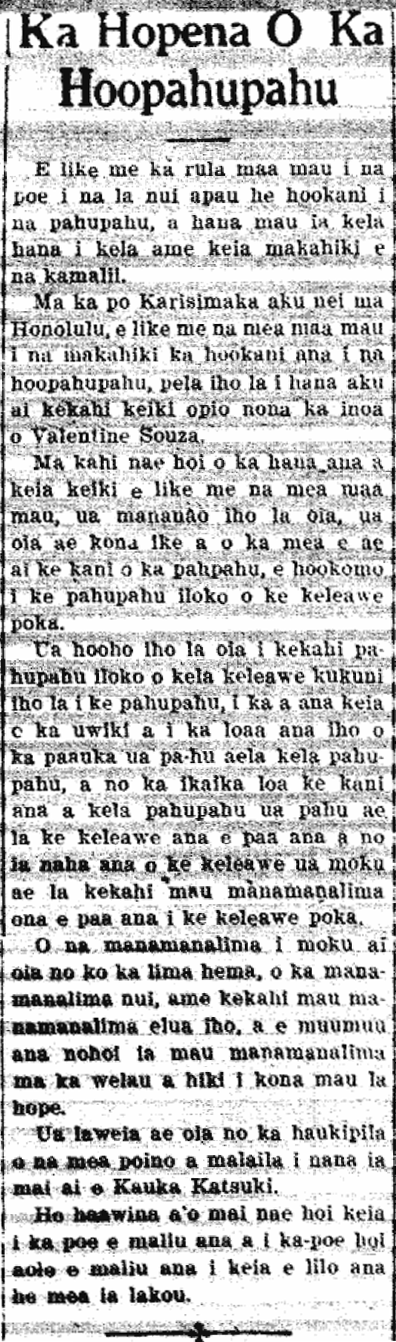
Some people just shouldn’t play with firecrackers! 1939.

Consequences of Firecrackers

Just as people pop firecrackers on all important days, it is also played with by children every year.

On this past Christmas night in Honolulu, just as fireworks are set off yearly, so too did a young child named Valentine Souza.

But when this child was doing this as usual, he thought that he and the others would hear the blast more if he put the firecracker inside a metal shell [keleawe poka?]

He shoved a firecracker in the metal, and lit it; the fuse started to burn and when it reached the powder, the firecracker exploded, and because of the strength of the blast of that firecracker, the metal he was holding, and because the metal shattered, some of his fingers holding on to the metal shell were severed.

The fingers that were severed were from his left hand: the thumb and two others; those fingers will be short at the tips until the end of his days.

He was taken to the emergency room and there was examined by Dr. Katsuki.

But this is a lesson to those who heed it, and for those that don’t listen, they will get their’s [e lilo ana he mea ia lakou?]

(Hoku o Hawaii, 1/11/1939, p. 3)

Ka Hopena O Ka Hoopahupahu

Ka Hoku o Hawaii, Vol. XXXIII, No. 37, Aoao 3. Ianuari 11, 1939.