The Hawaiian Moses? 1893.

“THE MISTAKES OF MOSES.”

We refer, of course, to the Hawaiian political Moses, who has recently broken camp, and set the faithful in motion through sea, desert and wilderness to the Land of Promise, beyond the shadow of the Throne. Yes! We refer to the Hawaiian political Moses, but whether his other name is Dole or Thurston, has not, at this writing, fully transpired. Still, the doubt as to his other name is a merely nominal doubt, not affecting the merits of the case. And as the original state—man of that name was not gifted with immunity from error, so neither has the Hawaiian Moses, even during his very brief pilgrimage, avoided all mistakes. It should ever be the part of a friend to note his friends’ infirmities, and, by bringing them mildly to their authors’ notice, suggest their reform, or convey a warning against their repetition.

———

We are all aware of the high pressure of seeming necessity under which the present government was formed. We can therefore appreciate, to some extent, the causes of the neglect to observe, towards the numerous Native element, those marks of regard and confidence without which no government can hope to endure in Hawaii. We repeat, that the pressure of the occasion must be the excuse of the gentlemen at the head of the movement for their seemingly unfriendly, and even hostile attitude toward the entire Native race, in the ordering of early events under the new dispensation.

———

The exclusion of Hawaiians from a participation in the beneficent project not only seemed, but was, and is complete. There may have been, and no doubt were reasons, seemingly sound to those who adopted them, for such a course,—reasons of which the public cannot judge, because the public know them not. Yet it would seem that one of two propositions must be true; viz.: either the Hawaiians were needlessly, and, therefore, harshly excluded from such participation in the reforming of their own government, or else the entire race were deemed by the leaders to be unfit to participate in such an enterprise.

———

If the former of the above propositions be true, one would naturally expect the mistake to be rectified at the earliest opportunity. That it has not been rectified would seem to stamp it as having been no mistake, but a course deliberately adopted, for, note the opportunity to retrieve the error, (if error it had been thought to be) in the filling of the four vacancies in the Advisory Council, on the 21st inst. It was then, as seems to us, the manifest duty of the government to seek out and appoint to those vacancies, men of Hawaiian blood, whose brains, interests and loyalty to the new idea bespoke than as deserving of such honor and confidence.

———

The failure of the government to attempt to bring even one Hawaiian to a seat at the Council Board is susceptible of only one of two meanings:—1st, that no Hawaiian could be found possessing those qualifications, or, 2nd, that the government were determined to ignore and exclude them, in any event.

———

If such exclusion was premeditated and malicious, the less said of it the better, as it is self-condemnatory. If on the other hand, there be no native Hawaiian fit to occupy a seat in the government councils, with what degree of candor or confidence can the Provisional Government request of expect the United States to incorporate our country into itself? What a commentary upon that request is the action of the government itself, in thus excluding from their confidence the entire aboriginal race, more completely than the Mongolian is now excluded from the Union. Forty odd thousand Hawaiians on these shores, and not one, (in the opinion of the government,) entitled or qualified to have a voice in the government of his native land. What a text for the American enemies of annexation, and how they will use it!

(Liberal, 1/25/1893, p. 2)

"THE MISTAKES OF MOSES."

The Liberal, Volume I, Number 39, Page 2. January 25, 1893.
Annexation or not? 1893.

[Found under: “THIS AND THAT.”]

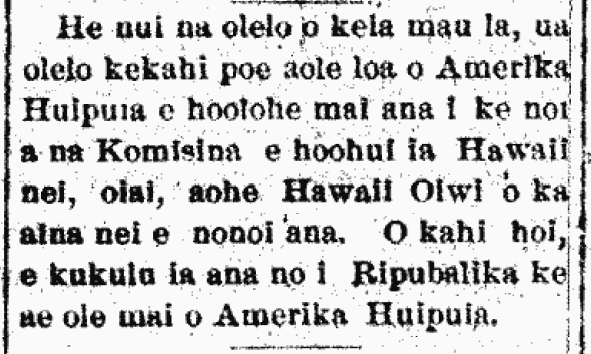
There is much talk these day; some say that there is no way that the United States of America will listen to the request of the Commission to annex Hawaii, being that there is no Native Hawaiian of the land asking for this. Some say that a Republic will be established if the U. S. doesn’t agree.

(Liberal, 1/25/1893, p. 4)

He nui na olelo o keia mau la...

The Liberal, Volume I, Number 39, Page 4. January 25, 1893.

More mele and coverage of the Waimea cowboys, 1908.

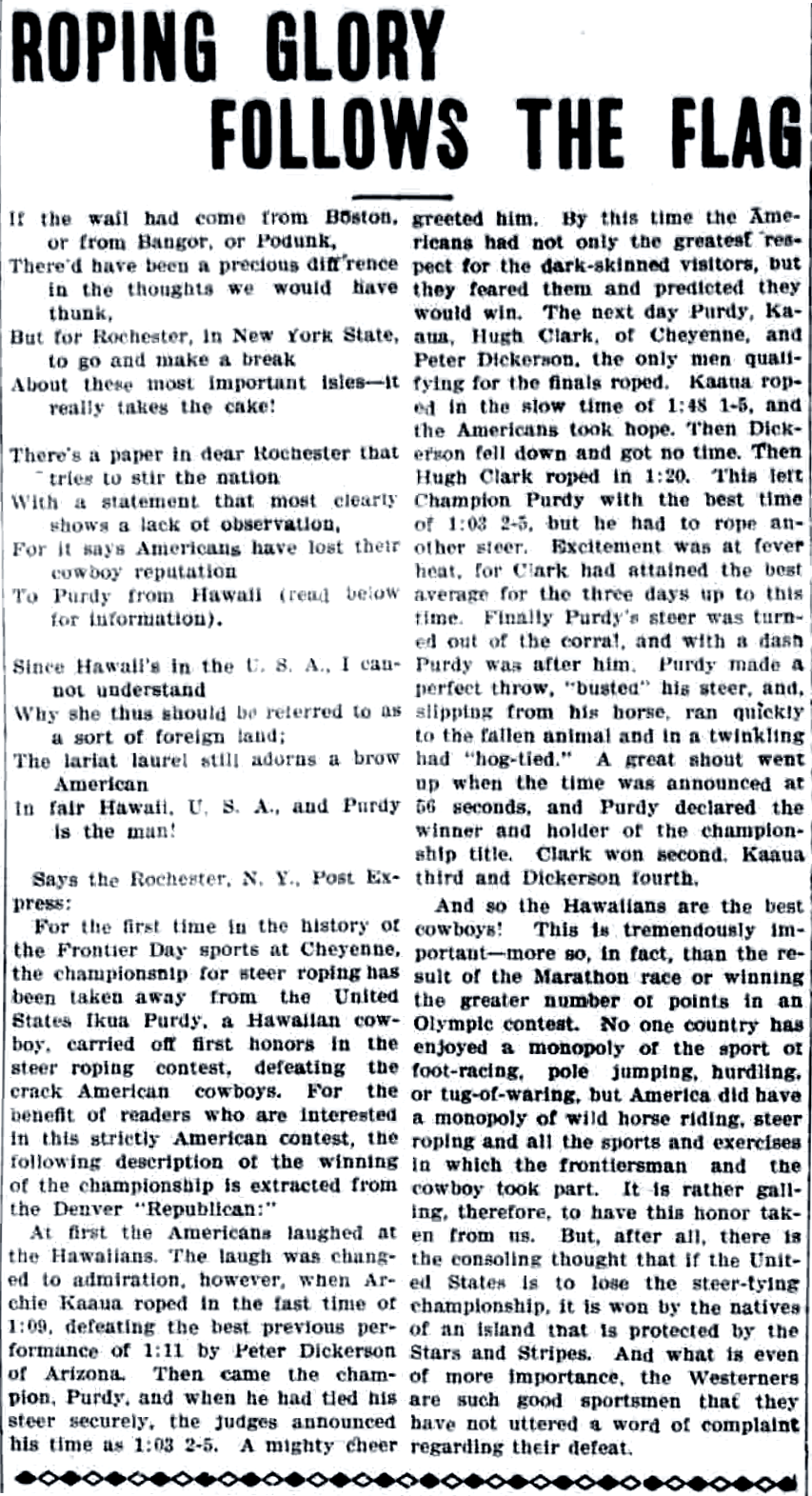
ROPING GLORY FOLLOWS THE FLAG

If the wail had come from Boston, or from Bangor, or Podunk,
There’d have been a precious diff’rence in the thoughts we would have thunk,
But for Rochester, in New York State, to go and make a break
About these most important isles—it really takes the cake!

There’s a paper in dear Rochester that tries to stir the nation
With a statement that most clearly shows a lack of observation,
For it says Americans have lost their cowboy reputation
To Purdy from Hawaii (read below for information).

Since Hawaii’s in the U. S. A., I cannot understand
Why she thus should be referred to as a sort of foreign land;
The lariat laurel still adorns a brow American
In fair Hawaii, U. S. A., and Purdy is the man!

Says the Rochester, N. Y., Post Express:

For the first time in the history of the Frontier Day sports at Cheyenne, the championship for steer roping has been taken away from the United States Ikua Purdy, a Hawaiian cowboy, carried off first honors in the steer roping contest, defeating the crack American cowboys. For the benefit of readers who are interested in this strictly American contest, the following description of the winning of the championship is extracted from the Denver “Republican:”

At first the Americans laughed at the Hawaiians. The laugh was changed to admiration, however, when Archie Kaaua roped in the fast time of 1:09, defeating the best previous performance of 1:11 by Peter Dickerson of Arizona. Then came the champion, Purdy, and when he had tied his steer securely, the judges announced his time as 1:03 2-5. A mighty cheer greeted him. By this time the Americans had not only the greates respect for the dark-skinned visitors, but they feared them and predicted they would win. The next day Purdy, Kaaua, Hugh Clark, of Cheyenne, and Peter Dickerson, the only men qualifying for the finals roped. Kaaua roped in the slow time of 1:48 1-5, and the Americans took hope. Then Dickerson fell down and got no time. Then Hugh Clark roped in 1:20. This left Champion Purdy with the best time of 1:03 2-5, but he had to rope another steer. Excitement was at fever heat, for Clark had attained the best average for the three days up to this time. Finally Purdy’s steer was turned out of the corral, and with a dash Purdy was after him. Purdy made a perfect throw, “busted” his steer, and, slipping from his horse, ran quickly to the fallen animal and in a twinkling had “hog-tied.” A great shout went up when the time was announced at 56 seconds, and Purdy declared the winner and holder of the championship title. Clark won second, Kaaua third and Dickerson fourth.

And so the Hawaiians are the best cowboys! This is tremendously important—more so, in fact, than the result of the Marathon race or winning the greater number of points in an Olympic contest. No one country has enjoyed a monopoly of the sport of foot-racing, pole jumping, hurdling, or tug-of-waring, but America did have a monopoly of wild horse riding, steer roping and all the sports and exercises in which the frontiersman and the cowboy took part. It is rather galling, therefore, to have this honor taken from us. But, after all, there is the consoling thought that if the United States is to lose the steer-tying championship, it is won by the natives of an island that is protected by the Stars and Stripes. And what is even of more importance, the Westerners are such good sportsmen that they have not uttered a word of complaint regarding their defeat.

(Hawaiian Star, 9/23/1908, p. 6)

ROPING GLORY FOLLOWS THE FLAG

The Hawaiian Star, Volume XVI, Number 5143, Page 6. September 23, 1908.

Updated Elepaio Story, 1894.

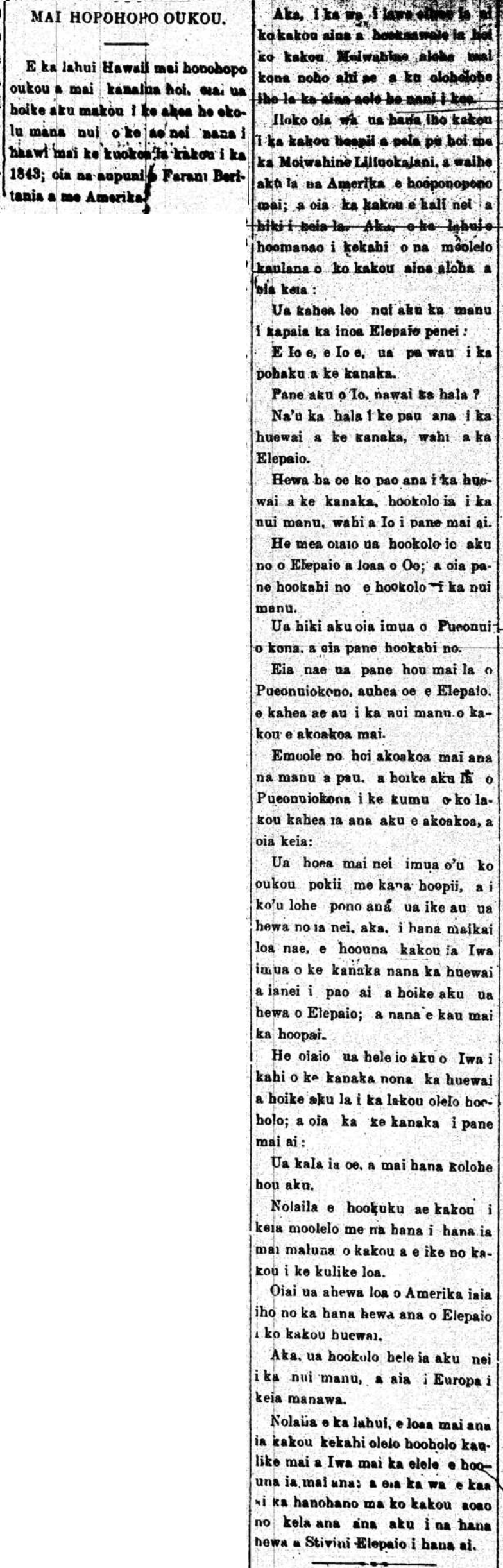
DON’T WORRY.

O Hawaiian people, don’t worry and don’t be uncertain. for we have publicly shown that there are three great powers of the world who have granted independence to us in 1843, that being France, Britain, and America.

But when our land was stolen and our beloved Queen was taken from her throne and our land stood bare without any beauty remaining,

During that time, we composed our protest, along with Queen Liliuokalani, and left if for America to make right; and it for this that we wait until today. But O Nation, do recall one of the famous stories of our beloved land, this being:

The bird called Elepaio called out loudly:

“O Io, O Io, I was hit by the rock of the man.”

Io answered, “Who was at fault?”

“I was wrong for pecking at the huewai of the man,” answered Elepaio.

“You are indeed at fault for puncturing the huewai of the man; let it be judged by the many birds,” was Io’s answer.

It was so, Elepaio was judged; he came upon Oo, and his answer was the same, that it be judged by the many birds.

Elepaio arrived before Pueonuiokona, and his answer was the same.

But Pueonuiokona went on to say, “Say Elepaio, I will call our many fellow birds to come together.”

In no time, all the birds came together, and Pueonuiokona revealed the reason for them being called to assemble, like this:

“Before me appeared your younger sibling with his protest, and when I heard correctly, I knew he was wrong, however, the best thing to do would be for us to send Iwa before the man to whom belonged the huewai that Elepaio pecked, and to tell him that Elepaio was guilty, and it is for him to set the punishment.”

And it was so, Iwa went to the place of the man to whom belonged the huewai, and told him of their decision; this is what the man said:

“You are forgiven, and don’t do anymore harmful acts.”

So we compare this story with the actions carried out upon us, and we see that they are exactly the same.

For America totally blames itself for the wrong done by Elepaio to our huewai.

But it is going around being judged by the many birds, and is currently in Europe.

So therefore, O Nation, we will receive a fair judgement from Iwa, the messenger that is being sent; and that will be when the dignity shall be awarded to our side through the judgement of the crimes carried out by Stevens Elepaio.

(Leo o ka Lahui, 10/11/1894, p. 2)

MAI HOPOHOPO OUKOU.

Ka Leo o ka Lahui, Buke II, Helu 1047, Aoao 2. Okatoba 11, 1894.

Great Britain to buy Niihau? 1892.

[Found under: “LOCAL NEWS.”]

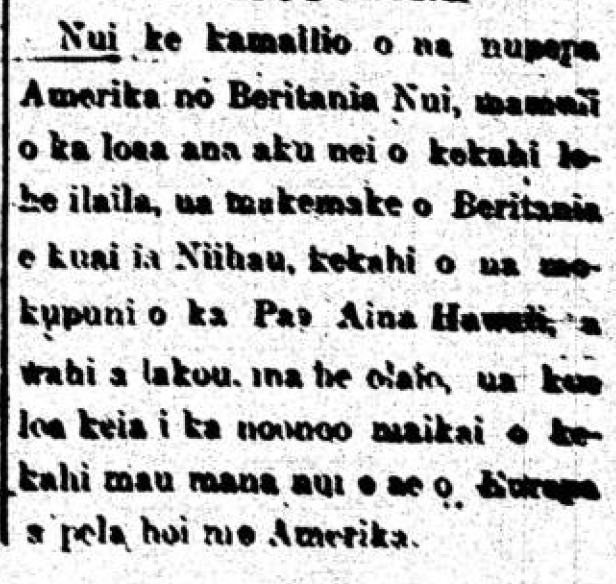
There has been much talk in the American newspapers about Great Britain, in that they received news that Britain is interested in purchasing Niihau, one of the islands of the Hawaiian Archipelago, and according to them, if it is true, this would be greatly go against the good will of some other major powers of Europe and America as well.

(Leo o ka Lahui, 9/29/1892, p. 2)

Nui ke kamailio o na nupepa...

Ka Leo o ka Lahui, Buke II, Helu 554, Aoao 2. Sepatemaba 29, 1892.

As it was then it is now. 1893 / 2013.

HE LEI NO KA POE ALOHA AINA.

Kaulana na pua a Hawaii
Kupaa mahope o ka Aina
Hiki mai ka Elele a ka lokoino
Palapala anunu me ka pakaha
Pane mai Hawaii Nui a Keawe
Kokua na Hono a Piilani
Kakoo mai Kauai o Mao
Pau pu me ke one o Kakuhihewa
Aole e kau kuu pulima
Maluna o ka pepa a ka Enemi
Aole makou e minamina
I ka puu kala a ke Aupuni
Ua ola makou i ka pohaku
I ka ai kamahao a ka Aina
Hoohui Aina kuai hewa
I ka pono Kiwila a o ke kanaka
Mahope makou o Liliulani
A kau hou ia i ke Kalaunu
Haina ia mai ana ka puana
No ka poe i Aloha i ka Aina.

A LEI FOR THE PATRIOTS.

Famous are the blossoms of Hawaii
Who stand steadfast behind the Land
When the evil-hearted Messengers arrives
With their documents of greed and plunder
Great Hawaii of the Chief Kakuhihewa answers
The Bays of the Chief Piilani assists
Kauai of the Chief Manokalanipo gives support
Along with the sands of the Chief Kakuhihewa
I will not affix my signature
Upon the paper of the Enemy¹
We will not feel longing
For the sums of money from the Government
We live on the rocks
On the amazing food of the Land
[Annexing and selling wrongfully
The Civil rights of the people]
We stand behind Liliulani
Her Crown shall be placed back upon her
Let the refrain be told
Of the people who Love the Land.

Miss Kekoaohiwaikalani,
Puahaulani Hale,
Honolulu, Feb. 10, 1893.

As a result of the many requests we received to reprint the mele of the Patriots, we are fulfilling your desire; and this is a totally accurate copy of this Mele gotten from the Lady who composed this mele.

[This mele was indeed printed many times in the Hawaiian-Language Newspapers, attesting to its importance. It is just as important today, 120 years since, if not more so!]

¹It appears that the bracketed lines were misplaced and should follow here. …or perhaps not, as it appears in basically this same form three years later: Aloha Aina, Buke III, Helu 24, Aoao 4. Iune 13, 1896. “E Nana Mai i ke Mele.”

(Leo o ka Lahui, 5/16/1893, p. 3)

HE LEI NO KA POE ALOHA AINA.

Ka Leo o ka Lahui, Buke II, Helu 706, Aoao 3. Mei 16, 1893.

1836, the beginnings of sericulture on Kauai. 1843.

SILK. NUMBER 2.

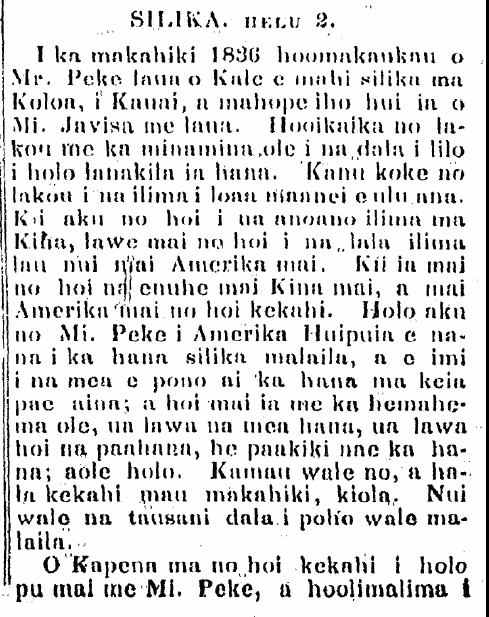
In the year 1836, Mr. Peke and Kale made ready to farm silk [silika] in Koloa, Kauai, and afterwards the two were joined by Mr. Jarvis [Mi. Javisa]. They put much effort into this without caring about money spent to make it a success. They immediately planted ilima found growing here. They went to get ilima [? mulberry] seeds from China and brought back branches of the ilima lau nui from America. Mr. Peke went to the United States of America to see silk production there, and to find what it took to raise them in this archipelago; he returned without anything lacking, with the necessary gear, and sufficient workers, but the work was difficult and did not move forward. They kept at it, and some years went by, and they gave up. Many thousands of dollars was wasted on it.

Kapena and others also came with Mr. Peke, and leased other lands in Koloa, with thoughts of raising silk there. He planted ilima, built a residence, a building to raise the worms, and a house for the workers. They began the work, but in not much time, it was a bust. Here are the reasons that it was a waste of time in Koloa: there is a strong wind so the ilima does not grow well as the leaves are torn in the strong wind and wilt, the worms don’t grow well there; and the people also, they are not eager and do not keep at the work; they come some days and slack off, are lazy and leave. Today, the ilima of those silk lands are all pulled out and sugar is planted there. So sad for those foreigners who wasted their money in this endeavor. A new enterprise almost started there to make the nation rich.

(Nonanona, 1/3/1843, p. 78)

SILIKA. HELU 2.

Ka Nonanona, Buke 2, Pepa 16, Aoao 78, Ianuari 3, 1843.

(Nonanona, 1/3/1843, p. 79)

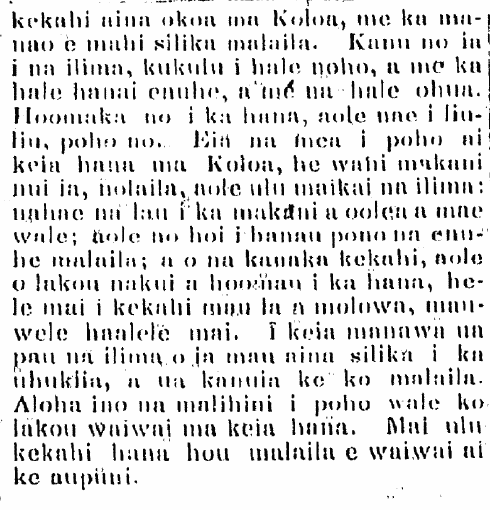
...kekahi aina okoa ma Koloa...

Ka Nonanona, Buke 2, Pepa 16, Aoao 79. Ianuari 3, 1843.

More on Kaheleiki trial: “Something not to be forgotten.” 1863.

Voyage of the Hawaiian Chiefs to San Francisco.

This past Wednesday morning [4/15/1863], the Honorable C. Gordon Hopkins [Hapakini], John Ii [Ioane Ii], Kaisara Kapaakea [Caesar Kapaakea], and J. Koii Unauna, along with the one who is involved in the dispute for whom they went to testify for, namely Harry Kaheleiki, came to shore riding aboard the ship, Yankee; and we are pleased to report the public that they are in good health.

During the trial of Harry Kaheleiki in San Francisco, there were many witnesses strongly against him; however, with the arrival of the alii mentioned above, there was true testimony in favor of the accused, and the error of those who testified against him was clear. The newspapers of San Francisco were filled with thoughts of appreciation for this Nation sending witnesses at much expense to have one of its citizens wrongly charged in a foreign land set free; according to one of the papers, this is a benevolent act not done by the enlightened Nations of the world, and so the Hawaiian Nation has taken the lead in this fine action. This is truly an act of aloha, and it is something not to be forgotten for all times.

The reason it was heard that a Hawaiian was being imprisoned in San Francisco was because of Doctor Gulick [Gulika], the one who was previously living in the islands of Micronesia, and due to weakening health, arrived in California. While he was in San Francisco several months ago, he heard that there was a Hawaiian man being held in one of the Jails there on the charge of murder; he therefore went quickly to meet with the man, and when he got there, he spoke with the aforementioned Kaheleiki, and though this conversation, it was clear in Doctor Gulick’s mind that the accused was innocent. And because Kaheleiki asked him if they could wait until witnesses were sent for from Hawaii for him, there would be many who would testify that he was innocent of the charges against him. So Doctor Gulick immediately went to the office of the Hawaiian Consul, Mr. Hitchcock [Kanikela Hawaii o Mr. Hikikoki], and told him about the circumstances of Kaheleiki and how he was certain that Kaheleiki was innocent of the charges. When the Hawaiian Consul heard of this, he went at once to meet with the accused, and upon seeing his demeanor and what he had to say, he knew for himself that Kaheleiki was innocent. He then went quickly to see the Judge to ask that the trial of Kaheleiki be postponed until he heard from here; for he had witnesses here for him. And that is how time was given to send his witnesses, and that is how he was freed. And when he sent for witnesses here, along with a letter from Doctor Gulick, and when His Highness L. Kamehameha heard of this, he along with Sheriff W. C. Parke put great effort into finding appropriate witnesses to testify for Kaheleiki, the one who was falsely charged. We are filled with appreciation for the Royal One, His Highness, and the Sheriff.

We must thank Doctor Gulick, and we are truly thankful for him in the name of all who desire that the innocent who are persecuted be freed, and in the name of all who strive to find ways to free the innocent from the hands of those who oppose them, while they live in foreign lands. God shall free the righteous.

[There are countless stories like this in the Hawaiian-Language Newspapers that should be relearned and retold and retold again, so they are not forgotten!]

(Kuokoa, 4/18/1863, p. 3)

Ka Huakai a na 'Lii Hawaii i Kapalakiko.

Ka Nupepa Kuokoa, Buke II, Helu 16, Aoao 3. Aperila 18, 1863.

More on the Kaheleiki trial, 1863.

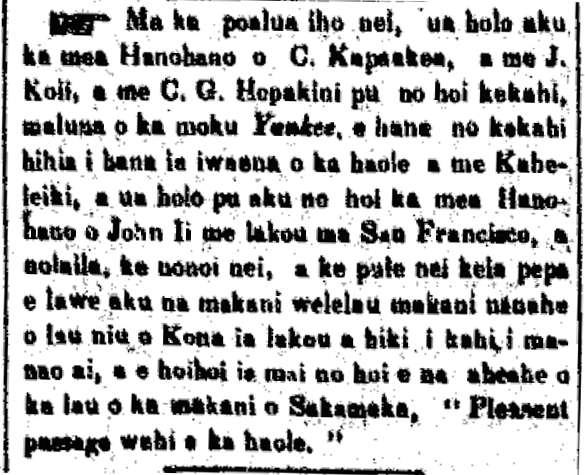
This past Tuesday [2/17/1863], the Honorable C. Kapaakea, and  J. Koii, and C. G. Hopkins also went aboard the ship Yankee, to appear in a case raised between the haole and Kaheleiki; the Honorable John Ii also accompanied them to San Francisco, and this paper hopes and prays that the fringes of the winds; the gentle winds of the coconut fronds of Kona take them to their destination, and that they are brought back by the soft puffs of the wind of Sakameka [? Sacramento]; “Pleasant passage,” according to the haole.

(Hoku o ka Pakipika, 2/19/1863, p. 2)

Ma ka poalua iho nei...

Ka Hoku o ka Pakipika, Buke 2, Helu 19, Aoao 2. Feberuari 19, 1863.

More on the Boston, in English, 1893.

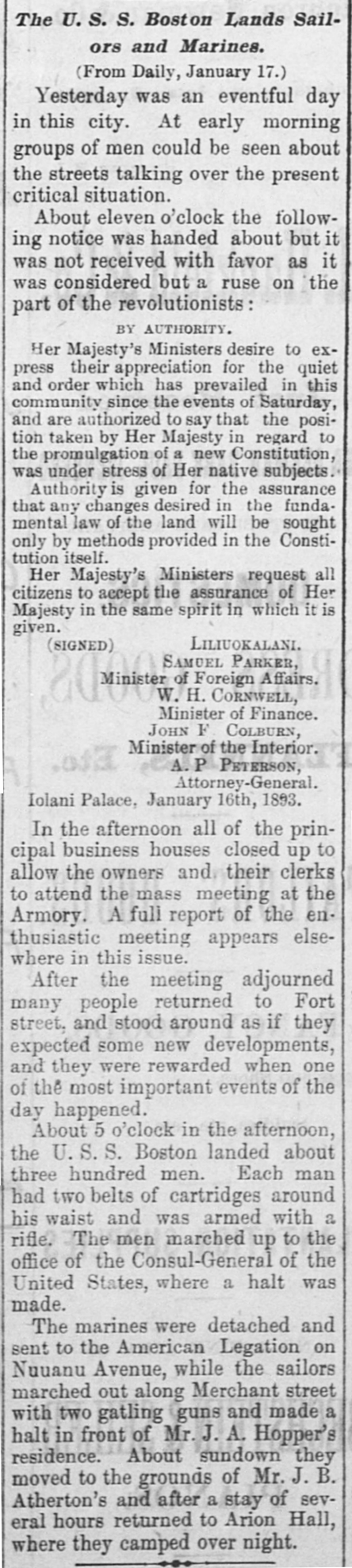
The U. S. S. Boston Lands Sailors and Marines.

(From Daily, January 17.)

Yesterday was an eventful day in this city. At early morning groups of men could be seen about the streets talking over the present critical situation.

About eleven o’clock the following notice was handed about but it was not received with favor as it was considered but a ruse on the part of the revolutionists:

BY AUTHORITY.

Her Majesty’s Ministers desire to express their appreciation for the quiet and order which has prevailed in this community since the events of Saturday, and are authorized to say that the position taken by Her Majesty in regard to the promulgation of a new Constitution, was under stress of Her native subjects.

Authority is given for the assurance that any changes desired in the fundamental law of the land will be sought only by methods provided in the Constitution itself.

Her Majesty’s Ministers request all citizens to accept the assurances of Her Majesty in the same spirit in which it is given.

(SIGNED) Liliuokalani.

Samuel Parker,
Minister of Foreign Affairs.

W. H. Cornwell,
Minister of Finance.

John F. Colburn,
Minister of the Interior.

A. P. Peterson,
Attorney-General.

Iolani Palace, January 16, 1893.

In the afternoon all of the principal business houses closed up to allow the owners and their clerks to attend the mass meeting at the Armory. A full report of the enthusiastic meeting appears elsewhere in this issue.

After the meeting adjourned many people returned to Fort street, and stood around as if they expected some new developments, and they were rewarded when one of the most important events of the day happened.

About 5 o’clock in the afternoon, the U. S. S. Boston landed about three hundred men. Each man had two belts of cartridges around his waist and was armed with a rifle. The men marched up to the office of the Consul-General of the United States, where a halt was made.

The marines were detached and sent to the American Legation on Nuuanu Avenue, while the sailors marched out along Merchant street with two gatling guns and made a halt in front of Mr. J. A. Hopper’s residence. About sundown they moved to the grounds of Mr. J. B. Atherton’s and after a stay of several hours returned to Arion Hall, where they camped over night.

[The “Daily” here mention at the top refers to the Daily Pacific Commercial Advertiser.]

(Hawaiian Gazette, 1/24/1893, p. 6)

The U. S. S. Boston Lands Sailors and Marines.

Hawaiian Gazette, Volume XXVIII, Number 4, Page 6. January 24, 1893.