Paaiea Pond, part 3, from the pen of J. W. H. Isaac Kihe, 1914.

SOME STORIED LANDS OF KONA

Written for the Hoku o Hawaii by ka Ohu Haaheo i na Kuahiwi Ekolu¹

PAAIEA POND

Meeting with Kolomu’o and Pahinahina.

When the woman left that place at the seaside of Kaelehuluhulu, she arrived in the uplands of Keoneeli, a place that is renown to this day called Kepuhiapele [‘the scorching of Pele’], a heap of aa lava that is almost 200 Feet high, downside of the place where J. A. MaGuire [known also as Keoni Kaimana] is living.

When the woman arrived there, there were two girls named Kolomu’o and Pahinahina broiling breadfruit, while the parents were away farming. This was a huge town during those days, with many people living there. When the woman met up with the girls broiling ulu. The woman said, “The ulu that you are cooking is done.” One of the girls responded, “We are cooking ulu, but it is not totally done.”

The woman went on, “When you ulu is cooked, who will partake of it first?” “La’i, my god, will eat first.” “So La’i is a powerful akua?” “Yes, La’i is powerful.” The name of this girl was Kolomu’o, and the area beneath that scorching of Pele is famous to this day and called Kolomu’o, and famous too is the Opelu fishing shrine [Ko’a] at the beach of Kaupulehu.

Then the woman asked the other girl, Pahinahina, “And when your ulu is done, who is it for?” “It is for Pele Honuamea, my god.” “Then it is our ulu; your ulu is cooked, let the two of us partake in it.” Pahinahina agreed, and the ulu was peeled [makikoe²] and eaten up. Continue reading

Paaiea Pond, from the pen of J. W. H. Isaac Kihe, 1914.

SOME STORIED LANDS OF KONA

Written for the Hoku o Hawaii by ka Ohu Haaheo i na Kuahiwi Ekolu¹

PAAIEA POND

Paaiea was a great pond almost like the ponds of Wainanalii and Kiholo. In the olden days, when the great ruling chiefs were living, and when these fish ponds were full of the riches of Awa, Anae, and Ahole, along with all sorts of fish which swam within.

During that time, Konohiki were stationed, and he was the guard of the pond that watched over the pond and all things, as here we are talking about Paaiea Pond which was destroyed by lava and became pahoehoe lava which remains today, which is what the writer is introducing to the readers of the Hoku o Hawaii.

In the correct and trues story of this pond, its boundaries began from Kaelehuluhulu on the north and on the south was at the place called Wawaloli, and the distance from one end to the other was 3 miles or more, and that was the length of this pond; and today within these boundaries, there are a number of pools [lua wai loko] remaining during this time that the writer is speaking before the readers of the Hoku.

The great Overseer [Konohiki] who cared for this pond was Kepaalani, and everything fell under him: the storehouses [hale papaa] where poi and fish were stored, the halau for the fishing canoes, the nets and all thing, and from him the fishermen and the retainers of the court would obtain their sustenance.

And at this time when the pond was destroyed by lava, Kamehameha was residing in Hilo for the purpose of waging war, and this war was called Kaipalaoa; during this war, Namakehaikalani died and was offered atop the Heiau of Piihonua in Hilo; and this was Kamehameha’s final war, and his enemies lived quietly without uprising once again. This was the time between 1798 until 1801, and it is said that this is when lava destroyed this pond that was full of riches, and turned it into a land of pahoehoe lava which remains to this day. Continue reading

Lahaina, and Hawaii through history, 1941.

OLD LAHAINA PRISON
and
ANCIENT LAHAINA

By INEZ ASHDOWN

According to information gleaned from the Bishop Museum records and the Archives of Mr. E. Bryan Jr., curator at the Museum, the old Lahaina Prison was built in 1851 and completed in April 1852. This was during the reign of Kamehameha III, who ruled until 1854.

For “local color” at that time I have talked with old Hawaiians who are from 70 to 80 years of age, and have also spent many hours at the Wailuku library reading old volumes supplied by Mrs. Juliette Davis, Librarian. Continue reading

Lahaina, a o Hawaii nei hoi o ka wa kahiko, 1941.

KA HALEPAAHAO KAHIKO O LAHAINA ame LAHAINA KAHIKO

(Kakauia e Inez Ashdown)

E like me na mea i hooloaa ia mai ka moolelo mai o Hale Hoahu o na Mea Kahiko o Bihopa mai ia Mr. E. H. Bryan Jr., mea malama o ua hale la, o ka Halepaahao kahiko o Lahaina i kukulu ia i ka M. H. 1851 a pau nohoi i ka makahiki 1852 i ka wa keia e noho moi ana o Kamehameha III, Kauikeaouli, i noho moi a hiki i ka makahiki 1854.

O ke ano oia au hui au a kamailio me na Hawaii kahiko o 70 a hiki i ke 80 makahiki, a pela pu nohoi ma o ka hoohala ana he mau hora lehulehu maloko o ka Hale Waiho Buke o Wailuku e heluhelu ana hoi i na buke kahiko i hoolako ia mai ia’u e Mrs. Juliette Davis, ka mea malama Hale Hoahu Buke. Continue reading

Mele found everywhere in the newspapers. 1899.

[Found in: “HALEIWA HOTELE: Ka Ui Mahiehie ma Waialua”]

O ka loku hala ole
A ka ua i Maili,
Ili hewa ka manao ia nei,
Ka waiho la i ka lai.

Chorus: O oe kai hui iho la,
Ka manao e puapuai la,
Ei ae o Puu-o-Hulu,
Hului no au, ua hiki no.

Nau i lahui i ka leo,
Ike i ka makani Kaieulu [Kaiaulu],
Ka makani o ka aina,
Ilaila hoola’i na manu.

[Here is another interesting mele found in a nice description of an excursion aboard the train Kaala to the newly-opened Haleiwa Hotel. It is added into the narrative by the writer as he describes passing by Puuohulu. This inserting of mele into prose is something found often in Hawaiian writing. This composition seems very reminiscent of another perhaps more famous mele still sung today.]

(Kuokoa, 8/11/1899, p. 1)

O ka loku hala oe, A ka ua i Maili...

Ka Nupepa Kuokoa, Buke XXXVIII, Helu 32, Aoao 1. Augate 11, 1899.

More on Moanalua Park, 1899.

MOANALUA PARK.

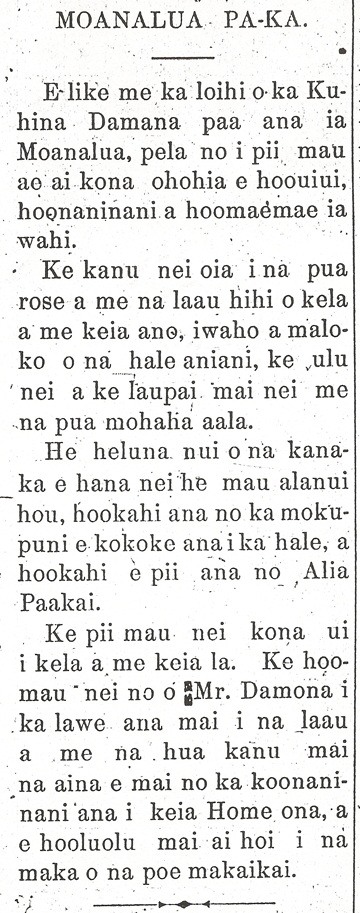
As long as Minister Damon [Damana] has been in possession of Moanalua, his desire to beautify, ornament, and to clean up the area has been increasing.

He is planting roses and vines of all sorts and these are growing and increasing inside and outside of the glass houses with their blossoming fragrant blossoms.

There are many people constructing new roads; one will be for the island which will be close to the house and one will go up to Alia Paakai.

Its beauty is intensifying every day. Mr. Damon will continue to bring in plants and fruits from other lands to adorn this Home of his, and it will please the eyes of those who visit.

(Lahui Hawaii, 3/25/1899, p. 5)

MOANALUA PA-KA.

Ka Lahui Hawaii, Buke 1, Helu 9, Aoao 5. Maraki 25, 1899.

Visitors to Moanalua Park, 1898.

GROUP OF VISITORS AT MOANALUA.

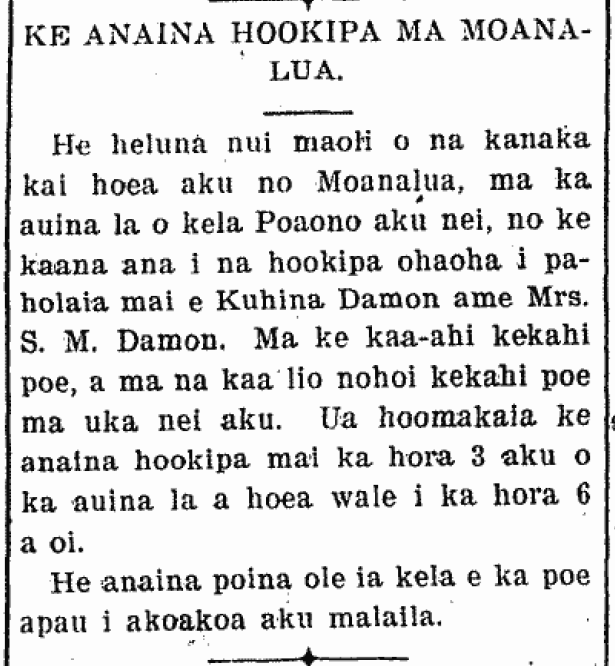
There was a truly great number of people who arrived in Moanalua, on the evening of last Saturday, to share in the delightful welcome extended by Minister Damon and Mrs. S. M. Damon. Some came by train, some came up by horse-drawn carriage. The reception began from 3 o’clock in the afternoon until 6 o’clock or so.

This was an unforgettable gathering to all who assembled there.

(Kuokoa, 10/7/1898, p. 3)

KE ANAINA HOOKIPA MA MOANALUA.

Ka Nupepa Kuokoa, Buke XXXVII, Helu 40, Aoao 3. Okatoba 7, 1898.

Royal huakai, 1865.

[Found under: “BITS OF NEWS OF HAWAII NEI.”]

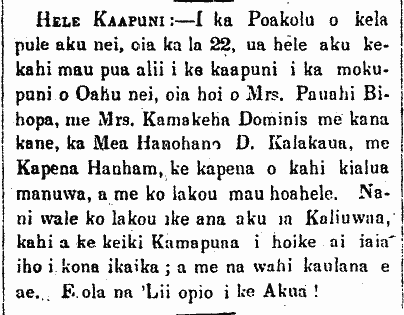
Circuit:—On Wednesday of the week last, that being the 22nd, some of the royal descendants made a circuit of Oahu nei, that being Mrs. Pauahi Bishop, Mrs. Kamakeha Dominis [Kamakaeha Dominis] and her husband, the Honorable D. Kalakaua, and Captain Hanham, the captain of a single-masted warship, along with their travelling companions. Splendid was their view of Kaliuwaa, where the youth Kamapuaa revealed himself and his strength; along with the other famous sites. Long live the young Alii in God!

(Kuokoa, 3/30/1865, p. 2)

Hele Kaapuni...

Ka Nupepa Kuokoa, Buke IV, Helu 13, Aoao 2. Maraki 30, 1865.

More on the Wahiawa “healing stones,” 1927.

THE SUPERNATURAL ROCKS WILL BE LEFT IN THEIR PLACE.

At the meeting of the Daughters of Hawaii last week Wednesday in the Home of Queen Emma Kaleleonalani in Nuuanu, the association decided not to move the “Healing Stones” from where the two stand in Wahiawa; they made no decision to perhaps not move them for a time between three and six months and after that time, to take up again the question of those rocks.

When ayes and nays were asked for per the request explained earlier by Mrs. Julie Judd Swanzy and added to with small changes made by Mrs. F. A. Potter, there were three members who were opposed to the changes.

The decision by the association agreed upon that day, was in accordance with the decision by the President of the Board of Health, F. E. Trotter, that there would be no action upon on the matter of the rocks and that they’d be left where they stand now without being moved. With this decision by the Daughters of Hawaii, the ones who have responsibility over the rocks, dashed was the hope and request of 400 citizens of Wahiawa made to this association in a petition to remove the rocks from Wahiawa.

Another subject considered and decided upon by the association was this: there shall be no monuments built upon heiau. At that meeting, announced were pledges of $588, and cash donations of $1712, and funds of $341.72 for the restoration of that palace in Kailua, Kona, Hawaii [Hulihee].

Because of the rumor that the enthusiasm over the healing powers of the rocks are dwindling, which was known because less people go to worship the stones and because of less donations, this is the reason for the postponement by the association on action to be taken in regard to the rocks, with their belief that perhaps in a short few months the craze of the people over worshiping them will decrease drastically.

At that meeting of the association, there were many letters read by the President, Mrs. Swanzy, in front of the members gathered there, from different people dealing with the stones.

One of these letters was a petition by 400 people of Wahiawa asking to remove these rocks from there; three of the people who signed their names to the document asked that their names not be publicized and to take out their names from the list; there was a letter against the moving of the rocks to the Bishop Museum, where the stones would just be a “Collection” there; in another letter, it was asked to move the rocks to an area near the new road in Koko Head.

Mrs. Charles Clark asked to return these stones to the grounds of Kukaniloko; her idea was opposed by the majority of the members for the reason that the ancient history of these stones have nothing to do with the history dealing with the alii born at Kukaniloko, and therefore, it is not right to move them there. The rocks were moved to Kukaniloko at the order of Galbraith, because he thought they might be broken up where they stood beneath the stream.  The association does not want to return the stones there; they have been something much cared for by the Filipinos and others, and other stones of Kukaniloko have been cracked because of candles placed upon them, and the grounds are full of rotting fruits and flowers; and seeing those things which marred the beauty of the area was why they were moved to where they stand now. Those stones will not be considered again for return to Kukaniloko.

As for the $3000 in the bank, it is from donations made by people who went to worship the stones, but the association has not agreed to take a cent of the money, but it will instead be appropriated for use for works benefiting the people of Wahiawa.

(Kuokoa, 11/24/1927, p. 4)

E WAIHOIA ANA NO NA POHAKU KUPUA MA KO LAUA WAHI.

Ka Nupepa Kuokoa, Buke LXVI, Helu 52, Aoao 4. Novemaba 24, 1927.

Pauahi and Likelike and the edible mud of Kawainui, 1872.

[Found under: “LOCAL NEWS”]

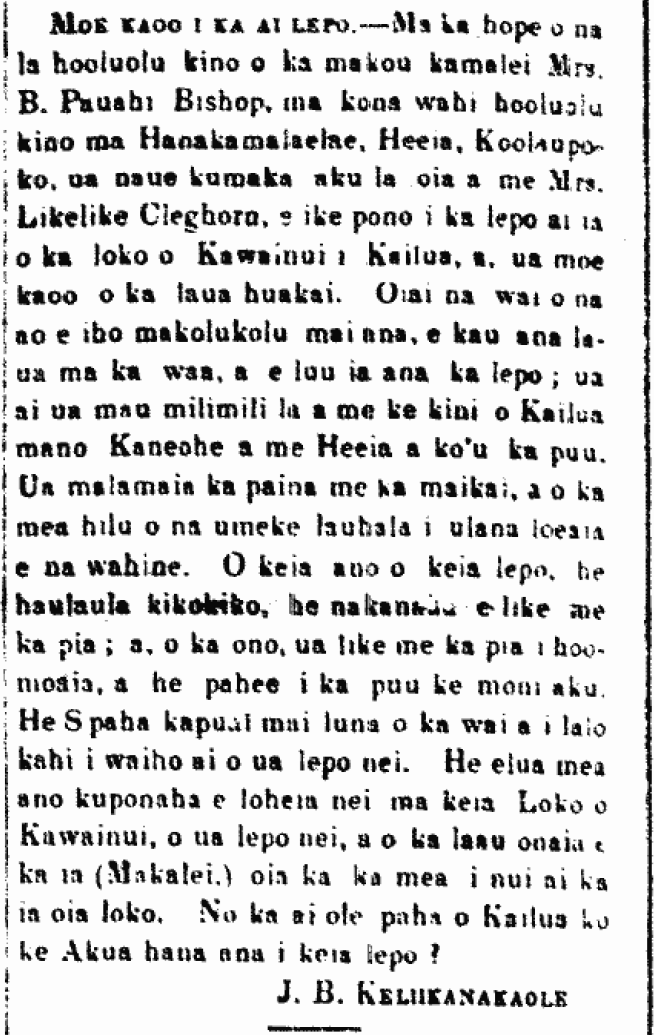
Excursion to eat the mud.—During the most recent days of rest and relaxation of our royal one, Mrs. B. Pauahi Bishop, at her vacation place, Hanakamalaelae, Heeia, Koolaupoko, she and Mrs. Likelike Cleghorn went to see for themselves the edible mud of the pond of Kawainui in Kailua, and they formed an excursion. While precipitation from the clouds fell heavily, the two of them boarded a canoe and the mud was dove for; the beloved ones, as well as the multitudes of Kailua, Kaneohe, and Heeia ate heartily. The feast went nicely and the attractive items there were the pandanus-frond [lauhala] bowls that were woven expertly by the women. The characteristics of this mud is that it is speckled pink and gelatinous like pia; it’s taste is like cooked pia and it is so smooth going down. It is perhaps 8 feet to the bottom from the surface of the water where this mud is found. There are two amazing things heard of in relation to this Kawainui Pond: this mud, and the fish entrancing stick (Makalei) which was why the number of fish increased in the pond. Maybe it is because Kailua had no food that God made this mud?

J. B. Keliikanakaole

[Does anyone know if Hanakamalaelae is documented on any map? And also does anyone have information on J. B. Keliikanakaole?]

(Kuokoa, 10/26/1872, p. 2)

Moe kaoo i ka ai lepo.

Ka Nupepa Kuokoa, Buke XI, Helu 43, Aoao 2. Okatoba 26, 1872.