Transfer of treasures of the National Museum to the Bishop Museum, 1891.

SLIPPING AWAY.

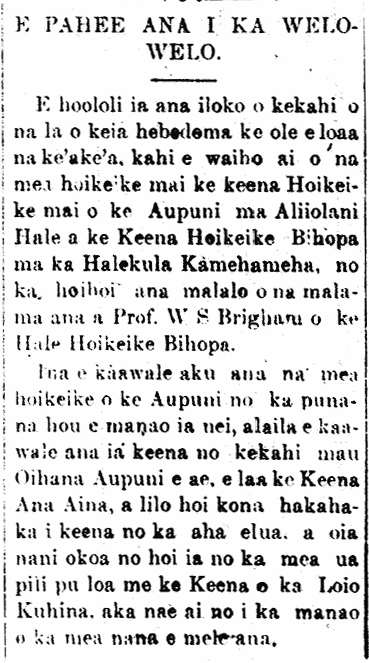
Barring any obstacles, during some of the days of this week, the location of the artifacts housed in the National Museum Office at Aliiolani Hale will be transferred to the Bishop Museum Office at Kamehameha School, to go under the care of Prof. W. S. Brigham of the Bishop Museum.

If the artifacts of the Nation are moved to their intended new nest, then that office will be open for other Government Agencies, like the Department of Land Survey, and its space will become an office for the two houses, and that is great because it is directly adjacent to the Attorney General’s Office; but this all depends on the decision of the one who sings.

(Leo o ka Lahui, 1/26/1891, p. 3)

E PAHEE ANA I KA WELOWELO.

Ka Leo o ka Lahui, Buke II, Helu 115, Aoao 3. Ianuari 26, 1891.

On the passing Gabriel K. Keawehaku, Ka Anela o Mekiko, 1921.

GABRIEL K. KEAWEHAKU PASSES AWAY.

Gabriel K. Keawehaku.

After being ill for the past many months, Gabriel K. Keawehaku left this life at 9 a. m. on the 4th of this month, just outside of his home in Kaimuki, and in the afternoon of the following 5th, his remains were put to rest at the Kaimuki cemetery.

He was given birth to by his parents, Keawehaku (m) and Olaola (f), on the 31st of the month of May, 1867, here in Honolulu, and when he grew weary of this life, he was 54 years old, plus 7 months and 4 days.

He was educated in Honolulu nei during his childhood; he was a kamaaina of this town, performing many jobs, and it was the illness that came upon him that made him give up his different jobs.

He first was employed in his youth in the Metropolitan Meat Market of Waller [Wala] and company. During the monarchy, he lived with King Kalakaua, in the king’s private guards for six years. He served as the customs inspector when the government was transferred under America, being sent to Hilo, and he was customs inspector there for five years. Continue reading

Helen H. Roberts, ethnomusicologist, collecting mele from across the islands, 1923.

SOMETHING WORTHWHILE HELPING

In this past Legislative session, $5,000 was set aside for the cost to prepare a book of “Ancient Hawaiian Music”. This endeavor has been given to Kamehameha School, and they are now utilizing this to preserve the “old mele olioli” of Hawaii nei. Miss Helen H. Roberts has been sent by the Trustees of the Kamehameha School to go amongst the Hawaiians and to search out ancient mele of Hawaii nei.

She is accompanied by a phonograph [ponotalapa (ipu malama olelo)], and is looking to have people chant ancient mele into the phonograph and to record and save it for generations to come. Not only mele olioli are being sought after, but also wanted are mele hula hoaeae of the Hawaiians. Many years from now the people who know these old mele will be gone, but these mele olioli and mele hoaeae will become something to look back to the history of the Hawaiian Lahui.

This will be something that will look for where the Hawaiians came from, whereas also being sought are mele of other Polynesians while comparing these ancient mele with the ancient mele of Hawaii.

This is something that the old people who are fluent for instance in the old mele hoaeae of Hawaii nei should assist in.

This is not being done for monetary profit, but to seek the ancient things of the beloved Kupuna of this Lahui; and for all Hawaiians who have pride in the fame of their Lahui, there is no reason for them to withhold these ancient things of the Kupuna and to go to the grave without leaving these blessings for those coming after them. We ask Rev. W. M. Kalaiwaa and Rev. William Kamau of the Kohala districts to support this great endeavor for the acclaim of the Hawaiian Lahui. We are also helping to move this project along with what little we have, being that this will help to perpetuate the great Moolelo of the Hawaiian People.

[The opening to the book “Ancient Hawaiian Music” reads:

A survey of ancient Hawaiian music was conducted, 1923–24, by Miss Helen H. Roberts under the auspices of the Hawaiian Folk-Lore Commission represented by John R. Galt, chairman; Edna J. Hill, secretary; Mrs. Emma Ahuena Taylor, Hawaiian member. In cooperation with the Commission, manuscripts resulting from the survey are published by Bernice P. Bishop Museum.]

(Hoku o Hawaii, 12/6/1923, p. 2)

HE HANA MAIKAI E KOKUA IA

Ka Hoku o Hawaii, Buke XVII, Helu 28, Aoao 2. Dekemaba 6, 1923.

Bishop Museum, art exhibit highlighting their collections, 2014.

Nature’s Wonders

I just checked out this new exhibit today at the Bernice Pauahi Bishop Museum. It is awesome! If you are here on Oahu nei from now until the 27th of October, you have to go check it out. Once it is done, it will be gone like so many sand mandalas. The creations will be carefully taken apart and the specimens returned to their proper drawers for safe keeping.

Here is a little peek.

Nature's Wonders: Butterflies

Nature’s Wonders: Butterflies

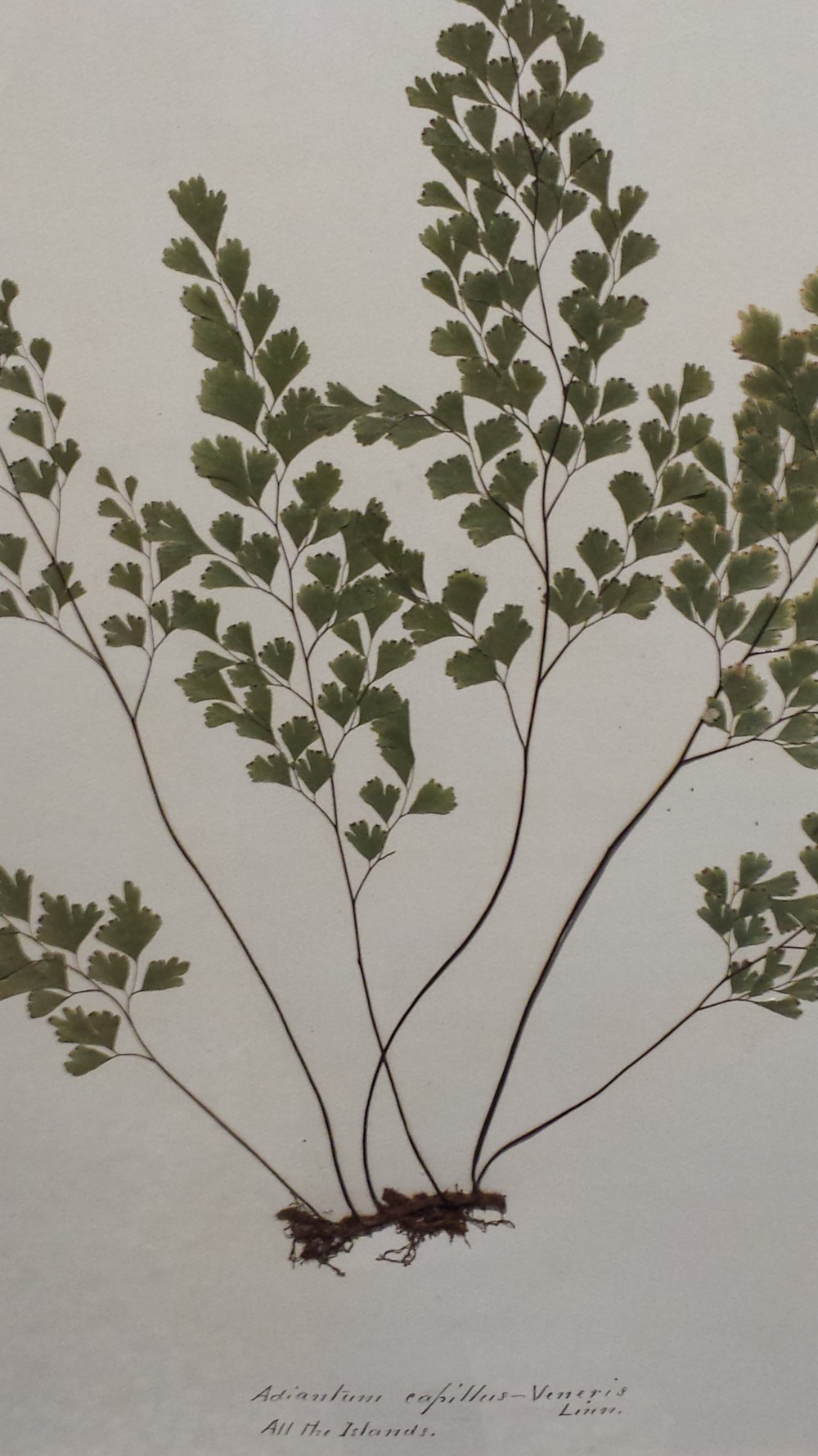
Nature's Wonders: Fern

Nature’s Wonders: Fern

Nature's Wonders: Shells

Nature’s Wonders: Shells

Titcomb’s list of fishes, 1940.

TO THOSE WHO KNOW THE NAMES OF FISHES AND THEIR DESCRIPTIONS

(Written by M. TITCOMB)

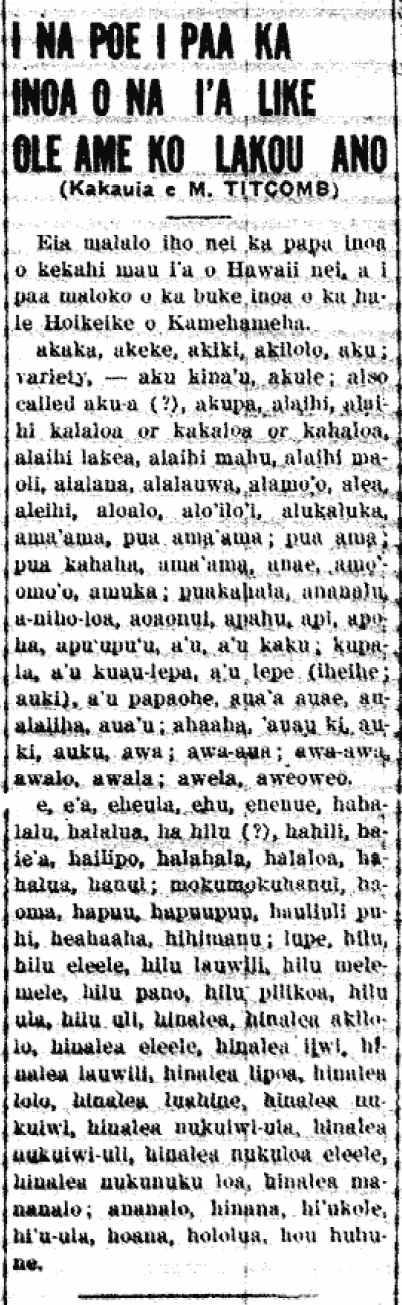
Here below is a list of names of some fishes of Hawaii nei that are found in the book of names in the Kamehameha Museum [Hale Hoikeike o Kamehameha].

akaka, akeke, akiki, akilolo, aku; variety, —aku kina’u, akule; also called aku-a (?), akupa, alaihi, alaihi kalaloa or kakaloa or kahaloa, alaihi lakea, alaihi mahu, alaihi maoli, alalana, alalauwa, alamo’o, alea, aleihi, aloalo, alo’ilo’i, alukaluka, ama’ama, pua ama’ama; pua ama; pua kahaha, ama’ama, anae, amo’omo’o, amuka; puakahala, ananalu, a-niho-loa, aoaonui, apahu, api, apoha, apu’upu’u, a’u, a’u kaku; kupala, a’u kuau-lepa, a’u lepe (iheihe; auki), a’u papaohe, aua’a auae, aualaliha, aua’u; ahaaha, auau ki, auki, auku, awa; awa-aua; awa-awa, awalo, awala; awela; awela, aweoweo.

e, e’a, eheula, ehu, enenue, hahalalu, halalua, ha hilu (?), hahili, haie’a, hailipo, halahala, halaloa, hahalua, hanaui; mokumokuhanui, haoma, hapuu, hapuupuu, hauliuli puhi, heahaaha, hihimanu; lupe, hilu, hilu eleele, hilu lauwili, hilu melemele, hilu pano, hilu pilikoa, hilu ula, hilu uli, hinalea, hinalea akilolo, hinalea eleele, hinalea iiwi, hinalea lauwili, hinalea lipoa, hinalea lolo, hinalea luahine, hinalea nukuiwi, hinalea nukuiwi-ula, hinalea nukuiwi-uli, hinalea nukuloa eleele, hinalea nukunuku loa, hinalea mananalo; ananalo, hinana, hi’ukole, hi’u-ula, hoana, hololua, hou huhune.

[This was the beginning of a series of lists of fish names appearing in the Hoku o Hawaii, and running until it seems like August 28, 1940.]

(Hoku o Hawaii, 6/5/1940, p. 2)
I NA POE I PAA KA INOA O NA I'A LIKE OLE AME KO LAKOU ANO

Ka Hoku o Hawaii, Volume XXXV, Number 6, Aoao 3. Iune 5, 1940.

Fishes, Margaret Titcomb, and the Bishop Museum, 1940.

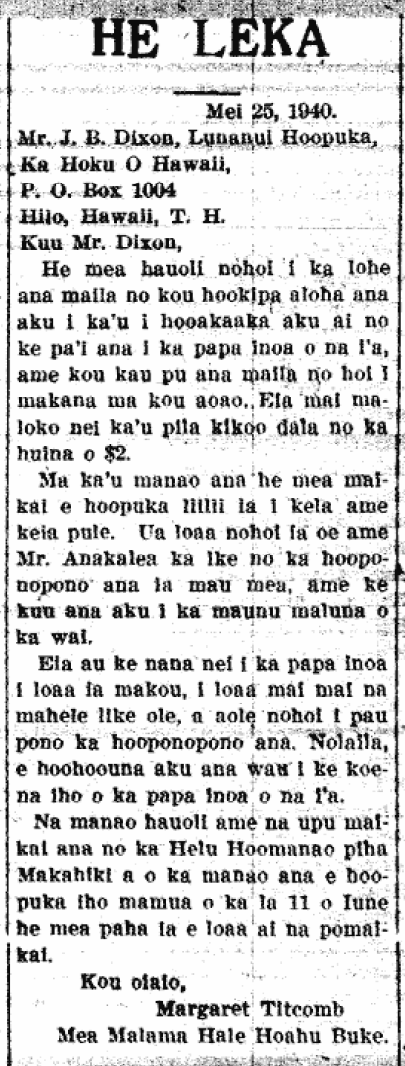
A LETTER

May 25, 1940.

Mr. J. B. Dixon, Circulation Manager,
Ka Hoku O Hawaii,
P. O. Box 1004
Hilo, Hawaii, T. H.

My Dear Mr. Dixon,

I am pleased to hear that you are willing to entertain with aloha my clarification of the publishing of a list of fish names and your running it complimentary on your part. Enclosed is my check for the total of $2.¹

I believe that it would be a fine thing to publish it in portions each week. You and Mr. Anakalea have the ability to edit this kind of thing, and to throw out the bait upon the water.

I am looking at the list of fish names that we have, they are found in various collections, and they are not edited completely. Therefore, I will send the remainder of the list of fish names.

Happy thoughts and good wishes on your Commemorative Anniversary Edition and with hopes that this will be printed before the 11th of June, it will perhaps be something beneficial.

Yours truly,

Margaret Titcomb
Librarian.

[This is no doubt a precursor to the publication Margaret Titcomb did with Mary Kawena Pukui, “Native Use of Fish in Hawaii,” first published in 1952 as Memoir 29 of the Polynesian Society, Wellington, New Zealand. It is currently available in book form from University of Hawaii Press.]

¹It is interesting to note that the cost (prepaid) for a year’s subscription of the Hoku o Hawaii was only $2.00. This is the same cost as a year’s subscription for the Hoku o ka Pakipika and the Nupepa Kuokoa in 1861!

(Hoku o Hawaii, 6/5/1940, p. 2)

HE LEKA

Ka Hoku o Hawaii, Volume XXXV, Number 6, Aoao 3. Iune 5, 1940.
Tahiti in the news, 1932.

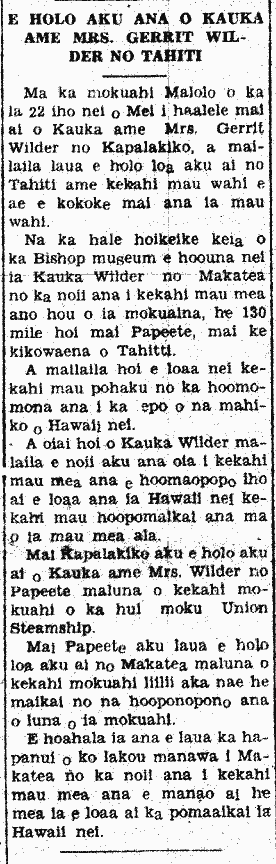
DR. AND MRS. GERRIT WILDER HEAD TO TAHITI

On the steamship Malolo of the 27th of this past May, Dr. and Mrs. Gerrit Wilder left for San Francisco, and from there, they will sail all the way to Tahiti and some other places in the vicinity.

The Bishop Museum has sent Dr. Wilder to Makatea to request some new items from that island which is 130 miles away from Papeete, the capital of Tahiti.

And from there, they will get a number of rocks to enrich the soil of the sugar cane plantations of Hawaii nei.

While Dr. Wilder is there, he will ask for some things which he believes will benefit Hawaii nei.

From San Francisco Dr. and Mrs. Wilder will head to Papeete aboard the steamer of the Union Steamship Company.

From Papeete they will travel to Makatea aboard a tiny steamship, whereas the accommodations aboard the ship are fine.

The two will spend most of there time on Makatea asking for some items that will bring benefit to Hawaii nei.

(Alakai o Hawaii, 5/26/1932, p. 3)

E HOLO AKU ANA O KAUKA AME MRS. GERRIT WILDER NO TAHITI

Ke Alakai o Hawaii, Buke 3, Helu 46, Aoao 3. Mei 26, 1932.

The name of Kaumualii’s mahiole, 1906.

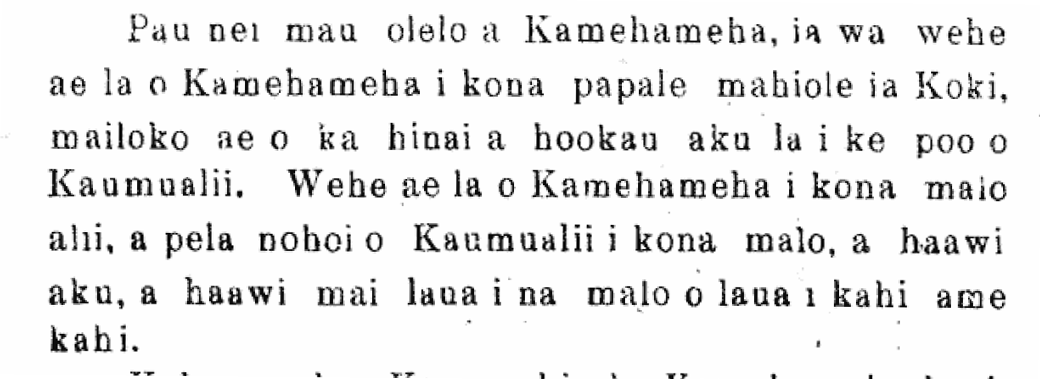
[Excerpt from: “He Moolelo no Kamehameha I. Ka Na’i Aupuni Hawaii.” by Hooulumahiehie.]

After these words of Kamehameha’s were over, he then took his mahiole, Koki, from a basket and placed it upon the head of Kaumualii. Kamehameha removed his royal malo and so too did Kaumualii remove his malo, and they exchanged them with each other.

[This account is from the meeting of Kamehameha and Kaumualii. It is just a tiny excerpt of the kind of awesome information available in the story of Kamehameha I translated by Kamaoli Kuwada, Emalani Case, and Beau Bassett, slated to come out from Kamehameha Publishing. I can’t wait.

I was informed that this priceless feathered object from the past is indeed being cared for amongst the many other antiquities at the Bernice Pauahi Bishop Museum.]

(Na’i Aupuni, 9/14/1906, p. 1)

HE MOOLELO NO KAMEHAMEHA I.

Ka Na’i Aupuni, Buke II, Helu 88, Aoao 1. Sepatemaba 14, 1906.

Z. P. K. Kawaikaumaiikamakaokaopua’s treatise on canoe building, 1922.

CANOE BUILDING AND ITS CHARACTERISTICS.

(Written by Z. P. K. Kawaikaumaiikamakaokaopua.)

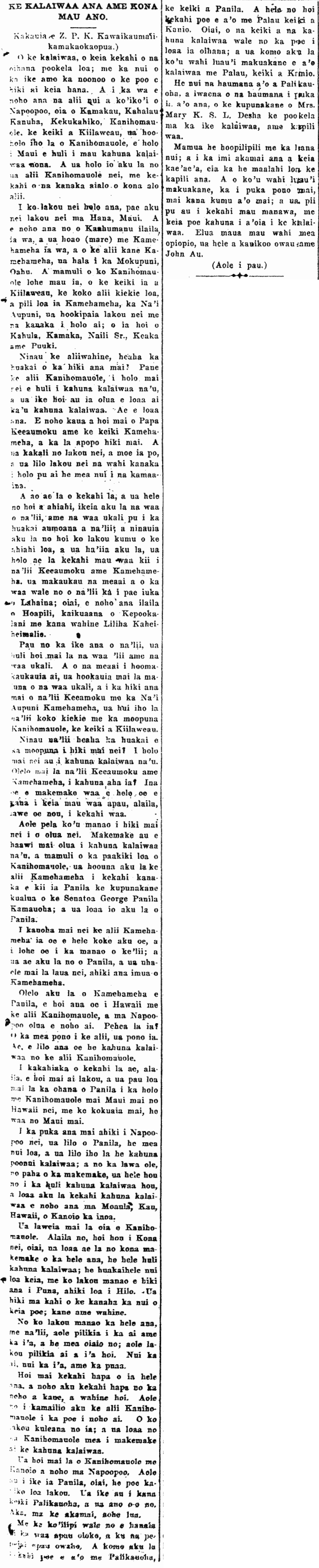
Canoe building is one of the greatest trades; it is with great knowledge and thought that this is done. And when the important high chiefs of Napoopoo were living, they being Kamakau; Kahalau; Kanuha; Kekukahiko; and Kanihomauole, the son of Kiilaweau; Kanihomauole decided to go to Maui in search of a number of canoe building kahuna for himself. And that alii Kanihomauole did indeed go with some attendants from his royal court.

When they went, they landed at Hana, Maui. Kaahumanu was there living at the time, and was married (hoao) with Kamehameha, who was away on Oahu. And because it was heard often that Kanihomauole was the child of Kiilaweau, the alii of highest blood, and that he was kin to Kamehameha, the Conqueror of the Nation, they were welcomed along with those who came, they being Kahula, Kamaka, Naili Sr., Keaka and Puuki.

The queen asked, “why have you come?” The alii Kanihomauole replied, “I have come in search of a kahuna kalaiwaa for myself, and I have come to see the two of you to get my kahuna kalaiwaa.” “Yes, you will have one. Let us remain until Papa Keeaumoku and the boy Kamehameha returns; they will be back tomorrow.” And they waited, and spent the night, and those that came were treated well by the kamaaina of the place.

[This is how the piece on canoes by Kalokuokamaile begins on 10/26/1922, and it continues on in the Kuokoa until 2/15/1923. This is one of the many priceless translations appearing in the Bernice Pauahi Bishop Museum’s Hawaiian Ethnographic Notes (HEN) Collection.  HEN: Newspapers, October 26, 1922.

Kalokuokamaile was very prolific. This series is then followed by yet another, this time on net making!]

(Kuokoa, 10/26/1922, p. 7)

KE KALAIWAA ANA AME KONA MAU ANO.

Ka Nupepa Kuokoa, Buke LXI, Helu 43, Aoao 7. Okatoba 26, 1922.

More on Emma Nakuina, W. T. Brigham, and the Bishop Museum, 1897.

NOT COURTEOUS

Treatment of Ladies at Bishop Museum.

An Open Protest to the Trustees of the Kamehameha Schools.

MR. EDITOR:—The undersigned with three other ladies, Hawaiians of the highest respectabily, standing and position, with five little children, were sitting this morning in the shade of the Kamehameha Museum enjoying the fine showing made by the naval men drilling on the College campus. Chairs had been offered by a Kamehameha graduate, he placing them on the grass plot adjoining the Museum. After a little while, Mr. Brigham, the curator of the Museum, drove by within a few feet of us. He scowled most savagely at us. In a few minutes a Portuguese workman came to order us away from the place.

As it has invariably been the custom to throw the College grounds open to the public when any sort of a public or semi-public show is taking place within its precincts, we did not pay any attention to his orders, thinking it a piece of officiousness on the part of an ignorant person, and the man went away. After a while the man re-appeared and ordered us off again, saying he was acting by Brigham’s orders, and to use force if necessary. He took hold of the chair of the wife of a prominent official and tipped it partly over. She sprang up to avoid a fall, as did two other ladies. I, being at the very corner of the building and a little in advance of the others did not perceive the man until he had taken hold of my chair and had partly spilled me on my knee. I turned around to protest, when he grabbed my arm and pulled me out of my chair, saying “you get out of this, those are my orders from Mr. Brigham. If you don’t go yourself, I make you go. Mr. Brigham don’t allow any one to get on this grass.”

There were quite a number of carriages standing around, occupied by spectators of the drill.

The actions of the Portuguese were so rough and insulting that the attention of quite a number were attracted to our forcible ejectment. Continue reading