More from Bishop Museum and Kamehameha Schools, 1894.

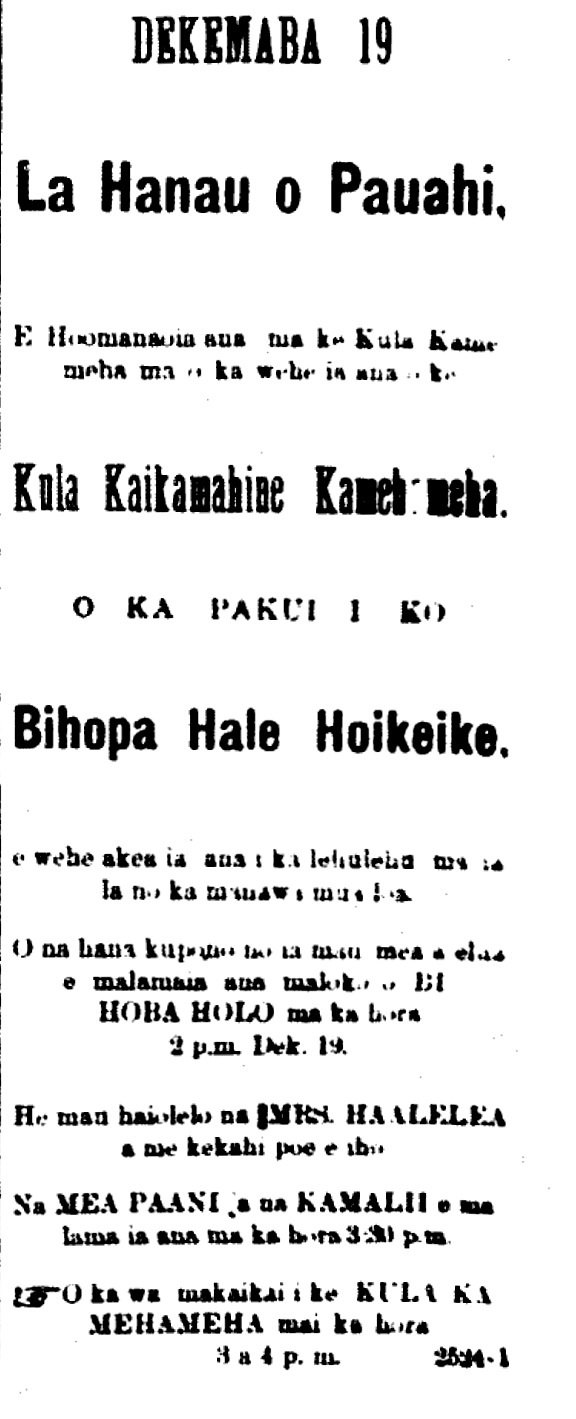
DECEMBER 19

Birthday of Pauahi.

Commemorated at the Kamehameha School with the opening of the

Kamehameha School for Girls.

THE ANNEX TO

Bishop Museum.

will be opened to the public on that day for the very first time.

Those are two fitting events held in BISHOP HALL [BiHOBA HOLO] at the hour of 2 p. m. Dec. 19.

Speeches by MRS. HAALELEA and some others.

GAMES for CHILDREN will be held at 3:30 p. m.

Period for touring the KAMEHAMEHA SCHOOL from 3 to 4 p. m.

[Mahalo to DeSoto Brown for commenting on this opening. This Annex to the Bishop Museum was unveiled to the public on the 19th of December, 1894, became Polynesian Hall, and today is reopening to the public after extensive renovations as Pacific Hall! If you are here on Oahu, go check it out!! Free admission all day today (Saturday, September 21, 2013, until 9:00 p. m.)!!!]

(Kuokoa, 12/15/1894, p. 2)

DEKEMABA 19 La Hanau o Pauahi

Ka Nupepa Kuokoa, Buke XXXIII, Helu 50, Aoao 2. Dekemaba 15, 1894.

Hawaiian-Language Newspapers | Historypin, 2013.

I have been playing with this page that puts history on the map (literally). Check it out, and let me know what you think. There are a lot of other Channels and Projects to explore, or just try moving around the map… who knows what cool stuff you might find!

history_pin1

Hawaiian-Language Newspapers | Historypin.

The Kamehameha Museum and the Kamehameha Schools, 1894.

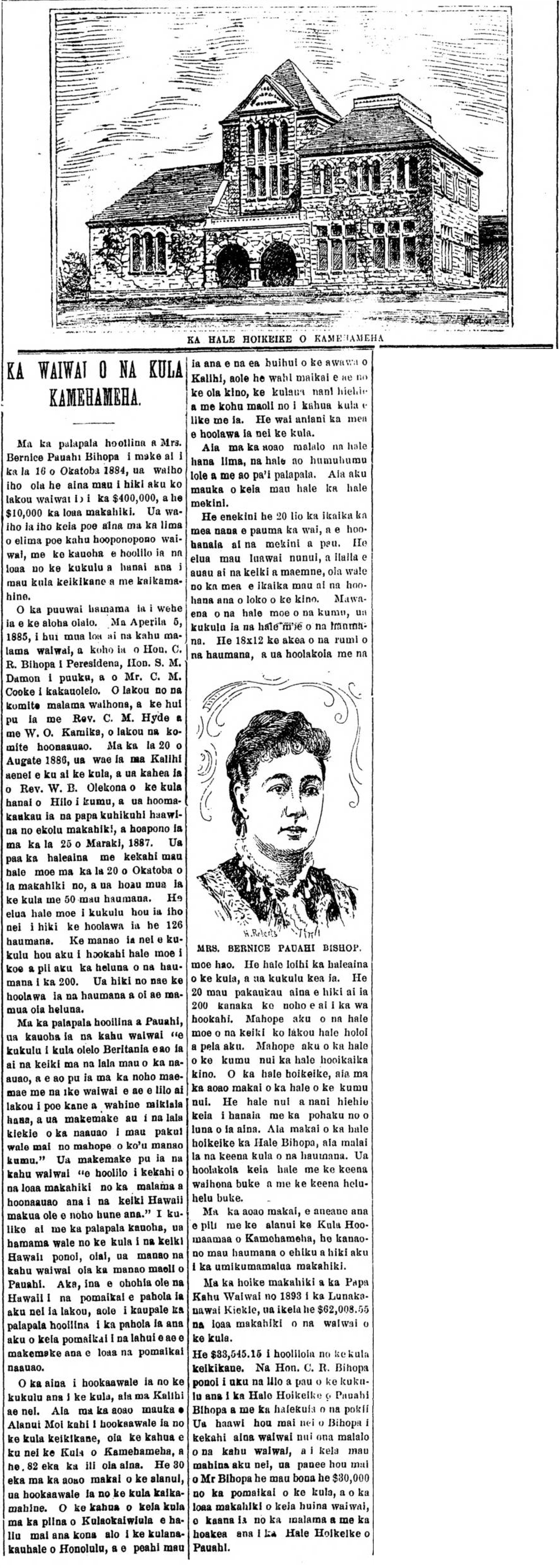
KA HALE HOIKEIKE O KAMEHAMEHA

THE ASSETS OF THE KAMEHAMEHA SCHOOLS.

In the will of Mrs. Bernice Pauahi Bishop, who died on the 16th of October 1884, she set aside lands whose true value comes to $400,000, with $10,000 profit per year. These lands are in the hands of five trustees, with the stipulation that the profits go to the building and caring for a school for boys and girls.

This generosity was based on true aloha. On the 5th of April, 1885, the trustees met for the first time and selected the Hon. C. R. Bishop as President, Hon. S. M. Damon as treasurer, and Mr. C. M. Cooke as secretary. They are the finance committee, along with Rev. C. M. Hyde and W. O. Smith, made the education committee. On the 20th of August, 1886, up in Kalihi was chosen as the place where the school would stand, and Rev. W. B. Olsen of the Hilo boarding school to be a teacher, and the curriculum for three years was prepared and approved on the 25th of March, 1887. The cafeteria and some dormitories were completed on the 20th of October of that same year, and the school began with 50 students. There were two dormitories just built, which can house 126 students. One more dormitory is planned which will increase the number of students to 200. However more than that number of students can be accommodated.

In the will of Pauahi, the trustees were instructed to “build an English-language school where the children were to be educated in the regular branches of knowledge, and they were also to be educated to live morally and with important knowledge to make them industrious men and women, and I want high branches of knowledge to supplement those basics.” It is desired that the trustees “use a portion of the profits to go to the education and care of the indigent orphaned Hawaiian children.” As per the will, the school is opened to native Hawaiians, being that the trustees believe that was the true intent of Pauahi. However, the Hawaiians are not interested in the good put before them, the will does not preclude the the provision of those blessings to the other races who want to receive the benefits of an education.

The land set aside for the building of the school is up in Kalihi. The land mauka of King Street is set aside for the boys’ school; this is where the Kamehameha School now stands; the area of that land is 82 acres. There are 30 acres makai of the street, which is set aside for the girls’ school. The area for this school is in the heights of Kulaokaiwiula with it face overlooking the cit of Honolulu, and it is constantly fanned by the cool air of the valley of Kalihi; there is no other finer place for the health, the beauty, and the suitability as a school campus like this. Clear water is supplied to the school.

Below that are the workshops, the sewing shop and the printing shop. And mauka of these buildings is the mechanic shop.

The strength of the engine pumping the water is 20 horses, and the total power is utilized. There are two huge pools where the children will bathe until clean, and that is what will keep their bodies working strong. Between the sleeping quarters of the teachers were built the dormitories of the students. The student rooms are 18 x 12 wide, and are furnished with…

MRS. BERNICE PAUAHI BISHOP.

…iron beds. The schools cafeteria is a long building, and it was built in the form of a cross. There are 20 dining tables accommodating 200 people at a time. Behind the children dormitories, are their laundry building, and so forth. Behind the principal’s house is the gymnasium. The museum is on the makai side of the principal’s house. This is a grand a beautiful structure constructed with rock from atop the land. Makai of the museum is Bishop Hall, and this is where the school rooms of the students are. This building is furnished with a library and a reading room.

On the makai side, almost adjacent to the road is the Kamehameha Preparatory School; there are sixty students from seven until twelve years of age.

In the yearly report of the Trustees for 1893 to the Chief Justice, it was seen that the school’s annual income was $62,008.55.

$33,545.15 was spent on the boys’ school. It was the Hon. C. R. Bishop who paid for the entire cost of the building of the Pauahi Bishop Museum and the preparatory school. Bishop also recently gave some of his valuable land holdings under the trustees, and several months ago, Mr. Bishop forwarded bonds of $30,000 for the benefit of the school, and the yearly income of these assets will be apportioned for the care and the expansion of the Pauahi Museum.

[It was just serendipity that caused me to notice this article the other day, and I thought with the re-opening of the new Pacific Hall at the Bernice Pauahi Bishop Museum, there was no better time to post this article about the actual beginnings of the Museum and of the Kamehameha Schools.

Check the early years of this familiar building (minus the dome) on campus as well, from an earlier post!

The public opening of Pacific Hall is tomorrow. Admission is free! Go check out all of the special events, and the newly redone Pacific Hall!!]

(Kuokoa 5/26/1894, p. 1)
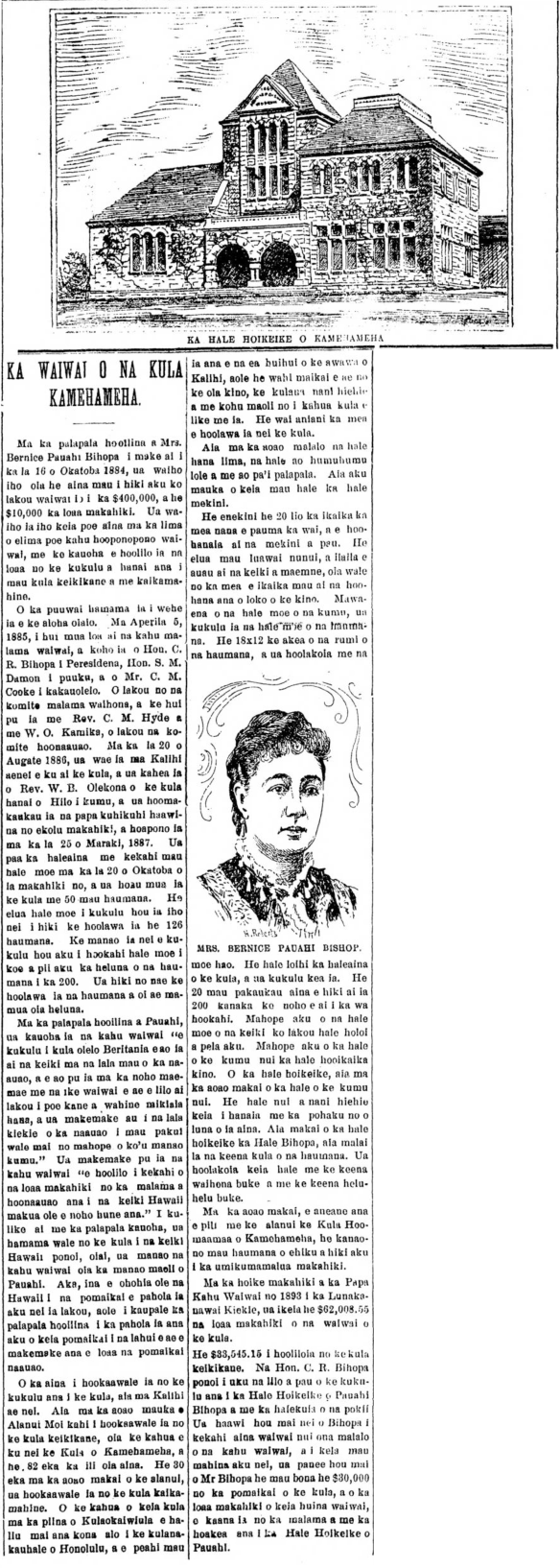
KA WAIWAI O NA KULA KAMEHAMEHA.

Ka Nupepa Kuokoa, Buke XXXIII, Helu 21, Aoao 1. Mei 26, 1894.

Another Aladdin translation, 1916.

A MOOLELO KAAO
OF
ALADDIN, THE PEASANT CHILD
AND THE SUPERNATURAL LAMP

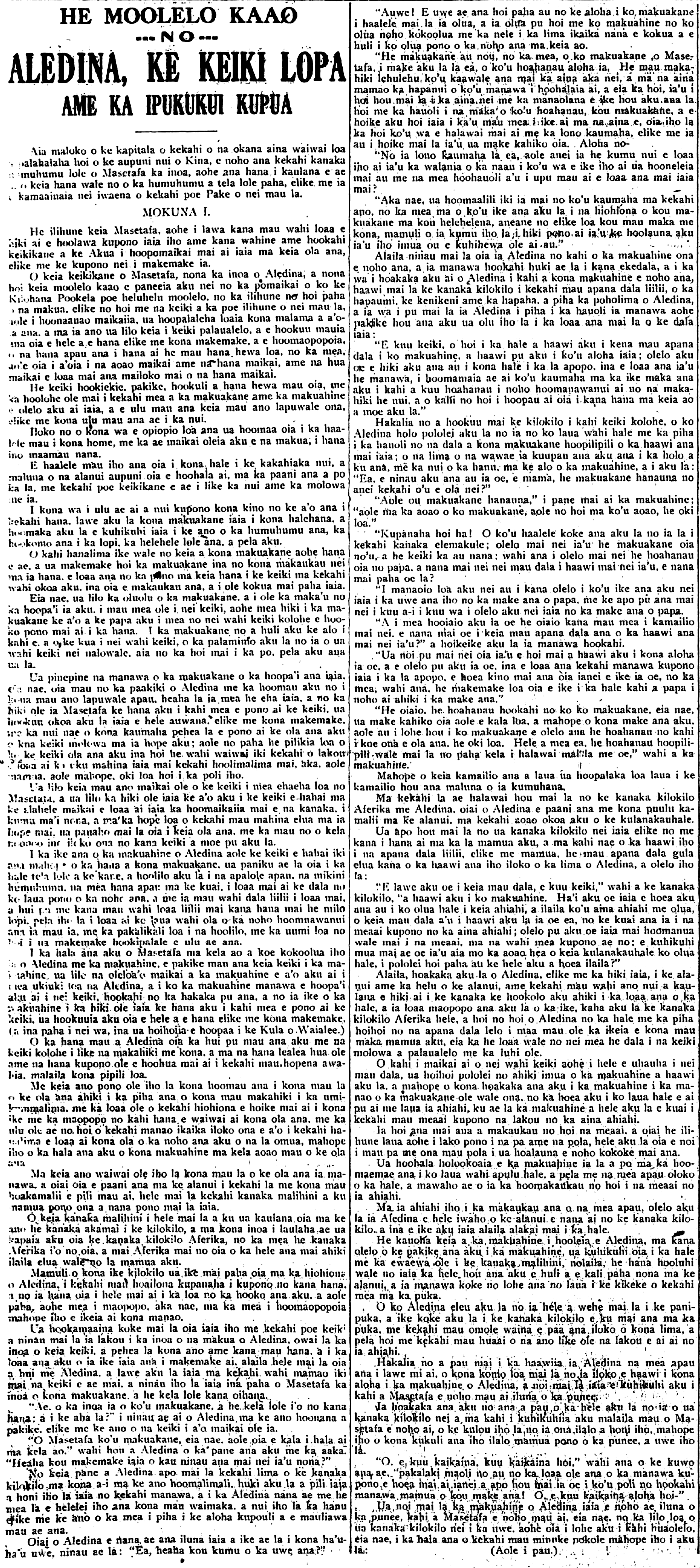
Aia maloko o ke kapitala o kekahi o na okana aina waiwai loa a palahalaha hoi o ke aupuni nui o Kina, e noho ana kekahi kanaka humuhumu lole o Masetafa kona inoa, aohe ana hana i kaulana e ae a o keia hana wale no o ka humuhumua tela lole paha, elike me ia e kamaaina nei iwaena o kekahi poe Pake o nei mau la.

MOKUNA I.

He iluhune keia Masetafa, aohe i lawa kana mau wahi loaa e hiki ai e hoolawa kupono iaia iho ame kana wahine ame hookahi keikikane a ke Akua i hoopomaikai mai ai iaia ma keia ola ana, elike me ke kupono nei i makemake ia.

O keia keikikane o Masetafa, nona ka inoa o Aledian, a nona hoi keia moolelo kaao e paneeia aku nei no ka pomaikai o ko ke Kilohana Pookela poe heluhelu moolelo, no ka ilihune no hoi paha o na makua, elike no hoi me na keiki a ka poe ilihune o nei mau la, aole i hoonaauao maikaiia, ua hoopalaleha loaia kona malama a a’oia ana, a ma ia ano ua lilo keia i keiki palaualelo, a e hookuu mauia ana oia e hele a e hana elike me kona makemake, a e hoomaopopoia, o na hana apau ana i hana ai he mau hana hewa loa, no ka mea, aole oia i a’oia i na aoao maikai ame na hana maikai, ame na hua maikai e loaa mai ana mailoko mai o na hana maikai…

[Perhaps this and the translation of the previous post were done from G. S. Beaumont’s “The Arabian Nights’ Entertainments: or, The Thousand and One Nights,” published in 1811. However, the S. K. Kaai version seems a little more simplistic. This later translation seems to follow closely Beaumont’s English and appears in the Nupepa Kuokoa from 11/3/1916 and concludes on 3/9/1917.]

(Kuokoa, 11/3/1916, p. 6)

HE MOOLELO KAAO NO ALEDINA, KE KEIKI LOPA AME KA IPUKUKUI KUPUA

Ka Nupepa Kuokoa, Buke LIV, Helu 44, Aoao 6. Novemaba 3, 1916.

Aladdin from One Thousand and One Nights, 1862.

A Mooolelo about
Aladdin and the Lamp that was
AMAZING!

Translated for the “Hoku o ka Pakipika” from
“The One Thousand and one Nights of Arabia.”
Translated by S. K. Kaai.

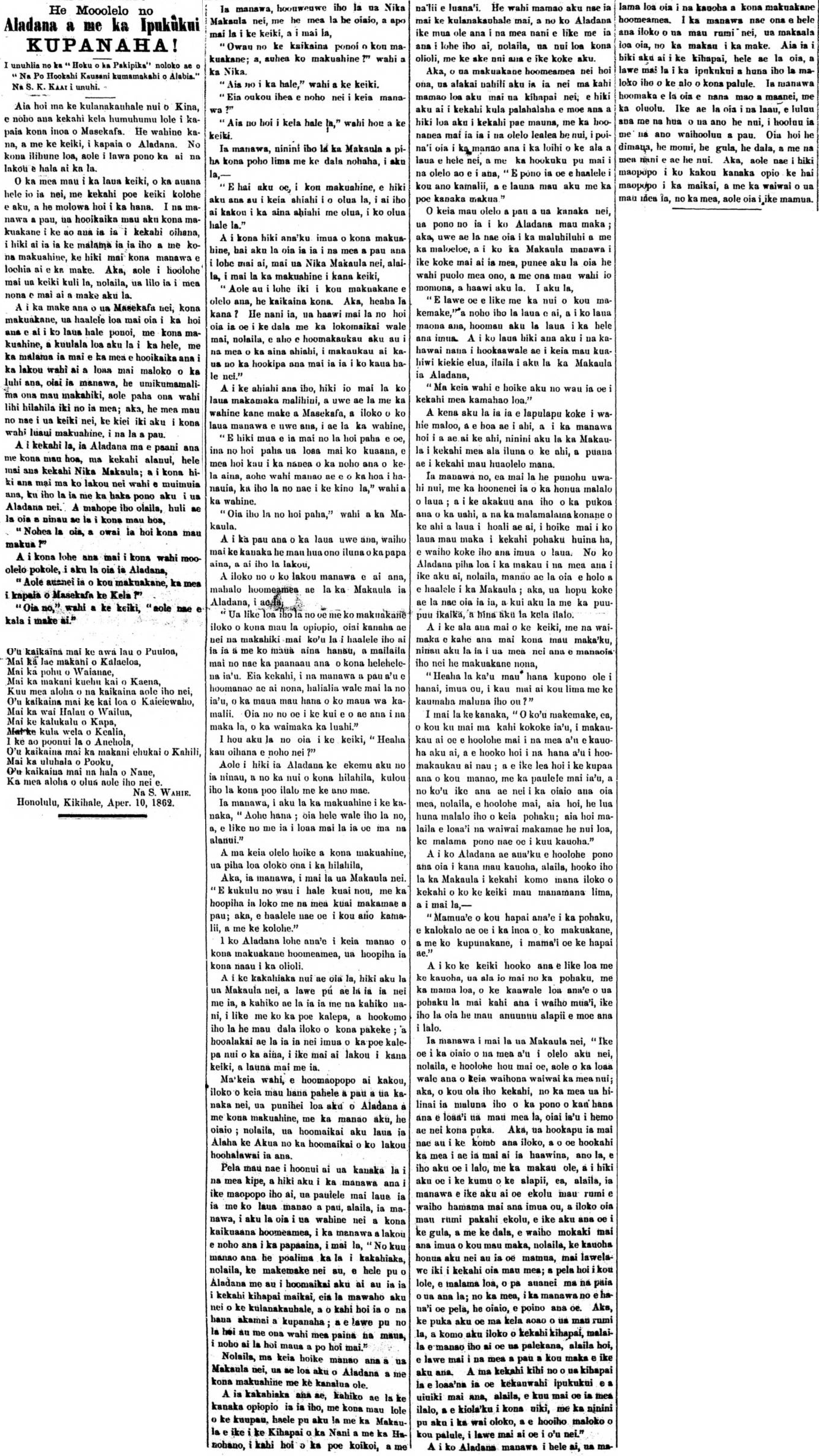
Aia hoi ma ke kulanakauhale nui o Kina, e noho ana kekahi kanaka humuhumu lole i kapaia kona inoa o Masekafa. He wahine kana, a me ke keiki, i  kapaia o Aladana. No kona ilihune loa, aole i lawa pono ka ai na lakou e hala ai ka la.

O ka mea mau i ka laua keiki, o ka auana hele io ia nei, me kekahi poe keiki kolohe e aku, a he molowa hoi i ka hana. I ka manawa a pau, ua hooikaika mau aku kona makuakane i ke ao ana ia ia i kekahi oihana, i hiki ai ia ia ke malama ia ia iho a me kona makuahine, ke hiki mai kona manawa e loohia ai e ka make. Aka, aole i hoolohe mai ua keiki kuli la, nolaila, ua lilo ia i mea nona e mai ai a make aku la…

[Tales from the One Thousand and One Arabian Nights seems to be one of the most often translated selection of stories throughout the life of the Hawaiian-Language Newspapers. This story of Aladdin and the Enchanted Lamp itself appears several times. Does anyone know what Simona K. Kaai based his translation off of? Could he have been translating from the French of Antoine Galland?

This story appears in Hoku o ka Pakipika from 5/1/1862 and concludes on 6/26/1862.]

(Hoku o ka Pakipika, 5/1/1862, p. 1)

He Mooolelo no Aladana a me ka Ipukukui KUPANAHA!

Ka Hoku o ka Pakipika, Buke I, Helu 32, Aoao 1. Mei 1, 1862.

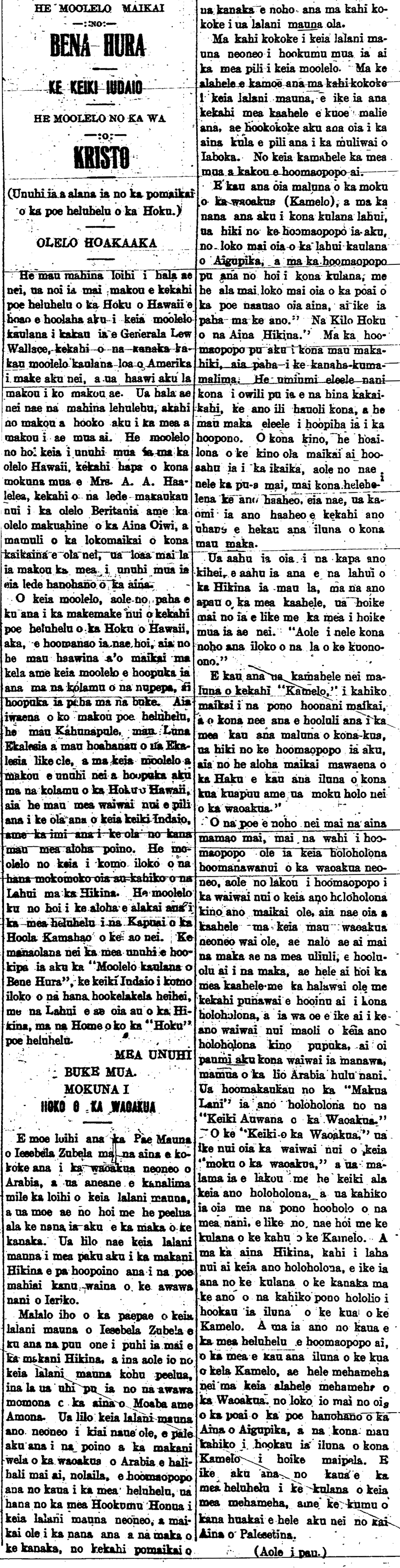
Ben Hur translation, 1913.

FINE STORY
OF

BEN HUR

THE JEWISH BOY

A STORY FROM THE TIME
OF

CHRIST

(Translated and provided for the benefit of the readers of the Hoku.)

INTRODUCTION

Some months past, we were asked by some of the readers of the Hoku o Hawaii if we could try printing the famous story written by General Lew Wallace, one of the very famous authors of America who just died, and we agreed. Many months have gone by and we have only now come through with what we first agreed to do. This is a moolelo which a portion of the beginning chapters were first translated into Hawaiian by Mrs. A. A. Haalelea, one of the ladies who was very adept at English and the mother tongue of the Native Land, and due to the kindness of her younger surviving sister, we have acquired what was translated earlier by this honored lady of this land.

This moolelo will perhaps not be greatly liked by some of the readers of the Hoku o Hawaii, however, let it be considered that there are valuable lessons in every moolelo published in the columns of the newspapers as well as books. Amongst our readers are Pastors, Church Leaders, and brethren of the many Churches, and within this moolelo which we are translating and publishing in the columns of Hoku o Hawaii, there are many very valuable things dealing with the life of this Jewish boy, along with his searching to find a life for his loved ones in distress. This story is one dealing with combat of that ancient times of the People in the East. This moolelo is one of aloha, pointing out to the reader the Steps of the  Wonderful Redeemer of the world. The translator hopes that the “Famous Story of Ben Hur,” the Jewish boy who took part in the glorious races with the other Nations of the time in the East, will be welcomed into the Homes of readers of the Hoku.

FIRST BOOK.
CHAPTER I
IN THE DESERT

E moe loihi ana ka Pae Mauna o Iesebela Zubela ma na aina e kokoke ana i ka waoakua neoneo o Arabia, a ua aneane e kanalima mile ka loihi o keia lalani mauna, a ua moe ae no hoi me he peelua ala ke nana ia aku e ka maka o ke kanaka. Ua lilo nae keia lalani mauna i mea paku aku i ka makani Hikina e pa hoopoino ana i na poe mahiai kanu waina o ke awawa nani o Ieriko.

Malalo iho o ka paepae o keia lalani mauna o Iesebela Zubela e ku ana na puu one i puhi ia mai e ka makani Hikina, a ina aole io no keia lalani mauna kohu peelua, ina la ua uhi pu ia no na awawa momona o ka aina o Moaba ame Amona. Ua lilo keia lalani mauna ano neoneo i kiai naue ole, e pale aku ana i na poino a ka makani wela o ka waoakua o Arabia e halihali mai ai, nolaila, e hoomaopopo ana no kaua i ka mea heluhelu, na hana no ka mea Hookumu Honua i keia lalani mauna neoneo, a maikai ole i ka nana ana a na maka o ke kanaka, no kekahi pomaikai o na kanaka e noho ana ma kahi kokoke i ua lalani mauna ola…

[Lew Wallace’s “Ben-Hur: A Tale of Christ” was translated by MEA UNUHI MOOLELO, “Translator of Stories,” in Hoku o Hawaii from 2/20/1913 to 7/4/1918. Unfortunately, the issues from the beginning (1913) until the early months of 1917 of the Hoku o Hawaii are still not available online.]

(Hoku o Hawaii, 2/20/1913, p. 1)

HE MOOLELO MAIKAI NO BENA HURA

Hoku o Hawaii, Buke 7, Helu 38, Aoao 1. Feberuari 20, 1913.

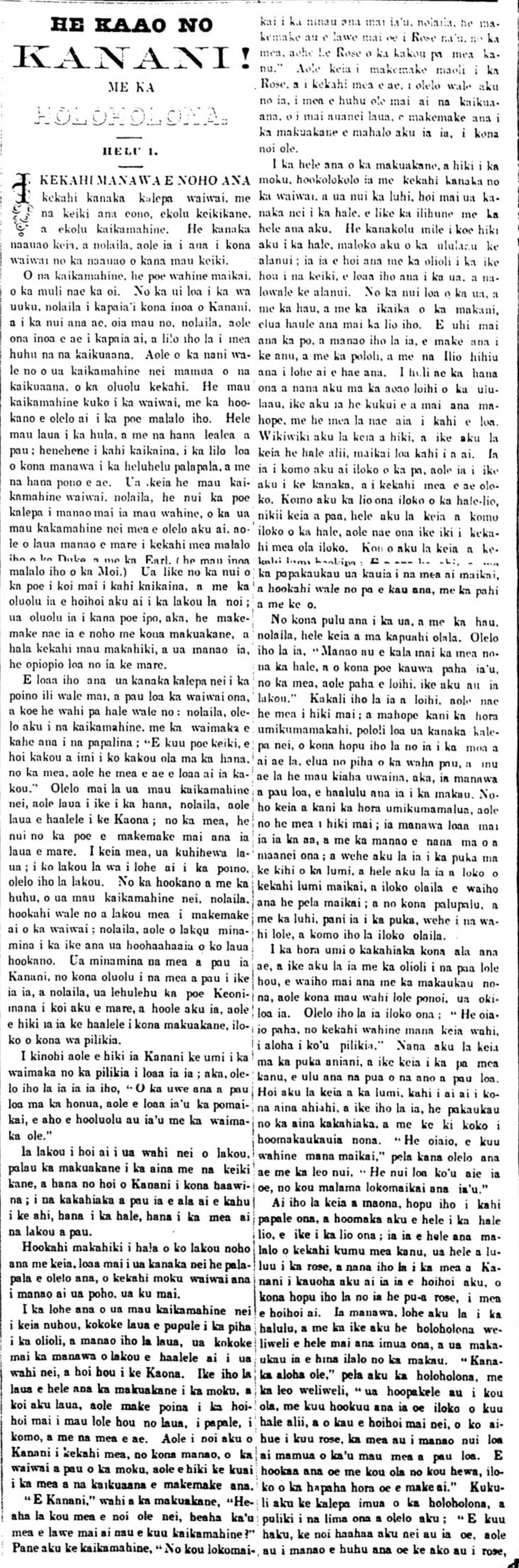
Beauty and the Beast, 1862.

HE KAAO NO
KANANI!
ME KA
HOLOHOLONA.

HELU 1.

I KEKAHI MANAWA E NOHO ANA kekahi kanaka kalepa waiwai, me na keiki ana eono, ekolu keikikane, a ekolu kaikamahine. He kanaka naauao keia, a nolaila, aole ia i aua i kona waiwai no ka naauao o kana mau keiki.

O na kaikamahine, he poe wahine maikai, o ka muli nae ka oi. No ka ui loa i ka wa uuku, nolaila i kapaia’i kona inoa o Kanani, a i ka nui ana ae, oia mau no, nolaila, aole ona inoa e ae i kapaia ai, a lilo iho la i mea huhu na na kaikuaana. Aole o ka nani wale no o ua kaikamahine nei mamua o na kaikuaana, o ka oluolu kekahi. He mau kaikamahine kuko i ka waiwai, me ka hookano e olelo ai i ka poe malalo iho. Hele mau laua i ka hula, a me na hana lealea a pau; henehene i kahi kaikaina, i ka lilo loa o kona manawa i ka heluhelu palapala, a me na hana pono e ae. Ua ikeia he mau kaikamahine waiwai, nolaila, he nui ka poe kalepa i manao mai ia mau wahine, o ka ua mau kakamahine nei mea e olelo aku ai, aole o laua manao e mare i kekahi mea malalo iho o ke Duke a me ka Earl, (he mau inoa malalo iho o ka Moi.) Ua like no ka nui o ka poe i koi mai i kahi kaikaina, a me ka oluolu ia e hoihoi aku ai i ka lakou la noi; ua oluolu ia i kana poe ipo, aka, he makemake nae ia e noho me kona makuakane, a hala kekahi mau makahiki, a ua manao ia, he opiopio loa no ia ke mare…

[Jeanne-Marie LePrince de Beaumont’s “Beauty and the Beast” was translated in the Kuokoa from 4/12/1862 to 4/26/1862 by J. W.]

(Kuokoa, 4/12/1862, p. 1–2)

HE KAAO NO KANANI! ME KA HOLOHOLONA.

Ka Nupepa Kuokoa, Buke I, Helu 20, Aoao 1. Aperila 12, 1862.

na kekahi o au mau kaikamahine...

Ka Nupepa Kuokoa, Buke I, Helu 20, Aoao 2. Aperila 12, 1862.

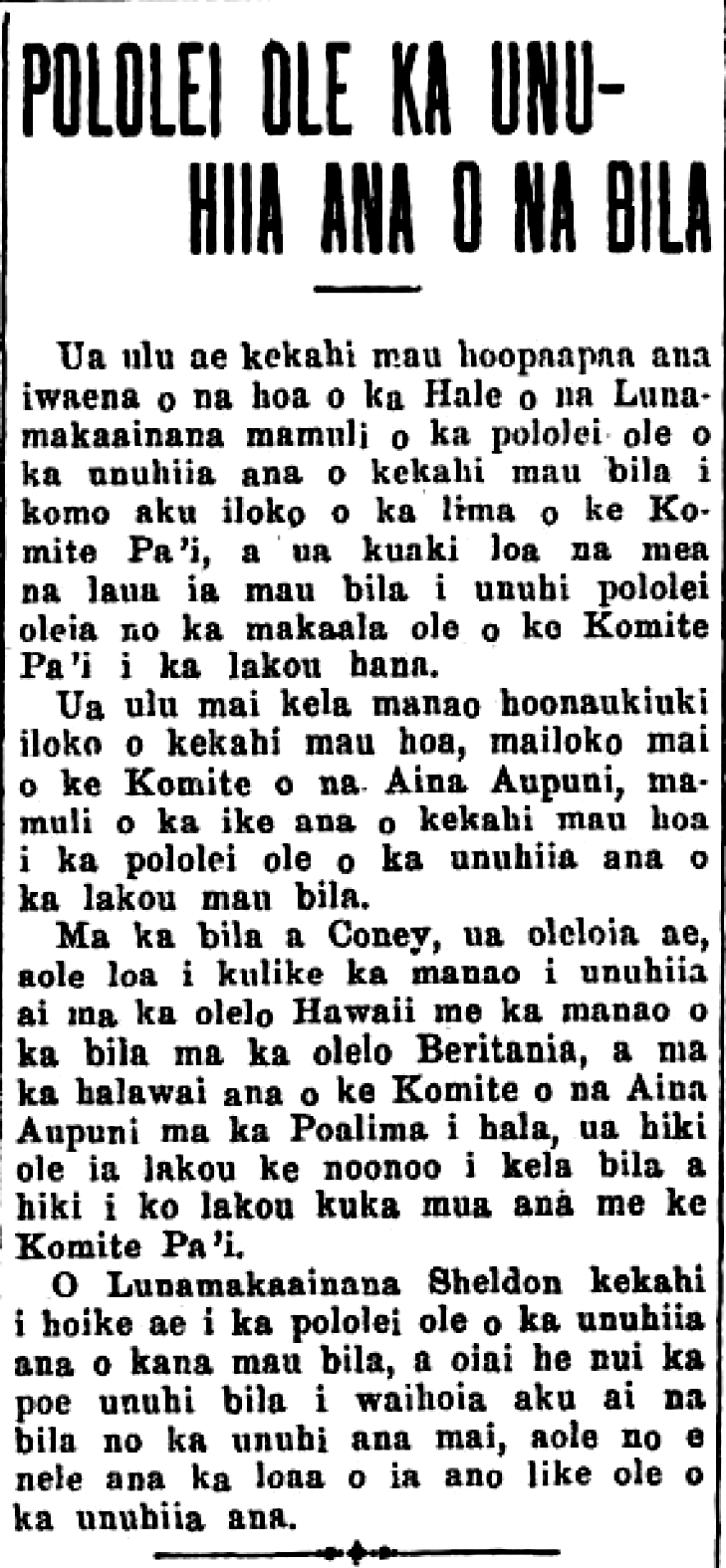
More on translations, 1909.

TRANSLATIONS OF BILLS ARE NOT CORRECT

Altercations arose between members of the House of Representatives over the incorrect translations of bills which were placed in the hands of the Publication Committee [Komite Pa’i], and the two from whom the incorrectly translated bills originated were upset at the inattentiveness of the Publication Committee in their work.

This anger of some of the members originated with the Public Lands Committee [Komite o na Aina Aupuni], because some of the members noticed the incorrect translation of their bills.

For the bill of Coney, it is said that the translation in Hawaiian is not at all like the idea of the bill in English, and at the meeting of the Committee on Public Lands on this past Friday, they could not consider that bill until they consult with the Publication Committee.

Representative Sheldon was one who made known the incorrect translation of his bills, and being that there are many bill translators with whom the bills were left with for translations, there will be no shortage of those types of divergent translations.

(Kuokoa, 3/5/1909, p. 1)

POLOLEI OLE KA UNUHIIA ANA O NA BILA

Ka Nupepa Kuokoa, Buke XLVI, Helu 10, Aoao 1. Maraki 5, 1909.

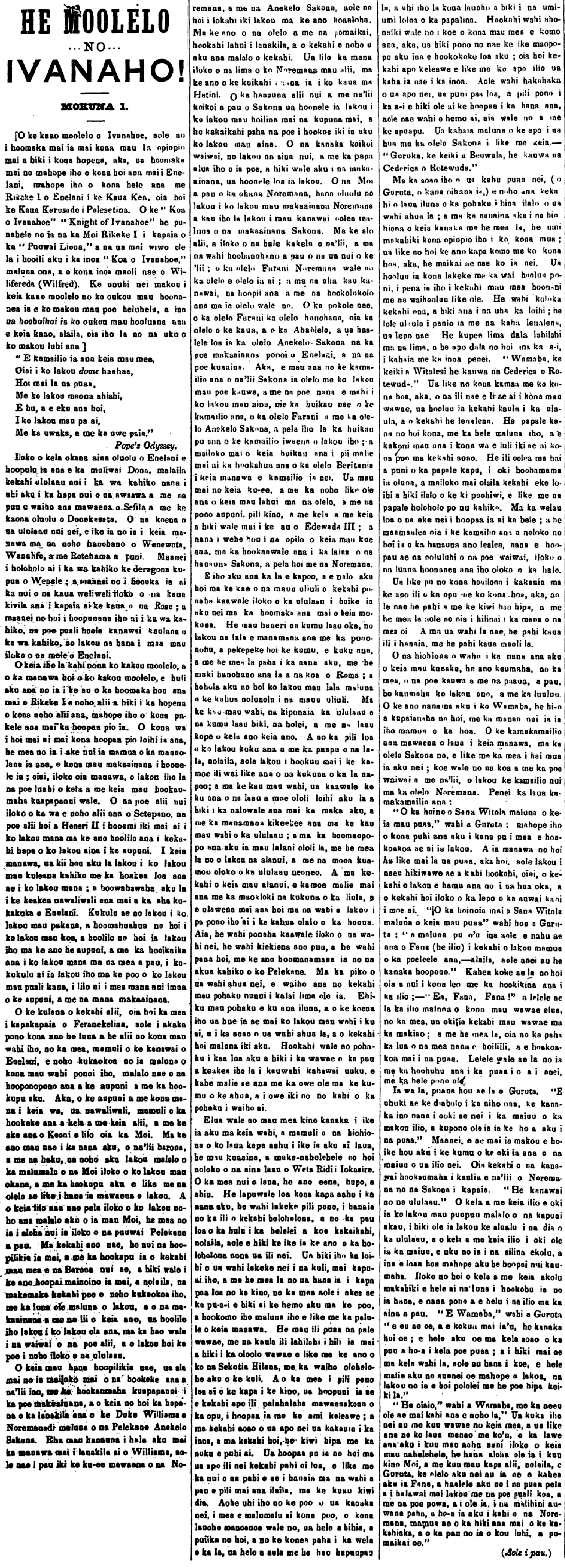
Ivanhoe! 1871.

A MOOLELO
OF
IVANHOE!

CHAPTER 1.

The kaao moolelo of Ivanhoe does not begin from his youth until the end, but it begins after his return to England right after he goes with Richard I of England on the Crusades “War of the Cross,” that being the Crusades in Palestine. The Knight of Ivanhoe was a favorite of King Richard I, called the “Lion Hearted,” and it was that fearless king who gave him the name “Knight of Ivanhoe,” but his real name was Wilfred. We are translating this kaao moolelo for your entertainment, our readers, and should your association with this story be made enjoyable, then that is payment for our labors.]

“E kamailio ia ana keia mau mea,
Oiai i ko lakou dome haahaa,
Hoi mai la na puaa,
Me ko lakou maona ahiahi,
E hu, a e eku ana hoi,
I ko lakou mau pa ai,
Me ka uwaka, a me ka uwe paia.”

Pope’s Odyssey.

Iloko o kela okana aina oluolu o Enelani e hoopulu ia ana e ka muliwai Dona, malaila kekahi ululaau nui i ka wa kahiko nana i uhi aku i ka hapa nui o na awaawa a me na puu e waiho ana mawaena o Sefila a me ke kaona oluolu o Donekesata. O na koena o ua ululaau nui nei, e ike ia no ia i keia manawa ma na noho hanohano o Wenewota, Wanalife, a me Rotehama a puni. Maanei i holoholo ai i ka wa kahiko ke deragona kupua o Wenale; a maanei no i hoouka ia ai ka nui o na kaua weliweli iloko o na kaua kivila ana i kapaia ai ke kaua o na Rose; a maanei no hoi i hoopunana iho ai i ka wa kahiko, na poe puali hoole kanawai kaulana o ka wa kahiko, no lakou na hana i maa mau iloko o na mele o Enelani…

[“Ivanhoe” by Sir Walter Scott is found in Au Okoa from 2/9/1871 until 8/29/1872.  The story is almost completed. Unfortunately, the issue that the last section of the story would have appeared in (9/5/1871) is missing the last two pages! The Ivanaho translation usually appeared on the fourth page of each issue. There are many missing pages and issues and volumes of Hawaiian-Language Newspapers, hopefully someday they will be found, if not in Hawaii, then somewhere across the ocean. Hawaiians lived all over the world, and they had the papers sent to them so that they would not lose touch with the sands of their birth…]

(Au Okoa, 2/9/1871, 4)

HE MOOLELO NO IVANAHO!

Ke Au Okoa, Buke VI, Helu 43, Aoao 4. Feberuari 9, 1871.