A protest by the United States of America, 1843.

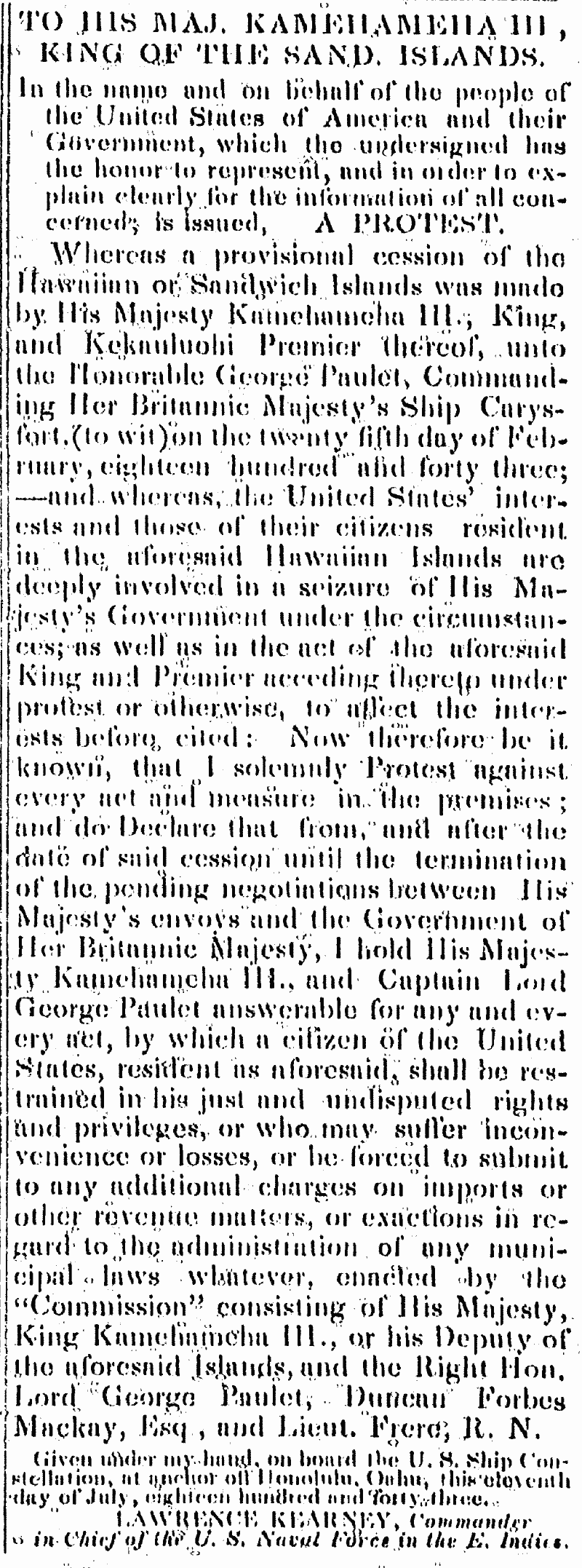
TO HIS MAJ. KAMEHAMEHA III, KING OF THE SAND. ISLANDS.

In the name and on behalf of the people of the United States of America and their Government, which the undersigned has the honor to represent, and in order to explain clearly for the information of all concerned, is issued, A PROTEST.

Whereas a provisional cession of the Hawaiian or Sandwich Islands was made by His Majesty Kamehameha III., King, and Kekauluohi Premier thereof, unto the Honorable George Paulet, Commanding Her Britannic Majesty’s Ship Carysfort, (to wit) on the twenty fifth day of February, eighteen hundred and forty three;—and whereas, the United States’ interests and those of their citizens resident in the aforesaid Hawaiian Islands are deeply involved in a seizure of His Majesty’s Government under the circumstances; as well as in the act of the aforesaid King and Premier acceding thereto under protest or otherwise, to affect the interests before cited: Now therefore be it known, that I solemnly Protest against every act and measure in the premises; and do Declare that from, and after the date of said cession until the termination of the pending negotiations between His Majesty’s envoys and the Government of Her Britannic Majesty, I hold His Majesty Kamehameha III., and Captain Lord George Paulet answerable for any and every act, by which a citizen of the United States, resident as aforesaid, shall be restrained in his just and undisputed rights and privileges, or who may suffer inconvenience or losses, or be forced to submit to any additional charges on imports or other revenue matters, or exactions in regard to the administration of any municipal laws whatever, enacted by the “Commission” consisting of His Majesty, King Kamehameha III., or his Deputy of the aforesaid Islands, and the Right Hon. Lord George Paulet, Duncan Forbes Mackay, Esq., and Lieut. Frere, R. N.

Given under my hand, on board the U. S. Ship Constellation, at anchor off Honolulu, Oahu, this eleventh day of July, eighteen hundred and forty three.

LAWRENCE KEARNEY, Commander in Chief of the U. S. Naval Force in the E. Indies.

(Nonanona, 7/25/1843, p. 21)
TO HIS MAJ. KAMEHAMEHA III., KING OF THE SAND. ISLANDS.

Ka Nonanona, Buke 3, Pepa 5, Aoao 21. Iulai 25, 1843.

Palapala hoole na Amerika Huipuia, 1843.

NA KAMEHAMEHA III., KE LII O KO HAWAII NEI PAE AINA.

Ma ka inoa, a ma ka aoao hoi o na kanaka o Amerika Huipuia a me ko lakou aupuni, (owau, ka mea i kakauia ka inoa malalo, he luna au no ia aupuni) a i mea hoi e hoakaka aku i na kanaka a pau i kuleana ma keia mea, ua hoopukaia’ku nei,

KEIA PALAPALA HOOLE.

No ka hoolilo ana o Kamehameha III, ke alii, a me Kekauluohi ke kuhina, i keia pae aina o Hawaii nei ia George Paulet, kapena o ka moku Beritania, Carysfort, ma ka la 25 o Feberuari, 1843; a no ka owiliia hoi o ka waiwai a me na hana a ko Amerika poe noho maanei, i loko o ia kaili ana o keia aupuni, a iloko hoi o ia hana a ke alii, a me ke kuhina, ma ia hoolilo ana, (me ka hoole paha, me ka ole paha)—

Nolaila, ke hoike aku nei au i keia: Ke hoole ikaika aku nei au i keia mau hana a pau.

Eia hoi ka’u e hai aku ai: Mai ka la ma i lilo ai keia aupuni a hiki i ka wa e pau ai ka hana pu ana a na luna o Kamehameha III, me ko Beritania aupuni, maluna o Kamehameha III, a me Kapena Haku George Paulet e kau ai ka hewa o kela hana, keia hana e poho ai ka pono akaka o ko Amerika poe e noho nei i keia pae aina. [O laua no ke hewa] ina paha e keakeaia ke kahi kanaka o Amerika Huipuia, a ina paha e poho ko lakou waiwai, a ina paha e koiia lakou e uku i dute hooi ma ka waiwai i laweia mai, a ma na mea e paha o ke aupuni, a ina paha e hooukuia lakou ma ka hooko ana i kekahi o na kanawai a pau i hanaia e “ka poe luna Beritania,” oia hoi ke alii, Kamehameha III, a o kona pani hakahaka paha, a me Haku George Paulet, a me Duncan Forbes Mackay Esquire, a me Lieutenant Frere, no ka manuwa Beritania.

Hanaia keia ma kuu lima maluna o ka moku manuwa o Amerika Huipuia, o Constellation ka inoa, a ke ku nei ia mawaho, ma Honolulu (Oahu.) i keia la umikumamakahi o Iulai, 1843.

LAWRENCE KEARNY, aliii nui maluna o na manuwa a pau o Amerika Huipuia ma Asia.

(Nonanona, 7/25/1843, p. 21)

NA KAMEHAMEHA III., KE LII O KO HAWAII NEI PAE AINA.

Ka Nonanona, Buke 3, Pepa 3, Aoao 21. Iulai 25, 1843.

The “Kearny Cloak” at Tiffany & Co., 1893.

THE WAR CLOAK OF KAMEHAMEHA I.

AN INTERESTING HAWAIIAN RELIC TO BE SEEN IN THIS CITY.

The recent proposed annexation of the Sandwich Islands has revived much forgotten lore concerning the people of Hawaii and their history, and nothing perhaps is more interesting than specimens of the handiwork of this semi-barbarous people who possessed certain arts for ingenuity and patient labor that cannot be equalled by the boasted civilization of the nineteenth century. In Tiffany & Co.’s window, in Union Square, there is on exhibition for a few days a feather war cloak or namo, once the property of Hawaii’s giant King, Kamehameha I (The Lonely One), which tradition says cost the labor of several generations of skilled workers. The body consists of a fine network of homespun cord, make from the native hemp or olona, the meshes of which vary from an eight to a thirty-second of an inch; over this is laid the feather-work in small bunches of three or four feathers each, tied with a minute thread highly twisted, made from the same fibre. The cloak is almost semicircular in shape, and cut to fit in at the neck. The meshwork being made in sections of various shapes, allows it, when placed on a tall man’s shoulders, to fall in graceful lines about his body. Continue reading

Warships, 1843.

SIX MEN-OF-WAR

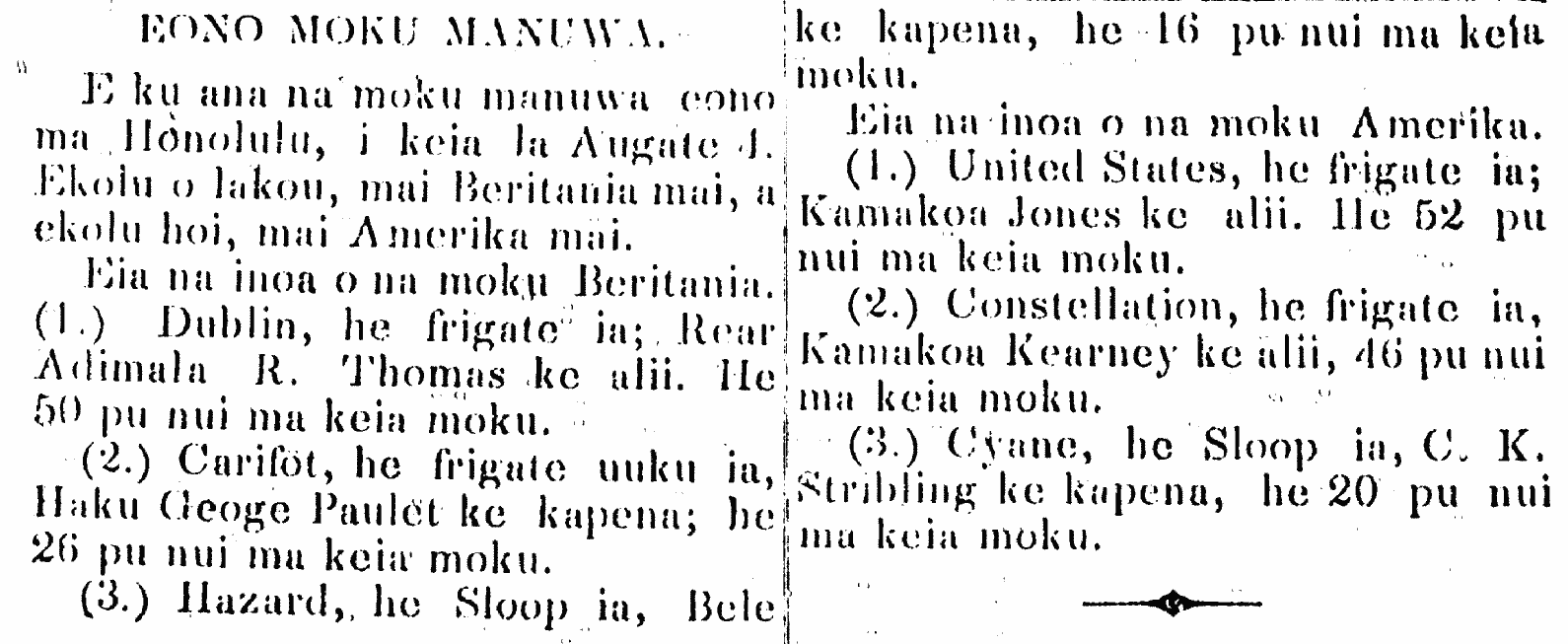
There are six men-of-war [manuwa] docked in Honolulu, on this day, the 4th of August. Three of them are from Britain, and three are from America.

Here are the names of the British ships. (1.) Dublin, a frigate; Rear Admiral R. Thomas is the officer. The ships has 50 cannons.

(2.) Carysfort is a small frigate; its captain is Lord George Paulet; this ship has 26 cannons.

(3.) Hazard is a Sloop; Bell is the captain, and it has 16 cannons.

These are the names of the American ships.

(1.) United States is a frigate; Commodore Jones is the officer. The ship has 52 cannons.

(2.) Constellation is a frigate; Commodore Kearney is the officer; it has 46 cannons.

(3.) Cyane is a Sloop; its captain is C. K. Stribling; it has 20 cannons.

(Nonanona, 8/8/1843, p. 29)

EONO MOKU MANUWA.

Ka Nonanona, Buke 3, Pepa 6, Aoao 29. Augate 8, 1843.

Translation of Henryk Sienkiewicz’s “Quo Vadis,” 1918.

A STORY OF THE

LADY LYGIA

AND

VINICIUS

THE PATRICIAN OF ROME

———

A STORY OF THE BATTLE

OF THE RIGHTEOUSNESS OF

CHRISTIANITY

AGAINST THE PERSECUTION OF

Emperor Nero

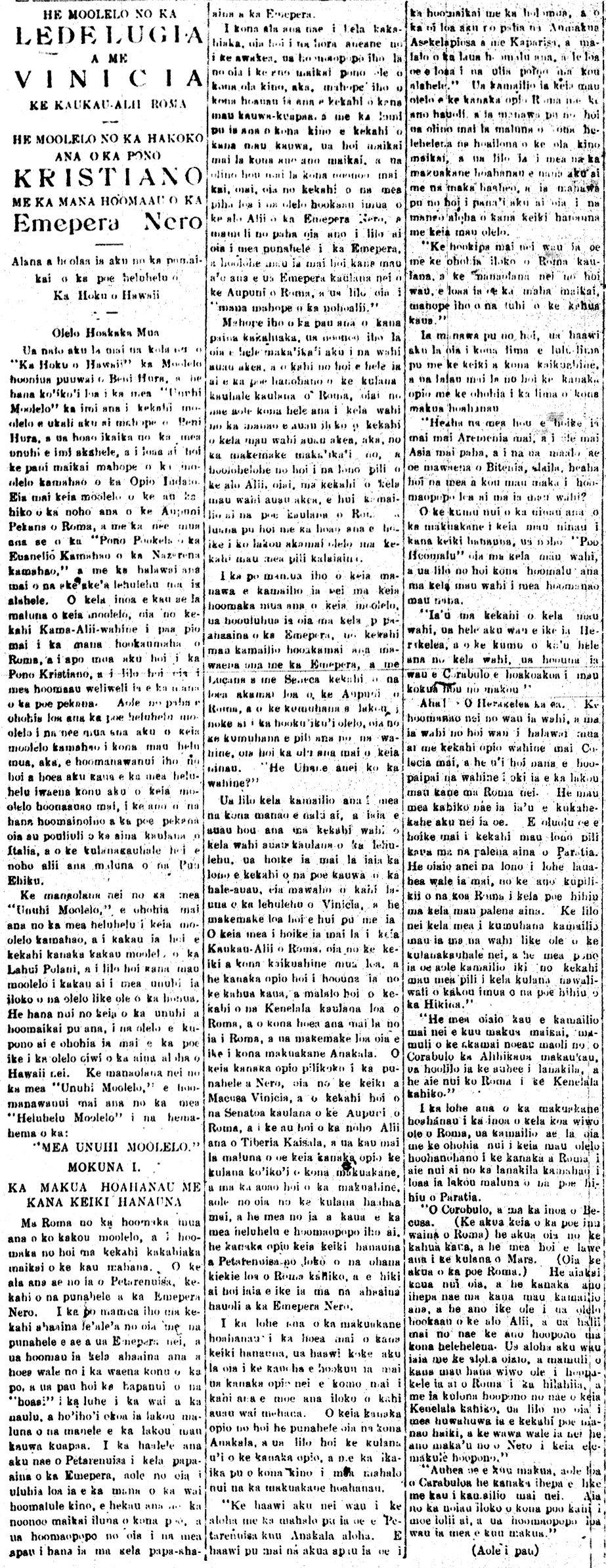
Offered and dedicated to the benefit of the readers of Ka Hoku o Hawaii.

[This is another translation of a major work found in the Hoku o Hawaii. I have no idea if this was translated from English or the original “Quo Vadis” by Henryk Sienkiewicz. It runs from 7/11/1918 to 4/10/1924!]

(Hoku o Hawaii, 7/11/1918, p. 1)

HE MOOLELO NO KA LEDE LUGIA A ME VINICIA KE KAUKAU-ALII O ROMA

Ka Hoku o Hawaii, Buke 12, Helu 6, Aoao 1. Iulai 11, 1918.


The Kawaihau Glee Club, 1904.

[Found under: “SOCIETY”]

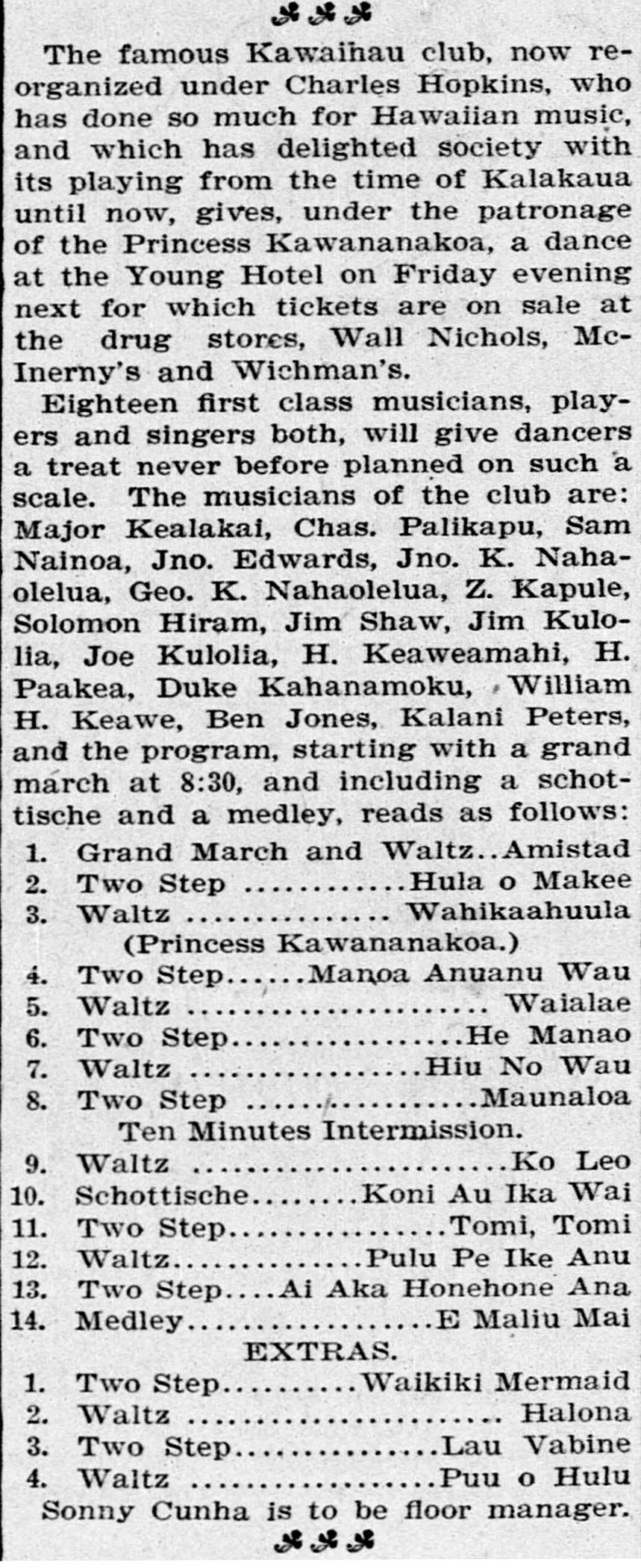
The famous Kawaihau club, now reorganized under Charles Hopkins, who has done so much for Hawaiian music, and which has delighted society with its playing from the time of Kalakaua until now, gives, under the patronage of the Princess Kawananakoa, a dance at the Young Hotel on Friday evening next for which tickets are on sale at the drug stores, Wall Nichols, McInerny’s and Wichman’s.

Eighteen first class musicians, players and singers both, will give dancers a treat never before planned on such a scale. The musicians of the club are: Major Kealakai, Charles Palikapu, Sam Nainoa, John Edwards, John K. Nahaolelua, George K. Nahaolelua, Z. Kapule, Solomon Hiram, Jim Shaw, Jim Kulolia, Joe Kulolia, H. Keaweamahi, H. Paakea, Duke Kahanamoku, William H. Keawe, Ben Jones, Kalani Peters, and the program starting with a grand march at 8:30, and including a schotische and medley, reads as follows:

1.  Grand March and Waltz ….. Amistad
2.  Two Step ….. Hula o Makee
3.  Waltz ….. Wahikaahuula (Princess Kawananakoa)
4.  Two Step ….. Manoa Anuanu Wau
5.  Waltz ….. Waialae
6.  Two Step ….. He Manao
7.  Waltz ….. Hiu No Wau
8.  Two Step ….. Maunaloa

Ten Minutes Intermission.

9.  Waltz ….. Ko Leo
10. Schottische ….. Koni Au Ika Wai
11.  Two Step ….. Tomi, Tomi
12.  Waltz ….. Pulu Pe Ike Anu
13.  Two Step ….. Ai Aka Honehone Ana
14.  Medley ….. E Maliu Mai

EXTRAS.

1.  Two Step ….. Waikiki Mermaid
2.  Waltz ….. Halona
3.  Two Step ….. Lau Vabine
4.  Waltz ….. Puu o Hulu

Sonny Cunha is to be floor manager.

(Pacific Commercial Advertiser, 6/19/1904, p. 6)

The famous Kawaihau club...

Sunday Advertiser, Volume II, Number 77, Page 6. June 19, 1904.

Princess Kaiulani proclaimed heir to the crown, 1891.

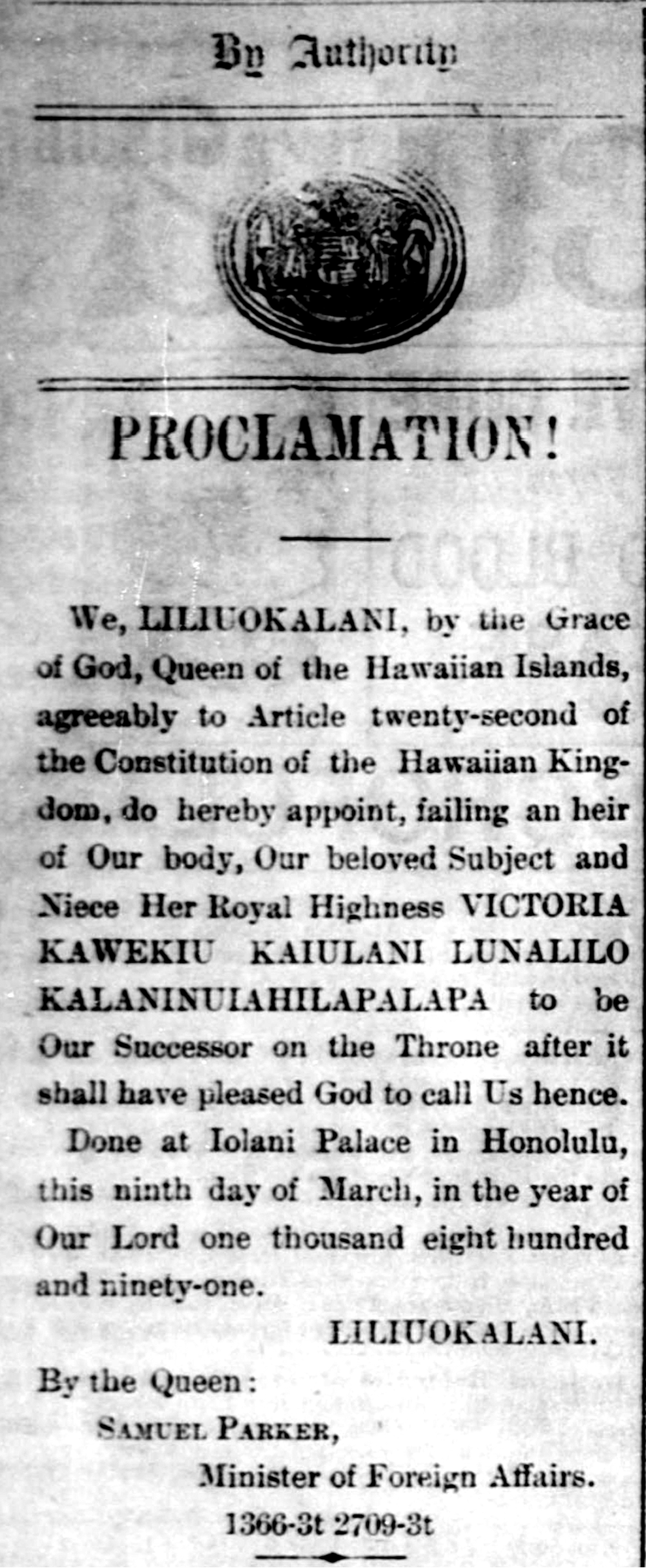
By Authority

PROCLAMATION!

We, LILIUOKALANI, by the Grace of God, Queen of the Hawaiian Islands, agreeably to Article twenty-second of the Constitution of the Hawaiian Kingdom, do hereby appoint, failing an heir of Our body, Our beloved Subject and Niece Her Royal Highness VICTORIA KAWEKIU KAIULANI LUNALILO KALANINUIAHILAPALAPA to be Our Successor on the Throne after it shall have pleased God to call Us hence.

Done at Iolani Palace in Honolulu, this ninth day of March, in the year of Our Lord one thousand eight hundred and ninety-one.

LILIUOKALANI.

By the Queen:

Samuel Parker,

Minister of Foreign Affairs.

[Sometimes there are typesetting errors in newspapers, which is why important numbers are often given in numeric form as well as in words. The Hawaiian proclamation found in the Leo o ka Lahui only used the numeric form of the date, and the typesetter seems to have flipped the “9” over.]

(Hawaiian Gazette, 3/17/1891, p. 4)

By Authority

Hawaiian Gazette, Volume XXVI, Number 11, Page 4. March 17, 1891.

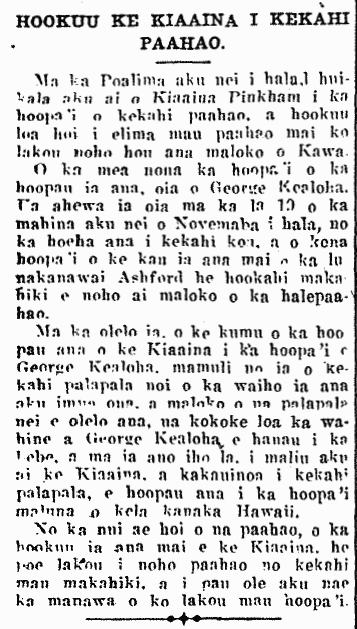
Pardons granted by Governor Pinkham, 1915.

GOVERNOR PARDONED A PRISONER.

This past Friday, Governor Pinkham forgave the punishment of a prisoner, and released for good five convicts from their imprisonment at Kawa.

The one who was pardoned was George Kealoha. He was found guilty on the 10th of this past month, November, for injuring a soldier, and the sentence he received from Judge Ashford was one year in prison.

From what was said, the reason for that the Governor ended the sentence of George Kealoha was because of a plea put before him, and in this document, it said that the wife of George Kealoha was very close to giving birth, and therefore, the Governor listened and signed his name to a document to end the sentence of that Hawaiian man.

Because of the many prisoners, they were released by the Governor; they were people who were imprisoned for some years but yet did not serve out their sentence.

(Kuokoa, 3/5/1915, p. 1)

HOOKUU KE KIAAINA I KEKAHI PAAHAO.

Ka Nupepa Kuokoa, Buke LIII, Helu 10, Aoao 1. Maraki 5, 1915.

Translation of H. Rider Haggard’s, “Morning Star,” 1910.

THE HEART-STIRRING TALE

—:OF:—

THE MORNING STAR

—AND—

RAMSES HER BELOVED SWEETHEART

“The Heir of Pharoah
The Favorite of Amen-Rah
The Proud Beauty of Egypt
The Darling of Her People.”

An Old Story from Egypt.
(Translated for the Hoku o Hawaii.)

Introduction.

We are printing this famous story of the Kingdom of Egypt. And it was near the time when Moses was living in Egypt. It is a story of speaking of the religion of that ancient people, and a story of their Chiefly kapu intertwined with their Godly kapu.

We published before our readers some years ago stories of our own Alii of ancient times of our land, and Tales of Hawaii which are nearly not remembered by the  current people of these times, and through this story which we are sharing with our readers, they will see some things about that ancient people of the land in the east. It is toilsome to translate these stories for the benefit of the people who enjoy reading stories in the Hoku. And from the Hoku, we lovingly urge its readers to please remember the life of this Hoku of ours. Printing a newspaper is very costly, and its existence and progress is reliant upon its readers.

We hope that some of the subscribers of the Hoku who are delinquent in their payments to the life of the Hoku will be moved with aloha, and they will make their payment towards the life of this patient servant.

Forgive us for these words that are not related to our story, however, “Ears do not get filled up with words.” And it is our responsibility to call out with aloha to our readers who have not paid their subscription, for the good of the newspaper to print educational stories and wise discussions of this new age.

[That was the introduction by the Hoku o Hawaii newspaper to their translation of the story, “The Morning Star” by H. Rider Haggard, which was printed just earlier that year in 1910. It ran in the weekly Hoku from March 17, 1910 to February 1, 1912.

It would be a cool thing if immersion students were introduced to old translations like these. They could see what kind of vocabulary and turns of phrase that were common during the period. I realize that trying to get through a novel in this format is tiresome and tedious, and I am considering reformatting a story (in the original orthography so that students can get more practice at reading material as they were presented in the newspapers) so that it reads continuously as a book. However, I am not sure if immersion teachers or students out there think that it would be beneficial. Perhaps it is already being done.]

(Hoku o Hawaii, 3/17/1910, p. 1)

HE MOOLELO HOONIUA PUUWAI NO KA HOKU KAKAHIAKA

Ka Hoku o Hawaii, Buke IV, Helu 46, Aoao 1. Maraki 17, 1910.

Isaac Testa dies, 1909.

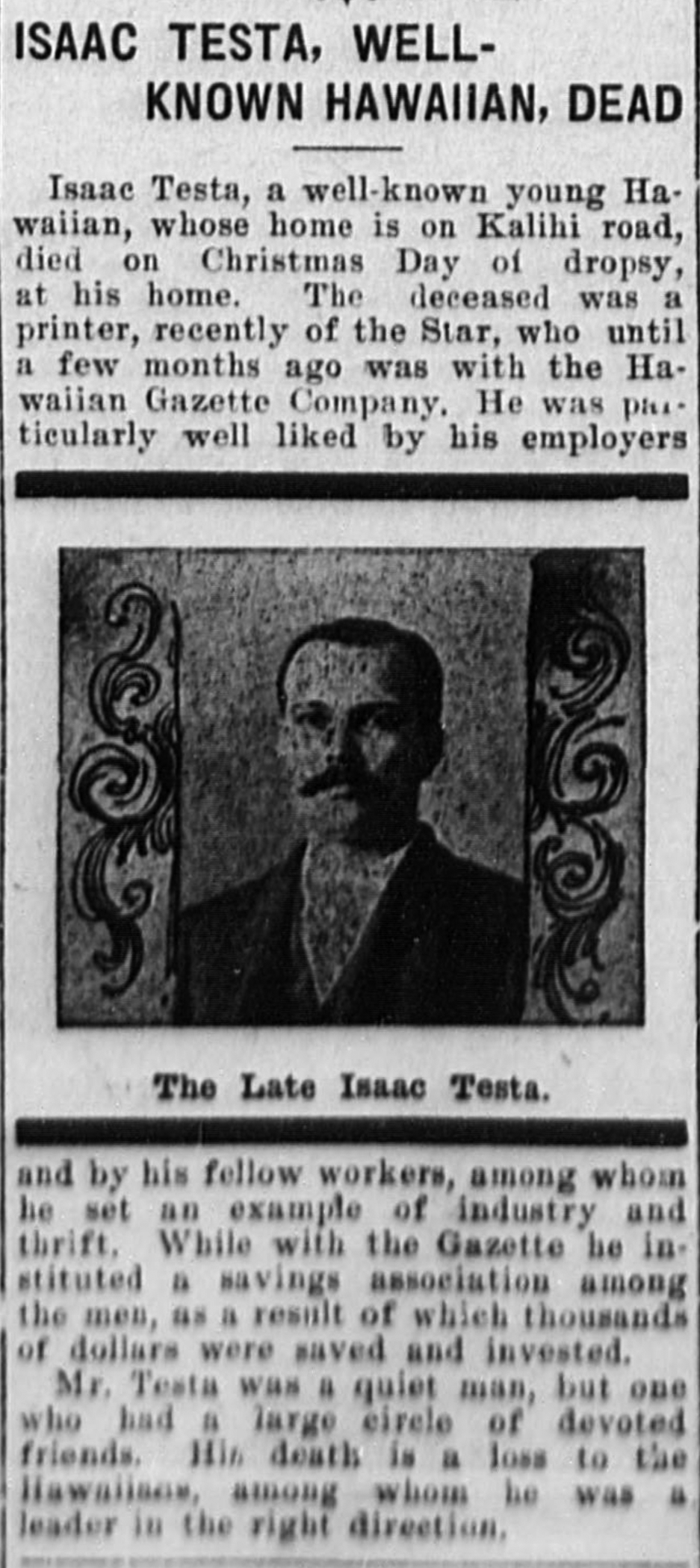
ISAAC TESTA, WELL-KNOWN HAWAIIAN, DEAD

Isaac Testa, a well-known young Hawaiian, whose home is on Kalihi road, died on Christmas Day of dropsy, at his home. The deceased was a printer, recently of the Star, who until a few months ago was with the Hawaiian Gazette Company. He was particularly well liked by his employers…

The Late Isaac Testa.

…and by his fellow workers, among whom he set an example of industry and thrift. While with the Gazette he instituted a savings association among the men, as a result of which thousands of dollars were saved and invested.

Mr. Testa was a quiet man, but one who had a large circle of devoted friends. His death is a loss to the Hawaiians, among whom he was a leader in the right direction.

[It seems that this is the son of the sister of Hoke (Francisco Jose Testa).]

(Hawaiian Gazette, 12/28/1909, p. 3)

ISAAC TESTA, WELL-KNOWN HAWAIIAN, DEAD

Hawaiian Gazette, Volume LII, Number 104, Page 3. December 28, 1909.