Heiau descriptions, lost for now, 1883.

SOME HEIAU OF OLD.

Earlier, some old temples of Hawaii were introduced: their description, and where they stand.

There are a number of old heiau standing in North Kohala. Mokini [Mookini] is the name of one of them in Kohala Waho, standing atop a flat base in Puuepa; it is a beautiful structure.

This heiau, according to its history, was built by the many and multitudes of gods and the menehune, that according to the natives who live there; the stones used to build it are from Pololu, and the menehune stood in a line all the way to Pololu; this heiau was built at night.

It faces the southwest, facing directly at the point of Upolu; some parts of the front enclosure have fallen, [???] are at the northwest, this heiau stands alone in a bare area, the land is level, and it has stood for centuries.

The second heiau is [Muleiula?], this heiau is located [???] Awaeli, its base is very flat like that of the earlier one, so too is the base of this one.

This heiau was erected by Hua, the one for whom is said, “The bones of Hua are dried in the sun,” [???] this heiau when he went [???] in the cliffs of Pololu, and [???] is called the cliffs of Kamakaohua.

The third heiau is named [Ku???], it is at [Maka???]; this heiau is very near to [???] at the harbor of Keokea; this heiau is like the earlier ones spoken of before, the purpose of this heiau was for agriculture, according to its history.

These heiau [???] multitudes of idol gods worshiped by the people of old, and they believed there was no other god.

In these modern days, [???] who are worshiping the idol gods of the old days? Here [???] children of men [???] in [???] and those hearts are full of idolatry.

[There are so many articles like these that are partially or totally illegible without going back to the original newspapers.

If made “word searchable” as is:

Ke kolu o na heiau, o Ku@@@@ ka inoa, aia keia heiau ma Maka@@@@@@@@ kokoke loa keia heiau i kanaka@@@@@@@@ ma ke awa ku moku o Keokea @@@@@@@@ ke keia heiau me na @@@@@ mua @@@@@@@ ia ae nei, o ka hana o keia heiau @@@@@ hooulu mea ai, wahi a ka moolelo.

The most logical thing to do would be to take new and clear images of the papers all together, so that each time someone is interested in a partial article like this one, they will not need to flip through the fragile originals just so they can see one page.]

(Kuokoa, 11/4/1883, p. 1)
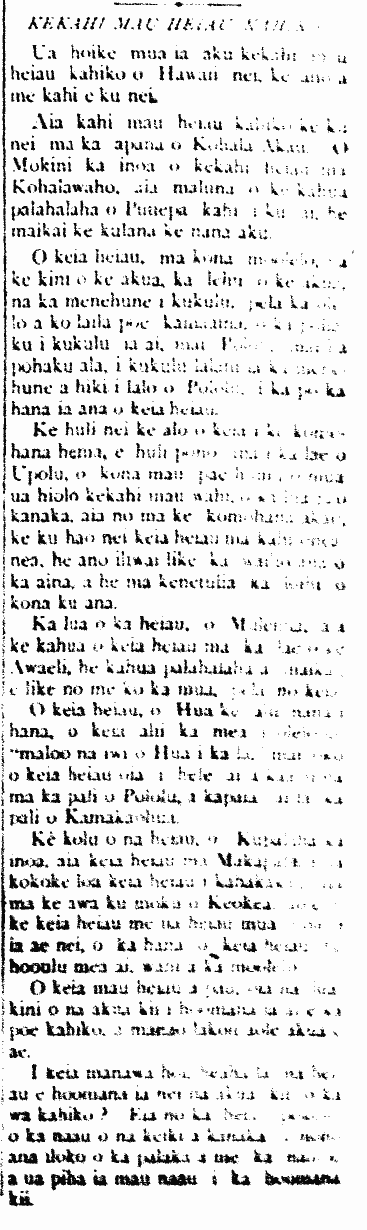
KEKAHI MAU HEIAU KAHIKO.

Ka Nupepa Kuokoa, Buke XXII, Helu 44, Aoao 1. Novemaba 4, 1883.

Maori in Hawaii, 1912.

A New Zealand Theater Group.

A New Zealand theater troupe under the leadership of Ara, a man from the Maori people who performs astonishing acts, arrived in Honolulu. After they left their own land, they visited the lands of the South: New Guinea, Fiji, Samoa, the Solomon Islands, and then arrived here. They are taking beautiful shots of Hawaii nei, and when they perform, they have some nice scenes of these islands.

They will also show some pictures of New Zealand, the lifestyle of the Maori, the Hot Volcanic Springs, Palorous Jack [Pelorus Jack], that astonishing piloting fish that guides the way before sailboats when they enter into the harbor of Wellington, and for which a law was made protecting its life, as well as some other lovely pictures of New Zealand. One day in March, they will hold their performance at the Hale Mele Hou [Opera House].

(Aloha Aina, 2/17/1912, p. 1)

HE PUALI KEAKA NU KILANI.

Ke Aloha Aina, Buke XVI, Helu 7, Aoao 1. Feberuari 17, 1912.

More from Kalaupapa, 1912.

A REMEMBRANCE OF THE ONE WHO HAS GONE.

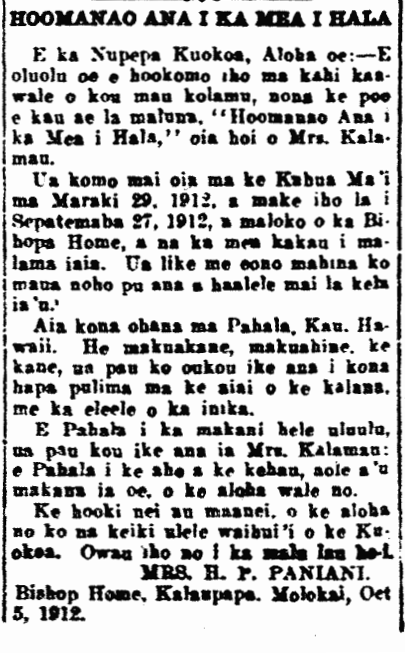
O Nupepa Kuokoa, Aloha oe:—Please be so kind as to include in an empty space of your columns the article with the title above, “A Remembrance of the One Who Has Gone,” that being Mrs. Kalamau.

She came to the leprosy settlement on March 29, 1912, and died on September 27, 1912 in Bishop Home, and it was your writer who took care of her. We lived together for about six months when she left me.

Her family is in Pahala, Kau, Hawaii. Her father, mother, and husband, you will no longer see her hand on white stationery with the black of ink.

O Pahala in the blustery winds, you shall no longer see Mrs. Kalamau; O Pahala in the soft blowing Kehau, i have no gift for you, only aloha.

I end here; my aloha to the type setting boys of the Kuokoa. Me, in the shade of the hoi [ho’i?] leaves.

Mrs. H. P. Paniani.

Bishop Home, Kalaupapa, Molokai, Oct. 5, 1912.

(Kuokoa, 10/18/1912, p. 7)

HOOMANAO ANA I KA MEA I HALA

Ka Nupepa Kuokoa, Buke XLVIII, Helu 42, Aoao 7. Okatoba 18, 1912.

Laying of the cornerstone of Liliuokalani School, 1912.

The Cornerstone of the New Great School is Laid.

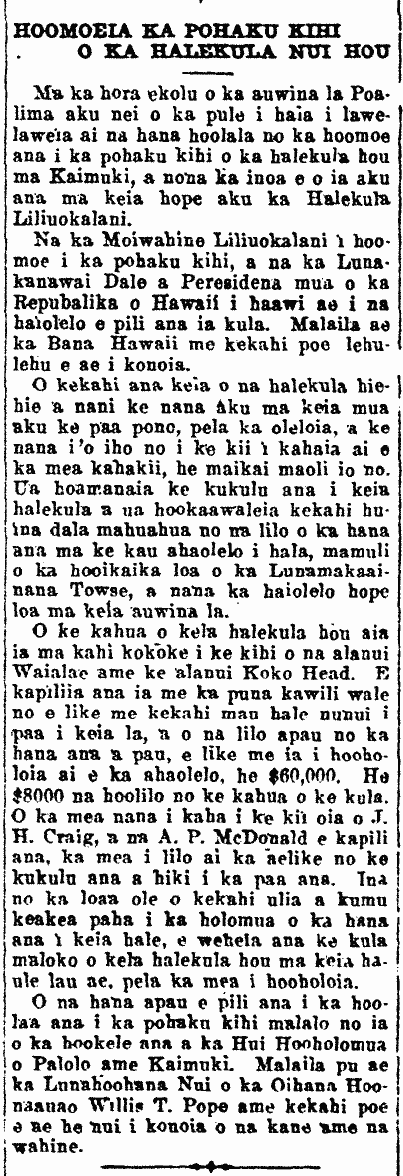
At three o’clock on the afternoon of last Friday (4/12/1912), a ceremony was conducted to lay the cornerstone of the new school house in Kaimuki, that will be called hereafter, Liliuokalani School.

Queen Liliuokalani laid the cornerstone, and Legislator Dole, and former President of the Republic of Hawaii gave a speech about the school. The Hawaiian Band was there along with many invited guests.

When it is completed, this will be one of the most distinguished and beautiful schools, according to what is being said. And when you look at the artist’s rendering, it is indeed splendid. Authorization for building and funds were set aside in the previous session of the Legislature, through the efforts of Legislator Towse, and it was he that gave the final speech that afternoon.

The grounds of this school is near the corner of Waialae and Koko Head. It is being constructed of cement, like many of the great buildings being built these days. And the entire costs will be, as decided by the legislature, $60,000. $8000 was spent to purchase the land. The artist who drew the rendering was J. H. Craig. A. P. McDonald is the one doing the constructing; he received the contract to build the school to completion. Should there be no accidents or hinderances to the progress, the school will be unveiled this coming fall, as per what was decided.

Everything concerning the dedication of the cornerstone fell under the Improvement Club of Palolo and Kaimuki. Present also the head of the DOE, Willis T. Pope, as well as many men and women invited to attend.

[Although sadly this school has been closed, I hear there will be a 100th year celebration of the laying of the cornerstone to be held on the Queen Liliuokalani School grounds, on the 12th of April, with gates opening at 3:00 p. m.

See also from Chronicling America these related articles in English:

Evening Bulletin, 4/13/1912, p. 11,

Hawaiian Gazette, 4/16/1912, p. 7.

And about the actual opening of the school:

Hawaiian Gazette, 10/15/1912, p. 7.]

(Kuokoa, 4/19/1912, p. 6)

HOOMOEIA KA POHAKU KIHI O KA HALEKULA NUI HOU.

Ka Nupepa Kuokoa, Buke XLVIII, Helu 16, Aoao 6. Aperila 19, 1912.

Criticism of treatment at Baldwin Home, 1896.

Improper Acts.

Editor:

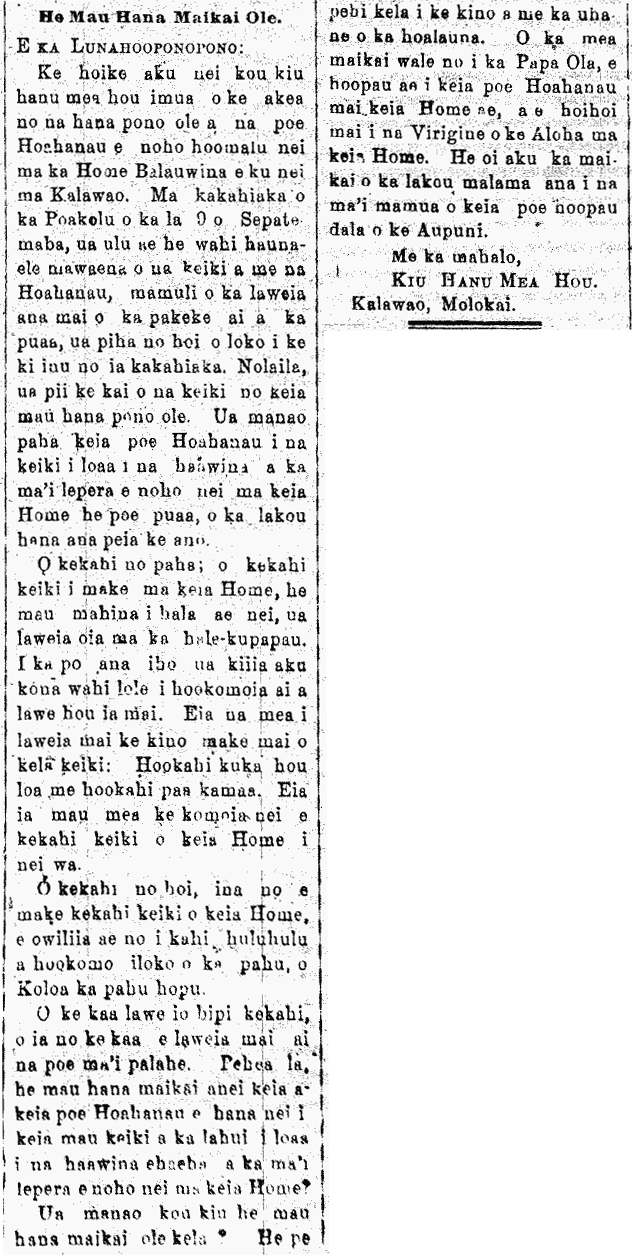
Your news-sniffing detective reports before all, the improper actions of the Brothers [Hoahanau] overseeing the Baldwin Home [Home Balauwina] in Kalawao. On Wednesday morning, the 9th of September, there was a uprising between the boys and the Brothers because the pig feed bucket was brought filled with tea to drink that morning. So the boys were incensed at that mistreatment. These Brothers must have thought that those boys inflicted with leprosy at that Home were pigs, and that is why they did that kind of thing.

Here is another thing: one of the boys who died at the Home some months ago was taken to the mortuary. That night, his clothes he was wearing were fetched. Here are the items taken from the body of the dead boy: One brand new suit, and a pair of shoes. These things are being worn now by another boy of the Home.

One more thing, if a boy of the Home dies, he is wrapped up in a blanket and put in a box and taken to Koloa [?].

The cart used to transport beef is another thing; that is the cart used to transport the patients with rotting sores. Is this something proper that the Brothers are doing to these boys of the lahui who are afflicted with this suffering from leprosy living in the Home?

Your detective believes that it is not right. It is killing the body and the soul of their neighbor. The Board of Health [Papa Ola] should remove these Brothers from the Home and return the Sisters [Viregine] of Aloha to this Home. Their care of the patients was much better than that of these people who waste the Government’s money.

With appreciation,

News-Sniffing Detective

Kalawao, Molokai.

(Makaainana, 11/9/1896, p. 3)

He Mau Hana Maikai Ole.

Ka Makaainana, Buke VI----Ano Hou, Helu 19, Aoao 3. Novemaba 9, 1896.

Renovation of Kawaiahao Cemetery, 1867.

[Found under: “LOCAL NEWS”]

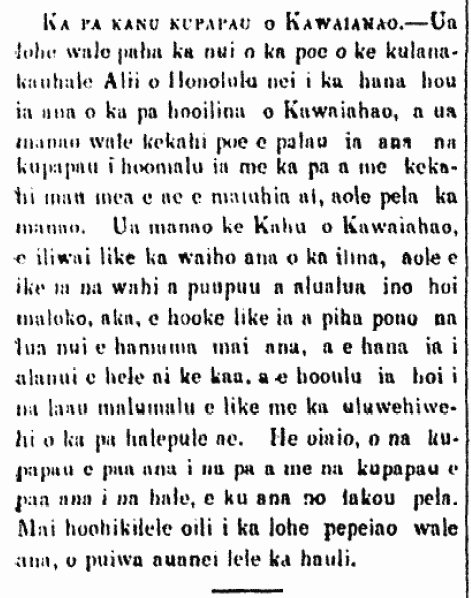
Graveyard of Kawaiahao.—Most of the people of the Capital City of Honolulu have perhaps heard that the cemetery of Kawaiahao is being renovated, and some people have imagined that the bodies laid there to rest, along with the yard and other things at peace there will be plowed up, but this is not the case. The Kahu of Kawaiahao wants to flatten out the graveyard so that there are no humps or holes, to flatten out and fill in the depressions that lay open, and also to make a road for carts to travel on, and to grow shade trees like the greenery of other church yards. It is the truth, the bodies that lay in the yard and the bodies in the crypts will remain as is. Don’t get worked up over what you hear, lest you be shocked.

(Kuokoa, 4/27/1867, p. 3)

Ka pa kanu kupapau o Kawaiahao...

Ka Nupepa Kuokoa, Buke VI, helu 17, Aoao 3. Aperila 27, 1867.

Donations for the commission carrying the anti-annexation petitions to America, 1898.

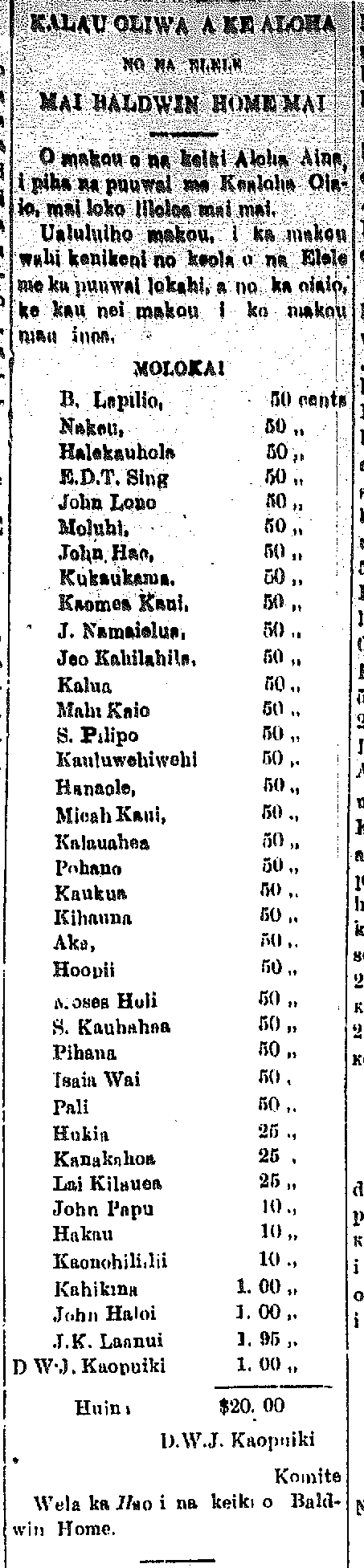
OLIVE LEAVES OF ALOHA

FOR THE REPRESENTATIVES

FROM BALDWIN HOME

We are the Aloha Aina boys whose hearts are full of true aloha from deep within.

We are donating our few cents for the well-being of the Representatives with unified hearts and to attest to this, we affix our names.

MOLOKAI.

B. Lapilio, 50 cents

Nakeu, 50 ”

Halekauhola, 50 ”

E. D. T. Sing, 50 ”

John Lono, 50 ”

Moluhi, 50 ”

John Hao, 50 ”

Kukaukama, 50 ”

Kaomea Kaui, 50 ”

J. Namaielua, 50 ”

Jeo Kahilahila, 50 ”

Kalua, 50 ”

Mahi Kaio, 50 ”

S. Pilipo, 50 ”

Kauluwehiwehi, 50 ”

Hanaole, 50 ”

Micah Kaui, 50 ”

Kalauahea, 50 ”

Pohano, 50 ”

Kaukua, 50 ”

Kihauna, 50 ”

Ake, 50 ”

Hoopii, 50 ”

Moses Holi, 50 ”

S. Kauhahaa, 50 ”

Pihana, 50 ”

Isaia Wai, 50 ”

Pali, 50 ”

Hukia, 25 ”

Kanakahoa, 25 ”

Lai Kilauea, 25 ”

John Papu, 10 ”

Hakau, 10 ”

Kaonohiliilii, 10 ”

Kahikina, 1.00 ”

John Haloi, 1.00 ”

J. K. Laanui, 1.95 ”

D. W. J. Kaopuiki, 1.00 ”

Total: $20.00

D. W. J. Kaopuiki

Committee.

The boys of Baldwin Home are speedy.

[The newspaper Ka Loea Kalaiaina (and many other Hawaiian-Language Newspapers) are for some reason still not available online in searchable text form or even in image form. This is unfortunate, for although most people are familiar with the anti-annexation petitions (“Kū‘ē Petitions”), many have not seen the many lists of donations collected from all over the islands for the expenses of the commission carrying the petition to Washington D. C.

This particular list of donors and donations are from Kalawao! These patients were forced to live isolated from mainstream society, and yet they remained staunch patriots!!

This image is difficult to read, and I hope that clear images of these pages will be made, so if they are typed out to be word-searchable online, people will be able to find their kupuna—it will be near impossible to find a name if there is an “@” somewhere within it…]

(Loea Kalaiaina, 3/14/1898, p. 3)

KALAU OLIWA A KE ALOHA

Ka Loea Kalaiaina, Buke II, Helu 11, Aoao 3. Maraki 14, 1898.

Rebuilding of Aliiolani Hale, 1912.

[Found under, “Local News”]

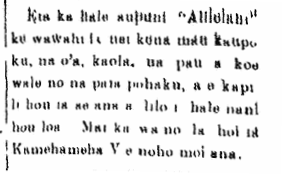
The government building, “Aliiolani” is being demolished; its roof, rafters, and beams are all gone, and only its stone walls remain, and it will be rebuilt and will be a new, splendid structure. It was from the time that Kamehameha V. was ruling as king.

(Kuokoa Home Rula, 2/16/1912, p. 2)

Eia ka hale aupuni "Aliiolani"...

Kuokoa Home Rula, Buke X, Helu 7, aoao 2. Feberuari 16, 1912.

Yokohama Union Church.

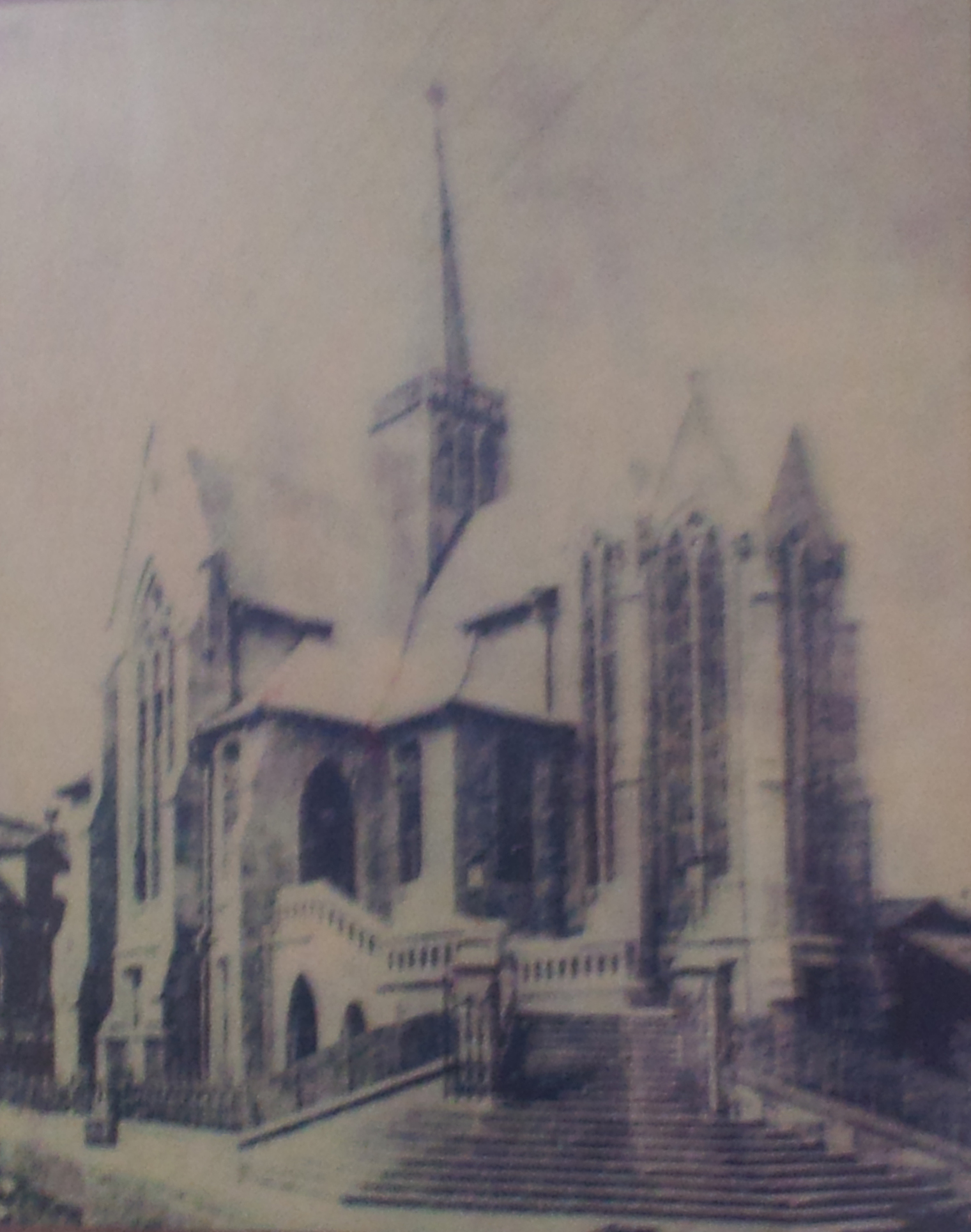
The church pastors did have this picture of the old church which was located on what is now a girl’s school nearby (Ferris). They do not believe that this is the church, because they hear it was built later (but there are no documentation to any of this)…

11/17/2011

Old Yokohama Union Church

…so I can’t say I stood where Kalakaua stood 130 years ago, but all I can say for sure is that it was close by…

Hawaii State Library—the early years, 1915.

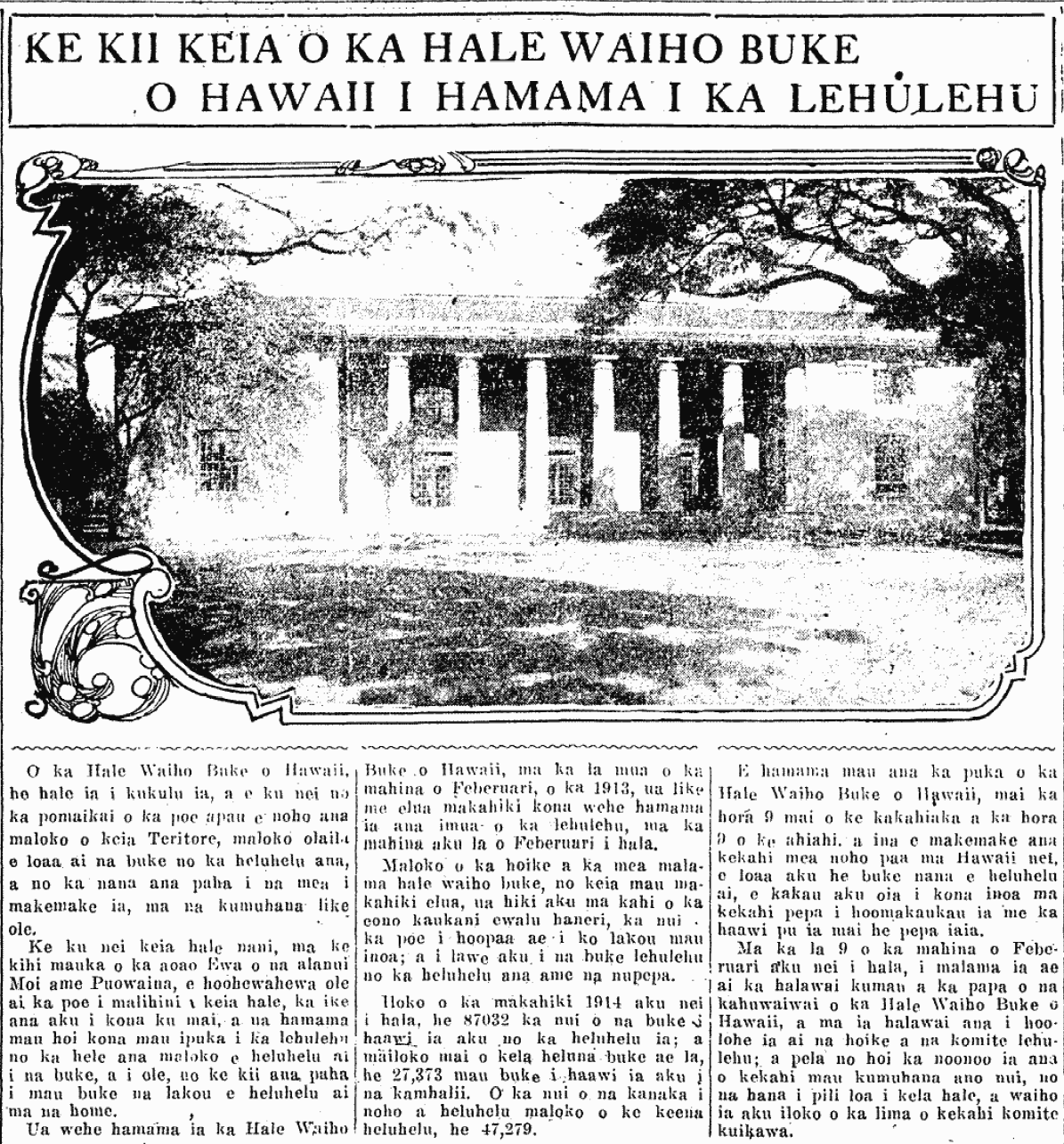
Picture of the Library of Hawaii Opened to the Public

The Library of Hawaii is a building that was built and now stands for the benefit of all people living in this Territory; within it, there are books to read and look at of things of your interest, in all different subjects.

This beautiful structure stands on the corner mauka on the Ewa side of King Street and Punchbowl, so as not to be mistaken by those unfamiliar with where this building stands; and it’s doors are always opened to the public to enter to read books, or to get books for them to read at home.

The Library of Hawaii was opened on the first day of February, 1913; it has been two years that it has been open to the public, this past February.

According to the statement of the caretaker of the library, within these two years, the number of patrons who registered reached about six-thousand eight-hundred; they took out many books and newspapers to read.

In 1914, this past year, 87,032 books were lent out, and from within that number, 27,373 were lent to children. The number of patrons who sat and read within its reading room was 47,279.

The doors of the Library of Hawaii are always open from 9 in the morning to 8 [?] in the evening, and should someone residing in Hawaii wish to get a book to read, he must fill out his name on a ready made form, and he will receive a paper [library card?].

On the 9th of this past February, the regular meeting of the treasury board of the Library of Hawaii, and at that meeting was heard the reports of the many different committees, and also about a consideration of a number of grand plans relating closely to this library, and they were put in the hands of a special committee.

(Kuokoa, 3/5/1915, p. 5)

KE KII KEIA O KA HALE WAIHO BUKE O HAWAII I HAMAMA I KA LEHULEHU

Nupepa Kuokoa, Buke LIII, Helu 10, Aoao 5. Maraki 5, 1915.