Poi made from wheat flour in Kalawao and Kalaupapa, 1879.

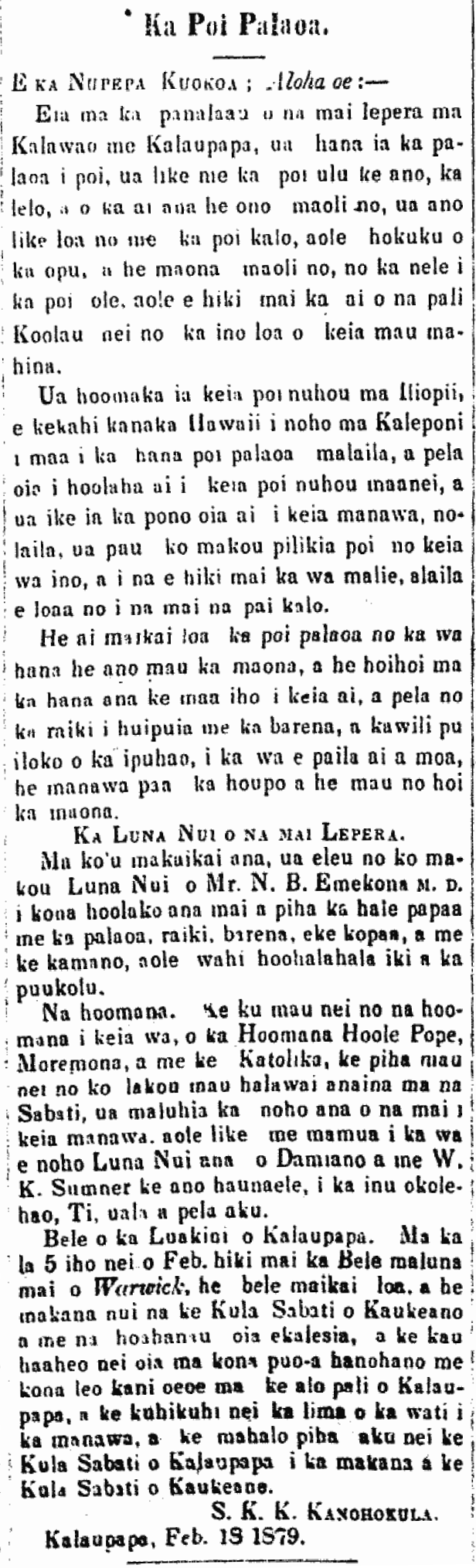
Poi Palaoa.

O Kuokoa Newspaper; Aloha oe:—

Here in the colony of the leprosy patients in Kalawao and Kalaupapa, flour is used to make poi [poi palaoa]; it is similar to poi made of breadfruit [poi ulu] in the yellow color, and it is truly delicious; it is a lot like taro poi [poi kalo]: your stomach doesn’t get sore, and you become full indeed; we have no poi because the taro won’t arrive to these Koolau cliffs because of the terrible weather during these months.

This new poi began at Iliopii, by a Hawaiian who lived in California who was used to making it there, and that is how he spread this new poi here; and the benefits of this poi is now known, and therefore, our poi problems are over during this stormy period, and should calm weather return, the patients will get their paʻi ʻai¹ [pai kalo].

Poi palaoa is very appropriate when working because you stay full, and it is fun to make when you get used to it, and so too with rice mixed with crackers and stirred up in a pot; when it boils and is cooked, it is time for to fill the stomach, and you will be always full.

The Superintendent of the Leprosy Patients.

In my observations, our Superintendent, Mr. N. B. Emerson [Emekona], M. D. is quick with filling the storehouse [hale papaa] with flour [palaoa], rice [raiki], crackers [barena], bags of sugar [eke kopaa], and salmon [kamano]; there is nothing to complain of Kapuukolu.²

Worship. Worship always happens now: Protestants [Hoole Pope], Mormons [Moremona], and Catholics [Katolika]; their meetings on Sundays are always full; life of the patients is peaceful now, not like before when Damien [Damiano] and when W. K. Sumner were Superintendent; there were uprisings from drinking okolehao and other alcoholic drinks made of ti, sweet potato [uala], and so forth.

Bell of the Church of Kalaupapa. On the 5th of Feb., the Bell arrived on the Warwick; a very fine bell which was a gift from the Sunday School of Kaukeano and the brethren of that church; and now it hangs proudly in its honored steeple with its ringing voice in the cliff faces of Kalaupapa, and it points out the movement of the hands of the clock, and the Sunday School of Kalaupapa fully appreciates the gift of the Sunday School of Kaukeano.

S. K. K. Kanohokula.

Kalaupapa, Feb. 18, 1879.

¹Although i tend not to use ʻokina and kahakō, i marked “pai ai” here for added clarity.

²Kapuukolu is a place on Kauai, figuratively used to represent abundance of good food.

(Kuokoa, 3/15/1879, p. 2)

Ka Poi Palaoa.

Ka Nupepa Kuokoa, Buke XVIII, Helu 11, Aoao 2. Maraki 15, 1879.

Sap of the Kukui, 1867.

[Found under: “LOCAL NEWS: Oahu”]

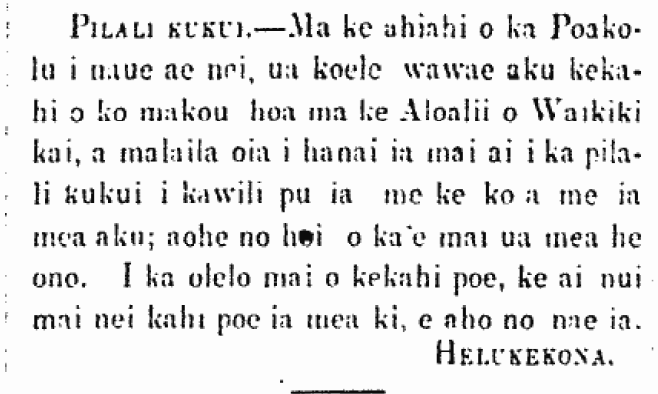
Kukui Sap.—On the evening of last Wednesday, one of our friends was walking by the Royal Court at Waikiki Kai, and there he was given the pilali of the kukui tree mixed with sugar and other things; it was just so delicious. According to some people, there are people who eat a lot of  ti [probably the baked root of the ti plant], however it is better.

[Has anyone ever tried either of these? Does anyone still do this today?]

(Kuokoa, 4/20/1867, p. 2)

Pilali Kukui.

Ka Nupepa Kuokoa, Buke VI, Helu 16, Aoao 2. Aperila 20, 1867.

Food Exports, 1890.

[Found under: “HAWAII NEWS”]

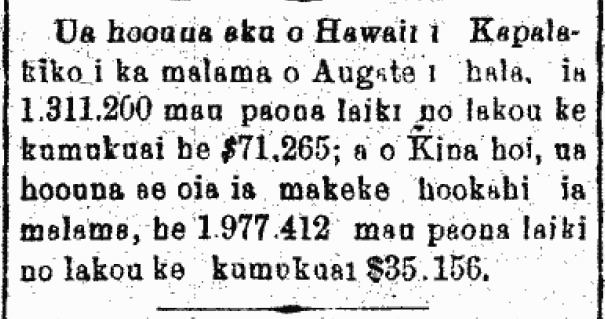
Hawaii exported to San Francisco in the month of this past August, 1,311,200 pounds of rice at the price of $71,265; and China exported to the same market in that month, 1,977,412 pounds of rice at the price of $35,156.

[What a different world we live in where we import most of our food…]

(Ko Hawaii Pae Aina, 10/18/1890, p. 2)

Ua hoouna aku o Hawaii i Kapalakiko...

Ko Hawaii Pae Aina, Buke XIII, Helu 42, Aoao 2. Okatoba 18, 1890.

Paper Lei and Hawaiian foods popular in New York. 1912.

PAPER LEI ARE MUCH SOUGHT AFTER IN NEW YORK.

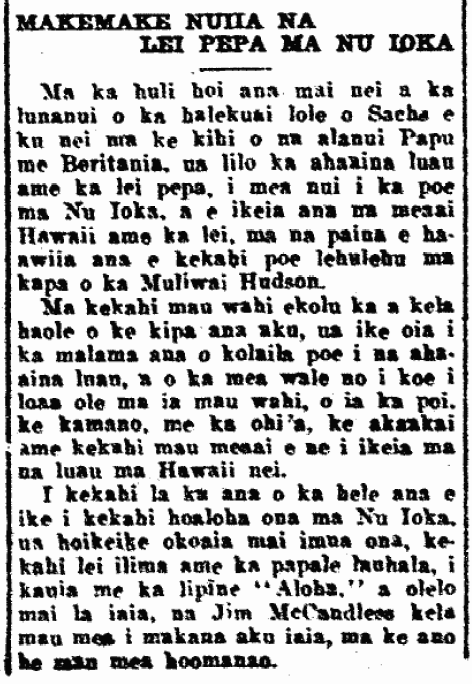
At the return of the head manager of the clothiers, Sachs, which stands at the corner of Fort and King Streets; [he said,] “Luau and paper lei have become popular with New Yorkers, and Hawaiian foods and lei are seen at parties given by many people on the banks of the Hudson River.

Supposedly at three places that haole went to visit, he saw people holding luau parties, and the only thing missing at those places was poi, salmon, tomatoes, onions and some other foods seen at luau in Hawaii nei.

One day when he went to go see one of his friends in New York, shown before him was an ilima lei and a lauhala hat upon which was a ribbon which read “Aloha,” and he said that they were a gift from Jim McCandless, as a memento.

(Kuokoa, 8/9/1912, p. 6)

MAKEMAKE NUIIA NA LEI PEPA MA NU IOKA

Ka Nupepa Kuokoa, Buke XLVIII, Helu 32, Aoao 6. Augate 9, 1912.

Rising food prices: Will politicians ever learn? 1923 / timeless.

REASONS FOR THE RISING COST OF FOOD.

There is perhaps no other more important question pertaining to the life of man than that of the cost of food. How many people have sat down and thought to themselves about the reasons for the rising costs and ways to lessen their living expenses.

If we consider that there is no man on earth that can live without food, then we can find a reason; and through thought and careful consideration, we can figure out the major reasons for the rise in food prices.

First of all, for nations who rely upon other nations or other lands to supply their food, their food will be expensive, and food price stability will not be realized. But for a land that produces its own food, and exports the excess to nations who are lacking, they will see a fall in their food costs.

With these facts, we can move forward. Here we are in Hawaii, growing two major crops, however these two things are not main dishes which give sustenance to the body, but they are just treats. They being sugar and pineapple. We are putting our efforts into these two things and this nation draws its income from it; however, at the same time, we are forgetting about the foods necessary for the body, and because we are so focused on chasing after money, we assume that these funds will supply us with food for nourishment.

The problem with our focus on the pursuit of money, is that we neglect looking after the actual things that are necessary for our bodies, the main staples. We are purchasing our food from foreign nations, while we are in pursuit of making money. When the nations which we rely upon to get our food have a small harvest, this is the time we will see an increase in the costs of food. It will rise because of the small amount of food growing in those countries in which we rely upon from where we get our food.

The second detriment to us in relying on the outside for feeding us is that when the shipping costs rise to ship in the food to us, there will be another set back, and that will be another reason the costs will rise. And should the occasion arise when there is war, or the lack of ships to bring our food, then the prices will shoot up; or there will be times when there is no food, because there will be no means to get the food.

And when the shipping costs rise, it will not be the sailors who will be in trouble, but it will be those who eat the food. For with the increase in the costs to the ship owners for pay for the sailors, or the ship builders perhaps, the ship owners will add on some pennies to the shipping charges, and when this comes to the hands of the consumer, he will understand that the expense to ship food here by boat resulted in an increase in the price of food; and the one paying the exorbitant prices for those foods is you, who eat them. And when the person is eating, he will see that the price of salmon here has risen.

And another factor in the rise of food costs is the number of people who eat the food, in a country that does not produce its own food. With the increase in population, the number of mouths will increase, so there will be less, or just doing without; and as a result of this lack, and to remedy it, the outside is relied upon to make up for this, and this is a problem bigger than all others. There may be a great amount of food brought in, but in comparison to the number of those who eat the food, that food is only a little, which is the main reason for the rise in food costs.

Therefore, we have come to where we can see where the problem lies. First, we do not grow staples. Second, although we have fertile land upon which we can grow food, we just grow things that bring in money and go without growing main foods.

What are staples? Vegetables and meat. These two things are staples. Other things are just treats, and man can live without them.

Here is Hawaii, a land where all foods can be grown which people eat here, along with the condiments. During the times of our ancestors, they had ample food so that they became big and strong. But these days, we are not planting staples. The Chinese and Japanese have come with their foods, with rice being the main food. This rice can be grown here in Hawaii nei. The haole came with their thing, the Irish potato and bread. Potatoes are being grown here now. As for flour, in the year 1849 or there about, Hawaii supplied California with flour. Wheat was grown in Kula, Maui, and on Molokai. Today, wheat can be grown should we desire. And if it is not possible, this is not a problem, because we are satisfied with other foods that can take its place.

And today, should we Hawaiians consider joining together in the growing of food, we will have the best food, and we will have produce that will help lessen the cost of food, as a result of this increase in the number of farmers.

The raising of livestock is also something needed, for that is a staple. Cows, pigs, goats, sheep, chicken, and the fishes of the sea. There is a lot of land now lived on by wild goats. If they were domesticated goats, then we’d have that meat, but because it is wild, and hard to get, it will not be enough for us; all the while the wild goats are feeding off of the fields which is for the sustenance of domesticated goats; some people are going into this profession.

The main thing that will lessen the costs of our food that we eat is the increasing of the growing of those foods; the joining into the growing of these things, because the quality of soil of this land is sufficient to grow these things. And let us look to making money through that, and not solely from treats.

We Hawaiians are supplied with land where we can enter into the occupation of growing food. There is probably no piece of land in Hawaii where staples cannot be grown. The land of Molokai has been opened up. The land of Kalamaula has enough water to grow food whenever it is desired. The lands upland of Palaau and Hoolehua will be opened up. These lands have soil good enough to grow Irish potatoes and corn.

Melons and other things can be grown which can support pig farming. With these staple foods, the farmer and those that raise livestock will receive good money from the mouths of those who live here, while being relied upon by those from outside to supply their food. Maybe the food won’t be cheaper, but you will have your food, O Farmer, with ease, and your family will be supplied, without it all being consumed; and the leftover, you can sent out to be purchased by those in pursuit of making money.

When foreign nations don’t have enough to send food to Hawaii, or when there are not enough ships, or if this nation enters into war, you and your family will have enough food, and you will get a higher price, because there will not be enough food imported. For these reasons, let us Hawaiians recognize these fields of gold stretched out before us, and let us grab it and harvest its many blessings. The seeking of one’s livelihood from the soil was the first way of life of the earliest men. And we know that there is no greater occupation than this. You are independent. You will have enough staple foods. You will have enough money, and with this money, you will have things that you do not grow. Clothes and things that make your life pleasant.

[I dedicate this to all the awesome farmers out there, both big and small (and fishermen and ranchers and dairy people for that matter). Also to the farmers’ markets, and establishments who support them. And to you, the people who try to buy local first. Conversely, I would like all of you politicians and others who think that agricultural lands and farmers are not important, to think about the big picture before another 89 years pass by. At this rate, we will be leaving the next generations with a very dismal way of life.]

(Kuokoa, 2/15/1923, p. 2)

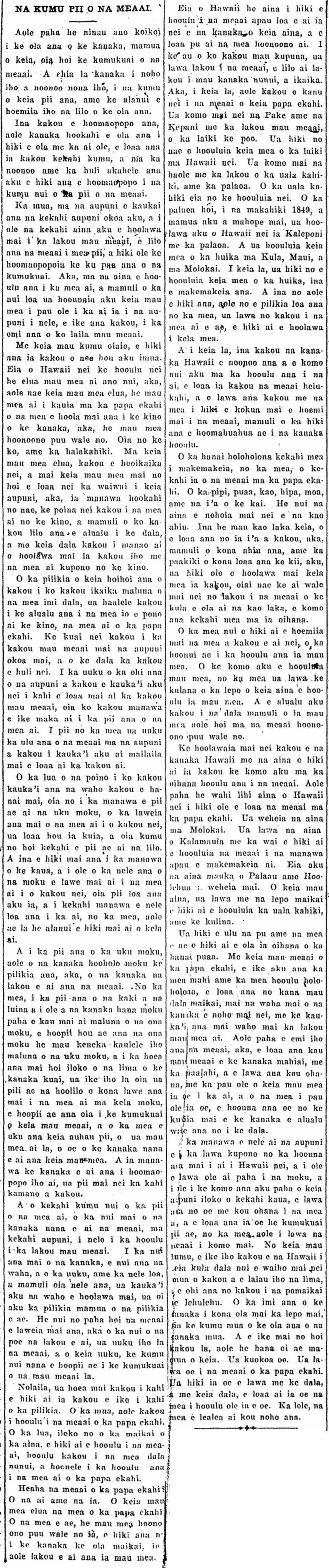
NA KUMU PII O NA MEAAI.

Ka Nupepa Kuokoa, Buke LXII, Helu 7, Aoao 2. Feberuari 15, 1923.

Recipes brought to you by Royal Baking Powder, 1920.

Royal Baking Powder Biscuits

There is nothing to compare for breakfast, lunch, or tea; it is easy to make with the help of

ROYAL

Baking Powder

ABSOLUTELY PURE

Here is the recipe for Royal Baking Powder Biscuits—famous around the world—clip this out and try them. But use Royal Baking Powder. Cheap substitutes won’t do. Only by using Royal, will you see the proper results which made Royal famous around the world.

Biscuits [Palaoa Liilii]

2 cups flour
4 teaspoons Royal Baking Powder
1/2 teaspoon salt
2 tablespoons shortening
3/4 cup milk or half milk and half water

Sift together flour, baking powder and salt, add shortening and rub in very lightly; add liquid slowly; roll or pat on floured board to about one inch in thickness (handle as little as possible); cut with biscuit cutter. Bake in hot oven 15 to 20 minutes.

Here is a fine recipe for Cheese Biscuits:

Cheese Biscuits [Palaoa Waiupaa]

1-1/2 cups flour
2 teaspoons Royal Baking Powder
1/4 teaspoon salt
1 teaspoon shortening
6 tablespoons grated cheese
5/8 cup milk

Sift together flour, baking powder and salt; add shortening and cheese; mix in lightly; add milk slowly, just enough to hold dough together. Roll out on floured board about 1/2-inch thick; cut with biscuit cutter. Bake in hot oven 12 to 15 minutes.

Level off all measurements.

In many of the recipes, there are a lot of eggs; you will however get fine results if you lessen the eggs by half and add one teaspoon of Royal Baking Powder in place of each egg left out.

Write for the Free Recipe Book. A recipe book that is economical with eggs and other expensive material will be sent by mailbag at no cost. Write to

Royal Baking Powder Co., 135 William St., New York, U. S. A.

[These recipes were part of a series of ads in the Kuokoa (and in papers across the United States as well). It is a good way to get cooking descriptions in Hawaiian!

The English for the main parts of the recipes came from “The New Royal Cookbook” put out by the Royal Baking Powder Company in 1920 (which is the cookbook mentioned in this ad which they are giving away free if you mail away for it). It is provided online by Project Gutenberg!]

(Kuokoa, 3/12/1920, p. 3)

Palaoa Liilii Royal Baking Powder

Ka Nupepa Kuokoa, Buke LVIII, Helu 11, Aoao 3. Maraki 12, 1920.

A visit to the Mormon settlement, Iosepa, Utah, 1912.

Travelling to Find Hawaiians in Iosepa, Utah.

Following the Presidential Nominating Convention in Chicago, I boarded the evening train, along with my travelling companions, on the sabbath, June 23, to return to San Francisco. We arrived at Salt Lake City at 5 p. m. on Tuesday evening, and I jumped off alone in that foreign land while my companions continued all the way.

The next day, I went to grounds of the Mormon temple and asked for the way to get to where the Hawaiians lived in Iosepa. I was told by the locals that Tempie was where the train stopped to go to Iosepa, and eight more miles and you’d reach Iosepa. I was restrained to wait for one of the Mormon teachers who lived here in Hawaii, for they knew the way to Iosepa, but I did not wait, I toured about the city until the time the train departed, and I boarded for Tempie.

I arrived there at 4:30 and saw a barren land with but two buildings, no trees, no crops, and they were just houses for the men who worked on the railroad. I was shocked, because there was no one home; I looked at the road lying to the south, to the east of the valley and I decided to walk until the houses of the locals of Iosepa, and so I went as a malihini on that lonely deserted road; I looked as far as my eyes could see, and there were no homes in sight, but I continued walking forward for eight miles and reached a hillock from which I could see four more miles, but I couldn’t see any houses, while I recalled what was told to me, that it was eight miles from Tempie to Iosepa; I was confused, thinking that maybe this wasn’t the correct road, so I turned back once again for Tempie. The sun went down, but the moon came out, so the trip on this deserted foreign land was not forlorn.

I arrived back in Tempie at eleven that night, knocked on the door, and the kamaaina, who was a Greek, awoke, and I slept there that night. He asked me about my travels, and I told him that I was headed for Iosepa, and I asked him the right way to get there, and he told me that that was indeed the road but he estimated that it was fourteen miles before reaching Iosepa.

Early the next morning, we were done with breakfast, and my kamaaina went off to work; he locked up the house, and I sat out on the lanai, waiting for for the mail truck, since the locals told me that the letter truck to Iosepa arrived at two that afternoon; I thought to walk once again, but because of swelling of my legs, I couldn’t do it.

In the afternoon, a delivery truck driven by a Hawaiian youth born there arrived first. After him arrived the mail truck driven by John Broad, the son of Charles Broad, along with three passengers headed for Salt Lake. I spent time with them until their train arrived and they left; and I waited for the train from Salt Lake; its arrival ran late, and it came at about six; we got the mail bag, and I went along with Jno. Broad to Iosepa which he said was sixteen miles from Iosepa to Tempie. We arrived at Iosepa at dusk, at eight in the evening and visited the home of Charles Broad and his queen [wife]. There I ate poi once again, that being poi palaoa [poi made of flour], and this was much tastier and better than the expensive haole food that I had in the American hotels.

I spent time with the Hawaiians living there, and asked about how their lives were;  they said their way of life in Iosepa was pleasant. Charles Broad and George Hubbel told me that when they were home in the land of their birth, they were subject to frequent bouts of rheumatism but in Iosepa they were fine and this ailment giving them sore bones disappeared. I was asked to stay back by the kamaaina to spend [seems to be a dropped line here: “hoohala i mau lakou”] so that they can properly welcome me, like by roasting a pig, joining together in celebration, and allowing time for the two singing groups to  come and entertain me with their music and Hawaiian songs that they cherish in that foreign land. But because of my very short time left before the Wilhelmina, my ship upon which I was returning, was leaving, therefore, I could not accept their invitation.

The town of Iosepa is east of Skull Valley [Awawa Pookanaka], and it is land dedicated as a home for kanaka people. Hawaiians are the majority living there, and there are some kauna [forty] samoans and the head haole and his family. There are 176 people in Iosepa. There is a school house, store, post office, church, dance hall, and a lanai for parties on special occasions.

The work people do there is farming, planting oats, wheat, potatoes, barley, and so forth. The land is flat and stretches out, and there is much space, enough for a thousand people, and there is a lot of spring water in that valley, but the land is like a salt bed, and it is by irrigation that the crops grow. Should you want a homestead, you can get 320 acres, being that there is abundant land yet few people.

Water is brought in for the town of Iosepa from the deep, grooved ravines of the mountains for many miles in canals which are lined with cement and runs out to a reservoir, and from there the water runs into great pipes reaching the roads of Iosepa and entering the house lots of the people.  The Church spent $76,000 to lay the waterway.

It is thought that it was an ultimate feat of Maui County, which spent $100,000 to lay the water system to bring the water from Puohokamoa Stream as water for the thousands of people of Makawao and Kula and the thousands of cattle of Kahikinui, however, people have to pay to get the water; as for the water in Iosepa, the Mormon Church paid $76,000 to get the water to make the life of the Hawaiians there easy, and they give it for free.

After finishing breakfast, the Head Boss, William Wadup [Waddoups], invited me to  tour the work place of the people, and so I went with him aboard his vehicle [Not sure what a “kaa bake” is, but it appeared in an earlier article i put up]. We arrived at the place of work, and I saw two men cutting grass. They sat atop the machine, guided the horses straight, and the machine was what cut the grass. And at another location, the dried grass (hay) was piled onto a large truck and taken to where it was heaped up, and the pile was as tall as a two-story building.

George Hubbel told me that pitching hay with long-handled three-pronged pitch forks was the most important job there, and the pay for that job was two dollars and a half a day for a single man, and three dollars for a married man; for other jobs, the pay was a dollar quarter and  a dollar half a day.

As I made ready to depart Iosepa that afternoon, people were let off work, they told me because it was windy that they could not pitch hay, and they all came down to see me and to give their aloha to the families in the land of their birth. There was much asking for me to visit them again should I come back to America, and from what I saw, they were very happy at the arrival of one of their own who saw and visited with them in this foreign land upon which they live.

They told me that in the twenty or more years which they lived in Iosepa, there were a great many Hawaiians who visited Salt Lake City, but I was a Hawaiian who actually went to Iosepa to see them before returning here to the sands of our birth.

Here are some people I saw there: Makaweli, the last born of the wife of Nailima of Hilo, who has many children and grandchildren in Iosepa. It was this kind Hawaiian lady who took care of Emilia Kalua (f), the grandchild of Keanini of Waikapu, Maui, because both of her parents died; the family of her father wanted to bring back this young girl to live with them. The Circuit Court of Maui appointed me as executor for her portion of the estate of her grandfather, and these are they things which made me visit Iosepa, Utah, and to see firsthand how this Hawaiian girl was living without parents in this foreign land. From what I saw and heard about her there, she was being properly taken care of, and she did not want to come to Hawaii nei.

Also, there is Naihe, a child of D. B. Mahoe of Hana; he is family there; he has eight children living. George Hubbel formerly of Honolulu, his wife, and their children, and so many more other Hawaiians gave their aloha to their family here in the land of their birth. According to some of them, it is their homeland, the treatment of the church elders is good, and the thought to return to the land of their birth is very far away, except for the fact that their aloha for Hawaii is not gone, as for their kin at home with their never-ending thoughts of them.

KALE WILIKOKI [Charles Wilcox]

(Kuokoa Home Rula, 7/12/1912, p. 4)
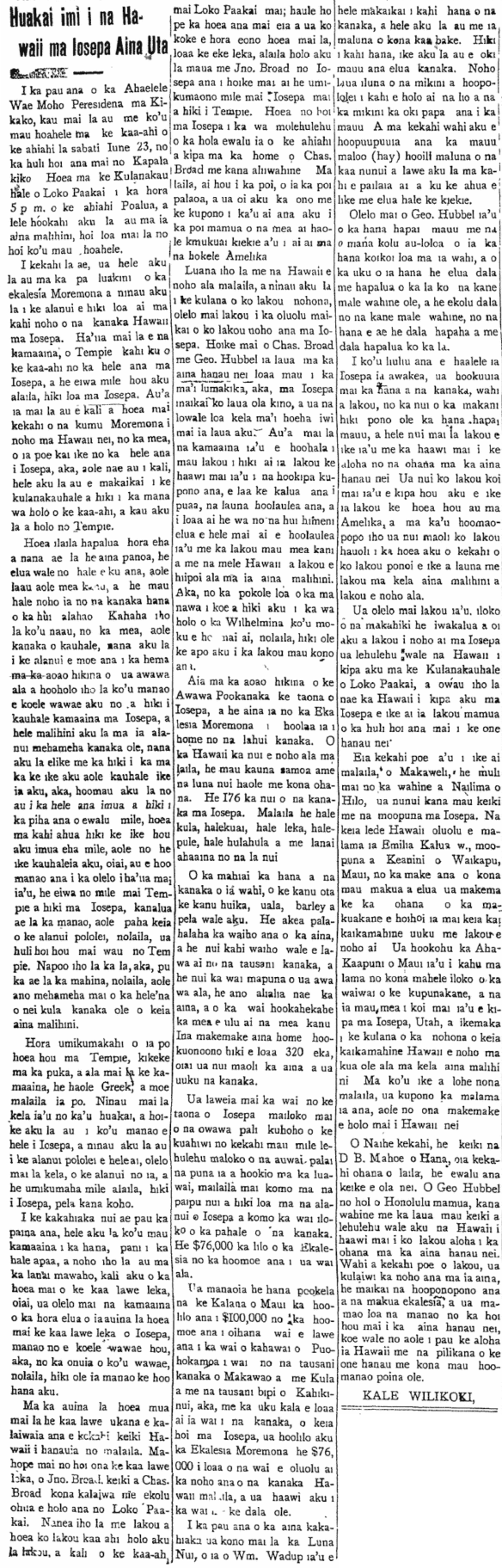
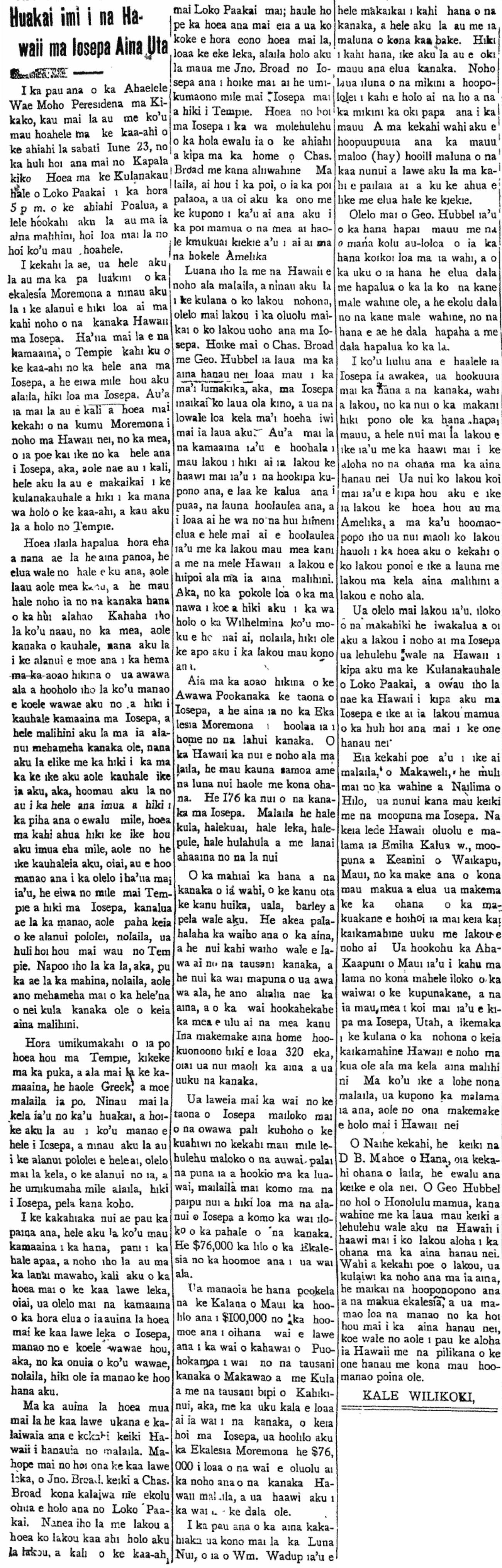
Huakai imi i na Hawaii ma Iosepa Aina Uta

Kuokoa Home Rula, Buke X, Helu 28, Aoao 4. Iulai 12, 1912.

Poi description in English. 1909.

[Found under: “Our English Items”]

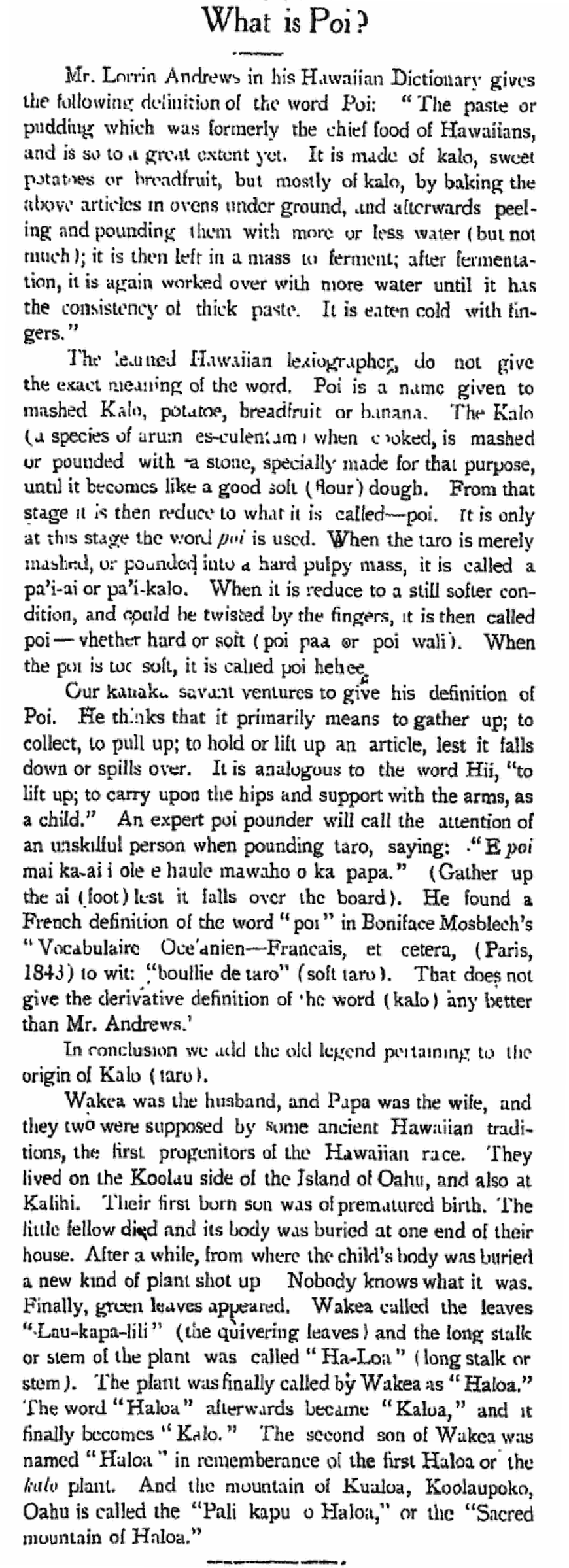
What is Poi?

Mr. Lorrin Andrews in his Hawaiian Dictionary gives the following definition of the word Poi: “The paste or pudding which was formerly the chief food of Hawaiians, and is so to a great extent yet. It is made of kalo, sweet potatoes or breadfruit, but mostly of kalo, by baking the above articles in ovens under ground, and afterwards peeling and pounding them with more or less water (but not much); it is then left in a mass to ferment; after fermentation, it is again worked over with more water until it has the consistency of thick paste. It is eaten cold with fingers.”

The learned Hawaiian lexiographer [lexicographer] do not give the exact meaning of the word. Poi is a name given to mashed Kalo, potatoe, breadfruit or banana. The Kalo (a species of arum ex-culentum [arum esculentum] when cooked, is mashed or pounded with a stone, especially made for that purpose, until it becomes like a good soft (flour) dough. From that stage it is then reduce to what is called—poi. It is only at this stage the word poi is used. When the taro is merely mashed, or pounded into a hard pulpy mass, it is called a pa’i-ai or pa’i-kalo. When it is reduced to a still softer condition, and could be twisted by fingers, it is then called poi—whether hard or soft (poi paa or poi wali). When the poi is too soft, it is called poi hehee.

Our kanaka savant ventures to give his definition of Poi. He thinks that it primarily means to gather up; to collect, to pull up; to hold or lift up an article, lest it falls down or spills over. It is analogous to the word Hii, “to lift up; to carry upon the hips and support with the arms, as a child.” An expert poi pounder will call the attention of an unskillful person when pounding taro, saying: “E poi mai ka ai i ole e haule mawaho o ka papa.” (Gather up the ai (foot [food]) lest it falls over the board). He found a French definition of the word “poi” in Boniface Mosblech’s “Vocabulaire Oce’anien—Francais, et cetera, (Paris, 1843) to wit: “boullie de taro” (soft taro). That does not give the derivative definition of the word (kalo) any better than Mr. Andrews.

In conclusion we add the old legend pertaining to the origin of Kalo (taro).

Wakea was the husband, and Papa was the wife, and they two were supposed by some ancient Hawaiian tradition, the first progenitors of the Hawaiian race. They lived on the Koolau side of the Island of Oahu, and also at Kalihi. Their first born son was of premature birth. The little fellow died and its body was buried at one end of their house. After a while, from where the child’s body was buried a new kind of plant shot up. Nobody knows what it was. Finally, green leaves appeared. Wakea called the leaves “Lau-kapa-lili” (the quivering leaves) and the long stalk or stem of the plant was called “Ha-Loa” (long stalk or stem). The plant was finally called by Wakea as “Haloa.”

(Kuokoa Home Rula, 1/1/1909, p.1)

What is Poi?

Kuokoa Home Rula, Buke VII, Helu 1, Aoao 1. Ianuari 1, 1909.

Poi and Kalo and a self sufficient Hawaii, 1915.

THE TIME WILL COME WHEN POI WILL BE SCARCE.

It would appear that the days are numbered, and 5 pounds of poi will go for a quarter, that is five cents per pound. This rise in price of poi is due to the lack of kalo, and perhaps because Hawaiians just don’t care to plant kalo in their fields.

These days in Honolulu, there are but few places that plant kalo. Places that loi kalo were seen are now dried out because the lands were accrued by other groups of people, and they dried the fields out; whereas it would be more beneficial if those back turners continued the planting of kalo. It has been almost two years since this spokesperson [the newspaper Ke Aloha Aina] first advised those with lands to farm them, for the time will come when there will be food shortages, at that time, America will declare war against Germany, which will intensify the problem, and that time we spoke of has come indeed. As proof of what we say, look to the issues of A. D. 1915–16, and you will find our words of advice, strongly encouraging Hawaiians to plant kalo and other crops, because the time will come when there will be hardships, and it will come, without fail.

Something terribly astonishing to us is that it as if kalo is being made into poi outside of Hawaii, for the cost is rising like goods imported here.

Why is this so? Because there is so little kalo being farmed, and there are a lot of people eating poi. These days, there are other ethnicities eating poi because their staples are expensive, and therefore, many people are eating poi and not much kalo is being planted.

We give our appreciation to the poi association of the stevedores which took some kalo lands and leased them out long term to plant kalo to supply their outlets at the markets and feed the poi-eating public.

Probably the public doesn’t realize that these days there is a poi shortage; maybe they continue to assume that poi is as usual. No! There is less poi now; six and a half pounds for a quarter, and some weeks it is just six pounds and sometimes five pounds for a quarter, which is five cents per pound.

So all you people with some kalo land, you should plant a lot of kalo and pull up well-developed corms when the time is right. Neglect during the day will leave you without. Work while the sun is up.

(Aloha Aina, 9/7/1917, p. 4)

E HIKI AKU ANA I KA MANAWA E LIILII LOA AKU AI O KA POI

Ke Aloha Aina, Buke XXII, Helu 36, Aoao 4. Sepatemaba 7, 1917.

Eat local advertisement? 1932.

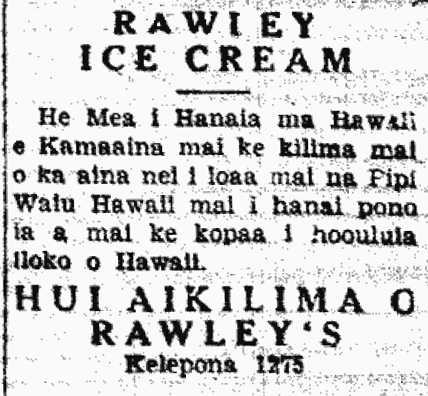
RAWLEY

ICE CREAM

Made in Hawaii by Kamaaina, from cream which is produced locally from Hawaii dairy cows which are well fed, and from sugar grown in Hawaii.

RAWLEY’S ICE CREAM COMPANY

Telephone 1275

(Alakai o Hawaii, 1/14/1932, p. 3)

RAWLEY ICE CREAM

Ke Alakai o Hawaii, Buke 3, Helu 37, Aoao, 3. Ianuali 14, 1932.