“Early movies of Hawaii” follow up, 2012.

Mahalo to Connie Woyciesjes and Uluulu for their responses pertaining to the scenes shot by the “man famous for filming movies”!

Perhaps this was R. K. Bonine as Connie suggests, but i am not sure why he’d be arriving on the Wilhelmina, i assumed he was already here in Hawaii at that time. There are by the way many articles about Bonine taking movies. Here is one which i previously posted from 1915.

From Uluulu, there was the suggestion that maybe the reels labeled “Picturesque Hawaii ca. 1916” at Critical Past are the scenes in question. Look for instance at this short movie put out by the Ford Motor Company dealing with the pineapple and labeled 1916, (which was described in the article).

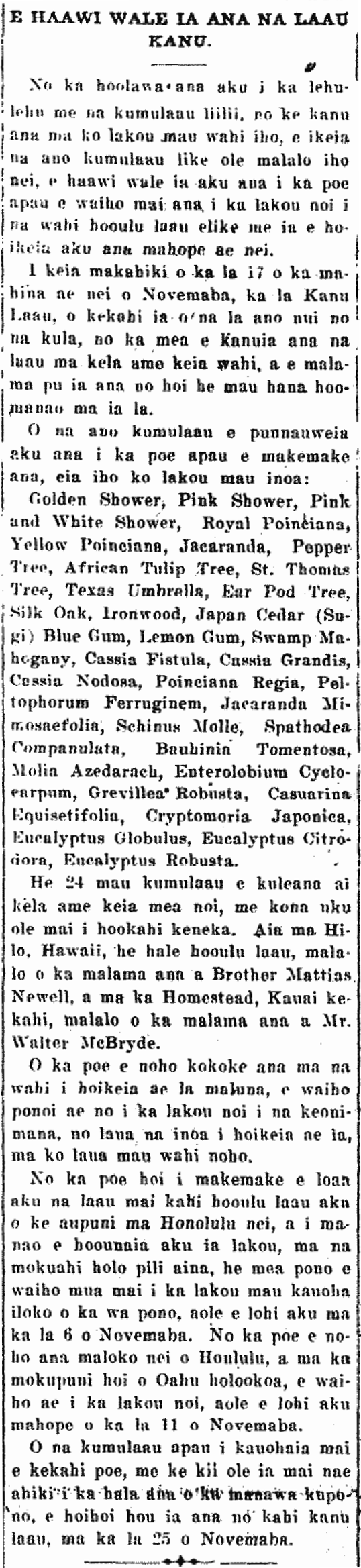
Arbor Day, 1916.

PLANTS TO BE GIVEN AWAY.

To supply the public with small trees to plant at their own places, all of these various plants seen below will be given to anyone who places a request at arboretums like those shown hereafter.

This year, the 17th of the coming November is Arbor Day [ka la Kanu Laau]; this day is important for schools, for plants will be planted everywhere, and celebrations will be held on that day.

The types of trees to be divided among all those who want it, are here named below:

Golden Shower, Pink Shower, Pink and White Shower, Royal Poinciana, Yellow Poinciana, Jacaranda, Pepper Tree, African Tulip Tree, St. Thomas Tree, Texas Umbrella, Ear Pod Tree, Silk Oak, Ironwood, Japan Cedar (Sugi), Blue Gum, Lemon Gum, Swamp Mahogany, Cassia Fistula, Cassia Grandis, Cassia Nodosa, Poinciana Regia, Peltophorum Ferruginem, Jacaranda Mimosaefolia, Schinus Molle, Spathodea Companulata, Cauhinia Tomentosa, Molia Azedarach, Enterolobium Cyclocarpum, Grevillea Robusta, Casuarina Equisetifolia, Cryptomeria Japonica, Eucalyptus Globus, Eucalyptus Citrodora, Eucalyptus Robusta.

Each person who requests may have 24 trees without paying a cent. In Hilo, Hawaii, is a greenhouse under the care of Brother Mattias Newell, and at the Homestead, Kauai, there is one under the care of Mr. Walter McBryde.

Those living in the vicinity of the places mentioned above should put in their orders with the gentlemen named above at their residences.

For those who want plants from government arboretums in Honolulu, and to have them shipped over the inter-island steamships, they must put in their orders in proper time, no later than the 6th of November. For the people who live in Honolulu, or anywhere on Oahu, they should put in their orders by the 11th of November.

The trees ordered by a person and not picked up in good time, will be returned to the arboretums, on the 25th of November.

[Check out what is going on today across Hawaii nei on the Arbor Day Hawaii page.]

(Kuokoa, 10/27/1916, p. 5)

E HAAWI WALE IA ANA NA LAAU KANU.

Ka Nupepa Kuokoa, Buke LIV, Helu 43, Aoao 5. Okatoba 27, 1916.

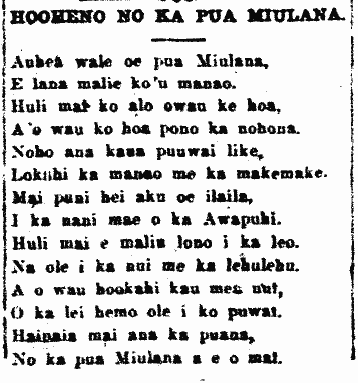
Here is a pretty love song likening the object of one’s affection to a miulana flower, 1913.

HOOHENO NO KA PUA MIULANA.

Auhea wale oe pua Miulana,
E lana malie ko’u manao.
Huli mai ko alo owau ke hoa,
A o wau ko hoa pono ka nohona.
Noho ana kaua puuwai like,
Lokahi ka manao me ka makemake.
Mai puni hei aku oe ilaila,
I ka nani mae o ka Awapuhi.
Huli mai e maliu lono i ka leo.
Na ole i ka nui me ka lehulehu.
A o wau hookahi kau mea nui,
O ka lei hemo ole i ko puuwai.
Hainaia mai ana ka puana,
No ka pua Miulana a e o mai.

[“Don’t be captivated by that over there, At the fading beauty of the Ginger blossom…”

For more on the miulana plant, check out this article by Heidi Bornhorst in the Honolulu Advertiser, 6/10/2001.]

(Kuokoa, 12/19/1913, p. 2)

HOOHENO NO KA PUA MIULANA.

Ka Nupepa Kuokoa, Buke LI, Helu 50, Aoao 2. Dekemaba 19, 1913.

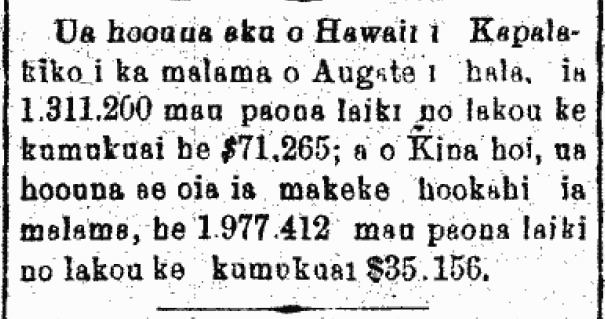
Food Exports, 1890.

[Found under: “HAWAII NEWS”]

Hawaii exported to San Francisco in the month of this past August, 1,311,200 pounds of rice at the price of $71,265; and China exported to the same market in that month, 1,977,412 pounds of rice at the price of $35,156.

[What a different world we live in where we import most of our food…]

(Ko Hawaii Pae Aina, 10/18/1890, p. 2)

Ua hoouna aku o Hawaii i Kapalakiko...

Ko Hawaii Pae Aina, Buke XIII, Helu 42, Aoao 2. Okatoba 18, 1890.

One more related article on Kalaupapa, 1867.

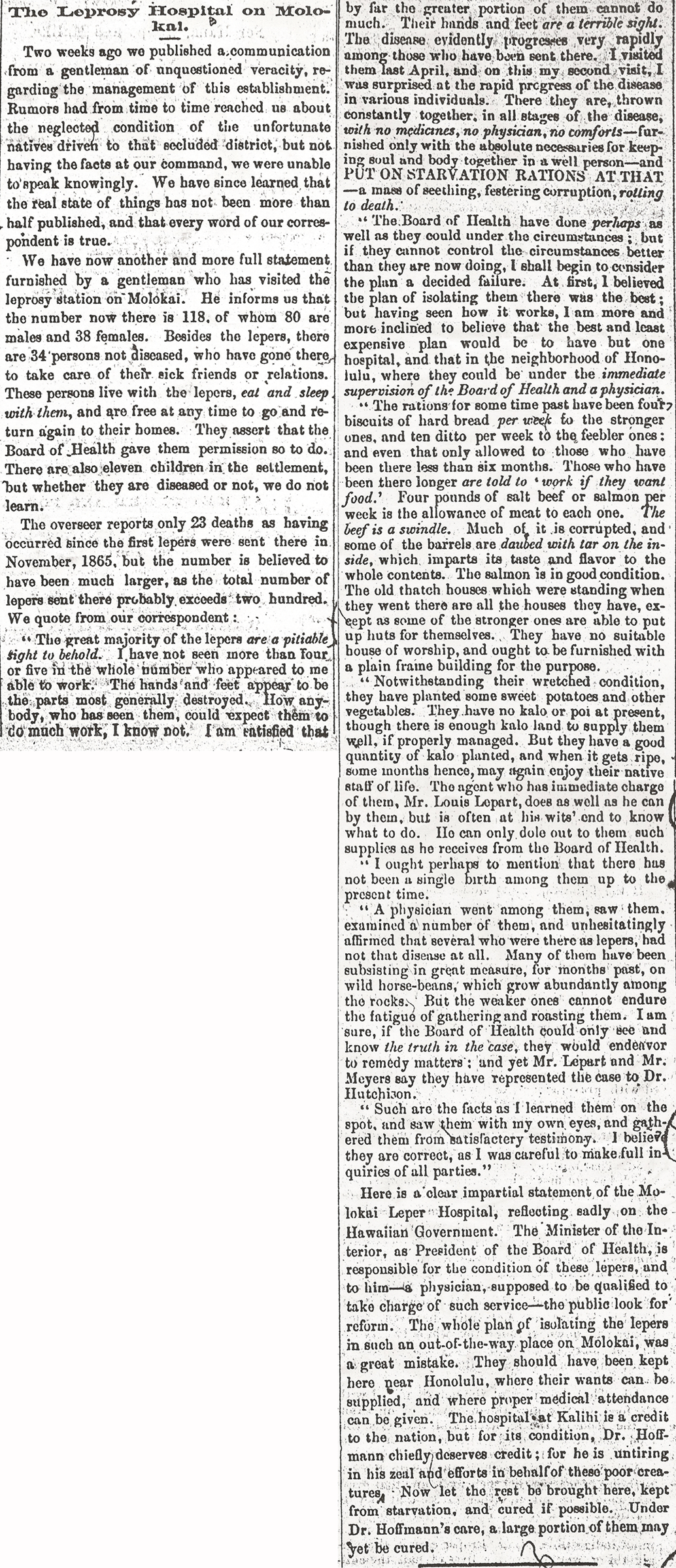
The Leprosy Hospital on Molokai.

Two weeks ago we published a communication from a gentleman of unquestioned veracity, regarding the management of this establishment. Rumors had from time to time reached us about the neglected conditions of the unfortunate natives driven to that secluded district, but not having the facts at our command, we were unable to speak knowingly. We have since learned that the real state of things has not been more than half published, and that every word of our correspondent is true.

We have no another and more full statement furnished by a gentleman who has visited the leprosy station on Molokai. He informs us that the number now there is 118, of whom 80 are males and 38 females. Besides the lepers, there are 34 persons not diseased, who have gone there to take care of their sick friends or relations. These persons live with the lepers, eat and sleep with them, and are free at any time to go and return again to their homes. They assert that the Board of Health gave them permission so to do. There are also eleven children in the settlement, but whether they are diseased or not, we do not learn.

The overseer reports only 23 deaths as having occurred since the first lepers were sent there in November, 1865, but the number is believed to have been much larger, as the total number of lepers sent there probably exceeds two hundred. We quote from our correspondent:

“The great majority of the lepers are a pitiable sight to behold. I have not seen more than four or five in the whole number who appeared to me able to work. The hands and feet appear to be the parts most generally destroyed. How anybody, who has seen them, could expect them to do much work, I know not. I am satisfied that by far the greater portion of them cannot do much. Their hands and feet are a terrible sight. The disease evidently progresses very rapidly among those who have been sent there. I visited them last April, and on this my second visit, I was surprised at the rapid progress of the disease in various individuals. There they are, thrown constantly together, in all stages of the disease, with no medicines, no physicians, no comforts—furnished only with the absolute neccessaries for keeping soul and body together in a well person—and PUT ON STARVATION RATIONS AT THAT—a mass of seething, festering corruption, rotting to death.

“The Board of Health have done perhaps as well as they could under the circumstances; but if they cannot control the circumstances better than they are now doing, I shall begin to consider the plan a decided failure. At first, I believed the plan of isolating them there was the best; but having seen how it works, I am more and more inclined to believe that the best and least expensive plan would be to have but one hospital, and that in the neighborhood of Honolulu, where they could be under the immediate supervision of the Board of Health and a physician.

“The rations for some time past have been four biscuits of hard bread per week to the stronger ones, and ten ditto per week to the feebler ones: and even that only allowed to those who have been there less than six months. Those who have been there longer are told to ‘work if they want food.’ Four pounds of salt beef or salmon per week is the allowance of meat to each one. The beef is a swindle. Much of it is corrupted, and some of the barrels are daubed with tar on the inside, which imparts its taste and flavor to the whole contents. The salmon is in good condition. The old thatch houses which were standing when they went there are all the houses they have, except as some of the stronger ones are able to put up huts for themselves. They have no suitable house of worship, and ought to be furnished with a plain frame building for the purpose.

“Notwithstanding their wretched condition, they have planted some sweet potatoes and other vegetables. They have no kalo or poi at present, though there is enough kalo land to supply them well, if properly managed. But they have a a good quantity of kalo planted, and when it gets ripe, some months hence, may again enjoy their native staff of life. The agent who has immediate charge of them, Mr. Louis Lepart, does as well as he can by them, but is often at his wits’ end to know what to do. He can only dole out to them such supplies as he receives from the Board of Health.

“I ought perhaps to mention that there has not been a single birth among them up to the present time.

“A physician went among them, saw them, examined a number of them, and unhesitatingly affirmed that several who were there as lepers, had not that disease at all. Many of them have been subsisting in great measure, for months past, on wild horse-beans, which grow abundantly among the rocks. But the weaker ones cannot endure the fatigue of gathering and roasting them. I am sure, if the Board of Health could only see and know the truth in the case, they would endeavor to remedy matters; and yet Mr. Lepart and Mr. Meyers say they have represented the case to Dr. Hutchison.

“Such are the facts as I learned them on the spot, and saw them with my own eyes, and gathered them from satisfactery testimony. I believe they are correct, as I was careful to make full inquiries of all parties.”

Here is a clear impartial statement of the Molokai Leper Hospital, reflecting sadly on the Hawaiian Government. The Minister of the Interior, as President of the Board of Health, is responsible for the condition of these lepers, and to him—a physician, supposed to be qualified to take charge of such a service—the public look for reform. The whole plan of isolating the lepers in such an out-of-the-way place on Molokai, was a great mistake. They should have been kept here near Honolulu, where their wants can be supplied, and where proper medical attendance can be given. The hospital at Kalihi is a credit to the nation, but for its condition, Dr. Hoffmann chiefly deserves credit; for he is untiring in his zeal and efforts in behalf of these poo creatures. Now let the rest be brought here, kept from starvation, and cured if possible. Under Dr. Hoffmann’s care, a large portion of them may yet be cured.

(Pacific Commercial Advertiser, 1/12/1867, p. 3)

The Leprosy Hospital on Molokai.

The Pacific Commercial Advertiser, Volume XI, Number 28, Page 3. January 12, 1867.

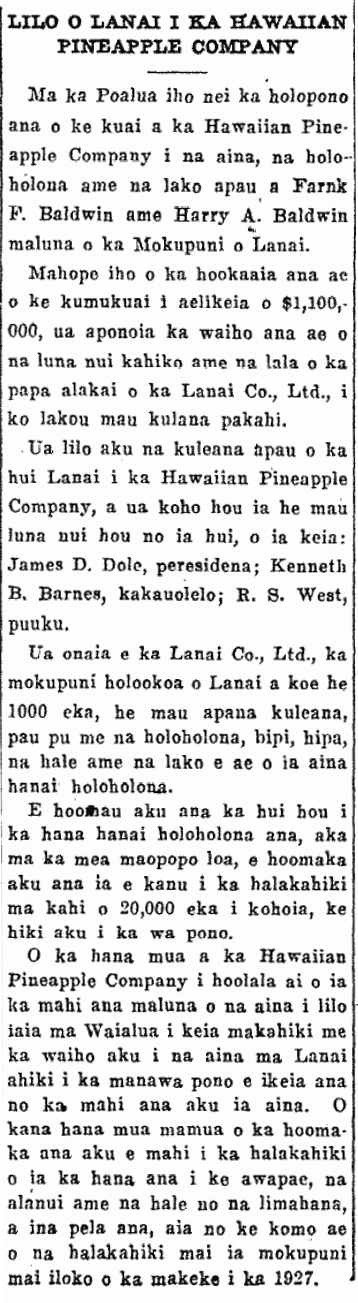
Hawaiian Pine purchases Lanai, 1922.

LANAI GOES TO THE HAWAIIAN PINEAPPLE COMPANY

Last Tuesday the deal went through for Hawaiian Pineapple Company to purchase the land, the animals, and all equipment of Frank F. Baldwin and Harry A. Baldwin upon the Island of Lanai.

After paying the agreed price of $1,100,000, the retention of the old head managers and the members of the board of supervisors [papa alakai] of the Lanai Company, Ltd., of each of their positions was approved.

All of the rights of the Lanai Company has accrued to the Hawaiian Pineapple Company, and a number of new leaders have been chosen for that company, those being: James D. Dole, president; Kenneth B. Barnes, secretary; R. S. West, treasurer.

The entirety of Lanai is owned by the Lanai Co., Ltd, except for 1,000 acres, some kuleana lands, and all animals, cows, sheep, structures and other equipment of the ranch.

The new company will continue ranching, however, according to what is clearly understood, it will begin to plant pineapple on approximately 20,000 acres of chosen land, when the time is right.

The first thing planned by the Hawaiian Pine Company is to farm on land bought in Waialua this year while put aside the lands on Lanai until the right time comes to farm there. What it must do prior to farming pineapple is to build a pier, roads, and housing for the laborers, and if that happens, then pineapple from that island will hit the market in 1927.

(Kuokoa, 12/7/1922, p. 1)

LILO O LANAI I KA HAWAIIAN PINEAPPLE COMPANY

Ka Nupepa Kuokoa, Buke LXI, Helu 49, Aoao 1. Dekemaba 7, 1922.

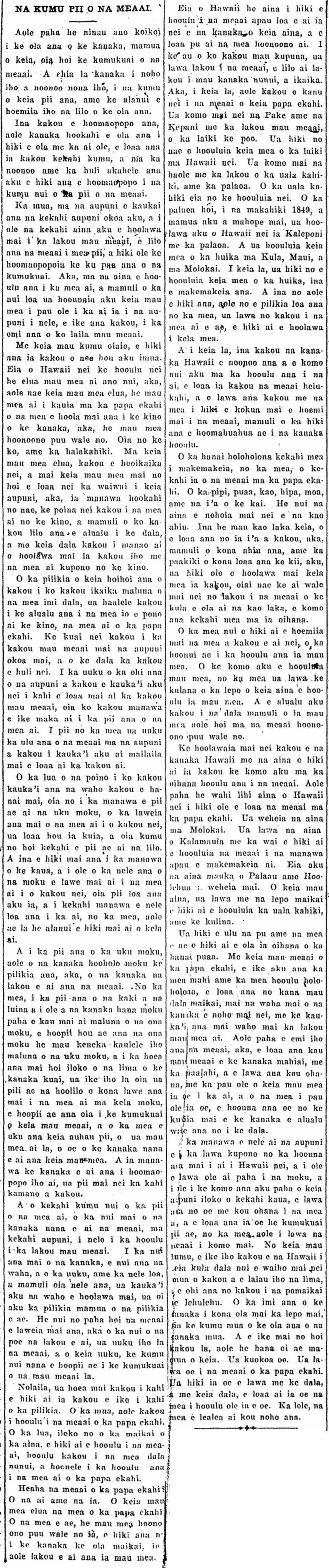
Rising food prices: Will politicians ever learn? 1923 / timeless.

REASONS FOR THE RISING COST OF FOOD.

There is perhaps no other more important question pertaining to the life of man than that of the cost of food. How many people have sat down and thought to themselves about the reasons for the rising costs and ways to lessen their living expenses.

If we consider that there is no man on earth that can live without food, then we can find a reason; and through thought and careful consideration, we can figure out the major reasons for the rise in food prices.

First of all, for nations who rely upon other nations or other lands to supply their food, their food will be expensive, and food price stability will not be realized. But for a land that produces its own food, and exports the excess to nations who are lacking, they will see a fall in their food costs.

With these facts, we can move forward. Here we are in Hawaii, growing two major crops, however these two things are not main dishes which give sustenance to the body, but they are just treats. They being sugar and pineapple. We are putting our efforts into these two things and this nation draws its income from it; however, at the same time, we are forgetting about the foods necessary for the body, and because we are so focused on chasing after money, we assume that these funds will supply us with food for nourishment.

The problem with our focus on the pursuit of money, is that we neglect looking after the actual things that are necessary for our bodies, the main staples. We are purchasing our food from foreign nations, while we are in pursuit of making money. When the nations which we rely upon to get our food have a small harvest, this is the time we will see an increase in the costs of food. It will rise because of the small amount of food growing in those countries in which we rely upon from where we get our food.

The second detriment to us in relying on the outside for feeding us is that when the shipping costs rise to ship in the food to us, there will be another set back, and that will be another reason the costs will rise. And should the occasion arise when there is war, or the lack of ships to bring our food, then the prices will shoot up; or there will be times when there is no food, because there will be no means to get the food.

And when the shipping costs rise, it will not be the sailors who will be in trouble, but it will be those who eat the food. For with the increase in the costs to the ship owners for pay for the sailors, or the ship builders perhaps, the ship owners will add on some pennies to the shipping charges, and when this comes to the hands of the consumer, he will understand that the expense to ship food here by boat resulted in an increase in the price of food; and the one paying the exorbitant prices for those foods is you, who eat them. And when the person is eating, he will see that the price of salmon here has risen.

And another factor in the rise of food costs is the number of people who eat the food, in a country that does not produce its own food. With the increase in population, the number of mouths will increase, so there will be less, or just doing without; and as a result of this lack, and to remedy it, the outside is relied upon to make up for this, and this is a problem bigger than all others. There may be a great amount of food brought in, but in comparison to the number of those who eat the food, that food is only a little, which is the main reason for the rise in food costs.

Therefore, we have come to where we can see where the problem lies. First, we do not grow staples. Second, although we have fertile land upon which we can grow food, we just grow things that bring in money and go without growing main foods.

What are staples? Vegetables and meat. These two things are staples. Other things are just treats, and man can live without them.

Here is Hawaii, a land where all foods can be grown which people eat here, along with the condiments. During the times of our ancestors, they had ample food so that they became big and strong. But these days, we are not planting staples. The Chinese and Japanese have come with their foods, with rice being the main food. This rice can be grown here in Hawaii nei. The haole came with their thing, the Irish potato and bread. Potatoes are being grown here now. As for flour, in the year 1849 or there about, Hawaii supplied California with flour. Wheat was grown in Kula, Maui, and on Molokai. Today, wheat can be grown should we desire. And if it is not possible, this is not a problem, because we are satisfied with other foods that can take its place.

And today, should we Hawaiians consider joining together in the growing of food, we will have the best food, and we will have produce that will help lessen the cost of food, as a result of this increase in the number of farmers.

The raising of livestock is also something needed, for that is a staple. Cows, pigs, goats, sheep, chicken, and the fishes of the sea. There is a lot of land now lived on by wild goats. If they were domesticated goats, then we’d have that meat, but because it is wild, and hard to get, it will not be enough for us; all the while the wild goats are feeding off of the fields which is for the sustenance of domesticated goats; some people are going into this profession.

The main thing that will lessen the costs of our food that we eat is the increasing of the growing of those foods; the joining into the growing of these things, because the quality of soil of this land is sufficient to grow these things. And let us look to making money through that, and not solely from treats.

We Hawaiians are supplied with land where we can enter into the occupation of growing food. There is probably no piece of land in Hawaii where staples cannot be grown. The land of Molokai has been opened up. The land of Kalamaula has enough water to grow food whenever it is desired. The lands upland of Palaau and Hoolehua will be opened up. These lands have soil good enough to grow Irish potatoes and corn.

Melons and other things can be grown which can support pig farming. With these staple foods, the farmer and those that raise livestock will receive good money from the mouths of those who live here, while being relied upon by those from outside to supply their food. Maybe the food won’t be cheaper, but you will have your food, O Farmer, with ease, and your family will be supplied, without it all being consumed; and the leftover, you can sent out to be purchased by those in pursuit of making money.

When foreign nations don’t have enough to send food to Hawaii, or when there are not enough ships, or if this nation enters into war, you and your family will have enough food, and you will get a higher price, because there will not be enough food imported. For these reasons, let us Hawaiians recognize these fields of gold stretched out before us, and let us grab it and harvest its many blessings. The seeking of one’s livelihood from the soil was the first way of life of the earliest men. And we know that there is no greater occupation than this. You are independent. You will have enough staple foods. You will have enough money, and with this money, you will have things that you do not grow. Clothes and things that make your life pleasant.

[I dedicate this to all the awesome farmers out there, both big and small (and fishermen and ranchers and dairy people for that matter). Also to the farmers’ markets, and establishments who support them. And to you, the people who try to buy local first. Conversely, I would like all of you politicians and others who think that agricultural lands and farmers are not important, to think about the big picture before another 89 years pass by. At this rate, we will be leaving the next generations with a very dismal way of life.]

(Kuokoa, 2/15/1923, p. 2)
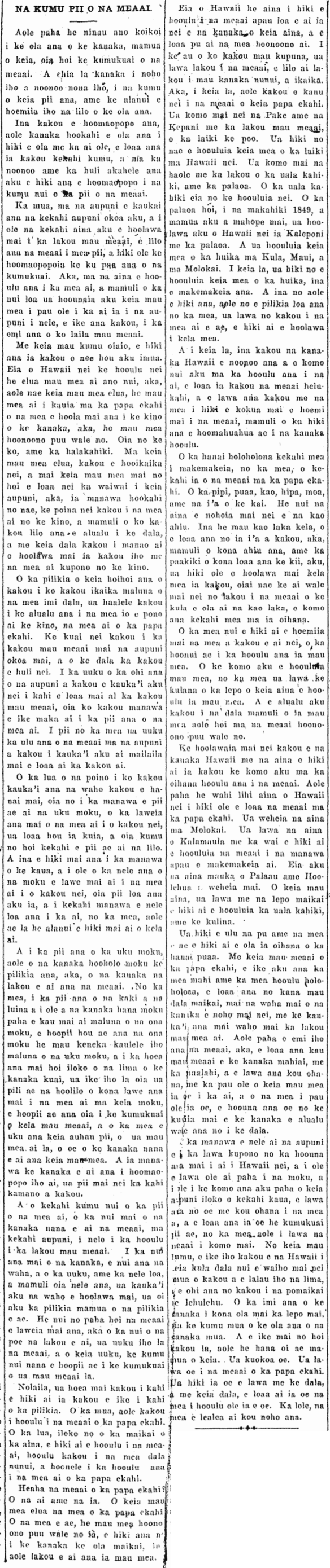
NA KUMU PII O NA MEAAI.

Ka Nupepa Kuokoa, Buke LXII, Helu 7, Aoao 2. Feberuari 15, 1923.

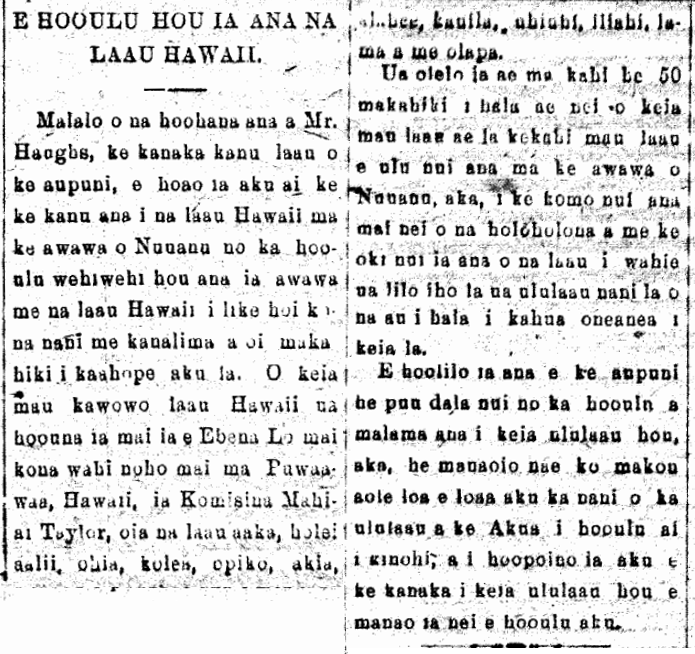
Replanting of native plants, 1901!

HAWAIIAN PLANTS WILL BE GROWN AGAIN.

Under the direction of Mr. Haughs, the nurseryman of the government, the planting of Hawaiian plants in the valley of Nuuanu will be attempted, to make that valley verdant once again with native plants, so that it will be just as beautiful as it was fifty or more years ago. These seedlings were sent by Ebena Lo [Eben Low] from his residence at Puuwaawaa, Hawaii, to Commissioner Taylor, those being aaka, holei, aalii, ohia, kolea, opiko, akia, alahee, kauila, uhiuhi, iliahi, lama, and olapa.

It is said that it has been about 50 years that these plants were growing in abundance in Nuuanu Valley, for with the influx of animals and the mass cutting of trees for firewood, the beautiful forest of times gone by became a barren field.

The government will spend a sum of money to grow and foster this new forest, however, we believe that there is no way that the beauty of the forest which God grew originally and which was damaged by man will be attained by this new forest which is intended to be grown.

(Aloha Aina, 12/7/1901, p. 4)

E HOOULU HOU IA ANA NA LAAU HAWAII.

Ke Aloha Aina, Buke VII, Helu 49, Aoao 4. Dekemaba 7, 1901.

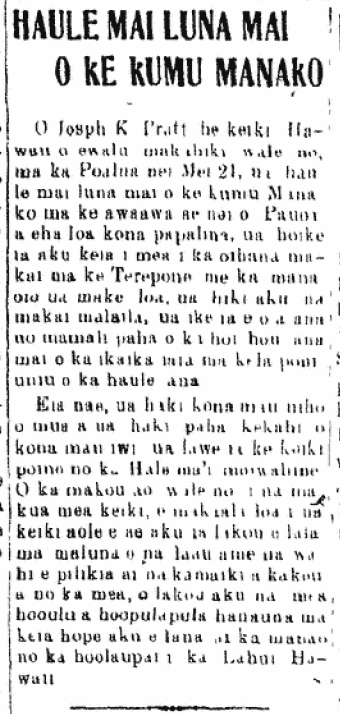
Dangers of Mango Season, 1912.

FELL FROM A MANGO TREE.

Joseph K. Pratt, a Hawaiian boy of just eight years of age, on this Tuesday, the 21st of May, fell from a Mango tree in Pauoa Valley, and his cheek was severely hurt; this information was given to the police department over the Telephone with belief that he was dead, but the police arrived there and it was seen that he was alive, perhaps because he regained consciousness from the dizziness after falling.

However, he broke his front teeth and maybe he broke some of his bones; the injured child was taken to Queen’s Hospital. Our instruction to parents of children is to watch over them and not allow them to climb on trees and places that would put the children of ours in danger, for they are the ones who will increase and procreate the generations here forward and through which there is hope for the increase of the Hawaiian Race.

[Words to live by: whether in 1912 or a hundred years later in 2012.]

(Kuokoa Home Rula, 5/24/1912, p. 1)

HAULE MAI LUNA MAI O KE KUMU MANAKO

Kuokoa Home Rula, Buke X, Helu 21, Aoao 1. Mei 24, 1912.

Niihau purchased for $10,800. 1864.

The Haole are Really Working Niihau.

O Kuokoa Newspaper; Aloha to you:—I met up with the newspaper article under News of Hawaii, in Issue 15 of the 9th of April, about the selling of Niihau to Mr. James Francis Sinclair, for $10,800, along with the lands of Kuakanu, which are the konohiki lands of Halewela and Kahuku, which the Government sold to the one named above, along with the konohiki lands, and this whole island has gone to the haole; perhaps you all and those others as well have heard that Niihau was sold, along with those penny-pinching folks who don’t get the shining beacon of Hawai nei through the Kuokoa Newspaper. And it is we who know of the great, who know of the small, and who know of the wide, that knows of the selling from Kii to Kawaihoa, from the Makahuena Point to Pueo Point; everything upon the land is bought and there is nothing left for us, the Hawaiians, under the haole owners.

Their Way of Living: They are pleasant and good, and speak nicely with the people, but they are not very proficient in the Hawaiian language. The haole say, “mahope aku kumaki” [?] There are ten Hawaiians, caretakers [hoaaina] of the land, chosen from amongst the locals, but two are from elsewhere, they are newcomers, one from Hawaii and the other from Maui, and including them there are ten caretakers. Here are each of their names which the haole selected: A. Puko, D. Kauki, Hetesia, J. H. Kanakaiki, P. R. Holiohana, H. Haokaku, Mose Kanohai, Ioela, Kapahee and Pouli; Kanakaiki is from Napoopoo, Hawaii, and Holiohana is from Hana, Maui, and are locals from there. Those caretakers are in charge of the three work days every month just like the konohiki of the chiefs, should there be work by haole owner to be done.

Their Number: Mr. James Francis Sinclair them total twelve in number; two brothers, three sisters, five children, one mother, and one in-law, which totals twelve; they live in Kununui; they are religious, with one God, but their religion is very different; their houses were constructed in Britain and brought to Niihau: three houses, one currently stands, and two more to follow; we appreciate how nice and beautiful it is to see.

Dealing with the Animals: There are two horses per man and woman, and should there be three, it is killed, and so forth; as for dogs, there are none left, they were all killed, from the big ones to the small ones because sheep were being killed, and so the government is without money from the dog tax, also the goats were all killed. You Kauai people who own horses and sheep, get them quick, don’t dawdle, or they will be taken by the haole.

Things Grown by the People.

The Hawaiians consume what they produce, and they also assist with the land owners in the watering of the sweet potato, ke pola akaakai [?], and chickens, as long as they were pleasant, or else that was that.

On the Number of Sheep

Set loose on Niihau are the sheep which you have perhaps seen in our Newspaper; as for the count, you probably have not heard; this is the truth as to the abundance or dearth: the number of sheep is 3,400, with 1,400 belonging to the Hon. W. Webster and 2,000 belonging to the King; there is no end to their desire for sheep.

Sugar Cane Cultivation.

Niihau will be planted with sugar cane if the test on one acre goes well; and if the cane grows nicely, then planting will commence, but if it doesn’t grow, that’s it, because it is an arid land.

This is an undesirable land for those foreigners seeking to make money because it is dry and scorched by the sun, and crops die; but here are people who are after wealth, and they tell us, the locals, that this is very valuable land for sheep and cane; our good friend, H. M. Whitney, the local of Waimea and Niihau, along with his parents, are familiar with this island and its extreme heat in the Makalii months [summer]. I will stop writing as the Naulu rain of Niihau is falling. With aloha.

P. R. Holiohana.

Kihalaui, Niihau, May 2, 1864.

[This P. R. Holiohana (later it seems he goes by the name P. R. Holi) writes in to the newspapers often from Niihau on a number of subjects.]

(Kuokoa, 6/4/1864, p. 1)

Hana io ka Haole ia Niihau.

Ka Nupepa Kuokoa, Buke III, Helu 23, Aoao 1. Iune 4, 1864.