Patriotism, sovereignty, and unity, 1894.

A CALL.

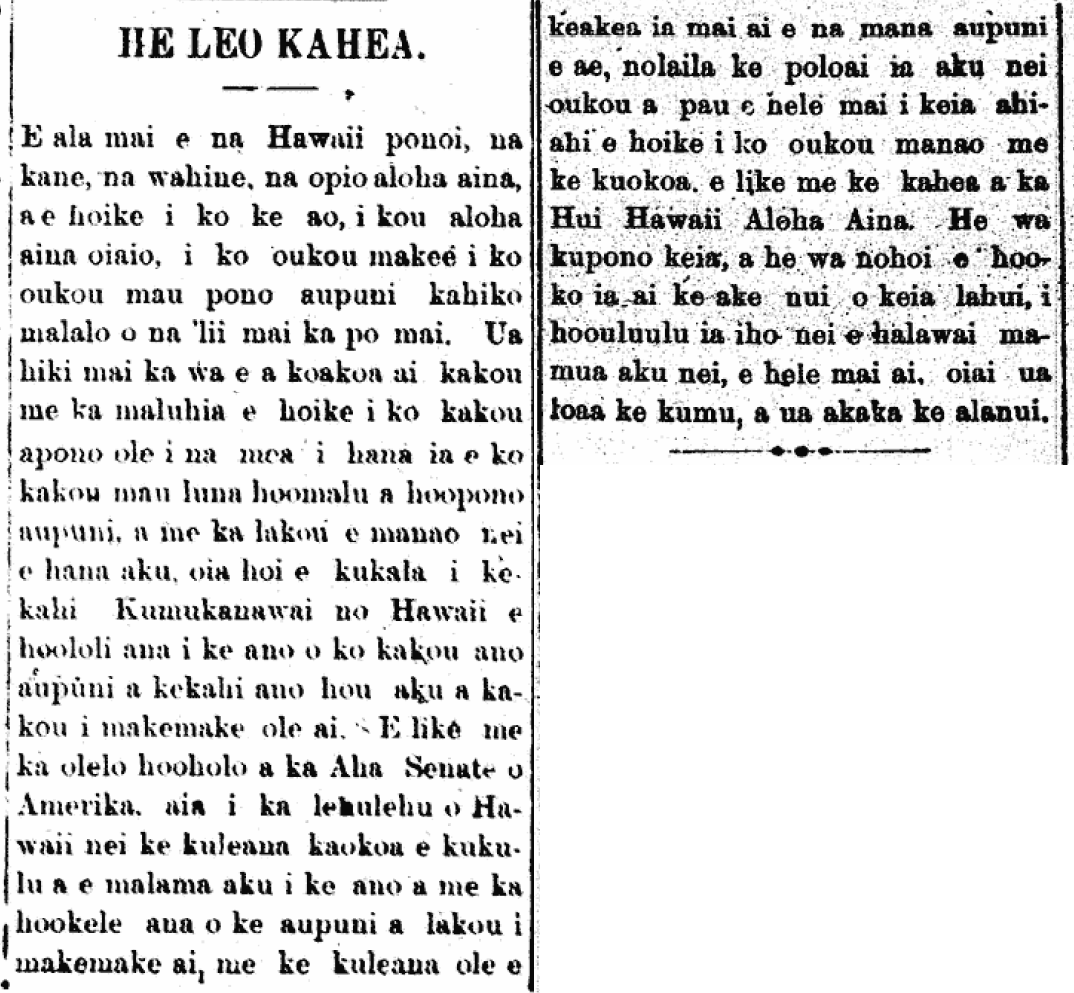
Rise, O Hawaii’s Own, patriotic men, women, and youth, and show to the world your true patriotism, how you treasure your traditional rights to the land under the alii from time immemorial. It is time that we come together in peace to show our disapproval of what is being done by the our nation’s administrators, that being their proclaiming of a Constitution for Hawaii that changes the nature of our nation and other things which we do not desire. As per the resolution of the Senate of America, to the people of Hawaii belongs the total right to establish and protect the form and the leadership of their nation as they desire, without interference from other national powers, therefore, you are all being summoned to come this evening to show your thoughts and independence, in accordance with this call by the Hawaiian Patriotic League. This is the right time, the time when the great desire of this lahui who were just earlier stirred to meet, to come, for there is a goal and the means to it is clear.

(Leo o ka Lahui, 7/2/1894, p. 2)

HE LEO KAHEA.

Ka Leo o ka Lahui, Buke II, Helu 974, Aoao 2. Iulai 2, 1894.

D. L. Conkling, from bicyclist to treasurer, 1909.

BICYCLE RACER IS NOW TERRITORIAL TREASURER

David L. Conkling Is Given Fat Job in Hawaii

[Special Correspondence of the Call]

HONOLULU, July 2.—David Lloyd Conkling, formerly chief clerk of the territory, has been appointed territorial treasurer to succeed A. M. Campbell, whom the senate refused to confirm.

Conkling is a young man who came to Hawaii from San Francisco as a fancy bicycle rider and racer, having been well known on the coast tracks 10 years ago.

After the bicycle craze died out he became purser on one of the inter-island steamers and later was a reporter for the Honolulu papers. He was appointed chief clerk by Governor Carter and received his promotion from Governor Frear.

Conkling’s appointment has been received with general favor.

(San Francisco Call, 7/11/1909, p. 28)

BICYCLE RACER IS NOW TERRITORIAL TREASURER

San Francisco Call, Volume CVI, Number 41, Page 28. July 11, 1909.

Hawaii and the United States, 1911.

Hawaii is a Gold Mine for America

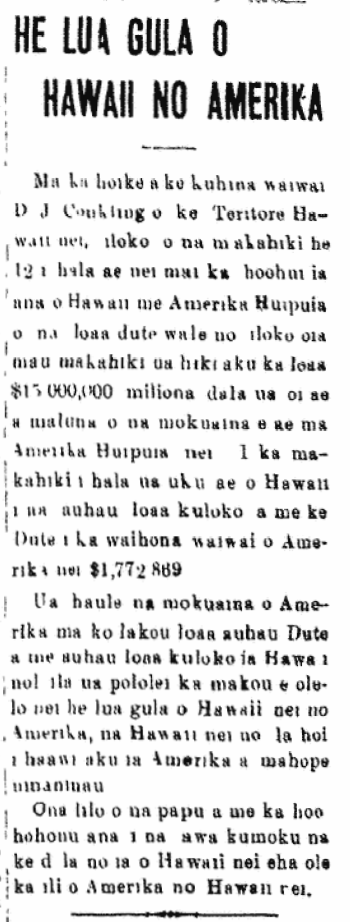
According to the report by the treasurer of the Territory of Hawaii, D. L. Conkling, in the 12 years which have passed since the annexation of Hawaii to America, the income just from duties during that time come to more than $15,000,000, more than the other states of the United States. In the past year, Hawaii paid $1,772,869 in income taxes and duties to the coffers of America.

The rest of the states fell behind Hawaii in duties and income taxes, and therefore what we say about Hawaii being a gold mine for America is true; it is Hawaii who gave it to America then asked questions.

All of the expenses for the forts and the dredging of the harbors are paid for by Hawaii’s dollars, and America suffers nothing for Hawaii.

(Kuokoa Home Rula, 8/11/1911, p. 1)

HE LUA GULA O HAWAII NO AMERIKA

Kuokoa Home Rula, Buke IX, Helu 32, Aoao 1. Augate 11, 1911.

Constitution of the Hawaiian Patriotic League, in English, 1893.

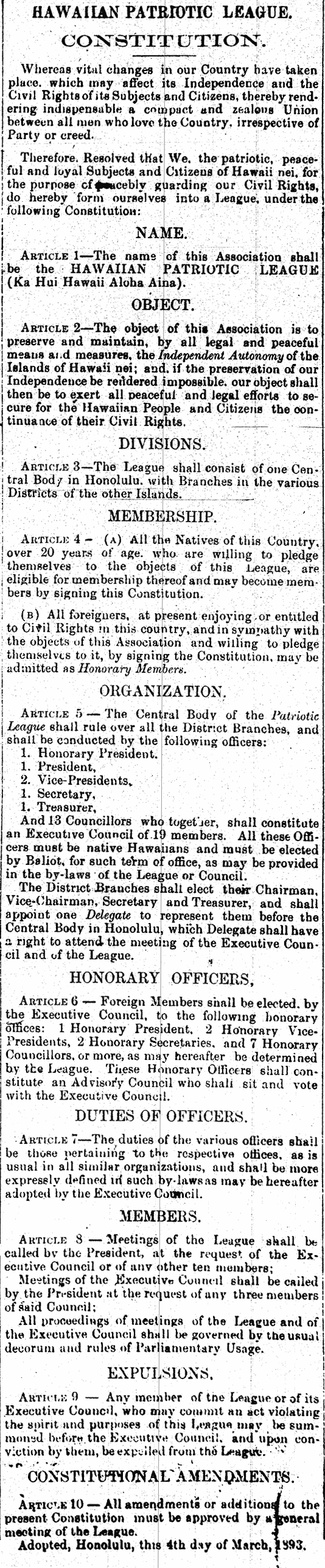
HAWAIIAN PATRIOTIC LEAGUE.

CONSTITUTION.

Whereas vital changes in our Country have taken place, which may affect its Independence and the Civil Rights of its Subjects and Citizens, thereby rendering indispensable a compact and zealous Union between all men who love the Country, irrespective of Party or creed.

Therefore, Resolved that We, the patriotic, peaceful and loyal Subjects and Citizens of Hawaii nei, for the purpose of peaceably guarding our Civil Rights, do hereby form ourselves into a League, under the following Constitution:

NAME.

Article 1—The name of this Association shall be the HAWAIIAN PATRIOTIC LEAGUE (Ka Hui Hawaii Aloha AIna).

OBJECT.

Article 2—The object of this Association is to preserve and maintain, by all legal and peaceful means and measures, the Independent Autonomy of the Islands of Hawaii nei; and, if the preservation of our Independence be rendered impossible, our object shall then be to exert all peaceful and legal efforts to secure for the Hawaiian People and Citizens the continuance of their Civil Rights.

DIVISIONS.

Article 3—The League shall consist of one Central Body in Honolulu, with Branches in the various Districts of the other Islands.

MEMBERSHIP.

Article 4—(A) All the Natives of this Country, over 20 years of age, who are willing to pledge themselves to the objects of this League, are eligible for membership thereof and may become members by signing this Constitution.

(B) All foreigners, at present enjoying or entitled to Civil Rights in this country, and in sympathy with the objects of this Association and willing to pledge themselves to it, by signing the Constitution, may be admitted as Honorary Members.

ORGANIZATION.

Article 5—The Central Body of the Patriotic League shall rule over all the District Branches , and shall be conducted by the following officers:

1. Honorary President,

1. President,

2. Vice-Presidents,

1. Secretary,

1. Treasurer,

And 13 Councillors who together, shall constitute an Executive Council of 19 members. All these Officers must be native Hawaiians and must be elected by Ballot, for such term of office, as may be provided in the by-laws of the League or Council.

The District Branches shall elect their Chairman, Vice-Chairman, Secretary and Treasurer, and shall appoint one Delegate to represent them before the Central Body in Honolulu, which Delegate shall have a right to attend the meeting of the Executive Council and of the League.

HONORARY OFFICERS,

Article 6—Foreign Members shall be elected by the Executive Council, to the following honorary offices: 1 Honorary President, 2 Honorary Vice-Presidents, 2 Honorary Secretaries, and 7 Honorary Councillors, or more, as may hereafter be determined by the League. These Honorary Officers shall constitute and Advisory Council who shall sit and vote with the Executive Council.

DUTIES OF OFFICERS.

Article 7—The duties of the various officers shall be those pertaining to the respective offices, as is usual in all similar organizations, and shall be more expressly defined in such by-laws as may be hereafter adopted by the Executive Council.

MEMBERS.

Article 8—Meetings of the League shall be called by the President, at the request of the Executive Council or of any other ten members;

Meetings of the Executive Council shall be called by the President at the request of any three members of said Council;

All proceeding s of meetings of the League and of the Executive Council shall be governed by the usual decorum and rules of Parliamentary Usage.

EXPULSIONS.

Article 9—Any member of the League or of its Executive Council, who may commit an act violating the spirit and purposes of this League may be summoned before the Executive Council, and upon conviction by them, be expelled from the League.

CONSTITUTIONAL AMENDMENTS.

Article 10—All amendments or additions to the present Constitution must be approved by a general meeting of the League.

Adopted, Honolulu, this 4th day of March, 1893.

[See the Hawaiian-Language Constitution here!]

(Leo o ka Lahui, 3/22/1893, p. 3)

HAWAIIAN PATRIOTIC LEAGUE.

Ka Leo o ka Lahui, Buke II, Helu 667, Aoao 3. Maraki 22, 1893.

Constitution of the Hawaiian Patriotic League, in Hawaiian, 1893.

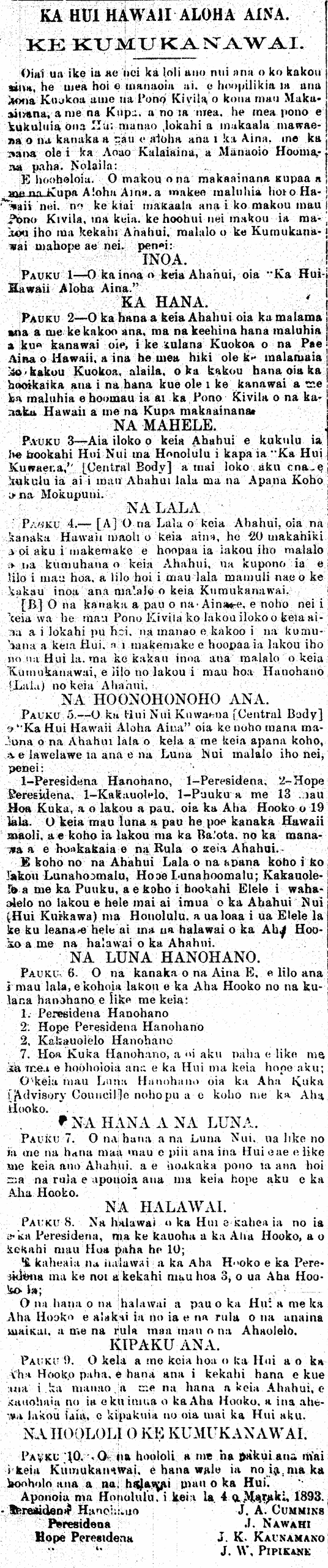
KA HUI HAWAII ALOHA AINA.

KE KUMUKANAWAI.

Oiai ua ike ia ae nei ka loli ano nui ana o ko kakou aina, he mea hoi e manaoia ai, e hoopilikia ia ana kona Kuokoa ame na Pono Kivila o kona mau Makaainana, a me na Kupa, a no ia mea, he mea pono e kukuluia ona Hui manao lokahi a makaala mawaena o na kanaka a pau e aloha ana i ka Aina, me ka nana ole i ka Aoao Kalaiaina, a Manaoio Hoomana paha. Nolaila:

E hooholoia. O makou o na makaainana kupaa a me na Kupa Aloha Aina a makee maluhia hoi o Hawaii nei, no ke kiai makaala ana i ko makou mau Pono Kivila, ma keia, ke hoohui nei makou ia makou iho ma kekahi Ahahui, malalo o ke Kumukanawai mahope ae nei. penei:

INOA.

Pauku 1—O ka inoa o keia Ahahui, oia “Ka Hui Hawaii Aloha Aina.”

KA HANA.

Pauku 2—O ka hana a keia Ahahui oia ka malama ana a me ke kakoo ana, ma na keehina hana maluhia a kue kanawai ole, i ke kulana Kuokoa o na Pae Aina o Hawaii, a ina he mea hiki ole ke malamaia ko lakou Kuokoa, alaila, o ka kakou hana oia ka hooikaika ana i na hana kue ole i ke kanawai a me ka maluhia e hoomau ia ai ka Pono Kivila o na kanaka Hawaii a me na Kupa makaainana.

NA MAHELE.

Pauku 3—Aia iloko o keia Ahahui e kukulu ia he hookahi Hui Nui ma Honolulu i kapa ia “Ka Hui Kuwaena,” [Central Body] a mai loko aku ona e kukulu ia ai i ma Ahahui lala ma na Apana Koho o na Mokupuni.

NA LALA.

Pauku 4—[A] O na Lala o keia Ahahui, oia na kanaka Hawaii maoli o keia aina, he 20 makahiki a oi aku i makemake e hoopaa ia lakou iho maloko o na kumuhana o keia Ahahui, ua kupono ia e lilo i mau hoa, a lilo hoi i mau lala mamuli nae o ke kakau inoa ana malalo o keia Kumukanawai.

[B] O na kanaka a pau o na Aina e, e noho nei i keia wa he mau Pono Kivila ko lakou iloko o keia aina a i lokahi pu hoi, na manao e kakoo i na kumuhana a keia Hui, a i makemake e hoopaa ia lakou iho no ua Hui la, ma ke kakau inoa ana malalo o keia Kumukanawai, e lilo no lakou i mau hoa Hanohano (Lala) no keia Ahahui.

NA HOONOHONOHO ANA.

Pauku 5—O ka Hui Nui Kuwaena [Central Body] o “Ka Hui Hawaii Aloha Aina” oia ke noho mana maluna o na Ahahui lala o kela a me keia apana koho, a e lawelawe ia ana e na Luna Nui malalo iho nei, penei:

1—Peresidena Hanohano, 1—Peresidena, 2—Hope Peresidena, 1—Kakauolelo, 1—Puuku a me 13 mau Hoa Kuka, a o lakou a pau, oia ka Aha Hooko o 19 lala. O keia mau luna a pau he poe kanaka Hawaii maoli, a e koho ia lakou ma ka Balota, no ka manawa a e hoakakaia e na Rula o keia Ahahui.

E koho no na Ahahui Lala o na apana koho i ko lakou Lunahoomalu, Hope Lunahoomalu; Kakauolelo a me ka Puuku, a e koho i hookahi Elele i wahaolelo no lakou e hele mai ai imua o ka Ahahui Nui (Hui Kuikawa) ma Honolulu, a ua loaa i ua Elele la ke kuleana e hele ai ma na halawai o ka Aha Hooko a me na halawai o ka Ahahui.

NA LUNA HANOHANO.

Pauku 6. O na kanaka o na Aina E, e lilo ana i mau lala, e kohoia lakou e ka Aha Hooko no na kulana hanohano e like me keia:

1. Peresidena Hanohano

2. Hope Peresidena Hanohano

2. Kakauolelo Hanohano

7. Hoa Kuka Hanohano, a oi aku paha e like me ka mea e hooholoia ana e ka Hui ma keia hope aku;

O keia mau Luna Hanohano oia ka Aha Kuka [Advisory Council] e noho pu a e koho me ka Aha Hooko.

NA HANA A NA LUNA.

Pauku 7. O na hana a na Luna Nui, ua like no ia me na hana maa mau e pili ana ina Hui e ae e like me keia ano Ahahui, a e hoakaka pono ia ana hoi ma na rula e aponoia ana ma keia hope aku e ka Aha Hooko.

NA HALAWAI.

Pauku 8. Na halawai o ka Hui e kahea ia no ia e ka Peresidena, ma ke kauoha a ka Aha Hooko, a o kekahi mau Hoa paha he 10;

E kaheaia na halawai a ka Aha Hooko e ka Peresidena ma ke noi a kekahi mau hoa 3, o ua Aha Hooko la;

O na hana o na halawai a pau o ka Hui a me ka Aha Hooko e alakai ia no ia e na rula o na anaina maikai, a me na rula maa mau o na Ahaolelo.

KIPAKU ANA.

Pauku 9. O kela a me keia hoa o ka Hui a o ka Aha Hooko paha, e hana ana i kekahi hana e kue ana i ka manao a me na hana a keia Ahahui, e kauohaia no ia e ku imua o ka Aha Hooko, a ina ahewa lakou iaia, e kipakuia no oia ma ka Hui aku.

NA HOOLOLI O KE KUMUKANAWAI.

Pauku 10. O na hoololi a me na pakui ana mai i keia Kumukanawai, e  hana wale ia no ia ma ka hooholo ana a na halawai mau o ka Hui.

Aponoia ma Honolulu, i keia la 4 o Maraki, 1893.

Peresidena Hanohano  J. A. Cummins

Peresidena  J. Nawahi

Hope Peresidena  J. K. Kaunamano

” ”  J. W. Pipikane

[See the English-language version here.]

(Leo o ka Lahui, 3/22/1893, p. 3)

KA HUI HAWAII ALOHA AINA.

Ka Leo o ka Lahui, Buke II, Helu 667, Aoao 3. Maraki 22, 1893.

More on George Glendon and Samoa, 1890.

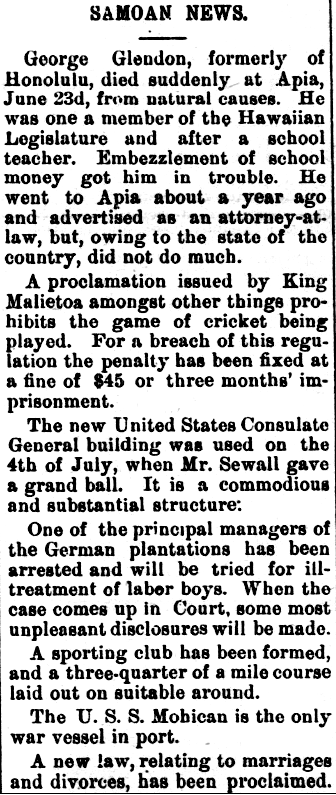
SAMOAN NEWS.

George Glendon, formerly of Honolulu, died suddenly at Apia, June 23d, from natural causes. He was one a member of the Hawaiian Legislature and after a school teacher. Embezzlement of school money got him in trouble. He went to Apia about a year ago and advertised as an attorney-at-law, but, owing to the state of the country, did not do much.

A proclamation issued by King Malietoa amongst other things prohibits the game of cricket being played. For a breach of this regulation the penalty has been fixed at a fine of $45 of three months’ imprisonment.

The new United States Consulate General building was used on the 4th of July, when Mr. Sewall gave a grand ball. It is a commodious and substantial structure.

One of the principal managers of the German plantation has been arrested and will be tried for ill-treatment of labor boys. When the case comes up in Court, some most unpleasant disclosures will be made.

A sporting club has been formed, and a three-quarter of a mile course laid out on suitable around.

The U. S. S. Mohican is the only war vessel in port.

A new law, relating to marriages and divorces, has been proclaimed.

(Pacific Commercial Advertiser, 7/28/1890, p. 2)

SAMOAN NEWS.

Pacific Commercial Advertiser, Volume XII, Number 23, Page 2. July 28, 1890.


Hawaiians deported from Samoa, 1891.

Hawaiians From Samoa

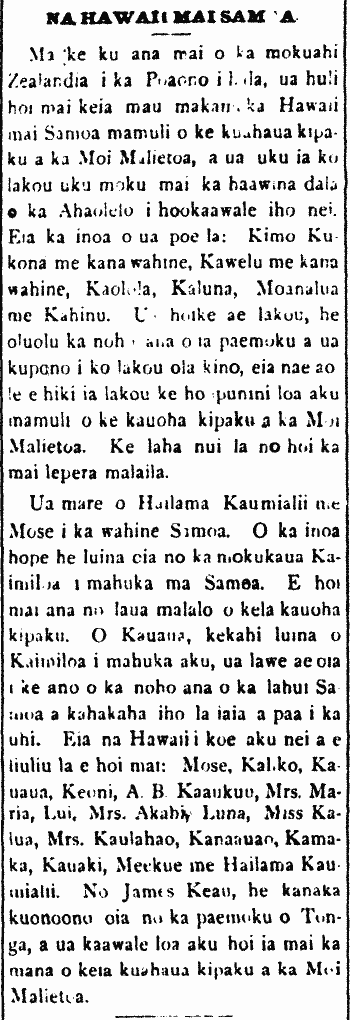
Aboard the steamship Zealandia which landed this past Saturday, these Hawaiian friends came back from Samoa due to the deportation proclamation by King Malietoa, and their passage was paid for by funds from the Legislature which was set aside. Here are their names: Kimo Kukona and wife, Kawelu and wife, Kaolola, Kaluna, Moanalua, and Kahinu. They said that life in those islands was comfortable, and suitable for the health, but they could not stay long because of King Malietoa’s deportation order. There is much leprosy spreading there.

Hairama Kaumialii and Mose wed Samoan wives. The latter named is a sailor on the Kaimiloa who abandoned ship at Samoa. They both will return under the deportation law. Kauaua, a sailor from the Kaimiloa who fled, assimilated to the Samoan way of life, and is covered in a tattoo. These are the Hawaiians who remained and are preparing to return: Mose, Kaliko, Kauaua, Keoni, A. B. Kaaukuu, Mrs. Maria, Lui, Mrs. Akahi, Luna, Miss Kalua, Mrs. Kaulahao, Kanaauao, Kamaka, Kauaki, Meekue, and Hailama Kaumialii. As for James Keau, he is well off, living in the islands of Tonga, and is far from the authority of this expulsion order by King Malietoa.

[If some of my posts look familiar to some of you, they are being reposted from my old Hoolaupai Facebook page. They cannot be easily found on that page, and that was one of the major reasons for starting this one. Here at least i can do tags and categories, and hopefully that makes them easier to find. Google also does a pretty good job of making them searchable!]

(Kuokoa, 1/17/1891, p. 2)

NA HAWAII MAI SAMOA

Ka Nupepa Kuokoa, Buke XXX, Helu 3, Aoao 2. Ianuari 17, 1891.

The pioneers of the Hawaiian Homes Lands in Kalamaula, Molokai, 1922.

Eight Ohana will Head First to the Homestead Lands at Molokai

The Hawaiian Homes Commission Chose those People who were Thought to be Appropriate for Going First to the Lands of Kalamaula, Molokai

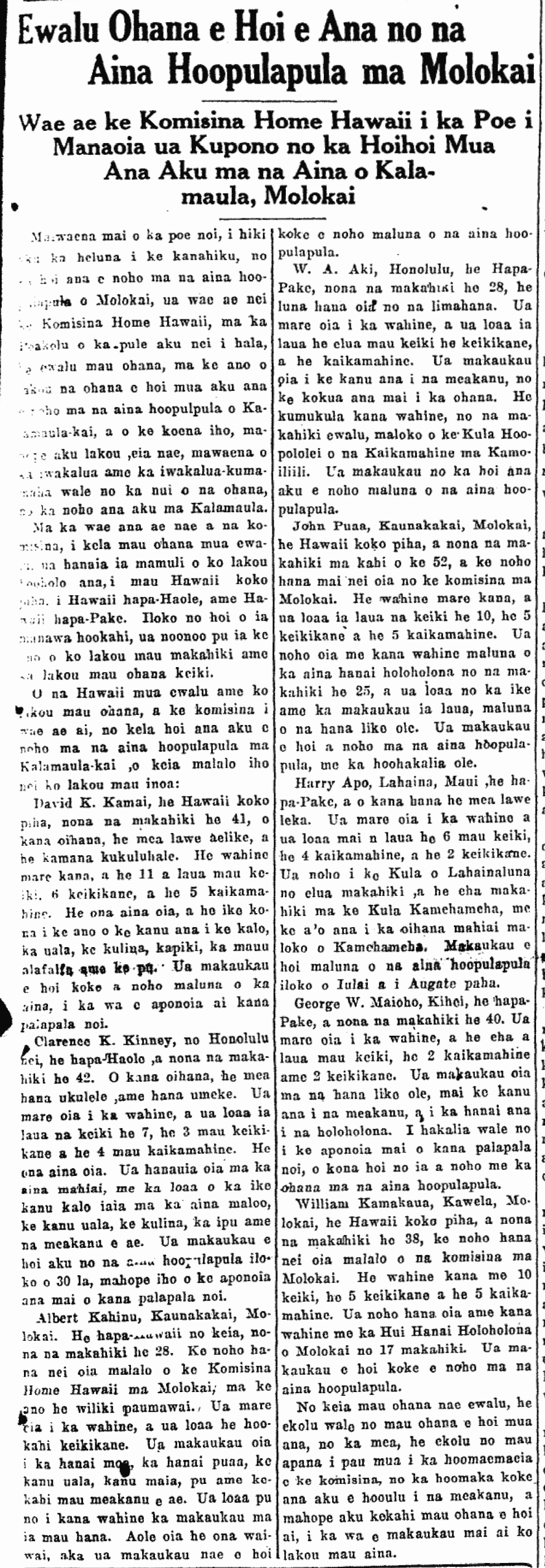
Amongst the applicants that reached seventy in number, to go back to the homestead lands of Molokai, the Commissioner of Hawaiian Homes chose  last week Wednesday, eight families as the first to go to live on the homestead lands of Kalamaula Kai, and the rest, they will go later, however, only between twenty and twenty-four families total will live at Kalamaula.

In the selection of the commission of those eight families, it was done with them choosing full-blooded Hawaiians, hapa Haole, and hapa Chinese. At the same time, considered were their ages and the children in their families.

The first eight Hawaiians and their families which were selected by the commission to go to the aina hoopulapula at Kalamaula Kai are here named below:

David K. Kamai, a full-blooded Hawaiian who is 41 years old, his occupation is a contractor and a carpenter. He has a wife and they have 11 children, 6 boys and 5 girls. He is a land owner and he has knowledge of taro cultivation, sweet potato, corn, cabbage, alfalfa grass and melons. He is prepared to go at once and live on the land when his application is approved.

Clarence K. Kinney [Clarence W. Kinney], of Honolulu nei, is a hapa Haole, and is 42 years old. His occupation is an ukulele maker and a maker of umeke. He is married, and they have 7 children, 3 boys and 4 girls. He is a land owner. He was born on farm lands, with knowledge of dry land taro cultivation, sweet potato planting, corn, melon and other crops. He is ready to go to the aina hoopulapula in thirty days after his application is approved.

Albert Kahinu, Kaunakakai, Molokai. He is a hapa Hawaii that is 28 years old. He is employed by the Hawaiian Homes Commission on Molokai as a water pump engineer. He is married and they have one son. He knows how to raise chicken and pig, and how to plant sweet potato, banana, melon, and other crops. His wife is also knowledgeable in that kind of work. He does not own property, but is prepared to go at once to live on the homestead lands.

W. A. Aki, Honolulu, is a Hapa Chinese, and is 28 years old; he is an overseer of laborers. He is married and they have two children, a son and daughter. He is knowledgeable about planting crops to assist his family. His wife has been a school teacher for eight years at the Girls’ Correctional School at Kamoiliili. They are ready to go live on the aina hoopulapula.

John Puaa, Kaunakakai, Molokai, is a full-blooded Hawaiian, and is 52 years old; he is employed by the commission at Molokai. He is married, and they have 10 children, 5 boys and 5 girls. He has lived with his wife on a ranch for 25 years, and the two are knowledgeable at various work. They are prepared to go live on homestead lands without delay.

Harry Apo, Lahaina, Maui, is a hapa Chinese, and he works as a letter carrier. He is married, and they have 6 children, 4 girls and 2 boys. He lived at Lahainaluna School for two years, and four years at Kamehameha School, learning farming at Kamehameha. He is ready to move to the aina hoopulapula in July or August perhaps.

George W. Maioho, Kihei, is a hapa Chinese, and is 40 years old. He is married, and they have four children, 2 girls and 2 boys. He is capable of all sorts of work, from planting crops to raising livestock. He will go at once after his application is approved to live on the aina hoopulapula with his family.

William Kamakaua, Kawela, Molokai, is a full-blooded Hawaiian, and is 38 years old; he is employed by the commission on Molokai. He is married with 10 children, 5 sons and 5 daughters. He worked along with his wife on Molokai Ranch for 17 years. He is prepared to live on the homestead lands.

Of these eight families, only three will go first, because only three of the lots have been so far cleared by the commission to be farmed at once, and thereafter, other families will go when their lots are ready.

[There was a nice article in this month’s Ka Wai Ola, on page 5, about a remembrance of the first settlers of the Hawaiian Homes lands at Kalamaula. Here are more families that were chosen, listed in the Kuokoa on 8/17/1922.

Here is perhaps a more detailed article on the eight found in the Kuokoa on 7/6/1922, p. 2.]

(Kuokoa, 7/6/1922, p. 1)

Ewalu Ohana e Hoi e Ana no na Aina Hoopulapula ma Molokai

Ka Nupepa Kuokoa, Buke LXI, Helu 27, Aoao 1. Iulai 6, 1922.

I hookahi, kahi ka manao, 1897.

LET US BE OF ONE SHOULDER,¹ LET US BE OF UNIFIED THOUGHT.

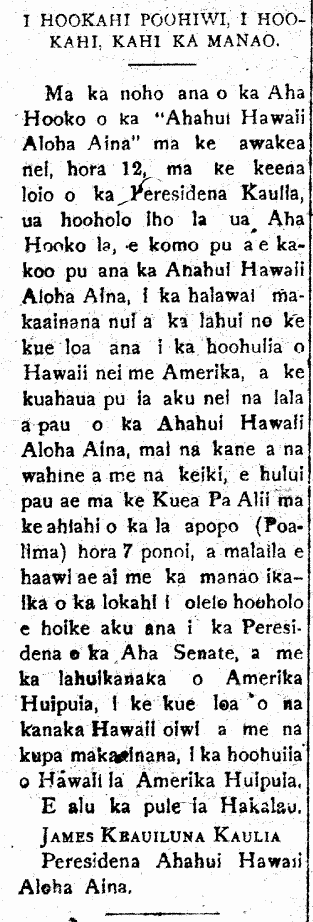
At the meeting of the Executive Committee of the “Ahahui Hawaii Aloha Aina” [Hawaiian Patriotic League] at noon, 12 o’clock, at the attorney’s office of President Kaulia, the said Executive Committee decided that the Patriotic League will join and support the great rally of the makaainana of the lahui to absolutely protest the annexation of Hawaii to America, and it is announced to all of the members of the Hawaiian Patriotic League, from the men, to the women, to the children, to assemble at the Palace Square [Kuea Pa Alii] tomorrow evening (Friday) at exactly 7 o’clock, and there will be presented with insistence and unity, the resolution informing the President of the Senate and the people of the United States, that the native Hawaiians and the long-time makaainana protest the annexation of Hawaii to the United States of America.

Let us combine our prayers to overcome Hakalau. [E alu ka pule ia Hakalau.]²

James Keauiluna Kaulia

President of the Ahahui Hawaii Aloha Aina.

¹Hearkening to the idea of “I hookahi umauma, i hookahi poohiwi, a i hookahi puuwai.” [Let us be of one chest, one shoulder, and of one heart.] Also from earlier that year, see by Samuel K. Kamakaia, “Nai Wale no Oukou A’oe Pau.”

²According to Mary Kawena Pukui’s Olelo Noeau (115): “A sorcerer at Hakalau once created havoc in his own and other neighborhoods. Many attempts to counter-pray him failed until a visiting kahuna suggested that all of the others band together to concentrate on the common enemy. This time they succeeded.”

(Aloha Aina, 10/9/1897, p. 3)

I HOOKAHI POOHIWI, I HOOKAHI, KAHI KA MANAO.

Ke Aloha Aina, Buke III, Helu 41, Aoao 3. Okatoba 9, 1897.

“Missionary Herald,” 1821–.

 Here is another reference available online. This publication was put out by the American Board of Commissioners for Foreign Missions (ABCFM), reporting home to America on their work throughout the world. Of particular interest to us is what they say about Hawaii. Here for instance is an article appearing in the year of the overthrow, 1893.

The position taken by the United States Secretary of State in regard to affairs at the Hawaiian Islands is simply astounding. That he should suggest that the United States interpose for the restoration of the late Hawaiian Queen seems almost incredible. Even were it admitted, as it is not, that our representatives at Hawaii afforded unwarrantable aid to the revolutionary party, it is a strange suggestion that, after this lapse of time, our government should reseat upon the throne one who had forfeited all her rights to it, and whose influence was only detrimental to the interests of the islands. The so-called royal house of Hawaii has been its curse for years. Queen Liliuokalani had yielded to the corrupting influences which every decent man had recognized as becoming more and more potent in political affairs at the islands, and by influences which she knew how to exert on the worst classes, she secured the passage of the bill giving a home on Hawaii to the infamous Louisiana Lottery which had been driven out of the United States. Restrictions upon the opium traffic, so necessary for the welfare of Hawaiians, were removed. A faithful cabinet was displaced and men of no character were placed in power. But the final act, which was practical…

(Missionary Herald, 12/1893, p. 510.)


The position taken...

The Missionary Herald, Volume LXXXIX, Number XII, Page 510. December 1893.

…suicide of the monarchy, was the attempt on her part to abrogate the Constitution and by sheer force establish a new one of her own making. Even her subservient ministers refused to endorse the scheme, yet she insisted upon it and sought to incite the populace to stand by her in her autocratic plans. It was then that all the better classes united as one man and deposed her. Never was there a revolution more warranted by facts, never was one more peacefully accomplished, and a queen of worthless character was set aside and the monarchy by its own act came to an end. If Minister Stevens or the commander of the Boston erred in judgment in any transaction, which we are not prepared to admit, yet there is no valid ground for the interference of our government to reverse the revolution months after it was consummated. We do not speak here of the political question as to what it is expedient for the United States to do in reference to a protectorate or to annexation. Opinions of these points may differ, but it would seem as if there were no room for difference of opinion in regard to this question of reestablishing the old monarchy on Hawaii. The best portion of her citizens have asked for some form of connection with the United States. Our government has a perfect right to say yes or no to all these proposals. And the Provisional Government at Honolulu has a right to say to us, “Either accept our proposal or hands off.” We regret to be obliged to speak in such terms of propositions that come from our national administration. We certainly should not do so did we not believe that any attempt to restore the Hawaiian Queen to her throne would be a gross outrage, and would be followed by the most serious consequences to the moral and religious interests of the islands, as well as to their material prosperity. We cannot think that our people will tolerate any intervention which has for its object the replacing upon the throne of a sovereign whose influence will be only for evil.

(Missionary Herald, 12/1893, p. 511.)

Continue reading