Charles K. Shaw marries Indian princess, 1912.

THAT HAWAIIAN MARRIES AN INDIAN PRINCESS.

Seattle, Washington, Mar. 20. A princess of the Sioux Indians of Rosebud, S. D., whose name is Miss Indeta Lapollette [Lafollette], married this evening by the Rev. A. Sandell on Seventh Avenue, Number 313, to Charles K. Shaw, a Hawaiian boy. With the marriage of this half-Indian lady, she left J. H. Magoon, the one who has a theater in the Hawaiian Islands. This beautiful young lady is half French and half Indian. Her mother is a Sioux Indian. Her father is a chief of the Sioux Indians, and when he died, his wealth was inherited by his daughter.

Because her mother saw the decrease in the Indian race, she thought it would not be useful for her daughters to continue the traditional ways of the Indians, so she told her daughter to learn the ideas and knowledge of Europe. Her education began in school on their reservation. She is fluent in the English language.

The marriage of these two was a marvelous. The woman wore full Indian dress, and the man, he wore a black suit. The words of Rev. A. Sandell spoke when the two were wed were short. Her husband is training her in Hawaiian song and dance. When the ceremony was over, Miss Lapollette stated:

“I’ve not stepped at all on the stage of a theater, but my husband is trying hard to teach me so that I learn Hawaiian hula. I have some singing ability, and if I am with a group of four or five friends from Hawaii, I believe I can be of assistance to them.

When the groom’s mother, Mrs. Esther Shaw, who lives at Number 3618 Fifth Avenue, Portland, heard that her son was getting married to a woman, she immediately sent a telegram to Claude Gage, the issuer of marriage licenses, for her son, being that he only 19 years old at the time, but the license granter was already told that Mr. Shaw was 21 years old. The mother’s telegram was received too late.

(Aloha Aina, 4/13/1912, p. 2)

MARE IA HAWAII I KEKAHI KAIKAMAHINE ALII ILIKINI

Ke Aloha Aina, Buke XVI, Helu 15, Aoao 2. Aperila 13, 1912.

More from David Keaweamahi on Japanese contract laborers, 1890.

From Japan!

INFORMATION FOR THE HAWAIIAN PEOPLE!

Mr. J. U. Kawainui,

Honolulu, H. I.

O Friend,

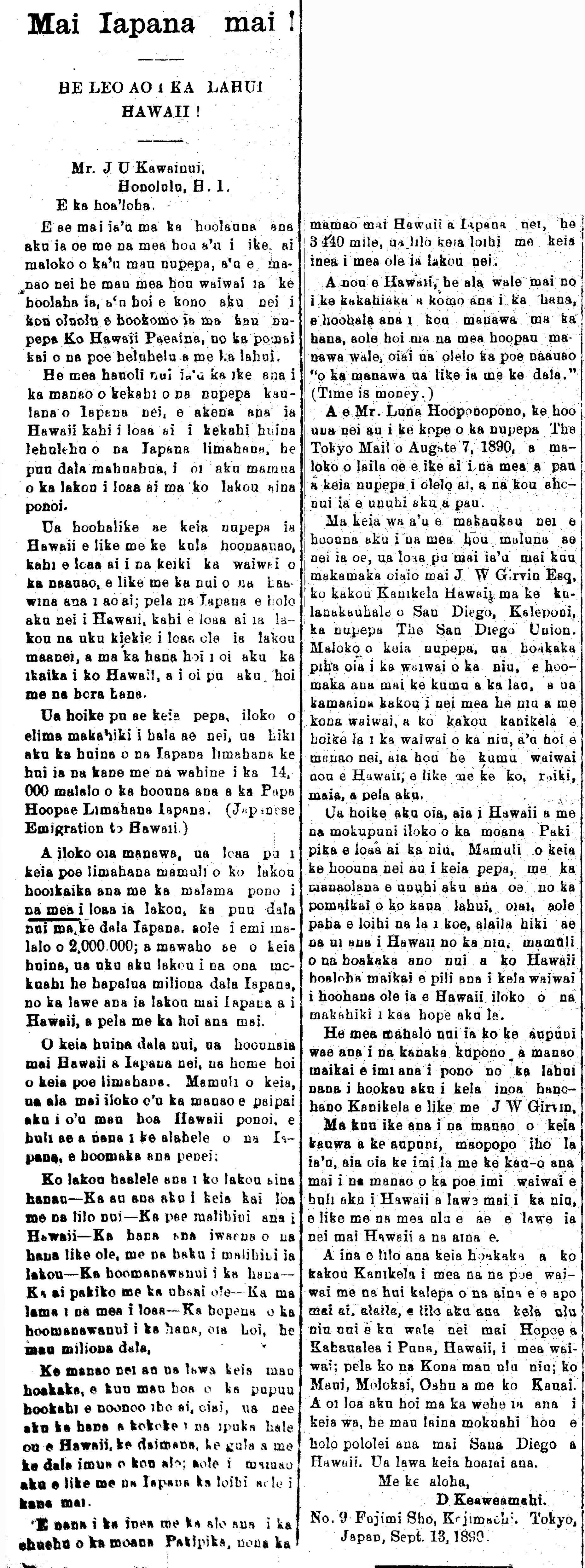
Please allow me to introduce you to the new things I have seen in my newspaper which I believe are new information important to spread; which I invite you to kindly insert into your newspaper, Ko Hawaii Pae Aina, for the benefit of the readers and the nation.

I was pleased to see the thoughts of a famous newspaper of Japan, praising Hawaii as the place where a great number of Japanese laborers obtained a big sum of money, more than they’d receive in their homeland.

This newspaper likened Hawaii to a school of education, where a child receives the wealth of knowledge, equal to the amount of lessons he studies; so too with the Japanese who are going to Hawaii, where they get high salaries that they’d not get here, and for more intense work than in Hawaii, along with more hours.

This paper also stated that within the past five years, the total number of Japanese laborers including men and women has reached 14,000, sent by the Board for Emigration of Japanese Laborers.

And within this period, these laborers, as a result of their effort and their saving of what they earned, made a great amount in Japanese money, not less than 2,000,000 yen; and not included with this, they paid the ship owners half a million yen to take them from Japan to Hawaii and return.

This great sum of money was sent from Hawaii to here in Japan, the home of these laborers. As a result, there rose within me the desire to encourage my own Hawaiian friends to take a look at the path taken by the Japanese, starting like this:

Their departure from the land of their birth—Their travelling across the great ocean at great expense—The landing as strangers in Hawaii—Working all sorts of jobs for a boss who is a stranger—Enduring the work—Eating only a little without wasting—Caring for what they have—The results of their putting up with the work, that being millions of dollars.

I believe that this is ample explanation, O Friends of the same womb, for you to think about; for the work has come to your door O Hawaiians—diamonds, gold, and money, right before your eyes; it is not far away like for the Japanese for whom it is far, far away.

Look at the hardships and the facing of the spray of the Pacific Ocean whose distance from Hawaii to Japan is 3,440 miles; this distance and hardships became nothing to them.

And you, O Hawaiians, you wake up in the morning and take up your work, and put in your time working, and not with things that waste your time, as goes the saying of the educated people: “Time is like money.”

And O Mr. Editor, I am sending a copy of the newspaper, “The Tokyo Mail” of August 7th, 1890, and within it you will see all of what this paper has said, and it is for you to patiently translate it all.

As I am preparing to send to you the news above, I have also received from my true friend, J. W. Girvin, Esq., our Hawaiian Consul in the city of San Diego, California, the newspaper “The San Diego Union”. Within this paper, he explained fully the value of coconuts, starting from the trunk to the leaves; we are familiar with coconuts and its value; and with our consul explaining the value of the coconut, I am thinking that there are also other sources of wealth for you, O Hawaiians, like sugarcane, rice, bananas, and so forth.

He explains that coconuts can be found in Hawaii and the islands of the Pacific Ocean. Therefore, I am sending this paper with hopes that you will translate it for the good of our people, being that it should not be long before Hawaii starts receiving inquiries for coconuts because of this important description of Hawaii’s good friend dealing with the asset not put to use by Hawaiians in the past years.

It is a very admirable thing that the government selects good people with good ideas to search after the well being of the people that conferred upon him that honorable title, Consul, like J. W. Girvin.

When I look at the ideas of this servant of the nation, I know that he is searching while pulling along the minds of entrepreneurs to look to Hawaii to export coconuts, like the other produce exported from Hawaii to other lands.

And should this description of our Consul become something that the wealthy people and trade companies of foreign lands latch on to, then those great fields of coconut from Hopoe until Kahaualea in Puna, Hawaii will become a source of wealth; so too the stands of coconut in the Kona districts, along with those of Maui, Molokai, Oahu and Kauai. And even more so, with the opening these days of new steamship lines which go directly from San Diego to Hawaii. This clarification should be sufficient.

With aloha,

D. Keaweamahi.

No. 9 Fujimi Sho [Fujimi-cho], Kojimachi, Tokyo, Japan, Sept. 13, 1890.

[As we celebrate Merrie Monarch week, Japanese contract laborers is one of Kalakaua’s many legacies…]

(Ko Hawaii Pae Aina, 9/27/1890, p. 2)
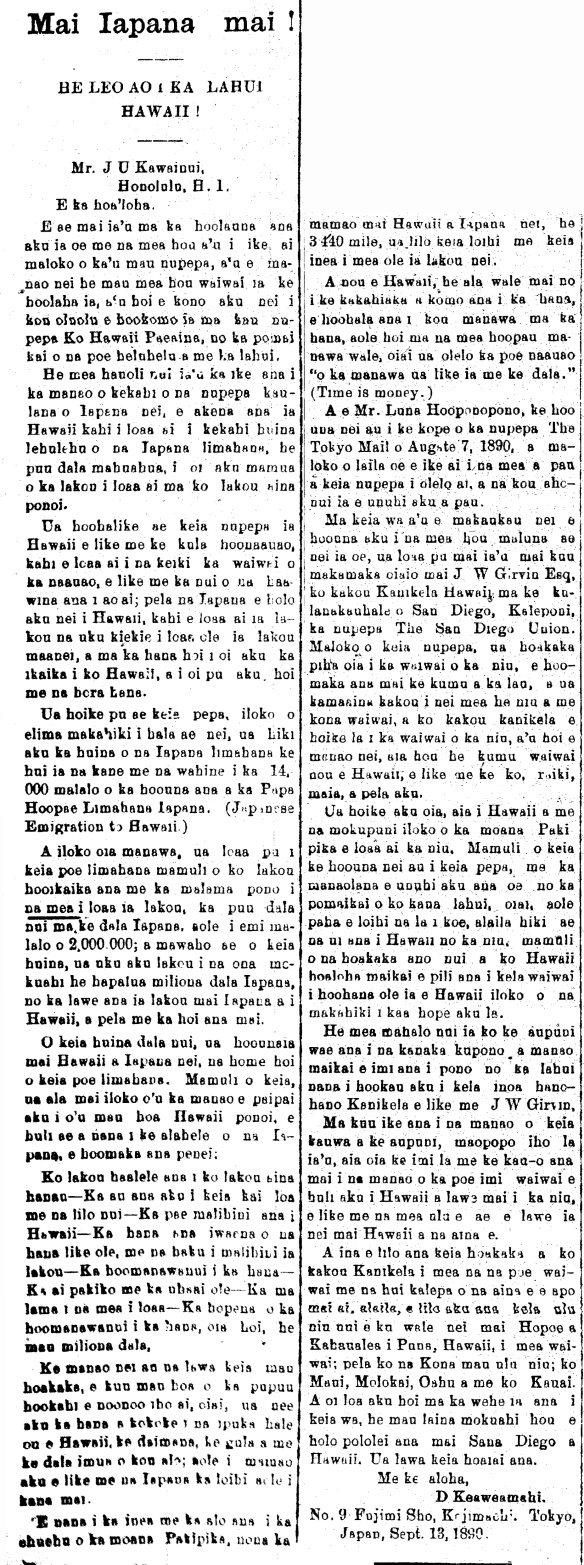
Mai Iapana mai!

Ko Hawaii Pae Aina, Buke XIII, Helu 39, Aoao 2. Sepatemaba 27, 1890.

David Keaweamahi living in Japan, 1890.

[Found under: “News of Hawaii”]

Mr. David Keaweamahi of Japan sent the newspaper, “The Tokyo Mail” of the 7th of August. Within that paper, an editorial expressed appreciation at the great benefits gained by the Japanese laborers brought to Hawaii nei to be put to work and then returned well off to Japan after five years.

(Ko Hawaii Pae Aina, 9/27/1890, p. 2)

Ua hoouna mai o Mr. David Keaweamahi...

Ko Hawaii Pae Aina, Buke XIII, Helu 39, Aoao 2. Sepatemaba 27, 1890.

Hawaiians all over America! 1913.

THE GOOD STANDING OF THE HAWAIIAN YOUTHS.

IN THEIR EMPLOYMENT IN AMERICA.

[The issue of this Aloha Aina is misprinted as 1/11/1912, but it should be 1/11/1913! This sort of thing happens once in a while, and if you are not careful, it can lead to wild goose chases. Case in point: i don’t know how long i spent looking for the English article that this was taken from because i was looking in 1912… This article originates from the Honolulu Star-Bulletin (1/4/1913).

See the Star-Bulletin article here.]

(Aloha Aina, 1/11/1912 [1913], p. 1)

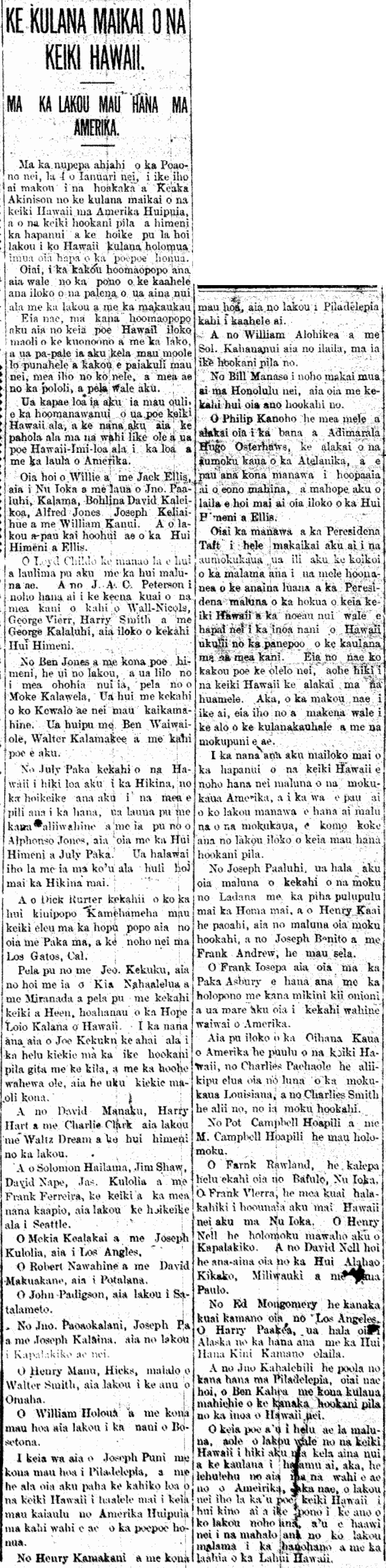
KE KULANA MAIKAI O NA KEIKI HAWAII.

Ke Aloha Aina, Buke XVII, Helu 2, Aoao 1. Ianuari 11, 1912* (1913).

Kawaihau Orchestra and Glee Club in SF. 1905.

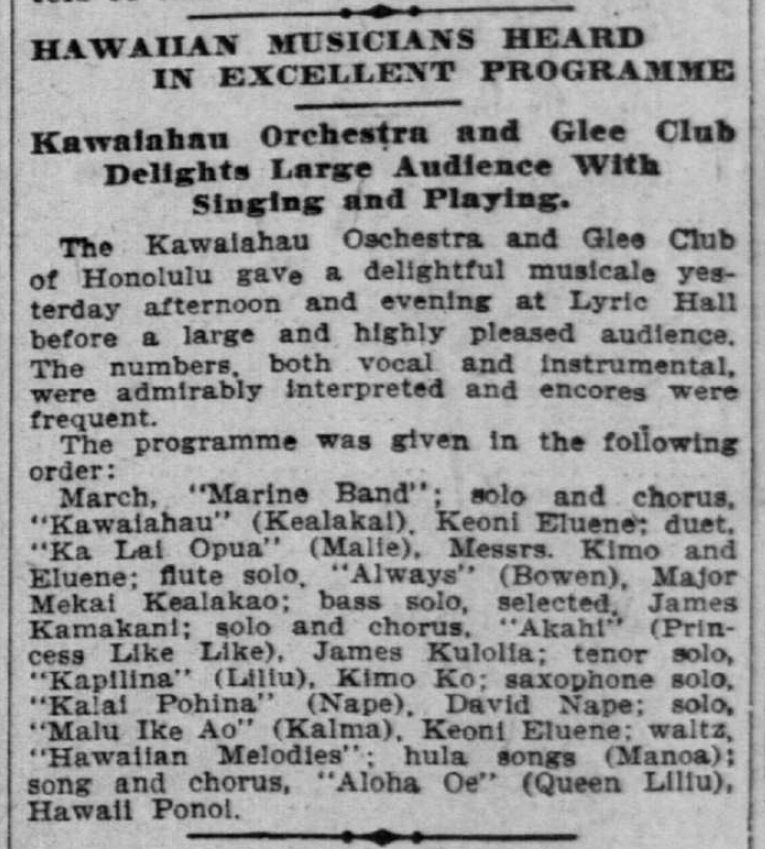
HAWAIIAN MUSICIANS HEARD IN EXCELLENT PROGRAMME

Kawaiahau Orchestra and Glee Club Delights Large Audience With Singing and Playing.

The Kawaiahau Orchestra and Glee Club of Honolulu gave a delightful musicale yesterday afternoon and eveing at Lyric Hall before a large and highly pleased audience. The numbers, both vocal and instrumental, were admirably interpreted and encores were frequent.

The programme was given in the following order:

March, “Marine Band”; solo and chorus, “Kawaiahau” (Kealakai), Keoni Eluene; duet, “Ka Lai Opua” (Malie), Messrs. Kimo and Eluene; flute and solo, “Always” (Bowen), Major Mekia Kealakao [Kealakai]; bass solo, selected, James Kamakani; solo and chorus, “Akahi” (Princess Like Like [Likelike]), James Kulolia; tenor solo, “Kapilina” (Liliu), Kimo Ko; saxophone solo, “Kalai Pohina” (Nape), David Nape; solo, “Malu Ike Ao” (Kalima), Keoni Eluene; waltz, “Hawaiian Melodies” ; hula songs (Manoa); song and chorus, “Aloha Oe” (Queen Liliu), Hawaii Ponoi.

[Because of its location, The San Francisco Call had much Hawaii coverage.]

(San Francisco Call, 10/7/1905, p. 16)

HAWAIIAN MUSICIANS HEARD IN EXCELLENT PROGRAMME

The San Francisco Call, Volume XCVIII, Number 129, Page 16. October 7, 1905.

Kawaihau Glee Club performs in Washington State. 1905.

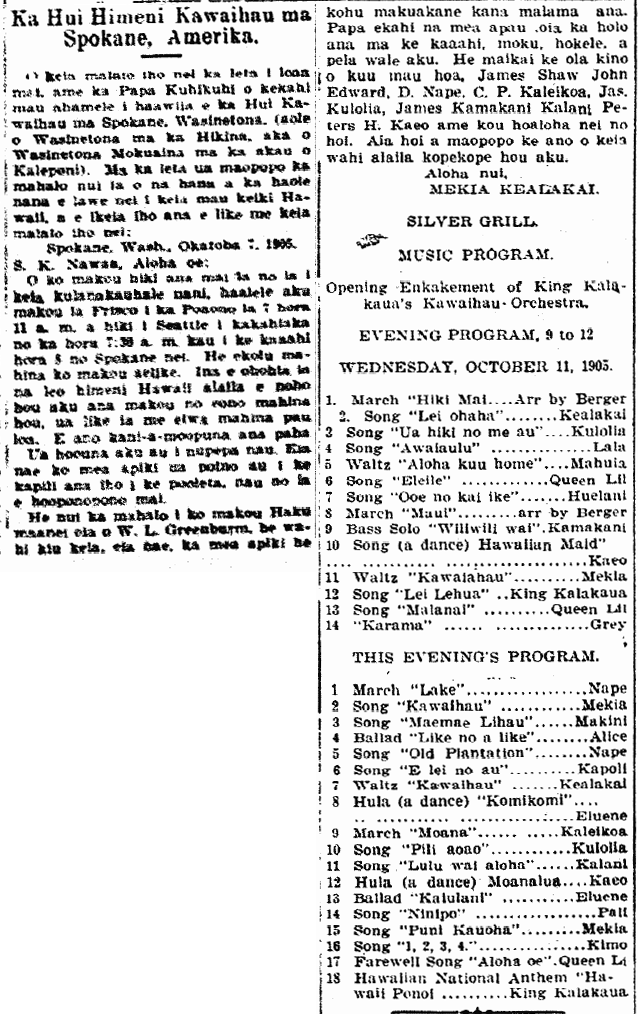
The Kawaihau Glee Club in Spokane, America.

Here below is a letter received as well as a program from some performances given by the Kawaihau Glee Club at Spokane, Washington (not Washington in the East, but Washington State to the North of California). It is apparent from the letter that the actions of that haole taking these Hawaiian boys around is much appreciated, and this is seen as below:

Spokane, Wash., October 7, 1905.

S. K. Nawaa, Aloha to you:

We’ve arrived in this beautiful town, we left Frisco on Saturday the 7th [?] at 11 a. m. and got to Seattle in the morning, at 7:30 a. m. boarded the 8 o’clock train for Spokane. Our contract is for 3 months. If they are taken by the sound of Hawaiian music, we will stay on for another 6 months, which would make 9 months total. Perhaps we will be like old grandparents by then.
I have sent a newspaper to you. But here is the thing, I had problems with the postage, so you will have to take care of it.
We really are thankful for our Boss here, W. L. Greenburn [?], he is an investigator. The one problem is that he treats us as if he is our father. Everything is first class, from the train, to the boat, to the hotel, and so forth. My friends, James Shaw, John Edward [Edwards?], D. Nape [David Nape], C. P. Kaleikoa, James Kulolia, James Kamakani, Kalani Peters, H. Kaeo and me, your friend as well, we are all in good health. As soon as I get acclimated to how it is here, I will write again.
Much Aloha,
Mekia Kealakai.

SILVER GRILL
MUSIC PROGRAM
Opening Enkakement of King Kalakau’s Kawaihau Orchestra.
EVENING PROGRAM, 9 to 12

WEDNESDAY, OCTOBER 11, 1905.

1 March “Hiki Mai” Arr by Berger
2 Song “Lei ohaha” Kealakai
3 Song “Ua hiki no me au” Kulolia
4 Song “Awaiaulu” Lala
5 Waltz “Aloha kuu home” Mahuia
6 Song “Eleile” Queen Lil
7 Song “Ooe no kai ike” Huelani
8 March “Maui” arr by Berger
9 Bass Solo “Wiliwili wai” Kamakani
10 Song (a dance) Hawaiian Maid” Kaeo
11 Waltz “Kawaiahau” Mekia
12 Song “Lei Lehua” King Kalakaua
13 Song “Malanai” Queen Lil
14 “Karama” Grey

THIS EVENING’S PROGRAM.

1 March “Lake” Nape
2 Song “Kawaihau” Mekia
3 Song “Maemae Lihau” Makini
4 Ballad “Like no a like” Alice
5 Song “Old Plantation” Nape
6 Song “E lei no au” Kapoli
7 Waltz “Kawaihau” Kealakai
8 Hula (a dance) “Komikomi” Eluene
9 March “Moana” Kaleikoa
10 Song “Pili aoao” Kulolia
11 Song “Lulu wai aloha” Kalani
12 Hula (a dance) Moanalua Kaeo
13 Ballad “Kaiulani” Eluene
14 Song “Ninipo” Pali
15 Song “Puni Kauoha” Mekia
16 Song “1, 2, 3, 4.” Kimo
17 Farewell Song “Aloha oe” Queen Li
18 Hawaiian National Anthem “Hawaii Ponoi King Kalakaua

[I am assuming that they copied the program as it was printed out in Washington…]

(Kuokoa, 11/3/1905, p. 5)

Ka Hui Himeni Kawaihau ma Spokane, Amerika.

Ka Nupepa Kuokoa, Buke XLIII, Helu 44, Aoao 5. Novemaba 3, 1905.

Kawaihau Glee Club off to San Francisco. 1905.

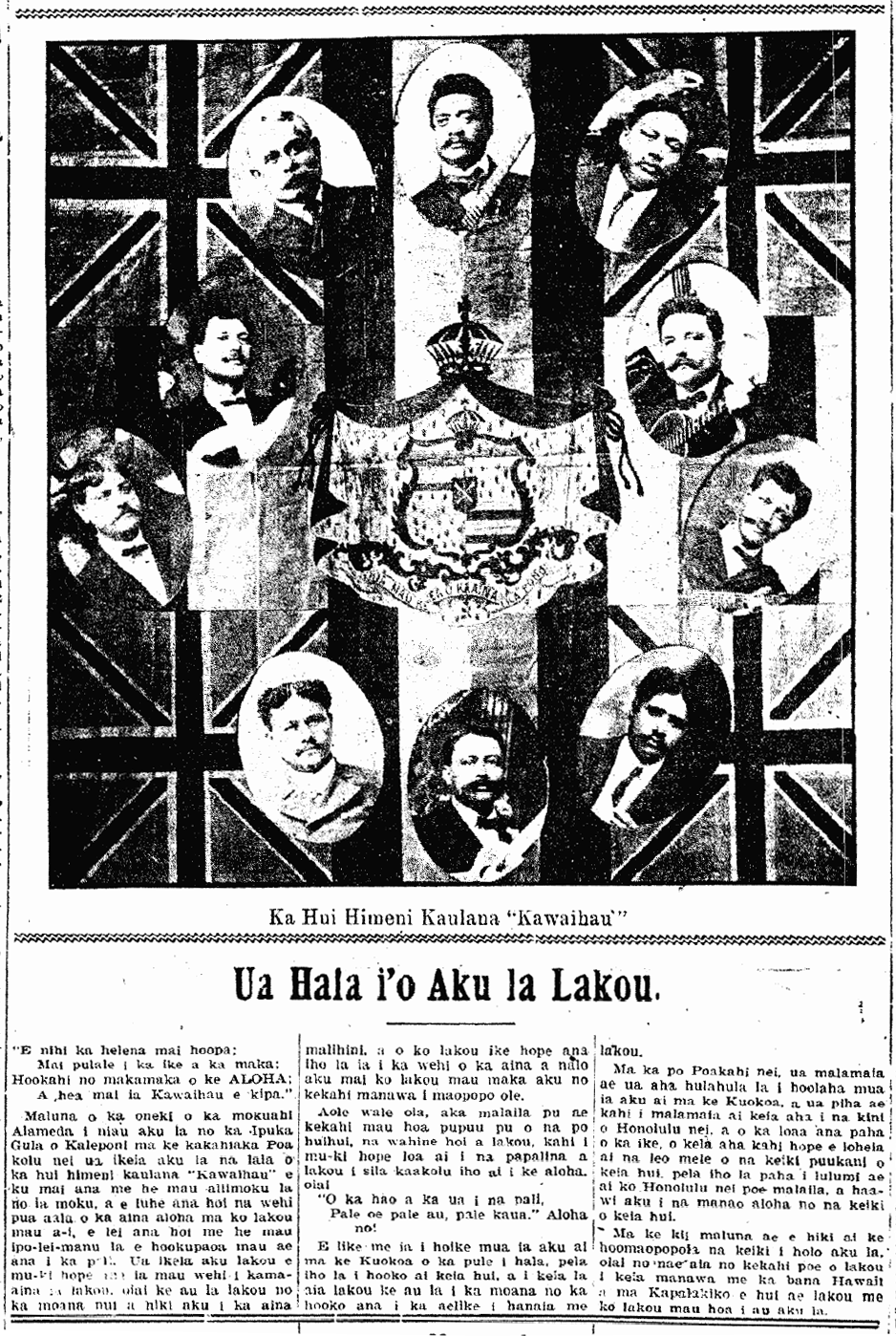
The Famous Singing Group “Kawaihau”

They Left for Afar.

“E nihi ka helena mai hoopa; [Tread carefully, don’t touch;]
Mai pulale i ka ike a ka maka [Don’t get excited by what the eye sees:]
Hookahi no makamaka o ke ALOHA [There is but one companion, that is ALOHA];
A hea mai ia Kawaihau e kipa. [Calling out to Kawaihau to come visit.]”¹

Aboard the deck of the steamship Alameda that moved swiftly on to the Golden Gate of California on the morning of Wednesday was seen the members of the famed singing group “Kawaihau” standing like officers of the ship while garlands of fragrant flowers of the beloved land hung about their necks; they wore the lei like a beloved sweetheart ever imbuing fragrance in their bosom. They were seen inhaling for the last time the adornment familiar to them as they were leaving for the great sea headed for foreign lands; and they were seeing for the last time the verdure of the land which disappeared from their eyes for who knows how long.

Not just them, but also there were the companions to curl up together in the cold nights—their wives, there to kiss their cheeks for the last time, which they sealed threefold with love, as

“O ka hao a ka ua i na pali [The assault of the rain in the cliffs]
Pale oe, pale au, pale kaua.” Aloha no! [I fend off, you fend off, we both fend off.”² Aloha!]

Just as reported earlier in the Kuokoa of last week, so did this group carry out, and today they are travelling over the ocean to fulfill the contract made with them.

This past Monday that dance advertised earlier in the Kuokoa was held, and the venue where the event took place was filled with the multitudes of Honolulu; perhaps they knew that this gathering would be the last they’d hear the singing of the performers of this group, and that is probably why Honolulu’s people thronged there and gave their aloha to the boys of the band.

In the picture above, you can see the boys who went, although some of them are currently with the Hawaiian Band in San Francisco and will meet up with their companions who left.

¹Play on the chorus of Kalakaua’s “E Nihi ka Hele.”
²Anyone know what mele this might come from?

[This is who played at that huge wedding celebration in Pauoa attended by Kaiulani in 1898 (the articles posted yesterday)]

(Nupepa Kuokoa, 9/22/1905, p. 1)

Ua Hala i'o Aku la Lakou

Ka Nupepa Kuokoa, Buke XLIII, Helu 38, Aoao 1. Sepatemaba 22, 1905.

More Hawaiians playing music afar, 1908.

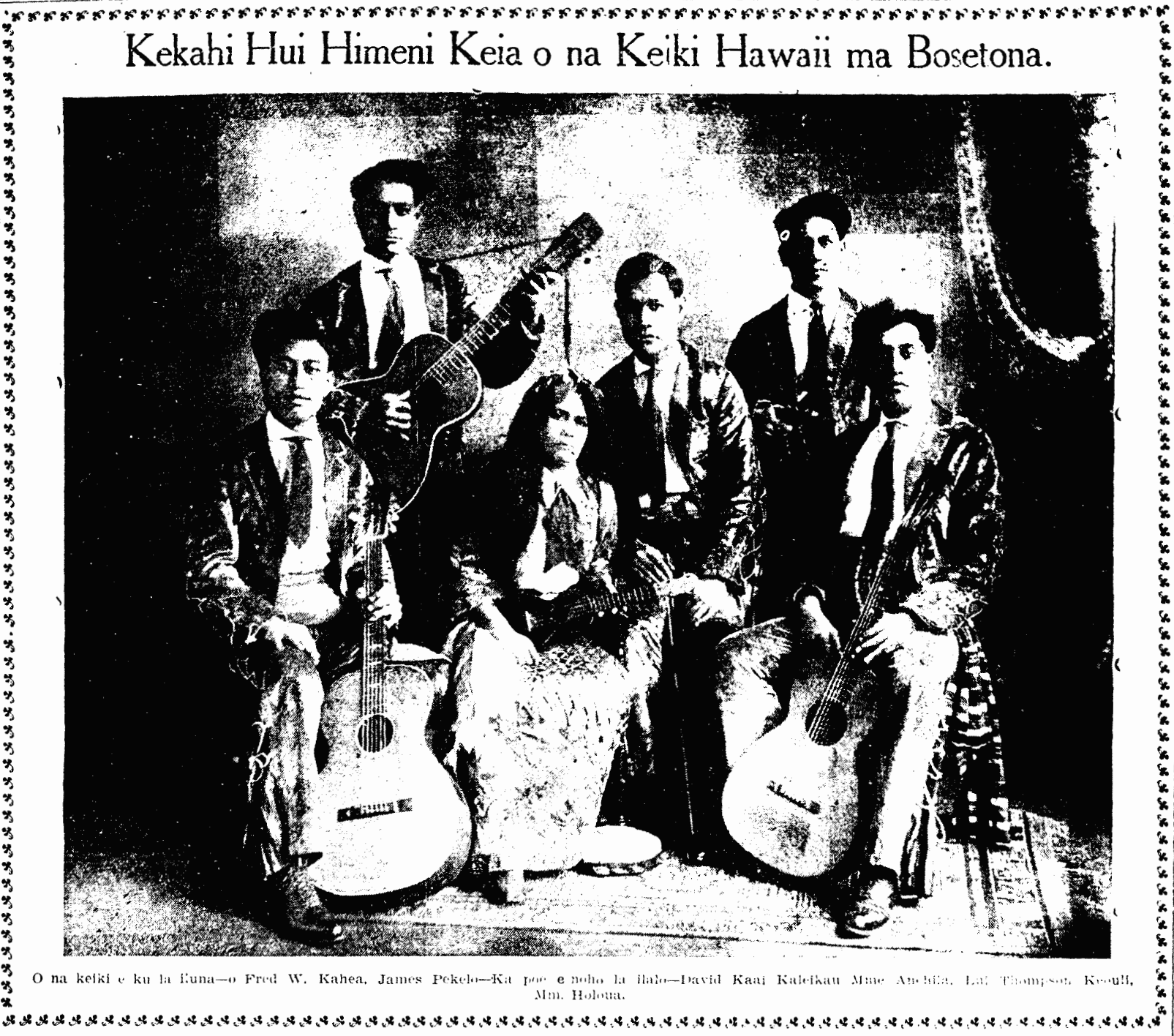
This is a Singing Group of Hawaiian Youths in Boston.

The ones standing–Fred W. Kahea, James Pekelo. Those sitting–David Kaai Kaleikau [Kaleikoa], Madame Anehila [Hobron], Lui Thompson Keouli, Monsieur [William] Holoua

[Plus check out this awesome brochure from the same time put up by the University of Iowa! The Honolulu Students from the Hawaiian Islands. Sometimes the internet is such a good thing!]

(Kuokoa 2/7/1908, p. 6)

Kekahi Hui Himeni Keia o na Keiki Hawaii ma Bosetona.

Ka Nupepa Kuokoa, Buke XLIII, Helu 6, Aoao 6. Feberuari 7, 1908.

More Ernest Kaai—meeting a Hawaiian living in Australia, 1925.

That Hawaiian Wants to Come Back Here

Ernest Kaai Finds L. G. Kaainoa in Australia, and He Tells of His Desire to See Once Again His Land

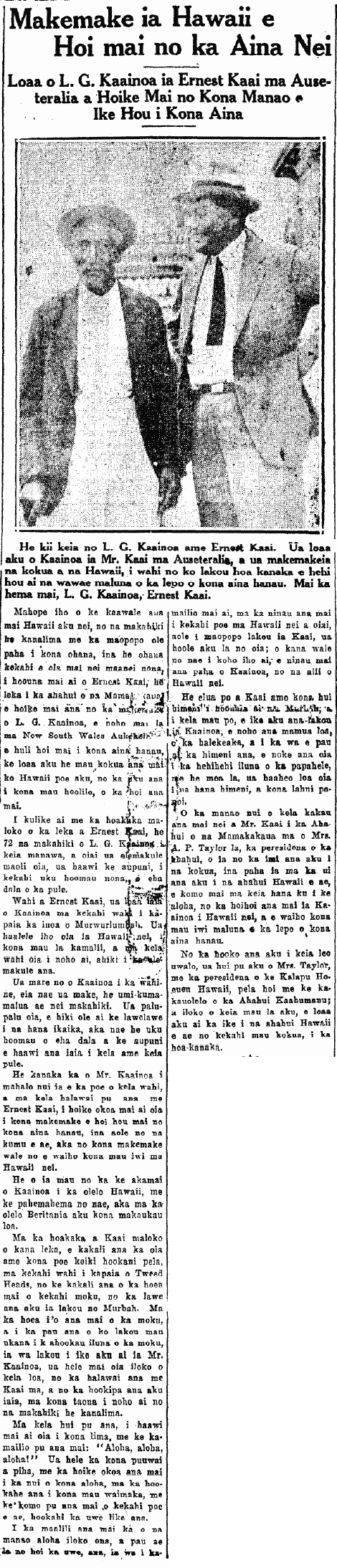
This is a picture of L. G. Kaainoa and Ernest Kaai. Mr. Kaai found Kaainoa in Australia, and he wants the help from Hawaiians to provide him a means for him to once again tread upon the land of his birth. From the left, L. G. Kaainoa, Ernest Kaai.

L. G. Kaainoa has been away from Hawaii for 50 years now without his family’s knowledge, or knowing even if he has ohana left alive here; Ernest Kaai sent a letter to the Ahahui Mamakakaua [Sons and Daughters of Hawaiian Warriors] telling them of the desire of Kaainoa (who now lives in New South Wales, Australia), to return to his homeland were he to receive assistance from Hawaii’s people to pay his expenses for the return.

According to the explanation in the letter of Ernest Kaai, L. G. Kaainoa is now 72 years old, and being that he is very old, the government provides him a pension of 4 dollars a week.

Ernest Kaai says he found Kaainoa at a place called Murwillumbah. He left Hawaii nei in his youth and it is there that he lived until his old age.

He married a woman, but she died 12 years earlier. He is infirm and cannot do hard labor. But he is given benefits by the government of 4 dollars every week.

Kaainoa is well liked by the people there, and when he met with Ernest Kaai, he made clear his hope to return to his homeland, if not for any other reason, but for his desire to leave his bones in Hawaii nei.

He is still very good at Hawaiian, yet is somewhat clumsy, but he is most fluent in English.

According to Kaai in his letter, he was staying along with his fellow musicians at a place called Tweed Heads, where they were waiting for the arrival of a ship to take them to Murbah. When the ship arrived, and after they loaded their belongings aboard, it was then they saw Mr. Kaainoa. He came all the way to meet with Kaai folk, and to welcome him to his town where he has lived for 50 years.

At their meeting, Kaainoa gave his hand, saying, “Aloha, aloha, aloha!” His heart was full while he expressed his great aloha as his tears flowed, while some others joined in with him.

After those feelings of aloha calmed within him, and his crying stopped, it was then that he began to speak, asking about some people in Hawaii nei. And as Kaai did not know them, he told him so. All he could think of that Kaainoa could ask of was the alii of Hawaii nei.

Kaai and his musical group spent two nights at Murbah, and on those two nights, they saw Kaainoa sitting way up front of the theater house. And when the singing was over, he continued to stomp on the floor as if he was so proud of this singing of his very own people.

The main reason Mr. Kaai wrote to the Ahahui Mamakakaua by way of Mrs. A. P. Taylor, the president of the Association, was to look for assistance; if she could ask the other Hawaiian associations to join in on this charitable endeavor to bring Kaainoa back to Hawaii nei for him to leave his bones in the soil of his homeland.

To follow through on this plea, Mrs. Taylor met with the president of the Hawaiian Civic Club [Kalapu Hoeueu Hawaii], and the secretary of the Kaahumanu Society; and in the upcoming days, the other Hawaiian organizations will learn about this assistance of their fellow Hawaiian.

(Kuokoa 3/5/1925, p. 1)

Makemake ia Hawaii e Hoi mai no ka Aina Nei

Ka Nupepa Kuokoa, Buke LXIV, Helu 10, Aoao 1. Maraki 5, 1925.