Sun Sun Lau and E. K. Fernandez, 1939.

This past Saturday, the new restaurant of the Sun Sun Lau Group was opened on Kamehameha Avenue near the Lumber Yard of American Factors, Ltd. Ice cream was given to children who came with their parents. The band of Mrs. Rose Kuamoo took care of the music and hula performances.

On the previous Saturday evening, the great show of E. K. Fernandez was opened on the grounds where the show is always held.

[For you Hilo people, a little nostalgia…]

(Hoku o Hawaii, 7/5/1939, p. 4)

Ma ka Poaono nei i weheia ae ai...

Ka Hoku o Hawaii, Volume XXXIV, Number 10, Aoao 4. Iulai 5, 1939.

Moanalua: Mele, Moolelo, and Mokumaia, 1922.

[From: “MOANALUA I KELA AU A O MOANALUA I KEIA AU.”]

O Moanalua haki ke au,
I Kahauiki hemo ka umoki
I ke kula loa hoi o Kalihi,
I Kaiwiula kikiipau,
Kapalama lo’i laiki,
I Keoneula malu ke kiawe,
Leleo i ka lokowai,
Haaliliamanu honi kaua,
Kapuukolo i ka Nekina,
Hololio laau me ka huapala,
Kamanuwai moa liilii,
Hauna ke kai eha oe ia’u,
Hainaia mai ana ka puana,
Moanalua au ha’i ke au.

He mau hiona no Moanalua...

Ka Nupepa Kuokoa, Buke LXI, Helu 35, Aoao 3. Augate 31, 1922.

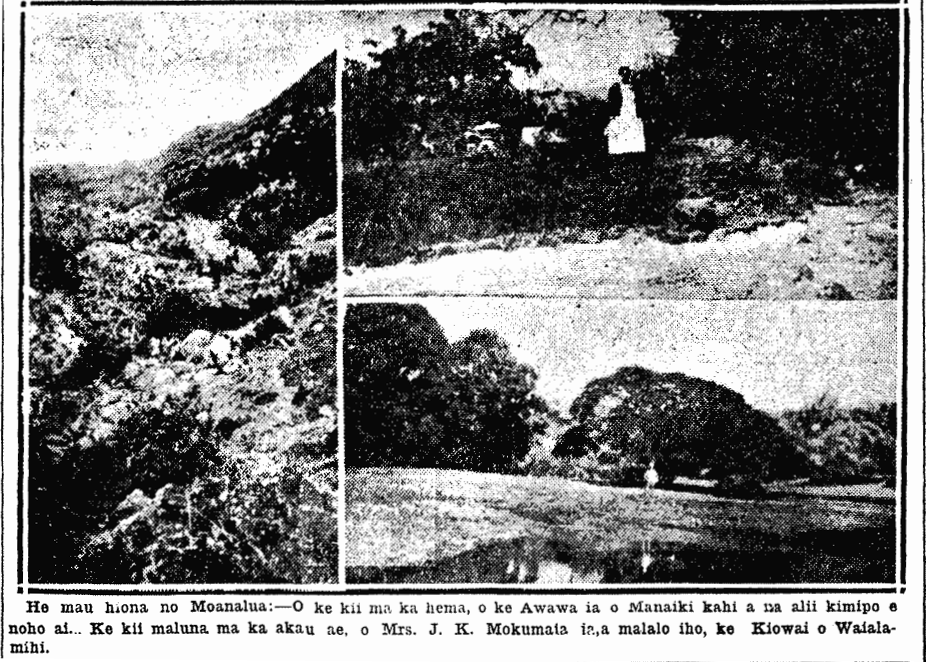
Some scenes of Moanalua:—The picture on the left is the Valley of Manaiki, where the royal assassins lived. The picture on the top on the right is Mrs. J. K. Mokumaia, and below is the Waialamihi Pond.

[This version of “Moanalua” is taken from a long-running column written by J. K. Mokumaia, a long-time resident of the area, on the history of Moanalua, which he called “Moanalua of the past and Moanalua of the Present.” This series which includes many priceless photographs like those above (which will be seen much more clearly when the newspapers are scanned properly) ran in the Kuokoa from 2/17/1922 until 8/31/1922 (although unfinished, it seems to end on this date).]

O Moanalua haki ke au...

O Moanalua haki ke au…

(Kuokoa, 8/31/1922, p. 3)

Mild hula ku’i and California Midwinter International Exposition, 1894.

DEPARTING FRIENDS.

The S. S. Australia Carries the Hawaiian Exhibit.

The departure of the S. S. Australia for the Coast was delayed until nearly 1 o’clock on account of the late arrival at the Oceanic wharf of articles to be exhibited at the Midwinter Fair in San Francisco, which has already opened. Among the numerous exhibits to be seen on the steamer were boxes of large and small coffee plants, boxes of large and small tea trees, brought from Hamakua, two wooden tanks containing different varieties of fish, including eels, a small shark, squid and crabs. The last two species were in one tank, and it is believed there will be a circus started between them when the aquarium is shaken up. There were two monster bullocks in stalls lashed near the stern. Kapahee, the famous surf rider, with his board, his wife and son, three hula girls and four other natives comprise part of the Hawaiian exhibit. Kapahee will give exhibitions in surf riding near the Cliff House, and if the water is clear he will dive and kill fish with a spear he has taken with him. He will also ride the bullocks. The girls under the management of D. Kaahanui will dance a mild hula-kui, while the others will assist about the grounds. Mr. L. A. Thurston superintends the exhibit.

Mrs. J. K. Ailau will make a first-class exhibition of Hawaiian curios at the fair in connection with the Hawaiian exhibit. She has taken with her four young ladies to act as saleswomen.

Messrs. Samuel Parker and A. P. Peterson were passengers on the Australia for the Coast on business bent.

Mr. W. P. Boyd, U. S. Vice-Consul-General, and wife were also passengers. They have gone to spend their honeymoon in the States. Both were gaily bedecked with leis and evergreens.

Miss Kate Cornwell, H. A. Widemann, Jr., F. M. Hatch and L. A. Thurston also left.

Mrs. and Miss Gerber, with their friend Miss A. Cahill, who lately returned from the Volcano, were among the departing throng. Mrs. Gerber and daughter left for home after a short and pleasant vacation on the islands.

Nearly all the passengers were covered with Hawaii’s tropical adieu, viz., wreaths and flowers. The P. G. band played previous and up to the departing of the steamer, and the scene on the wharf was one of bustle and excitement.

(Daily Bulletin, 1/6/1894, p. 2)

DEPARTING FRIENDS.

The Daily Bulletin, Volume VII, Number 924, Page 2. January 6, 1894.

More on the missionaries and hula ku’i …and Sweet Emalia, 1894.

CORRESPONDENCE.

[We do not hold ourselves responsible for the opinions or the utterances of our correspondents.]

Morality vs. Speculation.

Editor Holomua.

There is a class or clique of Christian (?) people in our little community who are constantly seeing “the mote that is in their neighbor’s eye, but do not perceive the beam that is in their own eye.” During the past year, that class has written a good deal about the morals of some of their neighbors also have made allusions to improper (?) events of past years.

The debauching hula has been a principal theme of attack. Yet, it may be safely said, that in a number of the “best” society families in this city, the sons and daughters are apt hula kui dancers. “They who live in glass houses should not throw stones.”

What was the scene last Saturday. Three hula dancers¹ went to San Francisco on the Australia, under engagement (presumably) to Mr. L. A. Thurston, who superintends the Hawaiian exhibit at the Midwinter Fair. It is true that the statement has been made that only a mild hula kui will be allowed to be danced. What ridiculousness. Have any of the parties interested ever seen mild hula kui. It has also been stated that the girls have signed a contract for five months.

What spectacle is now seen? The very class who have looked and written upon the Hula as an abomination; for the sake of profit and pecuniary benefit are willing to set aside all feelings of morality and decency, and enter into a contract with girls to use their bodies, so as to be able to offset the dence de ventre and obtain much monetary benefit.

The superintendent of the Hawaiian exhibit is the Envoy Extraordinary and Minister Plenipotentiary, representing the Provisional Government at Washington. SHAME!!!

“Consistency thou art a jewel”—for some people to get.

¹One of these was of course, Emalia Kaihumua.

(Hawaii Holomua, 1/8/1894, p. 3.)

CORRESPONDENCE.

Hawaii Holomua, Volume II, Number 6, Page 3. January 8, 1894.

More on the missionaries, 1894.

Missionary Descendants Show Their Knowledge of Hula Ku’i.

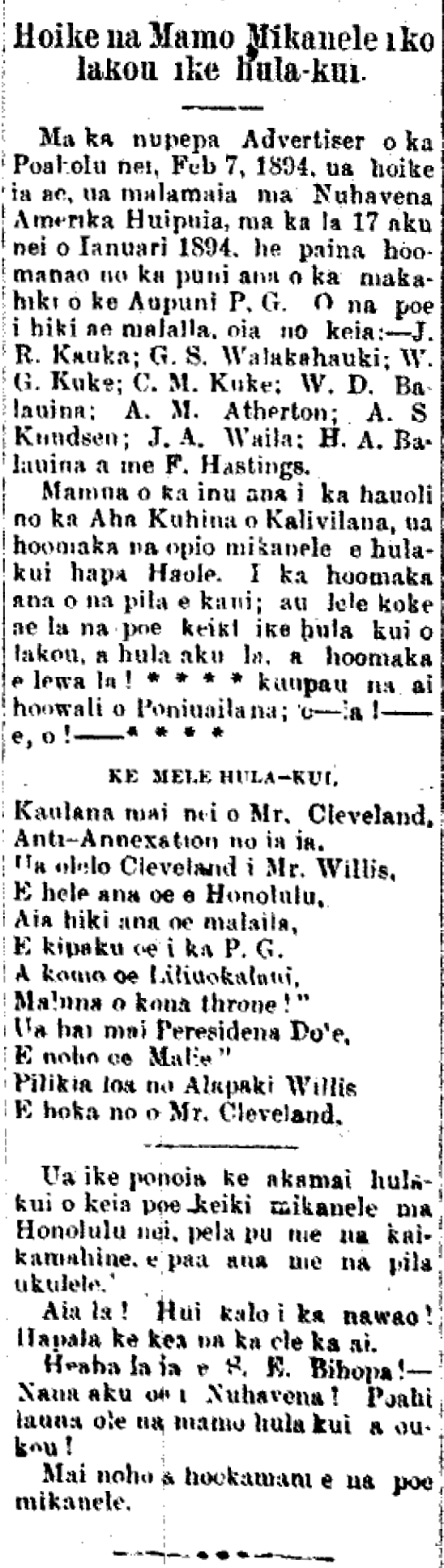
In the Advertiser of 2/7/1894, was shown that at New Haven, United States of America, on the past 17th of January 1894, there was held a party to commemorate the anniversary of the government by the P. G. Those present were: J. R. Kauka [James Robert Judd?], G. S. Walakahauki [George S. Waterhouse], C. M. Kuke [C. Montague Cooke, Jr.?], W. D. Balauina [William D. Baldwin], A. M. Atherton, A. S. Knudsen, J. A. Waila [James Austin Wilder], H. A. Balauina [Harry A. Baldwin], and F. Hastings.

Before drinking to the delight at the Cabinet of Ministers of Cleveland, the young missionaries danced a hula ku’i to a hapa haole song. When the music started, the youths among them who knew how to hula ku’i jumped up immediately and danced and started to sway! …the mixed poi of Poniuailana goes the limit; there you go!—answer the call!—…¹

KE MELE HULA-KUI.

Kaulana mai nei o Mr. Cleveland,
Anti-Annexation no ia ia,
Ua olelo Cleveland i Mr. Willis,
E hele ana oe e Honolulu,
Aia hiki ana oe malaila,
E kipaku oe i ka P. G.
A komo oe Liliuokalani,
Maluna o kona throne!”
Ua hai mai Peresidena Dole,
E noho oe Malie”
Pilikia loa no Alapaki Willis,
E hoka no o Mr. Cleveland.

A MELE HULA KU’I

Famed is Mr. Cleveland,
An Anti-Annexationist is he,
Cleveland said to Mr. Willis,
[“]You are going to Honolulu,
When you get there,
Banish the P. G.
And place Liliuokalani,
Upon her throne!”
President Dole spoke,
[“]You just sit still.”
Albert Willis is perplexed,
Mr. Cleveland is thwarted.

The adeptness at the hula ku’i by these missionary descendants was seen first hand here in Honolulu, along with the girls carrying ukulele.

There you go! Mixed up is the cultivated taro with the wild! The white is smeared; the black gets the score.

What is this S. E. Bishop!—Look to New Haven! Your people’s hula ku’i dancer descendants were  gyrating away!

You missionaries, don’t be hypocritical.

¹…kuupau na ai hoowali o Poniuailana; o—ia!—e, o!—…

[Does anyone have more information on the “Kuupau na ai hoowali o Poniuailana” phrase?]

(Nupepa Ka Oiaio, 2/9/1894, p. 3)

Hoike na Mamo Mikanele i ko lakou ike hula-kui.

Nupepa Ka Oiaio, Buke VI, Helu 6, Aoao 3. Feberuari 9, 1894.

Back to Sweet Emalia, 1897.

[Found under: “THIS AND THAT.”]

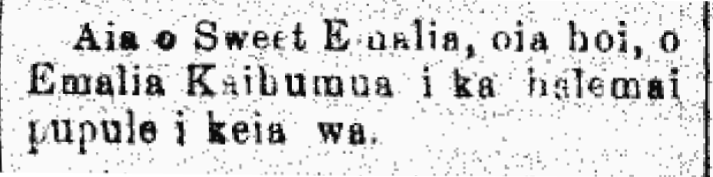
Sweet Emalia, that is Emalia Kaihumua, is now in the insane asylum [halemai pupule].

[After finding this abrupt notice, one would assume that now that Emalia was admitted into the insane asylum, other than escape, there would only be one way out…]

(Makaainana, 4/5/1897, p. 8)

Aia o Sweet Emalia...

Ka Makaainana, Buke VII—-Ano Hou, Helu 14, Aoao 8. Aperila 5, 1897.

James B. Pakele reports from San Francisco, 1894.

Behold California, a Land of Cold.¹

J. U. Kawainui,

Aloha oe,

Here I am in California in good health. This is a very cold land, but there is always something new, there is no night here; the nights are like days.

These past few days, I have almost travelled all around the town; I went to visit the sugar refinery of the Millionaire², the place where they build warships, the place where money is minted, and the place where the soldiers drill (the Pressido [Presidio]).

I was at the Cliff House this past Thursday, it is a place that many visitors travel to, I saw the animals of the sea, but that place was very cold. After that, I went to the New City Hall and I spent almost a day visiting the various offices; it is a large structure perhaps eight times the size of Iolani Palace.

There are many poor people here with no place to sleep, and there are also many rich people.

PERTAINING TO THE GREAT EXHIBITION.

I went into the different exhibition halls of the Fair, so astonishing to see; there were all kinds of beautiful things.

I was in Alameda County, a large building, and within it, there was every variety of fruit.

Arizona Indian Building is the exhibition hall of the Indians [Ilikini]. There I saw their way of dancing; their dress is fine, but their dancing isn’t great.

I went into the building of hand crafts and saw the making of the clothes that we wear and so forth, and the exhibition hall of all kinds of animals. This week, one of the handlers was killed, mauled by a lion; the reason for this was the the lights went out when the handler was sweeping inside, at which point it jumped and tore at him. I saw the blood and the suit which is placed out as a display in the pen; today there was a service over his dead body. All the people in the fair attended the funeral, the Hawaiian youths sang in Hawaiian, “In Jesus’ Hands” [“Ma ko Iesu mau lima.”] .

The most highly attended thing is the display of Kilauea in Hawaii; the haole men and women are very taken by Hawaiian things, but above all is the hula kui; all the time is filled with hula kui.

There are two bands constantly playing in the Park, but they aren’t good like the Hawaiian boys; I am always being asked by many people if I will be attending the college that John Wilson³ is attending; I have a letter urging me to go there (Stanford University).

James B. Pakele.

San Francisco, February 17, 1894.

¹”Ike ia Kaleponi he Aina Anu” hearkens back to the mele “E Nihi ka Hele”.

²Spreckels Sugar Company of Claus Spreckels, known here as the Ona Miliona [Millionaire].

³See more on John Henry Wilson in Men of Hawaii.

[For related articles and information, see the previous posts, and the posts soon to come as well! Oh… and coincidentally, i noticed i recently posted James B. Pakele’s death announcement from 1913. He died at Queen’s Hospital on January 30.]

(Kuokoa, 3/3/1894, p. 1)

Ike ia Kaleponi he Aina Anu.

Ka Nupepa Kuokoa, Buke XXXIII, Helu 9, Aoao 1. Maraki 3, 1894.

May Day in Hilo town, 1942.

Our Lei Day

According to what we understand and hear pertaining to the celebration of Lei Day, that being this Friday, the show put on will be great.

There will be two hula groups that will hula on that day, that being the hula troupe [Hui Lokelani] of Mrs. Rose Kuamoo and the Hui Huapala led by Albert Nahale-a. Other than these groups will be the Police Glee Club led by William K. Kahimoku (Kualii), and also the children of Mr. and Mrs. Joseph Kalima, and also perhaps some duets and some solos.

Last year, this show was held in the evening, beginning at 6:00, but this year, it can’t be put on in the late evening, but instead will be held at 3:00  p. m. This is times of blackout in this land, and we are not to turn on lights outside.

This show and hula will be held at Kalakaua Square, and we are lucky to have the military band join in and commemorate this day. There is nothing to be said about our County Band, for they have not dropped out of the activities of the day.

The activities of the day will begin with a concert put on by the military band at port here in Hilo, at 2:30 p. m. until 3:00 p. m., and the County band until 3:30 p. m. and followed by the other parts.

Here below is the program of events of that afternoon

MAY DAY IS LEI DAY
IN HAWAII
Directed by the Hawaiian Civic Club of Hilo
Friday, May 1, 1942,
at the Hour of 3:30 P. M.
KALAKAUA PARK

Part I, Old Hawaiian Hula

1. “Ka La o Mei He La Lei Ia Ma Hawaii” [May Day is Lei Day in Hawaii] Police Glee Club, Lokelani, and Huapala.

2. “Oli” by Mary Ahiena

3. Old Hawaiian Hula, by the Hui Lokelani.

a. Olapa — Niihau, Pua Hau o Maleka

b. Puili — Malualua

c. Iliili — Kona Hema

d. Uliuli — Moku Kia Kahi, Alekoki

4. Combined Old Hawaiian Hula, by the Hui Huapala

a. Puili & Uliuli — Nani Wale Na Hala

5. “Pua Mohala” by the Hilo Police Glee Club

Part II, Hawaiian Hula of Modern Times

1. “Kuikahi” by Huapala

2. A Hula for President Roosevelt, Lokelani

3. “Ua Hoomaka lakou i Kekahi Mea,” Frank Kahili

4. Holoholo Kaa, Huapala

5. “Loke Honesakala,” Ernest Hanaike and his Guitar

6. Nani Hilo, Lokelani

7. “Mele Maka Lalau” by Baby Kaieie

9. “Wiliwili Wai,” William Kualii

8. Aloha Ia No O Maui, Lokelani

10. Kona Hema, Huapala

11. My Sweet Sweetie, Three Children of Kalaima

12. Oahu, Lokelani

13. Ke Kali Nei Au, duet by Miss Kuaana Nathaniel and Joseph Kalima

14. Maikai Wale No Kauai, Lokelani

15. “TAHUAHUAI,” Abraham Laeha

16. Sasa & Somemore o Samoa, Huapala

17. THE CONCLUSION

a. Hilo March — Lokelani

b. “I Lei Nou” — Police Glee Club

c. Leahi, Hanohano Hanalei — Huapala

18. ALOHA OE

19. STARS SPANGLED BANNER

(Hoku o Hawaii, 4/29/1942, p. 2)

Ka La Lei O Kakou

Ka Hoku o Hawaii, Volume 37, Number 1, Page 2. Apelila 29, 1942.
Hula and King Kalakaua’s 50th Jubilee, 1886.

THE LUAU FEAST AT THE PALACE GROUNDS.

Nov. 23, 1886.

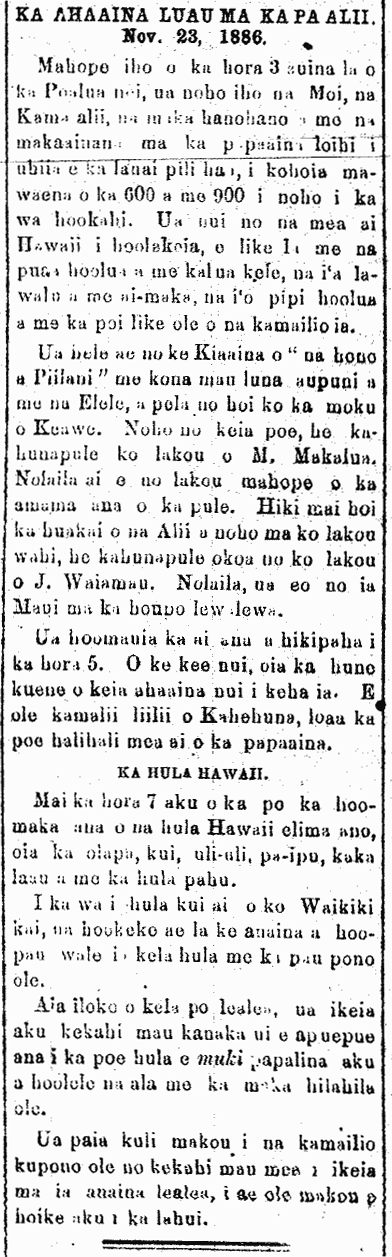
After 3 o’clock in the afternoon of this Tuesday, the King, the Princes and Princesses, the dignitaries, and the makaainana sat at a long table housed by a pavilion with corrugated iron roofing [lanai pili hao], which could sit an estimated 600 to 900 people at a time. There was much Hawaiian foods supplied, like laulau [puaa hoolua] and roasted pork [puaa kalua kele]; fish wrapped in ti leaves and baked [lawalu] and raw [ai-maka]; baked beef [i’o pipi hoolua] and all types of poi spoken of.

The Governor of the “bays of Piilani”¹ as well as his government officials and Delegates, along with those of the island of Keawe.² These people sat along with their pastor, M. Makalua. They began eating after the prayer was over. The entourage of the King and Queen arrived and sat in their area, and they had their own pastor, J. Waiamau. Therefore, Maui was victorious over their hunger [?? Nolaila, ua eo no ia Maui ma ka houpo lewalewa].

The eating continued perhaps until 5 o’clock. A big problem was the dearth of waiters for the grand feast that was boasted about. Thanks to the small children of Kahehuna [School], there were those to serve the food for the feast.

HAWAIIAN HULA.

From 7 o’clock in the night, Hawaiian hula of five types commenced, that being olapa, kui, uli-uli, pa-ipu, kaka laau, and hula pahu.

When those of Waikiki kai danced their hula kui, the audience complained, and that hula was put to an end without ending properly.

During that joyful night, some youths were seen attempting to get the dancers to kiss their cheeks, and to [?? hoolele na ala] without any sign of shame.

We were deafened by all the improper talk of some of the things seen in that partying crowd that we will not agree to tell the nation.

¹The governor of Maui was John Owen Dominis.

²The governor of Hawaii was Virginia Kapooloku Poomaikelani

(Ko Hawaii Pae Aina, 11/27/1886, p. 4)

KA AHAAINA LUAU MA KA PA ALII.

Ko Hawaii Pae Aina, Buke IX, Helu 48, Aoao 4. Novemaba 27, 1886.

Hula mounds, shoddy roads, and inclement weather in Hilo, 1887.

Mr. Editor.

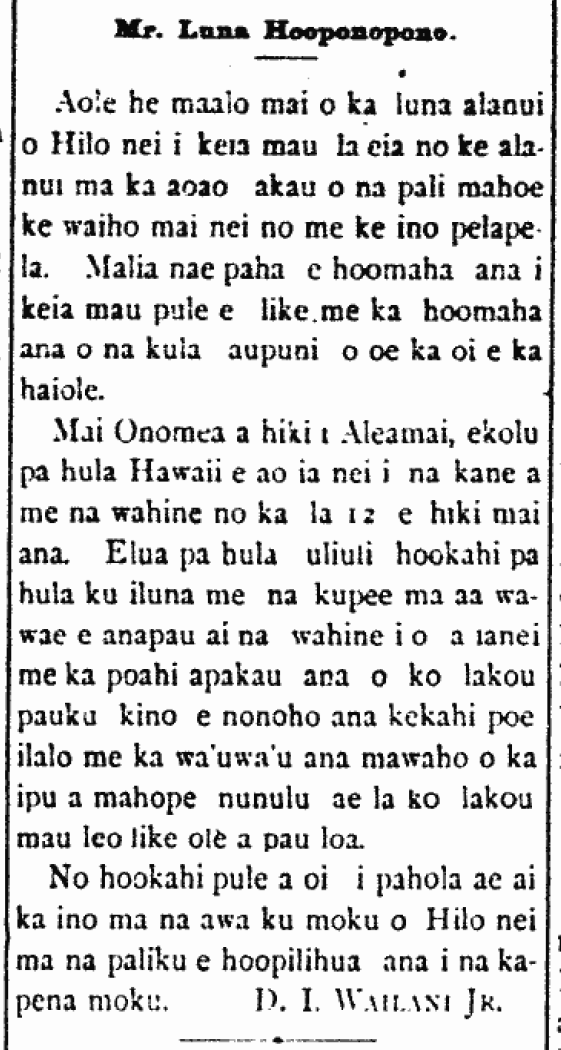
The road supervisor [luna alanui] of Hilo has not passed by these days; the road to the north of the twin cliffs [na pali mahoe] is left damaged and filthy. Perhaps he is on vacation these weeks as the public schools are on vacation; haiole [?], you are the best.¹

From Onomea until Aleamai, there are three Hawaiian hula mounds [pa hula] where men and women are being taught for the upcoming 12th. There are two green pa hula that are got on with anklets [kupee] on the legs as the women turn this way and that, while they rotate about [poahi apakau] their torsos; some people sit below while rasping [wa’uwa’u] against the outside of a gourd and then their various voices reverberate forth.

For over a week, there was a storm covering the docks here in Hilo, bewildering the ship captains on the Paliku side.

D. I. Wailana, Jr.

¹The Road Supervisor in Chief for Hawaii Island that year, according to Thrum, was C. N. Arnold.

(Kuokoa, 4/30/1887, p. 2)

Mr. Luna Hooponopono.

Ka Nupepa Kuokoa, Buke XXVI, Helu 18, Aoao 2. Aperila 30, 1887.