Another Wooden Kii found, 1868.

Akua Kii of Kalia.

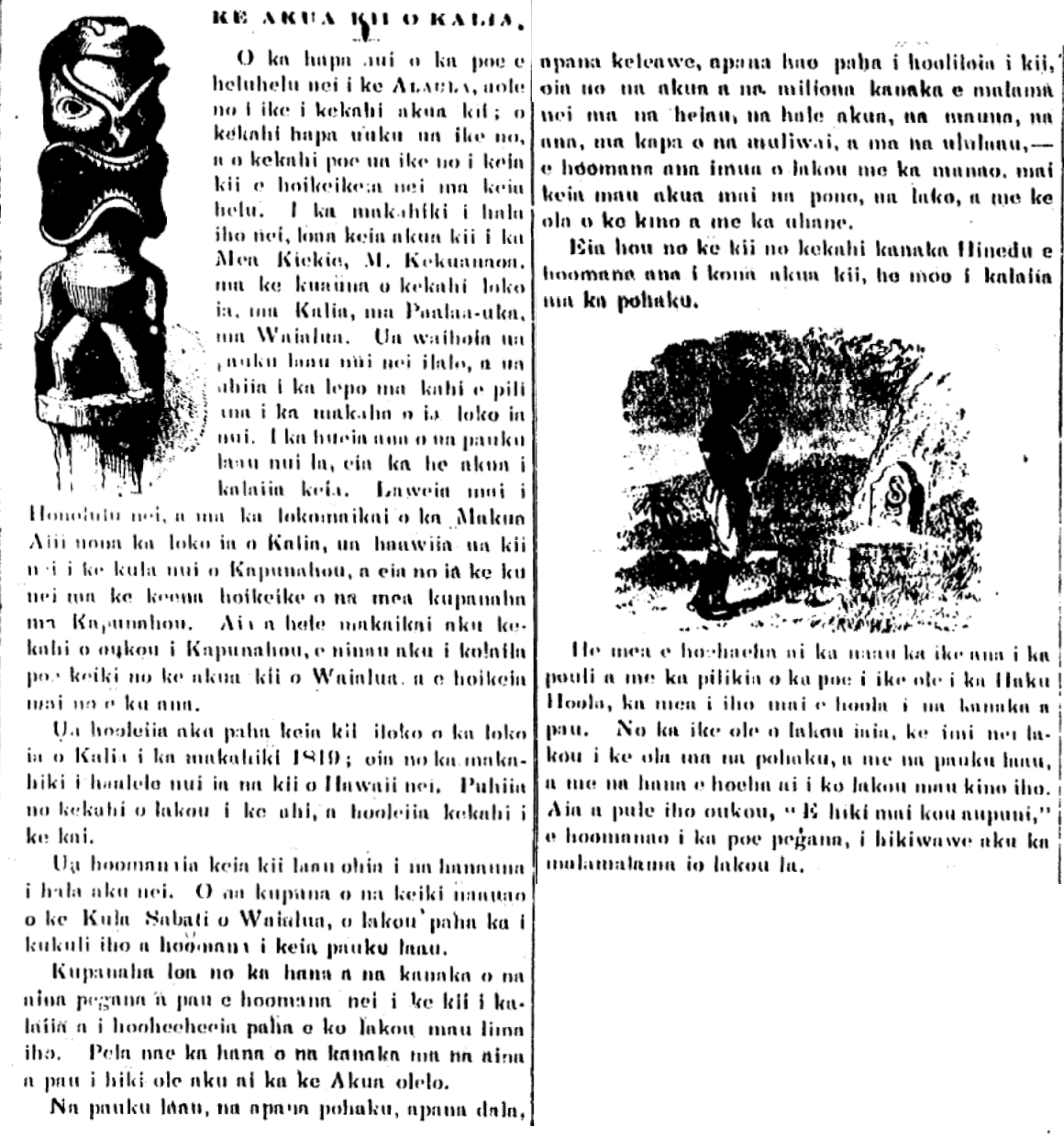
Most of the people reading Ke Alaula have not seen an akua kii, but a small fraction have seen one, and some of you saw this image that is shown here in this issue. Last year, this god idol was found by the Honorable M. Kekuanaoa on the banks of a fish pond at Kalia in Paalaa Uka in Waialua. That large piece of wood was set down and covered with soil near the sluice gate of that large fish pond. When that big piece of wood was unearthed, lo and behold, it was a carved god. It was brought to Honolulu nei, and through the goodwill of the Alii Elder who owns Kalia fishpond, that kii was given to the college of Kapunahou [Punahou], and there it stands in the exhibition room of curiosities at Kapunahou. When some of you go to visit Kapunahou, ask the children there about the kii from Waialua, and it will be shown to you where it stands.

This kii was probably thrown into the pond of Kalia in the year 1819; that is the year when there was the kii of Hawaii nei were greatly abandoned. Some of them were burnt in fire and some were thrown into the sea.

These ohia wood images were worshiped by previous generations. The kupuna of the educated children of Waialua Sunday School were probably those that knelt down and worshiped this piece of wood.

How astonishing are the actions of the people of all of the pagan lands, who worship idols that are carved or molded by their own hands. That is how all lands are where the word of God has not reached.

Pieces of wood, fragments of rock, chunks of silver, chunks of metal, or perhaps chunks of iron turned into images—those are the gods cared for by millions of people, in heiau, houses of god, mountains, caves, banks of rivers, and in forests; they worship before them thinking that from these gods come well being, wealth, and life in body and spirit.

Here also is a picture of a Hindu man worshiping his godly image; it is a snake carved into a rock.

This is something that pains the heart to see the darkness and trouble of those that don’t know of the God the Savior, the one who came down to save all man. Because they don’t know him, they seek salvation from rocks and pieces of wood and from actions that hurt their very own bodies. When you pray, “Thy kingdom come,” remember the pagans so that the light reaches them quickly.

[Could this Akua Kii be the one now at the Bishop Museum which was found in Waialua and presented to Punahou?]

(Alaula, 1/1868, p. 39)
KE AKUA KII O KALIA.

Ke Alaula, Buke II, Helu 10, Aoao 39. Ianuari, 1868.

Speaking of immigration… 2012.

Tradition and Transition: Stories of Hawai‘i Immigrants

Tradition and Transition

Fall 2011 – Summer 2013

Castle Hall’s second floor gallery features special treasured stories in focus cases, a timeline of Hawaiian history, video stations, and significant artifacts and document to relay the history of Japanese in Hawai‘i.

Inspiring stories abound when the discussion centers on the challenges faced by immigrants coming to a new homeland. Tradition and Transition, Stories of Hawai‘i Immigrants presents these and celebrates the diversity brought by all ethnic groups who contribute to the economic strength and cultural multiplicity of Hawai‘i.

Tradition and Transition, Stories of Hawai‘i’s Immigrants celebrates the stories of challenge and victory, tales of hardship matched with those of success. It is a story that focuses on the strength of human spirit and the power of change.

For children, a Pā‘ani Place is forfor kids to learn about multi-ethnic playthings and pastimes.

The hallway adjacent to the main exhibition gallery is Ho‘olaule‘a Hall, filled with large photomurals, hanging celebratory items, and smaller exhibit cases that focus on multiethnic celebrations.

At the end of the Ho‘olaule‘a Hall, will be Ho‘okipa Parlor, a recreation of the interior of a plantation home living room, welcoming visitors who wish to sit a while and browse books on various local ethnic traditions or watch some old news reels of plantation-era Hawai‘i.

Tradition and Transition: Stories of Hawai‘i’s Immigrants is funded by generous gifts from the Atsuhiko & Ina Goodwin Tateuchi Foundation and Hawai‘i Imin Shiryō Hozon Kai.

Tateuchi Foundation

[Don’t forget to check out this ongoing exhibit at the Bishop Museum! The description is taken from the Bishop Museum page.]


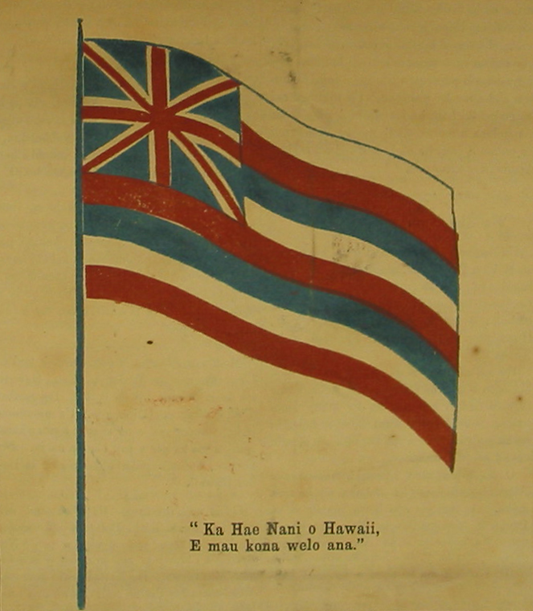
The Hawaiian Flag—a closeup. 1862.

“The Beautiful Flag of Hawaii,
Let it forever wave.”

[The image of the Hawaiian Flag as it appeared to the readers of the Kuokoa in 1862! (Courtesy of the library/archives at the Bishop Museum.)

The Library and Archives at the Museum holds so much priceless information! They need more funding to do important things!!]

"Ka Hae Nani o Hawaii...

Ka Nupepa Kuokoa, Buke I, Helu 6, Aoao 1. Ianuari 1, 1862.

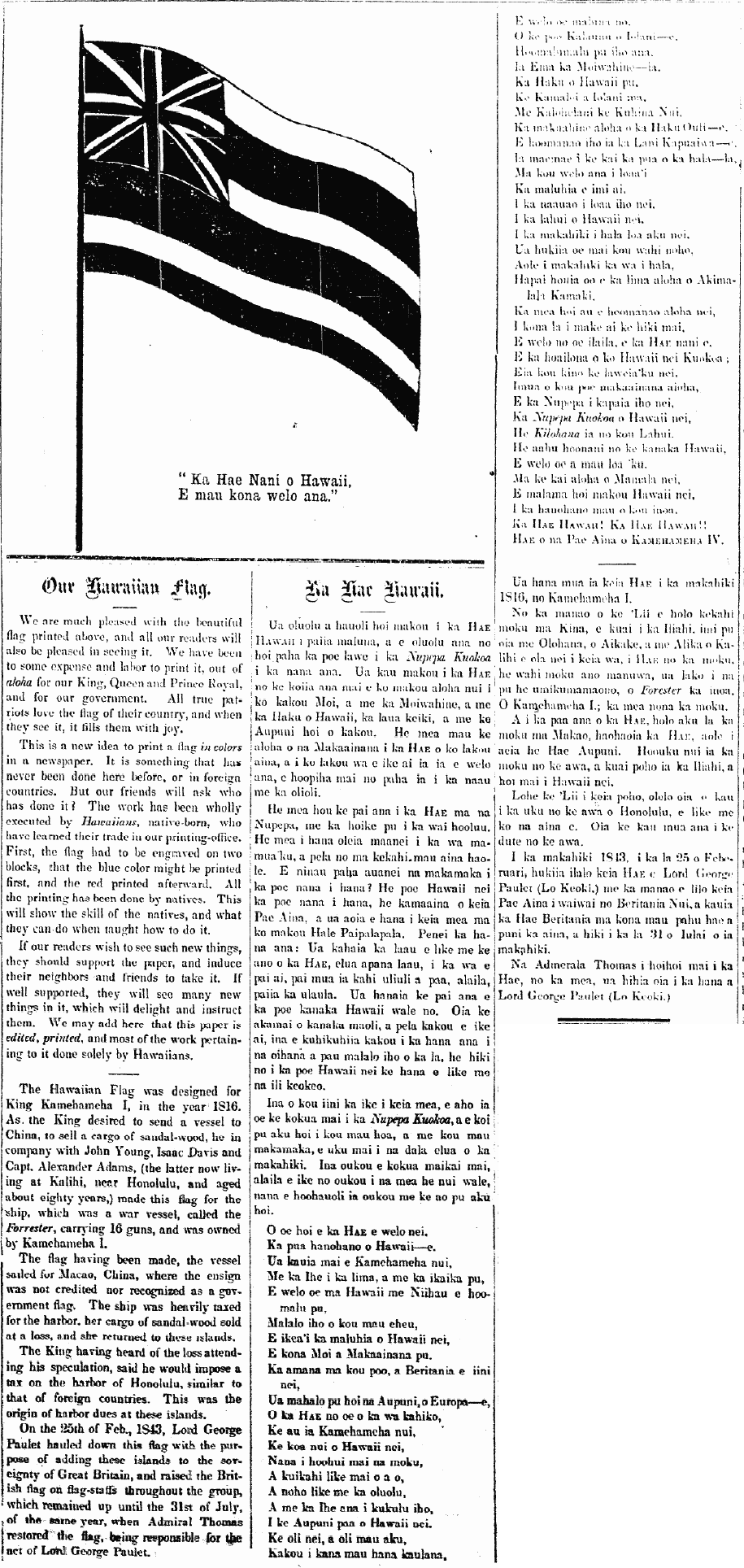
History of the Hawaiian Flag. 1862.

“The Beautiful Flag of Hawaii,
Let it forever wave.”

The Hawaiian Flag

We are pleased and happy about the Hawaiian Flag printed above, and the people subscribing to Ka Nupepa Kuokoa will be delighted to see it. We display the Flag, urged to do so by our great aloha for our King, Queen, and Ka Haku o Hawaii, their son, as well as for our Nation. The love by the people for their flag of their country is customary, and when they see her fluttering, it fills their hearts with joy.

The printing of the Flag in a Newspaper is something new, along with the displaying of its colors*. This is something not done previously here, as well as in some foreign countries. Perhaps our friends will inquire as to who did this work. Some Hawaiians did the work, people from this Archipelago, and they were taught to do this in our Printing Office. Here is how it was done: Woodblocks were carved in the fashion of the flag using two blocks. When it was printed, first the blue was printed, allowed to set, then the red was printed. This printing was done solely by Hawaiians. Such is the intelligence of the kanaka maoli, and that is how we recognize it. If we are instructed to do any task under the sun, Hawaiians can do the same as the white-skinned people.

If you should want to see this, you should support Ka Nupepa Kuokoa, and urge your acquaintances and friends to pay the two dollars a year. If you would kindly help, you will see many things that will gladden and instruct you.

You, O fluttering Flag,
The proud blossom of Hawaii.
Established by Kamehameha the great,
With Spear in hand, with strength,
Flutter over Hawaii and Niihau, and give protection.
Beneath your wings,
So that the peace of Hawaii be known,
By her King and the people as well.
The cross on your crest that Britain holds dear,
The Nations of Europe also give acclaim,
You are the Flag of old,
The time of Kamehameha the great,
The bravest warrior of Hawaii,
He who joined the islands,
With unity from end to end,
Living as one in contentment,
Along with the Spear upon which he erected,
The steadfast Nation of Hawaii.
We rejoice, and rejoice for all time,
His famed accomplishments,
You wave there above,
The crown of Iolani, the king
While giving shelter,
To Emma, the Queen.
Along with Ka Haku o Hawaii.
The Royal child of Iolani and Emma,
And Kalohelani, the Regent, Victoria Kamamalu.
The loving aunt of the young lord, Prince Albert,
Do remember his His Highness, Lot Kapuaiwa,
Cleansing the fruit of the pandanus in the sea,
Your fluttering has garnered
The peace that allowed us to seek,
The knowledge that has come,
To the Hawaiian populace.
That year long ago.
You were taken from your proper place.
Not a year passed,
You were raised by the loving hands of Admiral Thomas.
The one you fondly recall,
On the day of his death when it approaches,
You will wave there, O beautiful Flag.
O symbol of Hawaii’s Independence ;
Here is your body, being brought.
Before your beloved people,
By the Newspaper called,
Ka Nupepa Kuokoa of Hawaii,
The Excellence of your Nation.
A garment that adorns the Hawaiian People,
Wave forever.
Over the beloved sea of Mamala,
We, Hawaii, will cherish always,
The eternal glory of thy name.
The Hawaiian Flag! The Hawaiian Flag!!
The Flag of the Islands of Kamehameha IV.

This Flag was first designed in the year 1816 for Kamehameha I.

The King, wanting a ship to sail to China to sell Sandalwood, searched along with John Young, Isaac Davis, and Captain Alexander Adams of Kalihi, who is still living, for a Flag for the ship. It was a man-o-war, called the Forrester, carrying sixteen guns. Kamehameha I owned the ship.

When the Flag was completed, the ship sailed to Macao. The Flag was puzzled over, and was not accepted as a National Flag. The ship was charged exorbitantly for harbor fees, the Sandalwood was sold for a loss, and the ship returned to Hawaii.

The King learned of this loss, and he said that a tax should be placed on the harbor of Honolulu like those of foreign lands. That is when duty was first charged for the harbor.

In 1843, the 25th of February, this Flag was taken down by Lord George Paulet [Lo Keoki], with the intent that this Archipelago be taken as a possession of Great Britain. The British flag was raised on flag poles all around the land, until the 31st of July of that year.

It was Admiral Thomas who restored the Flag, for he disputed the actions of Lord George Paulet.

[Notice the English column to the left, which gives a translation of the Hawaiian. It seems this issue of the Kuokoa was sent to home by many a missionary, to show the progress they were making…

*A word of clarification: This is not the first time color appears in a newspaper. For more on this topic, see Hana Hou Magazine, August/September 2011: “Read All About It!” by Ron Williams.

For more flag articles, just click here!]

(Kuokoa, 1/1/1862, p. 1)

"Ka Hae Nani o Hawaii...

Ka Nupepa Kuokoa, Buke I, Helu 6, Aoao 1. Ianuari 1, 1862.

Lava destroys the village of Hoopuloa, Kona. 1926.

The Harbor of Hoopuloa is Destroyed by Lava.

On this past Sunday [4/18/1926], the fire of woman of Mokuaweoweo appeared and reached the sea and it swept aside the things blocking its path. When it got close to the upland of Hoopuloa, the flow of lava separated into two, and one of the flows went straight for the village of Hoopuloa and the harbor, and the second flow went towards the village of Milolii. The fiery lava engulfed the harbor and village of Hoopuloa, and now they are but a heap of pahoehoe lava.

According to eyewitnesses of this engulfing lava, it was frightening seeing the lava coming down, and others say that it was truly awesome watching the flowing lava and its sweeping aside of all obstructions in its path.

The last word heard before the the Hoku went to the press was that this Wondrous Woman of Halemaumau returned to her Palace at Kilauea, and she is bringing to life her fires at the famed crater of Halemaumau.

Perhaps her rage has been quenched as the skin of that woman has touched the sea, but the memory of the tragedy which befell the people of that section of Kona is heartbreaking.

[And check out this awesome picture of the tragic event taken by Tai Sing Loo, put up by the Hawaiian Historical Society!]

(Hoku o Hawaii, 4/20/1926, p. 2)

Pau ka Uwapo o Hoopuloa i ke Ahi Pele

Ka Hoku o Hawaii, Buke XIX, Helu 48, Aoao 2. Aperila 20, 1926.

Kawaihau Glee Club off to San Francisco. 1905.

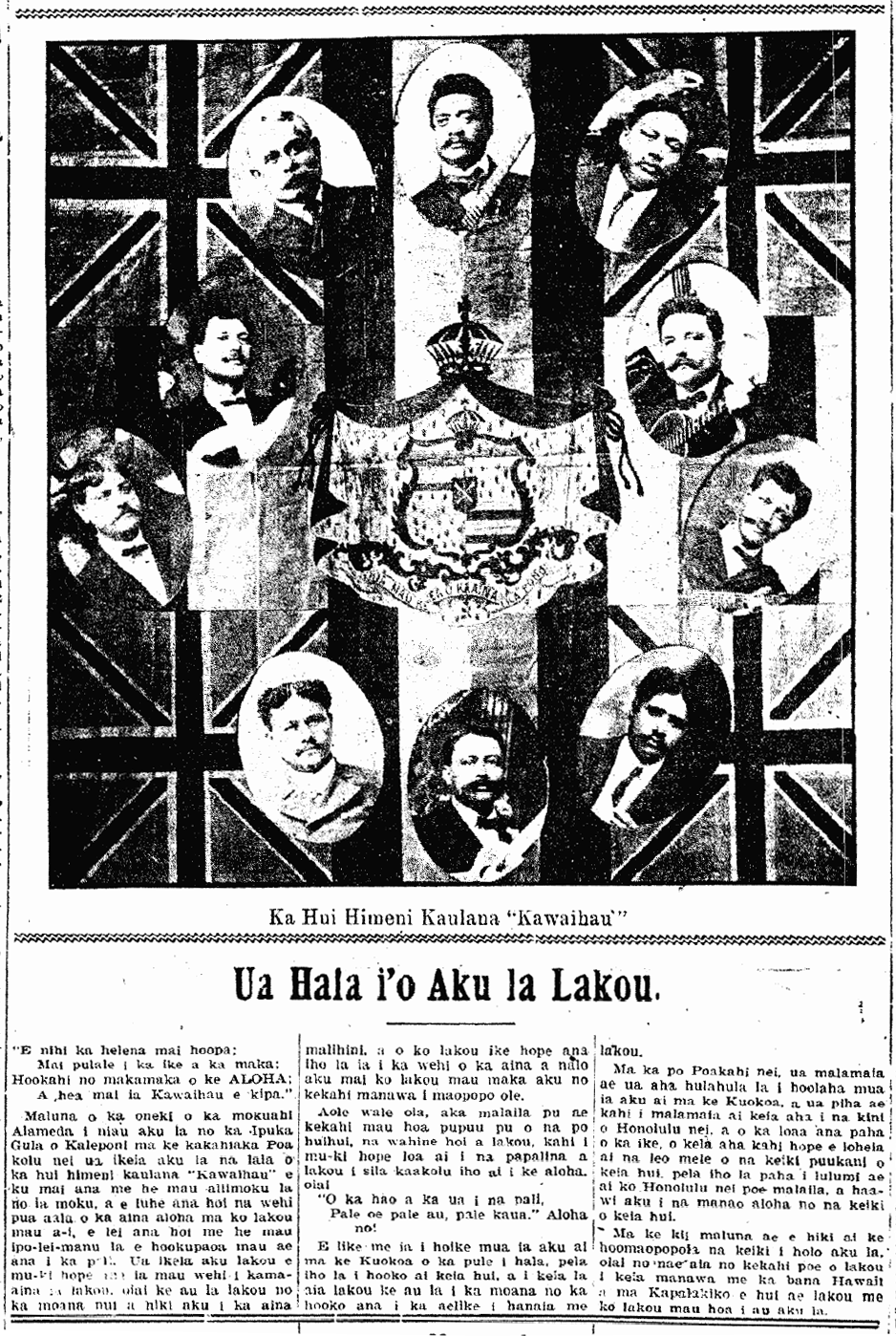
The Famous Singing Group “Kawaihau”

They Left for Afar.

“E nihi ka helena mai hoopa; [Tread carefully, don’t touch;]
Mai pulale i ka ike a ka maka [Don’t get excited by what the eye sees:]
Hookahi no makamaka o ke ALOHA [There is but one companion, that is ALOHA];
A hea mai ia Kawaihau e kipa. [Calling out to Kawaihau to come visit.]”¹

Aboard the deck of the steamship Alameda that moved swiftly on to the Golden Gate of California on the morning of Wednesday was seen the members of the famed singing group “Kawaihau” standing like officers of the ship while garlands of fragrant flowers of the beloved land hung about their necks; they wore the lei like a beloved sweetheart ever imbuing fragrance in their bosom. They were seen inhaling for the last time the adornment familiar to them as they were leaving for the great sea headed for foreign lands; and they were seeing for the last time the verdure of the land which disappeared from their eyes for who knows how long.

Not just them, but also there were the companions to curl up together in the cold nights—their wives, there to kiss their cheeks for the last time, which they sealed threefold with love, as

“O ka hao a ka ua i na pali [The assault of the rain in the cliffs]
Pale oe, pale au, pale kaua.” Aloha no! [I fend off, you fend off, we both fend off.”² Aloha!]

Just as reported earlier in the Kuokoa of last week, so did this group carry out, and today they are travelling over the ocean to fulfill the contract made with them.

This past Monday that dance advertised earlier in the Kuokoa was held, and the venue where the event took place was filled with the multitudes of Honolulu; perhaps they knew that this gathering would be the last they’d hear the singing of the performers of this group, and that is probably why Honolulu’s people thronged there and gave their aloha to the boys of the band.

In the picture above, you can see the boys who went, although some of them are currently with the Hawaiian Band in San Francisco and will meet up with their companions who left.

¹Play on the chorus of Kalakaua’s “E Nihi ka Hele.”
²Anyone know what mele this might come from?

[This is who played at that huge wedding celebration in Pauoa attended by Kaiulani in 1898 (the articles posted yesterday)]

(Nupepa Kuokoa, 9/22/1905, p. 1)

Ua Hala i'o Aku la Lakou

Ka Nupepa Kuokoa, Buke XLIII, Helu 38, Aoao 1. Sepatemaba 22, 1905.

May Day Queen, 1941.

Became Queen

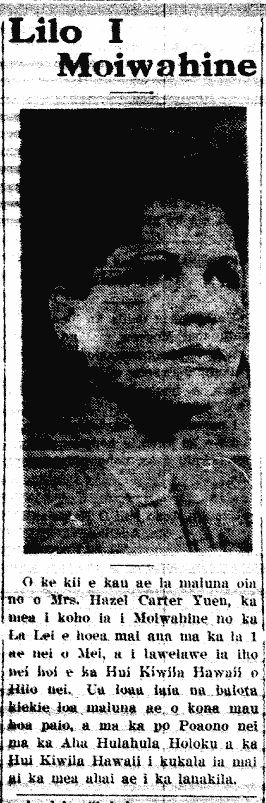
The picture above is of Mrs. Hazel Carter Yuen, the one chosen as Queen for the upcoming Lei Day, the 1st of May, held by the Hawaiian Civic Association [Hui Kiwila Hawaii] of Hilo. She received the most ballots from amongst her running mates, and on the night of this past Saturday at the Holoku Ball of the Hawaiian Civic Association the one who took the win was announced.

(Hoku o Hawaii, 4/9/1941, p. 1)

Lilo i Moiwahine

Ka Hoku o Hawaii, Buke XXXV, Helu 50, Aoao 1. Aperila 9, 1941.

More Hawaiians playing music afar, 1908.

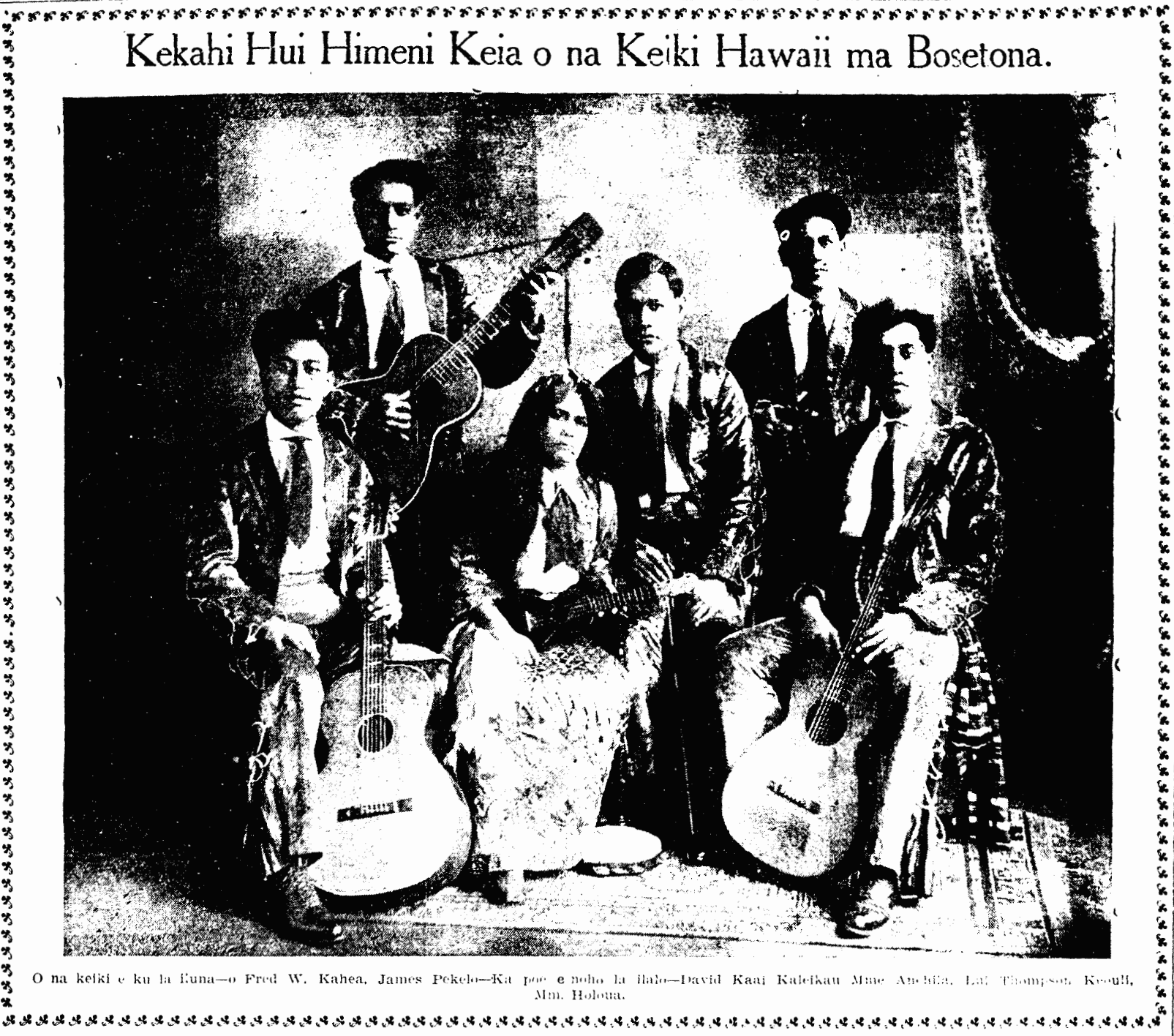
This is a Singing Group of Hawaiian Youths in Boston.

The ones standing–Fred W. Kahea, James Pekelo. Those sitting–David Kaai Kaleikau [Kaleikoa], Madame Anehila [Hobron], Lui Thompson Keouli, Monsieur [William] Holoua

[Plus check out this awesome brochure from the same time put up by the University of Iowa! The Honolulu Students from the Hawaiian Islands. Sometimes the internet is such a good thing!]

(Kuokoa 2/7/1908, p. 6)

Kekahi Hui Himeni Keia o na Keiki Hawaii ma Bosetona.

Ka Nupepa Kuokoa, Buke XLIII, Helu 6, Aoao 6. Feberuari 7, 1908.

More music—Ernest Kaai, 1906.

ERNEST KAAI LEFT ON HIS MUSICAL TOUR OF KAUAI.

Last evening, Professor Ernest Kaai of the town of Honolulu nei left for the island of Kauai along with his fellow musicians to hold concerts in the places where they will visit, and they will not be left without being welcomed by the people of Kauai.

Travelling along with him are Mrs. Nane [Nani] Alapai, the singer of the Royal Hawaiian Band; Miss Keala; Mr. Holokahiki; and John Noble, Jr., a youth skilled on the flute [hoopiopio?]. They number five in total, and they are members of that band that is moving quickly through the places they visit.

After arriving on Kauai, Lihue is the first port where they stop, and it is there that they will hold their first concert tomorrow. After that, their tour will go all the way to Koloa where they will have a concert on the coming Monday, the 6th.

Then their musical tour will move on to Eleele, where they will have a musical assembly on the next Tuesday, the 7th. From there they will arrive at Waimea, and they will open another concert on Tuesday [Wednesday] the 8th. And then onto Makaweli where they will have another concert on the next day, the 9th.

Ernest Kaai and his band mates will spend a number of days on Kauai, and when they reach Makaweli, and hold a concert there on the day shown, it is then that they will know where their tour will move to next.

On this tour, Professor Kaai has time to give benefit concerts for good causes if it will be beneficial, but this all depends on the scheduling.

Mr. Kaai is a young Hawaiian that is well known in this town among the Hawaiians and among the haole that love playing music, for the regular job of that young man is teaching music. There are many haole women and haole men and Hawaiians as well who were taught by him and graduated in music.

[If this post looks familiar to some of you, it is because I posted it some time ago on the old Hoolaupai Facebook page. I found that it is not easy to find anything on that page, so started the blog at http://nupepa-hawaii.com, where it is a whole lot easier to find posts! So I will be on occasion reposting articles so that they will be findable in one location. They will all be under the category “Repost”.]

(Kuokoa, 8/3/1906, p. 8)

UA HALA AKU O ERNEST KAAI I KE KAAHELE HIMENI NO KAUAI.

Ka Nupepa Kuokoa, Buke XLV, Helu 31, Aoao 8. Augate 3, 1906.