ENGLISH IS SHUT OUT
MEMBERS OF THE HOUSE PREFER THE HAWAIIAN LANGUAGE AND HAVE TAKEN TO DEBATING IN THAT TONGUE WITHOUT ANY INTERPRETATION—LONG DISCUSSION MEANINGLESS TO THE ENGLISH-SPEAKING PUBLIC. Continue reading
MEMBERS OF THE HOUSE PREFER THE HAWAIIAN LANGUAGE AND HAVE TAKEN TO DEBATING IN THAT TONGUE WITHOUT ANY INTERPRETATION—LONG DISCUSSION MEANINGLESS TO THE ENGLISH-SPEAKING PUBLIC. Continue reading
LET ALL MEN know the thoughts of the Hawaiian Medical Practitioners [Kahuna Lapaau Hawaii], they who number one hundred and fifty. O Ke Au Okoa, speak their thoughts. About how we will bear this immense right of ours impeccably, without deceit. Let them be instructed to put behind these evil thing: evil sorcery [anaana], imitative magic [hoopiopio], sending spirits [hoounauna], and the deification of all evil things; Continue reading
At 4 oʻclock after daybreak on this past Saturday, March 22, death came for the member of the house of nobles, Simon Kaloa Kaai, and took him from this side of the black river of death. Continue reading
Senator James Kealoha of Hawaii introduced a law into the Legislature to teach Hawaiian language in the government schools, and in schools that stand on land under the care of the Hawaiian Homes Commission [Komisina o na Home Hawaii].
The senator believes that by teaching children Hawaiian in the places shown above, for only Hawaiians live on Hawaiian Homes land, and it is right to teach them the mother tongue. This idea of the young senator is a fine one indeed. But in the mind of some people they do not believe that this is a very good bill to be supported by the other members of the senate as well as the house of representatives.
Thoughts expressed by some who are not Hawaiian is that this bill should be amended to whereby it is opened up widely and Hawaiian is taught at all government schools in the Archipelago.
If this young senator did not submit this bill, the thoughts of others would not have been known. Continue reading
He inoa nou e Kalanianaole,
Ka onohi momi a o Hawaii nei.
He mea nui oe na ka lahui,
Milimili na ka Ua Kukalahale.
Ua ku’i e ka lono puni na moku,
O Kalanianaole ua hele loa.
Aia paha oe i Amerika,
I ka uluwehi a o Wakinekona.
Ua kohoia oe e ka lahui,
I wahaolelo no Hawaii.
Kakooia e ka ili keokeo,
Repubalika kou baloka. Continue reading
Unexpected opposition raised against the B. H. 21 which was introduced by Representative John W. Kalua to make the birthday of Prince Kuhio Kalanianaole into a government holiday [kulaia aupuni] was seen last Monday when the bill was taken up for the third reading in the house of representatives [hale o na lunamakaainana]. Notwithstanding the great opposition, the bill passed the third reading, 20 to 10 opposing. This was the first time that great number of people opposing a bill was seen. Continue reading
This candidate for the legislature in the Democratic party of Oahu nei was born at Honomakau, which is famous for the saying: “No youth of Kohala goes out unprepared” [“Aohe u’i hele wale o Kohala”]. This also is the birthplace of the Hon. H. M. Kaniho. He was born on the 27th of March, 1852. When he was small, he was brought to Honolulu. He entered into the districts schools [kula apana] here in Honolulu, and also in Kalauao, Ewa. And thereafter he attended the Royal School at Kehehuna, and its head Instructor was Mr. Beckwith. After two years there, he entered Ahuimanu College in Koolaupoko, under the instruction of the Fathers Elekenio, Remona, Livino, and the many other teachers. He was taught law in North Kohala under Judge P. Kamakaia. He returned here to Honolulu and studied law at the law school of W. R. Castle [W. R. Kakela], as well as at the law school of S. B. Dole. He studied law with lawyers Davidson and Lukela. In 1884, he received his full license to practice law in all Courts of Hawaii nei, and he still retains his law license. He was an editor for many of the Hawaiian-language newspapers in this town. Currently, he is the editor for KE ALOHA AINA. He was a teacher at the boarding school of Rev. E. Bond [Rev. E. Bona] in Kohala. He was the first to establish an English language school in North Kohala, Hawaii. He was an assistant teacher at the British Government School at Ainakea, under H. P. Wood, and thereafter under E. N. Dyer. For many years he tried to join the Legislature, so that the lahui would see him pass laws that would benefit the lahui in need; but the people did not assent. Now his hope is that it will be in the upcoming election that the voters will come through, making him a Representative, whereupon he will show his works for the good of the land and for the advancement of the lahui.
[Poepoe played a huge part in the history of the Hawaiian-Language Newspapers! I was happy to find this. Also, I just saw this morning more on the Catholic school at Ahuimanu on Nanea Armstrong-Wassel’s instagram page. Go check it out. There is a picture of the school as well!]
(Aloha Aina, 10/26/1912, p. 1)
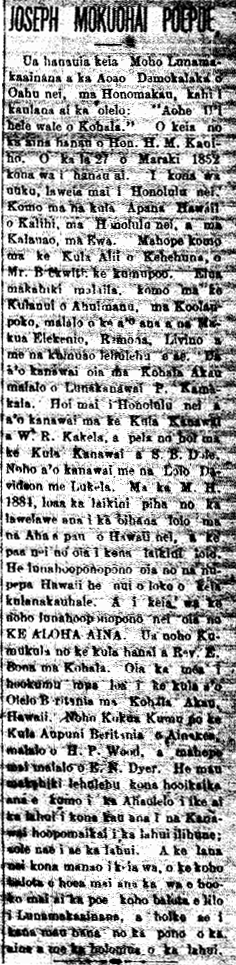
Ke Aloha Aina, Buke XVII, Helu 43, Aoao 1. Okatoba 26, 1912.
[Translated from the Kuokoa, of Mar. 18.]
Mr. Editor:—In the Commercial of the last Saturday I observe a matter of importance emanating from foreigners of Honolulu. It is a memorial to the King in respect to repopulation, and mainly advocating the bringing hither of people from India whereby this nation shall be reinvigorated.
Therein also the King is recommended to seek for information abroad from persons skilled in such matters. This is not, I think, good advice; the real meaning however is a contempt for the Ministers because they have done nothing.
The astonishing thing about this memorial is that the Hawaiian people are entirely left out in so important a matter as a proposition to bring people from a foreign land to increase this nation.
The idea of increasing the nation by bringing people of another country here, is a good one, but it is proper that the Hawaiians themselves should be as well consulted in the matter. But we are altogether thrown on one side; and if the foreigners wish to bring East Indians here to increase without our concurrence or knowledge, it will be altogether wrong. If this is really their intention, thus to treat us like dumb animals, then we had better arise and seriously consider this startling scheme that is being projected among the foreigners.
Know O Hawaiian People! The King’s increase of the nation is the Reciprocity Treaty. When we have got that secured and in operation, then we will consider in regard to getting people from India, Japan, China or Malaysia; provide first something for people to do when they arrive; but if you get laborers now, and East India population, where is the work for them to do or the land to give them.
The impudence and haste of these people is surprising; they appear like a lot of children, fuming and showing their teeth at the Ministers, accusing them and accusing the King of having done nothing. Indeed! and how about the Treaty?
Another surprising thing is that four members of the House of Nobles signed their names to that paper, Messrs. Rhodes, Cleghorn, Smith and Castle. Which of these labored so hard to put the King on the throne, as stated in the memorial? I am of the opinion that the names of some of these persons are those of annexationists, who were strong for the treaty when Lunalilo was King. It is certain that they did not vote for the present King, for they were not then in the Legislature, having only recently been appointed as Nobles. I am of the opinion that they having thus dragged the King’s Ministers into the memorial, it would be well for the King to withdraw their appointments, or better still that they return their patents as Nobles to His Majesty—if it was not for the fact that it would be unconstitutional.
Perhaps they want to become Ministers themselves? Yes, that is so; but if their judgments are thus perverted, they are unfit for the Ministerial office, for they would by and bye be doing something without consulting the people, and disaster might follow. Let their desires be disappointed, and let the King appoint none but native Hawaiians.
This is a matter for the Legislature to attend to; but as we have not been consulted by the memorialists, it is proper that we should stand and consider what is to be the end of this business.
Respectfully, Edward Lilikalani.
[Here is a translation of Edward Kamakau Lilikalani’s response to the repopulation memorial that was printed in the Kuokoa on 3/18/1876.]
(Pacific Commercial Advertiser, 3/25/1876, p. 3)
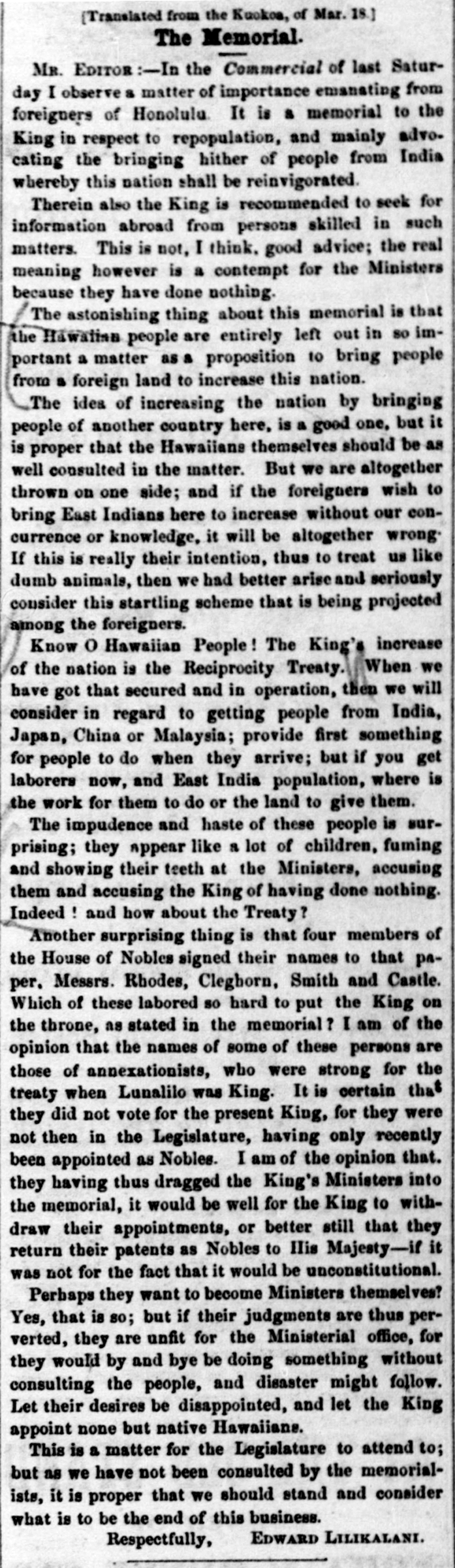
The Pacific Commercial Advertiser, Volume XX, Number 39, Page 3. March 25, 1876.
REPORTS OF COMMITTEES.
Mr. Sheldon from the select committee on the subject of hulas, presented a draft of a bill for their suppression, as follows:
“An act to suppress the Hawaiian Hulas.
Be it enacted, &c:
Sec. 1. That the Hawaiian hulas mentioned in this section are common nuisances. Whoever shall publicly perform the following hulas, viz: Kuolo, Pahu, Puniu, Paipu, Paiumauma, Kakalaau, Kihelei, Pele, Ulili, Kii, Kilo, Kake, Pela, Alaapapa, Pana, Ami, Pahua, Olapa, and hulas of like nature, whether performed by an individual or by an assembly, shall, on conviction thereof, be punished as guilty of a common nuisance. Provided, however, that this act shall not be regarded as prohibiting any Court of the Kingdom from applying the law of common nuisance to any dances or hulas not specified in this section, if they be proved nuisances.
Sec. 2. This act shall take effect at the expiration of three months from the date of its publication in the Polynesian and Hae Hawaii newspapers.”
Ordered for Friday next.
[The members of the House there that day were: S. P. Kalama, S. Lainaholo, James I. Dowsett, J. H. Kaakua, J. W. Austin, Paul F. Manini, M. Kapihe, J. S. Low, Ioane Richardson, C. K. Kakani, D. Nuuhiwa, J. H. Kaauwaepaa, R. S. Hollister, E. P. Kamaipelekane, J. E. Chamberlain, Z. P. Kaumaea, M. Kenui, J. W. B. Kiolea, J. W. Kupakee, J. Kahai, J. M. Kalanipoo, D. H. Hitchcock, and H. L. Sheldon.
The committee itself was made up of H. L. Sheldon, James I. Dowsett, and S. P. Kalama.]
(Polynesian, 1/1/1859, p. 2)
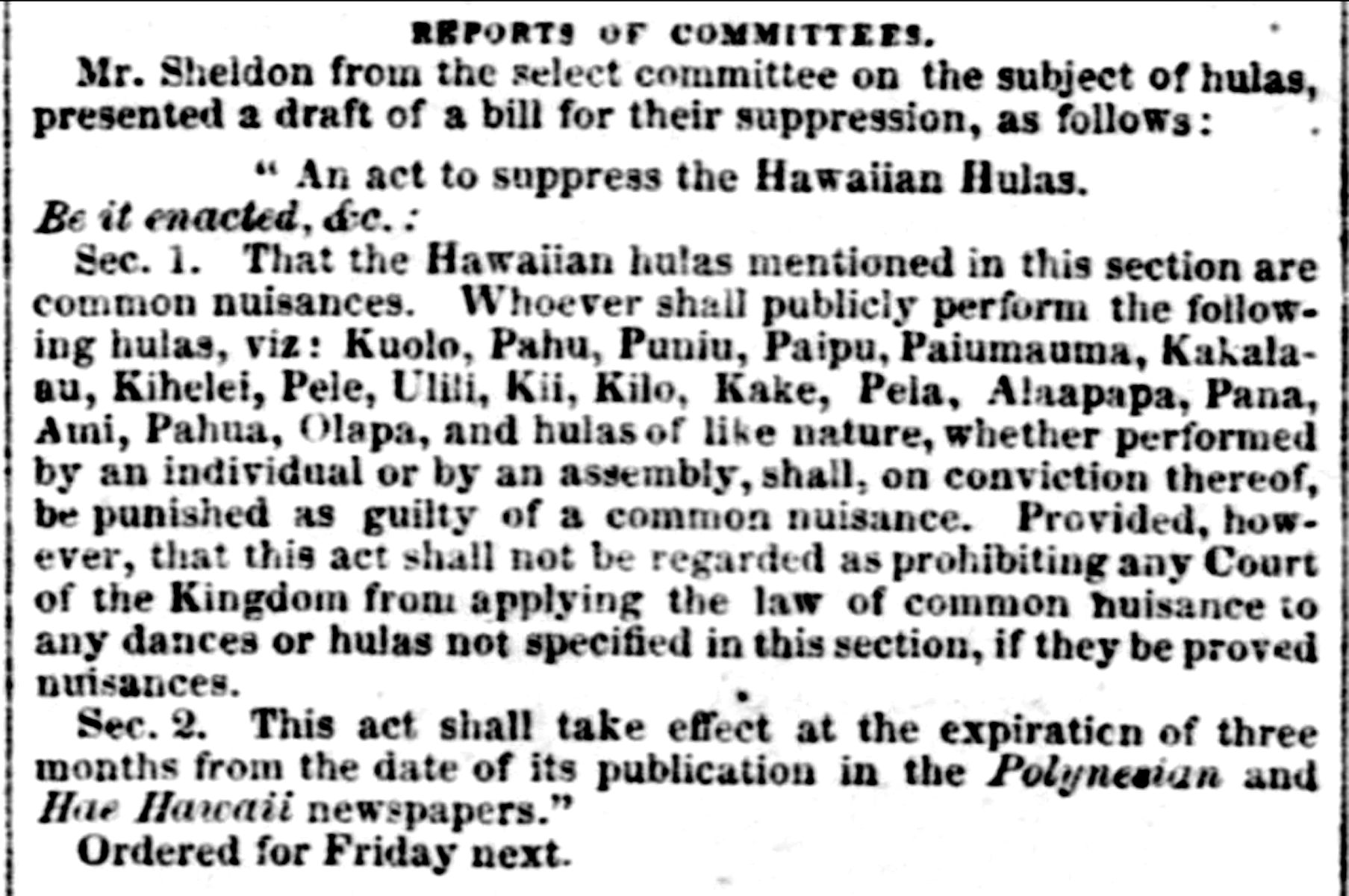
The Polynesian, Volume XV, Number 35, Page 2. January 1, 1859.
Order of the Day.
The bill to protect the oo, iiwi, mamo, and akakane birds for the king, so that they are not killed, was read for the third time. It was left to the select committee [komite wae], Kaai, Aholo, Kahanu, Nahaku, and Wana.
[This is found in the minutes of the 1876 Session of the Legislature.]
(Kuokoa, 9/2/1876, p. 1)
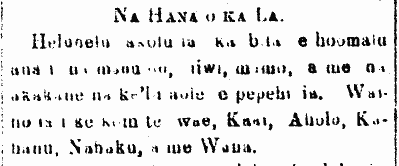
Ka Nupepa Kuokoa, Buke XV, Helu 36, Aoao 1. Sepatemaba 2, 1876.
 nupepa