Mistreatment of leprosy patients and why we need to reshoot the Hawaiian-Language Newspapers, 1886.

ABUSE BY THE BOARD OF HEALTH.

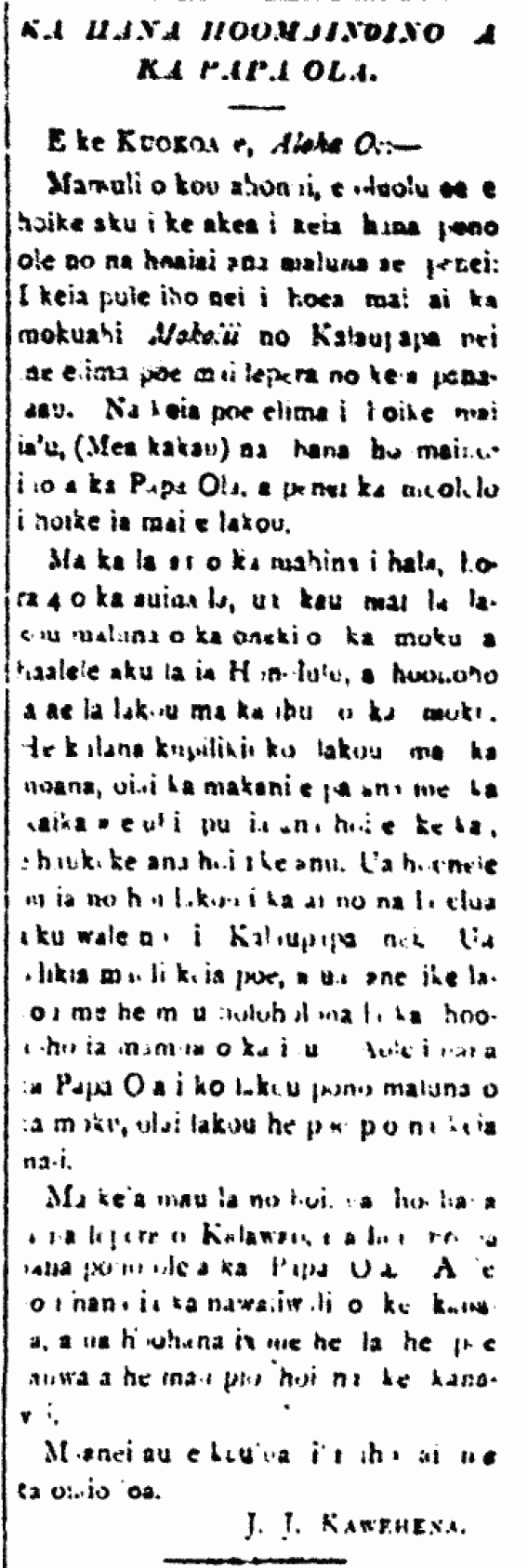
O Kuokoa, Aloha Oe:—

Please be so patient as to show this improper behavior to clarify the above, thus: This past week the steamship Makalii arrived here in Kalapapa with five leprosy patients for this colony. These five people told me (the Writer) about the cruelty done by the Board of Health, and this is the story told by them.

On the 21st of the past month, at 4 in the afternoon, stepped onto the deck of the ship and left Honolulu, and they were placed at the bow of the ship. They were in distress while at sea due to the winds that were blowing strongly and they were covered by the sea and shivered in the cold. They were not give food for two days and then landed here in Kalaupapa. They were in desperate shape, and were treated like animals being placed at the bow. The Board of Health did not look after their well-being even if they ?????

These days, the leprosy patients of Kalawao are made to work ?????? mistreated by the Board of Health. They don’t consider the weak state of the people and are worked like slaves and they are prisoners of the law.

Here, I ????? with sincerity.

J. J. Kawehena.

[I know i keep saying that the Hawaiian-Language Newspapers need to be reshot again so that we can have the clearest images possible, but i can’t help it. Here is a perfect example. I am guessing at a good deal of the content, and where i couldn’t, i left as “????” Once the papers deteriorate and crumble away, there is no way we can get these histories.]

(Kuokoa, 7/3/1886, p. 1)

KA HANA HOOMAINOINO A KA PAPA OLA.

Ka Nupepa Kuokoa, Buke XXV, Helu 27, Aoao 1. Iulai 3, 1886.

Anonymous accusations against a Catholic priest in Kalawao, 1874.

The deeds of the Catholic teacher in Kalawao.

We are printing below the deeds of a certain Catholic priest amongst the leprosy patients in Kalawao:

1. Clothes—The clothes donated by the brethren of Honolulu for the needy leprosy patients of Kalawao, that is what the Catholic teacher is using to lure the people of the Evangelical faith [hoomana Euanelio] to join the Catholic religion. While he goes around doing his converting, and when they hear him they convert, but should they be steadfast, the teacher will say, “Should you join the Catholic faith, I will give you the clothing and things that you lack, should you desire.” By this action, some agree to join; there have been many converted over the clothes. This is the cunning way [kumu hinu ?] of the Catholic priest.

2. Wooden staff—The Catholic teacher constantly carries a staff in his hand, and it is with this that he converts people to his faith. This is what he does. For that person or persons who are resolute against being converted over clothes, they are struck by the cane of the Catholic teacher. This is what he does with the cane, and he converts them.

3. The church house—The church in Kalaupapa is of the Catholics.¹ He uses this church to convert some people to his religion. This is basically what he does. When the church was completed in Kalaupapa, the Catholic teacher when to the houses to convert people; the Catholic teacher said, “What is your faith.” “I’m a Calvinist [Kalawina],” that being a Protestant of the Evangelist faith, said the person in response. “That is a faith without any church,” said the Catholic teacher.”We are fine without a church; we hear that our kahu is coming and will hold services at the homes of brethren, and if we are in good health, we will attend the services,” he answered. “That’s no good, for here is our church, you all should come in, and then I’ll give you people clothes, and things you need, should you all desire,” replied the Catholic teacher. With this and everything else said in that conversation, some people converted, and some others remained steadfast behind the truth of the Gospel.

4. The cemetery.—The cemetery of the Catholics recently constructed here in Kalawao is one of the things used by that Catholic teacher and the Catholic disciples to convert people to their side. This Catholic teacher saw that the people were troubled with dead bodies left out, eaten up by pigs; and he was intent on converting the people to his belief, and therefore, he ordered Honolulu to send over several bundles of pine lumber; it arrived recently and is now standing here in Kalawao like a net to catch stupid fish who stray and are caught. So too is this graveyard; there are two faiths who come in, and they are left until the day they rise; who will they be for?

5. Extreme Unction [Ukione].—This act, Extreme Unction, is one of the most heinous acts which the Catholic teacher is doing here in Kalawo, and we all agree that this is akin to thievery. This is what he does. For those who don’t convert over clothes, or the rod, or the church, or the cemetery, he practices Extreme Unction on them. When the Catholic teacher sees or hears of a that a patient has grown weak, one that is from another faith, he goes to them constantly to urge them, and because the patient grows weary, he submits, whereupon the Catholic teacher performs the Extreme Unction; and when the patient recovers, he protests this improper deed of the Catholic teacher; this happens often; some people protest, and other mistakenly submit. From what we’ve seen, the Catholic teacher by these actions is like a yellow-eyed cat spying on its enemy, the mouse. And we believe that these actions of the Catholic teacher are not right in his sacred and faithful position.

Here is another new important thing we are witnessing. On the night of the 22nd of Dec. of the year 1873, at maybe 10 o’clock of that night, Kaiakoili (m) died, he was a brethren of the church of Kawaiahao, and he contracted leprosy and lived here in Kalawao, and was a member of the Siloama Church, and this was his faith until the day he died. However, on the night shown above, during his last hours, he was Baptized [Babetema ia] by Kulia (f), who is a disciple of the Catholic faith, but he was Baptized when he was dead.

Leprosy Patient.

¹St. Philomena Church

(Kuokoa, 1/17/1874, p. 1)

Na hana a ke kumu Pope ma Kalawao.

Ka Nupepa Kuokoa, Buke XIII, Helu 3, Aoao 1. Ianuari 17, 1874.

People suspected of having leprosy held in jail, 1872.

The leprosy patients taken to Kalawao!

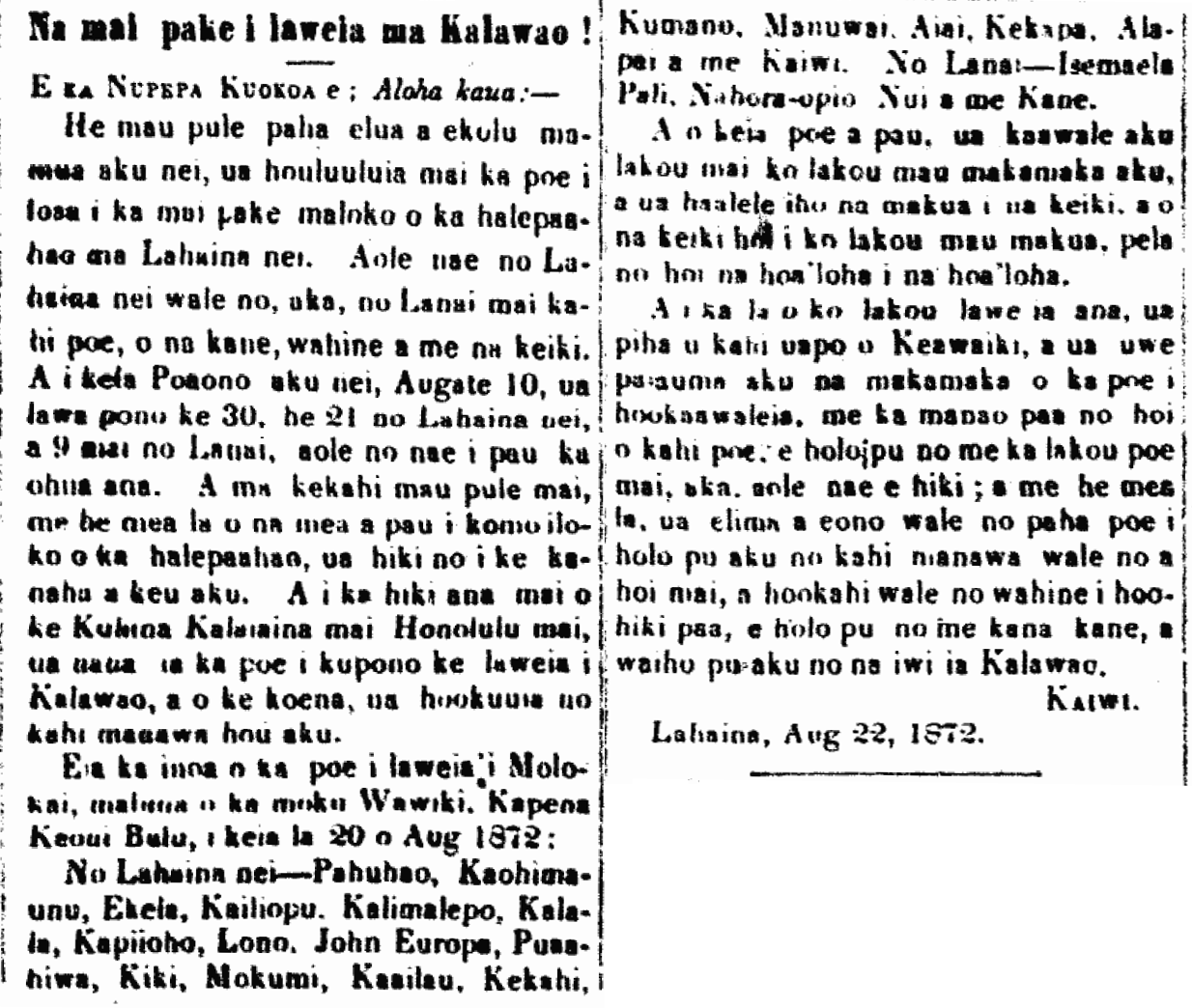
O Kuokoa Newspaper: Aloha kaua:—

Perhaps some two or three weeks ago, those afflicted with the “Chinese disease” were assembled in the jail here in Lahaina. And it wasn’t just people from Lahaina, but some were also from Lanai: men, women, and children. And on this past Saturday, August 10, they totalled 30; 21 from Lahaina nei and 9 from Lanai; but the gathering is not over. And in the coming weeks, it seems as if the total of all those put in the jail will reach forty or more. And when the Minister of the Interior [Hutchison] arrives from Honolulu, they are examined for those who should go to Kalawao, and the rest are released for another time.

Here are the names of those taken to Molokai aboard the ship Warwick [Wawiki], Captain Keoni Bulu, today, the 20th of Aug. 1872:

From here in Lahaina—Pahuhao, Kaohimaunu, Ekela, Kailiopu, Kalimalepo, Kalala, Kapiioho, Lono, John Europa [? Europe], Puaahiwa, Kiki, Mokumi, Kaailau, Kekahi, Kumano, Manuwai, Aiai, Kekapa, Alapai, and Kaiwi. From Lanai—Isemaela Pali, Nahora opio, Nui, and Kane.

All of these people, they were separated from their companions, and parents left their children, children left their parents, and so too did friends leave friends.

On the day they were taken, the pier of Keawaiki was packed, and the friends of those who were being separated wailed in grief, while some of them were determined to go along with their sick, but that was not possible; and it seemed that there were but five or six who went along for just a while then returned; and there was only one woman who swore that she’d go with her husband and leave her bones in Kalawao.

Kaiwi.

Lahaina, Aug. 22, 1872.

(Kuokoa, 8/31/1872, p. 2)

Na mai pake i laweia ma Kalawao!

Ka Nupepa Kuokoa, Buke XI, Helu 35, Aoao 2. Augate 31, 1872.

New Years celebration in Kalawao, 1888.

NEW YEAR’S FEAST IN KALAWAO, MOLOKAI.

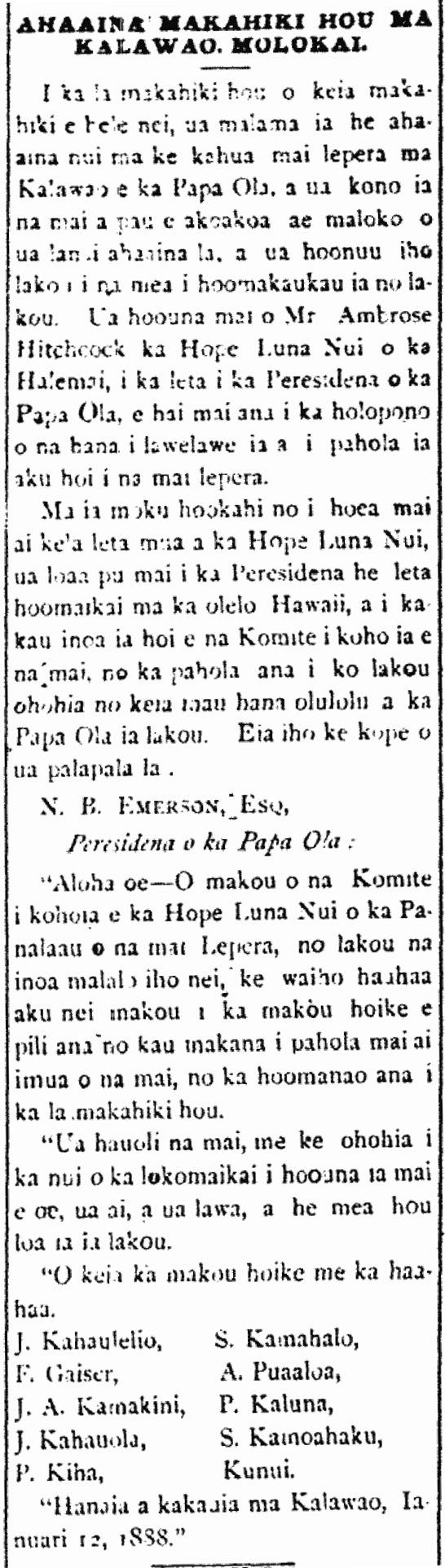
On new year’s day of this year, a feast was held in the land of the leprosy patients at Kalawao by the Board of Health, and all of the patients were invited to gather within the party lanai where they feasted upon the things prepared for them. Mr. Ambrose Hitchcock [Hutchinson], the Assistant Superintendent of the Hospital, sent a letter to the President of the Board of Health, reporting on the good outcome of the efforts done for the leprosy patients.

Upon that same ship which arrived the letter from the Assistant Superintendent, the President [of the Board of Health] also received a letter of appreciation in Hawaiian, which was signed by the Committee chosen by the patients, to express their delight in the kind act done by the Board of Health for them. Here is a copy of that document.

N. B. Emerson, Esq.,

President of the Board of Health:

“Aloha oe—We are the Committee chosen by the Assistant Superintendent of the Leprosy Colony, whose names appear below; we humbly put before you our expression in response to your gift spread before the patients, to celebrate the new year.

“The patients are joyous and delighted with the great blessings sent by you, they ate until full, and this a something brand new for them.

“This is our expression, respectfully,

J. Kahaulelio,  S. Kamahalo,

F. Gaiser,  A. Puaaloa,

J. A. Kamakini,  P. Kaluna,

J. Kahauola,  S. Kamoahaku,

P. Kiha,  Kunui.

“Done and signed at Kalawao, January 12, 1888.”

[I think that the phrase, “this is something brand new for them,” is something to ponder and consider.]

(Kuokoa, 1/21/1888, p. 2)

AHAAINA MAKAHIKI HOU MA KALAWAO, MOLOKAI.

Ka Nupepa Kuokoa, Buke XXVII, Helu 3, Aoao 2. Ianuari 21, 1888.

More on the taxing of leprosy patients, 1876.

The Leprosy Patients are Taxed.

O Lahui Hawaii; Aloha oe:—

That is the title put up by Siloama (no such person), an ignorant one from Kawaapae [“the beached canoe”], a speaking companion and lover of Waawaa [Stupid] folks, that was released in Helu 50 of the “Kuokoa” of the 11th of December, page 4, of 1875. It is for the readership to see this incompetence. In the title is that the leprosy patients are being taxed. And in the second paragraph, line 1½, he states, “taxing of the animals, all but the body of man.” Look at what James said. “A double minded man is unstable in all his ways.” James 1:8.

Then it goes on to say: “it has almost been 10 years that these people have been living as prisoners in the penitentiary of the law, and this is the first time we’ve been taxed.” Here is what Jesus had to say to the laborers, “Is it not lawful for me to do what I will with mine own? Is thine eye evil, because I am good?” Matthew 20:15.

And further.—”This is astonishing that those dead to the Law are being taxed.” This is not right; it is the truth; all of the animals of the patients are being taxed, and that is the true intent of the Law.

And this too.—And even the tiniest of rights that we have are being taken away.” [The following two lines of this paragraph is not legible because of what appears to be a fold in the paper.] Yours,

LIHAU ANUENUE

Kalawao, Molokai, Dek. 28, 1875.

[This is a response to the article in the previous post.

The newspapers need to be reshot one page at a time, so that folds like these can be undone, and every possible word can be read as was intended. I am sure i am not the only one interested in what the last couple of lines said about their rights being taken away…]

(Lahui Hawaii, 1/13/1876, p. 1)

Ua Auhauia na mai Lepera.

Ka Lahui Hawaii, Buke II, Helu 3, Aoao 1. Ianuari 13, 1876.

On taxation and leprosy patients, 1875.

The Leprosy Patients are Taxed!

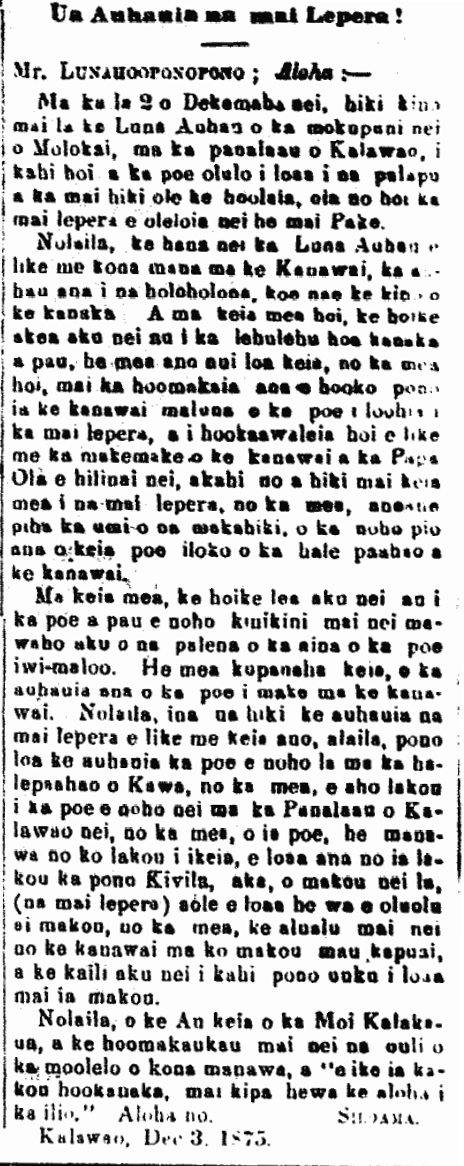
Mr. Editor; Aloha:—

On the 2nd of this December, the Tax Assessor [Luna Auhau] of this island of Molokai came in person to the colony of Kalawao, the place of the castaways who are afflicted with wounds of an incurable sickness, that being leprosy [mai lepera], which is called he Chinese sickness [mai Pake].

Therefore, the Tax Assessor is acting as per his power under the Law; the taxing of animals, all except the body of man. And as such, I am announcing before all of our fellow people, that this is a major thing, because from the beginning of the enforcement of this law upon people afflicted with leprosy and who are set apart as based on the intent of the edict of the Board of Health; this is the first time this sort of thing has come before the patience, as it has almost been ten years that these people have been living as prisoners in the penitentiary of the law.

Through this, I am announcing clearly to all the people living all over outside of the boundaries of the land of the skeletons. This is astonishing that those dead to the law are being taxed. So if leprosy patients are taxable in this way, then those imprisoned in Kawa [the government prison] should be taxed, for they are better off than those living here in the Colony of Kalawao; those people, there is a given time when they will once again receive their Civil rights, but we here (the leprosy patience), we will not have a time when we are relieved, because the law follows after our steps, and takes from us even the tiniest of rights that we have.

This is the Era of King Kalakaua, and the character of the history of his reign is being prepared; so “Recognize your fellow man, and don’t waste your aloha on dogs.” Aloha no. SILOAMA.¹

Kalawao, Dec. 3, 1875

¹Siloama is probably a pen name; it is the Protestant church in Kalawao.

(Kuokoa, 12/11/1875, p. 4)

Ua Auhauia na mai Lepera!

Ka Nupepa Kuokoa, Buke XIV, Helu 50, Aoao 4. Dekemaba 11, 1875.

Board of Health and leprosy, 1906.

A HAWAIIAN WOMAN HIDDEN AWAY.

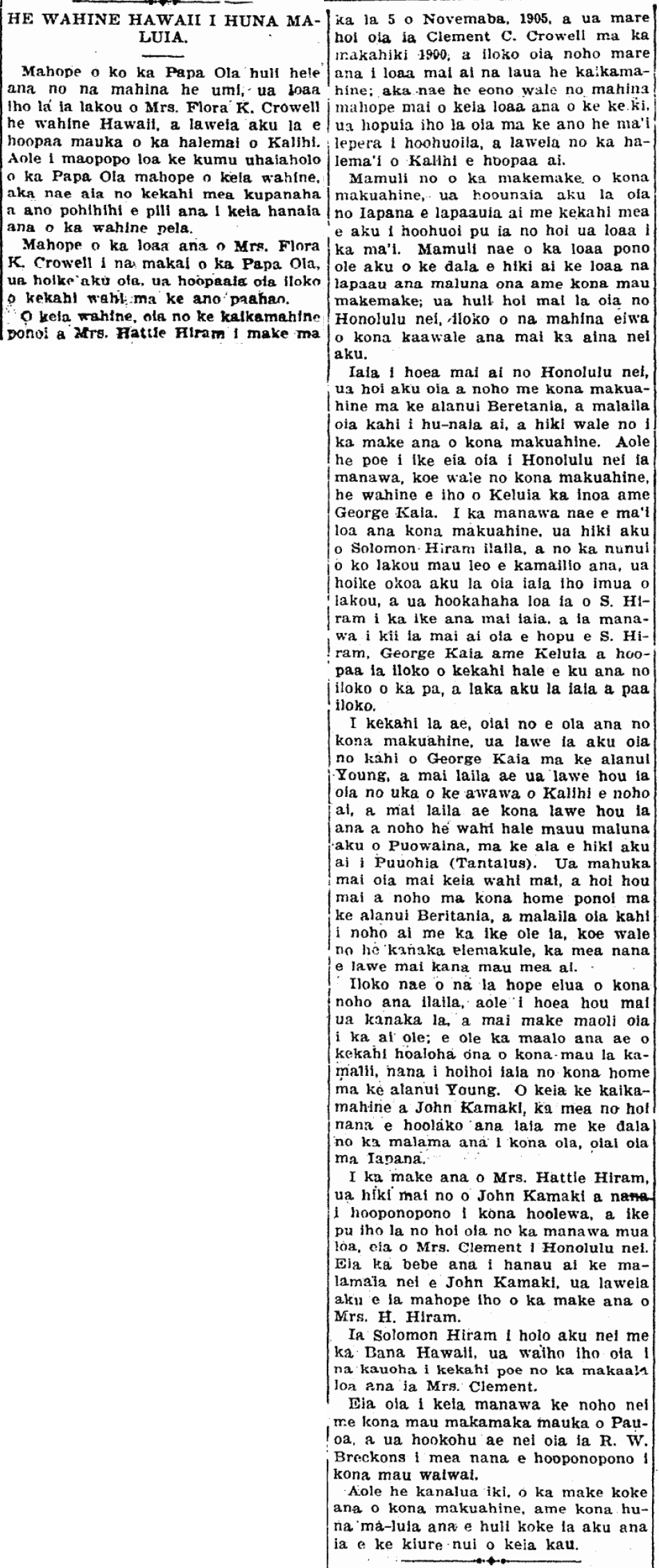
After the Board of Health [Papa Ola] searched for ten months, they found Mrs. Flora K. Crowell, a Hawaiian woman, and she was taken and detained mauka of the Kalihi Hospital. It is not clear why the Board of Health chased after that woman, but there is something astonishing and unclear about what was done to this woman.

After Mrs. Flora K. Crowell was found by the officers of the Board of Health, she said she was locked away like a prisoner.

This wahine is the birth daughter of Mrs. Hattie Hiram who died on the 5th of November 1905, and she married Clement C. Crowell in the year 1900, and by this marriage the two of them had a daughter; but just six months after they had the girl, she [Flora Crowell] was suspected of having leprosy and taken away to be held at the Kalihi Hospital.

According to the wishes of her mother [Hattie Hiram], she was sent to Japan to be treated along with others who were suspected of having the illness. Being that she did not have the funds to be treated and per her wishes, she came back to Honolulu nei after nine months of being away from here.

When she arrived in Honolulu, she went to live with her mother on Beritania Street, and she was hidden there until the death of her mother. There was no one who knew she was here in Honolulu at the time, except her mother along with another woman named Keluia and George Kaia. However, when her mother was extremely ill, Solomon Hiram came, and because they were speaking so loudly, he showed himself before them; S. Hiram was shocked at seeing her; and it was then that she was subdued by S. Hiram along with George Kaia and Keluia and detained in a building on the grounds, and she was locked inside.

A few days later, while her mother was still alive, she [Flora Crowell] was taken to the place of George Kaia on Young Street, and from there she was then taken to the uplands of Kalihi Valley to live, and from there she was taken to a grass house atop Puowaina, on the road that goes up to Puuohia (Tantalus). She escaped from this place and returned to live at her own home on Beritania Street, and it was there she lived unbeknownst to others, all except an old man who brought her food.

But during her last two days there, that man did not come back, and she almost starved for lack of food; it was only because of the passing by of one of her friends from her youth, that she was brought to that friend’s home on Young Street. This was the daughter of John Kamaki, the one who gave Flora Crowell money to care for herself while in Japan.

At the death of Mrs. Hattie Hiram, John Kamaki came and took care of her funeral, and saw for the first time that here was Mrs. Clement in Honolulu nei. Her baby was being cared for by John Kamaki, who took her after the death of Mrs. H. Hiram.

When Solomon Hiram just left with the Royal Hawaiian Band [Bana Hawaii], he left instructions for some people to keep good watch over Mrs. Clement.

She is now living with her friends mauka of Pauoa, and she has chosen R. W. Breckons as the executor of her estate.

There is no doubt, the quick death of her mother and her being hidden away, will be investigated immediately by the grand jury of this session.

(Kuokoa, 11/2/1906, p. 8)

HE WAHINE HAWAII I HUNA MA-LUIA.

Ka Nupepa Kuokoa, Buke XLV, Helu 44, Aoao 8. Novemaba 2, 1906.

The “Chinese Disease,” 1865.

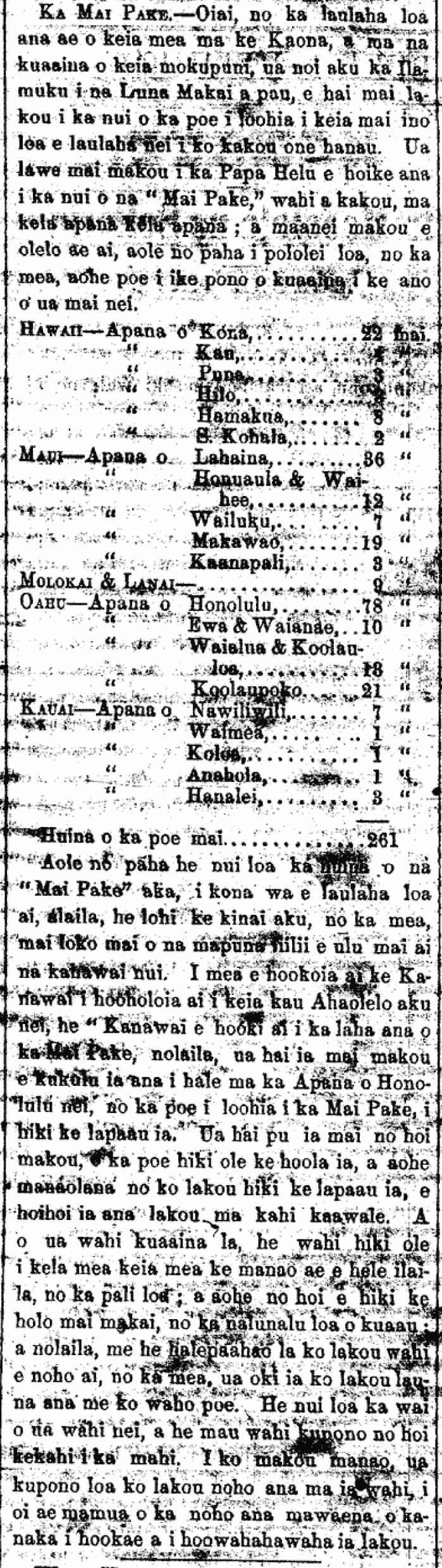
Leprosy [Mai Pake]—As this is greatly spreading about Town and in the country of this island, the Sheriff [Ilamuku ?] has requested that all of the District Sheriffs [Luna Makai ?] to report the number of people inflicted with this horrible sickness that is spreading in our homeland. We have taken the List showing the number of “Chinese Disease,” as we call it, in each district; and we say here that this is probably not accurate, because there is no one in the country who knows for certain what the symptoms are.

Hawaii—District of Kona, . . . 22 sick.
” of Kau, . . . 4 ”
” of Puna, . . . 3 ”
” of Hilo, . . . 3 ”
” of Hamakua, . . . 8 ”
” of S. Kohala, . . . 2 ”
Maui—District of Lahaina, . . . 36 ”
” of Honuaula & Waihee, . . . 12 ”
” of Wailuku, . . . 7 ”
” of Makawao, . . . 19 ”
” of Kaanapali, . . . 3 ”
Molokai & Lanai— . . . 9 ”
Oahu—District of Honolulu, . . . 78 ”
” of Ewa & Waianae, . . . 10 ”
” of Waialua & Koolauloa, . . . 18 ”
” of Koolaupoko, . . . 21 ”
Kauai—District of Nawiliwili, . . . 7 ”
” of Waimea, . . . 1 ”
” of Koloa, . . . 1 ”
” of Anahola, . . . 1 ”
” of Hanalei, . . . 3 ”
Total of sick . . . 261
Maybe the total of the number of “Mai Pake” is not so great, but when it truly spreads, then it will be too late to extinguish, for it is from tiny springs which great rivers grow forth. In order to comply with the law which was passed this last session of the legislature, “An Act to Prevent the Spread of Leprosy,” we are told that structures will be built here in Honolulu for those inflicted with leprosy so that they may be treated. We are also told that for those who are incurable, and for those for whom there is no hope in treating, they will be sent to a place set apart. And that country side will be a place that no one will think about going to, because of great cliffs; and it cannot be accessed by sea because of the rough conditions of the lagoon. So where they live will be like a prison, for their association with those on the outside will be cut off. There is much water there, and it is also a place suitable for farming. In our opinion, it is better for them to live there than for them to live amongst people who hate and scorn them.
(Au Okoa, 6/26/1865, p. 2)
Ka Mai Pake

Ke Au Okoa, Buke I, helu 10, Aoao 2. Iune 26, 1865.

The latest from Kalawao, 1909.

News From the Land of the Suffering.

To the Editor of the Aloha Aina Newspaper, Aloha:

Please allow my small parcel a space in your newspaper which is greatly enjoyed, and that is what is down below; let the paper take it proudly around so that our multitudes of friends may see.

Movies come regularly every Wednesday, and are shown on the evenings of Wednesday, Thursday, and Friday; and every Saturday in Honolulu. There has been a building erected for the patients to watch the movies. The patients are thrilled. They donated money to buy a first-class phonograph [pahu olelo]. They are very happy with singing, the sweet sound of the strings and the blare of the brass instruments.

There was an announcement made to the ones without the sickness or those partially afflicted that wanted to be examined by the Doctors who are coming into the settlement.

Some went to sign up, and some just looked on because they did not want to go back to where they came from, being there might be difficulties waiting ahead for them. And because of the small number of those going to sign up, the Superintendent of the settlement ordered someone to go to the houses to sign people up; the total of those people number 58, but I don’t have their names; the only names I have are those who went to sign up, and they number 55, along with their doctor.

THE PEOPLE WHOSE DOCTOR IS DR. WAYSON

[Names difficult to make out.]

THE PEOPLE WHOSE DOCTOR IS DR. GOODHUE.

The Men

[Names difficult to make out.]

The Women

[Names difficult to make out.]

The total number told to the writer is 108. This includes the people chosen by the Legislature [?]

With much aloha for my Lahui.

Sincerely,

S. K. MAIALOHA.

Kalawao, Molokai, Aug. 2, 1909

[Here is just another example of why the original newspapers need to be reshot clearly before the acid in the paper consumes all of the words, leaving us with crumbs…]

(Aloha Aina, 9/4/1909, p. 3)

Na Mea Hou o ke Kahua Ma'i.

Ke Aloha Aina, Buke XIV, Helu 36, Aoao 3. Sepatemaba 4, 1909.

Hawaiian with leprosy sent back from California? 1906.

THE DEPORTATION OF A HAWAIIAN WOMAN WITH LEPROSY IS KEPT SECRET.

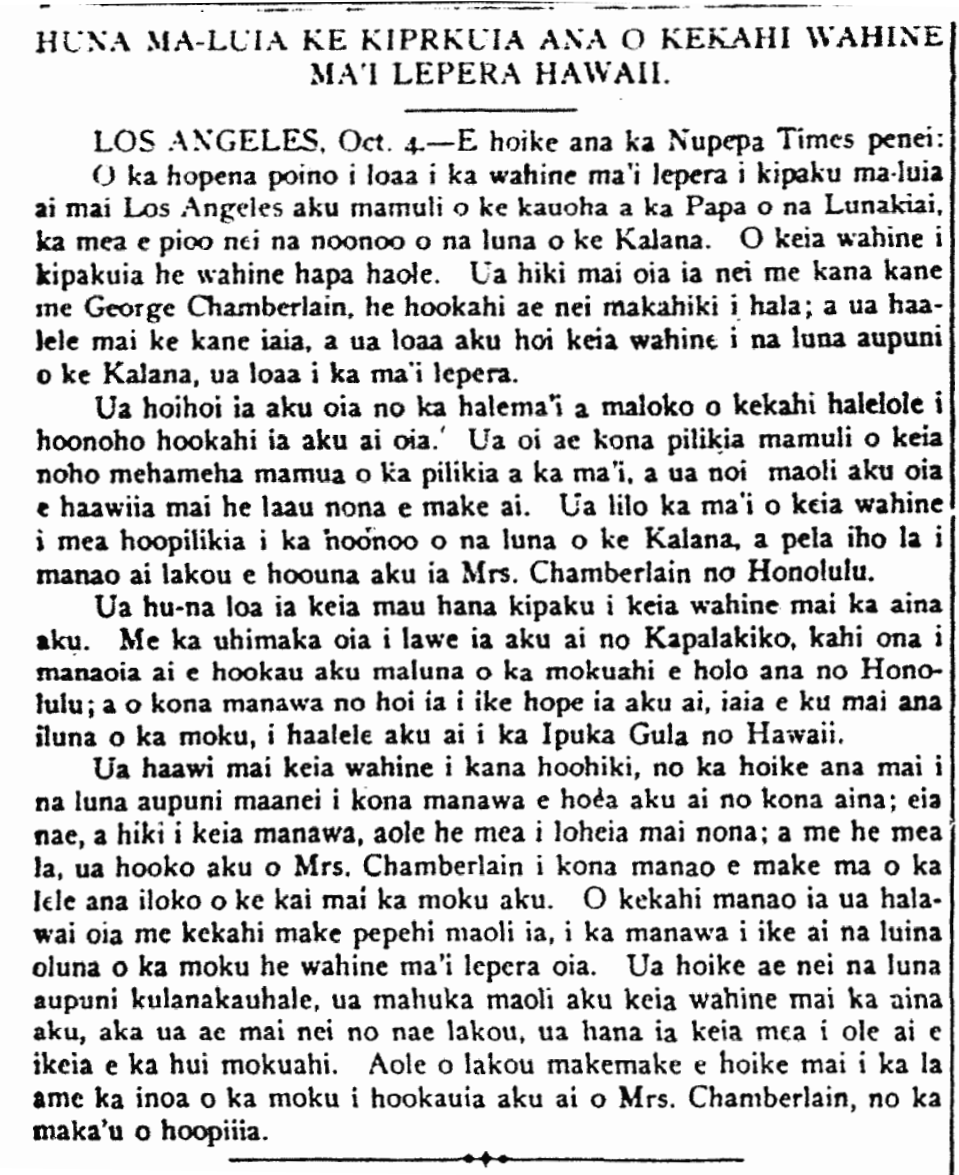
LOS ANGELES, Oct. 4.—The Times Newspaper reported thus:

The sad fate of a woman with leprosy deported secretly from Los Angeles because of an order by the Board of Supervisors [Papa Lunakiai] is what has gotten the heads of the County perturbed. This woman that was sent away is a hapa haole. She arrived with her husband, George Chamberlain, one year ago; her husband left her, and this woman was found with leprosy by the government officials of the County.

She was sent to the hospital and she was kept alone in a laundry room. She was more troubled by being kept in solitary more than by the disease, and she pleaded them to give her a medicine to kill her. This woman’s ailment was something that was problematic for the heads of the County, and so they decided to send Mrs. Chamberlain to Honolulu.

This deportation from the land was kept a strict secret. She was sent blindfolded to San Francisco, where she was to be put aboard a steamship for Honolulu; and that was the last time she was seen, as she stood atop the ship leaving the Golden Gate for Hawaii.

She gave her word that she would present herself to the government officials here when she arrived in her land; however, until this moment, there has been nothing heard from her; and it would seem that Mrs. Chamberlain carried out her thought to die by jumping off the ship into the sea. One thought is that she was murdered when the sailors aboard the ship found out that she was afflicted by leprosy. The town officials said that she escaped, but however they admit that this was done so that the ship company would not find out. They do not want to say what day and the name of the ship which Mrs. Chamberlain was placed upon, because they are afraid of being sued.

(Kuokoa, 10/26/1906, p. 6)

HUNA MA-LUIA KE KIPRKUIA ANA O KEKAHI WAHINE MA'I LEPERA HAWAII.

Ka Nupepa Kuokoa, Buke XLV, Helu 43, Aoao 6. Okatoba 26, 1906.