More on the missionaries and hula ku’i …and Sweet Emalia, 1894.

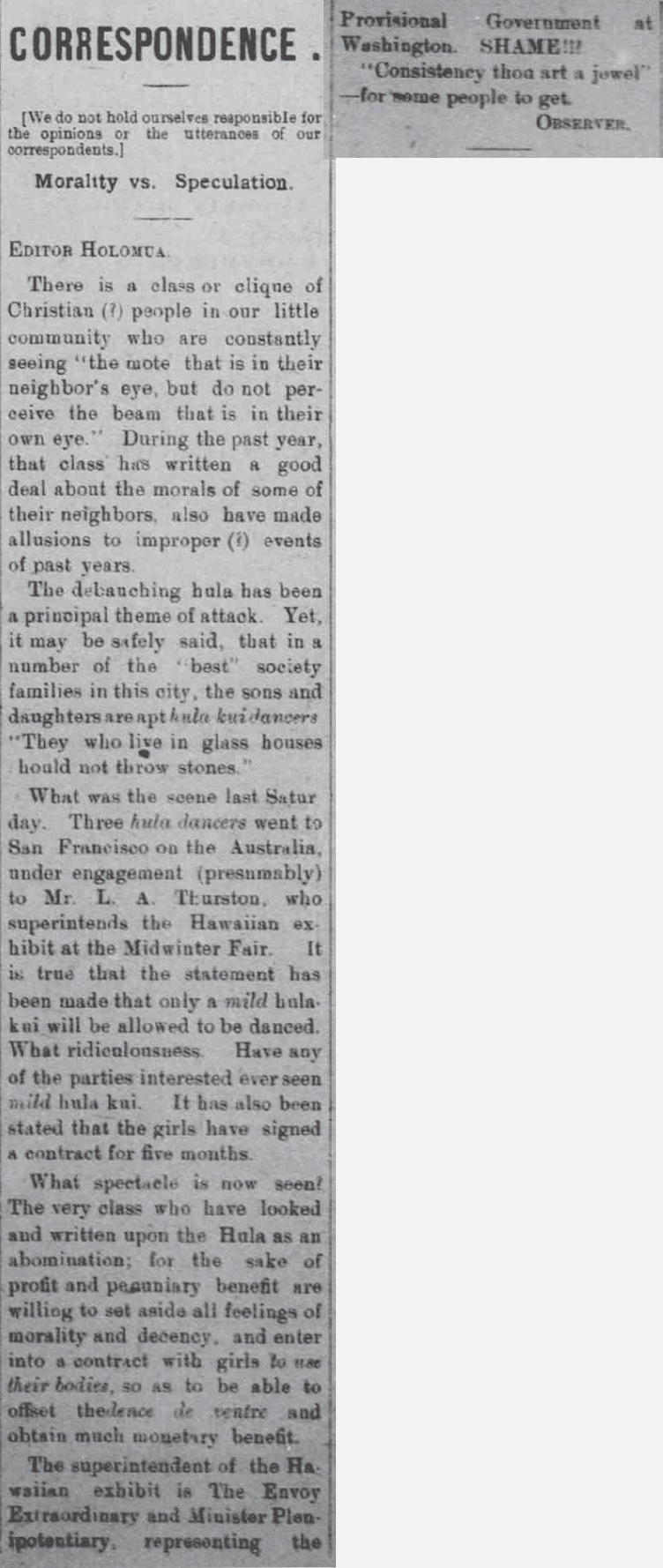
CORRESPONDENCE.

[We do not hold ourselves responsible for the opinions or the utterances of our correspondents.]

Morality vs. Speculation.

Editor Holomua.

There is a class or clique of Christian (?) people in our little community who are constantly seeing “the mote that is in their neighbor’s eye, but do not perceive the beam that is in their own eye.” During the past year, that class has written a good deal about the morals of some of their neighbors also have made allusions to improper (?) events of past years.

The debauching hula has been a principal theme of attack. Yet, it may be safely said, that in a number of the “best” society families in this city, the sons and daughters are apt hula kui dancers. “They who live in glass houses should not throw stones.”

What was the scene last Saturday. Three hula dancers¹ went to San Francisco on the Australia, under engagement (presumably) to Mr. L. A. Thurston, who superintends the Hawaiian exhibit at the Midwinter Fair. It is true that the statement has been made that only a mild hula kui will be allowed to be danced. What ridiculousness. Have any of the parties interested ever seen mild hula kui. It has also been stated that the girls have signed a contract for five months.

What spectacle is now seen? The very class who have looked and written upon the Hula as an abomination; for the sake of profit and pecuniary benefit are willing to set aside all feelings of morality and decency, and enter into a contract with girls to use their bodies, so as to be able to offset the dence de ventre and obtain much monetary benefit.

The superintendent of the Hawaiian exhibit is the Envoy Extraordinary and Minister Plenipotentiary, representing the Provisional Government at Washington. SHAME!!!

“Consistency thou art a jewel”—for some people to get.

¹One of these was of course, Emalia Kaihumua.

(Hawaii Holomua, 1/8/1894, p. 3.)

CORRESPONDENCE.

Hawaii Holomua, Volume II, Number 6, Page 3. January 8, 1894.

More on the missionaries, 1894.

Missionary Descendants Show Their Knowledge of Hula Ku’i.

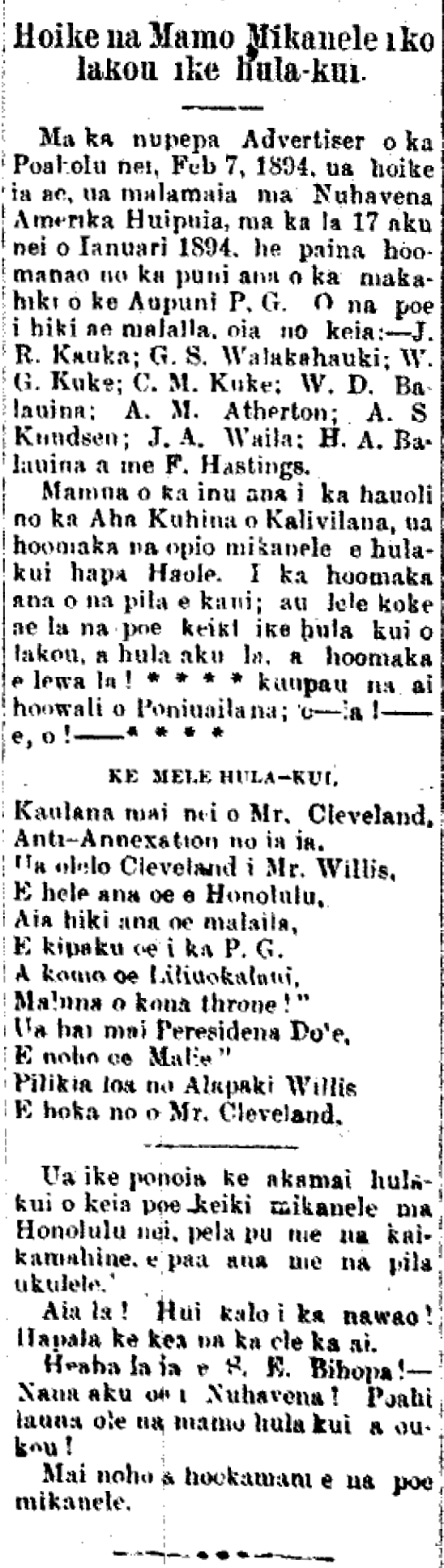
In the Advertiser of 2/7/1894, was shown that at New Haven, United States of America, on the past 17th of January 1894, there was held a party to commemorate the anniversary of the government by the P. G. Those present were: J. R. Kauka [James Robert Judd?], G. S. Walakahauki [George S. Waterhouse], C. M. Kuke [C. Montague Cooke, Jr.?], W. D. Balauina [William D. Baldwin], A. M. Atherton, A. S. Knudsen, J. A. Waila [James Austin Wilder], H. A. Balauina [Harry A. Baldwin], and F. Hastings.

Before drinking to the delight at the Cabinet of Ministers of Cleveland, the young missionaries danced a hula ku’i to a hapa haole song. When the music started, the youths among them who knew how to hula ku’i jumped up immediately and danced and started to sway! …the mixed poi of Poniuailana goes the limit; there you go!—answer the call!—…¹

KE MELE HULA-KUI.

Kaulana mai nei o Mr. Cleveland,
Anti-Annexation no ia ia,
Ua olelo Cleveland i Mr. Willis,
E hele ana oe e Honolulu,
Aia hiki ana oe malaila,
E kipaku oe i ka P. G.
A komo oe Liliuokalani,
Maluna o kona throne!”
Ua hai mai Peresidena Dole,
E noho oe Malie”
Pilikia loa no Alapaki Willis,
E hoka no o Mr. Cleveland.

A MELE HULA KU’I

Famed is Mr. Cleveland,
An Anti-Annexationist is he,
Cleveland said to Mr. Willis,
[“]You are going to Honolulu,
When you get there,
Banish the P. G.
And place Liliuokalani,
Upon her throne!”
President Dole spoke,
[“]You just sit still.”
Albert Willis is perplexed,
Mr. Cleveland is thwarted.

The adeptness at the hula ku’i by these missionary descendants was seen first hand here in Honolulu, along with the girls carrying ukulele.

There you go! Mixed up is the cultivated taro with the wild! The white is smeared; the black gets the score.

What is this S. E. Bishop!—Look to New Haven! Your people’s hula ku’i dancer descendants were  gyrating away!

You missionaries, don’t be hypocritical.

¹…kuupau na ai hoowali o Poniuailana; o—ia!—e, o!—…

[Does anyone have more information on the “Kuupau na ai hoowali o Poniuailana” phrase?]

(Nupepa Ka Oiaio, 2/9/1894, p. 3)

Hoike na Mamo Mikanele i ko lakou ike hula-kui.

Nupepa Ka Oiaio, Buke VI, Helu 6, Aoao 3. Feberuari 9, 1894.

C. C. Moreno on missionaries, 1893.

A Misunderstood People.

MORENO ON THE MISSIONARIES.

Editor Post: For several years your public-spirited paper has published correspondence and statements submitted by me about Hawaii in which was foreshadowed the present state of affairs. The revolution which has just taken place is the inevitable result of missionary rule; the long-standing and deep-rooted cause of the unrest.

The missionaries in Hawaii, as in China, Japan, and elsewhere, consider that country as their open hunting grounds, regardless of the rights, customs, wishes, and priviliges of the natives and of stipulations.

I positively know that the self-appointed four chiefs of the Provisional Government in the Hawaiian Islands and the five commissioners coming to Washington to negotiate a treaty of annexation are, without a single exception, missionariesʻ confederates. Not a single native Hawaiian is with them, therefore, they cannot be considered as the representatives of the Hawaiian nation, of which they are aliens and enemies, but only as the emissaries of one side (or of a higher), which is not the right side.

The truth about Hawaiian affairs has never reached the State Department and that is the reason why, in the department, the knife has always been taken by the blade instead of by the handle in dealing with the Hawaiian question.

The United States always sent third rate politicians as ministers and consult to Honolulu, hence the erroneous information about Hawaii. I have on the spot studied Hawaii and the Hawaiians, their troubles with the missionaries of all creeds, and when distant from the islands I have kept an uninterrupted correspondence with the leaders of the Hawaiian nation, such as the Hons. Wilcox, Bush, Testa, Kaai, Kapena, Kaunamano, Kimo Pelekane [James I. Dowsett], and others.

My views on the Hawaiian question I explained at length to President Hayes and Secretary of State Evarts, to President Cleveland and to Assistant Secretary of State Porter: later, to Senator Morgan and to Congressman McCreary, and these are the statesmen that ought to dispose of the Hawaiian question and render justice to the weak, ill-treated, honest, and generous Hawaiian people that have been continually misrepresented, misjudged, and grossly wronged.

In accordance with the good order of things the coming self-appointed and self-styled Hawaiian commissioners, with more appearance than substance, should not be received by the United States authorities, because their self-attributed mission to Washington is based only upon selfish and malignant motives.

This will be a good opportunity for the great people of the United States to show their sentiment for fair play and generosity toward the unfortunate, harmless, friendly, and oppressed Hawaiian people, worthy of sympathy and of help in this their hour of national distress.

Celco Cæsar Moreno.

(Liberal, 2/25/1893, p. 2)

A Misunderstood People.

The Liberal, Volume I, Number 48, Page 2. February 25, 1893.

More on the life and passing of Naomi Kekela, 1902.

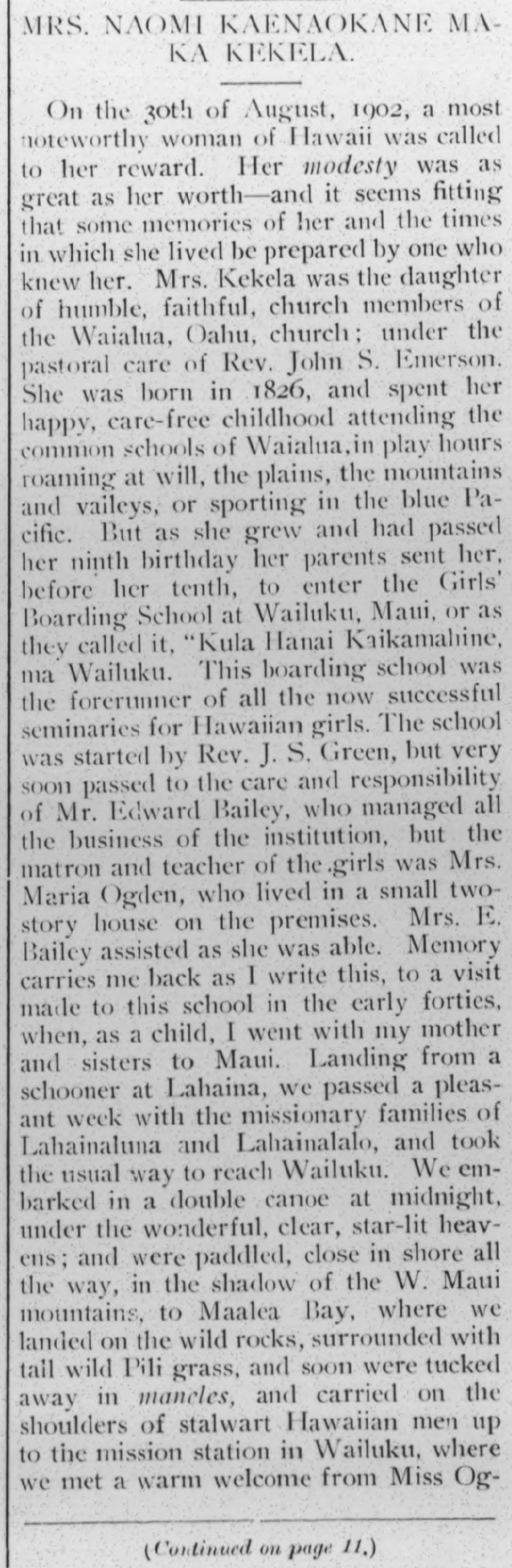
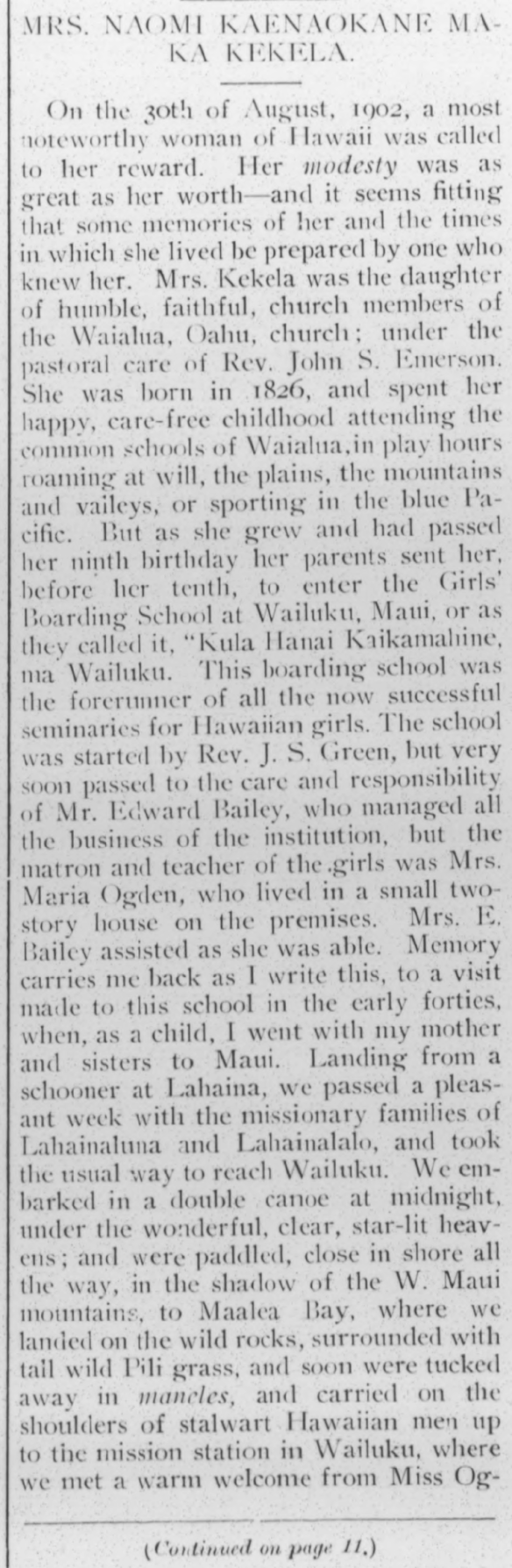
MRS. NAOMI KAENAOKANE MAKA KEKELA.

On the 30th of August, 1902, a most noteworthy woman of Hawaii was called to her reward. Her modesty was as great as her worth—and it seems fitting that some memories of her and the times in which she lived be prepared by one who knew her. Mrs. Kekela was the daughter of humble, faithful, church members of the Waialua, Oahu church; under the pastoral care of Rev. John S. Emerson. She was born in 1826, and spent her happy, care-free childhood attending the common schools of Waialua, in play hours roaming at will, the plains, the mountains and valleys, or sporting in the blue Pacific. But as she grew and had passed her ninth birthday her parents sent her, before her tenth, to enter the Girls’ Boarding School at Wailuku, Maui, or as they called it, “Kula Hanai Kaikamahine, ma Wailuku.[“] This boarding school was the forerunner of all the now successful seminaries for Hawaiian girls. The school was started by Rev. J. S. Green, but very soon passed to the care and responsibility of Mr. Edward Bailey, who managed all the business of the institution, but the matron and teacher of the girls was Mrs. Maria Ogden, who lived in a small two-story house on the premises. Mrs. E. Bailey assisted as she was able. Memory carries me back as I write this, to a visit made to this school in the early forties, when, as a child, I went with my mother and sisters to Maui. Landing from a schooner at Lahaina, we passed a pleasant week with the missionary families of Lahainaluna and Lahainalalo, and took the usual way to reach Wailuku. We embarked in a double canoe at midnight, under the wonderful, clear, star-lit heavens; and were paddled, close in shore all the way, in the shadow of W. Maui mountains, to Maalea Bay, where we landed on the wild rocks, surrounded with tall Pili grass, and soon were tucked away in maneles, and carried on the shoulders of stalwart Hawaiian men up to the mission station in Wailuku, where we met a warm welcome from Miss Og-

(Continued on page 11.)

(Friend, 10/1902, p. 6)
MRS. NAOMI KAENAOKANE MAKA KEKELA.

The Friend, Volume LX, Number X, Page 6. October 1902.

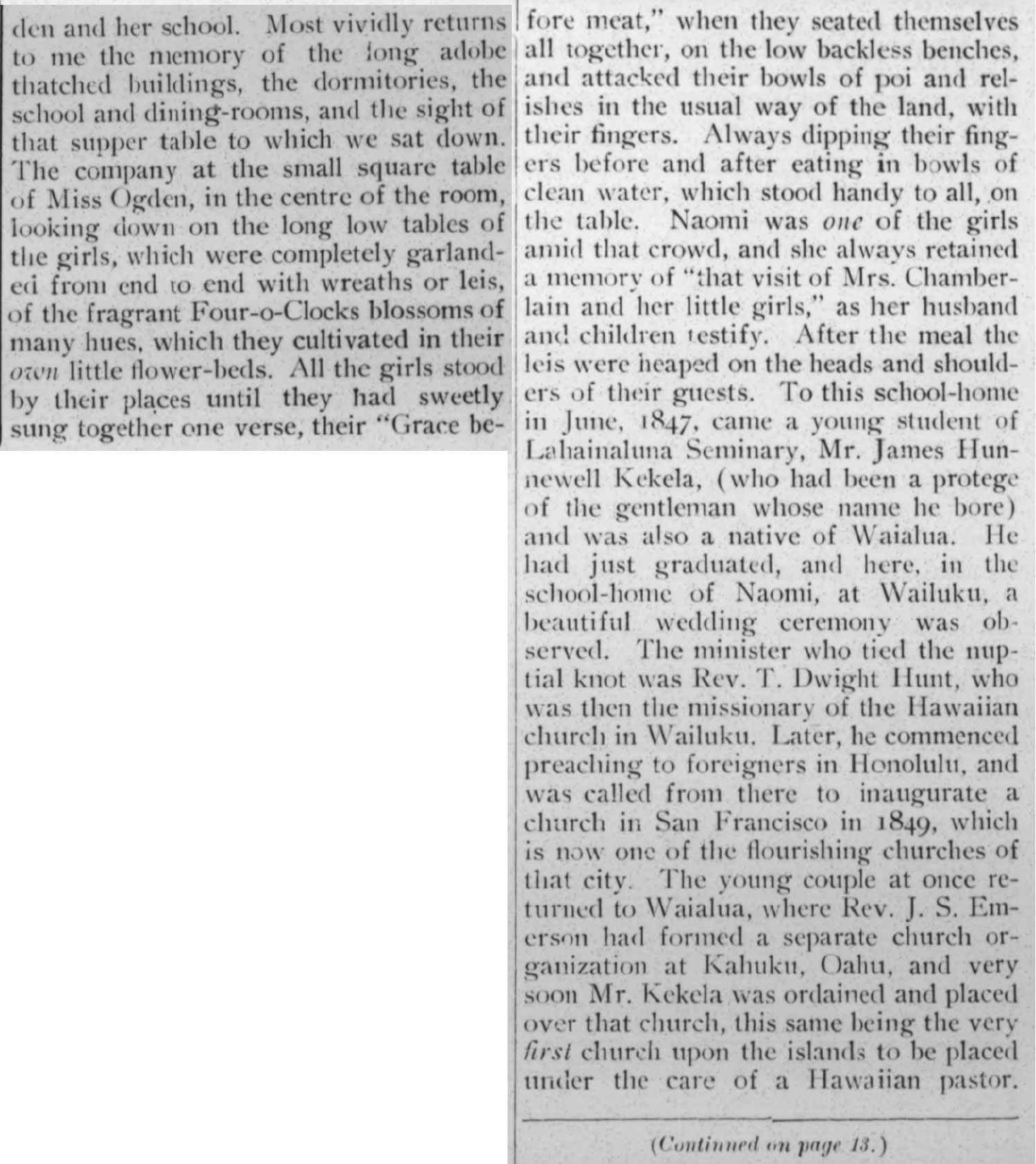
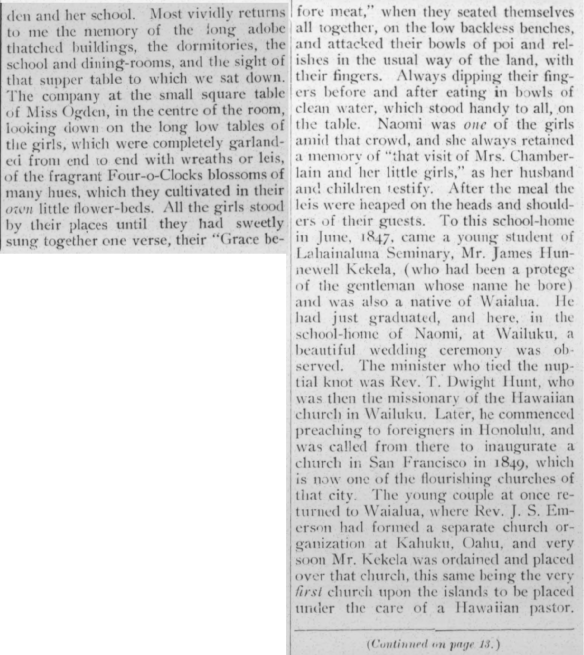
den and her school. Most vividly returns to me the memory of the long adobe thatched buildings, the dormitories, the school and dining-rooms, and the sight of that supper table to which we sat down. The company at the small square table of Miss Ogden, in the centre of the room, looking down on the long low tables of the girls, which were completely garlanded from end to end with wreaths or leis, of the fragrant Four-o-Clocks blossoms of many hues, which they cultivated in their own little flower-beds. All the girls stood by their places until they had sweetly sung together one verse, their “Grace before meat,” when they seated themselves all together, on the low backless benches, and attacked their bowls of poi and relishes in the usual way of the land, with their fingers. Always dipping their fingers before and after eating in bowls of clean water, which stood handy to all, on the table. Naomi was one of the girls amid that crowd, and she always retained a memory of “that visit of Mrs. Chamberlain and her little girls,” as her husband and children testify. After the meal the leis were heaped on the heads and shoulders of their guests. To this school-home in June, 1847, came a young student of Lahainaluna Seminary, Mr. James Hunnewell Kekela, (who had been a protege of the gentleman whose name he bore) and was also a native of Waialua. He had just graduated, and here, in the school-home of Naomi, at Wailuku, a beautiful wedding ceremony was observed. The minister who tied the nuptial knot was Rev. T. Dwight Hunt, who was then the missionary of the Hawaiian church in Wailuku. Later, he commenced preaching to foreigners in Honolulu, and was called from there to inaugurate a church in San Francisco in 1849, which is now one of the flourishing churches of that city. The young couple at once returned to Waialua, where Rev. J. S. Emerson had formed a separate church organization at Kahuku, Oahu, and very soon Mr. Kekela was ordained and placed over that church, this same being the very first church upon the islands to be placed under the care of a Hawaiian pastor.

(Continued on page 13.)

(Friend, 10/1902, p. 11)
den and her school.

The Friend, Volume LX, Number X, Page 11. October 1902.

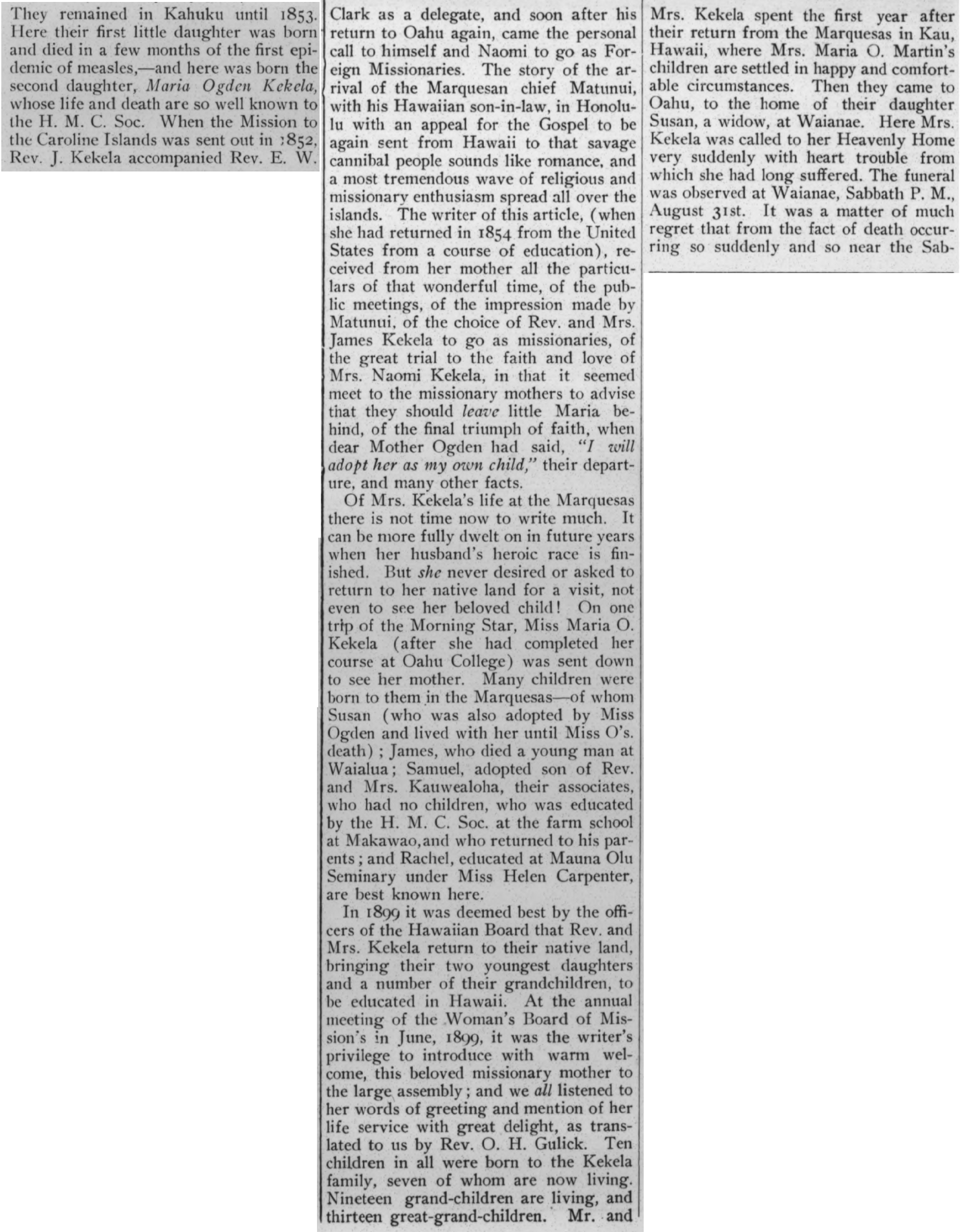
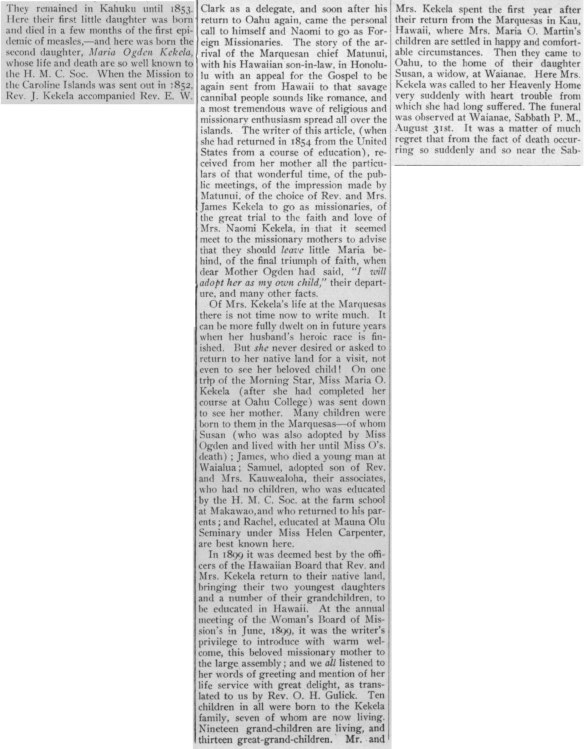
They remained in Kahuku until 1853. Here their first little daughter was born and died in a few months of the first epidemic of measles,—and here was born the second daughter daughter, Maria Ogden Kekela, whose life and death are so well known to the H. M. C. Soc. When the Mission to the Caroline Islands was sent out in 1852, Rev. J. Kekela accompanied Rev. E. W. Clark as a delegate, and soon after his return to Oahu again, came the personal call to himself and Naomi to go as Foreign Missionaries. The story of the arrival of the Marquesas chief Matunui, with his Hawaiian son-in-law, in Honolulu with an appeal for the Gospel to be again sent from Hawaii to that savage cannibal people sounds like romance, and a most tremendous wave of religious and missionary enthusiasm spread all over the isalnds. The writer of this article, (when she had returned in 1854 from the United States from a course of education), received from her mother all the particulars of that wonderful time, of the public meetings, of the impression made by Matunui, of the choice of Rev. and Mrs. James Kekela to go as missionaries, of the great trial to the faith and love of Mrs. Naomi Kekela, in that it seemed that they should leave little Maria behind, of the final triumph of faith, when dear Mother Ogden had said, “I will adopt her as my own child,” their departure and many other facts.

Of Mrs. Kekela’s life at the Marquesas there is not time now to write much. It can be more fully dwelt on in future years when her husband’s heroic race is finished. But she never desired or asked to return to her native land for a visit, not even to see her beloved child! On one trip of the Morning Star, Miss Maria O. Kekela (after she had completed her course at Oahu College) was sent down to see her mother. Many children were born to them in the Marquesas—of whom Susan (who was also adopted by Miss Ogden and lived with her until Miss O’s death); James, who died a young man at Waialua; Samuel, adopted son of Rev. and Mrs. Kauwealoha, their associates, who had no children, who was educated by the H. M. C. Soc. at the farm school at Makawao, and who returned to his parents; and Rachel, educated at Mauna Olu Seminary under Miss Helen Carpenter, are best known here.

In 1899 it was deemed best by the officers of the Hawaiian Board that Rev. and Mrs. Kekela return to their native land, bringing their two youngest daughters and a number of grandchildren, to be educated in Hawaii. At the annual meeting of the Woman’s Board of Mission’s in June, 1899, it was the writer’s privilege to introduce with warm welcome, this beloved missionary mother to the large assembly; and we all listened to her words of greeting and mention of her life service with great delight, as translated to us by Rev. O. H. Gulick. Ten children in all were born to the Kekela family, seven of whom are now living. Nineteen grand-children are living, and thirteen great-grand-children. Mr. and Mrs. Kekela spent the first year after their return from the Marquesas in Kau, Hawaii, where Mrs. Maria O. Martin’s children were settled in happy and comfortable circumstances. Then they came to Oahu, to the home of their daughter Susan, a widow, at Waianae. Here Mrs. Kekela was called to her Heavenly Home very suddenly with heart trouble from which she had long suffered. The funeral was observed at Waianae, Sabbath P. M. August 31st. It was a matter of much regret that from the fact of death occurring so suddenly and so near the Sab-

(Friend, 10/1902, p. 13)
They remained in Kahuku...

The Friend, Volume LX, Number X, Page 13. October 1902.

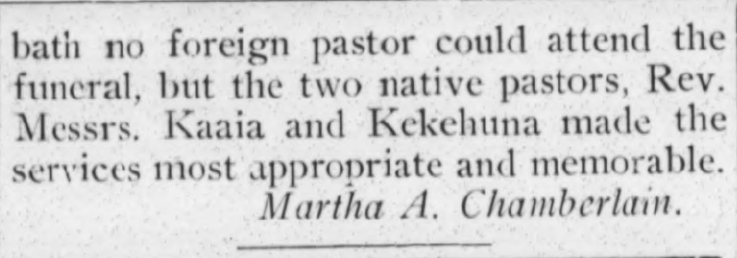
bath no foreign pastor could attend the funeral, but the two native pastors, Rev. Messrs. Kaaia and Kekehuna [Kekahuna] made the services most appropriate and memorable.

Martha A. Chamberlain.

(Friend, 10/1902, p. 14)
bath no foreign pastor...

The Friend, Volume LX, Number X, Page 14. October 1902.
Mrs. Naomi Kekela passes away, 1902.

Expression of Gratitude

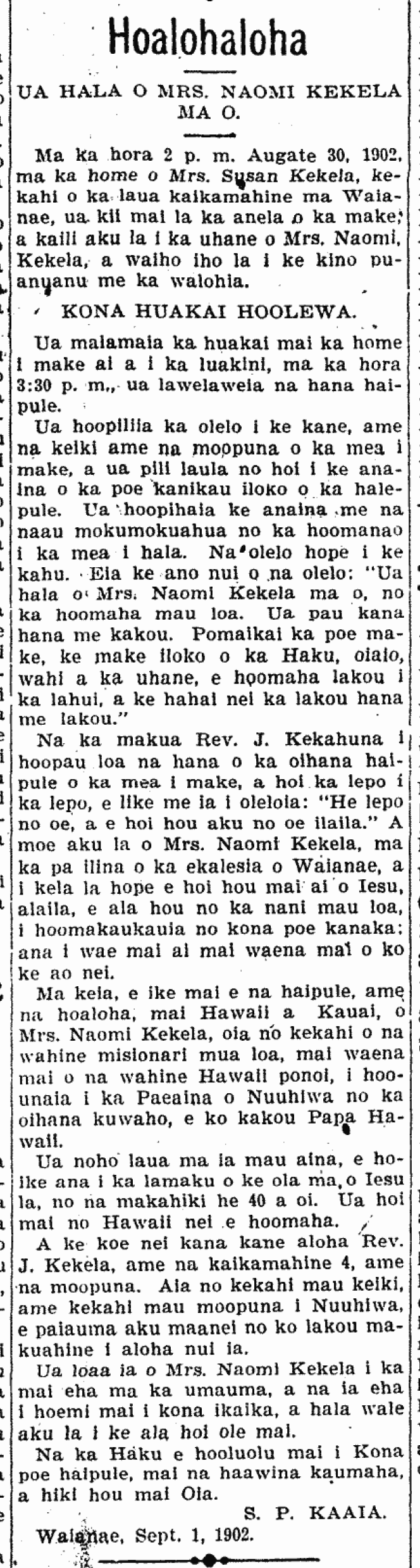
MRS. NAOMI KEKELA PASSES ON.

At 2 p. m. on August 30, 1902, at the home of Mrs. Susan Kekela, one of their daughters in Waianae, the angel of death came to take the spirit of Mrs. Naomi Kekela, and left behind her cold body in sadness.

HER FUNERAL PROCESSION.

The procession took place from the home where she died until the church, at 3:30 p. m., the services were held.

The words were related to the husband, children, and grandchildren of the deceased, and they were related to all the mourners in the church house. The congregation was filled with grieving hearts remembering the one who passed. The last words were of the pastor. Here is the essence of the words: “Mrs. Naomi Kekela passed on, for her eternal rest. Her work with us is over. Blessed are the dead which die in the Lord: Yea, saith the Spirit, that they may rest from their labours; and their works do follow them.”

It was the father Rev. J. Kekahuna who concluded the services for the deceased, and the earth returned to earth, as the saying goes: “You are earth, and you shall return there.” And Mrs. Naomi Kekela lay at the cemetery of the church of Waianae, and on the last day, Jesus will return, and everlasting beauty will be resurrected, made ready for his people who he chose from amongst this world.

With this, know, O faithful, and friends from Hawaii to Kauai, Mrs. Naomi Kekela is one of the first female missionaries from amongst Hawaii’s own women, sent to the Archipelago of Nuuhiwa for foreign service, by the Hawaiian Board of Missionaries [Papa Hawaii].

The two of them lived in that land proclaiming the light of life through Jesus, for 40 years or more. They returned to Hawaii to retire.

Left behind is her beloved husband, Rev. J. Kekela, and 4 daughters, and her grandchildren. There are a number of children and grandchildren in Nuuhiwa who are grieving here [there?] for their dearly beloved mother.

Mrs. Naomi Kekela was afflicted with a painful illness of the chest, and it is this pain that sapped her strength, and she went on the path of no return.

The Lord will ease His devout from sadness until He returns.

S. P. KAAIA.

Waianae, Sept. 1, 1902.

(Kuokoa, 9/12/1902, p. 5)

Hoalohaloha

Ka Nupepa Kuokoa, Buke XL, Helu 37, Aoao 5. Sepatemaba 12, 1902.

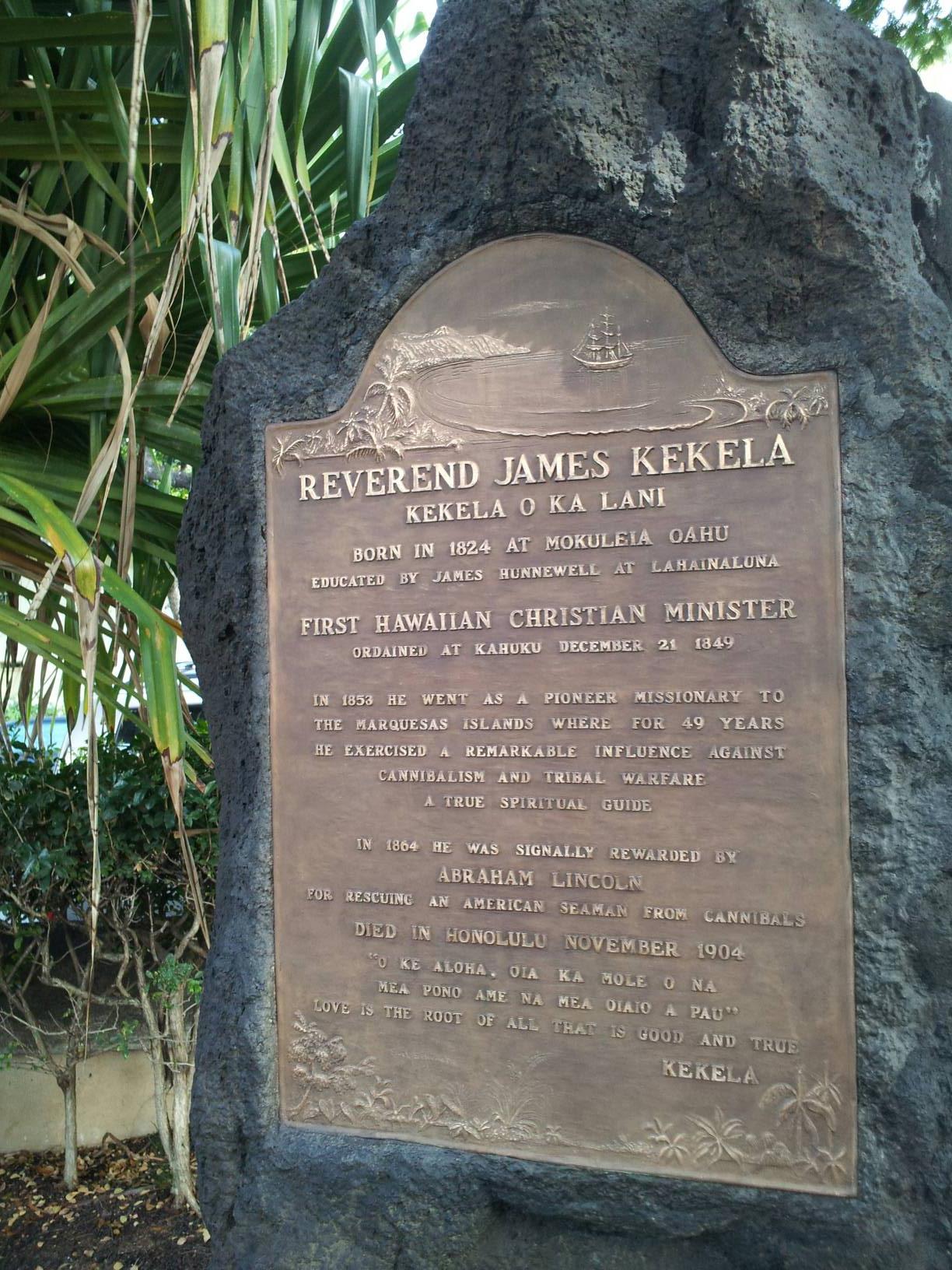
Reverend James Kekela plaque at Kawaiahao Church, 2013.

REVEREND JAMES KEKELA

KEKELA O KA LANI

BORN IN 1824 AT MOKULEIA OAHU

EDUCATED BY JAMES HUNNEWELL AT LAHAINALUNA

FIRST HAWAIIAN CHRISTIAN MINISTER

ORDAINED AT KAHUKU DECEMBER 21 1849

IN 1853 HE WENT AS A PIONEER MISSIONARY TO THE MARQUESAS ISLANDS WHERE FOR 49 YEARS HE EXERCISED A REMARKABLE INFLUENCE AGAINST CANNIBALISM AND TRIBAL WARFARE

A TRUE SPIRITUAL GUIDE

IN 1864 HE WAS SIGNALLY REWARDED BY

ABRAHAM LINCOLN

FOR RESCUING AN AMERICAN SEAMAN FROM CANNIBALS

DIED IN HONOLULU NOVEMBER 1904

“O KE ALOHA, OIA KA MOLE O NA MEA PONO A ME NA MEA OIAIO A PAU”

LOVE IS THE ROOT OF ALL THAT IS GOOD AND TRUE

KEKELA

[Kekela is buried in the cemetery of Kawaiahao Church in front of his daughter Maria. His wife Naomi however is buried at the Waianae Church.]

(Kawaiahao Church)

Kawaiahao Church

Rev. James Kekela Plaque, Kawaiahao Church

Introduction to the reminiscences of Hawaiian missionary James Kekela, 1901.

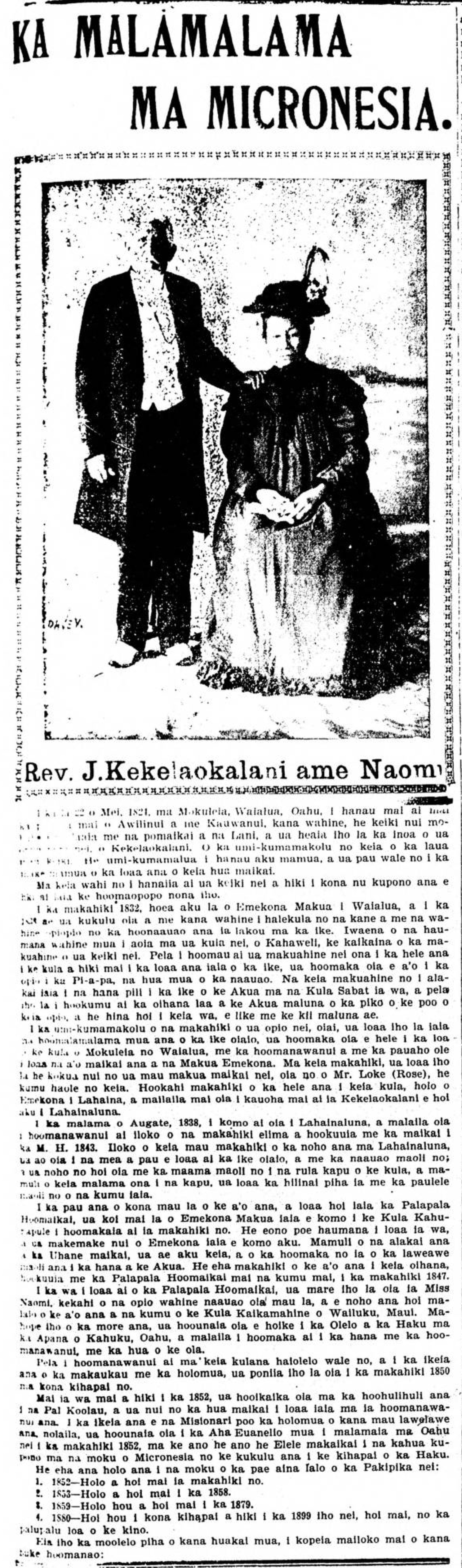
THE LIGHT IN MICRONESIA.¹

Rev. J. Kekelaokalani and Naomi

On the 22nd of May, 1821, at Mokuleia, Waialua Oahu, born of Awilinui and Kauwanui, his wife, was a big well filled-out baby with the blessings of the Heavens, and child was called by the name Kekelaokalani. This was the thirteenth of their children. Twelve were born prior, and with the [unclear phrase] of that fine offspring.

It was here that that child was raised until he was capable of understanding things for himself.

In the year 1832, Emerson, Sr. [Emekona Makua] arrived in Waialua, and in the following 1833 [unclear] he built a schoolhouse with his wife for the young men and women to enlighten them with knowledge. From among the first women to be taught there at that school was Kahaweli, the younger sister of the mother of that child. And following her, his mother as well attended the school until she was educated; and she began teaching the children the alphabet [Pi-a-pa], the beginnings of knowledge. It was this mother who guided him at that time in the knowledge about God and Sunday School, and it was thus that the sacred work of God was instilled a top the fontanel of the head [piko o ke poo] of this child, which is silver now, as in the picture above.

When that child was thirteen years old, being that he had received the beginnings of the light of true knowledge, he began to travel the width of the plain of Mokuleia for Waialua, with patience and without exhaustion, to receive the good teachings of the elder Emersons. In this year, those fine elders got great help in the form of Mr. Rose (Loke), a haole teacher. After one year of attending this school, Emerson went to Lahaina, and from there he told Kekelaokalani to come to Lahainaluna.

In August 1838, he entered Lahainaluna, and there he patiently remained for five years and he graduated in the year 1843. During those years at Lahainaluna, he learned everything about the true knowledge, as well as actual knowledge; and he remained, following the rules of the school, and as a result of his following the rules, he gained the full trust and total faith of the teachers.

After his days of learning were over, and he received his Diploma [Palapala Hoomaikai], Emerson, Sr. encouraged him to join the school for the clergy [Kula Kahunapule] that was started that very year. There were six students at the time, and Emerson wanted greatly for him to join. And because of the guidance of the righteous Spirit, he agreed, and so began his actual performing of the work of God. He spent four years at this work, and graduated with a Diploma from the teachers, in the year 1847.

When he received his Diploma, he married Miss Naomi, one of the educated young women of the time, and was living under the instruction of the teachers of the Girls’ School of Wailuku, Maui. After they were wed, he was sent to teach the Word of the Lord in the District of Kahuku, Oahu, and there he began his work with patience, with the word of life.

And he thus patiently continued as but a preacher; and when his readiness and progress was seen, he was ordained at his own parish.

From then until 1852, he strove to convert the Koolau Cliffs, and the fruits of his patience were many. When the head Missionaries saw his progress of his work, he was sent by the first Evangelical Convention held here on Oahu in the year 1852 as a Representative to travel to the places suitable to build parishes of the Lord in the Micronesian Islands.

He went to the islands of the South Pacific four times:

1. 1852—Went and returned that same year.

2. 1853—Went and returned in 1858.

3. 1859—Went again and returned in 1879.

4. 1880—Returned to his parish until this past year 1899, and came back, in feeble health.

Here is the entire story of his first excursion, copied from his journal:

[A long account follows. Perhaps i will post it here one of these days…]

¹Kekela was based in the Marquesas Islands, and not the Micronesian Islands.

(Kuokoa, 1/18/1901, p. 5)

KA MALAMALAMA MA MICRONESIA.

Ka Nupepa Kuokoa, Buke XXXIX, Helu 3, Aoao 5. Ianuari 18, 1901.

James Kekela retires, 1899.

A HAWAIIAN MISSIONARY.

After fifty years of the Rev. James Kekela and his wife carrying out missionary work, and after forty-six years of them telling the Gospel of Christ [Euanelio o Karisto] in the Marquesas [Makuisa], here they are returning to spend the rest of their days here in their homeland.

They are being accompanied by their children and grandchildren totalling 14. According to the last word heard, they will be carried by a schooner of 50 tons, chartered to return them home. This month they will leave the Marquesas, and in March they will arrive here. According to what the newspaper the Friend published about Kekela and his fellow missionaries:

Their good works which they have done have spread wide. Kekela was honored by Lincoln when he tried to save the life of an American officer [Jonathan Whalon].

Kekela, Kauwealoha, and Hapuku civilized the ignorant of the Marquesas, and their fame has spread to Tahiti and the colonies of France in the South and East Pacific.

Kauwealoha has no children, and will live there until he dies; but for Kekela, he has a big family, and according to his friends, he is bringing back a part of his family to the land of his birth.

[There are many many letters in the Hawaiian-Language Newspapers throughout the years from the Marquesas Islands written by these Hawaiian missionaries: James Kekela, Zachariah Hapuku, and Samuel Kauwealoha.]

(Aloha Aina, 2/18/1899, p. 5)

HE MISIONARI HAWAII.

Ke Aloha Aina, Buke V, Helu 7, Aoao 5. Feberuari 18, 1899.

Biography of Henry Opukahaia, 1865–1866.

Here is one of a number of times where the Hawaiian-Language Newspapers run the biography of Heneri Opukahaia. This is a translation of the book, “MEMOIR OF HENRY OBOOKIAH, A NATIVE OF THE SANDWICH ISLANDS, WHO DIED AT CORNWALL, CONNECTICUT, FEBRUARY 17, 1818, AGED 26.” by Rev. E. W. Dwight. The story runs in the Kuokoa from 9/9/1865 until 3/24/1866.

This is not the same text as the book published later in Hawaiian in 1867 in New York: “KA MOOLELO O HENERI OPUKAHAIA, UA HANAUIA MA HAWAII, M. H. 1787, A UA MAKE MA AMERIKA, FEBERUARI 17, 1818. OIA KA HUA MUA O HAWAII NEI.” The published book is based on the same English story, but is edited for errors, and includes further information gathered by Rev. S. W. Papaula in Kealakekua. That being said, most books in Hawaiian were first printed as a serial in the newspapers first, and then published as a book.

It opens this way:

The Story of Henry
Opukahaia

NUMBER 1.

HIS STORY PRIOR TO HIS
ARRIVAL IN AMERICA.

Heneri Opukahaia is from Hawaii, the famous and densely populated island of the Hawaiian Archipelago. He was born in the year 1792. His parents were makaainana, however, his mother was connected to chiefly circles. Her name was Kumuola, and the name of his father is not known. When Opukahaia reached the age of perhaps ten or twelve, his parents were killed before his eyes. There were but two in his family that survived, he and his youngest sibling who was three months old. He hoped to save his young sibling from the tragedy which befell upon his parents, so he grabbed his little sibling and placed it upon his back and ran from the enemy; however, he was found by those chasing after them, and the younger sibling was cruelly killed. That telling of that account is written in another book according to what was told by Opukahaia…

[If you are in or around Hilo this Monday, consider checking out the talk by Deborah Liʻikapeka Lee on Opukahaia at the Lyman Museum. For more information see the Lyman Museum page.]

(Kuokoa, 9/9/1865, p. 2)

Ka Moolelo o Heneri Opukahaia.

Ka Nupepa Kuokoa, Buke IV, Helu 36, Aoao 2. Sepatemaba 9, 1865.

Keolaokalani Paki Bishop, 1863.

There was a Baptism at the Residence of the Honorable C. R. Bishop, “Haleakala;” baptized was the child of the honorable R. Keelikolani and J. Y. Davis, and he was called, “Keolaokalani Paki Bihopa.”

The Honorable C. R. Bishop and Pauahi (the wife of Bishop) were those who bestowed the name, and Rev. C. Corwin is the one who performed the baptism.

(Hoku o ka Pakipika, 2/12/1863, p. 2)

"He Babetizo ma ka Hale..."

Ka Hoku o ka Pakipika, Buke 2, Helu 18, Aoao 2. Feberuari 12, 1863.