Letters from Samoa, 1889.

Malietoa Arrives in Samoa!

Three-thousand Go to Meet Him with Gifts!
Important Correspondences!

Apia, Upolu, Samoa.

July 23, 1889.

John S. Kukahiko,

Much aloha between us.

I arrived on the 18th of June and am doing well.

Before I left Honolulu on the 7th of June, I went to your place often, thinking that perhaps we would meet one final time, but you weren’t at your place.

I’ve seen what’s new here and I have gone with Hairama Kaumialii to see the battlegrounds here in Samoa. All of their actions are admirable; they are a fearless people and true warriors. They are a loving and kind people. These are the most comely people I’ve seen throughout the world.

Each morning the King Mataafa attends Catholic Mass nearby where I live. And when he attends mass, he is accompanied by his fearless warriors very prepared, carrying weapons and firearms. They are very cautious [?? lili] in their protection of him; there is no enemy who is able to abduct him, lest he be abused.

The German and British warships are here in the port of Apia, but the Germans cannot try once again wage war and take him captive. Mataafa has fine features, and when he goes to pray, he and his guards are a magnificent sight to see. He is well regarded by the haole and his own people.

On the 22nd of this month, the American Consul and Admiral Kimberly bestowed upon him gifts from the President of the United States for them helping the Americans in Apia in the recent terrible storm. The Counsul and Admiral Kimberly gave speeches, and Mataafa gave a short reply which was printed in the newspaper, “Samoan Times.”

I’ve met fequently with Hairam Kaumialii, but where he lives is twelve miles away from here, in Malie. Continue reading

Joseph Nawahi, born on this day in 1842, was not only a patritot, but a beautiful singer to boot, 1875.

Relating to Kaumakapili Church.

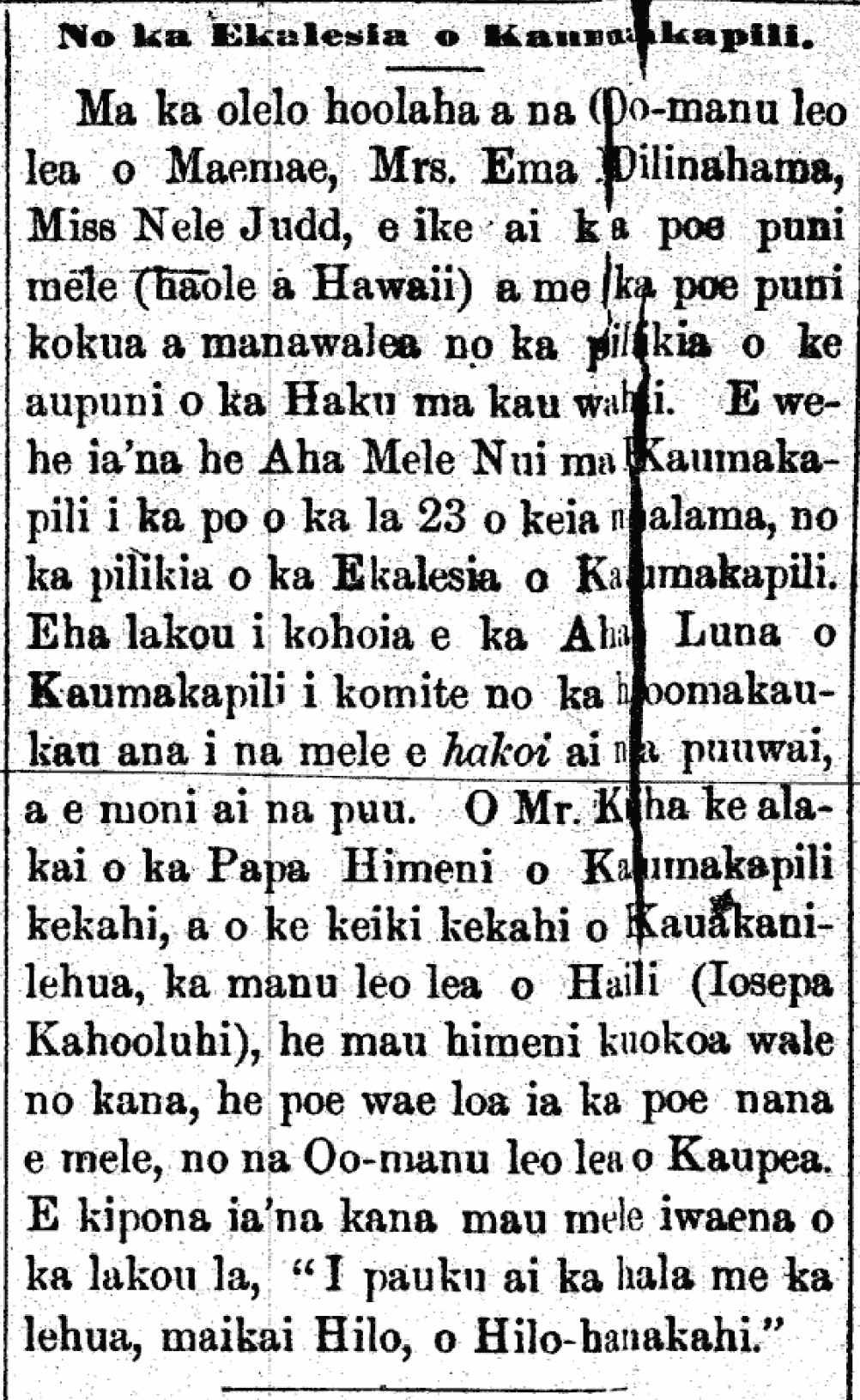
In the announcement of the sweet-voiced Oo birds of Maemae, Mrs. Emma Dillingham [Ema Dilinahama] and Miss Nelly Judd [Nele Judd], those who love music (both English and Hawaiian) as well as those who love helping and donating to the troubled kingdom of the Lord in some way. There will be held a Grand Concert at Kaumakapili on the night of the 23rd of this month, for the difficulties of Kaumakapili Church. There are four chosen by the Leadership of Kaumakapili as a committee to prepare mele to excite the heart and to whet the appetite. Mr. Kiha, the leader of the Kaumakapili Choir is one of them, and the son of the Kanilehua rain, the sweet-voiced bird of Haili (Joseph Kahooluhi) is another, who will only be singing solos; those singing were chosen carefully from amongst the beautiful-voiced Oo birds of Kaupea. His songs will be mixed in amongst theirs, “So that the hala will be sectioned in with the lehua; wonderful is Hilo, Hilo Hanakahi.”

[We all know that Joseph Kahooluhi Nawahiokalaniopuu was one of the great patriots of all times, and we even know about his fine painting skills, but did you know that he composed mele and that he had a sweet singing voice? The newspapers are like treasure boxes filled with all sorts of pearls.]

(Lahui Hawaii, 12/16/1875, p. 2)

No ka Ekalesia o Kaumakapili.

Ka Lahui Hawaii, Buke I, Helu 51, Aoao 2. Dekemaba 16, 1875.

The Chiefs’ Children’s School and its beginnings. 1844.

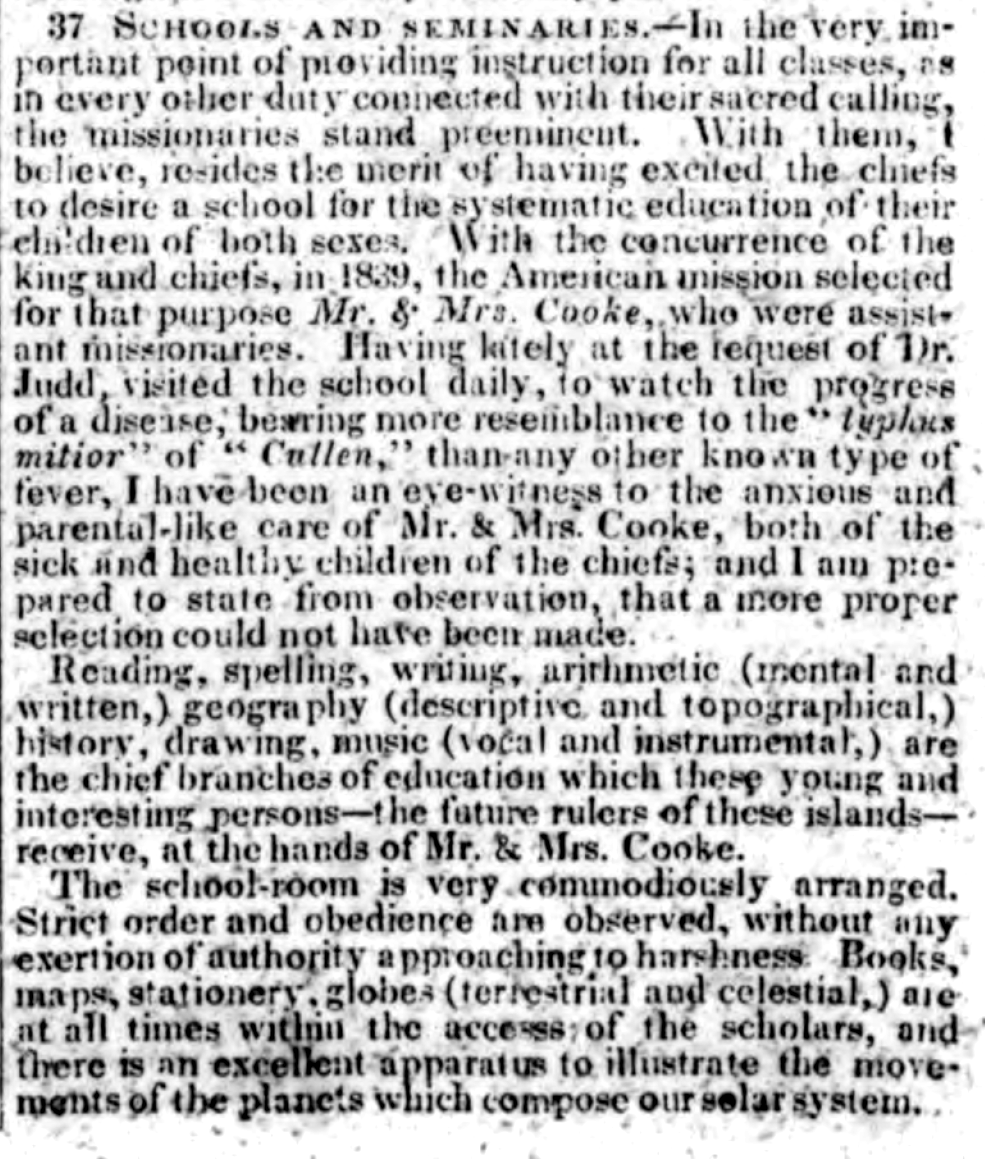
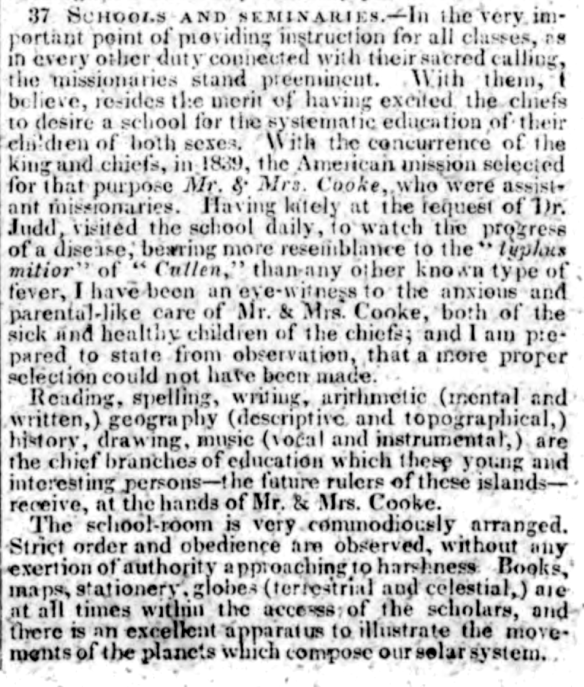
Schools and Seminaries.—In the very important point of providing instruction for all classes, as in every other duty connected with their sacred calling, the missionaries stand prominent. With them, I believe, resides the merit of having excited the chiefs to desire a school for the systematic education of their children of both sexes. With the concurrence of the king and chiefs, in 1839, the American mission selected for that purpose Mr. & Mrs. Cooke, who were assistant missionaries. Having lately at the request of Dr. Judd, visited the school daily, to watch the progress of a disease, bearing more resemblance to the “typhus mitior” of “Cullen,” than any other known types of fever, I have been an eye-witness to the anxious and parental-like care of Mr. & Mrs. Cooke, both of the sick and healthy children of the chiefs; and I am prepared to state from observation, that a more proper selection could not have been made.

The school-room is very commodiously arranged. Strict order and obedience are observed, without any exertion of authority approaching to harshness. Books, maps, stationery, gloves (terrestrial and celestial,) are at all times within the access of the scholars, and there is an excellent apparatus to illustrate the movements of the planets which compose our solar system.

(Friend, August 1, 1844, p. 35)
37. Schools and Seminaries.

The Friend, Volume II, Number VIII, Page 35. August 1, 1844.

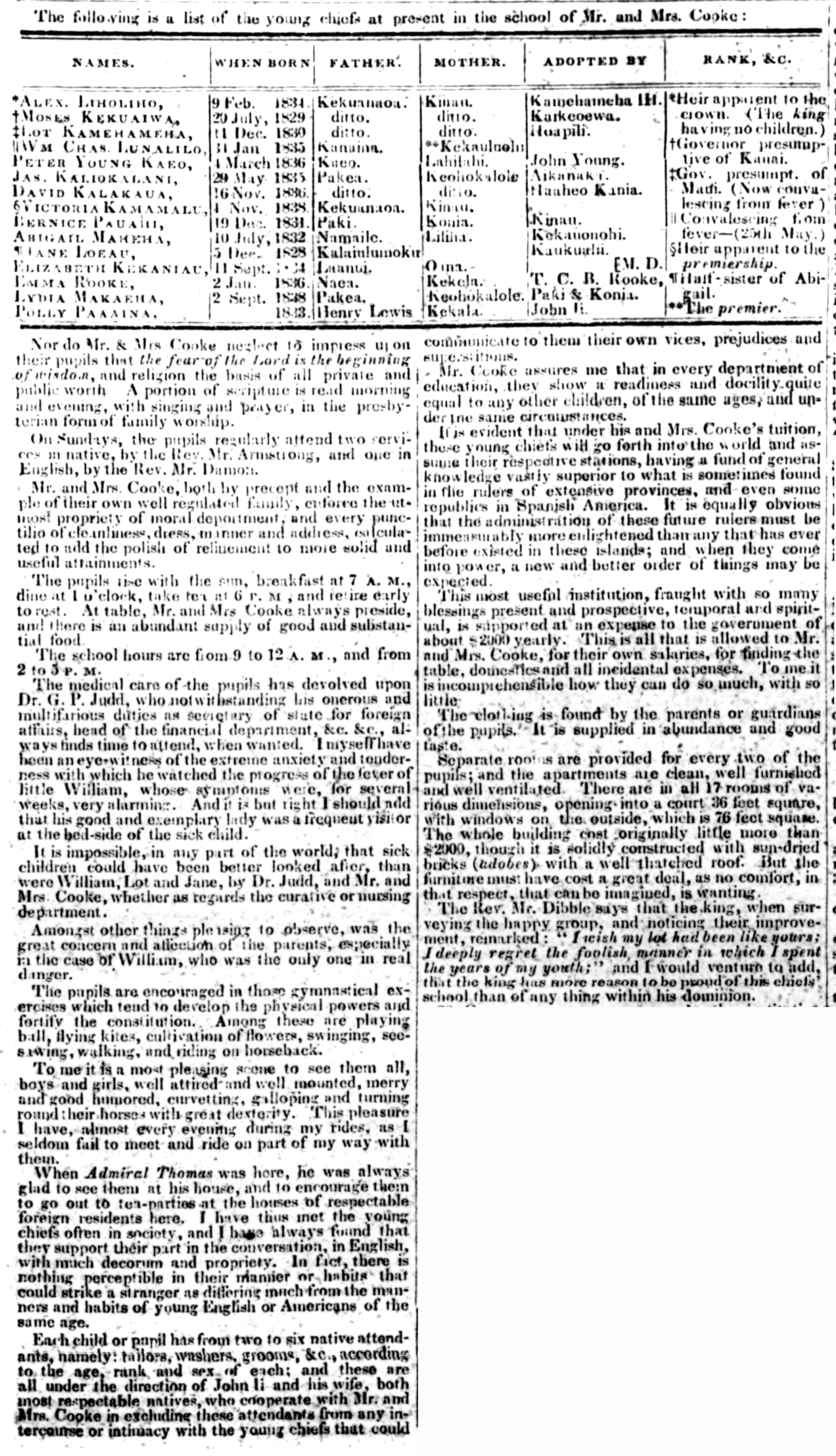
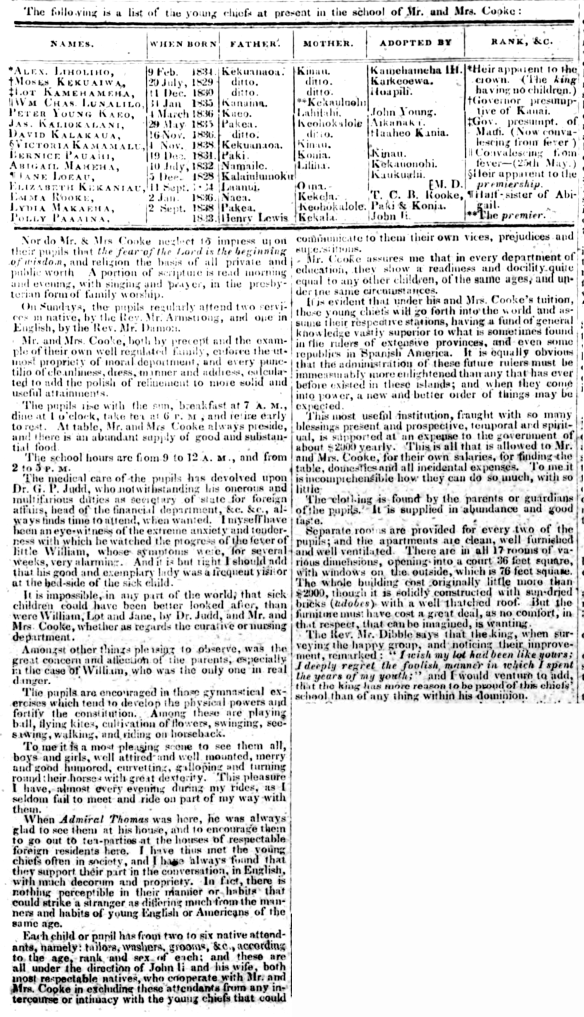
The following is a list of the young chiefs at present in the school of Mr. and Mrs. Cooke:

NAMES. WHEN BORN FATHER MOTHER ADOPTED BY
*Alexander Liholiho, 9 Feb. 1834. Kekuanaoa. Kinau. Kamehameha III.
†Moses Kekuaiwa, 20 July 1829. ditto. ditto. Kaieoewa [Kaikioewa].
‡Lot Kamehameha, 11 Dec. 1830. ditto. ditto. Hoapili.
‖William Charles Lunalilo, 31 Jan. 1835. Kanaina. **Kekauluohi.
Peter Young Kaeo, 4 March 1836. Kaeo. Lahilahi. John Young.
James Kaliokalani, 29 May 1835. Pakea [Kapaakea]. Keohokalole. Aikanaka.
David Kalakaua, 16 Nov. 1836. ditto. ditto. Haaheo Kania [Kaniu].
§Victoria Kamamalu, 4 Nov. 1838. Kekuanaoa. Kinau.
Bernice Pauahi, 19 Dec. 1831. Paki. Konia. Kinau.
Abigail [Lanihau] Maheha, 10 July 1832. Namaile. Liliha. Kekauonohi.
¶Jane Loeau, 5 Dec. 1828. Kalaiulumoku [Kalaniulumoku] [Liliha.] Kaukualii.
Elizabeth Kekaniau [Kekaaniau], 11  Sept. 1834. Laanui. Oana.
Emma Rooke, 2 Jan. 1836. Naea. Kekela. T. C. B. Rooke, M. D.
Lydia Makaeha [Kamakaeha], 2 Sept. 1838. Pakea [Kapaakea]. Keohokalole. Paki & Konia.
Polly Paaaina, 1833. Henry Lewis. Kekala [Kekela]. John Ii.

*Heir apparent to the crown. (The king having no children.)
†Governor presumptive of Kauai.
‡Gov. presumpt. of maui. (Now convalescing from fever.)
‖Convalescing from fever—(25th May.)
§Heir apparent to the premiership.
¶Half-sister of Abigail.
**The premier.

Nor do Mr. & Mrs. Cooke neglect to impress upon their pupils that the fear of the Lord is the beginning of wisdom, and religion the basis of all private and public worth. A portion of scripture is read morning and evening, with singing and prayer, in the presbyterian form of family worship.

On Sundays, the pupils regularly attend two services in native, by the Rev. Mr. Armstrong, and one in English, by the Rev. Mr. Damon.

Mr. and Mrs. Cooke, both by precept and the example of their own well regulated family, enforce the utmost propriety of moral deportment, and every punctilio of cleanliness, dress, manner and address, calculated to add the polish of refinement to more solid and useful attainments.

The pupils rise with the sun, breakfast at 7 A. M., dine at 1 o’clock, take tea at 6 P. M., and retire early to rest. At table, Mr. and Mrs. Cooke always preside, and there is an abundant supply of good and substantial food.¹

The school hours are from 9 to 12 A. M., and from 2 to 5 P. M.

The medical care of the pupils has devolved upon Dr. G. P. Judd, who not withstanding his onerous and multifarious duties as secretary of state for foreign affairs, head of the financial department, &c., &c., always finds time to attend, when wanted. i myself have been an eye-witness of the extreme anxiety and tenderness with which he watched the progress of the fever of little William, whose symptoms were, for several weeks, very alarming. And it is but right I should add that his good and exemplary lady was a frequent visitor at the bed-side of the sick child.

It is impossible, in any part of the world, that sick children could have been better looked after, than were William, Lot and Jane, by Dr. Judd, and Mr. and Mrs. Cooke, whether as regards the curative or nursing department.

Amongst other things pleasing to observe, was the great concern and affection of the parents, especially in the case of William, who was the only one in real danger.

The pupils are encouraged in the gymnastical exercises which tend to develop the physical powers and fortify the constitution. Among these are playing ball, flying kites, cultivation of flowers, swinging, see-sawing, walking, and riding on horseback.

To me it is a most pleasing scene to see them all, boys and girls, well attired and well mounted, merry and good humored, curvetting, galloping and turning round their horses with great dexterity. This pleasure I have, almost every evening during my rides, as I seldom fail to meet and ride on part of my way with them.

When Admiral Thomas was here, he was always glad to see them at his house, and to encourage them to go out to tea-parties at the houses of respectable foreign residents here. I have thus met the young chiefs often in society, and I have always found that they support their part in the conversation, in English, with much decorum and propriety. In fact, there is nothing perceptible in their manner or habits that could strike a stranger as differing much from the manners and habits of young English or Americans of the same age.

Each child or pupil has from two to six native attendants, namely: tailors, washers, grooms, &c., according to the age, rank and sex of each; and these are all under the direction of John Ii and his wife, both most respectable natives, who cooperate with Mr. and Mrs. Cooke in excluding these attendants from any intercourse of intimacy with the young chiefs that could communicate to them their own vices, prejudices and superstitions.

Mr. Cooke assures me that in every department of education, they show a readiness and docility quite equal to any other children, of the same ages, and under the same circumstances.

If is evident that under his and Mrs. Cooke’s tuition, these young chiefs will go forth into the world and assume their respective stations, having a fund of general knowledge vastly superior to what is sometimes found in the riders of extensive provinces, and even some republics in Spanish America. It is equally obvious that the administration of these future rulers must be immeasurably more enlightened than any that has ever before existed in these islands; and when they come into power, a new and better order of things may be expected.

This most useful institution, fraught with so many blessings present and prospective, temporal and spiritual, is supported at an expense to the government of about $2000 yearly. This is all that is allowed to Mr. and Mrs. Cooke, for their own salaries, for finding the table, domestics and all incidental expenses. To me it is incomprehensible how they can do so much, with so little.

The clothing is found by the parents or guardians of the pupils. It is supplied in abundance and good taste.

Separate rooms are provided for every two of the pupils; and the apartments are clean, well furnished and well ventilated. There are in all 17 rooms of various dimensions, opening into a court 36 feet square, with windows on the outside, which is 76 feet square. The whole building cost originally little more than $2000, though it is solidly constructed with sun-dried bricks (adobes) with a well thatched roof. But the furniture must have cost a great deal, as no comfort, in that respect, that can be imagined, is wanting.

The Rev. Mr. Dibble says that the king, when surveying the happy group, and noticing their improvement, remarked: “I wish my lot had been like yours; I deeply regret the foolish manner in which I spent the years of my youth;” and I would venture to add, that the king has more reason to be proud of this chiefs’ school than of any thing within his dominion.

(Friend, August 1, 1844, p. 36)
The following is a list...

The Friend, Volume II, Number VIII, Page 36. August 1, 1844.

¹This comment about the abundance of food reminded me of something Liliuokalani said in Hawaii’s Story by Hawaii’s Queen. “…our instructors were especially particular to teach us the proper use of the English language; but when I recall the instances in which we were sent hungry to bed, it seems to me that they failed to remember that we were growing children. A thick slice of bread covered with molasses was usually the sole article of our supper, and we were sometimes ingenious, if not over honest, in our search for food: if we could beg something of the cook it was the easier way; but if not, anything eatable left within our reach was surely confiscated. As a last resort, we were not above searching the gardens for any esculent root or leaf, which (having inherited the art of igniting a fire from the friction of sticks), we could cook and consume without the knowledge of our preceptors.”

Speaking of Hawaii’s Story by Hawaii’s Queen, i was expecting the new much-awaited edition to be available already, but hopefully it will be out in bookstores soon! I am thinking of putting up related articles like this one (mostly from the Hawaiian-Language Newspapers) to perhaps give a fuller picture of topics covered in the Queen’s book.

[This is written by Robert Crichton Wyllie, and is found in a very enlightening treatise describing many aspects of life in Honolulu in the 1840s. “NOTE On the Shipping, Trade, Agriculture, Climate, Diseases, Religious Institutions, Civil and Social Conditions, Mercantile and Financial Policy of the Sandwich or Hawaiian Islands, viewed in relation to other groups of islands, and to the natural and acquired advantages of the Sandwich or Hawaiian Islands.” Friend, June 1–September 24, 1844.]

Local coverage of Queen Emma’s visit to New York, 1866.

LOCAL NEWS.

NEW YORK AND THE VICINITY.

Movements of the Queen Dowager of Hawaii—She attends church twice yesterday—Interesting interview with deaf mutes—Queen Emma passed a comparatively quiet day on Saturday. She had her photographs taken in various positions at two photographic galleries in the morning, being accompanied by Miss Spurgin, Major Hopkins, her maid servant, and Mr. John Welsh. She also, in company with Miss Spurgin, did some shopping on Broadway during the day. The Rev. Dr. Gallaudet, Rector of St. Ann’s Church for Deaf Mutes, visited Her Majesty in the evening, and invited her to attend his church yesterday. The invitation was accepted. Gen. Darling and Col. Gerhard, of Gov. Fenton’s staff, also called and extended a formal invitation to the Queen to visit Albany, which she promised to do on her return from Boston, in the evening Her Majesty and suite dined with Hon Moses H. Grinneli and suite, and at 10 o’clock the royal party returned to the Brevcort House.

Early yesterday morning Old Trinity was crowded in every part by visitors, who, from appearances, had been attracted there by the announcement that the Queen would be present. At about half-past ten  her Majesty entered the Church accompanied by her suite, and proceeded up the main aisle, proceeded by the sexton and Rev. Dr. Vinton, who conducted her to the pew which the Prince of Wales occupied when he was here. The royal [unclear line] In the first pew were her Majesty Queen Emma, and Mr. Odel (Hawaiian Consul) and [unclear] Second—Major Hopkins, Miss Spurgin, and Mr. Chilton, Government Agent from Washington. Third—Mr. John Walsh, Mr. J. V. B. Marshall and the Swiss maid servant. As her Majesty entered the pew she knelt and remained some moments in silent prayer, and as she rose an elegant prayer book bearing a suitable inscription, and bound in royal purple with illuminated rubrics was presented to her. A suitable writing was also within the book, staiting that it was presented to her Majesty in memory of her visit and her fellowship with the Apostolic Church. Morning prayer was intoned throughout by the Rev. Dr. Vinton; the first lesson was read by Rev. Joseph J. Kinegood, of Eastern Pennsylvania. The second by Rev. Sidney Corbett, of Quincy, Ill. In the ante-communion service the epistic was read by Rev. Mr. Elesegood, and the gospel by Rev. Dr. Vinton. The music was splendid and consisted of Onseley’s service in G. the anthem, “O! Lord our Governor.” Ps. VIII, V. 1, 3, 4, by Marcello, also in G. This was the anthem sung at the Coronation of the Queen of England, and at the visit of the Prince of Wales to Trinity Church. The 41st hymn concluded the musical portion of the exercices. The solos were by Master Knowles and Mr. Yatman. In the anthem both organs were used, as they were in the [unclear] Voluntary (hallelujah chorus) Organists, Mr. W. A. M. Diller and Mr. Arthur G. Messeter. In the morning service the prayer for a safe return from sea was said, it having special reference to the Royal party. The Rev. Dr. Vinton preached the sermon from the words, “If I perish, I perish.” Esther IV: 16. He gave an account of the deposition of Queen Vashti and the elevation of Queen Esther, and remarked that this must have been no chance work, but was pre-ordained by the Almighty for the preservation of her people. He concluded by directing all to do their duty fearlessly in this world and Christ would hold out the golden sceptre of his love to those and bring them to this presence. A collection was then taken up for the benefit of the church in the Sandwich Islands, after which the congregation retired. As the Queen entered her carriage she was loudly cheered by the crowds who had collected outside the church. The party then retired to the hotel. The Queen and suite again attended St. Ann’s Church on Eighteenth street, near Fifth avenue, at 3 1/2 P. M. and witnessed the service for deaf mutes. The Rev. Dr. Gallandet explained many of the signs before the service commenced and stated some interesting circumstances connected with the church. The services were conducted by Rev. Dr. Vinton, and the sermon was preached by the Rev. Eastman Benjamin, the whole being interpreted by Rev. Dr. Gallaudet in the sign language. At the close an address was delivered by Rev. Dr. Vinton, who stated that the present was an occasion of thankfulness, inasmuch as a lady born in one of the isles of the sea and who had been lifted to a throne, had come among them to witness the miracle which had been performed, of causing the deaf to hear and the dumb to speak. It was delightful to show this miracle to her Majesty, whom God had made the instrument of making a nation Christian, which only a few years ago had been steeped in heathenism. She was now on a mission for the purpose of raising houses of mercy in her own land, and he hoped God would prosper it. By invitation, the Queen and suite remained after service, and a number of questions were asked the mutes and answered. Her Majesty, who by the way writes an elegant female hand, wrote the following, and handed it to one of the lady deaf mutes:—”My delight has been very great at being able to have prayed with you this day. I shall always remember brothers and sisters in you here when I am far away in my own land, far off, in my prayers. Do you believe we shall meet in Heaven and why?—Emma R.” The lady mute immediately wrote the following—”We, deaf mutes, are very happy to see her Majesty Queen Emma, of the Sandwich Islands to-day; and moreover we are greatly delighted in sitting with you in the house of the Lord. For myself I believe that there will be a mutual recognition in heaven.” Her Majesty then shook hands with several of the mutes, and also with the clergyman. She was accompanied to the carriage by the Rev. Dr. Gallaudet, who pressed her hand  and said, “God bless you.” She thanked him with a smile, and was driven to the hotel. This morning the Queen and suite will take the eight o’clock train to Philadelphia, en route to Washington. Mr. Cheiton, the special envoy from Mr. Seward, will accompany the royal party. The Queen will be received at Washington by Attorney General Stansbury, Acting Secretary of State.

(New York Sun, 8/13/1866, p. 1)

LOCAL NEWS.

The New York Sun, Year 33, Number 10,629, Page 1. August 13, 1866.

Queen Emma abroad,

Queen Emma.

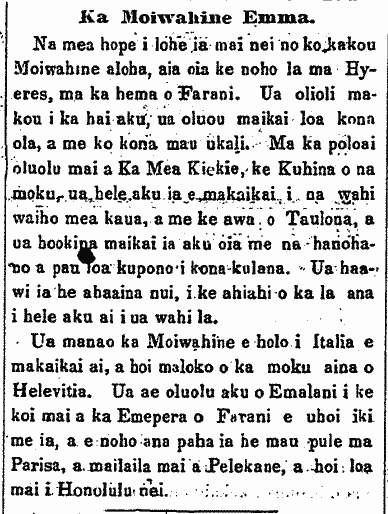
The latest heard of our beloved Queen is that she is staying at Hyeres, in the south of France. We are greatly pleased to say that she is in excellent health, and so are her attendants. By the kindly invitation of His Highness, the Naval Minister,  she toured the places where arms are stored, and the harbor of Toulon, and she was well received with all honors appropriate for her stature. There was given a grand reception on the evening of the day on which she went there.

The Queen plans to go to tour Italy, and to return by way of the Helvetic state. Emalani kindly agreed to the urging by the Emperor of France to return for a bit with him and to stay for some weeks in Paris, and from there to Britain and all the way back to Honolulu nei.

[There is much printed in the Hawaiian-Language Newspapers about Queen Emma’s travels abroad. Here is but one report informing her people of her progress.]

(Au Okoa, 4/23/1866, p. 2)

Ka Moiwahine Emma.

Ke Au Okoa, Buke II, Helu 1, Aoao 2. Aperila 23, 1866.

Near tragedy on the way from Kauai to Niihau, 1864.

Barely survived at sea

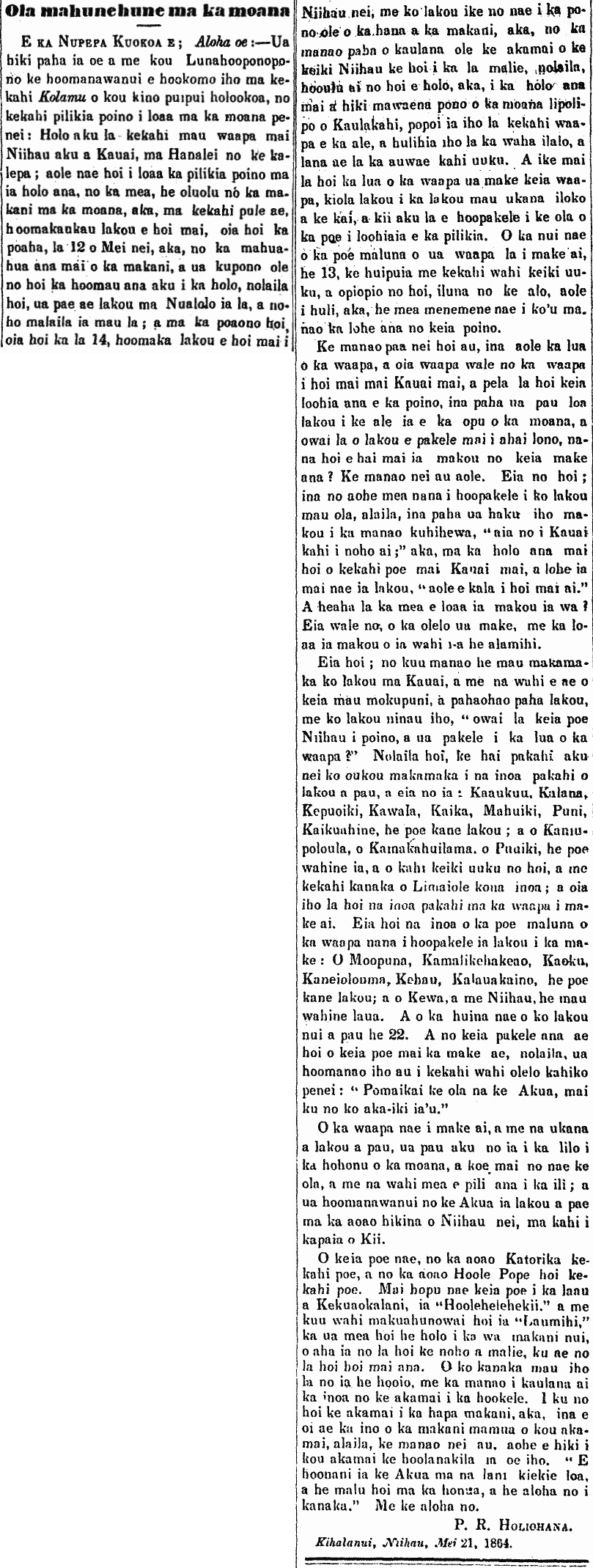
O Kuokoa Newspaper; Aloha oe:—Perhaps you and your Editor can be tolerant and include this in a Column of your entire stout body, about a crisis at sea, like this: Several skiffs left Niihau for Kauai, in Hanalei, to peddle goods; they did not face the crisis during this trip because the winds were calm on the sea, however, the next week they made ready to return, that being Thursday, the 12th of May, but because the wind was growing stronger, it wasn’t appropriate to continue the travels, therefore they landed at Nualolo that day, and stayed there for those days; and on Saturday, the 14th, they made to return here to Niihau while knowing the activity of the wind was bad; perhaps it was because they felt that the skill of the Niihau youth would not be acclaimed should they return in the calm, so they were worked up to sail, but after leaving and reaching the middle of the deep seas of Kaulakahi, one of the skiffs was pounded by a billow, and it overturned, and they were in dire straits. And when the second skiff noticed that this one had sunk, they threw their belongings into the sea and went to save the lives of the people overcome by calamity. The number of people aboard that vessel that had sunk was 13 including a small, young child who wasn’t yet crawling; I felt sorrow when I heard of this tragedy.

I strongly believe that if it wasn’t for the second skiff, and there was but just one skiff returning from Kauai, and they ran into this trouble, then they would be all gone, being swallowed by the belly of the ocean, and which of them would have escaped to be the messenger, the one to tell us of this sinking? I don’t think any one of them. And here is another thing; should none of them have lived, then we would have imagined something that was not true: “They are there living on Kauai;” but when some people from Kauai came and heard of them: “They left a long time ago.” Then what would we have then? Just this, the word that they had died, while accepting that fish, an alamihi.”¹

Here is another thing; being that I believe they have relatives on Kauai, along with other places of these islands, who are full of wonder, asking, “who are these Niihau people who were in trouble, and were they saved by the second skiff” So your friend will give each of their names, and here they are: Kaaukuu, Kalana, Kepuoiki, Kawala, Kaika, Mahuiki, Puni, and Kaikuahine, who are men; and Kamupoloula, Kamakahuilama, and Puuiki, who are women; and the small children and a man named Limaiole; those are the names of each of them in the skiff that sank. These are the names of the people aboard the skiff which saved them: Moopuna, Kamalikehakeao, Kaoku, Kaneiolouma, Kehau, and Kalauakaino, who are men; and Kewa and Niihau, who are women. The total number of them all was 22. And with this saving of these people from death, I recall an old saying: “Life is blessed through God, your snicker was almost fitting for me. [?? “Pomaikai ke ola na ke Akua, mai ku no ko aka-iki ia’u.”

As for the skiff that sunk and all of their cargo, it is all gone into the depths of the ocean, and all that was left are their lives, and what they had on; and God was patient with them and they landed on the east side of Niihau nei, in the place called Kii.

These people, some of them were of the Catholic faith, and some were Protestants. These people nearly grabbed onto the club of Kekuaokalani, “Hoolehelehekii,”² along with my father-in-law, “Laumihi,”³ as they set off in strong winds; what’s wrong with staying put until it is calm and then get up and come back. It is in man’s nature to show off, thinking that he will be famous for his prowess at sailing. You are competent facing a fraction of the wind, but should the ferocity of the wind be greater than your skill, then I believe that your intelligence would not leave you victorious. “Praise god in the high heavens, peace on earth, and good will towards men.” With aloha,

P. R. Holiohana.⁴

Kihalanui, Niihau, May 21, 1864.

¹A play on alamihi crab which can also sound like “path to repentance”.

²A play on the name “Hoolehelehekii,” meaning to be all talk.

³A play on the name “Laumihi,” perhaps meaning much remorse.

⁴P. R. Holiohana is most likely also known as P. R. Holi.

[On a related note, please don’t drive if you have been drinking. It isn’t worth the risk you are putting yourself and others on the road in.]

(Kuokoa, 6/18/1864, p. 4)

Ola mahunehune ma ka moana

Ka Nupepa Kuokoa, Buke III, Helu 25, Aoao 4. Iune 18, 1864.

New organ being assembled at Kawaiahao Church, 1901.

Organ of Kawaiahao.

The new Organ of the Church has arrived, and if you go inside, you will see all sorts of small parts of this organ strewn here and there of the church. It is being assembled as quickly as possible by those working on it. There are hundreds of small parts to be put together until the large organ is complete. Because the church is being taken up by this activity, the church activities will take place in the room below.

[This is just one of a number of new organs that Kawaiahao received throughout the years!]

(Kuokoa, 7/12/1901, p. 4)

Ka Ogana o Kawaiahao.

Ka Nupepa Kuokoa, Buke XXXIX, Helu 28, Aoao 4. Iulai 12, 1901.

Those afflicted with leprosy forsaken by the church? 1873.

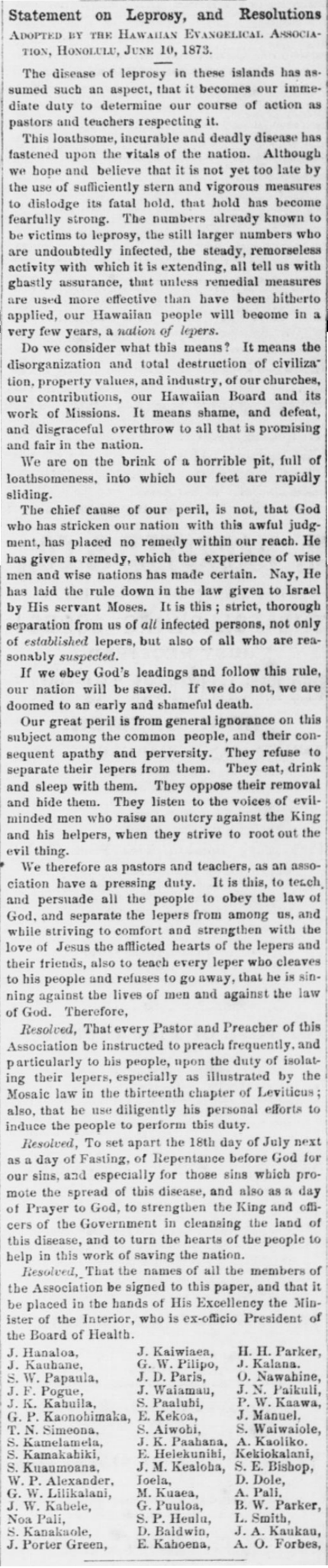
Statement on Leprosy, and Resolutions

Adopted by the Hawaiian Evangelical Association, Honolulu, June 10, 1873.

The disease of leprosy in these islands has assumed such an aspect, that it becomes our immediate duty to determine our course of action as pastors and teachers respecting it.

This loathsome, incurable and deadly disease has fastened upon the vitals of the nation. Although we hope and believe that it is not yet too late by the use of sufficiently stern and vigorous measures to dislodge its fatal hold, that hold has become fearfully strong. The numbers already known to be victims to leprosy, the still larger numbers who are undoubtedly infected, the steady, remorseless activity with which it is extending, all tell us with ghastly assurance, that unless remedial measures are used more effective than have been hitherto applied, our Hawaiian people will become in a very few years, a nation of lepers.

Do we consider what this means? It means the disorganization and total destruction of civilization, property values, and industry, of our churches, our contributions, our Hawaiian Board and its work of Missions. It means shame, and defeat, and disgraceful overthrow to all that is promising and fair in the nation.

We are on the brink of a horrible pit, full of loathsomeness, into which our feet are rapidly sliding.

The chief cause of our peril, is not, that God who has stricken our nation with this awful judgment, has placed no remedy within our reach. He has given a remedy, which the experience of wise men and wise nations has made certain. Nay, He has laid the rule down in the law given to Israel by His servant Moses. It is this; strict, thorough separation from us of all infected persons, not only of established lepers, but also of all who are reasonably suspected.

If we obey God’s leadings and follow this rule, our nation will be saved. If we do not, we are doomed to an early and shameful death.

Our great peril is from general ignorance on this subject among the common people, and their consequent apathy and perversity. They refuse to separate their lepers from them. They eat, drink and sleep with them. They oppose their removal and hide them. They listen to the voices of evil-minded men who raise an outcry against the King and his helpers, when they strive to root out the evil thing.

We therefore as pastors and teachers, as an association have a pressing duty. It is this, to teach and persuade all the people to obey the law of God, and separate the lepers from among us, and while striving to comfort and strengthen with the love of Jesus the afflicted hearts of the lepers and their friends, also to teach every leper who cleaves to his people and refuses to go away, that he is sinning against the lives of men and against the law of God. Therefore,

Resolved, That every Pastor and Preacher of this Association be instructed to preach frequently, and particularly to his people, upon the duty of isolating their lepers, especially as illustrated by the Mosaic law in the thirteenth chapter of Leviticus; also, that he use diligently his personal efforts to induce the people to perform this duty.

Resolved, To set apart the 18th day of July next as a day of Fasting, of Repentance before God for our sins, and especially for those sins which promote the spread of this disease, and also as a day of Prayer to God, to strengthen the King and officers of the Government in cleansing the land of this disease, and to turn the hearts of the people to help in this work of saving the nation.

Resolved, That the names of all the members of the Association be signed to this paper, and that it be placed in the hands of His Excellency the Minister of the Interior, who is ex-officio President of the Board of Health.

J. Hanaloa,  J. Kaiwiaea, H. H. Parker,
J. Kauhane,  G. W. Pilipo,  J. Kalana,
S. W. Papaula,  J. D. Paris,  O. Nawahine,
J. F. Pogue,  J. Waiamau,  J. N. Paikuli,
J. K. Kahuila,  S. Paaluhi,  P. W. Kaawa,
G. P. Kaonohimaka,  E. Kekoa,  J. Manuel,
T. N. Simeona,  S. Aiwohi,  S. Waiwaiole,
S. Kamelamela,  J. K. Paahana,  A. Kaoliko,
S. Kamakahiki,  E. Helekunihi,  Kekiokalani,
S. Kuaumoana,  J. M. Kealoha,  S. E. Bishop,
W. P. Alexander,  Ioela,  D. Dole,
G. W. Lilikalani,  M. Kuaea,  A. Pali,
J. W. Kahele,  G. Puuloa,  B. W. Parker,
Noa Pali,  S. P. Heulu,  L. Smith,
S. Kanakaole,  D. Baldwin,  J. A. Kaukau,
J. Porter Green,  E. Kahoena,  A. O. Forbes.

[How have things changed today? How have things remained the same? Find the Hawaiian-Language version printed in the Kuokoa, 6/18/1873, p. 3, here.]

(Pacific Commercial Advertiser, 6/14/1873, p. 3)

Statement on Leprosy, and Resolutions

The Pacific Commercial Advertiser, Volume XVII, Number 50, Page 3. June 14, 1873.

Ia oe e ka la e alohi nei… 1874.

The Birthday of the King.

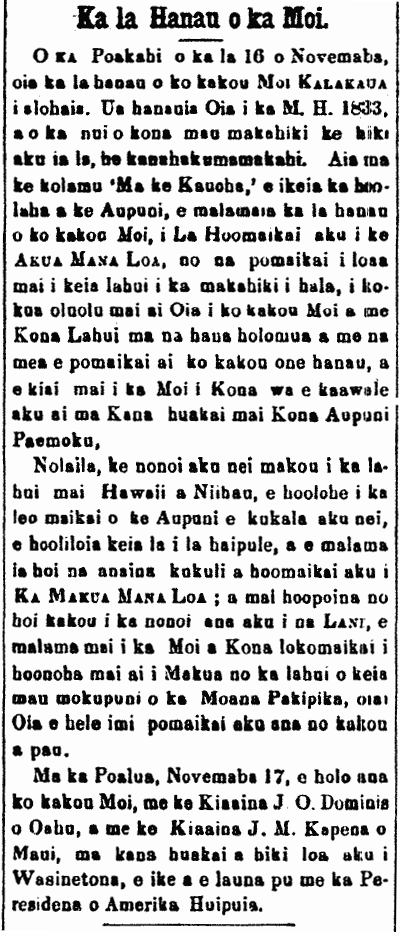
Monday, the 16th of November, is the birthday of our beloved King Kalakaua. He was born in the year 1833, and he will be making forty-three years old. In the column ‘Ma ke Kauoha’ [By Authority], seen is the Government notice that the birthday of our King will be held as a Day of Thanks to the Almighty God, for the blessings received by our lahui this past year; He has kindly assisted our King and His People in progressive endeavors and in things that will benefit our homeland, and may He watch over the King during His time away from his Kingdom of Islands on His travels.

Therefore, we ask the lahui from Hawaii to Niihau to heed the good announcement of the Government, that this day shall be a day of prayer, and that meetings will be held to kneel and give appreciation to the Almighty Father; and let us not forget to ask of the Heavens to watch over the King who He in his benevolence has placed as a Father to the lahui of these islands in the Pacific Ocean, while He will be travelling to seek blessings for us all.

On Tuesday, November 17th, our King and the Governor of Oahu, J. O. Dominis, along with the Governor of Maui, J. M. Kapena, will go on a trip to Washington to meet with the President of the United States of America.

(Kuokoa, 11/7/1874, p. 2)

Ka la Hanau o ka Moi.

Ka Nupepa Kuokoa, Buke XIII, Helu 5, Aoao 2. Novemaba 7, 1874.

Hattie Linohaupuaokekoolau Saffery Reinhardt, correspondent for Hamakua and Kohala, 1941.

Bits of News from Hamakua and Kohala

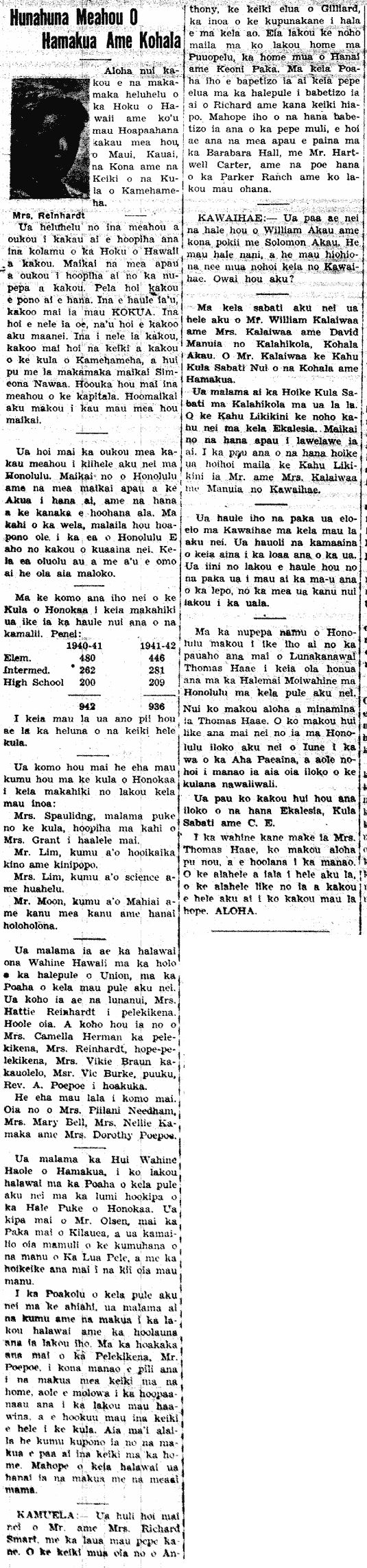
Aloha nui kakou, readers of the Hoku o Hawaii and my fellow news writers from Maui, Kauai, the two Kona [North and South], and the Children of Kamehameha Schools.

I’ve read the news you all have written filling the columns of our Hoku o Hawaii. All that you all have written to fill our newspaper have been fine. That is the way we should do it. Should I be put aside, I will support those who KOKUA. Should you not have material, I will give aid here. If we all are without, our children from the Kamehameha School will give support, along with that good friend, Simeona Nawaa. Do send more news from the capitol. We give appreciation for your choice news.

Your news writer has returned from her wandering in Honolulu. Honolulu is great, along with all the great many things God has created, as well as all that man is carrying out. Where it is hot, that is what I don’t like, the air of Honolulu. We in the countryside are better off. With this cool air which you and I breathe; there is life there within.

With the recent start of Honokaa School this year, there has been seen a severe drop in the number of children. Like this:

1940–41 1941–42
Elem.    480    446
Intermed.    262    281
High School    200    209
 ———  ———
   942    936

These past days, the number of children attending school has rebounded.

Four new teachers came to Honokaa School this year, their names being:

Mrs. Spaulding, librarian for the school; taking the place of Mrs. Grant who left.

Mr. Lim, fitness teacher and baseball.

Mrs. Lim, science and math teacher.

Mr. Moon, Farming and Agriculture and Animal husbandry teacher.

The Hawaiian Women’s meeting was held in the hall of the Union Church several Thursdays ago. The officers were selected; Mrs. Hattie Reinhardt as president. She refused. Reselected was Mrs. Camella Herman as president; Mrs. Reinhardt as vice president; Mrs. Vikie Braun as secretary; Mrs. Vic Burke as treasurer; and Rev. A. Poepoe as adviser.

Four members joined. They being Mrs. Piilani Needham, Mrs. Mary Bell, Mrs. Nellie Kamaka and Mrs. Dorothy Poepoe.

The Haole Women’s Board of Hamakua held their meeting last Thursday in the lobby of the Honokaa Library. Mr. Olsen paid a visit, from the Kilauea Park, and he talked on the subject of the birds of the Volcanic Crater, while showing pictures of the birds.

On the Wednesday of last week, in the evening, the teachers and parents held their meeting and introduced themselves. In the introduction by the President, Mr. Poepoe, pertaining to his thoughts on parents at home, was the idea that they should not be lax in the children’s studies, and that they should let them always go to school. If the child is sick, that is a proper reason for the parents to keep the child at home. After the meeting, the parents were fed a snack.

KAMUELA:—Mr. and Mrs. Richard Smart returned along with their baby boy. The first child is Anthony, the second is Gilliard, named for the grandfather who has gone to the other world. They are living at their home in Puuopelu, at the previous residence of Hanai and Keoni Paka [Hannah and John Parker]. This coming Thursday, the second baby will be baptized at the church where Richard and his first child were baptized. After the baptism of the youngest child, everyone will return to eat at Barabara hall, with Mr. Hartwell Carter and the workers of Parker Ranch and their families.

KAWAIHAE:—The new homes of William Akau and his younger brother, Solomon Akau, have been completed. They are beautiful houses, and it is a sign of progress for Kawaihae. Now who else?

This past sabbath, Mr. William Kalaiwaa and Mrs. Kalaiwaa and David Manuia  went to Kalahikiola in North Kohala. Mr. Kalaiwaa is the head Kahu of the Sunday Schools of two Kohala [North Kohala and South Kohala] and Hamakua.

On that day, they were holding the Sunday School Hoike at Kalahikiola. Pastor Likikini presides as kahu of the Church. Everything that took place was fine. After the hoike was through, Pastor Likikini took Mr. and Mrs. Kalaiwaa and Manuia back to Kawaihae.

Drenching raindrops fell at Kawaihae these past days. The kamaaina of this area were glad to receive rain. They hope the rain will fall again so that the soil remains damp, for they have planted much sweet potato.

We saw in the English newspaper of Honolulu that Judge Thomas Haae grew weary of this life at the Queen’s Hospital in Honolulu last week. We have great aloha and regret for Thomas Haae. We met up with him in Honolulu in June during the [church] Island-wide Convention, and it was not known that he was in weak condition.

We will no longer meet at the Church, Sunday School, and C. E. events.

To the widow, Mrs. Thomas Haae, to you goes our aloha, and let your thoughts be lightened. The path that he has taken is the same path that we shall take on our last days. ALOHA.

[Mrs. Reinhardt was the news correspondent for Hamakua and Kohala to the newspaper Hoku o Hawaii.]

(Hoku o Hawaii, 10/15/1941, p. 1)

Hunahuna Meahou O Hamakua Ame Kohala

Ka Hoku o Hawaii, Volume XXXVI, Number 25, Page 1. Okatoba 15, 1941.