Rev. Robert Stewart McArthur rails on the monarchy, 1895.

M’ARTHUR ON HAWAII.

Kalakaua and Liliuokalani Responsible for Heathenism.

CONVERTS AMONG THE NATIVES.

Great Hopes for the Hawaiians Now that They Are in the Enjoyment of a Pure and Free Government—Officers of State are Especially Praised.

NEW YORK, Dec. 2.—The Rev. Robert Stewart McArthur delivered a sermon in the Calvary Baptist church last night on “The Responsibility of Kalakaua and Liliuokalani.”

After referring to the characteristics of the Hawaiians he quoted figures to show the falling off in the number of Christian converts among the natives since the reign of Kamehameha V, who removed all restraint from the Hula masters and Kahuna influence and thereby sided the spread of idolatry. Continue reading

More on Jane Loeau’s passing, 1873.

Death of a Chiefess.—Jane Loeau, a descendant in the female line of the ancient chiefs of Kauai, and a reputed granddaughter of Kamehameha I., died suddenly in this city on Wednesday last. She was 45 years of age, and was in childhood an inmate of the Chief’s school under the charge of Mr. and Mrs. Cooke, at the same time with Kamehameha IVth and Vth and His present Majesty.

(Pacific Commercial Advertiser, 8/2/1873, p. 3)

Death of a Chiefess.

The Pacific Commercial Advertiser, Volume XVIII, Number 5, Page 3. August 2, 1873.

Salt production, 1869.

[Found under: “LOCAL NEWS: Oahu.”]

Salt Storehouse.—We’ve seen makai of Kakaako in Honolulu nei, a huge wooden Structure is being constructed by the King [Kamehameha V], and the great riches that will be stored in that building is salt. This is the salt that now stands near the banks of the salt ponds. The past few days it has been drizzling a bit, and it would be best if it [the salt] was stored in a safe location.

(Kuokoa, 9/18/1869, p. 3)

HALE HOAHU PAAKAI.

Ka Nupepa Kuokoa, Buke VIII, Helu 38, Aoao 3. Sepatemaba 18, 1869.

The first Kamehameha Day out in the country, continued, 1872.

At Wailuku.

The children of the Hawaiian nation celebrated this day to commemorate the day believed to be the incorrect [? kupaewa] day of birth of the old chief who passed on, the one who joined Hawaii nei together to become one.

Here below are the activities done in celebration on that day. A crowd gathered at the protestant church in Wailuku; people were separated into those who were born during the time of Kamehameha I, who had a separate seating section, and so too of the people of Kamehameha IIʻs time, and all the way until those of Kamehameha Vʻs time; when looking about, a majority of the audience was born in the time of Kamehameha III.

The program was opened with the singing of a hymn to Almighty God; Hymn 33 and Mr. Napue gave a prayer; there was a second Hymn 196, and that came to an close. J. A. Napela [J. H. Napela] served as the Chairman, and spoke about things of Kamehameha Iʻs time and his deeds, his strength, and so forth. This was the first speech, and it was given for the commemoration, appropriately done by one who is well-immersed in the ways of those times.

Speech number two. C. P. Kealakai, teacher of Halehaku; his speech was about the one being commemorated; his main topic which he expounded upon was aloha for God.

Speech number three. D. H. Hakuole, teacher of Kauaula; his speech was about Opukahaia, and not about the remembrance of Kamehameha I.

Speech number four. Kamoku, a student of the theological seminary; this speech was on the mark [pilipono ka la i papaenaena] and did not go astray; it was the first delightful speech for the audience.

Speech number five. A. Keohokalole, audience member from the island of Maui; this was a speech suited for the learned; the items were woven skillfully together, and was fitting to the program.

Speech number six. I donʻt have the name; it was a speech that was not pertinent to the topic; he was made to sit down by the Chairman.

Speech number seven. Mr. Kaleohano; the speech was about electricity, but it was related to the topic. He spoke about these famous words before the audience, because the haole sugar farmers don’t recall the words of the alii, Kamehameha V, who said: “If I had a million dollars in my pocket, I would be able to demolish these sugar mills for their contempt of the royal proclamation.

Speech number eight. P. Kaluna, teacher of Papohaku, it was electric; it was apparent that his speech showed his great thought for the celebration of the day.

Speech number nine. Kawelau, teacher of the district of that famous rain, the Ukiukiu [of Makawao]; I will not say that he wasn’t electric, but it was somewhat like speech number four.

Speech number ten. Nahunahupu; this was a speech not appropriate for the person who was being commemorated that day.

Speech number eleven. D. Mamaki, teacher of Lahaina; this was a fine speech.

After this speech was over, that concluded the activities of the day. Everyone proceeded down to the place of N. Kepoikai, Esq. There, they were supplied with every type of Hawaiian food, along with haole food, all except liquor. This feast was appreciated for its peaceful nature and great pride, well-suited for gentlemen. The majority of those who partook in the food were government school teachers of the from all around Maui.

[This is a continuation of “Day Commemorating Kamehameha I.” There is one more section describing the celebration held at Kailua, Kona, with quite a display of whale ivory! I will try to get that up sometime in the future.]

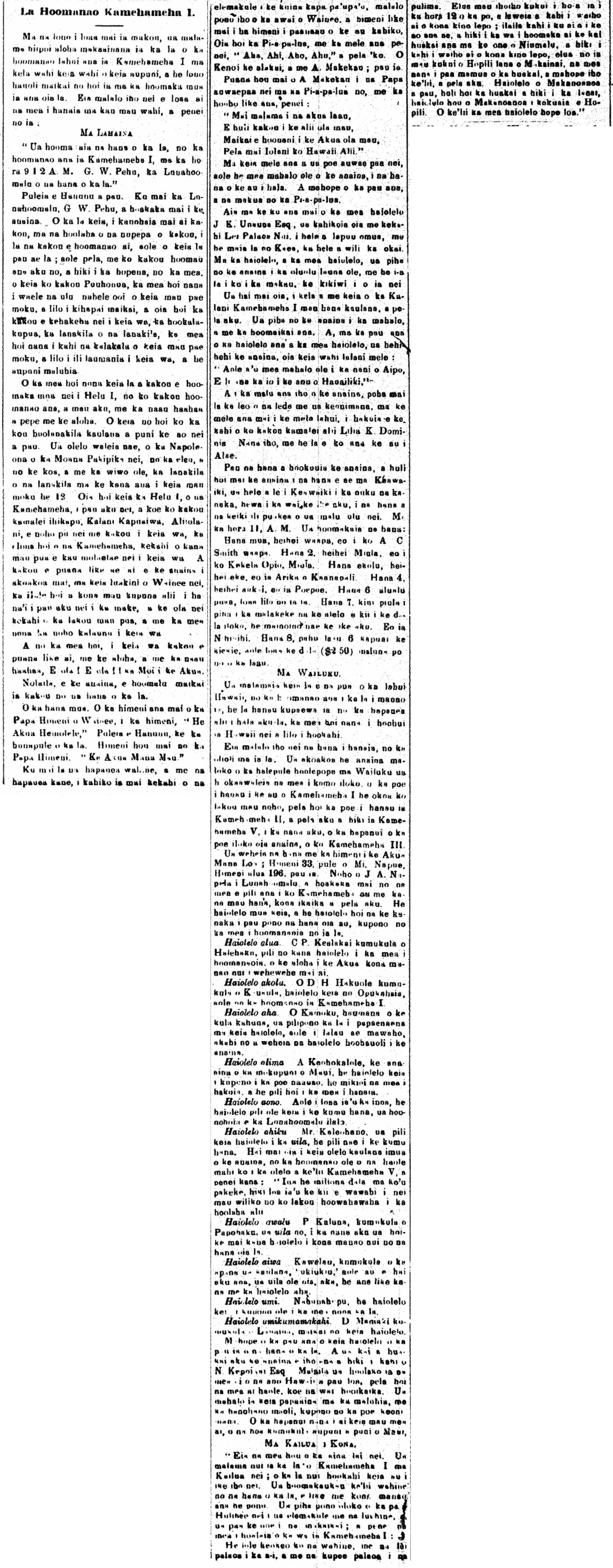
The first Kamehameha Day out in the country, 1872.

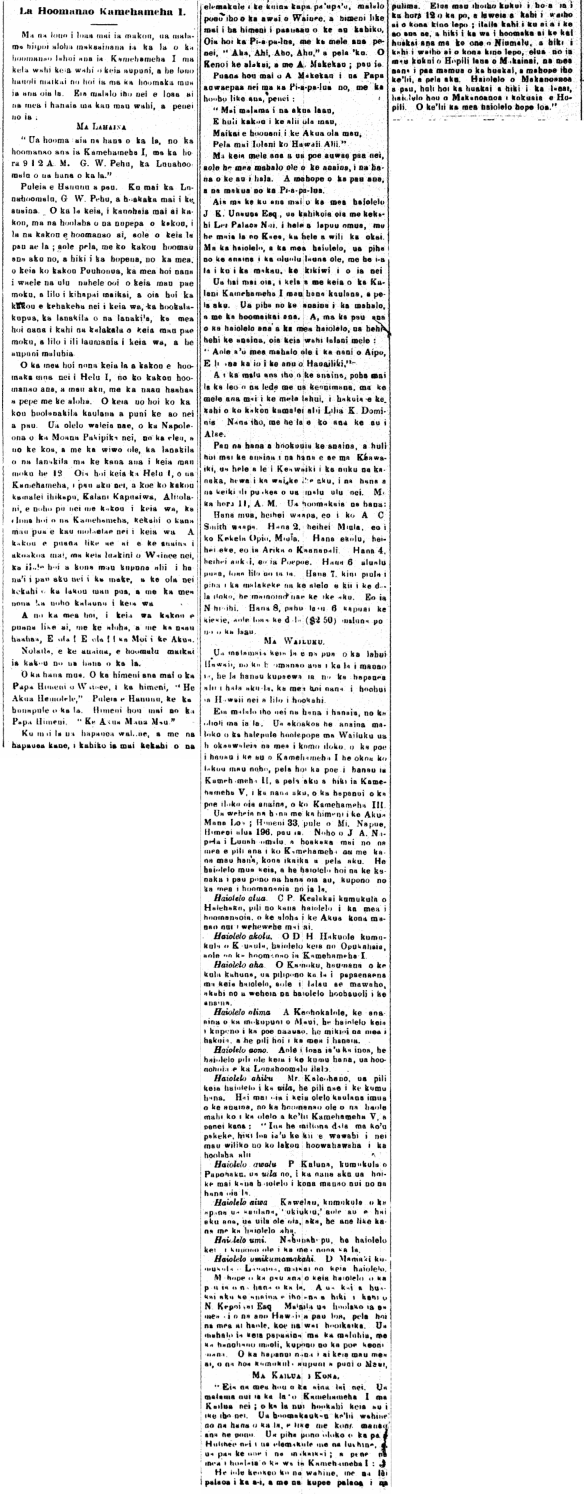
Day Commemorating Kamehameha I.

According to the news we received, the day the nation remembers Kamehameha I was preciously observed in different places of the nation, and this is good news for the very beginning of this day. Here below you will find what took place in various places, and here it is:

In Lahaina

“The activities of the day for the commemoration of Kamehameha I began at 9:12 A. M. with G. W. Pehu as the Chairman of the day’s events.”

A prayer was given by Hanunu. Chairman G. W. Pehu stood and explained to the crowd. This is the day that we were told in the announcements in our newspapers that this day is one that we are to commemorate, but not just on this day and that’s it; no, we are to continue this until the end, for he is the pillar of our world, the one who cleared away the thorny wilderness of this archipelago and made it into a fine garden, and it for him which we have pride: the wondrous one, the victor of victors, the one who shorn off the roughness  of these islands and smoothed it out making it a peaceful nation.

The one for whom we are starting off with this very first day, for whom we are celebrating for all times, with humble hearts, modesty, and aloha. He is our famed conqueror across the whole world. He is called the Napoleon of the Pacific Ocean, for his dexterity and his bravery and fearlessness; the victor of victors in battle for these 12 islands. He is the 1st of the Kamehamehas, who has gone, leaving our sacred offspring, King Kapuaiwa, Aliiolani, now living amongst us, the fifth of the Kamehamehas, one of his blossoms now appears clearly before us. And we proclaim together O Crowd gathered here at the church of Wainee, the House made by his royal ancestors who are passed on, while some of their descendants live on, along with the one who occupies the throne today.

For we now say in unison with aloha and humble hearts, May He Live! May the King Live in God!!

Therefore O People, let us keep the activities of the day well under control.

The first event. The singing of the Choir of Wainee, the hymn, “He Akua Hemolele.” There was a prayer by Hanunu, the pastor of the day. The Choir sang once more, “Ke Akua Mana Mau.”

The old ladies stood, along with the old men; some of the old men were right below the pulpit of Wainee, decked out in  layers of pa’upa’u kapa, and sang memorized songs of old. Like the Second Alphabet [Pi-a-pa-lua], sung like this: “Aha, Ahi, Aho, Ahu,” and so forth. Kenoi was the leader along with A. Makekau; this came to an end.

A. Makekau called out once more to this group of oldsters, with the Pi-a-pa-lua, exhorting in this manner:

“Don’t care after wooden idols,
Let us turn to the ever-living ruler,
It is good to glorify the ever-living God,
This, according to Iolani, the King of Hawaii.”

With this singing of the old ones, there was not a single one there who did not feel gratitude for the work done in times past. And after this was done, the makua then sang the Pi-a-pa-lua.

When the speaker, J. K. Unauna, stood, he was wearing a Large Whale Ivory Lei [Palaoa], which curved at the front like a banana of Kaea whose blossom containers [okai] are twisted. By the speech, of the speaker, the audience was immensely pleased, like a fish caught on the hook, weaving this way and that.

He spoke of the different famous feats of the Chief Kamehameha I. The audience was filled with thanks and appreciation. And, at the end of the speech of the speaker, the audience stomped their feet, like these lines of mele:

“I have nothing but praise for the beauty of Aipo,
Shuddering at the cold of Hauailiki”

[“Aole a’u mea mahalo ole i ka nani o Aipo,
E li ana ka io i ke anu o Hauailiki.”]

And when the audience calmed down, the voices of the men and women burst forth, singing the national anthem [mele lahui] composed by one of our chiefly children, Lilia K. Dominis. To witness this, it was as if the current was drawing to Alae [e ko ana ke au i Alae].

The program was over, and the audience was released, and the went to the other festivities at Keawaiki, which was teeming with people; there were so many people seen at the activities of the white ones of Lahaina nei. At the hour of 11 A. M., the games began:

First event, boat race, won by the boat of A. C. Smith. Event 2, Mule race, won by Castle Jr.’s mule. Event three, sack race, won by Arika of Kaanapali. Event 4, swimming race, won by Poepoe. Event 6, pig chase [alualu puaa], which was won by him. Event 7, tin can filled with molasses and you try to get the dollar inside using your tongue; it was miserable to watch. Won by [?Nahioihi]. Event 8, a wooden pole of 6 feet tall; the money ($2.50) atop the pole was not gotten.

[This article continues with scenes from Wailuku and Kailua, Kona. Look for the continuation at a later date. The image online is very hard to read. I can’t wait for the day when all the newspapers are rescanned clearly!]

(Au Okoa, 6/20/1872, p. 3)
La Hoomanao Kamehameha I.

Ke Au Okoa, Buke VIII, Helu 10, Aoao 3. Iune 20, 1872.
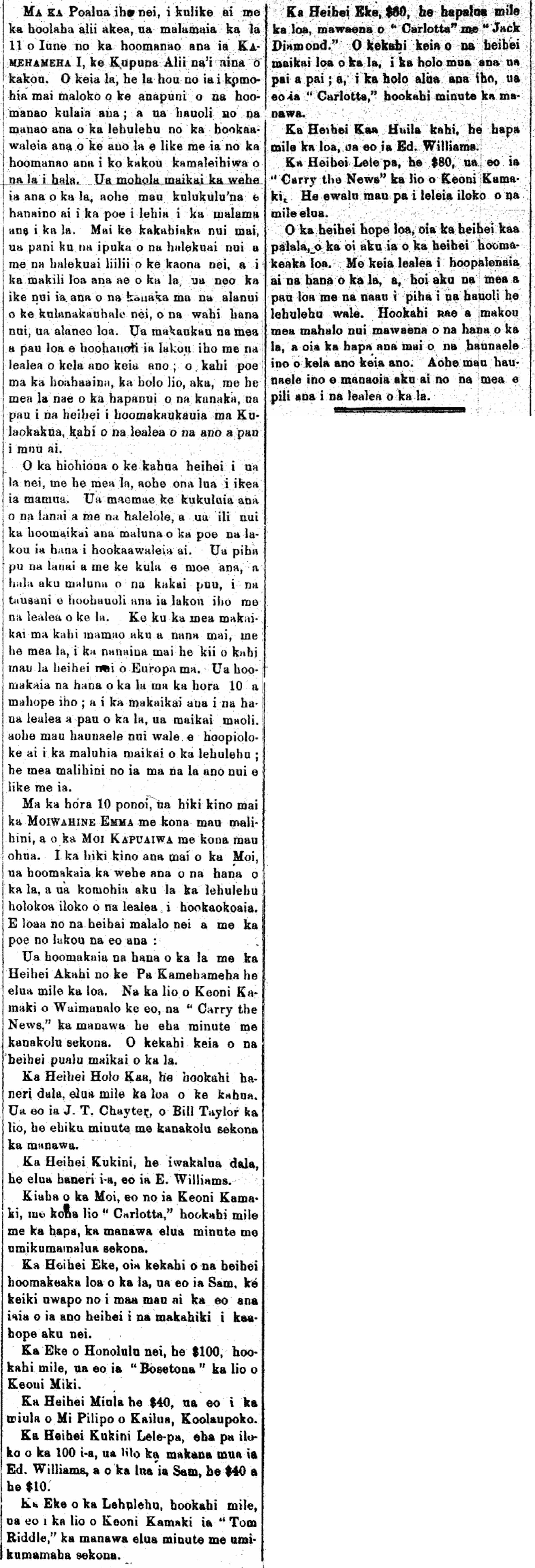
The First Kamehameha Day, 1872.

This past Tuesday, as per the Royal Proclamation, the 11th of June was observed as the day to commemorate Kamehameha I, our Royal Ancestor who conquered the land. This is a new day included in the realm of holidays; and the people were joyous at the designating of a day like this for the remembering of our precious beloved one of days gone by. The day opened beautifully, without any drops to bother the people who were well adept to celebrate the day. From early morning, the doors of the large and small shops of town were closed shut, and when the sun came out, nonexistent the sight of many people on the streets of this town, and the places of work were deserted. Everyone was ready to entertain themselves with pleasures of all sorts; some people with feasts or horse riding, but it seemed as if most of the people were at the races set up at Kulaokahua, where enjoyments of all sorts took place [? i muu ai].

The sight of the race track on that day, was as if like no other before. The lanai and tents were nicely built, and congratulations go to those responsible for that distinguished job. The lanai and grounds were filled all the way atop the hills with thousands enjoying themselves with the festivities of the day. Should a visitor stand far away and look forth, it was as if it was a scene from great racing days in Europe. The events of the day began at 10 o’clock or thereafter; and to take in all of the many fun activities of the day was great; there were no big uproars to disturb the peace; that is something unusual for big days like this.

At 10 o’clock sharp, Queen Emma made an appearance with her guests, and King Kapuaiwa with his suite. At the arrival of the King, the activities of the day were opened, and all the people joined in the festivities set aside. There are the races below as well as those who won.

The activities of the day began with the First Race for the Kamehameha Plate, which was two miles long. John A. Cummins [Keoni Kamaki] of Waimanalo won, with “Carry the News,” with a time of four minutes and thirty seconds. This was one of the fine open races [heihei pualu] of the day.

Trotting Race [Heihei Holo Kaa], for one hundred dollars, two mile long course. J. T. Chayter won with the horse Bill Taylor, with a time of seven minutes and thirty seconds.

Foot Race [Heihei Kukini], for twenty dollars, two hundred yards, won by E. Williams [Edward Williams].

King’s Cup, won by John A. Cummins [Keoni Kamaki], with his horse, “Carlotta,” one mile and  a half, with a time of two minutes and twelve seconds.

Sack Race [Heihei Eke], was one of the most humorous races of the day, won by Sam, the harbor boy who is used to winning that type of race in past years.

Honolulu Purse [Eke Honolulu nei], of $100, one mile, won by “Bosetona,” the horse of Keoni Miki [John Meek].

Mule Race [Heihei Miula], $40, won by the mule of Mr. Pilipo of Kailua, Koolaupoko.

Foot Hurdle Race [Heihei Kukini Lele-pa], four hurdles in a hundred yards; the first place went to Ed. Williams, and the second to Sam; $40 and $10.

Public Purse [Eke o ka Lehulehu], one mile, the horse of John A. Cummins [Keoni Kamaki], “Tom Riddle,” won, with a time of two minutes and fourteen seconds.

$60 Purse [Heihei Eke $60], half a mile long, between “Carlotta” and “Jack Diamond.” This was one of the best races of the day, in the first running, they were head to head; but on the second race, “Carlotta” won with a time of one minute.

Velocipede Race [Heihei Kaa Huila kahi], half a mile long, won by Edward Williams.

Hurdle Race [Heihei Lele pa], for $80, won by “Carry the News,” the horse of John A. Cummins [Keoni Kamaki]. Eight hurdles were jumped over in two miles.

The final race was the wheelbarrow race [heihei kaa palala], which was the most comical. With this race, the activities of the day came to a close, and everyone went home with hearts filled with much joy. There is one thing amongst all the activities which we appreciate greatly, that is the fraction of various sorts of commotions. There were no disturbances believed to have resulted from the gaiety of the day.

[This is quite a different type of celebration compared to today. Whatever you may have planned for today, let there be remembering of the one who unified the islands, Kamehameha Paiea.]

(Au Okoa, 6/13/1872, p. 2)

Ma ka Poalua iho nei...

Ke Au Okoa, Buke VIII, Helu 9, Aoao 2. Iune 13, 1872.

Keahu Kealiiaukai, an awesome biography, 1941.

Recalling the Days of Kamehameha V.

KEAHU KEALIIAUKAI

Keahu Kealiiaukai is one of the last Hawaiians left who is not proficient in English. He is a Hawaiian famous for his knowledge of plants, and he is 82 years old. He lives in Lahaina, Maui, the capital of Hawaii in days of yore. Kealiiaukai is now living with his daughter, Mrs. Juliette Pali.

When Kealiiaukai was born in Kaupo, Maui, on the road going to the crater of Haleakala, in the year 1859, this was the fifth year of Kamehameha IV’s reign over Hawaii nei. Kealiiaukai was 4 when that monarch died. He does not recall this.

Remembering the King.

However, Kealiiaukai does in fact remember Kamehameha V, or King Kapuaiwa, his given name; and the last of the Kamehamehas. Kapuaiwa went to Lahaina numerous times, where he was welcomed warmly by his makaainana.

In Kealiiaukai’s eighty and two years of life, he witnessed the passing of the monarchs of his homeland, closing with the overturning of the nation under Queen Liliuokalani’s protection, in 1893. Then the establishing of the provisional government and the Republic of Hawaii, and the joining of the Islands to the United States and the formation of this Territory of America, 40 years ago.

A Religious Man

Kealiiaukai is an important man in Lahaina for the kamaaina there. His wife left this world eight years ago, but she did not however leave behind children. Kealiiaukai is still strong and active. He participates often in works of this Father in Heaven. He spent his life being a member of the Faith of the Latter Day.

Perhaps he is the last medicine man living and practicing from before the times when there was licensing of those in that profession. During his time, it is said that Kealiiaukai practiced healing with plants amongst his own people and healed them due to his expertise in the use of plants growing in the forests of Hawaii, for all types of illnesses.

(Hoku o Hawaii, 3/5/1941, p. 1)

Hoomanao Ina La O Kamehameha V

Hoku o Hawaii, Volume XXXV, Number 45, Page 1. Malaki 5, 1941.

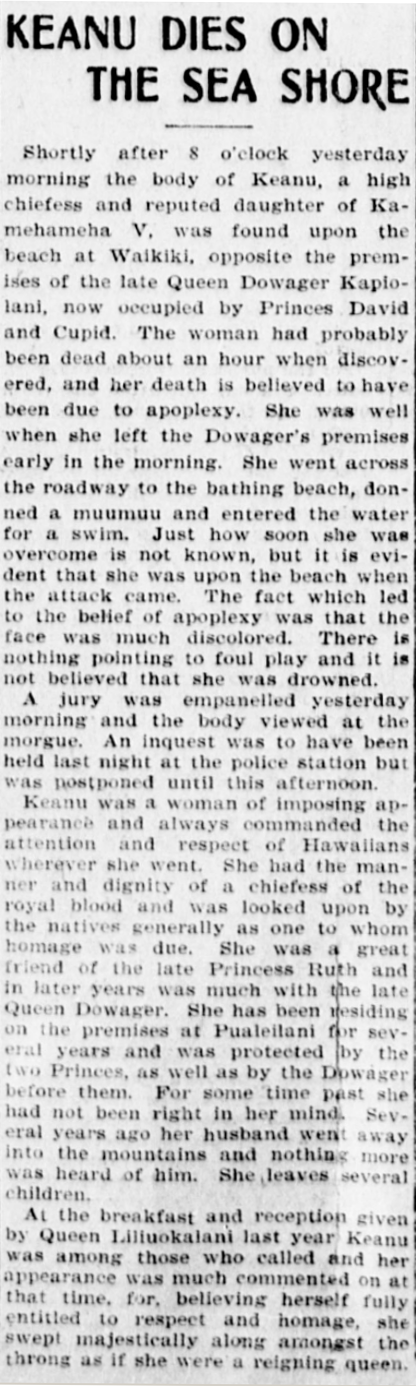
More on the death of Keanu, 1902.

KEANU DIES ON THE SEA SHORE

Shortly after 8 o’clock yesterday morning the body of Keanu, a high chiefess and reputed daughter of Kamehameha V, was found upon the beach at Waikiki, opposite the premises of the late Queen Dowager Kapiolani, now occupied by Princes David and Cupid. The woman had probably been dead about an hour when discovered, and her death is believed to have been due to apoplexy. She was well when she left the Dowager’s premises early in the morning. She wen across the roadway to the bathing beach, donned a muumuu and entered the water for a swim. Just how soon she was overcome is not known, but it is evident that she was upon the beach when the attack came. The fact which led to the belief of apoplexy was that the face was much discolored. There is nothing pointing to foul play and it is not believed that she was drowned.

A jury was empanelled yesterday morning and the body viewed at the morgue. An inquest was to have been held last night at the police station but was postponed until this afternoon.

Keanu was a woman of imposing appearance and always commanded the attention and respect of Hawaiians wherever she went. She had the manner and dignity of a chiefess of the royal blood and was looked upon by the natives generally as one to whom homage was due. She was a great friend of the late Princess Ruth and in later years was much with the late Queen Dowager. She has been residing on the premises at Pualeilani for several years and was protected by the two Princes, as well as by the Dowager before them. For some time past she had not been right in her mind. Several years ago her husband went away into the mountains and nothing more was heard of him. She leaves several children.

At the breakfast and reception given by Queen Liliuokalani last year Keanu was among those who called and her appearance was much commented on at that time, for, believing herself fully entitled to respect and homage, she swept majestically along amongst the throng as if she were a reigning queen.

(Hawaiian Gazette, 7/1/1902, p. 4)

KEANU DIES ON SEA SHORE

Hawaiian Gazette, Volume XXXVII, Number 50, Page 4. July 1, 1902.

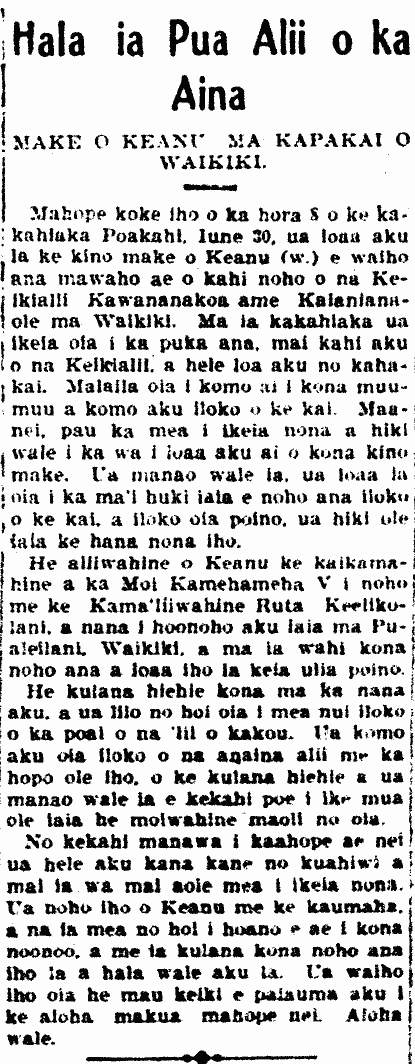
Keanu, daughter of Kamehameha V and Keelikolani, passes, 1902.

That Royal Descendant of the Land has Passed.

KEANU DIES ON THE SHORE OF WAIKIKI.

Right after 8 o’clock in the morning of Monday, June 30, the dead body of Keanu (f.) was found out near the residence of the Princes Kawananakoa and Kalanianaole at Waikiki. On that morning she was seen coming out of the Princes’ place, and went all the way to the ocean. There she put on her muumuu and went into the ocean. From here, that was all that was known of her until her body was found. It is believed that she had a stroke [ma’i huki] while in the water, and while being so afflicted, she could not help herself.

Keanu was a chiefess, the daughter of Kamehameha V and Princess Ruth Keelikolani [Ruta], and it was he who housed her at Pualeilani, Waikiki, and it was there that she lived until this unfortunate accident.

She had a regal stature, and she became an important presence in our chiefly circles. She fearlessly appeared at royal audiences with elegance, and some who had not seen her before thought she was an actual queen.

Some time ago, her husband went into the mountains, and since then nothing was known of him. Keanu lived in sadness, and it was this that made her lose her senses. She left behind children who grieve in their love for her. How pitiful.

[Anyone have more information on Keanu?]

(Kuokoa, 7/4/1902, p. 1)

Hala ia Pua Alii o ka Aina

Ka Nupepa Kuokoa, Buke XL, Helu 27, Aoao 1. Iulai 4, 1902.

Beginning of line-by-line commentary of “Aia i Honolulu kuu pohaku,” 1929.

EXPLANATION OF THE FIRST LINE.

1. Aia i Honolulu kuu pohaku

Kapanookalani’s thoughts:—This land Honolulu, it is close to Nanawale, Puna, by the sea. It is a ku, a small land in between large lands.

The stone [pohaku] is Lord [Haku] of the chiefess and in this word, the important idea is chiefess [‘lii wahine].

Kahapula’s thoughts:—Honolulu is on Oahu, where King Kamehameha V dwelt and those who opposed him is the Honolulu in this first line of the mele. It was here his enemies schemed and carried out all their defiant acts against him. While they knew the wish of the King to marry the chiefess Pauahi, her teacher, Amos Cooke secretly agreed to  Bishop for him to meet with Pauahi without the knowledge of her parents. That is how Pauahi became Bishop’s, and this is how Bishop and his relative Lee [? William Little Lee] became dignitaries of the land.

Kupihea’s thoughts:—Honolulu is a fish stone called a Kuula, and was brought here to this Honolulu [on Oahu] from the Honolulu of Puna [on Hawaii]. This Kuula was placed in the tiny land of Honolulu where an Alii called Honolulu lived, who was related to the chiefess Peleula, whose younger sister was the beautiful Waikiki. This place is mauka of the old Rawlin’s Estate. There is a bank of coral where Honolulu is; the fishing altar [Kuula] for the fish ponds [loko i’a] is on the Waikiki side of Liliha Street and between Vineyard and King Streets.

The stone is related to chiefs from times immemorial [mai ka po mai]. It is a manifestation made by God.

Iokepa’s thoughts:—Honolulu is a small land and a canoe landing makai of Nanawale, Puna, between two sand dunes, one on the Hilo side and one on the Puna side, called Puu Waawaa. From this Honolulu is called the Honolulu here [on Oahu] which used to be called Kou before, and after it was called Honolulu until this day.

This is the meaning for the word Honolulu:—The wind is very calm [lulu] an the sea is serene; it is very fine and peaceful. Bay [? Hono] of calm sea; Hono that is peaceful.

Kuluwaimaka’s thoughts:—The stone is related to Kamehameha V. Honolulu in Puna is a lowland next to the sea. Its width is perhaps half a mile long between Na Puu o Pele and Waiakahiula on the Hilo side. Honolulu is a place where you pick opihi [ku’i opihi] and pick limu [hana limu]. There is a fine spring [punawai] there and there is a foot path there.

[And to think that this is but the very beginning of Kelsey’s detailed account of the explanation of the six loea of the mele “Aia i Honolulu kuu pohaku.” This is just the first line! It continues in the following issues!!

One more (huge) reason that Hawaiian-Language Newspapers are priceless!!!]

(Alakai o Hawaii, 12/5/1929, p. 2)

NA MANAO WEHEWEHE MALUNA O KA LAINA EKAHI.

Ke Alakai o Hawaii, Buke 1, Helu 32, Aoao 2. Dekemapa 5, 1929.