More on mele, 1860.

Pertaining to Mele

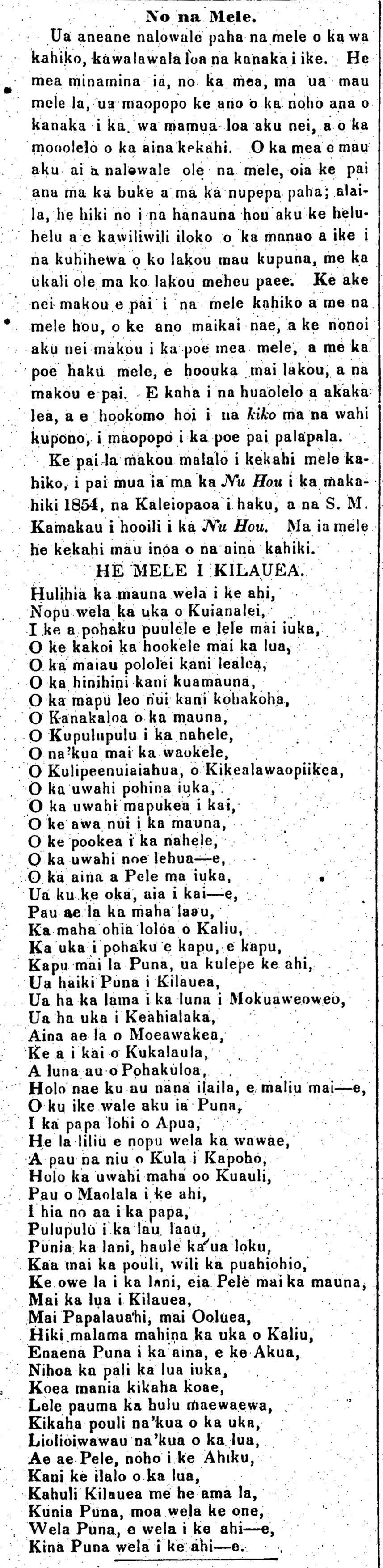
Perhaps the mele of old are almost all lost; those who know them are but few. This is something to be regretful of for in those mele, one can understand the way of life of the people of very long ago, and the stories of the land as well. The means for these mele to continue and not to be lost is by printing them in books and newspapers perhaps; in that way, the new generations can read them and contemplate over it and see the misconceptions of their kupuna and to not follow in their misguided ways. We wish to print the old mele and new mele, as long as they are good, and we ask of those who have mele and the composers of mele to send them to us and we will print them. Write the letters very clearly, and insert punctuation where they should be so that the printers understand.

We are printing below an old mele previously printed in Nu Hou in 1854, composed by Kaleiopaoa and submitted to the Nu Hou by S. M. Kamakau. In the mele there are foreign place names.

HE MELE I KILAUEA.

Hulihia ka mauna wela i ke ahi,
Nopu wela ka uka o Kuianalei,
I ke a pohaku puulele e lele mai iuka,
O ke kakoi ka hookele mai ka lua,
O ka maiau pololei kani lealea,
O ka hinihini kani kuamauna,
O ka mapu leo nui kani kohakoha,
O Kanakaloa o ka mauna,
O Kupulupulu i ka nahale,
O na’kua mai ka waokele,
O Kulipeenuiaiahua, o Kikealawaopiikea,
O ka uwahi pohina iuka,
O ka uwahi mapukea i kai,
O ke awa nui i ka mauna,
O ke pookea i ka nahele,
O ka uwahi noe lehua—e,
O ka aina a Pele ma iuka,
Ua ku ke oka, aia i kai—e,
Pau ae la ka maha laau,
Ka maha ohia loloa o Kaliu,
Ka uka i pohaku e kapu, e kapu,
Kapu mai la Puna, ua kulepe ke ahi,
Ua haiki Puna i Kilauea,
Ua ha ka lama i ka luna i Mokuaweoweo,
Ua ha uka i Keahialaka,
Aina ae la o Moeawakea,
Ke a i kai o Kukalaula,
A luna au o Pohakuloa,
Holo nae ku au nana ilaila, e maliu mai—e,
O ku ike wale aku ia Puna,
I ka papa lohi o Apua,
He la liliu e nopu wela ka wawae,
A pau na niu o Kula i Kapoho,
Holo ka uwahi maha oo Kuauli,
Pau o Maolala i ke ahi,
I hia no aa i ka papa,
Pulupulu i ka lau laau,
Punia ka lani, haule ka ua loku,
Kaa mai ka pouli, wili ka puahiohio,
Ke owe la i ka lani, eia Pele mai ka mauna,
Mai ka lua i Kilauea,
Mai Papalauahi, mai Ooluea,
Hiki malama mahina ka uka o Kaliu,
Enaena Puna i ka aina, e ke Akua,
Nihoa ka pali ka lua iuka,
Koea mania kikaha koae,
Lele pauma ka hulu maewaewa,
Kikaha pouli na’kua o ka uka,
Liolioiwawau na’kua o ka lua,
Ae ae Pele, noho i ke Ahiku,
Kani ke ilalo o ka lua,
Kahuli Kilauea me he ama la,
Kunia puna, moa wela ke one,
Wela Puna, e wela i ke ahi—e,
Kina Puna wela i ke ahi—e.

(Hae Hawaii, 3/21/1860, p. 204)
No na Mele.

Ka Hae Hawaii, Buke 4, Ano Hou.—Helu 51, Aoao 204. Maraki 21, 1860.
Lava to come? 1908.

A FRIGHTENING PREDICTION.

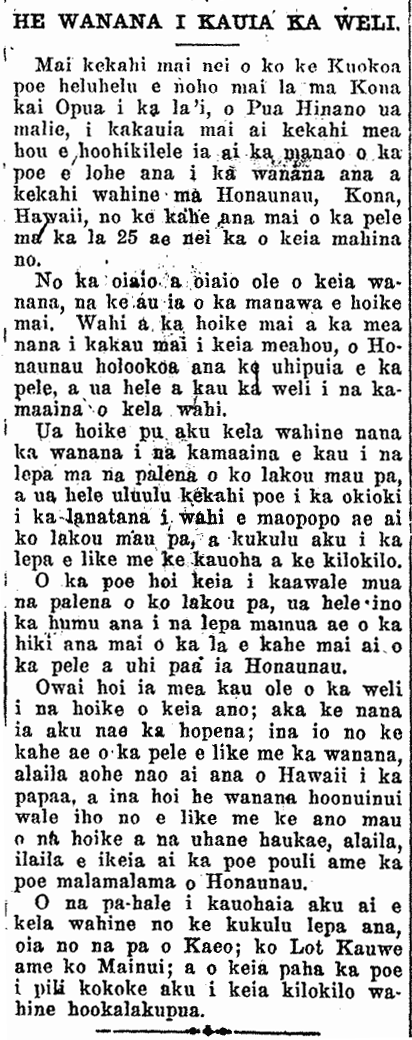
From a Kuokoa reader living in Kona of the Cloud banks in the calm, of the Hinano blossoms in the serenity, a bit of news was written in which frightened the minds of those who heard the prediction of a woman of Honaunau, Kona, Hawaii, about a lava flow on the 25th of this very month.

Whether this prediction is true or not, it is the passing of time that will tell. According to the statement by the person who wrote in the news, all of Honaunau will be covered by lava, and the kamaaina of the place are frightened.

The woman whose prediction it was also told the locals to place white flags [lepa] on the borders of their yard, and some of them excitedly trimmed back their lantana [lanatana] to clear their yard, and posted lepa as was ordered by the seer [kilokilo].

The people who first cleared the borders of their yard, they quickly sewed lepa before the day that the pele is supposed to come and cover over Honaunau.

Who is not scared by news of this kind; but let us watch what happens; if the pele does come like it was predicted, then Hawaii will be in dire straits, and if it should just be big talk as is much of the revelations of vile spirits, it is then that it will be seen who are the ignorant ones and who are the enlightened ones of Honaunau.

The residences told by the woman to post lepa were those of Kaeo, Lot Kauwe and Mainui; they are perhaps those who are close to this extraordinary woman prophet.

(Kuokoa, 10/23/1908, p. 4)

HE WANANA I KAUIA KA WELI.

Ka Nupepa Kuokoa, Buke XLIII, Helu 43, Aoao 4. Okatoba 23, 1908.

Storied places of Kiholo and Luahine Wai, 1923.

THE PLEASURES OF TIME

Luahine Wai

It is a big pool close to Kiholo and Laemano. It is a famed bathing spot for the alii of old. Its waters are numbing, and it is said that one cannot swim its circumference because it is cold like ice water.

It is said that within this pond is a hole where you enter into a hidden cave where the bones of the old chiefs are laid. It is said that Kamehameha’s bones are there as well. As for the truth of it all, it is not certain, until some living person enters this hidden cave; then there will be a witness to verify what is in this cave.

This pond is about 5 fathoms deep at its deepest, which is at its center, where it is very cold. And if you dive to the bottom, you will soon feel your body grow cold, and you won’t be able to stay there long. You will shoot up and swim for the edge.

A person that dives down to that deep area will turn red, like the red of coral [? puko’a] Continue reading

Paaiea Pond, part 4 and final, from the pen of J. W. H. Isaac Kihe, 1914.

SOME STORIED LANDS OF KONA

Written for the Hoku o Hawaii by ka Ohu Haaheo i na Kuahiwi Ekolu¹

PAAIEA POND

Meeting with Kolomu’o and Pahinahina.

When the flames subsided, the fire disappeared, and this is why it was assumed it was the fire of the Uau Bird Catchers in the Mountains.

In the middle of that night, the lava emerged and flowed like water below a crater on the side of a peak called Kileo, and it is black, shiny pahoehoe that remains there to this day. And from there the lava dove down and resurfaced makai side and several deep fissures cracked open and remain near the village that Mr. Maguire lives at.

The lava dropped down again and on the makai side of the old road there opened up a small furrow six (6) feet wide, and from here the lava began to flow and overran everything before it.

Villages were destroyed and some people died as victims to the wrath of the Goddess of the crater, because of the denial of Pele by that Konohiki [Kepaalani] which the Alii [Kamehameha I] stationed to oversee all of his wealth. And when the Konohiki saw the lava burning everything and turning into pahoehoe and gorging away, he finally realized that the old lady was Pele that appeared before him asking for fish, palu, and then shrimp, and he regretted this filled with dread and great fear. Continue reading

Paaiea Pond, part 3, from the pen of J. W. H. Isaac Kihe, 1914.

SOME STORIED LANDS OF KONA

Written for the Hoku o Hawaii by ka Ohu Haaheo i na Kuahiwi Ekolu¹

PAAIEA POND

Meeting with Kolomu’o and Pahinahina.

When the woman left that place at the seaside of Kaelehuluhulu, she arrived in the uplands of Keoneeli, a place that is renown to this day called Kepuhiapele [‘the scorching of Pele’], a heap of aa lava that is almost 200 Feet high, downside of the place where J. A. MaGuire [known also as Keoni Kaimana] is living.

When the woman arrived there, there were two girls named Kolomu’o and Pahinahina broiling breadfruit, while the parents were away farming. This was a huge town during those days, with many people living there. When the woman met up with the girls broiling ulu. The woman said, “The ulu that you are cooking is done.” One of the girls responded, “We are cooking ulu, but it is not totally done.”

The woman went on, “When you ulu is cooked, who will partake of it first?” “La’i, my god, will eat first.” “So La’i is a powerful akua?” “Yes, La’i is powerful.” The name of this girl was Kolomu’o, and the area beneath that scorching of Pele is famous to this day and called Kolomu’o, and famous too is the Opelu fishing shrine [Ko’a] at the beach of Kaupulehu.

Then the woman asked the other girl, Pahinahina, “And when your ulu is done, who is it for?” “It is for Pele Honuamea, my god.” “Then it is our ulu; your ulu is cooked, let the two of us partake in it.” Pahinahina agreed, and the ulu was peeled [makikoe²] and eaten up. Continue reading

Paaiea Pond, part 2, from the pen of J. W. H. Isaac Kihe, 1914.

SOME STORIED LANDS OF KONA

Written for the Hoku o Hawaii by ka Ohu Haaheo i na Kuahiwi Ekolu¹

PAAIEA POND

The old woman replied. “I have come to the alii. I live in the uplands, and grew hungry for fish, so I got up and made the descent thinking that the Konohiki of the alii would be the friend here at the ocean side from whom I could receive something fishy to return upland with.

The Konohiki immediately answered. “Your trip will not be rewarded for the all the fish belongs to the alii.” “If I can’t have fish, then what about some palu?”² “There is no palu for you, it is for the alii. This is a work day for the alii; the people care for him, and I am placed here to oversee the wealth of the alii and the wealth of all of his dependents.”

“Both the Aku and the palu are kapu to the alii, as well as the amaama from the pond,” Kepaalani said, “they are restricted for the alii.” “If those are kapu, what about some small Aholehole or a little shrimp?” “Kahaha! Perhaps you can’t hear; all of those things are for the alii.” Continue reading

Paaiea Pond, from the pen of J. W. H. Isaac Kihe, 1914.

SOME STORIED LANDS OF KONA

Written for the Hoku o Hawaii by ka Ohu Haaheo i na Kuahiwi Ekolu¹

PAAIEA POND

Paaiea was a great pond almost like the ponds of Wainanalii and Kiholo. In the olden days, when the great ruling chiefs were living, and when these fish ponds were full of the riches of Awa, Anae, and Ahole, along with all sorts of fish which swam within.

During that time, Konohiki were stationed, and he was the guard of the pond that watched over the pond and all things, as here we are talking about Paaiea Pond which was destroyed by lava and became pahoehoe lava which remains today, which is what the writer is introducing to the readers of the Hoku o Hawaii.

In the correct and trues story of this pond, its boundaries began from Kaelehuluhulu on the north and on the south was at the place called Wawaloli, and the distance from one end to the other was 3 miles or more, and that was the length of this pond; and today within these boundaries, there are a number of pools [lua wai loko] remaining during this time that the writer is speaking before the readers of the Hoku.

The great Overseer [Konohiki] who cared for this pond was Kepaalani, and everything fell under him: the storehouses [hale papaa] where poi and fish were stored, the halau for the fishing canoes, the nets and all thing, and from him the fishermen and the retainers of the court would obtain their sustenance.

And at this time when the pond was destroyed by lava, Kamehameha was residing in Hilo for the purpose of waging war, and this war was called Kaipalaoa; during this war, Namakehaikalani died and was offered atop the Heiau of Piihonua in Hilo; and this was Kamehameha’s final war, and his enemies lived quietly without uprising once again. This was the time between 1798 until 1801, and it is said that this is when lava destroyed this pond that was full of riches, and turned it into a land of pahoehoe lava which remains to this day. Continue reading

Two paintings by Joseph Nawahi, 1877.

[Found under: “NA ANOAI.”]

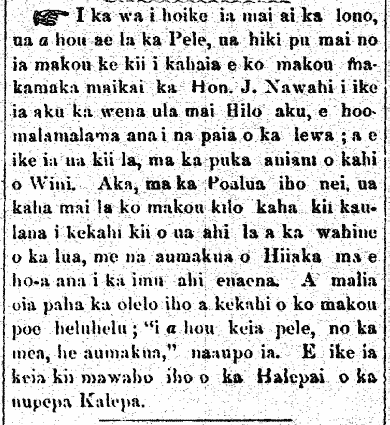
When it was made known that Lava was erupting once again, along with it came the painting done by our good friend, the Hon. J. Nawahi; seen is the fiery red from Hilo, lighting up the walls of the heavens; and that painting can be seen in Whitney’s [bookstore] window. But this past Thursday, our famous seer artist did a painting of the fires of that woman of the pit, with the many Hiiaka aumakua igniting that fiery hot imu. Perhaps this is what some of our readers are saying; “the lava has reignited because of the aumakua;” that is ignorant. See this painting right outside of the printing office of the Pacific Commercial Advertiser [Kalepa].

[After that Antique Roadshow episode in 2007, nearly everyone knows about that painting of Hilo done by Joseph Nawahi now hanging up at Kamehameha Schools. I believe that these two however are not known today. Anyone have any ideas?]

(Lahui Hawaii, 2/22/1877, p. 3)

I ka wa i hoike ia mai ai...

Ka Lahui Hawaii, Buke III, Helu 8, Aoao 3. Feberuari 22, 1877.

Alika, South Kona, 1886.

The story of how Alika was named.

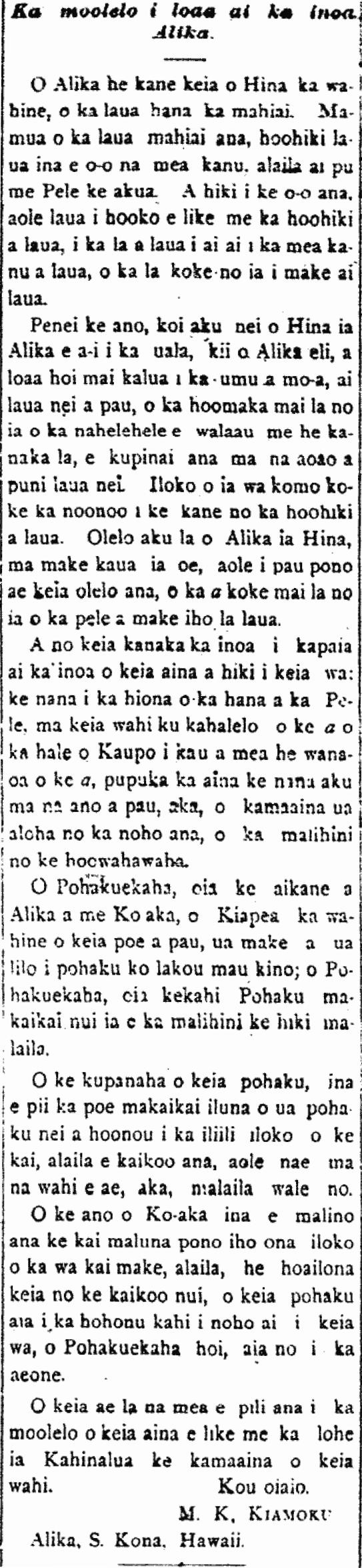
Alika was a man and Hina was his wahine, and their occupation was farming. Before they would begin farming, they would vow that should their crops mature, they would consume it along with Pele, the god. But when the crops reached maturity, the two of them didn’t carry out their promise, and the day that they ate of their crops, that was when they soon died.

This is how it happened: Hina urged Alika to eat sweet potato, and so Alika went to dig up some, and after finding some, he baked it in the umu¹ until done and then they ate it all; then the forest began to speak as if it were a man, echoing all about them. During which time, the man soon thought of their vow. Alika said to Hina, “We will die because of you,” and before he was done speaking, lava soon flamed forth and they perished.

And it is for this man that this land is called by that name until this day; if you look at the aftermath of the lava, in this area, the burnt homes of Kaupo stand jagged because of the spreading flames²; the land is horrid in appearance in every way; but the kamaaina love it here, and it is only the malihini who disparage it.

Pohakuekaha was the aikane of Alika and Ko-aka; Kiapea was the woman of all of them; they died and their bodies transformed into rocks; Pohakuekaha is a stone that is visited often by malihini who are in the area.

The amazing thing about this rock is that if the visitor climbs atop of the rock and throws pebbles into the sea, the sea will turn rough, but not in any other area, just right there.

As for Ko-aka, if the sea is calm right above it, during low tide, this is a sign that will be rough seas; this rock is now located in down in the deep, while Pohakuekaha is on the sand.

These things above deal with the story of this land as was heard by Kahinalua, the kamaaina of this place.

Yours truly,

M. K. KIAMOKU

Alika, S. Kona, Hawaii.

¹Umu is another word for imu, the underground oven (as in the name, Kaumualii).

²I am not sure if this is a reference to the actual place called Kaupo in South Kona, or to the famous saying “Kū ke ʻā i ka hale o Kaupō” from the story of Pāmano…

(Kuokoa, 8/7/1886, p. 3)

Ka moolelo i loaa ai ka inoa Alika.

Ka Nupepa Kuokoa, Buke XXV, Helu 32, Aoao 3. Augate 7, 1886.

Play of Pele and Lohiau at Hawaii Theater, 1925.

Tableau of the Hawaiian Dramatic Club

The Tableau of Pele and Lohiau shown in the Hawaii Theater [Halekeaka Hawaii] last Friday by the Hawaiian Dramatic Club. The play will be shown at Los Angeles, on the journey of the Royal Order of Kamehameha [Ahahui Kamehameha] for the city day coming up in June.

(Kuokoa, 4/23/1925, p. 5)

Tabalo a ka Haw'n Dramatic Club

Ka Nupepa Kuokoa, Buke LXIV, Helu 17, Aoao 5. Aperila 23, 1925.