Recollections of Kauai boy, William E. Rowell, 1916.

INTERVIEW WITH W. E. ROWELL
Dec. 6, 1915

The following interview with the late W. E. Rowell, who died recently in Honolulu, was read at the meeting of the Kauai Historical Society last week by J. M. Lydgate:

I was born at Hanalei in 1845. My father followed Alexander there for a couple of years. When I was about one year old were moved to Waimea. We came by canoe I believe, bag and baggage. No I don’t remember anything about it. Mr. Gulick I understand had built the house at Waimea. Mr. Whitney had died I think just before our arrival or soon after so that the whole work and responsibility of the station fell on my father. The Whitney house stood just about where the Hofgaard house is now, while ours stood near by. No, no, the Whitney house wasn’t built of adobie, but of stone coral sand stone. I remember very distinctly how it cracked because of imperfect foundation and the walls bulged out and had to be shoved up with heavy timber props. The house was demolished finally for the stone which was taken to build the Kekaha chimney. I think they paid $100 for it. Mother Whitney lived there for a good many years. In the division of the mission sands there was some difficulty about coming to an amicable decision, for, you know, these old missionaries were quite human in spite of the fact that they were missionaries. Mrs. Whitney wanted about everything that was any good.

We got a piece of pasture land on the east of the river called Mahai-hai: it was there we kept our stock, and in dry times they fairly grubbed up the roots of the manienie.

We had an old man who took the stock back and forth: he took them to the river and they swam across and when he wanted them he called them and they came across the river.

When Mrs. Whitney died she left her land to the native church. The minister was to live at the Whitney place, but that was inconvenient so an exchange was made for a kuleana in the valley, and I bought the balance of the land for $1800. That is the basis of the church fund to this day.

There was a grass church in those days down on the beach west of the river, where afterwards the school house stood and about where the Chinese church is now. There were two services on Sunday and a prayer meeting on Wednesday afternoon. No, the crowds were not very large and the church was not as big as the stone church built later. The church was built of pili grass, closed in, as I remember it, on the mauka and windward side, but open makai on the lee side. There were no windows, at least no glazed windows. The people sat on mats on the floor. The matter of windows, reminds me that I made quite a little money in my boyhood days, making window and door cases for Hawaiian grass houses. Yes, all the houses at that time were of grass. Continue reading

Kamehameha Day preparations, 1916.

Please Give Your Help for Our Holiday

THE EVENTS FOR KAMEHAMEHA DAY ON THE COMING JUNE 11

At the discussion meeting held at the office of Edgar Henriques in the McCandless Brothers Building, chaired by Mayor John C. Lane of the executive committee and the secretary of that committee William E. Miles. The members who gathered for that meeting other than those named above were: Edgar Henriques, Jesse Uluihi, Mrs. H. H. Webb [Lahilahi Webb], Mrs. S. C. Dwight, Mrs. Abraham Fernandez, Louis Makanani and James K. Nakila.

The schedule prepared for the coming birthday of Kamehameha, that is Monday, the 12th of June, being that the 11th is a Sunday, is like this: Parade in the morning from Aala Park of the various Societies and the public. 8:30 a. m., under the direction of the Marshal of the day, Robert Waipa Parker, when reaching the government building where the statue of Kamehameha stands, the procession will surround the statue with each tossing flowers by the statue, and everyone in the parade should please have a bouquet of flowers in their hands.

Those that stand near the Kamehameha statue will be the Hale o na Alii Association with the war god of Kamehameha, Kukailimoku; from there the procession will go on to the palace grounds [palii] for short speeches given that morning, but the speakers have not been chosen as of yet. It was left for the chairman of the executive committee to decide, that being Mayor John C. Lane, and the names of the speakers will be announced at the appropriate time. Continue reading

E o e Kuini Kapiolani! 1898.

HANOHANO NUUANU.

Hanohano Nuuanu aia iuka,
Kahiko i ka Ua Popokapa,
Ke nihi ae la Waolani,
A loaa maua i Kanenelu,
Wai auau a kuu aloha,
Me Eha hua hiu a wela,
Ua ahi ua wela Wananakoa,
I ka hooni a nei kupueu,
A he eueu au no Kahikina,
No na pali hulaana o Maui,
O ke ewe ia a o’u mau kupuna,
I lohe mai oe Koleakani,
Aulii ma hana a Piilani,
A he lani a he kupa no ka aina,
Haina ia mai ana ka puana,
Na Eha Hua hiu a Wela.

EHAHUA.

(Loea Kalaiaina, 7/30/1898, p. 4)

LoeaKalaiaina_7_30_1898_4.png

Ka Loea Kalaiaina, Buke II, Helu 30, Aoao 4. Iulai 30, 1898.

Protesting of Advertiser’s coverage of Hui Aloha Aina meeting, 1893.

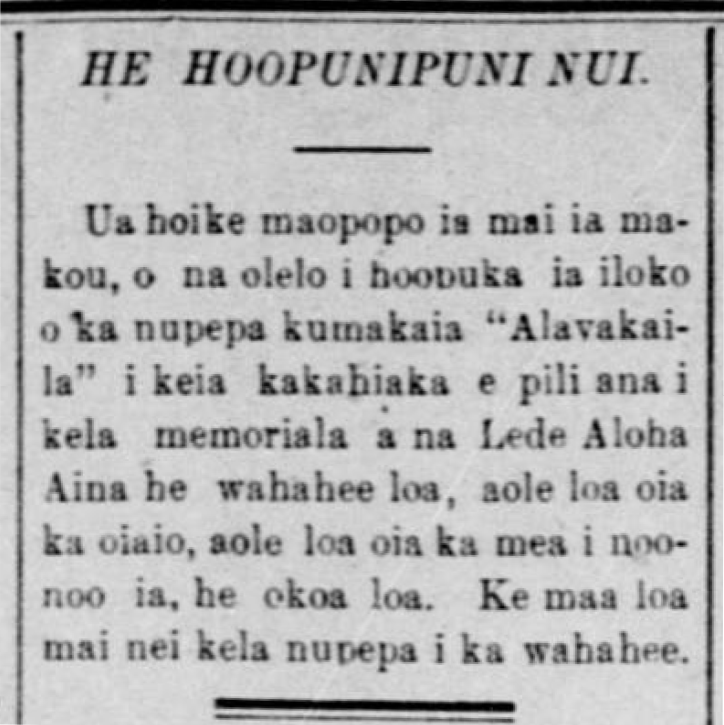
A GREAT FALSEHOOD. We were clearly shown that the words printed by the traitor newspaper “Advertiser” this morning pertaining to the memorial of the Patriotic League Ladies was a big lie, and that it was not the truth, and that is not what is thought, it is very different. That newspaper is becoming very prone to telling falsehoods.

(Hawaii Holomua, 4/13/1893, p. 2)

Hawaii Holomua, Buke III, Helu 200, Aoao 2. Aperila 13, 1893.

An adornment for Prince Kuhio by Mrs. Annie Freitas, 1922.

HE WEHI ALOHA NO KALANIANAOLE.

He inoa nou e Kalanianaole,
Ka onohi momi a o Hawaii nei.

He mea nui oe na ka lahui,
Milimili na ka Ua Kukalahale.

Ua ku’i e ka lono puni na moku,
O Kalanianaole ua hele loa.

Aia paha oe i Amerika,
I ka uluwehi a o Wakinekona.

Ua kohoia oe e ka lahui,
I wahaolelo no Hawaii.

Kakooia e ka ili keokeo,
Repubalika kou baloka. Continue reading

Bill to make the birthday of Kalanianaole a holiday, 1923.

THE BILL FOR THE BIRTHDAY OF KALANIANAOLE PASSES.

Unexpected opposition raised against the B. H. 21 which was introduced by Representative John W. Kalua to make the birthday of Prince Kuhio Kalanianaole into a government holiday [kulaia aupuni] was seen last Monday when the bill was taken up for the third reading in the house of representatives [hale o na lunamakaainana]. Notwithstanding the great opposition, the bill passed the third reading, 20 to 10 opposing. This was the first time that great number of people opposing a bill was seen. Continue reading

Birthday of Prince Kuhio commemorated, 1922.

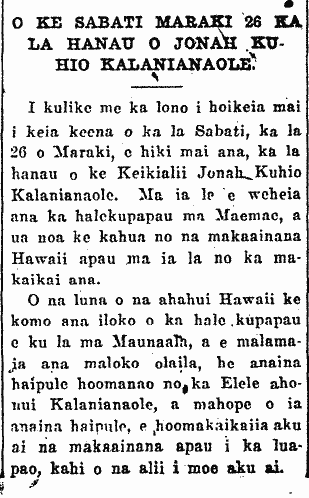
SUNDAY, MARCH 26, IS THE BIRTHDAY OF JONAH KUHIO KALANIANAOLE.

According to what is heard by this office, this coming Sunday, the 26th of March, is the birthday of Prince Jonah Kuhio Kalanianaole. And on that day the tomb at Maemae will be opened and the grounds will be free that day to all the makaainana of Hawaii to visit.

The officers of the Hawaiian 0rganizations will enter into the tomb standing at Maunaala, and and a religious service will be held within it for the persevering Representative Kalanianaole, and after that service, all of the makaainana will taken on tour of the mausoleum in which the chiefs rest.

(Kuokoa, 3/17/1922, p. 1)

Kuokoa_3_17_1922_1

Ka Nupepa Kuokoa, Buke LXI, Helu 11, Aoao 1. Maraki 17, 1922.

Praise for Prince Kuhio and Hawaiian Homesteads by Phillip Luahiwa, 1926.

HE INOA NO KALANIANAOLE

1 He inoa nou e Kalanianaole
He hiwahiwa oe o ka lahui.

2 Eia makou ou mau kini
I ka aina hoopulapula.

3 Ua imi oe i ka pono me [ke] ahonui
I pono au mau kini.

4 E ola mau na kini opio ou e Kalani
Mai na lani kiekie loa mai. Continue reading

Kalaniopuu’s fame as told by S. M. Kamakau, 1867.

[Found under: “KA MOOLELO O KAMEHAMEHA I.”]

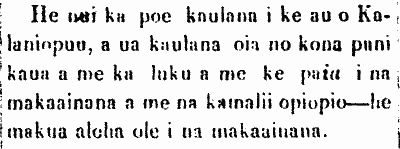
He nui ka poe kaulana i ke au o Kalaniopuu, a ua kaulana oia no kona puni kaua a me ka luku a me ka paia i na makaainana a me na kamalii opiopio—he makua aloha ole i na makaainana.

There were many famous ones during the era of Kalaniopuu, and he himself was well known, as someone who loved war, and massacring, and the striking of the makaainana and small children—he was a father who had no aloha for the makaainana.

[Although Kamakau describes many a chief as “war loving,” he describes Kalaniopuu as particularly cruel. This passage can be found in “Ruling Chiefs of Hawaii,” page 115.]

(Kuokoa, 2/23/1867, p. 1)

Kuokoa_2_23_1867_1.png

Ka Nupepa Kuokoa, Buke VI, Helu 8, Aoao 1. Feberuari 23, 1867.

Some of the battles of Kalaniopuu, 1866.

[Found under: “Ka Moolelo o Kamehameha I.”]

The battles between Kalaniopuu, the King of Hawaii, with Kahekili, the King of Maui.

The years 1775, 1776, 1777, 1778, and 1778. Kalaniopuu went to war at Kaupo on Maui, with his Alii, his war Officers, and his soldiers. Kalaniopuu first went to war at Kaupo, and he tortured the makaainana of Kaupo by clubbing their foreheads with his war club [newa]. This battle was called Kalaehohoa [“Clubbing-of-the-Forehead”] Continue reading