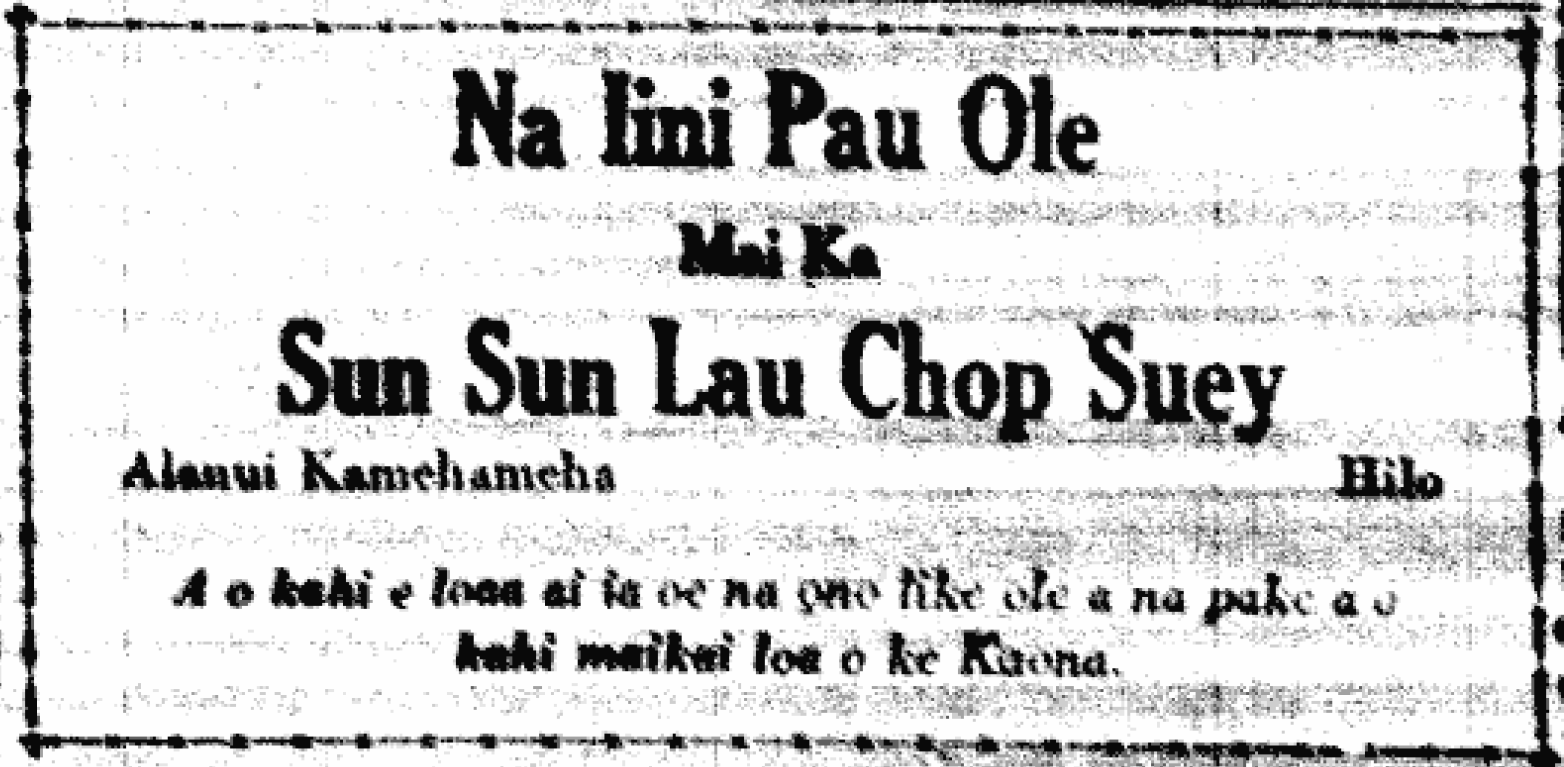
All Your Desires
From
Sun Sun Lau Chop Suey
Kamehameha Avenue Hilo
And the place to get all the delicacies of the Chinese and
the best place in Town.
(Hoku o Hawaii, 4/30/1941, p. 1)
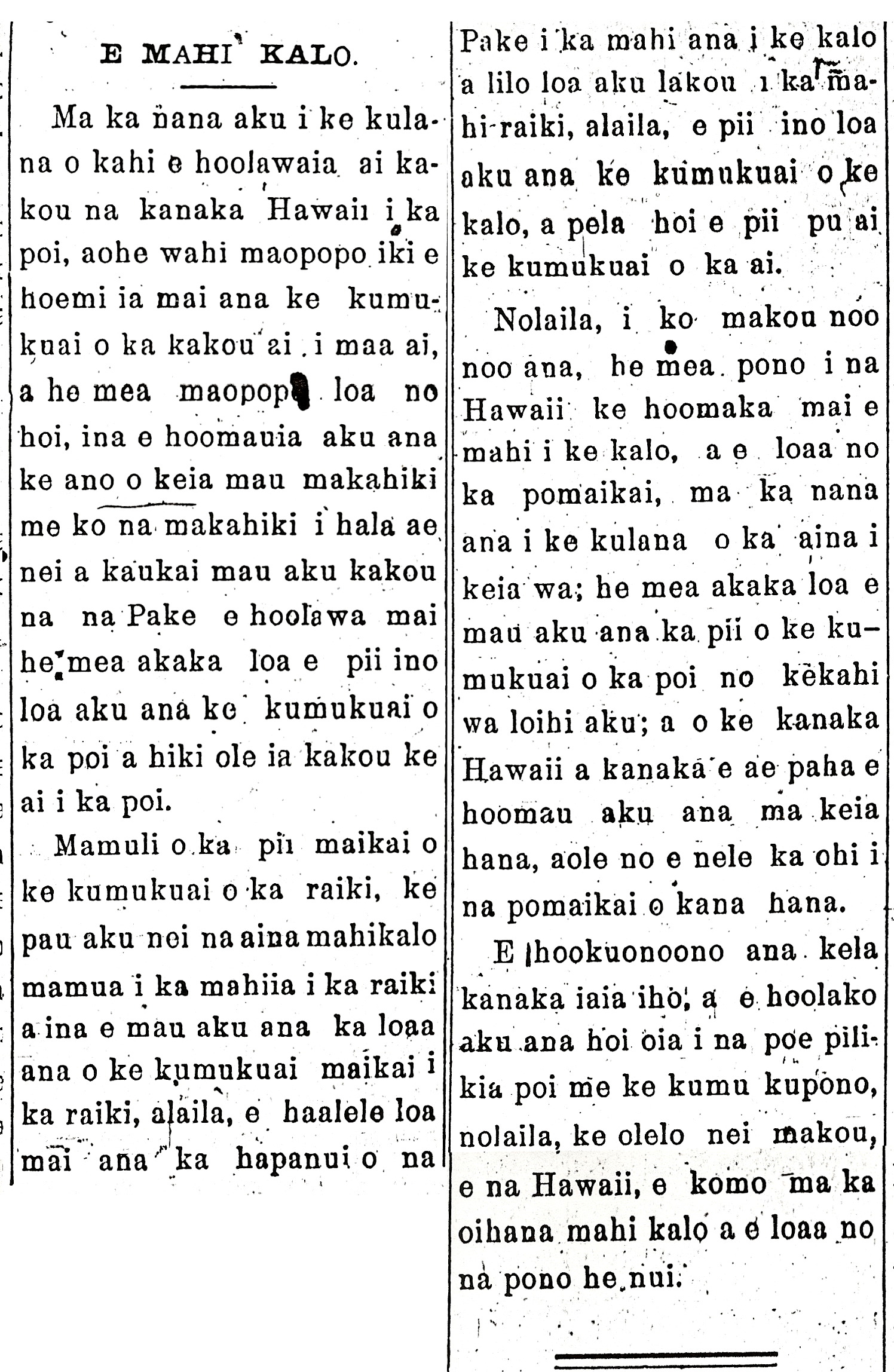
When considering how we Hawaiians are being supplied with poi, there is not the slightest indication that the cost of our staple food will decrease, and it is also very clear that if what has happened in the past years continues on into the upcoming years, and we continue relying on the Chinese for our supply, it is obvious that the price of poi will shoot up, and we will not be able to eat poi.
As a result of the increase in the price of rice, the former taro lands are being planted with rice, and should the rice market continue to be favorable, then a majority of the Chinese will abandon taro and become rice farmers, then, the cost of kalo will skyrocket, and as a result, so too will the price of poi.
Therefore, in our opinion, Hawaiians should start farming kalo, and obtain its benefits; looking at the land situation these days, it is very clear that the price of poi will continue to rise for long into the future; and the Hawaiians or others perhaps who continue this occupation will not fail to reap its benefits.
That man will make himself prosper and he will supply those who are lacking poi at a fair price, and so we say, O Hawaiian people, go into the occupation of kalo farming, and there shall be many blessings.
[While rice is no longer being planted here, perhaps in its place are being planted buildings. What is there to be done today?]
(Lahui Hawaii, 6/22/1901, p. 4)
MORENO ON THE MISSIONARIES.
Editor Post: For several years your public-spirited paper has published correspondence and statements submitted by me about Hawaii in which was foreshadowed the present state of affairs. The revolution which has just taken place is the inevitable result of missionary rule; the long-standing and deep-rooted cause of the unrest.
The missionaries in Hawaii, as in China, Japan, and elsewhere, consider that country as their open hunting grounds, regardless of the rights, customs, wishes, and priviliges of the natives and of stipulations.
I positively know that the self-appointed four chiefs of the Provisional Government in the Hawaiian Islands and the five commissioners coming to Washington to negotiate a treaty of annexation are, without a single exception, missionariesʻ confederates. Not a single native Hawaiian is with them, therefore, they cannot be considered as the representatives of the Hawaiian nation, of which they are aliens and enemies, but only as the emissaries of one side (or of a higher), which is not the right side.
The truth about Hawaiian affairs has never reached the State Department and that is the reason why, in the department, the knife has always been taken by the blade instead of by the handle in dealing with the Hawaiian question.
The United States always sent third rate politicians as ministers and consult to Honolulu, hence the erroneous information about Hawaii. I have on the spot studied Hawaii and the Hawaiians, their troubles with the missionaries of all creeds, and when distant from the islands I have kept an uninterrupted correspondence with the leaders of the Hawaiian nation, such as the Hons. Wilcox, Bush, Testa, Kaai, Kapena, Kaunamano, Kimo Pelekane [James I. Dowsett], and others.
My views on the Hawaiian question I explained at length to President Hayes and Secretary of State Evarts, to President Cleveland and to Assistant Secretary of State Porter: later, to Senator Morgan and to Congressman McCreary, and these are the statesmen that ought to dispose of the Hawaiian question and render justice to the weak, ill-treated, honest, and generous Hawaiian people that have been continually misrepresented, misjudged, and grossly wronged.
In accordance with the good order of things the coming self-appointed and self-styled Hawaiian commissioners, with more appearance than substance, should not be received by the United States authorities, because their self-attributed mission to Washington is based only upon selfish and malignant motives.
This will be a good opportunity for the great people of the United States to show their sentiment for fair play and generosity toward the unfortunate, harmless, friendly, and oppressed Hawaiian people, worthy of sympathy and of help in this their hour of national distress.
Celco Cæsar Moreno.
(Liberal, 2/25/1893, p. 2)

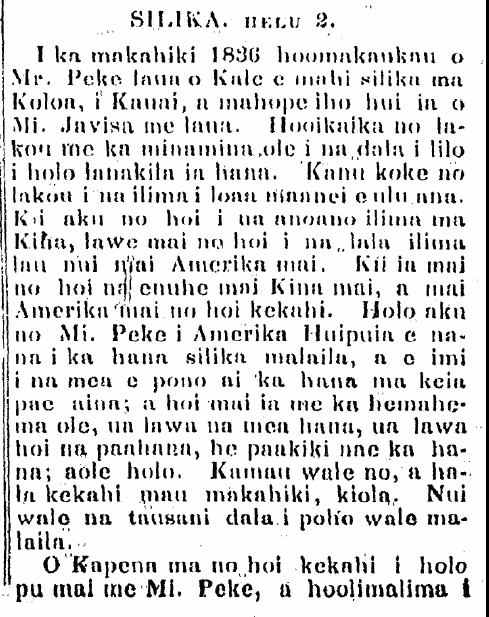
In the year 1836, Mr. Peke and Kale made ready to farm silk [silika] in Koloa, Kauai, and afterwards the two were joined by Mr. Jarvis [Mi. Javisa]. They put much effort into this without caring about money spent to make it a success. They immediately planted ilima found growing here. They went to get ilima [? mulberry] seeds from China and brought back branches of the ilima lau nui from America. Mr. Peke went to the United States of America to see silk production there, and to find what it took to raise them in this archipelago; he returned without anything lacking, with the necessary gear, and sufficient workers, but the work was difficult and did not move forward. They kept at it, and some years went by, and they gave up. Many thousands of dollars was wasted on it.
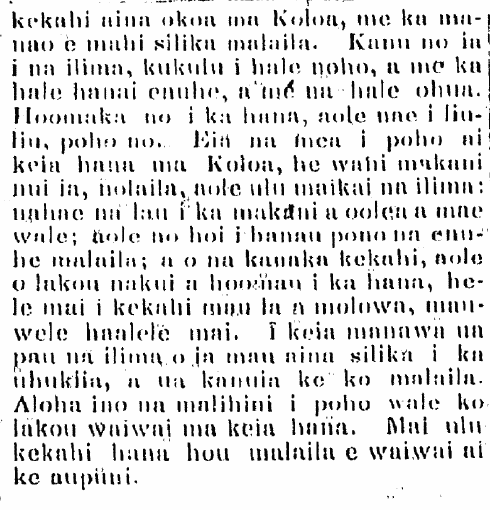
Kapena and others also came with Mr. Peke, and leased other lands in Koloa, with thoughts of raising silk there. He planted ilima, built a residence, a building to raise the worms, and a house for the workers. They began the work, but in not much time, it was a bust. Here are the reasons that it was a waste of time in Koloa: there is a strong wind so the ilima does not grow well as the leaves are torn in the strong wind and wilt, the worms don’t grow well there; and the people also, they are not eager and do not keep at the work; they come some days and slack off, are lazy and leave. Today, the ilima of those silk lands are all pulled out and sugar is planted there. So sad for those foreigners who wasted their money in this endeavor. A new enterprise almost started there to make the nation rich.
(Nonanona, 1/3/1843, p. 78)
(Nonanona, 1/3/1843, p. 79)
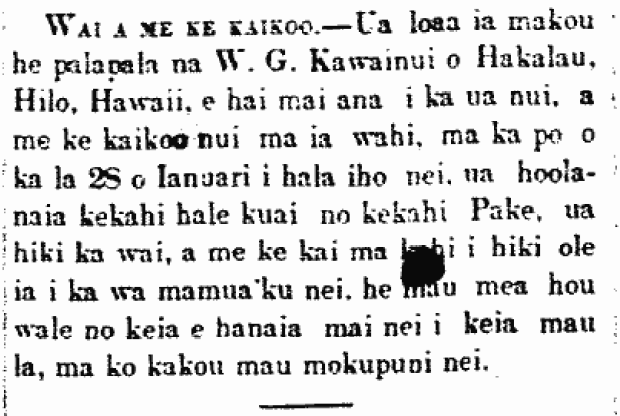
Water and the rough seas.—We received a letter from W. G. Kawainui of Hakalau, Hilo, Hawaii, telling us of the big rain and the rough seas in that area on the night of the 28th of this past January; a store of a Chinese floated away, and the water and tide reached areas not reached before; the things happening these days are truly something new for our islands.
(Kuokoa, 2/15/1862, p. 2)
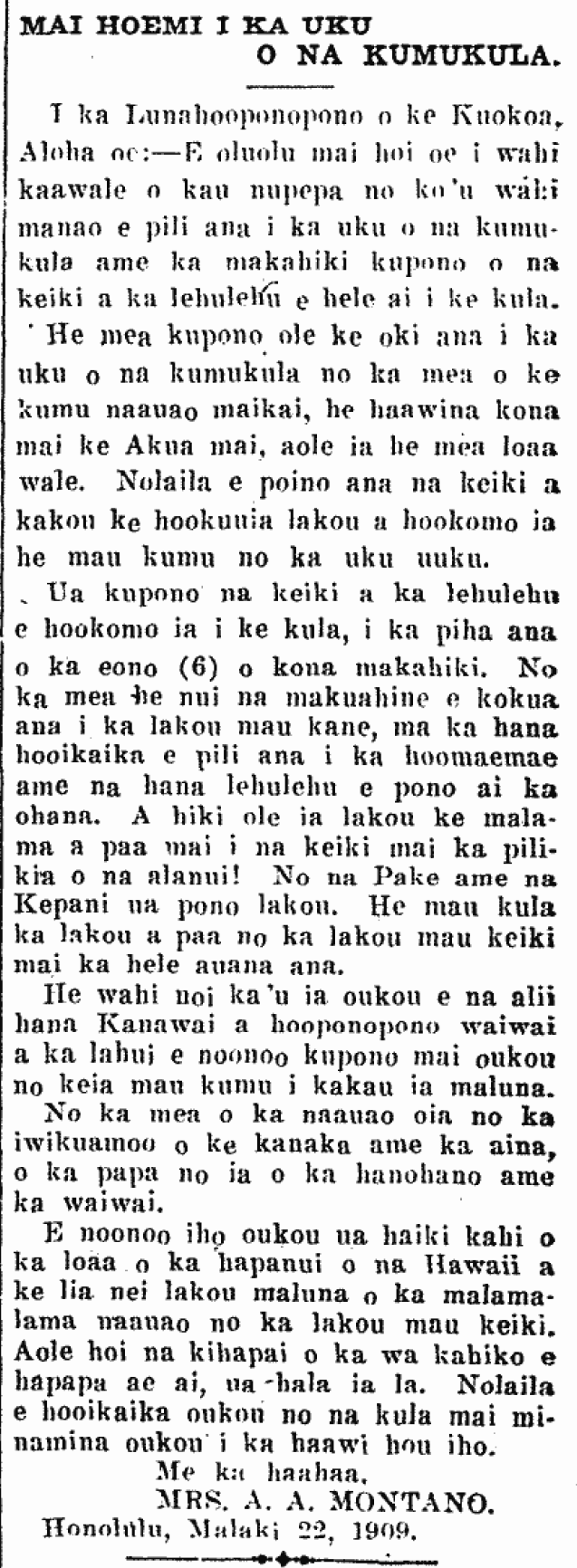
To the Editor of the Kuokoa, Aloha oe:—Please allow me some space in your newspaper for my humble thoughts dealing with the salary of teachers and the age at which children of the public should attend school.
It is wrong to cut the teachers’ pay because a well-educated teacher has a gift from God; it is not something readily gotten. And our children will be hurt should we let those teachers go and employ teachers for little pay.
The children of the people should be enrolled in school when they turn six (6) years of age. For there are many women who assist their husbands by endeavoring to take care of the many duties for the good of the family. And they are not able to care for and keep their children from the harm of the streets! As for the Chinese and the Japanese, they are fine. They have schools and their children are kept from wandering about.
I beseech all of you leaders who make Laws and who regulate public funds, do think carefully about these thoughts written above.
For knowledge is the backbone of man and his nation; it is the basis for fame and wealth.
Consider that the income of the majority of the Hawaiians is limited, and they are counting on the light of education for their children. The plantations of the old days are not to be reached out for, for those days are past. So all of you, please put effort into the schools, and don’t feel hesitant in investing more.
Sincerely,
MRS. A. A. MONTANO.
Honolulu, Malaki 22, 1909.
[Times have changed. Hopefully we learn from the past…
This letter is written by famed composer, Mary Jane Kekulani Montano.]
(Kuokoa, 3/26/1909, p. 4)
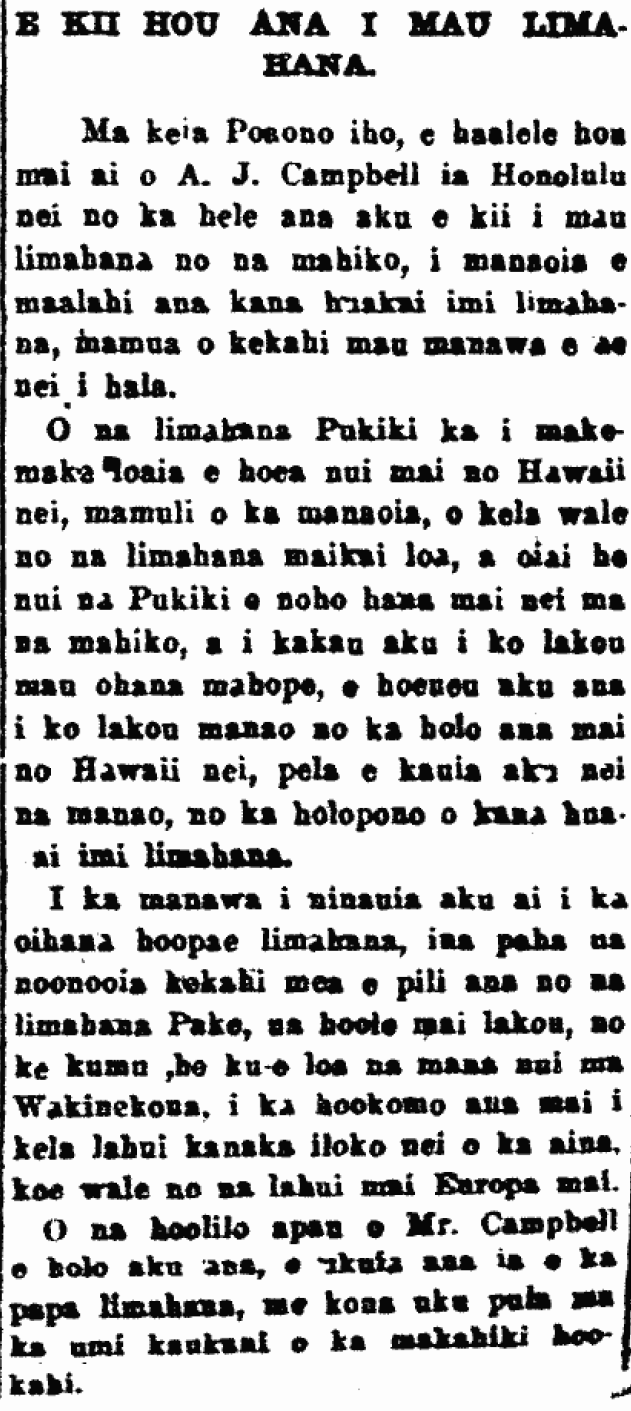
On this Saturday, A. J. Campbell will leave Honolulu once again to go to get more laborers for the sugarcane plantations; it is believed that this mission to obtain laborers will be easier than the earlier ones.
Portuguese laborers are wanted most to come to Hawaii nei because of the belief that they are the best laborers, and being that there are many Portuguese now working in the sugar plantations, and that they wrote letters to their families behind, it has made them excited to come to Hawaii nei, and thus it is believed that his journey to fetch laborers will go smoothly.
When the board of immigration [oihana hoopae limahana] was asked if they were thinking about Chinese laborers, they denied this because the authorities in Washington are strongly against the importation of those people into the land; they are only in favor of European stock.
The entire expenses of Mr. Campbell’s travels will be paid by the board of labor [papa limahana], along with his salary of ten-thousand dollars a year.
[Here is a related publication available online:
“FIRST REPORT OF THE BOARD OF IMMIGRATION TO THE GOVERNOR OF THE TERRITORY OF HAWAII.” Honolulu : Bulletin Pub. Co., Ltd., 1907-1911.]
(Kuokoa, 7/14/1911, p. 7)
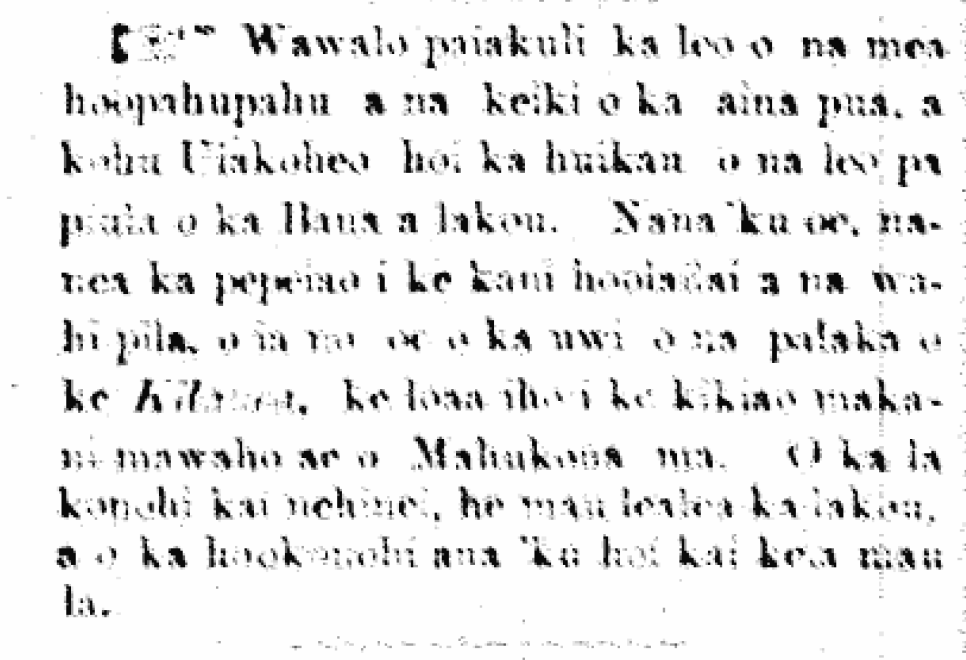
The sound of the firecrackers of the Chinese was deafening. and Ulakoheo was festive with the din of the sound of the corrugated iron [? pa piula] of their Band. When you look, their ears are enjoying the joyous strains of the instruments that sound like the squeal of the block of the ship Kilauea, when it encounters sudden gusts of winds outside of Mahukona and those places. The Chinese New Year [konohi] yesterday was a day of much fun for them, and they are wishing a happy new year these days.
(Lahui Hawaii, 1/27/1876, p. 3)
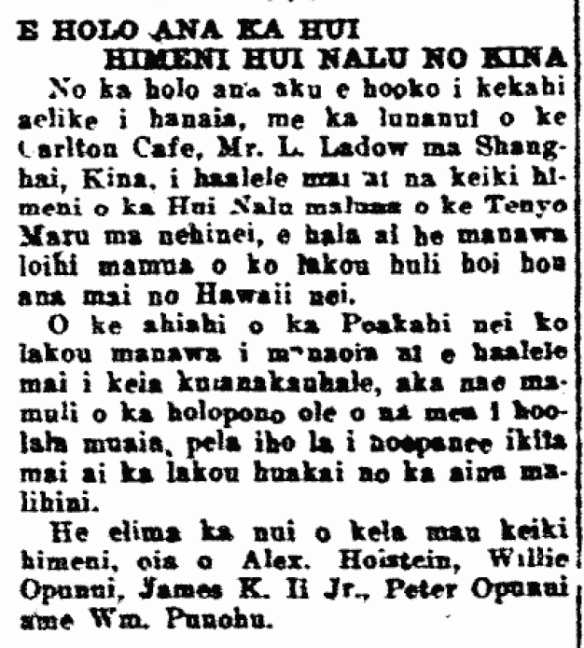
To fulfill their contract with the head of the Carlton Cafe, Mr. L. Ladow, in Shanghai, China, the singing boys of the Hui Nalu will leave aboard the Tenyo Maru yesterday, and they will spend a long period of time there before returning to Hawaii nei.
They were supposed to leave this town on Monday, however because what was planned earlier did not go well, their trip to foreign lands has been postponed for a bit.
There are five of these singers, they being: Alex. Holstein, Willie Opunui, James K. Ii, Jr., Peter Opunui, and William Punohu.
(Kuokoa, 12/20/1912, p. 4)
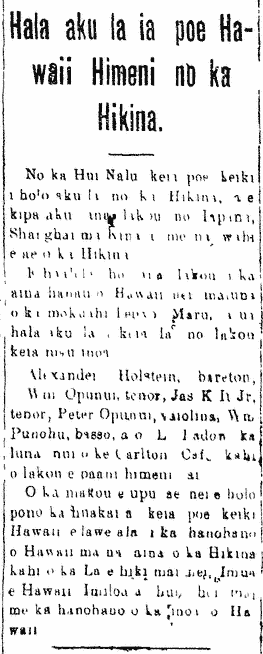
These youths are from the Hui Nalu [Singing Club] who left for the East; and they will visit Japan and Shanghai in China and other locations in the East.
They will leave the land of their birth aboard the steamship Tenyo Maru [?], and they left this day, their names being:
Alexander Holstein, baritone,
William Opunui, tenor, James K. Ii, Jr., tenor, Peter Opunui, violin, William Punohu, bass, and L. Ladon [Louis Ladow] the head of the Carlton Cafe, where they are to perform.
Our hope is that the journey of these Hawaii boys carrying with them the pride of Hawaii to East, to the land of the rising Sun, goes well. Go forward, go forward O Great-Travelling Hawaiians and return with glory in the name of Hawaii.
(Kuokoa Home Rula, 12/19/1912, p. 1)