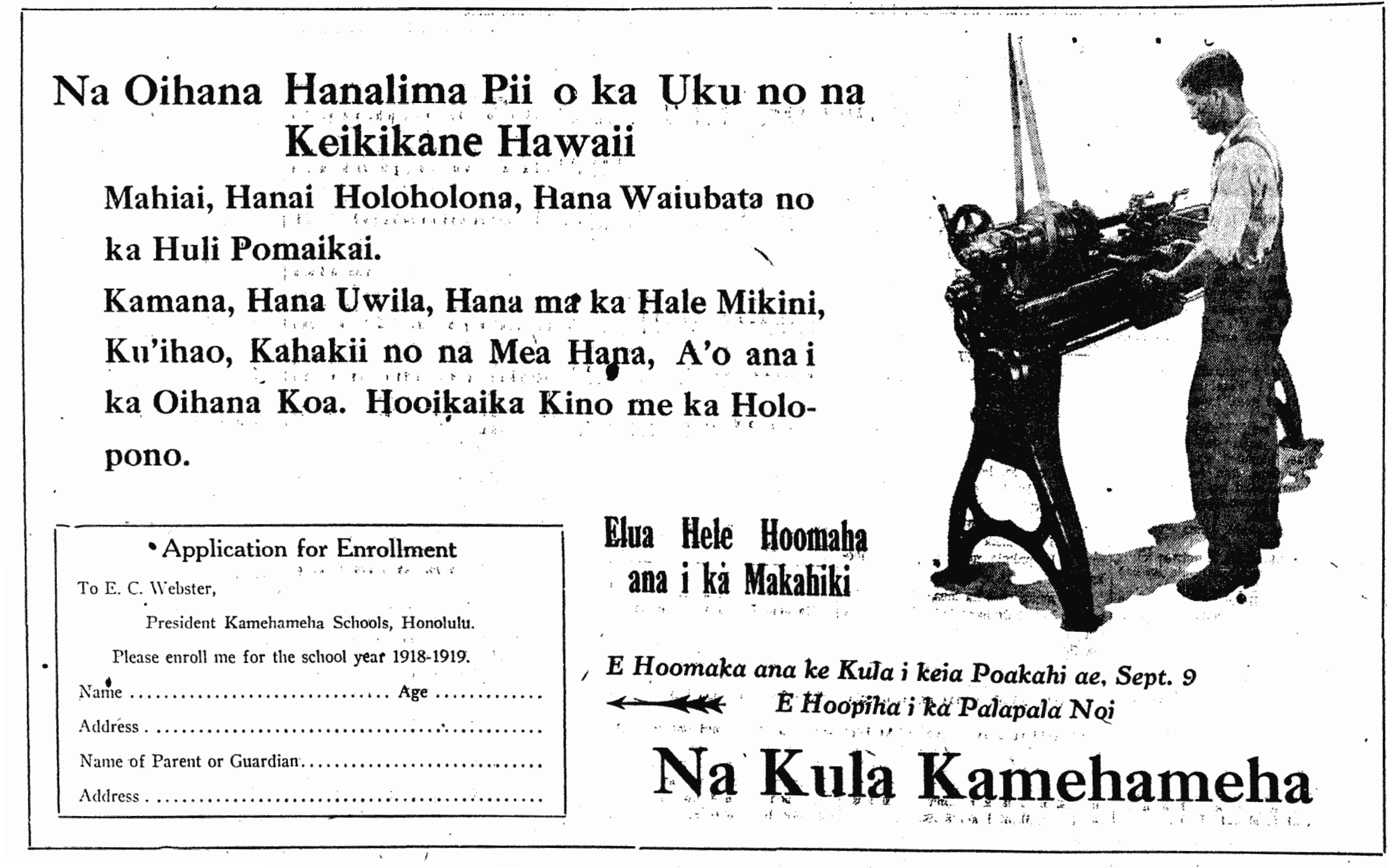
Application to Kamehameha Schools, 1918.

Profitable Trades for Hawaiian Boys

Farming, Stock Raising, Dairying for Profit,

Carpentry, Electricity, Machine Shop Practice,

Forging, Mechanical Drawing, Military, Athletic and Moral Training.

Two Field Trips Each Year.

School will begin this coming Monday, Sept. 9

Fill out the Application

Kamehameha Schools.

Application for Enrollment

To E. C. Webster,

President Kamehameha Schools, Honolulu.

Please enroll me for the school year 1918–1919.

Name … Age …

Address …

Name of Parent of Guardian …

Address …

(Kuokoa, 9/6/1918, p. 3)

Na Oihana Hanalima Pii o ka Uku no na Keikikane Hawaii

Ka Nupepa Kuokoa, Buke LVI, Helu 36, Aoao 3. Sepatemaba 6, 1918.

Kamehameha School for Girls new school year, 1898.

KAMEHAMEHA SCHOOL FOR GIRLS.

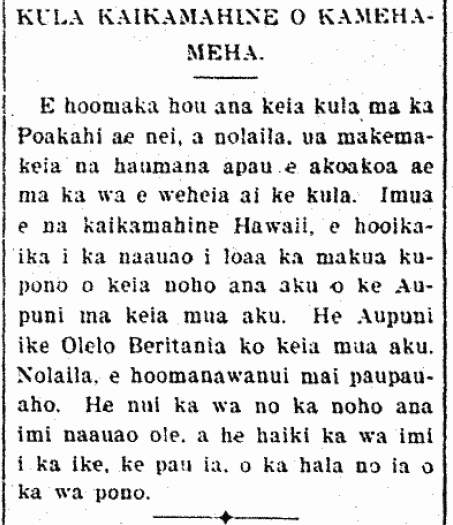
This school will be in session again starting next Monday, and so all students are requested to assemble when school opens. Imua, O Hawaiian girls, strive to be educated so that there will be good parents in the future of this Nation. Here forth this is a Nation of the English Language. Therefore, be patient and don’t give up. There is a lot of time not given to learning, and only a limited time allotted for learning; once this is over, it will be too late.

(Kuokoa, 9/2/1898, p. 3)

KULA KAIKAMAHINE O KAMEHAMEHA.

Ka Nupepa Kuokoa, Buke XXXVII, Helu 35, Aoao 3. Sepatemaba 2, 1898.

Letter from Iosepa, Utah, 1913.

A VOICE FROM UTAH.

Iosepa, Toole County. Dec. 19, 1912.

Solomon Hanohano, Editor of the Kuokoa, Aloha oe:—Because I want to know the news of the land of our birth, the desire to get a subscription to the Kuokoa grew. Being the the new year is coming, it would be a means for me to see the news of our home and the progress of the political scene or its regression, as well as the victories or discouragements of our fellow makaainana.

Not because Iosepa lacks newspaper subscribers, but for me to get a personal one.

This is one of the important years regarding the nation, being that the leadership of the power of the nation went to the Democrats; the big question is just this: Will the poor makaainana really benefit, or will they be left unstable once again like during the presidency of Cleveland, but it is only time that will tell.

If those elected could follow through on what their lips pledge to the masses, then we indeed will be blessed, however if it is like what Isaiah said, thusly: “These people come near to me with their mouth, but their hearts are far from me.” [Isaiah 29:13] Then comes those famous words of that old timer of Lahaina: “Saying, when indeed will that happen.” [“I mai hoi, ahea la ka hoi.”] The big-eyed images know that the small-eyed images are not watched. [Ikeia aku la no na kii maka nunui, nana oleia iho la na wahi kii maka liilii ??]

My aloha to the few Hawaiian makaainana left who are squeezed and assimilated [i ka opaia aku ua pili pu ?] until they are totally gone from the beloved face of Hawaii, along with the increase of the other races upon the land. And so too with the various diseases of the different races whose devastation spread to our people who lack immunity. Aloha to our people.

As for our living in this unfamiliar land, this land that true Mormons know as the chosen land, and a land to foster the believers in that one faith, all of the Hawaiians are in good health as well as the Samoans, from the old to the young.

I have faith that Iosepa will become a place where Hawaiians will multiply once again, and that these valleys will become full of true Hawaiians and Samoans, when the children are born, and grow up, and marry and give birth.

Some proof of this belief is the great desire of the president of the Mormons for the youths to marry of their own race so that this land is full of Hawaiians. For according to him, it is here that the people of the islands of the ocean will spread.

The town of Iosepa is growing. The church is building homes for the people without homes, lest they live in disarray as the Hawaiians before, with two or three families in a single dwelling.

The workers are paid a dollar every Saturday. The children are taught in the school here in Iosepa. Two children graduated from the local school of Iosepa, and are attending high school, they are Joseph H. Bird and William Pukahi, both are true Hawaiians.

I have been just chosen as judge, and George K. Hubbell as sheriff of the district. We are both Republicans, which also are the majority of the Hawaiians here.

Perhaps this will do.

Charles J. Broad.

Iosepa, Toole County, Utah.

(Kuokoa, 1/10/1913, p. 6)

HE LEO MAI UTAH MAI.

Ka Nupepa Kuokoa, Buke XLIX, Helu 2, Aoao 6. Ianuari 10, 1913.

Marriage announcement outside of the Vital Statistics Column, 1912.

BOUND WITH THE THREE-STRAND CORD OF TRUE LOVE

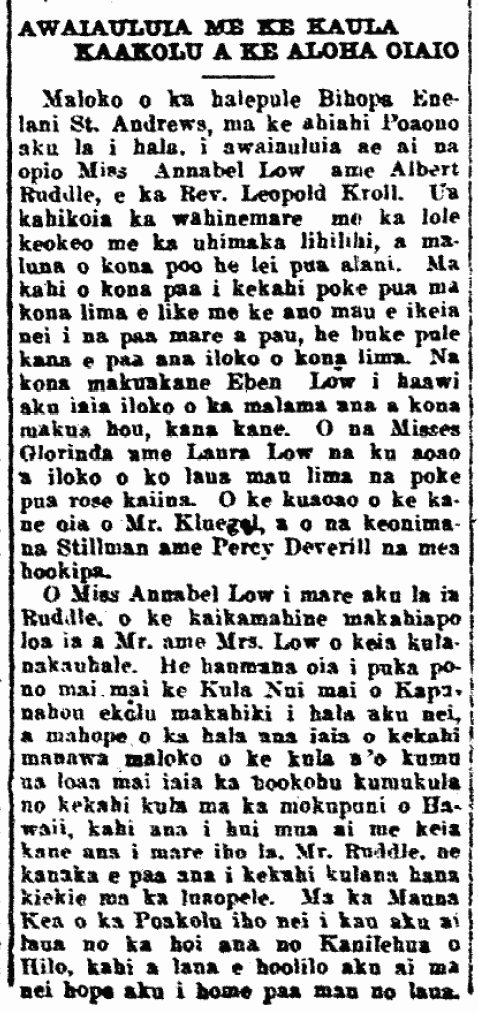
Within the Anglican Church of St. Andrew’s, on this past Saturday evening, the youths, Miss Annabel Low and Albert Ruddle were joined together by the Rev. Leopold Kroll. The bride was donned with a white dress and a sheer veil, and atop her head was a lei of orange blossoms. She held a bouquet of flowers in her hand as seen in all marriage ceremonies, and she held a book of prayers in her hand. It was her father, Eben Low, who gave her into the care of her new parent, her husband. Misses Glorinda and Laura Low were the bride’s maids, and they held in their hands, bouquets of lavender roses. The best man was Mr. Kinegal, and the gentlemen in charge of hospitality were Stillman and Percy Deverill.

Miss Annabel Low who married Ruddle is the eldest daughter of Mr. and Mrs. Low of this town. She was a student who graduated from the College of Kapunahou [Punahou] three years ago, and after some time in the teachers’ school, she was appointed as a teacher at a school on Hawaii Island, where she first met this man whom she wed, Mr. Ruddle, who is employed in a high position at the volcano. They will be returning to the Kanilehua of Hilo on Wednesday’s Mauna Kea where they will make their permanent home from here forth.

(Kuokoa, 7/12/1912, p. 6)

AWAIAULUIA ME KE KAULA KAAKOLU A KE ALOHA OIAIO

Ka Nupepa Kuokoa, Buke XLVIII, Helu 28, Aoao 6. Iulai 12, 1912.

The new and improved St. Louis College, 1881.

THE COLLEGE
OF SAINT LOUIS
—and the—
COMMERCIAL AND BUSINESS ACADEMY
HONOLULU, OAHU, H. I.

This institution being remote from city allurements, is an acknowledged safeguard for morals—for salubrity of climate, is unrivalled. The buildings are large and commodious, while the grounds afford the pupils opportunities for healthful exercises.

Unremitting attention will be given to the intellectual and moral culture of the pupils. Non-Catholic pupils will be free to attend the religious exercises or not, according as their parents or guardians may desire.

Pupils are received at any time during the year. No reduction will be made from regular charges, except for absence caused by protracted illness.

No leave of absence during the scholastic year, except at the College vacations or by special permission.

Each pupil must on entering obtain one suit of uniform, which with all other necessary clothing, &c., &c., will be furnished at moderate cost by the College; but none of these will be provided by the College unless by special arrangement.

Payments are to be made quarterly, and invariably in advance.

The course of study is Classical, Scientific and Commercial; Latin, Greek, French, Spanish, German and Italian are taught.

Particular attention will be paid to the English Language in all its branches. Literature, Pure and Mixed Mathematics, History, Geography, Chemistry and Natural Philosophy, &c.

TERMS:

For Board, Lodging, Tuition and Washing, per Scholastic Year…$200.00

Entrance fee…10.00

Vacation at College…40.00

Music, vocal and instrumental, Drawing and Modern Languages—extras.

DAY PUPILS—Senior Class…$60.00

Junior Class…40.00

The Scholastic Year consists of two Sessions, each comprising a period of five months. The first session commences on the 20th of August; the second on the 20th of January.

For all further particulars, apply to

REV. W. J. LARKIN, President.

No. 73 Beretania St.

Evening School Department of St. Louis College.

The President has decided to include this branch in the curriculum of the College.

Its object is to afford all classes of the community the means of acquiring a theoretical and practical knowledge of all commercial and business transactions in daily use; and also to give an insight into the workings and applications of the different Trades, which it is so essential to do in these Islands.

The Theoretical Branch will be under the supervision of the President and Professors of the College. The Practical and most important Branch will be specially attended to by volunteers from the various master artizans among us, who have kindly and generously promised their services to this useful and valuable enterprise.

They will, alternately, devote half and hour each evening to the task of imparting knowledge to the students. All the implements necessary to each trade, and to Agriculture, will be furnished by the College.

Each master-artizan, while connected with the College, will be entitled to name one Free-Life-Scholarship to the privileges of this Evening School Department.

TERMS—Each student per week, 50 cts. The Evening School will open at 7 o’clock p. m.

(Elele Poakolu, 2/2/1881, p. 5)

KE KULA NUI O SANA LUI

Ka Elele Poakolu, Buke I, Helu 22, Aoao 5. Feberuari 2, 1881.

[This is an advertisement for the recently moved Saint Louis College, back in 1881. The English is taken from the English advertisement appearing on page 5 of the Hawaiian Gazette, 2/9/1881.

This Hawaiian ad appears in the newspaper Ka Elele Poakolu, which for some reason is not available online as of yet, even if it has been available on microfilm for years…]

Rose Kanewanui of Hanalei passes, 1912.

MY BELOVED HAS GONE.

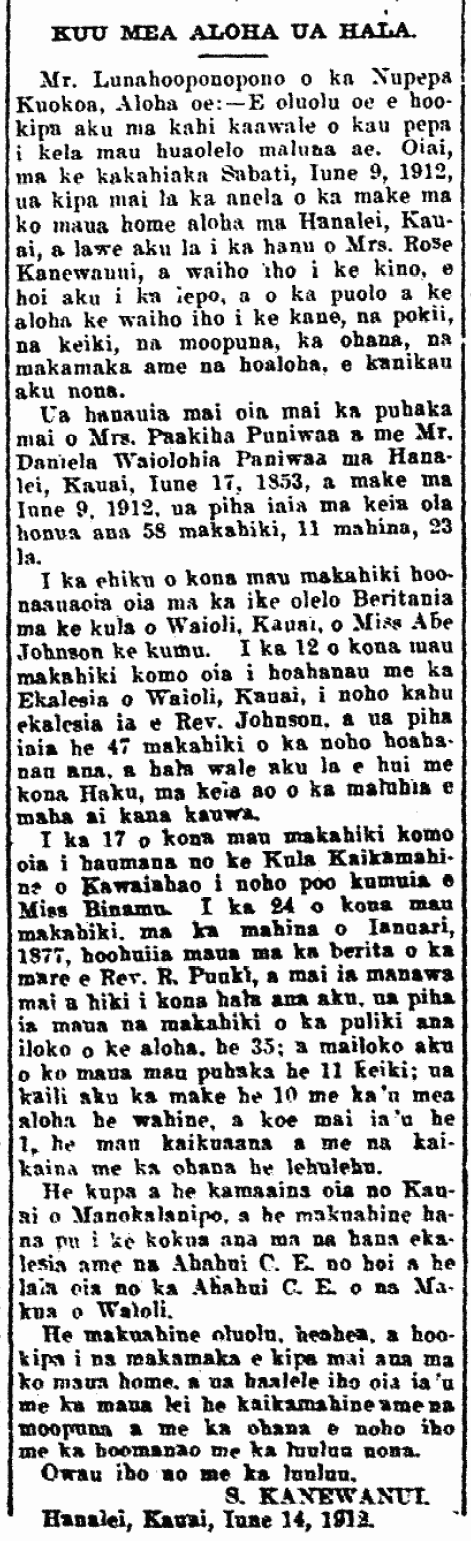
Mr. Editor of the Kuokoa Newspaper, Aloha oe:—Please be so kind as to welcome to a free space in your paper, the words above. Being that on the morning of the Sabbath, June 9, 1912, the angel of death visited our loving home in Hanalei, Kauai, and took the breath of Mrs. Rose Kanewanui, and left behind the body to return to the earth; and the puolo¹ of love is left with the husband, the younger siblings, the children, the grandchildren, the family, the intimates, and friends who grieve after her.

She was born from the loins of Mrs. Paakiha Puniwaa and Mr. Daniela Waiolohia Paniwaa at Hanalei, Kauai, June 17, 1853, and died June 9, 1912, she lived on this earth 58 years, 11 months, and 23 days.

At age seven, she was educated in the English language at the school of Waioli, Kauai, and Miss Abe Johnson was the teacher. At 12, she entered as a brethren of the Church of Waioli, Kauai, under the direction of Rev. Johnson, and she was a member for 47 years, until she died and met with her Lord in that realm of peace where his servants rest.

At 17, she entered into the Kawaiahao Girls’ School which was under the principal Miss Bingham. At 24, in the month of January 1877, we were joined together in the covenant of marriage by Rev. R. Puuki, and from then forth until her passing, we were joined together in the embrace of love for 35 years; and from our loins came 11 children; death snatched 10 and my beloved wife, and I am left with one, and a elder brother and younger brother, along with many relatives.

She was a native and familiar of Kauai of Manokalanipo, and a mother who volunteered her time with church duties and Ahahui C. E. [Christian Endeavor] and she was a member of the Ahahui C. E. of the elders of Waioli.

She was a kind mother, inviting, and welcomed friends to visit our home, and she left me and our child [lei], a daughter and grandchildren and the family to remembering and grieving for her.

Me with sadness,

S. KANEWANUI.

Hanalei, Kauai, June 14, 1912.

¹Puolo is  a bundle, and is used here figuratively.

[One should not just stop at the regular Vital Statistics Column when looking for kupuna. Rose Kanewanui’s death does not appear in the regular column, but this sweet remembrance by her husband is filled with so much more of her life story than would be given in the Vital Statistics Column. There are so many of these throughout the pages of the Hawaiian-Language Newspapers!]

(Kuokoa, 6/21/1912, p. 6)

KUU MEA ALOHA UA HALA.

Ka Nupepa Kuokoa, Buke XLVIII, Helu 25, Aoao 6. Iune 21, 1912.

English-Language Newspaper articles less important than Hawaiian-Language articles? 2012

Here is something to consider…

There are many who believe that English-Language articles are somehow less important than Hawaiian-Language ones. We should not turn our noses up at any history passed down by those who lived it—in any language. Although it is important to take into account who wrote the information and under what circumstances, any information is better than no information!

Here for instance is the coverage the first Kamehameha Girls School graduation received in The Hawaiian Gazette of July 6, 1897, p. 2, “CLOSING EXERCISES”.

Compare this to what we saw earlier from the Kuokoa of July 2, 1897, p. 2, “KA HOIKE O KE KULA KAIKAMAHINE O KAMEHAMEHA”.

First graduating class of Kamehameha School for Girls, 1897.

PERFORMANCE OF KAMEHAMEHA GIRLS SCHOOL.

The Graduates.

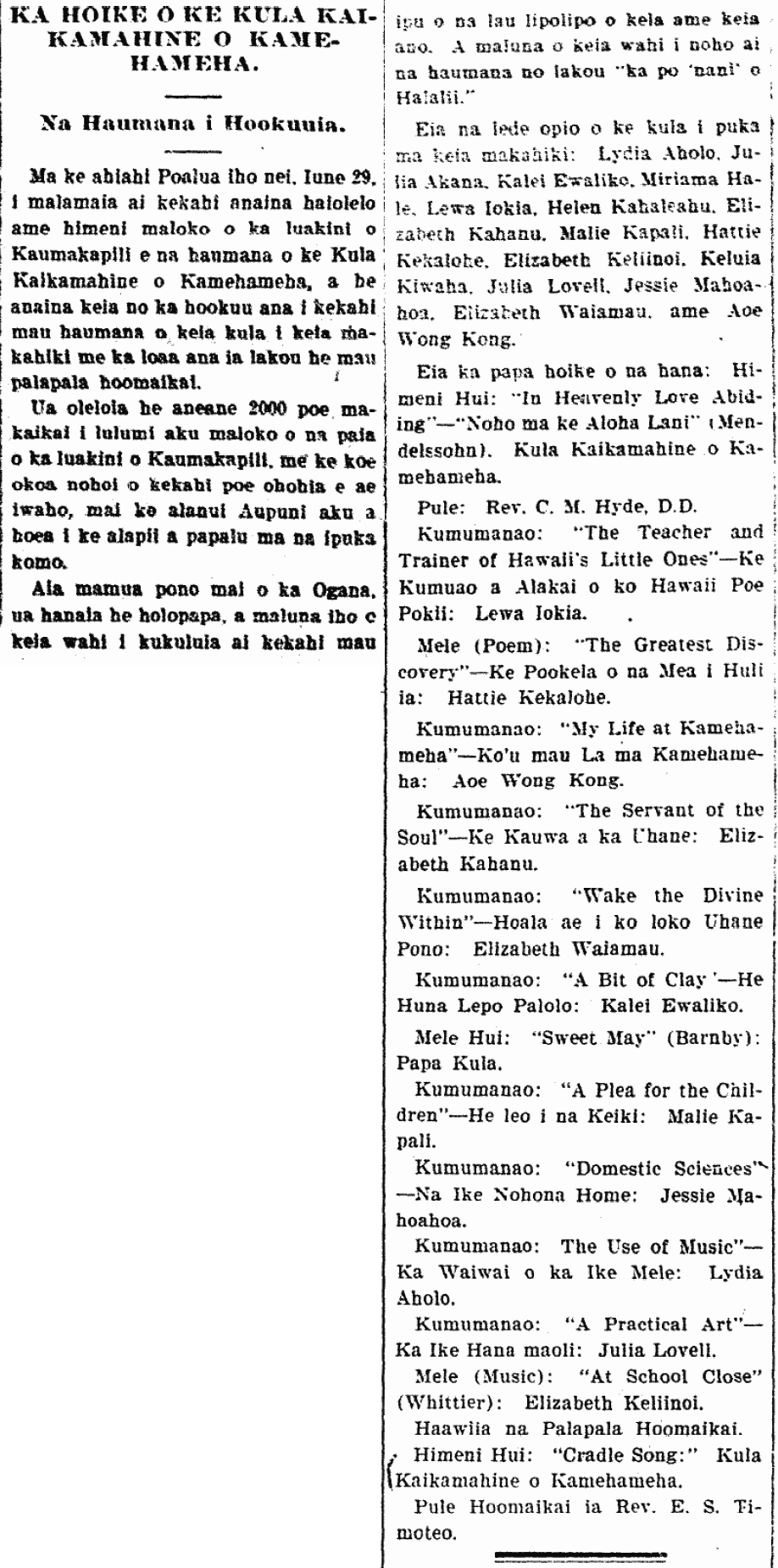
On the evening of this past Tuesday, June 29, a performance of speeches and singing was held at Kaumakapili Church by the students of the Kamehameha School for girls, and this was an assembly for the graduation of some students of this school this year with them receiving diplomas.

It is said that there were almost 2000 onlookers who crowded into the walls of Kaumakapili Church, with still more excited people outside, from the Government road until the steps and covering up the entrance.

Right before the Organ was made a stage, and above it were placed pots of greenery of all sorts. And upon this sad the students for whom was that beautiful night [“ka po nani o Halalii”¹].

These are the young ladies of the school who graduated this year: Lydia Aholo, Julia Akana, Kalei Ewaliko, Miriama Hale, Lewa Iokia, Helen Kahaleahu, Elizabeth Kahanu, Malie Kapali, Hattie Kekalohe, Elizabeth Kaliinoi, Keluia Kiwaha, Julia Lovell, Jessie Mahoahoa, Elizabeth Waiamau, and Aoe Wong Kong.

This is the program of events: Chorus: In Heavenly Love Abiding”—”Noho ma ke Aloha Lani” (Mendelssohn). Kamehameha Girls’ School.

Prayer: Rev. C. M. Hyde, D. D.

Topic: “The Teacher and Trainer of Hawaii’s Little Ones”—Ke Kumuao a Alakai o ko Hawaii Poe Pokii: Lewa Iokia.

Mele (Poem): “The Greatest Discovery—Ke Pookela o na Mea i Huliia: Hattie Kekalohe.

Topic: “My Life at Kamehameha”—Ko’u mau La ma Kamehameha: Aoe Wong Kong.

Topic: “The Servant of the Soul”—Ke Kauwa a ka Uhane: Elizabeth Kahanu.

Topic: “Wake the Divine Within”—Hoala ae i ko loko Uhane Pono: Elizabeth Waiamau.

Topic: “A Bit of Clay”—He Huna Lepo Palolo: Kalei Ewaliko.

Chorus: “Sweet May” (Barnby): Class.

Topic: “A Plea for the Children”—He leo i na Keiki: Malie Kapali.

Topic: “Domestic Sciences”—Na Ike Nohona Home: Jessie Mahoahoa.

Topic: “The Use of Music”—Ka Waiwai o ka Ike Mele: Lydia Aholo.

Topic: “A Practical Art”—Ka Ike Hana maoli: Julia Lovell.

Mele (Music): “At School Close” (Whittier): Elizabeth Keliinoi.

Diplomas Given.

Chorus: “Cradle Song:” Kamehameha School for Girls.

Benediction [Pule Hoomaikai] by Rev. E. S. Timoteo.

¹”Ka po nani o Halalii” [Beautiful night of Halalii] seems to be a variation of the idiom “Ka po le’a o Halalii” [Enjoyable night of Halalii].

[I just ran across this article while looking for something else today, and thought it would be a nice follow up to the earlier articles on the opening of Kamehameha Girls School.]

(Kuokoa, 7/2/1897, p. 2)

KA HOIKE O KE KULA KAIKAMAHINE O KAMEHAMEHA.

Ka Nupepa Kuokoa, Buke XXXVI, Helu 27, Aoao 2. Iulai 2, 1897.