Alligator loose?? 1928.

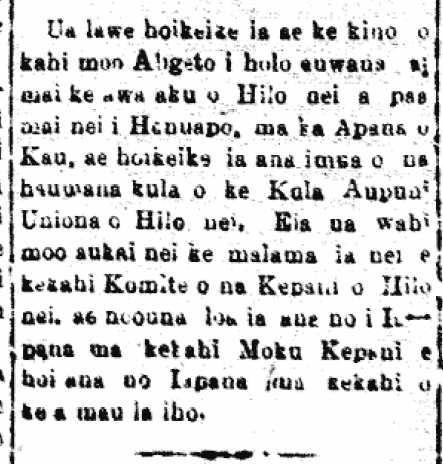
The body of an Alligator [moo Aligeto] that wandered from the port of Hilo and caught in Honuapo in Kau was taken to show before the school children of the Government School, Union, of Hilo nei. The sea navigating serpent is being cared for by a Japanese Committee of Hilo nei, and it will be sent all the way to Japan aboard a Japanese ship one of these upcoming days.

(Hoku o Hawaii, 1/10/1928, p. 2)

Ua lawe hoikeike ia ae ke kino o kahi moo Aligeto...

Ka Hoku o Hawaii, Buke XXI, Helu 32, Aoao 2. Ianuari 10, 1928.

POISONOUS SNAKE in Hawaii? 1912.

BITTEN BY A SNAKE AND DIED.

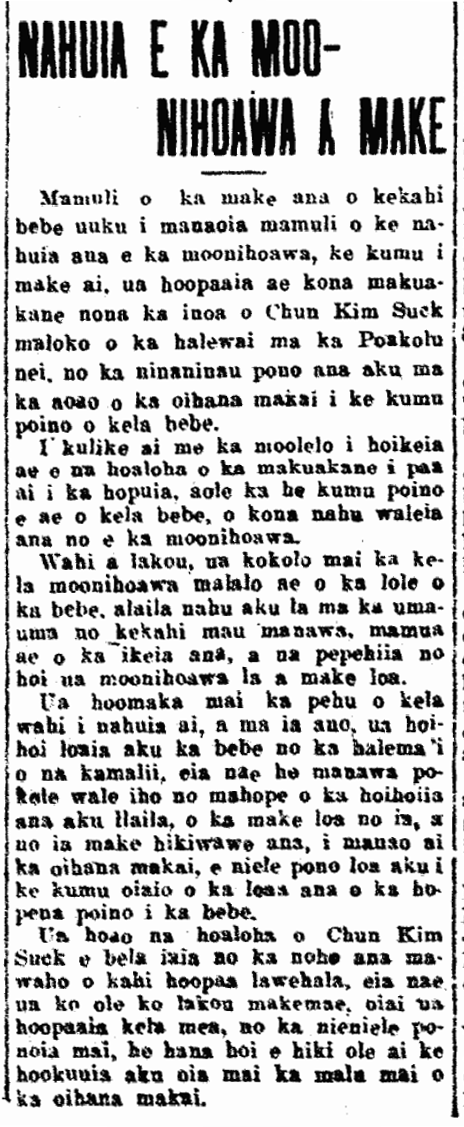
As a result of a small baby dying believed as a result of being bitten by a snake [moonihoawa], the parent, whose name is Chun Kim Suck was taken to jail on Wednesday to be questioned by the sheriff’s office as to the cause of the baby’s injuries.

According to statements of the friends of the father who was arrested, there was no other reason for the baby’s injuries other than that it was bitten by a snake.

According to them, the snake crawled beneath the clothing of the baby and then bit its chest several times before it was noticed, and then the snake was killed.

The bitten area began to swell at which point the baby was taken to the children’s hospital, however soon after being taken there, it died, and because of this quick death, the sheriff’s department decided to find the true cause of the tragic end of the baby.

Chun Kim Suck’s friends tried to bail him out of the hold for criminals, however, their wish was not granted because he is being held for interrogation, for which he cannot be released from the watch of the sheriff’s department.

(Kuokoa, 8/2/1912, p. 1)

NAHUIA E KA MOONIHOAWA A MAKE

Ka Nupepa Kuokoa, Buke XLVIII, Helu 31, Aoao 1. Augate 2, 1912.

Rising food prices: Will politicians ever learn? 1923 / timeless.

REASONS FOR THE RISING COST OF FOOD.

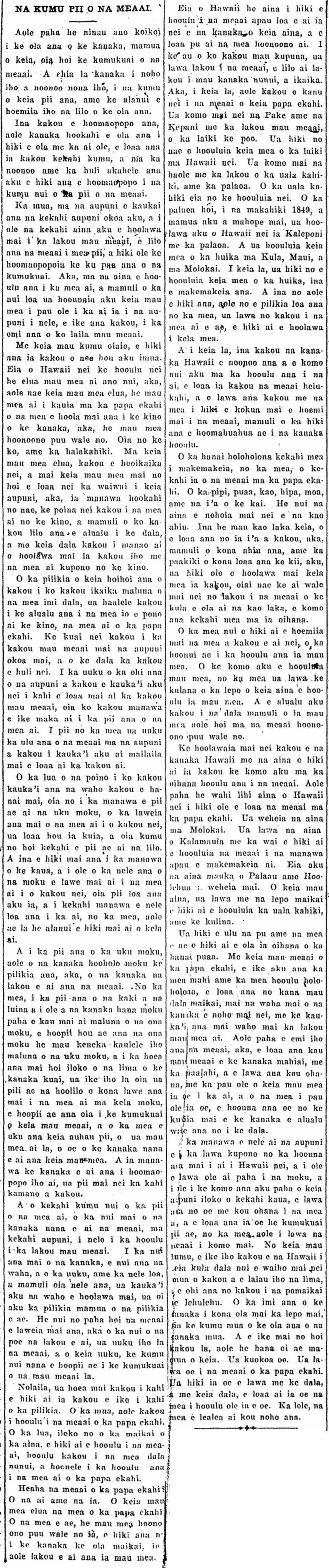
There is perhaps no other more important question pertaining to the life of man than that of the cost of food. How many people have sat down and thought to themselves about the reasons for the rising costs and ways to lessen their living expenses.

If we consider that there is no man on earth that can live without food, then we can find a reason; and through thought and careful consideration, we can figure out the major reasons for the rise in food prices.

First of all, for nations who rely upon other nations or other lands to supply their food, their food will be expensive, and food price stability will not be realized. But for a land that produces its own food, and exports the excess to nations who are lacking, they will see a fall in their food costs.

With these facts, we can move forward. Here we are in Hawaii, growing two major crops, however these two things are not main dishes which give sustenance to the body, but they are just treats. They being sugar and pineapple. We are putting our efforts into these two things and this nation draws its income from it; however, at the same time, we are forgetting about the foods necessary for the body, and because we are so focused on chasing after money, we assume that these funds will supply us with food for nourishment.

The problem with our focus on the pursuit of money, is that we neglect looking after the actual things that are necessary for our bodies, the main staples. We are purchasing our food from foreign nations, while we are in pursuit of making money. When the nations which we rely upon to get our food have a small harvest, this is the time we will see an increase in the costs of food. It will rise because of the small amount of food growing in those countries in which we rely upon from where we get our food.

The second detriment to us in relying on the outside for feeding us is that when the shipping costs rise to ship in the food to us, there will be another set back, and that will be another reason the costs will rise. And should the occasion arise when there is war, or the lack of ships to bring our food, then the prices will shoot up; or there will be times when there is no food, because there will be no means to get the food.

And when the shipping costs rise, it will not be the sailors who will be in trouble, but it will be those who eat the food. For with the increase in the costs to the ship owners for pay for the sailors, or the ship builders perhaps, the ship owners will add on some pennies to the shipping charges, and when this comes to the hands of the consumer, he will understand that the expense to ship food here by boat resulted in an increase in the price of food; and the one paying the exorbitant prices for those foods is you, who eat them. And when the person is eating, he will see that the price of salmon here has risen.

And another factor in the rise of food costs is the number of people who eat the food, in a country that does not produce its own food. With the increase in population, the number of mouths will increase, so there will be less, or just doing without; and as a result of this lack, and to remedy it, the outside is relied upon to make up for this, and this is a problem bigger than all others. There may be a great amount of food brought in, but in comparison to the number of those who eat the food, that food is only a little, which is the main reason for the rise in food costs.

Therefore, we have come to where we can see where the problem lies. First, we do not grow staples. Second, although we have fertile land upon which we can grow food, we just grow things that bring in money and go without growing main foods.

What are staples? Vegetables and meat. These two things are staples. Other things are just treats, and man can live without them.

Here is Hawaii, a land where all foods can be grown which people eat here, along with the condiments. During the times of our ancestors, they had ample food so that they became big and strong. But these days, we are not planting staples. The Chinese and Japanese have come with their foods, with rice being the main food. This rice can be grown here in Hawaii nei. The haole came with their thing, the Irish potato and bread. Potatoes are being grown here now. As for flour, in the year 1849 or there about, Hawaii supplied California with flour. Wheat was grown in Kula, Maui, and on Molokai. Today, wheat can be grown should we desire. And if it is not possible, this is not a problem, because we are satisfied with other foods that can take its place.

And today, should we Hawaiians consider joining together in the growing of food, we will have the best food, and we will have produce that will help lessen the cost of food, as a result of this increase in the number of farmers.

The raising of livestock is also something needed, for that is a staple. Cows, pigs, goats, sheep, chicken, and the fishes of the sea. There is a lot of land now lived on by wild goats. If they were domesticated goats, then we’d have that meat, but because it is wild, and hard to get, it will not be enough for us; all the while the wild goats are feeding off of the fields which is for the sustenance of domesticated goats; some people are going into this profession.

The main thing that will lessen the costs of our food that we eat is the increasing of the growing of those foods; the joining into the growing of these things, because the quality of soil of this land is sufficient to grow these things. And let us look to making money through that, and not solely from treats.

We Hawaiians are supplied with land where we can enter into the occupation of growing food. There is probably no piece of land in Hawaii where staples cannot be grown. The land of Molokai has been opened up. The land of Kalamaula has enough water to grow food whenever it is desired. The lands upland of Palaau and Hoolehua will be opened up. These lands have soil good enough to grow Irish potatoes and corn.

Melons and other things can be grown which can support pig farming. With these staple foods, the farmer and those that raise livestock will receive good money from the mouths of those who live here, while being relied upon by those from outside to supply their food. Maybe the food won’t be cheaper, but you will have your food, O Farmer, with ease, and your family will be supplied, without it all being consumed; and the leftover, you can sent out to be purchased by those in pursuit of making money.

When foreign nations don’t have enough to send food to Hawaii, or when there are not enough ships, or if this nation enters into war, you and your family will have enough food, and you will get a higher price, because there will not be enough food imported. For these reasons, let us Hawaiians recognize these fields of gold stretched out before us, and let us grab it and harvest its many blessings. The seeking of one’s livelihood from the soil was the first way of life of the earliest men. And we know that there is no greater occupation than this. You are independent. You will have enough staple foods. You will have enough money, and with this money, you will have things that you do not grow. Clothes and things that make your life pleasant.

[I dedicate this to all the awesome farmers out there, both big and small (and fishermen and ranchers and dairy people for that matter). Also to the farmers’ markets, and establishments who support them. And to you, the people who try to buy local first. Conversely, I would like all of you politicians and others who think that agricultural lands and farmers are not important, to think about the big picture before another 89 years pass by. At this rate, we will be leaving the next generations with a very dismal way of life.]

(Kuokoa, 2/15/1923, p. 2)
NA KUMU PII O NA MEAAI.

Ka Nupepa Kuokoa, Buke LXII, Helu 7, Aoao 2. Feberuari 15, 1923.

More from the Pacific Northwest, but a little more “recent,” 1912.

A LETTER FROM AFAR

(Written by Sam K. Nainoa.)

The following letter is written by Sam K. Nainoa from Seattle, after the passing of several weeks since he left his homeland with his queen, on their travels, explaining some major things that they saw in their sightseeing of these foreign lands, and this will be something which the readers of the Kuokoa will rejoice in because of the progress witnessed by the two of them made by the Hawaiian youths living in that foreign land.

SEATTLE, May 16, 1912, Aloha oe:—Here we are, staying in this town; we’ve been here almost two weeks, meeting with the Hawaiian boys, and we are full of joy.

There is a great number of my classmates living here, all of them Hawaiians; they are playing music and singing, and they are making a lot doing this work; and some of them married haole women, and they are truly taken by this land, with no desire at all to return to the land of their birth.

Some of them have land and are well off; according to what they tell me, their thoughts of returning to Hawaii are no more; this is where they will live and they will leave their bones in this foreign land.

We went touring around another area farther across this expansive ocean for a few days and came right back, and am writing this letter to you. We went sightseeing at a wood mill, at a place called Port Blakeley, which is one of the largest mills in the world.

What I saw was truly amazing. There are many Hawaiian boys indeed living there, and to go from one area to the next, you travel by steamship. The Hawaiians take a fancy to living there, and for work, they do lumbering.

Hawaiians have no problem with jobs there; they have work at all times.

Some boys from Port Blakeley came to Seattle and got together with us and the band boys who live in Seattle; they insisted that we go with them to where they live, and there was not refusing the hospitality of the kamaaina, so we went aboard a steamship, spending a few days there and immediately returning back.

There were two Hawaiian women there with their husbands, and they have become mothers to the Hawaiian boys there; their living is easy, and they get along lovingly; I would not be mistaken to say there is a place for them in this land without their parents [he mua a he hope ka noho ana o ka aina makua ole ?]

There is bountiful food there, and when we arrived, two pigs were roasted as is the custom of Hawaiians, and all the luau foods were prepared like inamona, limu eleele, dried fish, alamihi crab, raw fish, and their poi was poi palaoa [flour poi].

Here they have dried opelu and dried nehu and many other things so that Hawaiians living here have nothing to complain about; they have everything, perhaps even more than Hawaii.

We enjoyed ourselves, and there was but one thing to do, that is to sing and to play music, and we were terribly happy. There is an over abundance of palai fern there, it is protects your feet [he pale wawae ia mea he palai ?] and it grows all the way until the ocean. When we went pole fishing, we caught poopaa and also large kuahonu crabs. There is a fish that looks like opelu here, and perhaps it is opelu; so too with the puhikii, which is good eating raw.

There are so many delicacies here: salmon worked in with tomatoes and onions; and according to what these Hawaiians say, there is no food that you can’t get here, you have so much to choose from to satisfy your wants.

These people were very kind to us, and we are greatly indebted to them for their hospitality, and these Hawaiians of ours are blessed in making this place somewhere that they look for their livelihood.

This is enough for now, and maybe there will be more free time here after to write more of our travels. All the Hawaiians here give their aloha to our lahui.

Your friend,

S. K. NAINOA.

(Kuokoa, 6/7/1912, p. 6)

HE LEKA MAI NA AINA MAMAO MAIA

Ka Nupepa Kuokoa, Buke XLVIII, Helu 23, Aoao 6. Iune 7, 1912.

Replanting of native plants, 1901!

HAWAIIAN PLANTS WILL BE GROWN AGAIN.

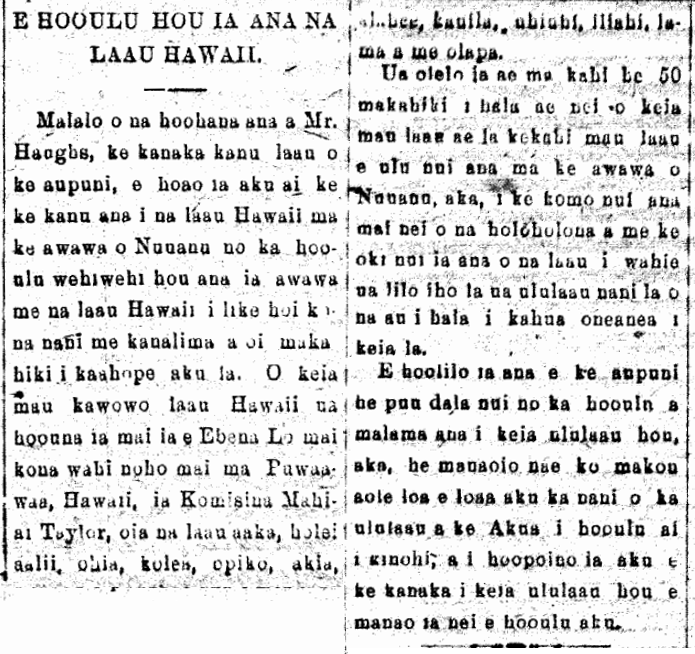
Under the direction of Mr. Haughs, the nurseryman of the government, the planting of Hawaiian plants in the valley of Nuuanu will be attempted, to make that valley verdant once again with native plants, so that it will be just as beautiful as it was fifty or more years ago. These seedlings were sent by Ebena Lo [Eben Low] from his residence at Puuwaawaa, Hawaii, to Commissioner Taylor, those being aaka, holei, aalii, ohia, kolea, opiko, akia, alahee, kauila, uhiuhi, iliahi, lama, and olapa.

It is said that it has been about 50 years that these plants were growing in abundance in Nuuanu Valley, for with the influx of animals and the mass cutting of trees for firewood, the beautiful forest of times gone by became a barren field.

The government will spend a sum of money to grow and foster this new forest, however, we believe that there is no way that the beauty of the forest which God grew originally and which was damaged by man will be attained by this new forest which is intended to be grown.

(Aloha Aina, 12/7/1901, p. 4)

E HOOULU HOU IA ANA NA LAAU HAWAII.

Ke Aloha Aina, Buke VII, Helu 49, Aoao 4. Dekemaba 7, 1901.

Law banning the killing of imported birds, 1870.

HE KANAWAI

E HOOLOLI ANA I KA PAUKU 3 A ME KA PAUKU 7, A E HOOPAU ANA I KA PAUKU 5, O KA MOKUNA LXXXV O KE KANAWAI HOOPAI KARAIMA.

E hooholoia e ka Moi a me ka Hale Ahaolelo o ko Hawaii Pae Aina i akoakoa iloko o ka Ahaolelo Kaukanawai o ke Aupuni:

PAUKU 1. E hoololiia a ma keia ke hoololiia nei ka Pauku 3, o ka Mokuna LXXXV o ke Kanawai Hoopai Karaima, a penei e heluheluia ai:

“PAUKU 3. Ina e pepehi a hoomake paha kekahi kanaka ma ke ki ana i ka pu, ma ke kipukaahele a ma kekahi ano e ae paha, i kekahi manu i laweia mai mai na aina e mai i mea e laha ai kona ano manu ma keia Pae Aina, a i kekahi puka ana o ia ano manu mai na aina e mai i hookuu wale ia maloko o keia Aupuni, a ina hoi e lawe wale i na hua, a i na punana paha o ia mau ano manu, alaila, e hoopaiia oia, ke ku ka hewa ma ka hookolokoloia ana imua o kekahi Lunakanawai Hoomalu a Apana paha, aole emi malalo iho o na dala he umi, aole hoi e oi mamua o na dala he iwakalua no kela hewa keia hewa, a ina aole i hookaaia, alaila e noho oia ma ka Hale Paahao a kaa ia dala hoopai.”

PAUKU 2. E hoololiia ka Pauku 7, o ia Mokuna a ma keia, ua hoololiia, a penei ka heluhelu ana:

“PAUKU 7. Aole no e kipu, aole e pepehi ma kekahi ano e ae, kekahi mea i na holoholona holo wale i laweia mai, mai na aina e mai, a o kekahi puka ana mai o ia holoholona, iloko o na makahiki he umi mahope o ia lawe ana mai, malalo o ka hoopai aole e oi aku mamua o ke kanalima dala no ka hana ana pela.”

PAUKU 3. Ma keia e hoopauia ka Pauku 5 o ia Mokuna i oleloia.

PAUKU 4. E lilo keia i Kanawai i kona la e hooholoia ai.

Aponoia i keia la 8 o Iulai, M. H. 1870.

KAMEHAMEHA R.

(Au Okoa, 8/4/1870, p. 4)

HE KANAWAI, E HOOLOLI ANA I KA PAUKU 3 A ME KA PAUKU 7...

Ke Au Okoa, Buke VI, Helu 16, Aoao 4. Augate 4, 1870.

AN ACT

TO AMEND SECTION 3 and 7 AND REPEAL SECTION 5 OF CHAPTER LXXXV OF THE PENAL CODE.

Be it Enacted by the King and the Legislative Assembly of the Hawaiian Islands, in the Legislature of the Kingdom assembled:

SECTION 1. That Section 3 of Chapter LXXXV of the Penal Code, be and hereby is amended to read as follows:

Section 3. Any person who shall shoot, snare or otherwise destroy any bird, brought from a foreign country for the purpose of propagating its species within this Kingdom, or any of the progeny of such imported bird; or who shall disturb the eggs and nests of such birds, shall, on conviction, before any Police or District Justice, be fined not less than ten dollars, nor more than twenty dollars, for each offense, and in default of payment, be imprisoned until such fine is paid.

SECTION 2. That Section 7 of the said Chapter be, and hereby is amended to read as follows:

“SECTION 7. No person shall shoot or otherwise destroy any animals ‘Feræ Naturæ,’ which shall have been introduced into this Kingdom, within ten years, nor the progeny of such animals, under a penalty of not more than fifty dollars for each offense.”

SECTION 3. That Section 5 of said Chapter, is hereby repealed.

SECTION 4. This Act shall take effect and become a law from and after the date of its passage.

Approved this 8th day of July, A. D. 1870.

KAMEHAMEHA R.

(Hawaiian Gazette, 7/27/1870, p. 4)

AN ACT, TO AMEND SECTION 3 and 7 AND REPEAL SECTION 5...

Hawaiian Gazette, Volume VI, Number 28, Page 4. July 27, 1870.

On the decline of native birds, 1871.

Locals of the Tuahine Rain are no more.

O Ke Au Okoa:—Aloha to you:

I am sending you a small gift atop your outstretched foundation, should your captain and Editor be so kind, and it will be for you to take it to the shores of these islands so that my newspaper-reading companions may see it, it being the letters placed above: “Some Locals of the Tuahine Rain¹ are no more,” and it has been ten or more years which they have not been seen.

And my friends are probably puzzled about these locals that have gone missing, and you, our old-timers, are all likely saying, not them, here they are, and some people have passed away, but we knew of their passing; but the departure of these kamaaina which I speak of was not witnessed. And this is it, the kamaaina birds of our uplands: the Iwi, the O-u, the Akakane, the Amakihi, the Oolomao, the Elepaio; these are the native birds of these uplands who have disappeared.

And some of you may be questioning, what is the reason for this disappearance? I tell you, it is because of the spread of the evil birds from foreign lands, in our plains, mountains, ridges, valleys, cliffs, forests, terraced taro patches, seashores, and rivers; that is why these kamaaina have gone, because of the spreading of these evil birds among us, and they are damaging the crops, and the food from the forests; rice planted by some are being eaten by these evil birds; and the bananas of the forests are all eaten up by these birds.

What do we gain from these evil birds being spread in Hawaii, and protecting them so that they are not killed? I say that we gain nothing from these evil birds which are hurting our native birds and crops and foods from the forests; because in the past, before the spread of these birds, if a kamaaina of this land wanted to go into the mountains to get thatching or some shrimp, or some oopu, they did not pack food with them, because they thought that there was food in the mountains, like banana, hawane fruit, and uhi; banana would ripen on the plant and then fall, without anything damaging them, but now, the bananas don’t ripen on the plant; they are eaten by these banana-eating mu [mu ai maia] of the forest; bananas don’t ripen, and [now] when you go into the mountains, there is just the oka-i [blossom container of bananas] left and the bananas are lost to these birds; and the kamaaina birds are gone. Where to? Perhaps they all went to Hawaii island.

And I say without any hypocrisy, the decrease of this people was because the arrival of the evil haole to Hawaii nei; it was they who spread the evil sicknesses: gonorrhea [pala] and syphilis [kaokao]. Smallpox [hepera] and leprosy [mai pake] are the reasons that our lahui was decimated, because of the arrival of the evil haole; if all the people who came to Hawaii were like the people who brought the light [missionaries],  then this lahui would not have decreased in number; so too with the arrival of the evil birds to Hawaii nei, which hurt our native birds and plants; this is like the decrease of our lahui with the arrival of the evil haole who spread gonorrhea and syphilis and similar diseases.

Therefore, I feel aloha for the kamaaina birds of my beloved land because they are all gone, and the youngsters of these days question, what are those birds like? They are tiny birds with beautiful voices, and their feathers as well, and they were an enjoyment in our childhood; when times of strong winds arrived, all the birds of the mountains would alight and show up at the doors of the houses which was entertaining for us to watch them flitting amongst the leaves of the ilima in our childhood and they were a playmate in our youth.

Before the arrival of these birds, there was a great abundance of Iwi, Amakihi, Akakane, O-u, Oolokela, and Elepaio, right here above us, atop the clumps of aliipoe, bushes of hau, noni trees, and more upland, the number of birds was amazing, atop the flowers of lehua of the mountain apples, and on the Ahihi and the Lehua Kumakua;  those uplands were so enjoyable but these days, they have all vanished, maybe because there were aggravated by these evil birds.

Here is another thing; if only the coming session of the Legislature could revise the law pertaining to birds from foreign lands, for there are destructive birds that have been imported as well from foreign lands.

And this is a supplication to you, O Ke Au Okoa. With aloha to the one who steers you, and also to the boys of the Government Printing Press. The boy from the uplands is turning back for the Tuahine rain of the land is spreading about.

T. N. Penukahi.

Manoa, June 24, 1871.

¹Tuahine [Kuahine] is the famous rain of Manoa.

(Au Okoa, 6/29/1871, p. 3)

He mau wahi kamaaina no ka ua Tuahine, ua nalowale.

Ke Au Okoa, Buke VII, Helu 11, Aoao 3. Iune 29, 1871.

Niihau purchased for $10,800. 1864.

The Haole are Really Working Niihau.

O Kuokoa Newspaper; Aloha to you:—I met up with the newspaper article under News of Hawaii, in Issue 15 of the 9th of April, about the selling of Niihau to Mr. James Francis Sinclair, for $10,800, along with the lands of Kuakanu, which are the konohiki lands of Halewela and Kahuku, which the Government sold to the one named above, along with the konohiki lands, and this whole island has gone to the haole; perhaps you all and those others as well have heard that Niihau was sold, along with those penny-pinching folks who don’t get the shining beacon of Hawai nei through the Kuokoa Newspaper. And it is we who know of the great, who know of the small, and who know of the wide, that knows of the selling from Kii to Kawaihoa, from the Makahuena Point to Pueo Point; everything upon the land is bought and there is nothing left for us, the Hawaiians, under the haole owners.

Their Way of Living: They are pleasant and good, and speak nicely with the people, but they are not very proficient in the Hawaiian language. The haole say, “mahope aku kumaki” [?] There are ten Hawaiians, caretakers [hoaaina] of the land, chosen from amongst the locals, but two are from elsewhere, they are newcomers, one from Hawaii and the other from Maui, and including them there are ten caretakers. Here are each of their names which the haole selected: A. Puko, D. Kauki, Hetesia, J. H. Kanakaiki, P. R. Holiohana, H. Haokaku, Mose Kanohai, Ioela, Kapahee and Pouli; Kanakaiki is from Napoopoo, Hawaii, and Holiohana is from Hana, Maui, and are locals from there. Those caretakers are in charge of the three work days every month just like the konohiki of the chiefs, should there be work by haole owner to be done.

Their Number: Mr. James Francis Sinclair them total twelve in number; two brothers, three sisters, five children, one mother, and one in-law, which totals twelve; they live in Kununui; they are religious, with one God, but their religion is very different; their houses were constructed in Britain and brought to Niihau: three houses, one currently stands, and two more to follow; we appreciate how nice and beautiful it is to see.

Dealing with the Animals: There are two horses per man and woman, and should there be three, it is killed, and so forth; as for dogs, there are none left, they were all killed, from the big ones to the small ones because sheep were being killed, and so the government is without money from the dog tax, also the goats were all killed. You Kauai people who own horses and sheep, get them quick, don’t dawdle, or they will be taken by the haole.

Things Grown by the People.

The Hawaiians consume what they produce, and they also assist with the land owners in the watering of the sweet potato, ke pola akaakai [?], and chickens, as long as they were pleasant, or else that was that.

On the Number of Sheep

Set loose on Niihau are the sheep which you have perhaps seen in our Newspaper; as for the count, you probably have not heard; this is the truth as to the abundance or dearth: the number of sheep is 3,400, with 1,400 belonging to the Hon. W. Webster and 2,000 belonging to the King; there is no end to their desire for sheep.

Sugar Cane Cultivation.

Niihau will be planted with sugar cane if the test on one acre goes well; and if the cane grows nicely, then planting will commence, but if it doesn’t grow, that’s it, because it is an arid land.

This is an undesirable land for those foreigners seeking to make money because it is dry and scorched by the sun, and crops die; but here are people who are after wealth, and they tell us, the locals, that this is very valuable land for sheep and cane; our good friend, H. M. Whitney, the local of Waimea and Niihau, along with his parents, are familiar with this island and its extreme heat in the Makalii months [summer]. I will stop writing as the Naulu rain of Niihau is falling. With aloha.

P. R. Holiohana.

Kihalaui, Niihau, May 2, 1864.

[This P. R. Holiohana (later it seems he goes by the name P. R. Holi) writes in to the newspapers often from Niihau on a number of subjects.]

(Kuokoa, 6/4/1864, p. 1)

Hana io ka Haole ia Niihau.

Ka Nupepa Kuokoa, Buke III, Helu 23, Aoao 1. Iune 4, 1864.

We still haven’t learned today what they knew a hundred years ago?

Remember the article on snakes we posted just a couple of weeks ago? Out today is a current related article…

How sad is it when Hawaii already had the answer a hundred years ago, that today, the State of Hawaii doesn’t think keeping alien pests out of Hawaii is important enough to fund! See this article out today by Audrey McAvoy: Alien pests risk fewer inspectors upon entry.