Some of the battles of Kalaniopuu, 1866.

[Found under: “Ka Moolelo o Kamehameha I.”]

The battles between Kalaniopuu, the King of Hawaii, with Kahekili, the King of Maui.

The years 1775, 1776, 1777, 1778, and 1778. Kalaniopuu went to war at Kaupo on Maui, with his Alii, his war Officers, and his soldiers. Kalaniopuu first went to war at Kaupo, and he tortured the makaainana of Kaupo by clubbing their foreheads with his war club [newa]. This battle was called Kalaehohoa [“Clubbing-of-the-Forehead”] Continue reading

On the moving of the Na-ha Stone to Hilo Library 100 years ago, and its history (2 of 6), 1915.

…the bitter words of Keawemauhili for his charge, Naeole gathered the young leaves of the bitter gourd [ipu awaawa] and broiled them until cooked, and fed them to Kamehameha as if it were young taro leaves,  and it is said that Naeole did this so that the biting and bitter words of Keawemauhili for his charge were neutralized, and those words spoken were those famous words of Hawaii nei of the olden days. “Nip the bud of the wauke while still young.” [“E o-u ka maka o ka wauke oi opiopio.”]

When Kamehameha grew older, and his own father, Keouanui, died, believed to have “been fed a cup of koheoheo by Alapainui here in Hilo,” [“hanai apu koheoheo ia e Alapainui ma Hilo nei,”] that is given poison in his food; Kalaniopuu, Keoua’s elder brother, was in the district of Kau, but moved forth to war with Alapainui, and war was fought where Kalaniopuu retreated. Afterwards war was waged upon the Son of Alapainui, and he died near Kawaihae, and all of Hawaii Island became ruled by Kalaniopuu. Continue reading

On the moving of the Na-ha Stone to Hilo Library 100 years ago, and its history (1 of 6), 1915.

THE STORY OF THE NA-HA STONE

These passing days, the Board of Trade of Hilo [Papa o ka Hui Kalepa o Hilo] is considering moving the Naha Stone [Na-ha Pohaku] from where it now is placed and putting it by the Library of the Hilo Town, and the Editor of the Hoku o Hawaii [S. L. Desha] was asked to tell of some things pertaining to this Royal Stone, and which were contained in the old history of this land, and that will become something for the Natives of this land to understand things about the history of this Birth Stone of the Alii of the Naha Class.

The Naha Stone spoken of in this story is the great Pohaku that is lies in Piihonua in Hilo Town on the Hilo side of Waianuenue Avenue, and is in front of the first house foundation of Governor Kipi of Hilo, and that place is named after an old Heiau called “Pinao.”

In the history of this Royal Stone, it is said that the Pohaku was brought from the Wailua River on Kauai, and it was brought upon double-hulled canoes, and it was brought by a high Chief of long ago named MAKALIINUIKUAKAWALE (m), and this pohaku was brought as a sign of chiefly births and this Pohaku Alii was placed before the Pinao Heiau. Continue reading

Life stages 15. Haumakaʻiole, 16. Palalauhala, and 17. Kāikōkō.1905.

[Found under: “KA MAKUAHINE PALEKA.”]

The famous saying of the Hawaiians said always in prayers of the old kahuna—”Haumakaiole, palalauhala a kaikoko;” it was those words that showed how long lived the ancient Hawaiians were. Because from the actual meaning of the word “haumakaiole,” it is the shriveling of a person’s eyes that is all wrinkly, which is why they are tiny like that of a rat’s, and that is the stage after gray-haired [poohina]; and elderly [elemakule] comes before gray-haired, but elemakule is the general stage for when a person becomes frail [palupalu].

And after an old and frail person passes the stage of “haumakaiole,” then that person enters into the stage “palalauhala,”and the idea behind that it is the very old age of a person if he continue to live, he cannot walk around by himself, should he not perhaps receive assistance; that is when the person lies constantly atop a mat, and sometimes the person is rolled up in a mat. Continue reading

Hawaiian medical kahuna and haole doctors, 1871.

Answer to W. P. Waha.

Mr. Editor; Aloha oe:

Perhaps it is well that I explain in your newspaper a thought responding to W. P. Waha of Honomaele Uka, Hana, Maui.

In the newspaper, Kuokoa, Buke 10, Helu 27, of the 8th of this past July, Waha published an opinion pertaining to the Practice of Hawaiian Medicine. From what I saw searching from beginning to end; this is what I mainly got out of it, that “he is jealous, malicious, and a slanderer, ” and so forth. You just chomp your mouth like a wild shark of the sea saying, “All of the Hawaiians are dying because of whom? Yes! They are dying because of you Heads of the Government!” If that is the intent of the questioner, then I ask of you, “Is that indeed true?” Let us all look at the thoughts of this malicious inciter, being that the Heads of our Nation are not looking to kill off the Hawaiian Lahui, and ways to kill them, but it is you, and it is you yourselves who offer yourselves off to die; and you enjoy grumbling to our Heads of Government. Take a short look at this, you fault finder; During the past session of the Legislature, in the year 1870, $4,000 was put to teach Hawaiian youths Medicine, and in the month of November of last year, the government chose the proper person in which they trust, as a teacher for the school, and it is being taught now. There is no other reason for this action except because of the aloha for you, O Hawaiian people.

Take another look; some Hawaiian medical kahuna are licensed, so that they can practice medicine in the country and areas where there are no doctors. The ignorant and uneducated practitioners are being sued. If you look at these actions by our Government Heads, it appears as if they are concerned that our Lahui will perish. Continue reading

Hiram Bingham and history, 1835.

Hear me, O Kepookulou, and those with knowledge, who have heard of the way of life of the alii of Hawaii of which you showed to us. You told us of the genealogy of this line of alii for fifty-seven generations, and we publish it in the Kumu Hawaii so that it is permanent, so that all the people and youth of Hawaii nei will understand from now into the future.

Where are these alii? They have all died. There is just one remaining. How did they live? People who know and who have heard, do tell us. When did they rule? We know the time of Liholiho and Kamehameha and Kalanikupuapaikalaninui, but the majority of them, we don’t know when they ruled. Continue reading

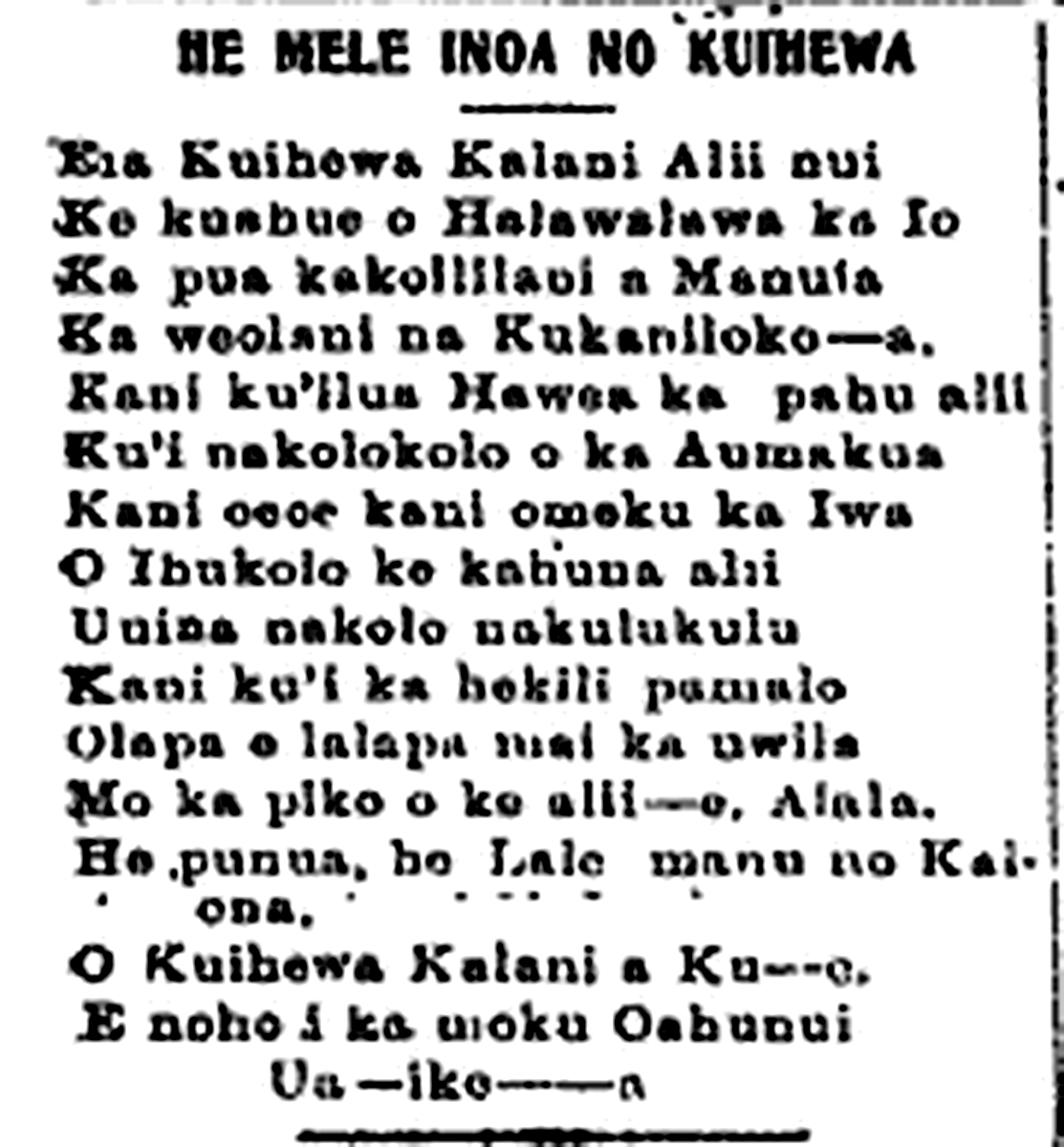
A mele inoa for Kuihewa, 1914.

HE MELE INOA NO KUIHEWA

Eia Kuihewa Kalani Alii nui
Ke kuahue o Halawalawa ka Io
Ka pua kakoililani a Manuia
Ka weolani na Kukaniloko—a
Kani ku’ilua Hawea ka pahu alii
Ku’i nakolokolo o ka Aumakua
Kani oeoe kani omeku ka Iwa
O Ihukolo ke kahuna alii
Uuina nakolo nakulukulu
Kani ku’i ka hekili pamalo
Olapa e lalapa mai ka uwila
Mo ka piko o ke alii—e, Alala
He punua, he Lale manu no Kaiona
O Kuihewa Kalani a Ku—e
E noho i ka moku Oahunui
Ua—ike——a

(Holomua, 10/10/1914, p. 1)

HE MELE INOA NO KUIHEWA

Ka Holomua, Buke II, Helu 2, Aoao 1. Okatoba 10, 1914.

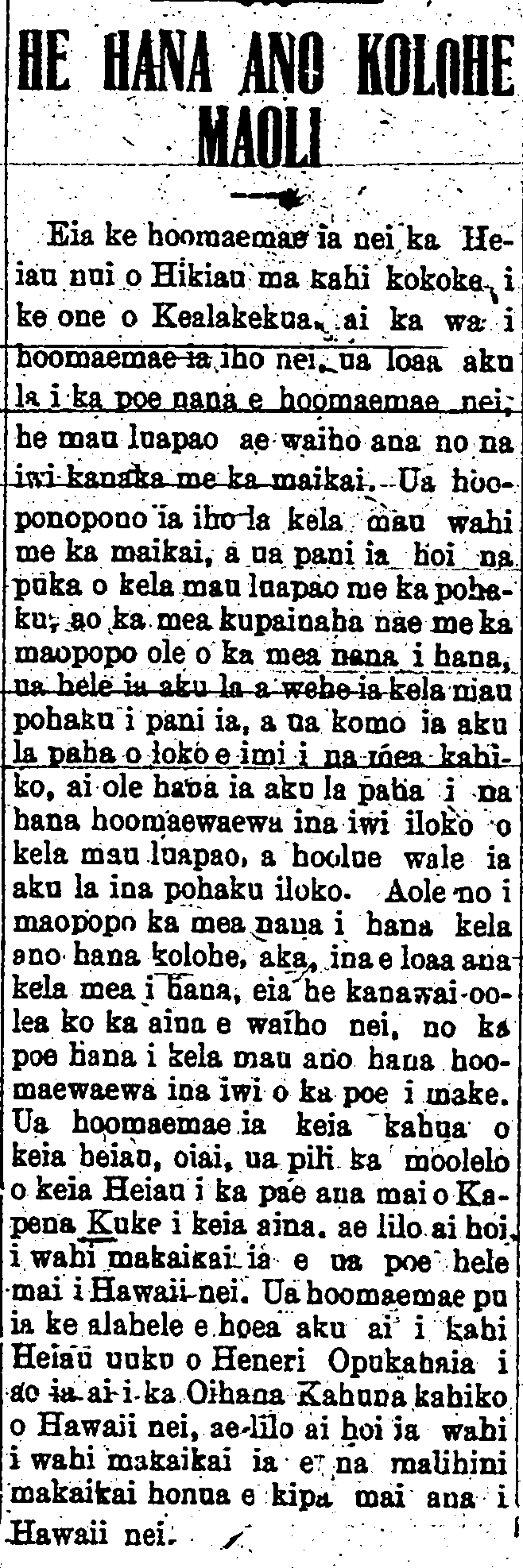
Desecration of heiau, 1917.

A Terribly Mischievous Act.

The great heiau, Hikiau, which is near the sands of Kealakekua, is being cleaned up, and while this cleaning was being done, the people working found some burial caves and in them were neatly placed human bones. They were arranged nicely and the mouths of the caves were closed over with rocks; the shocking thing is that the rocks were later removed and the caves were entered perhaps to be searched for antiquities, or perhaps to desecrate the bones in the caves, and the rocks were piled up inside by some unknown person. The perpetrator of such mischief is not known, however if the culprit is found, there is a stiff punishment established here for those who desecrate the bones of the dead. The grounds of this heiau were cleaned up because the history of this heiau includes the landing of Captain Cook here, and it will become an attraction for those visiting Hawaii nei. Also cleaned up was the pathway to the small heiau where Henry Opukahaia was taught the old ways of the kahuna of Hawaii nei, and this place will become a place visited by world travellers who come to Hawaii nei.

[The early years of Hoku o Hawaii (including the issue which includes this article) have yet to be put up online.]

(Hoku o Hawaii, 2/1/1917, p. 1)

HE HANA ANO KOLOHE MAOLI

Ka Hoku o Hawaii, Buke 11, Helu 36, Aoao 1. Feberuari 1, 1917.

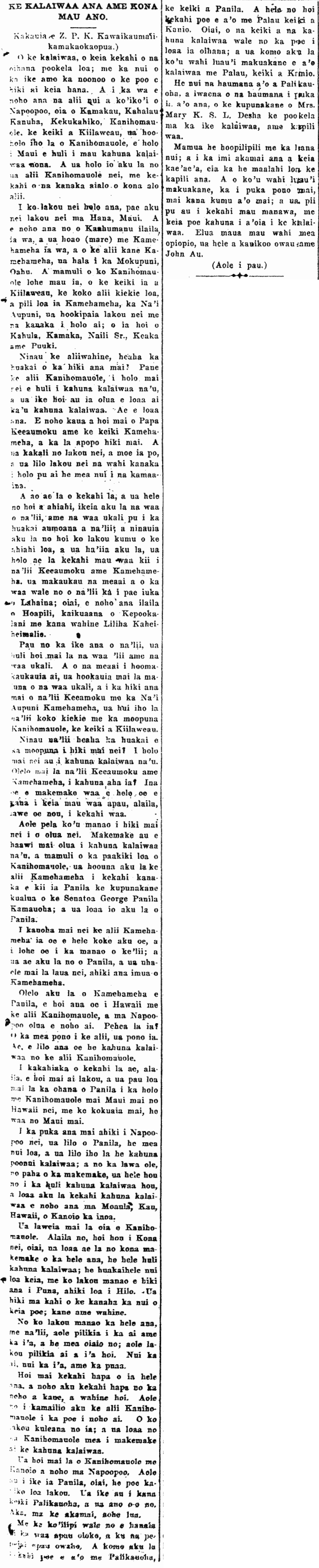
Z. P. K. Kawaikaumaiikamakaokaopua’s treatise on canoe building, 1922.

CANOE BUILDING AND ITS CHARACTERISTICS.

(Written by Z. P. K. Kawaikaumaiikamakaokaopua.)

Canoe building is one of the greatest trades; it is with great knowledge and thought that this is done. And when the important high chiefs of Napoopoo were living, they being Kamakau; Kahalau; Kanuha; Kekukahiko; and Kanihomauole, the son of Kiilaweau; Kanihomauole decided to go to Maui in search of a number of canoe building kahuna for himself. And that alii Kanihomauole did indeed go with some attendants from his royal court.

When they went, they landed at Hana, Maui. Kaahumanu was there living at the time, and was married (hoao) with Kamehameha, who was away on Oahu. And because it was heard often that Kanihomauole was the child of Kiilaweau, the alii of highest blood, and that he was kin to Kamehameha, the Conqueror of the Nation, they were welcomed along with those who came, they being Kahula, Kamaka, Naili Sr., Keaka and Puuki.

The queen asked, “why have you come?” The alii Kanihomauole replied, “I have come in search of a kahuna kalaiwaa for myself, and I have come to see the two of you to get my kahuna kalaiwaa.” “Yes, you will have one. Let us remain until Papa Keeaumoku and the boy Kamehameha returns; they will be back tomorrow.” And they waited, and spent the night, and those that came were treated well by the kamaaina of the place.

[This is how the piece on canoes by Kalokuokamaile begins on 10/26/1922, and it continues on in the Kuokoa until 2/15/1923. This is one of the many priceless translations appearing in the Bernice Pauahi Bishop Museum’s Hawaiian Ethnographic Notes (HEN) Collection.  HEN: Newspapers, October 26, 1922.

Kalokuokamaile was very prolific. This series is then followed by yet another, this time on net making!]

(Kuokoa, 10/26/1922, p. 7)
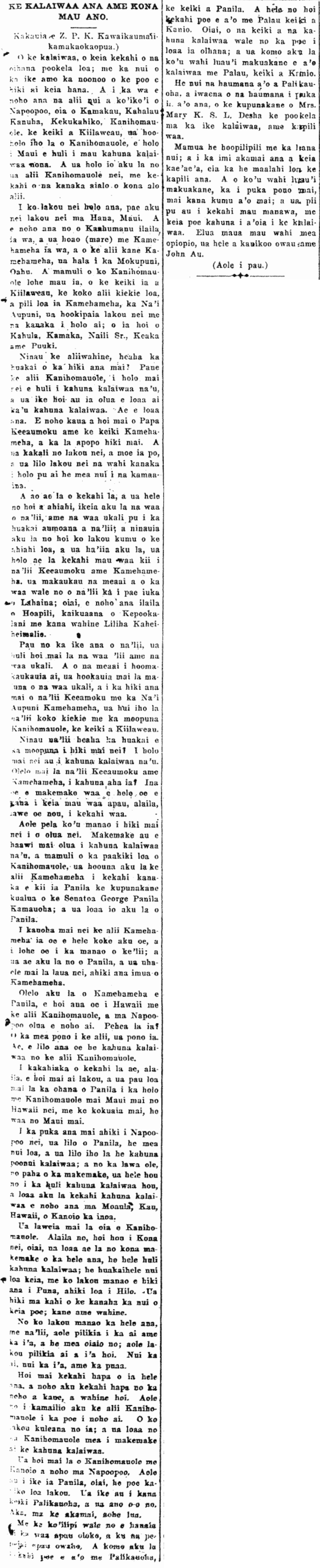
KE KALAIWAA ANA AME KONA MAU ANO.

Ka Nupepa Kuokoa, Buke LXI, Helu 43, Aoao 7. Okatoba 26, 1922.

Western medical school for Hawaiians, 1870.

Kahunas.

We understand that one of our physicians, who is thoroughly conversant with the native language, has been authorized to form a class of eight or ten Hawaiian young men, (graduates of the highest schools,) for instructions in the principles and practice of medicine.

There has never been made, that we are aware of, any systematic or earnest effort to instruct Hawaiian youth in the medical art. The knowledge that is necessary to be acquired to make a skillful and thoroughly competent practitioner is not to be obtained in this country, which as yet, does not possess medical schools and colleges, and the difficulties in the way of sending Hawaiian pupils abroad to obtain a medical education, are so various and insurmountable, as almost to preclude any hope of being overcome. Continue reading