On Owls and wishing organizations who have kuleana would fund reshooting the newspapers, 1893/2012.

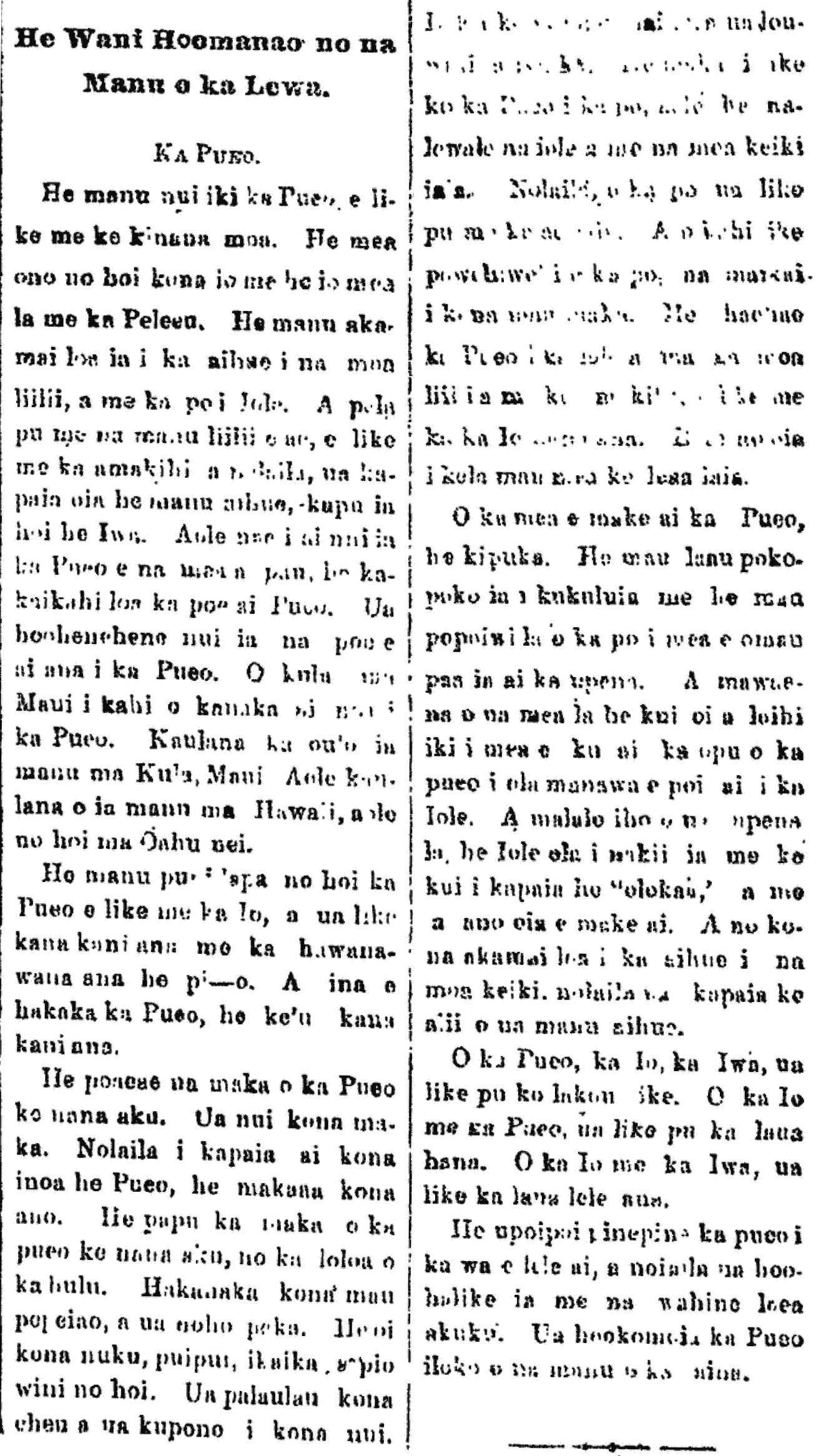
Some Recollections about Birds

The Owl.

The Pueo is a smaller large bird, like a hen of a chicken. Its flesh is delicious like chicken or Turkey. It is a very intelligent bird in stealing chicks by swooping down. So too other small birds, like the amakihi, and therefore, it is called a thieving bird, and called an Iwa [Frigate bird]. The owl is not eaten regularly by most people, there are only a few that eat Pueo. Those who eat it are greatly ridiculed. It is in Kula, on Maui, that people eat a lot of Pueo. The perching of that bird is famous at Kula, Maui. This bird is not famous on Hawaii or here on Oahu.

The Pueo is ???? like a Hawk [Io], and its cry is like a whispering “pi——o”. And if the Pueo fights, it hoots.

The eyes of a Pueo are round. Its eyes are large. That is why it is called a Pueo, as it has staring eyes…

[This article goes on, but most of it is hard to make out. I am not even sure about that part that says Kula people ate a lot of owls because of the bad image. Maybe now that Hamilton Library has a super scanner, there can be progress made on reshooting all of the Hawaiian-Language Newspapers?!

Also this is part of a series on birds, but much of it and a lot of this paper in general is hard to read because of the bad images now available.]

(Lei Momi, 7/27/1893, p. 2)

He Wahi Hoomanao no na Manu o ka Lewa.

Ka Lei Momi, Buke I, Helu 30, Aoao 2. Iulai 27, 1893.

Harrowing octopus encounter, 1896.

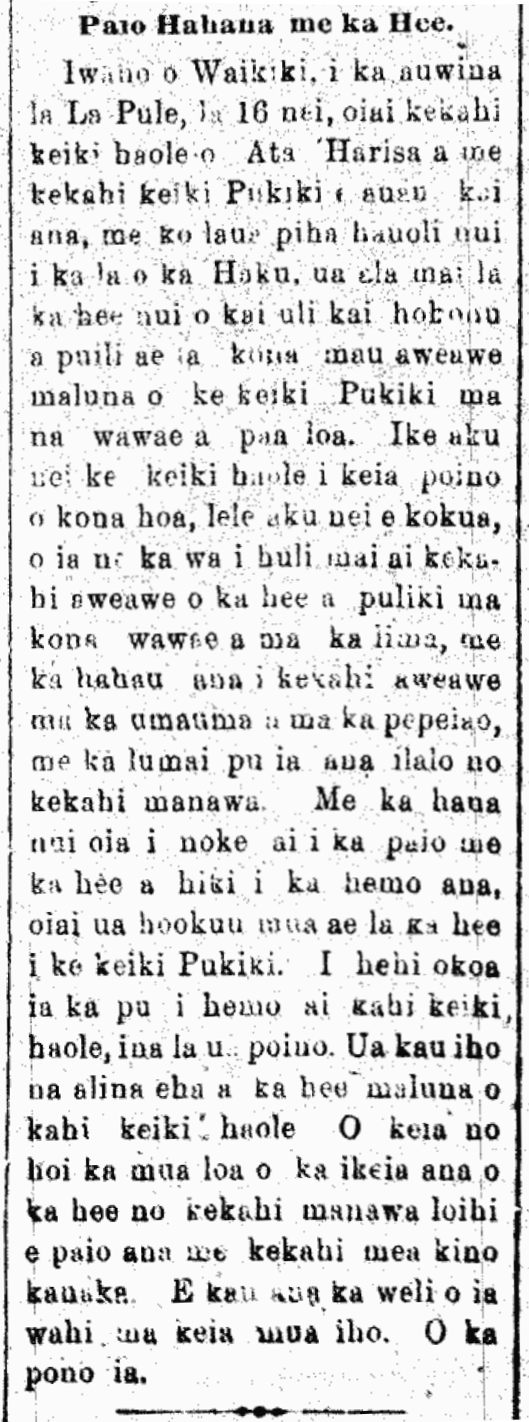
Fierce Battle with a Hee.

Outside of Waikiki, in the afternoon of Sunday, the 16th, while the haole children of Arthur Harris [Ata Harisa] and some Portuguese children were swimming in the ocean, full of joy on the day of the Lord, a great octopus from the deep, dark sea, rose up and wrapped its tentacles tightly about the legs of the Portuguese boy. The haole boy saw this trouble faced by his friend, and sped over to help; that is when one of the tentacles of the hee swung and grabbed on to his leg and arm while one of the tentacles pummeled his chest and ear, while he was pulled down under for a time. With much effort, he kept on fighting with the hee until he was free, being that it had previously released the Portuguese boy. The head of the hee was stomped full on so that it released the haole boy, or he would have been in trouble. The haole boy was left with scars on him from the hee. This is the first time in a long time that a hee was seen fighting with a person. That place will be feared from here forth. This is as it should be.

(Makaainana, 2/24/1896, p. 2)

Paio Hahana me ka Hee.

Ka Makaainana, Buke V—-Ano Hou, Helu 8, Aoao 2. Feberuari 24, 1896.

“All subjects were handled for what he believed to be the best interests of the Hawaiians…” 1902.

Ka ʻOihana Lawaiʻa: Hawaiian Fishing Traditions

Ka ʻOihana Lawaiʻa: Hawaiian Fishing Traditions

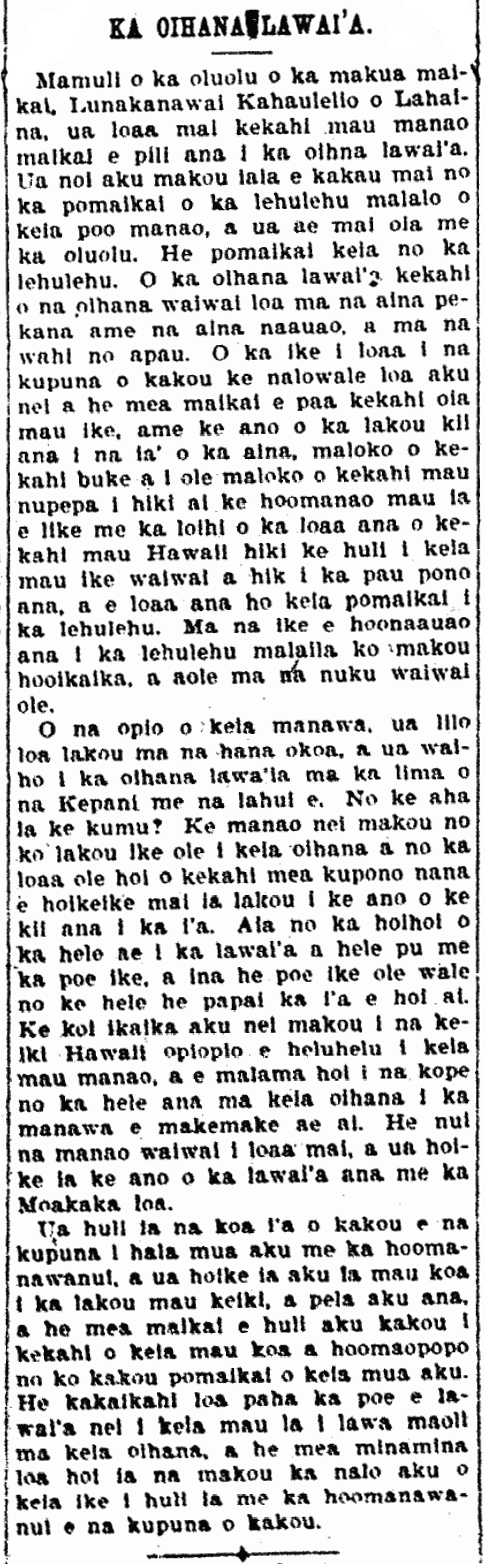
If you haven’t seen this book on fishing and so much more by Daniela Kahaulelio yet, it is one of the stories David Kanewanui, editor of the Kuokoa, knew was important for him to print for the youths of his time, and perhaps more importantly, for those of today and tomorrow. Kanewanui writes:

“…O ka ike i loaa i na kupuna o kakou ke nalowale loa aku nei a he mea maikai e paa kekahi oia mau ike, ame ke ano o ka lakou kii ana i na ia o ka aina, maloko o kekahi buke a i ole maloko o kekahi mau nupepa i hiki ai ke hoomanao mau ia e like me ka loihi o ka loaa ana o kekahi mau Hawaii hiki ke huli i keia mau ike waiwai a hik i ka pau pono ana, e loaa ana no keia pomaikai i ka lehulehu. Ma na ike e hoonaauao ana i ka lehulehu malaila ko makou hooikaika, a aole ma na nuku waiwai ole.”

“The knowledge possessed by our kupuna is disappearing, and it is good to record some of that knowledge, along with how they caught the fish of the land, within a book or within some newspapers, so that they can always be recalled as long as there are Hawaiians who can seek this treasured knowledge until it is exhausted, and its benefits will be for all. Through knowledge will the public be educated, and this is our focus, and not worthless complaining.”

(Kuokoa, 2/28/1902, p. 2)

KA OIHANA LAWAIA

Ka Nupepa Kuokoa, Buke XL, Helu 9, Aoao 2. Feberuari 28, 1902.

More from the Pacific Northwest, but a little more “recent,” 1912.

A LETTER FROM AFAR

(Written by Sam K. Nainoa.)

The following letter is written by Sam K. Nainoa from Seattle, after the passing of several weeks since he left his homeland with his queen, on their travels, explaining some major things that they saw in their sightseeing of these foreign lands, and this will be something which the readers of the Kuokoa will rejoice in because of the progress witnessed by the two of them made by the Hawaiian youths living in that foreign land.

SEATTLE, May 16, 1912, Aloha oe:—Here we are, staying in this town; we’ve been here almost two weeks, meeting with the Hawaiian boys, and we are full of joy.

There is a great number of my classmates living here, all of them Hawaiians; they are playing music and singing, and they are making a lot doing this work; and some of them married haole women, and they are truly taken by this land, with no desire at all to return to the land of their birth.

Some of them have land and are well off; according to what they tell me, their thoughts of returning to Hawaii are no more; this is where they will live and they will leave their bones in this foreign land.

We went touring around another area farther across this expansive ocean for a few days and came right back, and am writing this letter to you. We went sightseeing at a wood mill, at a place called Port Blakeley, which is one of the largest mills in the world.

What I saw was truly amazing. There are many Hawaiian boys indeed living there, and to go from one area to the next, you travel by steamship. The Hawaiians take a fancy to living there, and for work, they do lumbering.

Hawaiians have no problem with jobs there; they have work at all times.

Some boys from Port Blakeley came to Seattle and got together with us and the band boys who live in Seattle; they insisted that we go with them to where they live, and there was not refusing the hospitality of the kamaaina, so we went aboard a steamship, spending a few days there and immediately returning back.

There were two Hawaiian women there with their husbands, and they have become mothers to the Hawaiian boys there; their living is easy, and they get along lovingly; I would not be mistaken to say there is a place for them in this land without their parents [he mua a he hope ka noho ana o ka aina makua ole ?]

There is bountiful food there, and when we arrived, two pigs were roasted as is the custom of Hawaiians, and all the luau foods were prepared like inamona, limu eleele, dried fish, alamihi crab, raw fish, and their poi was poi palaoa [flour poi].

Here they have dried opelu and dried nehu and many other things so that Hawaiians living here have nothing to complain about; they have everything, perhaps even more than Hawaii.

We enjoyed ourselves, and there was but one thing to do, that is to sing and to play music, and we were terribly happy. There is an over abundance of palai fern there, it is protects your feet [he pale wawae ia mea he palai ?] and it grows all the way until the ocean. When we went pole fishing, we caught poopaa and also large kuahonu crabs. There is a fish that looks like opelu here, and perhaps it is opelu; so too with the puhikii, which is good eating raw.

There are so many delicacies here: salmon worked in with tomatoes and onions; and according to what these Hawaiians say, there is no food that you can’t get here, you have so much to choose from to satisfy your wants.

These people were very kind to us, and we are greatly indebted to them for their hospitality, and these Hawaiians of ours are blessed in making this place somewhere that they look for their livelihood.

This is enough for now, and maybe there will be more free time here after to write more of our travels. All the Hawaiians here give their aloha to our lahui.

Your friend,

S. K. NAINOA.

(Kuokoa, 6/7/1912, p. 6)

HE LEKA MAI NA AINA MAMAO MAIA

Ka Nupepa Kuokoa, Buke XLVIII, Helu 23, Aoao 6. Iune 7, 1912.

On the decline of native birds, 1871.

Locals of the Tuahine Rain are no more.

O Ke Au Okoa:—Aloha to you:

I am sending you a small gift atop your outstretched foundation, should your captain and Editor be so kind, and it will be for you to take it to the shores of these islands so that my newspaper-reading companions may see it, it being the letters placed above: “Some Locals of the Tuahine Rain¹ are no more,” and it has been ten or more years which they have not been seen.

And my friends are probably puzzled about these locals that have gone missing, and you, our old-timers, are all likely saying, not them, here they are, and some people have passed away, but we knew of their passing; but the departure of these kamaaina which I speak of was not witnessed. And this is it, the kamaaina birds of our uplands: the Iwi, the O-u, the Akakane, the Amakihi, the Oolomao, the Elepaio; these are the native birds of these uplands who have disappeared.

And some of you may be questioning, what is the reason for this disappearance? I tell you, it is because of the spread of the evil birds from foreign lands, in our plains, mountains, ridges, valleys, cliffs, forests, terraced taro patches, seashores, and rivers; that is why these kamaaina have gone, because of the spreading of these evil birds among us, and they are damaging the crops, and the food from the forests; rice planted by some are being eaten by these evil birds; and the bananas of the forests are all eaten up by these birds.

What do we gain from these evil birds being spread in Hawaii, and protecting them so that they are not killed? I say that we gain nothing from these evil birds which are hurting our native birds and crops and foods from the forests; because in the past, before the spread of these birds, if a kamaaina of this land wanted to go into the mountains to get thatching or some shrimp, or some oopu, they did not pack food with them, because they thought that there was food in the mountains, like banana, hawane fruit, and uhi; banana would ripen on the plant and then fall, without anything damaging them, but now, the bananas don’t ripen on the plant; they are eaten by these banana-eating mu [mu ai maia] of the forest; bananas don’t ripen, and [now] when you go into the mountains, there is just the oka-i [blossom container of bananas] left and the bananas are lost to these birds; and the kamaaina birds are gone. Where to? Perhaps they all went to Hawaii island.

And I say without any hypocrisy, the decrease of this people was because the arrival of the evil haole to Hawaii nei; it was they who spread the evil sicknesses: gonorrhea [pala] and syphilis [kaokao]. Smallpox [hepera] and leprosy [mai pake] are the reasons that our lahui was decimated, because of the arrival of the evil haole; if all the people who came to Hawaii were like the people who brought the light [missionaries],  then this lahui would not have decreased in number; so too with the arrival of the evil birds to Hawaii nei, which hurt our native birds and plants; this is like the decrease of our lahui with the arrival of the evil haole who spread gonorrhea and syphilis and similar diseases.

Therefore, I feel aloha for the kamaaina birds of my beloved land because they are all gone, and the youngsters of these days question, what are those birds like? They are tiny birds with beautiful voices, and their feathers as well, and they were an enjoyment in our childhood; when times of strong winds arrived, all the birds of the mountains would alight and show up at the doors of the houses which was entertaining for us to watch them flitting amongst the leaves of the ilima in our childhood and they were a playmate in our youth.

Before the arrival of these birds, there was a great abundance of Iwi, Amakihi, Akakane, O-u, Oolokela, and Elepaio, right here above us, atop the clumps of aliipoe, bushes of hau, noni trees, and more upland, the number of birds was amazing, atop the flowers of lehua of the mountain apples, and on the Ahihi and the Lehua Kumakua;  those uplands were so enjoyable but these days, they have all vanished, maybe because there were aggravated by these evil birds.

Here is another thing; if only the coming session of the Legislature could revise the law pertaining to birds from foreign lands, for there are destructive birds that have been imported as well from foreign lands.

And this is a supplication to you, O Ke Au Okoa. With aloha to the one who steers you, and also to the boys of the Government Printing Press. The boy from the uplands is turning back for the Tuahine rain of the land is spreading about.

T. N. Penukahi.

Manoa, June 24, 1871.

¹Tuahine [Kuahine] is the famous rain of Manoa.

(Au Okoa, 6/29/1871, p. 3)

He mau wahi kamaaina no ka ua Tuahine, ua nalowale.

Ke Au Okoa, Buke VII, Helu 11, Aoao 3. Iune 29, 1871.
Lost turtle? 1857.

TURTLE THAT TRAVELLED FAR INLAND.

O Hae Hawaii:

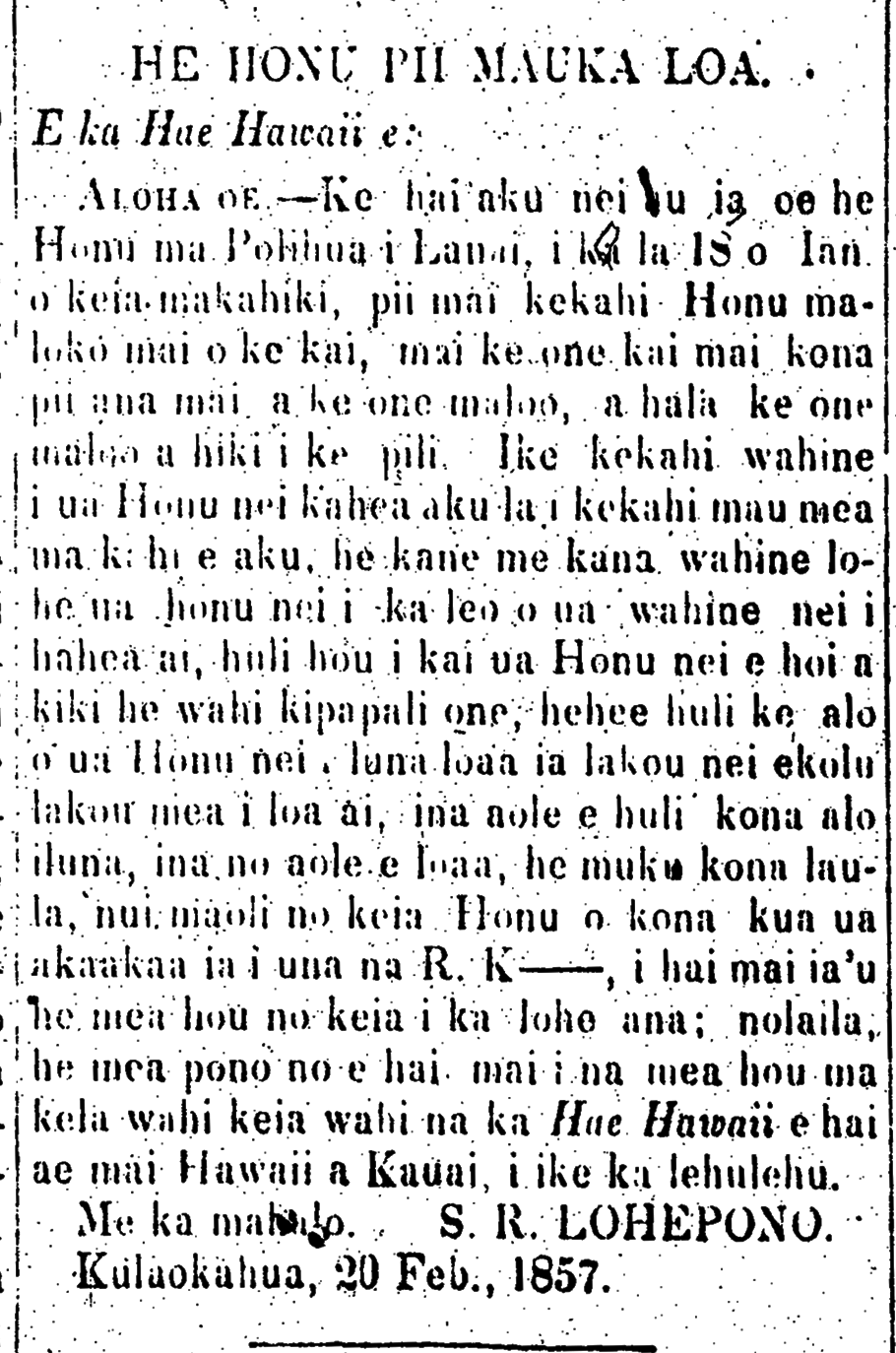
Aloha to you:—I am informing you about a Turtle at Polihua, Lanai: on the 18th of January of this month, a Turtle travelled from within the ocean; it went from the wet sands to the dry sands; passed the dry sands until where the pili grass grows. A woman saw this Honu, and called some people who were elsewhere, a man and his wife; the Turtle heard the voice of the woman that was calling out, and it turned back to return to the sea; it came upon a sandy cliff [kipapali one?] and the Honu slid and flipped over; the three got what they were after, but if it had not flipped over they wouldn’t have caught it; it was a muku¹ in width; the Honu was huge; the shell was removed by R. K_____, who said to me that this was something not heard of; so it is important that the Hae Hawaii covers news from all over so that all from Hawaii to Kauai can know.

With appreciation, S. R. LOHEPONO.

Kulaokahua, 20 Feb. 1857.

¹Muku is when you stretch out both arms, the length from the fingertips of one hand to elbow of other arm.

(Hae Hawaii, 3/4/1857, p. 1)

HE HONU PII MAUKA LOA.

Ka Hae Hawaii, Buke 2, Ano Hou.—Helu 1, Aoao 1. Maraki 4, 1857.

Moo at Mokuhinia, Lahaina, 1861.

Child Grabbed by Moo.

On the evening of the 7th of this month, that being a Friday, a couple of small children were bathing in Mokuhinia Pond in Lahaina, close to the bridge [uapo], when the sun was going down.

One of them continued to bathe, his name was Lono; he was almost eight years old, and his height was four feet. Right then after, this boy plain disappeared, but his parents did not think that he disappeared in the water.

A woman named Paahao saw a long fish in the water like an Swordfish [Auau], and its belly was white; she called out to the mother of the boy, “There is a long fish in the water with a white belly.” The mother named Kaohe said, “You must be confusing it with a Turtle.” The other responded, “Let’s go and see.” Kaohe went, and lo and behold, it was as Paahao had seen. Paahao went to go see the fish from atop the bridge while Kaohe continued to watch the fish; after a little time, Kaohe’s eyes were struck [temporarily blinded? “paia mai la ka maka”] and the water turned white, and the fish disappeared from her sight. As for Paahao, she arrived atop the bridge and the fish sprayed up dust, and it disappeared.

Then after, the two thought of Lono, and that he disappeared in the water. And they concluded that this was a moo that had revealed itself for Lono. They searched and went to look on the bridge, but it was not seen.

The father of the boy arrived, named Maalewa. He looked under the bridge, and come to find out, he saw the boy in the water where he was hidden by the moo; his body was attached to the coral and his hair was all that could be seen on the surface of the water.

The father grabbed him by the hair, and pulled him up, and he was almost dead; his body was stiff from top to bottom, and his eyes could not see, and his skin was slimy, which was believed to be the slime of the moo.

He was massaged by his parents until seven in the evening, whereupon he got slightly better but did not say a word, but later he revived.

Therefore, this was something miraculous to see; let it be known to all our friends from Hawaii to Kauai.

T. W. NAKAIKUAANA, PUAA.

Lahaina, Maui. June 8, 1861.

This is the remarkable thing; the foolishness of man. The women saw the child shaking in the water, close to dying, and they did not grab him and save him; but they just stood there saying, “A moo! A moo!” Auwe! the foolishness and heartlessness of some people. If the father had not arrived then, the child would be dead.

[I posted this article a long time ago on the Hoolaupai Facebook page, but because it has such bad search capabilities, i can’t find it. That is one of the reasons i started this blog. Searching for names or places or subjects, etc., is so much easier to do!

I am not sure what the commentary at the bottom is referring to, about the women seeing the boy shaking in the water…

For more on Mokuhinia and the work being done to restore this historic place, see: Friends of Mokuula.]

(Hae Hawaii, 6/12/1861, p. 41)

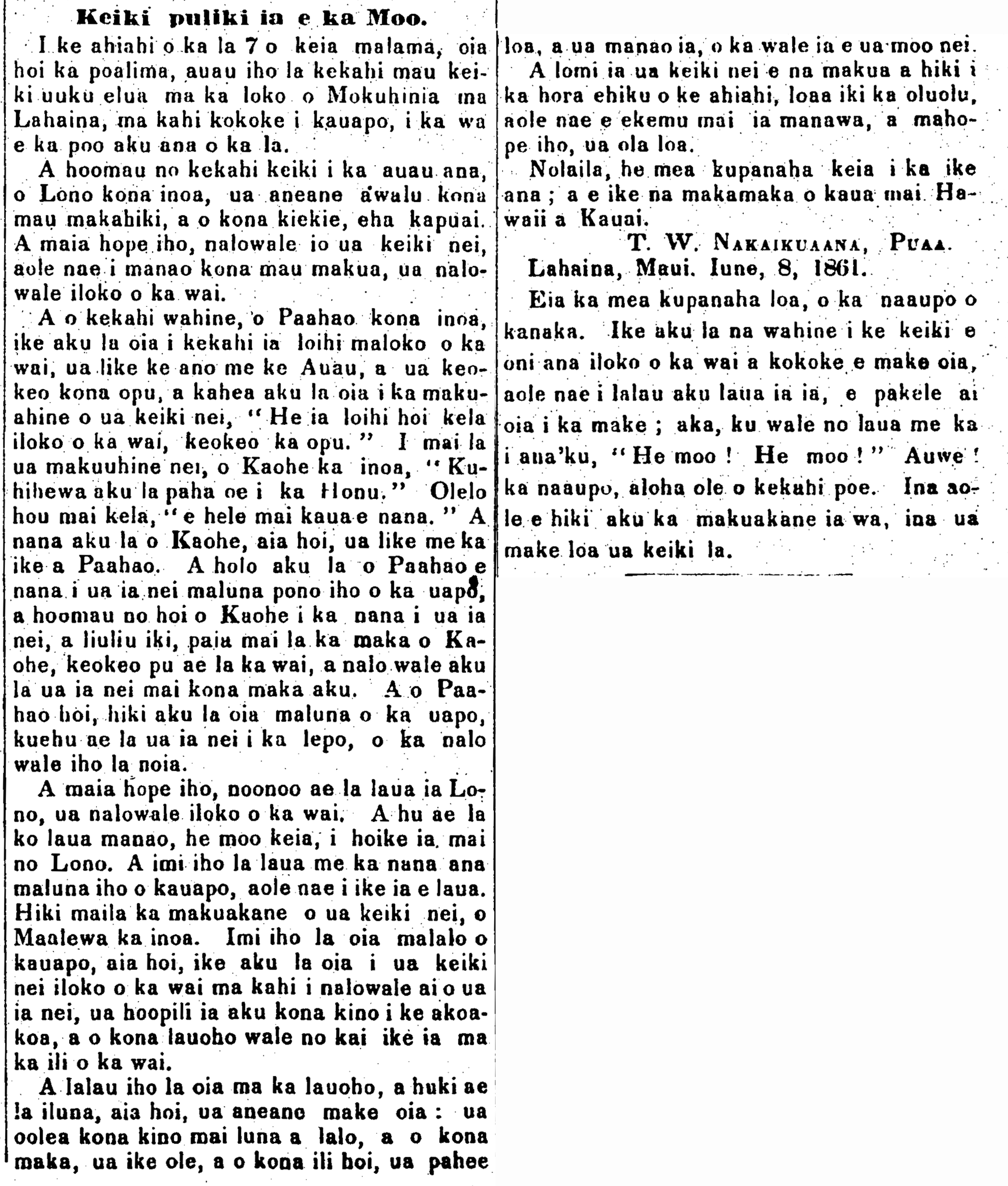
Keiki puliki ia e ka Moo.

Ka Hae Hawaii, Buke 6, Ano Hou.—Helu 11, Aoao 41. Iune 12, 1861.

Shark attack, 1914.

GRUESOME DEATH BY A SHARK

This Sunday, Mar. 1—A Japanese and his son went to pick opihi [kui opihi] on the sea cliffs of Honomu, and while they were enjoying the opihi picking, the boy slipped and fell into the ocean, and before the father could do something for the child, the boy was taken by a huge black shark.

The body of that Japanese boy was held upwards in view of the father, and when it went back down into the ocean, the waist was severed, and with the second bite of that man-eating shark, the body of that unfortunate boy was completely gone. The actions done by that niuhi to that pitiful child is truly frightening.

(Hoku o Hawaii, 3/5/1914, p. 2)

MAKE MAINOINO I KA MANO
Ka Hoku o Hawaii, Buke 8, Helu 39, Aoao 2. Maraki 5, 1914.

More Lei Day in Hilo, 1928.

DAY TO CELEBRATE LEI IN HILO

On Tuesday last week, Hilo held a celebration and display of flower lei of all sorts, and this was done at the Bank of Hawaii in Hilo. All types of lei were brought down and they were made will all kinds of flowers of all types, and prizes of all kinds were prepared of gold coins [dala gula].

The doors of the Bank were opened at seven in the morning, and lei of all types were brought in from then on until 10:00 A. M. of that morning, and then the doors were closed to bring in the judges.

However the bringing in of lei to put on display by others after that was not barred. Entered were all types of lei of all sorts; for instance, lei made of various flowers, and some lei were woven with the buds of the lehua, and lei hinahina, and lei pukamole of all sorts. Also brought for display were some oo bird feathers, and feather lei of various birds, but they were not there for judging, they were just there to show the many beautiful kinds. Some of those lei of oo bird feathers are valued at $1,700 for one.

The placing of the various lei were organized by the Committee chosen earlier, and also chosen before were the judges who would decide which lei won the prizes, and they were Miss Ivy Richardson, Mrs. Emily Sexton, and Mrs. S. L. Desha, Sr. Also selected was the one who would announce the winning lei and he would also hand out the prizes decided upon by the lei judges.

From the time when the Bank was opened until the time when the awards were given, there was approximately five-thousand visitors who entered to look at the many lei, and voices of appreciation were heard from the mouths of many attendees, and the crowd expressed their joint feelings to rouse this new Hawaiian spirit, and that this event will be commemorated always from now on. There were countless [hewa i ka wai] lei that were crafted of all sorts, and it was truly a difficult task for the Judges to give their decision on some of these lei.

When the many lei were brought in, the name of the maker was immediately announced, and a number was given to the lei, so therefore the judges did not know who strung the lei, or crafted them with great skill.

When the period for the competition lei to be entered was over and the doors were closed to the entry of lei competing for the various prizes, the judges began to examine each lei, paying attention to make up of the lei, and how it was crafted, and how cleanly it was made and how neat they were as well. [They were judged] not on just how pretty the flowers were, but on how the lei were made.

In the examination by the Judging Committee, their job was tremendous, being that there were just so many beautiful-looking lei of all sorts, but some were distinguished by how they were made, in that they were woven with true craftsmanship, or by how the flowers were sewn into the lei. By those qualities did they hand down each of their judgements.

There were two competition divisions that were entered, those being lei entered by individual lei makers, and lei entered by a group, and many different schools entered their lei. The Judges awarded the First Place Prize to the beautiful lei entered by Mrs. Lulu Kawelu, and that was a prize of $30.00 and the second place prize went to Miss Charlotte Lyman, $20.00.

To the Women’s Association of Hilo went the first prize of $20.00, for the lei entered by a group; and the First Place Prize of $20.00 for the beautiful lei entered by a skilled maker of lei—to Mrs. Susie Naope with a lei of Red Lehua skillfully woven  and wound with white lehua, and by weaving this lei, that prize went to her.

As for the schools, the prize of $15.00 went to the Mauna Huihui School, and the second place to the school children of Puumaile Home, a prize of $10.00.

To Hilo Junior High School went the first place, and to Kapiolani School the second place; $15.00 was the first prize and $10.00 was the second prize. The school that was the luckiest was the Kurtistown School, whose principal is Miss Mary Nailima—to them went the first prize and second prize, $15.00 and $10.00.

Kahu S. L. Desha, Sr. announced the winners of the prizes and it was he who presented the prizes. Some people had all sorts of ideas regarding the decisions of the judges, but the Judging Committee did as they thought was right. It is difficult indeed to please everyone, but they did what they could, and should you, O Fault Finders, be in their place, there mostly surely would be those faulting your decisions. The thing sensed by the crowd there at that time was the new Hawaiian spirit; and this event will become something that reawakens the spirit of Hawaii of times past.

(Hoku o Hawaii, 5/8/1928, p. 2)

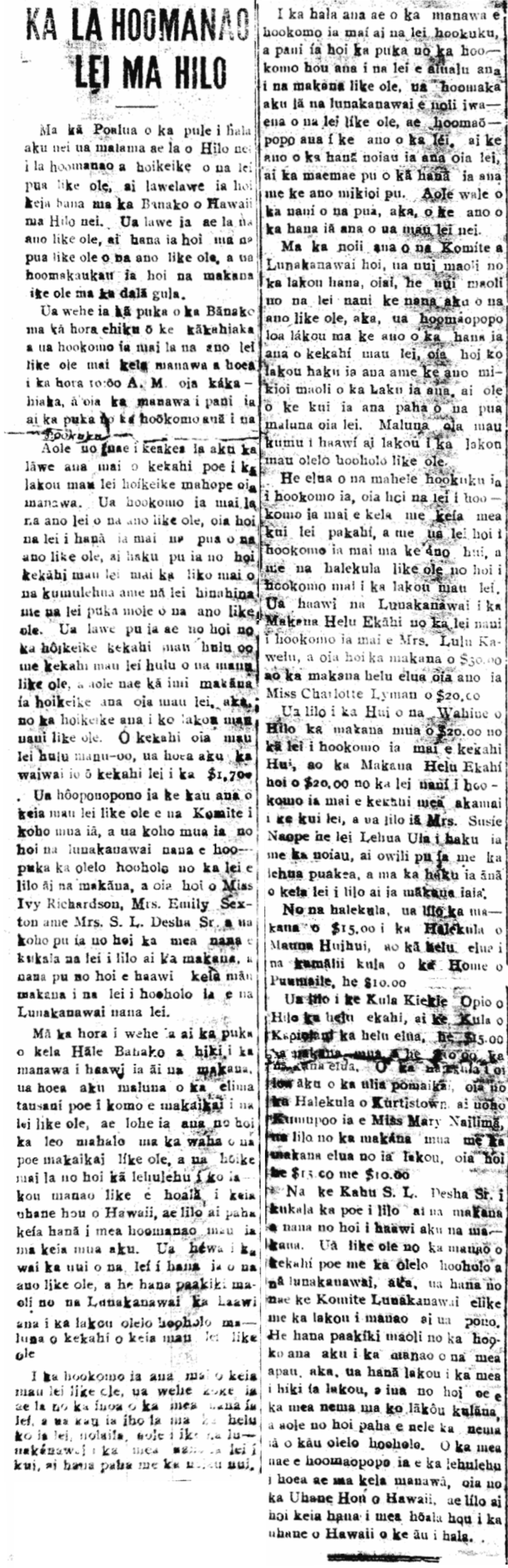
KA LA HOOMANAO LEI MA HILO

Ka Hoku o Hawaii, Buke XXI, Helu 48, Aoao 2. Mei 8, 1928.

Bad weather on Kauai. 1862.

Great Flooding in Waimea.

During this year, 1862, there was flooding here in Waimea. This is what I saw on the day of the flood, a lot of kindling; it wasn’t like that before in the years since I arrived here to Kauai, that being 1830; in the floods I’ve witnessed, there was only a little kindling. This year is the first time I’ve seen so much wood for fire; people were gathering it up and making piles. A strong man would have a pile and a half or more, and another would have a cord or less. Men would gather, women, and children too; people gathered it up, but there was no end to it; your body would get tired from carrying the wood, and yet the kindling, it would still be remain here and there.

Another thing I witnessed in the flood was a horse, and I hear from some other people that four horses came ashore at Pawehe; all together that makes five horses. And from some other people I hear that a cow died but did not wash up ashore, but was searched carefully for all the way until Kokole, but was not found.

I’ve seen pigs and goats that were dead, laying on the shore, and there are some ducks still alive; there are places which I’ve heard that are obstructed in the uplands of Waimea, and some people almost got in trouble in this flood.

J. W. Kapehe,

Waimea, Kauai, Jan. 3, 1862.

(Kuokoa, 3/22/1862, p. 2)

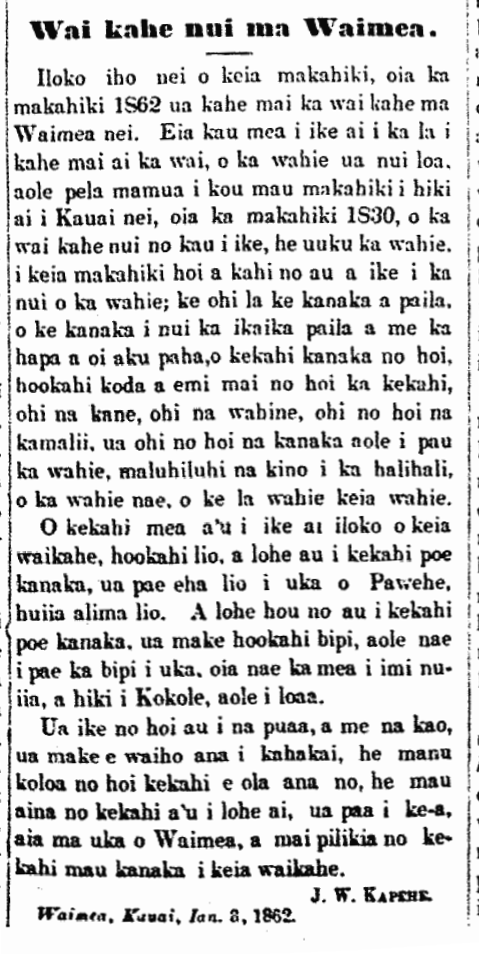
Wai kahe nui ma Waimea.

Ka Nupepa Kuokoa, Buke I, helu 17, Aoao 2. Maraki 22, 1862.