Prince Leleiohoku’s glittering gold bar, 1922.

[Found under: “Makalei, ka Laau Pii Ona a ka I’a o Moaula-Nui-Akea i Kaulana”]

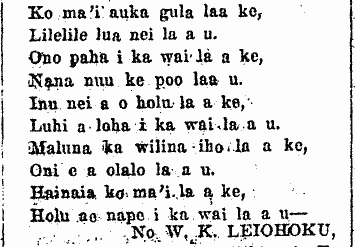
Ko ma’i auka gula laa ke,
Lilelile lua nei la a u.
Ono paha i ka wai la a ke,
Nana nuu ke poo laa u.
Inu nei a e holu la a ke,
Luhi a loha i ka wai la a u.
Maluna ka wilina iho la a ke,
Oni e a olalo la a u.
Hainaia ko ma’i la a ke,
Holu ae nape i ka wai la a u—

No W. K. LEIOHOKU [W. P. LELEIOHOKU]

[Many times mele are used to enhance stories, and there is no telling where you might find a mele, old or new. This procreation chant for William Pitt Leleiohoku for instance is included in this story to add to the mood following a description of the deeds of the “kalohe”.]

(Kuokoa, 2/17/1922, sec. 2, p. 2)

Ko ma'i auka gula laa ke...

Ka Nupepa Kuokoa, Buke LXI, Helu 7, Mahele Elua, Aoao 2. Feberuari 17, 1922.

The Hon. J. A. Nahaku passes on, 1887.

The Hon. J. A. Nahaku.

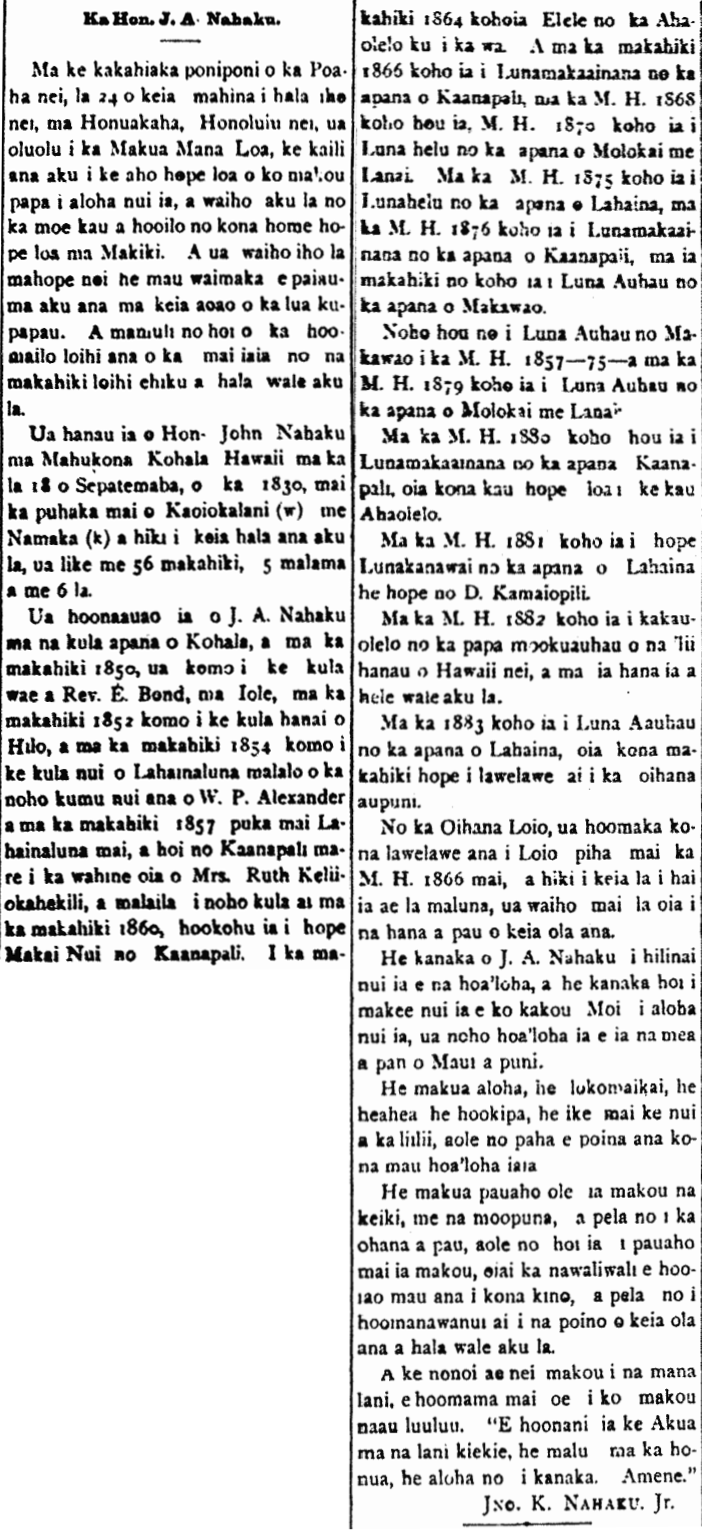
In the deep purple morning of this past Thursday, the 24th of this past month, at Honuakaha, here in Honolulu, the Almighty Father was pleased to take the last breath of our dearly beloved father, and leave him behind to sleep the eternal sleep at his last home in Makiki. And left behind were tears of grief on this side of the grave. And he passed after being troubled with sickness for the long period of seven years.

The Hon. John Nahaku was born at Mahukona, Kohala, Hawaii, on the 18th of September, 1830, from the loins of Kaoiokalani (f) and Namaka (m) and until  his recent passing, he was aged 56 years, 5 months, and 6 days.

J. A. Nahaku was educated at the district school of Kohala, and in the year 1850, he entered into the school of Rev. E. Bond, at Iole, and in 1852, he entered into the Hilo Boarding School, and in 1854, he entered into Lahainaluna College under the tutelage of W. P. Alexander, and in 1857, he graduated from Lahainaluna and returned to Kaanapali where he married his wife, Mrs. Ruth Keliiokahekili, and there he resided and in 1860 he was appointed Sheriff of Kaanapali. In 1864, he was elected as a Delegate to the Constitutional Convention. And in 1866, he was elected as the Representative for the district of Kaanapali, and in 1868, he was reelected, and in 1870 he was appointed as census taker [Luna helu] for the district of Molokai and Lanai. In 1875, he was appointed as Census taker for the district of Lahaina, and in 1876 he was elected as Representative for the district of Kaanapali, and in the same year he was chosen as Tax Assessor for the district of Makawao.

He served again as Tax Assessor for Makawao in 1857—75—and in 1879, he was chosen as Tax Assessor for the districts of Molokai and Lanai.

In 1880, he was reelected as Representative for the district of Kaanapali, and that was his last term in the Legislature.

In 1881, he was selected as assistant Judge [hope Lunakanawai] for the district of Lahaina, as an assistant to D. Kamaiopili.

In 1882, he was chosen as secretary for the Board of Genealogy of Hawaiian Chiefs [Papa Mookuauhau o na Alii Hanau o Hawaii nei], and it while serving at this post that he passed on.

In 1883, he was chosen as Tax Assessor for the district of Lahaina, and this was the last year which he filled a government post.

As a Lawyer, he began serving as a full Attorney in the year 1866, until that day mentioned above, when he left behind all the work of this life.

J. A. Nahaku was a greatly trusted man by his friends, and he was highly prized by our greatly loved King, and he was a friend to everyone all around Maui.

He was a loving father, he was kind, welcoming, he recognized the great and the small, and his friends most likely shall not forget him.

He was a tireless father to us children, and his grandchildren, and so too to all of his family; he never grew weary of us, even if weakness constantly attacked [?? hooiao ?? hoohao] his body, and thus he persevered the hardships of this life until he passed on.

We ask the powers of heaven to lighten our heavy hearts. “Glory to God in the highest, and on earth peace, good will toward men. Amen. [E hoonani ia ke Akua ma na lani kiekie, he malu ma ka honua, he aloha no i kanaka. Amene.]”

John K. Nahaku, Jr.

(Kuokoa, 3/5/1887, p. 3)

Ka Hon. J. A. Nahaku.

Ka Nupepa Kuokoa, Buke XXVI, Helu 10, Aoao 3. Maraki 5, 1887.

Poomaikelani’s search for alii genealogies, 1883.

ROYAL GENEALOGIES.

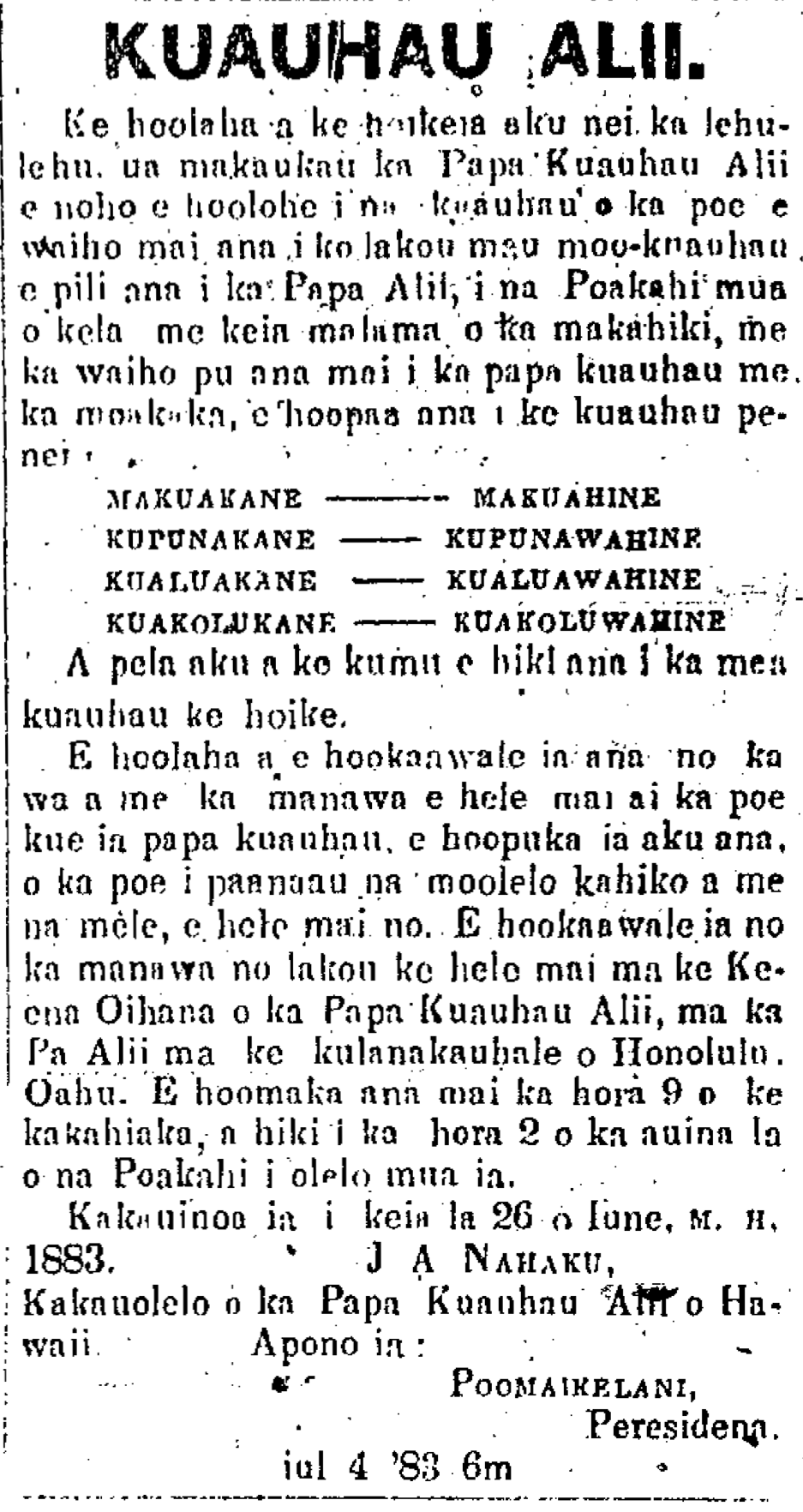
It is being advertised and shown to the public that the Board of Genealogy of Hawaiian Chiefs [Papa Kuauhau Alii] is prepared to hear the genealogies of those who put forward their pedigree as related to the Chiefly Class, every first Monday of the months of the year, where they put before us the clear genealogy written down in this fashion:

FATHER [makuakane]——— MOTHER [makuahine]

GRANDFATHER [kupunakane] ——— GRANDMOTHER [kupunawahine]

GREAT GRANDFATHER [kualuakane] ——— GREAT GRANDMOTHER [kualuawahine]

GREAT GREAT GRANDFATHER [kuakolukane]———— GREAT GREAT GRANDMOTHER [kuakoluwahine]

And so forth until the earliest that the genealogist can show.

A notice will be given and time will be set aside for those who object to the genealogies that will be published, for those who know the old stories and mele, you come as well. Time will be set aside for them to come to the Business Office of the Papa Kuauhau Alii, on the Palace Grounds in the town of Honolulu, Oahu. Commencing at 9 o’clock in the morning, until 2 o’clock in the afternoon on the Mondays mentioned previously.

Signed on this day the 26th of June, 1883.  J. A. Nahaku,

Secretary of the Papa Kuauhau Alii.  Approved by:

Poomaikelani,

President.

(Elele Poakolu, 8/1/1883, p. 4)

KUAUHAU ALII.

Ka Elele Poakolu, Buke IV, Helu 31, Aoao 4. Augate 1, 1883.

Argument in Vernon, California, 1870.

Murder.

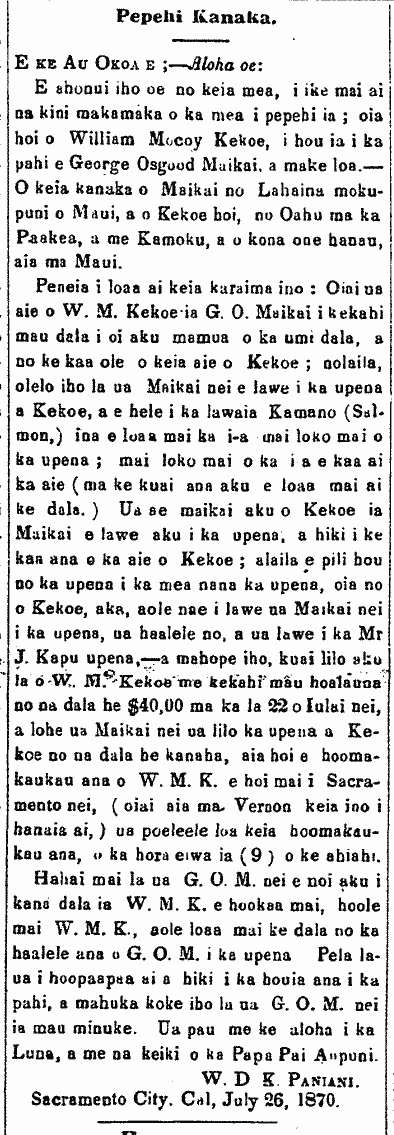
O Ke Au Okoa;—Aloha oe:

Please extend you patience for this, so that the many friends of the one killed will know; that being William McCoy Kekoe, who was stabbed with a knife by George Osgood Maikai, and died.—This man, Maikai, is from Lahaina, on the island of Maui, and Kekoe is from Oahu, at Paakea, and Kamoku, and his place of birth is on Maui.

This is how the heinous crime happened: while W. M. Kekoe owed G. O. Maikai a sum of money more than ten dollars, and being that Kekoe did not repay this debt; therefore, Maikai stated that he would take the net of Kekoe to go Salmon (Kamano) fishing, and if he caught fish in the net, the debt would be paid off with the fish (after selling it and getting money). Kekoe agreed to Maikai taking his net until Kekoe’s debt was paid off; and then the net would return to who it belonged, that being Kekoe; however, Maikai did not take the net and left it, and took Mr. J. Kapu’s net,—and thereafter, W. M. Kekoe sold his net off to some friends for $40.00 on the 22nd of this July, and Maikai heard that the net of Kekoe was sold for forty dollars, and that W. M. K. was getting ready to return here to Sacramento (being that it was in Vernon that this evil deed was done); this preparation was done in the dark, at nine (9) o’clock in the evening.

G. O. M. went after him to ask W. M. K. to repay his money, and W. M. K. refused; that G. O. M.  would not get the money because he left behind the net. They continued to argue in that way until the stabbing, and G. O. M. immediately fled in those minutes. This is all, with aloha for the Luna, and the boys of the Government Press [Papa Pai Aupuni].

W. D. K. Paniani.

Sacramento City, Cal, July 26, 1870.

(Au Okoa, 8/25/1870, p. 2)

Pepehi Kanaka.

Ke Au Okoa, Buke VI, Helu 19, Aoao 2. Augate 25, 1870.

Memorial Day past, 1902.

Honoring Alii

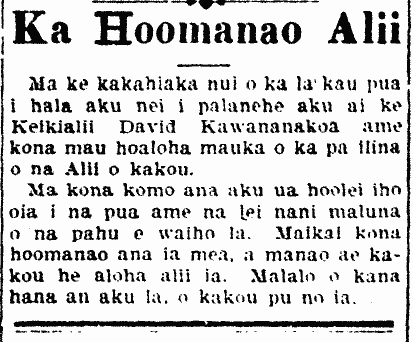
In the early morning of this past memorial day [la kau pua], Prince David Kawananakoa and his friends glided quietly up to the grave of our Alii.

As he entered, he placed flowers and beautiful lei upon the coffins there. It is good that he honored them, and we believe this to be aloha for the alii. We are with him in his actions.

[Let us not remember those who we aloha just on this one day of the year…]

(Kuokoa, 6/6/1902, p. 2)

Ka Hoomanao Alii

Ka Nupepa Kuokoa, Buke XL, Helu 23, Aoao 2. Iune 6, 1902.

Alatau Tamchiboulac Atkinson, organist for Kawaiahao Church, 1873.

[Found under: “NA MEA HOU KULOKO.”]

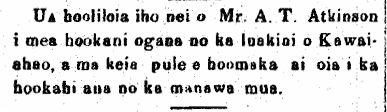
Mr. A. T. Atkinson has been made the organist [hookani ogana] for the Kawaiahao Church, and beginning this week, he will perform alone for the first time.

[This is just a tiny episode in the amazing life of Alatau Atkinson. There will be a talk on his life given by visiting author and journalist Nick Fielding at the Center for Biographical Research, UH Manoa today from noon to 1:15 at Henke Hall!]

(Au Okoa, 1/23/1873, p. 3)

Ua hooliloia iho nei...

Ke Au Okoa, Buke VIII, Helu 41, Aoao 3. Ianuari 23, 1873.

More news from Kamehameha Schools as reported by the students, 1944.

[Found under: “News From Boys, Girls Kamehameha School”]

By BARRY ONTAI

———

Ilona Momilani, a baby girl was welcomed into the family of Mr. and Mrs. Folinga Faufata on March 10.

The baby’s father, a graduate of Kamehameha with the class of 1935, is now an engineer at a power plant in Pearl Harbor.

The Fafatas reside on Kaunaoa Street in Kapahulu. Barbara, the eldest daughter, attends the Kamehameha kindergarten.

———

The Saturday night activities for the student body on April 22, were calling and movies.

The senior division enjoyed dancing and a social gathering which began at 7:30 o’clock in the common room of Lunalilo hall.

Two color movies were shown to the junior division at the school for boys’ assembly hall.

“A Victory”, a picture filmed for the Junior Police Officers on the K.S.B. campus, featured Samuel Fontaine, brother of David Fontaine, low-eleventh student at K.S.B., and James Noa, a ninth grader at the school for boys.

In the second feature, “Make Way for Victory”, two boys of the Preparatory department, Kealoha Coleman and Kui Lee, had leading roles. There were also dances by the preparatory pupils directed by Mrs. Mary K. Pukui and Mrs. Lei Hapai.

These pictures were filmed in color by George Tahara, a student at the University of Hawaii. He has also made two previous showings to Kamehameha audiences. Continue reading

Napoleon Kalolii Pukui supporting Charles E. King for delegate to Congress, 1922.

Truth of Truths.

There was something new heard from my candidate, Charles E. King [Kale E. Kini], when he announced on the past 18th, that being this past Monday, that he met with Papai (Clarence Crabbe), the manager of John Wise [Keoni Waika], who relayed his thoughts to my candidate. “We were given the endorsement from the prominent ones [maka nunui] of five sugar plantations, and here in the palm of my hand is the money to push John Wise into the win, the candidate of their choice.

“Therefore, you and Lyman [Laimana] have no hopes for winning.”

That was wen my candidate replied back to him, “Hey, Papai [“Crab”], wasn’t it you who came before me in person three times asking for me to run as a candidate this season?” So I said to you, What about John Wise? And you told me that I cannot trust him; you are the one that I trust, more than him; and now you are tossing me aside. This is not something that will make me give up; I will run for the win and the victory.”

This is what Papai’s answer was to him, “I really don’t want this job, my being prodded on at this work by the big wigs of the Sugar Plantations.”

So therefore friends, we see the sugar plantation’s representative and fishing konohiki; we scope out the name of the fish of the fisherman, a “Papai,” and that is the fish caught in the fish trap [hinai] of John Wise, his fish is a crab.

He will not catch the delectable travelling uhu of Kaena Point, the craving of the daughter of Kakuhihewa. How is that fisherman throwing out his chum; he probably did not consider first the flow of the current; he just threw out his chum where the current will carry it out to Mauiloa, and so the fisherman will return home with nothing, his fish will be the crab, the crab with its menacing claws.

We all know that money is being thrown about these days; take it and fill your palms, but on election day, think carefully. Let Charles King be yours.

Sincerely,

NAPOLEON K. PUKUI

[The word play in the original Hawaiian is very fun. N. K. Pukui was a character!]

(Kuokoa, 10/5/1922, p. 7)

KA OIAIO O NA OIAIO.

Ka Nupepa Kuokoa, Buke LXI, Helu 40, Aoao 7. Okatoba 5, 1922.

Papa holua found in Hookena by Napoleon Kalolii Pukui, 1905.

SLED OF A CHIEFESS

On the 6th of last month, N. K. Pukui, traveling agent of the Hawaiian Realty and Maturity Co., while on a tour of the Island of Hawaii, found the above illustrated sled in a cave at Hookena, Hawaii.

It is said that the oldest kamaainas of Hookena have heard from their parents and grandparents that sometime in the reign of King Keawenuiaumi, about two hundred and fifty years ago, a high chiefess named Kaneamuna [Kaneamama] was the living at Hookena. Her principal amusement was hee holua (coasting on a sled) and hee nalu (surfing).

She had her people make a sliding ground for her on a hill just back of the little village of Hookena, and ordered a sled, or land toboggan, called a papa holua, as well as a surfing board, or a papa hee nalu. When the slide was finished she passed many pleasant hours sliding down the steep hill. This slide was composed of smooth stones covered with rushes. After her death her sled and surf board disappeared, and the secred of their hiding place was never revealed.

It is believed the sled and board found in the cave belonged to the High Chiefess. They are made of the wood of the bread-fruit tree and at the present time are in very good condition. The cocoanut fiber ropes are still attached to the sled.

(Advertiser Photo.)

ANCIENT HAWAIIAN SLED FOUND IN A KONA, HAWAII, CAVE.

[See also the Hawaiian-Language article found in Ka Na’i Aupuni, 12/6/1905, p. 2.]

(Pacific Commercial Advertiser, 12/6/1905, p. 5)

SLED OF A CHIEFESS

The Pacific Commercial Advertiser, Volume XLII, Number 7279, Page 5. December 6, 1905.

Fishpond and fish and the court, 1915.

Court Holds Fish Don’t Go With Pond

Famous Molokai Fish Pond Case Passed on by Supreme Court—Decision Raises New Questions.

What’s fish pasture worth?

This is a question which Attorney Dan Case is trying to have answered, because on behalf of a client he will probably soon be putting in a bill against Attorney Eugene Murphy for a goodly sum for the care of Murphy’s finny property in a certain pond on Molokai. It is the famous fish pond case again.

The question has been brought up through a supreme court decision, rendered this week, in which the court apparently holds that when a man sells a fish pond he doesn’t necessarily sell the fish that may be in it. About six months ago a Japanese named Kanayama bought at sheriff’s sale the lease on the fish pond in question, only to be sued a little later for damages because he had taken fish from the pond. The suit was filed by Murphy, attorney for Akutogawa [Akutagawa], the Japanese who previously owned the lease, and who had given his attorney a bill of sale on the fish in the pond.

In the district magistrate’s court, judgement was rendered against Murphy, but on his appeal to the supreme court, this is reversed. The syllabus of the opinion of the higher court read:—”The judgement is reversed and the cause remanded to the district magistrate of Molokai with instructions to enter judgement in favor of the plaintiff for the sum of $75 and costs.”

The question is now what Murphy purposes doing to get his fish, which presumably are trespassing in the pond, and also what bill for pasture the owner of the pond can collect for caring for them all this time. And the end is not yet.

(Maui News, 7/24/1915, p. 6)

Court Holds Fish Don't Go With Pond

The Maui News, Volume XXII, Number 22, Page 6. July 24, 1915.