Ka Haku o Hawaii and Fire Engine Company 4, 1862.

[Found under: “NA MEA HOU O HAWAII NEI.”]

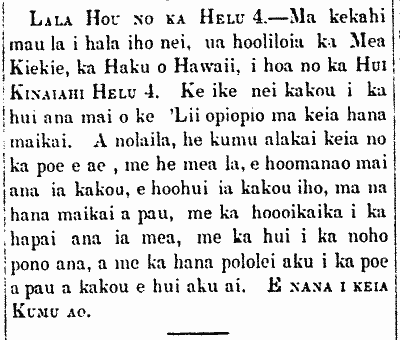
New Member for Number 4.—Recently, His Highness, Ka Haku o Hawaii, became a new member of Engine Company Number 4 [Hui Kinaiahi Helu 4]. We see the young Alii joining in on these fine work. This is an example for others, as if reminding us that we ourselves should join in good endeavors of all sorts, while putting effort into fostering these works, and living properly, and treating well all those with whom we meet. Look to this Example.

(Kuokoa, 1/25/1862, p. 2)

Lala Hou...

Ka Nupepa Kuokoa, Buke I, Helu 9, Aoao 2. Ianuari 25, 1862.

Rabbits for the Prince, 1861.

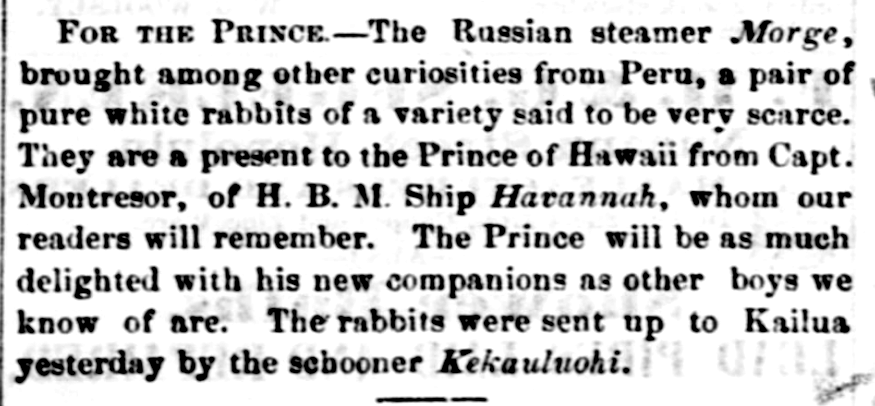
For the Prince—The Russian steamer Morge, brought among other curiosities from Peru, a pair of pure white rabbits of a variety said to be very scarce. They are a present to the Prince of Hawaii from Capt. Montresor, of H. B. M. Ship Havannah, whom our readers will remember. The Prince will be as much delighted with his new companions as other boys we know of are. The rabbits were sent up to Kailua yesterday by the schooner Kekauluohi.

[It is very interesting to compare this article with a Hawaiian-Language one found in the Kuokoa on 12/16/1861!]

(Pacific Commercial Advertiser, 12/5/1861, p. 2)

For the Prince.

The Pacific Commercial Advertiser, Volume VI, Number 23, Page 2. December 5, 1861.

Tahitian mele for La Kuokoa, 1861.

Songs of Polapola

Aue oe tau hoa hele e,
E fiteri tou e,
Tai ta pea ta te fa tu,
O Iesu ta haa maitai.

Eau ia oe te oa oa,
Eau ia oe te haa maitai,
Ia oe nae te fei a haa wale,
I loto i te au ahi oia nae.

Aue oe e ta Moi e,
He aroha to oe,
Mai horoa i te hau ia Mareta,
E ta pea maitai.

Iaorana oe e ta Hatu o Hawaii,
Tai haapao ia tai haapao hia,
E mono i tooe toloa.

Iaorana oe e Ema,
Te Alii Vahine e,
Faatere maitai to otou haue,
E mau te ora o te Alii e amuri no atu.

Auwe oe tou hoa he re e,
Pi te ri tou e tei ta pea i ta te fatu,
Oietu te parau maitai,
eau ia oe te oaoa,
Eau ia oe te haa maitai,
Ia oto nae te feia faa vare,
I roto o te au ahi oia nae.

Auwe oe e ta Moi e,
E aroha to oe e,
Mai ho roa i te hau,
Ia Amerita,
E ta pea maitai mai,
Iaorana oe e ta Hatu Hawaii e,
Tei haa pao hia i mano to oe to roa,
Iaorana oe e Ema te Rii vahine e,
Faa te re maitai to otou hau,
E mau te aroha o te Rii e,
Ea muri noatu.

Himeni 27.

1 Te ra, te aoae, te fetia,
Maramarama ai te ao,
Maitai atoa ai te po,
Na te Atua i faaue iho,

2 Ia ara, e ia moe tatou,
Te merahi maitai tei mau,
To ratou tiai ia tatou,
Aore e ino i roohia mai.

3 Te rai anaana i nia ae,
Te aihere rii i raro nei,
Te miti atoa e ati ae,
Na te Atua i hamani.

4 Te puapua, noanoa,
Unauna ai te raau nei,
Te raau maa na tatou a,
Na te Atua i horoa mai.

5 Te ata i pee, te ua i pou,
Te matai farara e oraʻi,
Te manu, i rere nei,
Te mau puaa nana anae,

6. Te ia e tere i te tai,
Tei nee i raro i te repo,
Tatiou atoa te taata nei,
Ohipa na te Atua mau.

7 Ia hamanihia ra tatou
Ia hau tu teie i te maitai,
E ia ra oe ta te Arii parau,
Ma te aau au i a rue ai.

[These are some of the mele performed on the 28th of November, 1861, at Kawaiahao Church in celebration of Independence Day.

For more Tahitian mele, see this composition of Ninito and Manaiula Sumner for Victoria Kaahumanu from 1862.]

(Kuokoa, 12/2/1861, p. 2)

He Mele Polapola.

Ka Nupepa Kuokoa, Buke I, Helu 4, Aoao 2. Dekemaba 2, 1861.

Queen’s Hospital news from George Pooloa, 1930.

AT THE QUEEN’S HOSPITAL

(Written by George Pooloa)

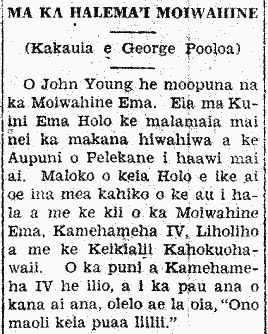
John Young is a grandchild of Queen Emma. Here at Queen Emma Hall [Kuini Ema Holo], the precious gifts from Britain are being cared for. In this Hall you can see antiquities of times gone by along with portraits of Queen Emma; Kamehameha IV, Liholiho; and the Prince, Kahakuohawaii. The favorite of Kamehameha IV was dogs, and when he was done eating, he would say, “That tiny pig was so delicious.”

[This is one of many articles written by George Pooloa in the Hawaiian-Language Newspapers. Many of his contributions are historical accounts. See here for an excerpt of one of them speaking of the naming of Hanauma: naneaarmstrongwassel on instagram  (as well as all the other articles!)

Does anyone know what became of these portraits and the other antiquities mentioned in this article?]

(Alakai o Hawaii, 2/20/1930, p. 3)

MA KA HALEMAʻI MOIWAHINE

Ke Alakai o Hawaii, Buke 2, Helu 43, Aoao 3. Feberuari 20, 1930.

More on Queen Emma, Leleonalani, 1866.

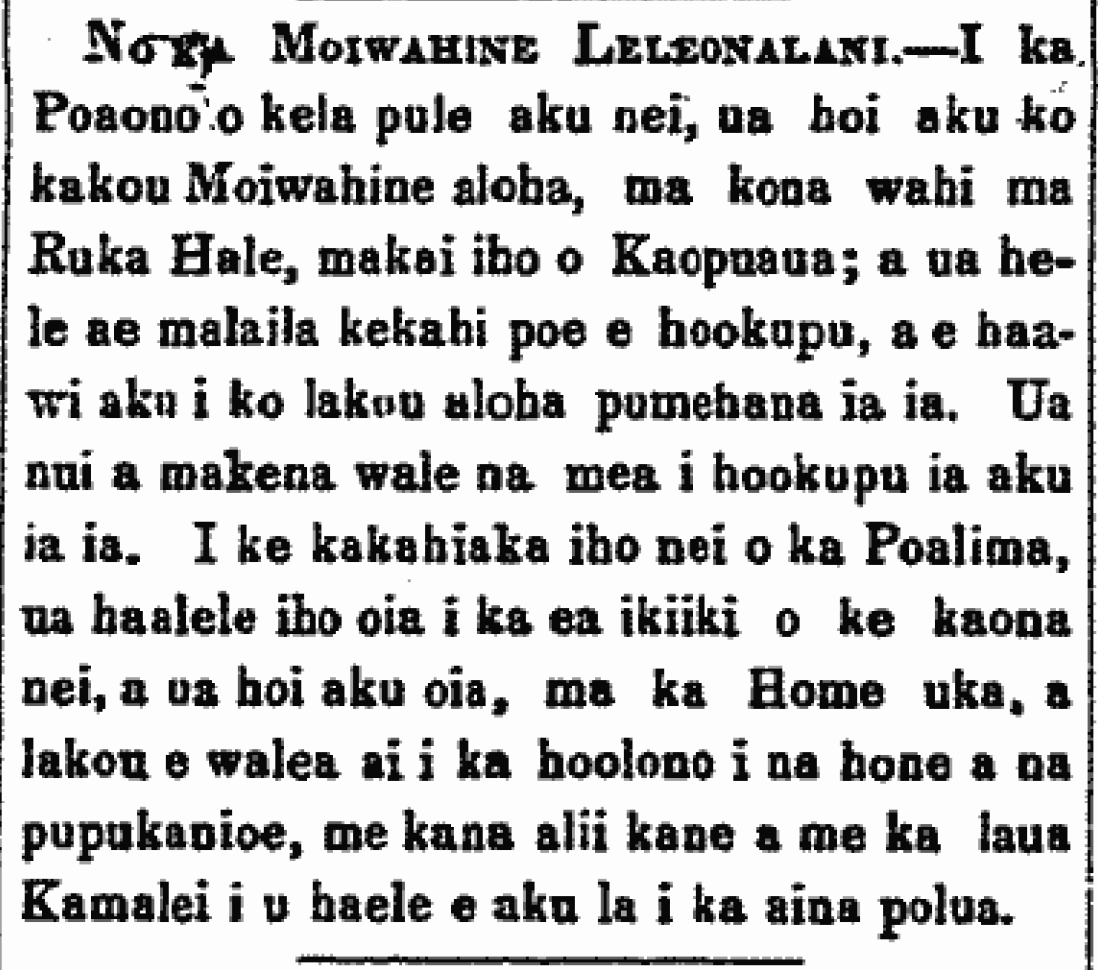
Pertaining to Queen Leleonalani.—This past Saturday, our beloved Queen returned to her residence Rooke House, seaside of Kaopuaua; and there many people went to give gifts [hookupu], and give their warm aloha to her. There was great and numerous hookupu given to her. This past Friday, she left the stifling air of town and returned to her Home in the uplands [Hanaiakamalama], where they relaxed to the sweet call of the singing snails [pupukanioe], and her royal husband and their beloved child who left for the dark lands.

[Here is another example where the initial “Ka” or “Ke” in a distinctive name is left off. Whereas Queen Emma is usually known as “Kaleleonalani,” here she is called “Leleonalani.” This works just as long as there is no confusion as to what or who is being referred to.

Kaumualii = Umualii, Kawaiahao = Waiahao, Kamoiliili = Moiliili, &c., &c., &c.]

(Au Okoa, 11/5/1866, p. 2)

No ka Moiwahine Leleonalani.

Ke Au Okoa, Buke II, Helu 29, Aoao 2. Novemaba 5, 1866.

More on Liliu’s marriage, 1862.

I was engaged to Mr. Dominis for about two years and it was our intention to be married on the second day of September, 1862. But by reason of the fact that the court was in affliction and mourning, our wedding was delayed at the request of the king, Kamehameha IV., to the sixteenth of that month; Rev. Dr. Damon, father of Mr. S. M. Damon, at present the leading banker of the Islands, being the officiating clergyman. It was celebrated at the residence of Mr. and Mrs. Bishop, in the house which had been erected by my father, Paki, and which, known as the Arlington Hotel [Haleakala], is still one of the most beautiful and central of the mansions in Honolulu. To it came all the high chiefs then living there, also the foreign residents; in fact, all the best society of the city.

[This is what Queen Liliuokalani had to say about her marriage in Hawaii’s Story by Hawaii’s Queen, first published in 1898. Mahalo to Heather Wilkinson Rojo for her response on the previous post, saying she posted an image of their marriage certificate on her blog. This is one of the many priceless treasures cared for by the Bernice Pauahi Bishop Museum!]

(Hawaii’s Story by Hawaii’s Queen, 1988. p. 22.)

History of the Hawaiian Flag. 1862.

“The Beautiful Flag of Hawaii,
Let it forever wave.”

The Hawaiian Flag

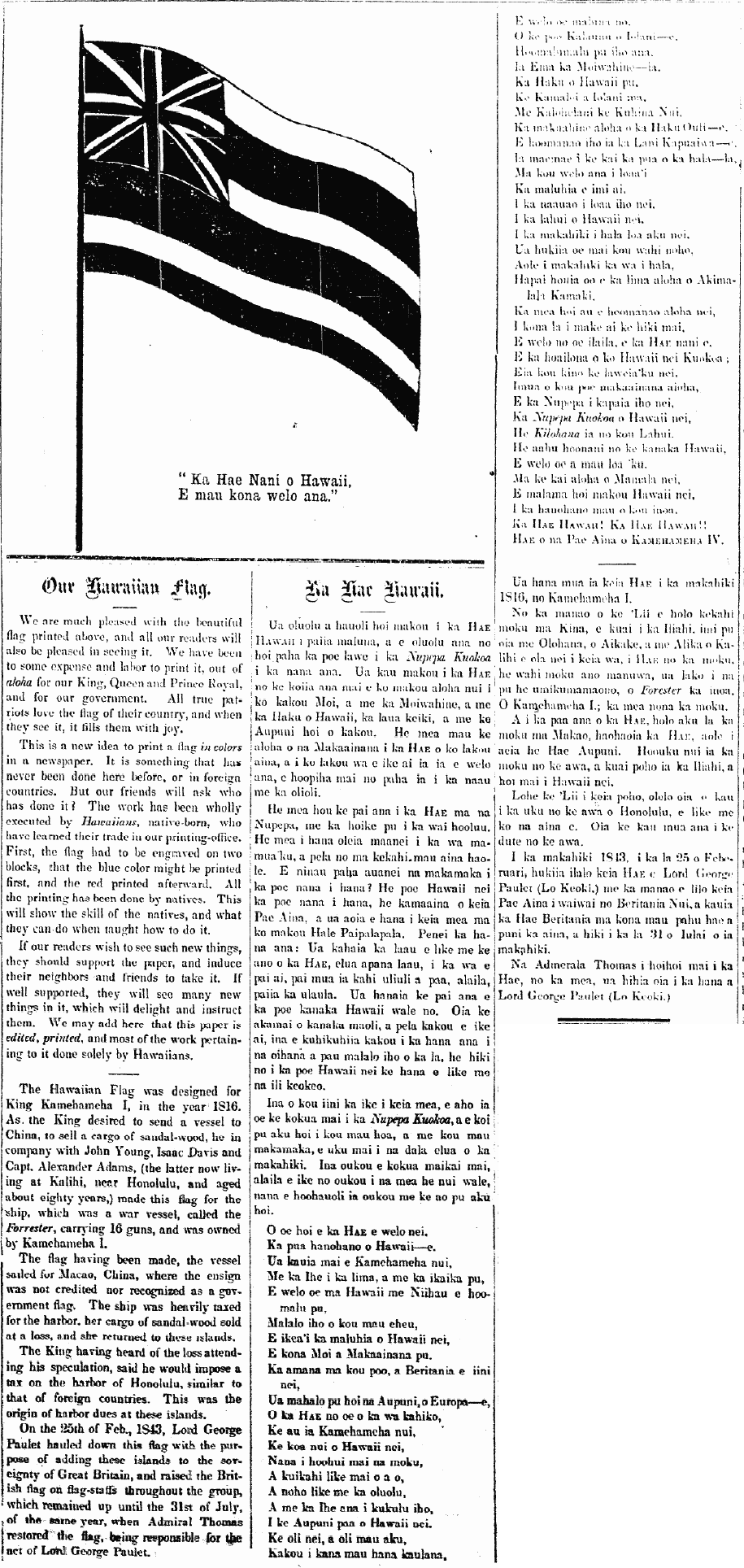
We are pleased and happy about the Hawaiian Flag printed above, and the people subscribing to Ka Nupepa Kuokoa will be delighted to see it. We display the Flag, urged to do so by our great aloha for our King, Queen, and Ka Haku o Hawaii, their son, as well as for our Nation. The love by the people for their flag of their country is customary, and when they see her fluttering, it fills their hearts with joy.

The printing of the Flag in a Newspaper is something new, along with the displaying of its colors*. This is something not done previously here, as well as in some foreign countries. Perhaps our friends will inquire as to who did this work. Some Hawaiians did the work, people from this Archipelago, and they were taught to do this in our Printing Office. Here is how it was done: Woodblocks were carved in the fashion of the flag using two blocks. When it was printed, first the blue was printed, allowed to set, then the red was printed. This printing was done solely by Hawaiians. Such is the intelligence of the kanaka maoli, and that is how we recognize it. If we are instructed to do any task under the sun, Hawaiians can do the same as the white-skinned people.

If you should want to see this, you should support Ka Nupepa Kuokoa, and urge your acquaintances and friends to pay the two dollars a year. If you would kindly help, you will see many things that will gladden and instruct you.

You, O fluttering Flag,
The proud blossom of Hawaii.
Established by Kamehameha the great,
With Spear in hand, with strength,
Flutter over Hawaii and Niihau, and give protection.
Beneath your wings,
So that the peace of Hawaii be known,
By her King and the people as well.
The cross on your crest that Britain holds dear,
The Nations of Europe also give acclaim,
You are the Flag of old,
The time of Kamehameha the great,
The bravest warrior of Hawaii,
He who joined the islands,
With unity from end to end,
Living as one in contentment,
Along with the Spear upon which he erected,
The steadfast Nation of Hawaii.
We rejoice, and rejoice for all time,
His famed accomplishments,
You wave there above,
The crown of Iolani, the king
While giving shelter,
To Emma, the Queen.
Along with Ka Haku o Hawaii.
The Royal child of Iolani and Emma,
And Kalohelani, the Regent, Victoria Kamamalu.
The loving aunt of the young lord, Prince Albert,
Do remember his His Highness, Lot Kapuaiwa,
Cleansing the fruit of the pandanus in the sea,
Your fluttering has garnered
The peace that allowed us to seek,
The knowledge that has come,
To the Hawaiian populace.
That year long ago.
You were taken from your proper place.
Not a year passed,
You were raised by the loving hands of Admiral Thomas.
The one you fondly recall,
On the day of his death when it approaches,
You will wave there, O beautiful Flag.
O symbol of Hawaii’s Independence ;
Here is your body, being brought.
Before your beloved people,
By the Newspaper called,
Ka Nupepa Kuokoa of Hawaii,
The Excellence of your Nation.
A garment that adorns the Hawaiian People,
Wave forever.
Over the beloved sea of Mamala,
We, Hawaii, will cherish always,
The eternal glory of thy name.
The Hawaiian Flag! The Hawaiian Flag!!
The Flag of the Islands of Kamehameha IV.

This Flag was first designed in the year 1816 for Kamehameha I.

The King, wanting a ship to sail to China to sell Sandalwood, searched along with John Young, Isaac Davis, and Captain Alexander Adams of Kalihi, who is still living, for a Flag for the ship. It was a man-o-war, called the Forrester, carrying sixteen guns. Kamehameha I owned the ship.

When the Flag was completed, the ship sailed to Macao. The Flag was puzzled over, and was not accepted as a National Flag. The ship was charged exorbitantly for harbor fees, the Sandalwood was sold for a loss, and the ship returned to Hawaii.

The King learned of this loss, and he said that a tax should be placed on the harbor of Honolulu like those of foreign lands. That is when duty was first charged for the harbor.

In 1843, the 25th of February, this Flag was taken down by Lord George Paulet [Lo Keoki], with the intent that this Archipelago be taken as a possession of Great Britain. The British flag was raised on flag poles all around the land, until the 31st of July of that year.

It was Admiral Thomas who restored the Flag, for he disputed the actions of Lord George Paulet.

[Notice the English column to the left, which gives a translation of the Hawaiian. It seems this issue of the Kuokoa was sent to home by many a missionary, to show the progress they were making…

*A word of clarification: This is not the first time color appears in a newspaper. For more on this topic, see Hana Hou Magazine, August/September 2011: “Read All About It!” by Ron Williams.

For more flag articles, just click here!]

(Kuokoa, 1/1/1862, p. 1)
"Ka Hae Nani o Hawaii...

Ka Nupepa Kuokoa, Buke I, Helu 6, Aoao 1. Ianuari 1, 1862.

Rabbits for the young prince, 1861.

[Found under: “This and That of Hawaii nei”]

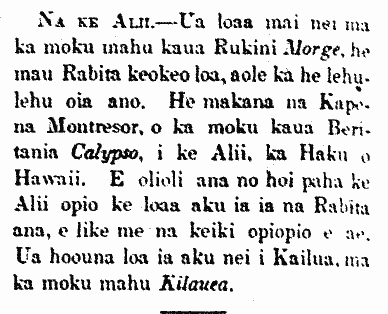
For the Alii.—Aboard the Russian warship, Morge, there were pure white Rabbits which are probably rare. They are a gift from Captain Montresor of the British warship Calypso to the Alii, Ka Haku o Hawaii. They young chief will most certainly be thrilled when receiving his Rabbits, just like other young children. It was sent all the way to Kailua by the steamboat Kilauea.

(Kuokoa, 12/16/1861, p. 2)

Na ke Alii.

Ka Nupepa Kuokoa, Buke I, Helu 5, Aoao 2. Dekemaba 16, 1861.

Early Thanksgiving in Hawaii, 1862

Thanksgiving Day.

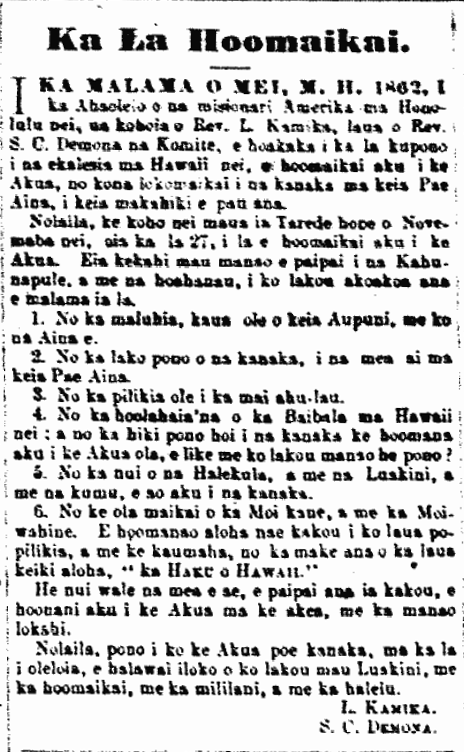
In the month of Mei, 1862, at the Conference of American missionaries here in Honolulu, Rev. L. Smith, and Rev. S. C. Damon were chosen as the Committee to clarify the appropriate day for the churches of Hawaii to give thanks to God for his blessing the people of this Archipelago in this year which is coming to an end.

Therefore, we select the last Thursday of this November, that being the 27th, as the day to give thanks to God. Here are some reasons to encourage the gathering of pastors and church members to celebrate this day.

1. For this Nation’s peace, and lack of war with other Countries.

2. For the availability of food for the people of this Archipelago.

3. For the lack of trouble from pestilence.

4. For the spread of the Bible here in Hawaii; and for the ability of the people to worship the living God as they wish?

5. For the abundance of Schools, and Churches, and teachers to teach the people.

6. For the good health of the King, and the Queen. Yet we remember with aloha, their tragedy, and grief, for the passing of their beloved child, “Ka Haku o Hawaii”.

There are many other things to encourage us to glorify God in the open as one.

Therefore, God’s people should gather at their churches on the specified day, to give their appreciation, exaltation, and songs of praise.

L. Smith.

S. C. Damon.

(Nupepa Kuokoa, 11/22/1862, p. 3)

Ka La Hoomaikai.

Nupepa Kuokoa, Buke I, Helu 52, Aoao 3. Novemaba 22, 1862.