Kauikeaouli’s 100th birthday at Kawaiahao Church, 1914.

TRIBUTE PAID TO MEMORY OF KING

Hawaiians Celebrate Centenary of Kamehameha III with Impressive Ceremony—Queen Liliuokalani Unveils Tablet to Mark Birthplace of Beloved Monarch

(From Wednesday Advertiser.)

The centenary of Kauikeaouli, Kamehameha III, was celebrated yesterday at Kawaiahao Church under the auspices of the Daughters of Hawaii. This old church, that has witnessed so many of the royal ceremonials of the Hawaiian people, was taxed to the utmost of its seating capacity. More than twenty-six hundred persons viewed the unveilling of the memorial tablet which had been prepared by the Daughters of Hawaii to mark the birthplace of “The Generous King” at Keauhou, in Kai-malino, Hawaii.

The tablet was hidden from view by the Royal Standard of Liliuokalani and a Hawaiian flag, both the property of and loaned by Hawaii’s venerable ex-queen for the sacred ceremonial.

The Queen and High Chiefess Elizabeth Kekaaniau Pratt, both of whom are lineal descendants of Keawe, the ancient king of Hawaii, and founder of the Kamehameha dynasty, were seated on either side of the memorial stone in the nave of the church. The palace chairs in which they sat were draped with ancient Hawaiian feather capes of priceless value.

Oldtime Dignitaries Attend.

Back of the Queen and High Chiefess Pratt were High Chiefs Beckley and Hoapili, clad in the ceremonial feather cloaks and helmets of the Royal Courtiers. High Chief Fred Kahapula Beckley, the spear-bearer, is a direct descendant through his father’s side from Kameeiamoku. High Chief Albert Kalaninoanoa Hoapili, the kahili bearer, is a lineal descendant of Kamanawa, the royal kahili bearer. These two therefore, in yesterday’s ceremony represented the spear-bearer and kahili bearer who are shown on the Hawaiian coat of arms and are descendants of the two chief court alii of Kamehameha I.

On either side of the royal court representatives were the kahili bearers in ordinary, sixteen young men from the Kamehameha School for Boys, robed in feather capes and the costumes of the warrior of old, representative of the court attendants.

The chancel and pulpit were tastefully decorated with beautiful ferns and palms while above was the Royal Standard of Kalakaua and the Hawaiian flags, both now the property of and loaned by the Kapiolani Estate.
Continue reading

Monument to Kauikeaouli on his 100th birthday, 1914.

UNVEILING OF THE DONATED TABLET

The Populace Gathers in Kawaiahao on the Evening of this Past Tuesday.

It was a scene from the sacred times when the Islands were ruled under monarchs, that was before a great crowd of people which arrived at Kawaiahao Church in the afternoon of this past Tuesday, when a memorial service for the hundredth birthday of King Kauikeaouli, Kamehameha III was held, and unveiled was the stone tablet dedicated to him that will be stood at the place of his birth at Keauhou, North Kona, Hawaii.

Before the hour set aside for that remembrance, at four o’clock in the afternoon, the crowd entered the church: from the members of the organizations of this town, the students of the Kamehameha Schools, the heads of the government, to the general public, filled up the church, with some people standing.

Outside of the church grounds was the Royal Hawaiian Band entertaining the people, with a majority of the people there, because they could not get a seat in the church.

Before the pulpit stood a painting of King Kauikeaouli, Kamehameha III, and right below the painting was the tablet with clear lettering that said: “Kauikeaouli, Kamehameha III, ke keiki a Kamehameha III ame Keopuolani. Hanauia i Maraki 17,1814. Ka Moi lokomaikai.”

Continue reading

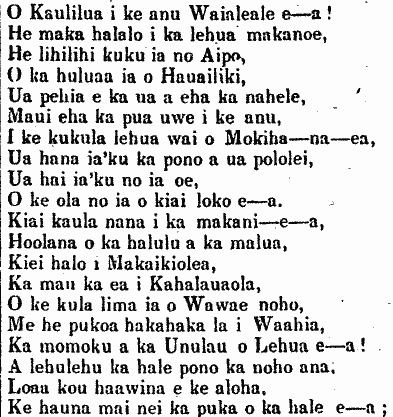
Kaulilua… Mele inoa for Kamehameha IV, 1864.

[Excerpt found under: “A DIRGE FOR KING Alexander Kalanikualiholiho, Maka o Iouli, Kunuiakea o Kukailimoku, KAMEHAMEHA IV!”]

O Kaulilua i ke anu Waialeale e—a!
He maka halalo i ka lehua makanoe,
He lihilihi kuku ia no Aipo,
O ka huluaa ia o Hauailiki,
Ua pehia e ka ua a eha ka nahele,
Maui eha ka pua uwe i ke anu,
I ke kukula lehua wai o Mokiha—na—ea,
Ua hana ia’ku ka pono a ua pololei,
Ua hai ia’ku no ia oe,
O ke ola no ia o kiai loko e—a.
Kiai kaula nana i ka makani—e—a,
Hoolana o ka halulu a ka malua,
Kiei halo i Makaikiolea,
Ka mau ka ea i Kahalauaola,
O ke kula lima ia o Wawae noho,
Me he pukoa hakahaka la i Waahia,
Ka momoku a ka Unulau o Lehua e—a!
A lehulehu ka hale pono ka noho ana,
Loaa kou haawina e ke aloha,
Ke hauna mai nei ka puka o ka hale e—a;

[So many interesting things about this. The first and foremost perhaps is that this appears as part of an unusual kanikau for Alexander Liholiho Kamehameha IV in the form of a conversation between Kamehameha III (K III.) and himself (K IV.). Another is that if you hula, you probably learned this as a mele inoa for Kalakaua and not as one for Kamehameha IV. Does anyone know who it is that is labeled as (M.) in the conversation? Click here for a PDF of the issue with the rest of the piece on page 4.]

(Kuokoa, 1/23/1864, p. 4)

O Kaulilua i ke anu Waialeale e—a!

Ka Nupepa Kuokoa, Buke III, Helu 4, Aoao 4. Ianuari 23, 1864.

Mele Inoa for Kauikeaouli, Kamehameha III. 1862.

HE INOA NO KAUIKEAOULI.

Auhea wale ana oe, kapua hau o Maleka,
Ke au nei ka manao, Pehea o Niagala,
Kela wai kamahao, wai halulu o ka moano,
Nene i na moku, lohe aku nei Lukini,
Ua ana ia Kuleke, aohe i hopo Ladana,
I ka nui o Asia, hue a ke kaona nui,
Laki ka moana Iniana, ehuehu Enelani,
Ke kowa o Sekotia, aita oe e palau,
No’u o Ainahau, a ka wai o Nolewai,
Pau mai ko’u palena, ilaila a’u la oki,
Lawe u’a linohau, a ai ka manu iluna,
I kilohi iho kuu hana, he nani o Hudesona,
Kaikuono Papine, mea ua ae ia,
Me oe a ke aloha iwini o ke aumoa,
Auhea wale ana oe, e ka uneune puuwai,
E ke kaukini ma-lo, nana i ue laholio,
Hoomaloe i kuu kino, hooueue i ka moe,
Lana koi kahi manao, halanalana i ka leo,
O ua mea ino nei, he hoouluulu ia,
Keehi pono i ko haka, i luhi lai ko kahu,
A ao luau ai, pau ko aumakua pi kai a kaua,
I ka lihi kai o lalo, eia la he manao,
Kai hiki mai ia nei, e kali iki iho oe,
A hala ae Welehu, ka malama ino ke kau,
Hiki ae la ia Nana, pe oi kahi manao,
Olu ka noho na o ka lani me oe a ke aloha,
Iwini o ke aumoe, i mai nei o Piuta,
Ua hala kou palena, aohe koina oonei,
O kou la luu loli, a lae hao au lohe,
Ilaila ka wahine Ia, nana i nai ka moana,
He ukali aina ahi, i ka lae o Kepohoni,
Aia iho o Palema, ke noho la i ka hema,
Nana e kuhikuhi mai, ka lonitu akau,
Ike ia na degere, na kuea o ka honua,
Alo mai Kapena Kuke, ka noe i Nouaiki,
Ikiiki wale hoi au, i ka lohe pepeiao,
E ake ko’u manao, ka ike ia Panama,
I pau kuu kuhihewa, i ke kai o Inia,
Nopia o Iapana, ke hui me Ualana,
Me oe a ke aloha, iwini o ke aumoe.

Ii.

Honolulu, Aperila 14, 1862.

[This is a mele known as a mele inoa for Kamamalu, but here it is submitted by Ioane Ii as a mele inoa for Kauikeaouli.]

(Hoku o ka Pakipika, 5/8/1862, p. 4)

HE INOA NO KAUIKEAOULI.

Ka Hoku o ka Pakipika, Buke I, Helu 33, Aoao 4. Mei 8, 1862.

More mele from Mary Jane Montano, 1927.

SOME OLD MELE OF HAWAII NEI.

Mr. Solomon Hanohano, Editor of the Kuokoa Newspaper:—Please publish the following mele from times past, when the land was filled with alii.

This is a name song [mele inoa] for the royal one Ahumanu [Kaahumanu], which was inherited by Kaumakaokane II, the mother of Kuakini (John Adams Cummins) during the youth of Kaumaka, and that royal woman [Kaahumanu] then called Kaumakaokane, by the name Papaleaiaina.

This name is the name that Kalaniahumanu [Kaahumanu] called the Royal One, Paiea Kamehameha I, and it is answered to today by the granddaughter of the Hon. J. A. Cummins, that being Matilda Papaleaiaina Walker Constable.

It would be best that these jewels of Hawaii nei be shown, for some of us will live on as teachers for the impertinent questions, as like the one who questioned in the Advertiser newspaper, about my dear brother, the Hon. J. A. Cummins, the “backbone” [iwikuamoo] of the chiefly ones who have passed into the next realm.

Kaumakaokane he inoa,
Hanau a koa he kupuna,
Eia ua aliiwahine nei,
Ke holo mai nei o ka moku,
Me ka hae o kau weloweloula,
Ku’ilua ka pu,
He aloha ia,
Aole i ike ka haole,
Wahi a Kalanikauleleiaiwi,
Iwi ka maka,
Holoholo ka onohi,
Lele ka puuwai i ka makemake,
I ka wai olu o Lanipo-e,
Nau ke ku’i haukeke ka auwae,
I hemahema i ka wa kamalii,
O ko’u wa naaupo no ia,
E laua la e,
Papaleaiaina kuu aloha e—
O kau ka haili aloha i o’u nei,
O ka welelau o kuu lima ka i pa aku,
Pa i ka lihi o Kilauea.

And here is the genealogy of the lei to adorn the neck of Ahia (Mrs. Capt. George Beckley), that being John Adams Cummins.

Liloa is the father who dwelt with Akahiakuleana, born was Umi. Umi, dwelt with Piikea, born was Aihakoko, Kumulaenuiaumi. Kumulaenui, dwelt with Kumunuipawalau, born was Kekapuhelemai; Kekapuhelemai dwelt with Piilani, born was Lonoikauakini.

Lonokauakini, dwelt with Kapukaheiau, born was Lonoikahaupo; Lonoikahaupo, dwelt with Ninauaiwi, born was Kekapalakea. Kekapalakea dwelt with Kelahuna, born was Kowali; Kolwali dwelt with Kaumaokaokane, born was Keaweaua. Keaweaua dwelt with Kaahaiku, born was Keauiaole; Keauiaole dwelt with Liloa, born was Kaumakaokane, Kameeiamoku.

Kaumakaokane (f) dwelt with Thomas Cummins, born was John Adams Cummins.

Kelahuna (f) is a descendant of Kelahunapaikua (m) and Ahia (f) and Kelahunapaikua (m) is a child of Kakuhihewa and Kolimoalani, that being Koaekea (f), the grandchild of Akahinuikameenoa (f), the woman that I placed a kapu upon.

Kelahuna (f) is the younger sister of Kamehaiku, these being female alii of Kau, Hawaii, and Kamehaiku is the woman of Keeaumoku, the father of Kaahumanu who slept with Kalanianoano and begot Kanehoa, the grandfather of Kaleianoano, Hoapili, and so forth, as well as Jesse Hakainai [Makainai ?], and so forth.

Sincerely, this is I

Ako-kuia ka hale lehua o ka manu,
Kauwewe i ka liko o ka ohia,
He uanoe he uaawa no ka mauna,
Uli ka nahele o Ookuauli,
Uli ka nahu hoomau a ka makani,
A makani a lei a lea,
Lea i na kauna ami a ka ua,
Alohi Maukele anapa i ka la e,
Okioki a hoe,
O ke aho no ia a ka ua Polohinalo,
A pikipiki ka lei,
Me he nu’a kapa la,
Popo ka lei a waiho malie,
Nana aku o kuu apana hala iuka o Panaewa,
Mamina ino no kuu kula lehua,
A’u i kawili mua ai,
Ua maka-pa ua eena ka manu,
He ena kai olohia ia no ke kanaka e—

The is the origin of my name from the heavenly one, Kauikeaouli; Kekulani is the name appended to Keoni Ana Opio [John Young, Jr.] when Kauikeaouli died and returned.

E o mai oe i kou inoa e Kekulani,
O ka lani no ka i ku,
I ka papa holu i ka makani,
A o oe no ke o mai e,

MARYJANE AHIA AHUENA KEKULANI MONTANO.

(Kuokoa, 3/31/1927, p. 1)

KEKAHI MELE KAHIKO O HAWAII NEI.

Ka Nupepa Kuokoa, Buke LXVI, Helu 13, Aoao 1. Maraki 31, 1927.

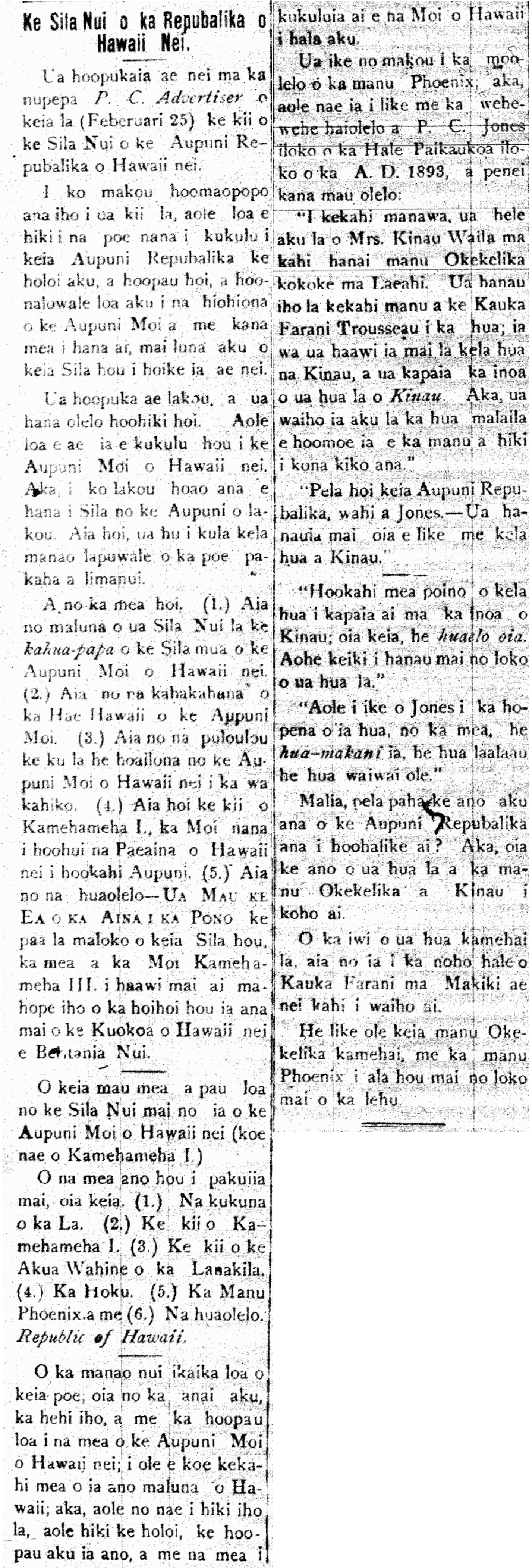
Different view of the seal of the republic, 1896.

Great Seal of the Republic of Hawaii.

In today’s P. C. Advertiser (February 25), a picture of the Great Seal of the Republic of Hawaii was printed.

By our understanding of that image, there is no way that those who established this Republic can erase or end or eradicate visages of the Monarchy and its accomplishments, from the seal mentioned above.

They stated and vowed that there will be no way that the reestablishment of the Kingdom of Hawaii nei will be allowed. However, when they set out to create a Seal for their Government. And now, that foolish idea of the plunderers and thugs has gone awry.

Being that, (1.) On that Great Seal, is the foundation of the first Seal of the Monarchy of Hawaii nei. (2.) There is the stripes of the Hawaiian Flag of the Monarchy. (3.) There stand puloulou, a symbol of the Hawaiian Monarchy of old. (4.) There is an image of Kamehameha I., the King who unified the Hawaiian Archipelago into one Nation. (5.) There are the words—”Ua Mau ke Ea o ka Aina i ka Pono” affixed onto this new Seal, the words given by King Kamehameha III after the restoration of the Independence of Hawaii nei by Great Britain.

All these things were from the Great Seal of the Monarchy of Hawaii nei (except Kamehameha I.)

The new things added are these. (1.) Rays of the Sun. (2.) The image of Kamehameha I. (3.) The image of the Goddess of Victory. (4.) The Star. (5.) The Phoenix Bird, and (6.) The words, Republic of Hawaii.

Their intense desire is to rub out, to stomp out, and to end for all time, things of the Monarchy of Hawaii nei, lest vestiges of that sort remain in Hawaii; but that is not possible: there is no erasing, nor putting end to deeds done by the past Monarchs of Hawaii.

We know the story of the Phoenix, but it is not the same as the explanatory speech by P. C. Jones at the Armory [Hale Paikaukoa] in the year 1893, and these are his words:

“Once, Mrs. Kinau Wilder [Waila] went to where Ostrich were raised near Diamond Head [Laeahi]. One of the birds of the French Doctor Trousseau laid an egg, and it was on that occasion given to Kinau, and the egg was called Kinau. However, it was left there to be sat on by a bird until it hatched.

“This is similar to this Republic,” according to Jones. “It was born like that egg, Kinau.”

There is one unfortunate thing about that egg called by the name of Kinau, that being, it was a rotten egg [huaelo]. There was no chick born from that egg.

Jones didn’t know of the outcome of that egg, for it was but a yolk-less egg [hua makani], a hua laalaau?, a worthless egg.

Perhaps this will be the outcome of the Republic to which he compares it to? But at any rate, that is the kind of Ostrich egg that Kinau chose.

The shell of that astonishing egg is kept at the residence of Trousseau [Kauka Farani] in Makiki.

This astonishing Ostrich is not the same as a Phoenix which rises from the ashes.

(Aloha Aina, 2/29/1896, p. 4)

Ke Sila Nui o ka Repubalika o Hawaii Nei.

Ke Aloha Hawaii, Buke II, Helu 9, Aoao 4. Feberuari 29, 1896.

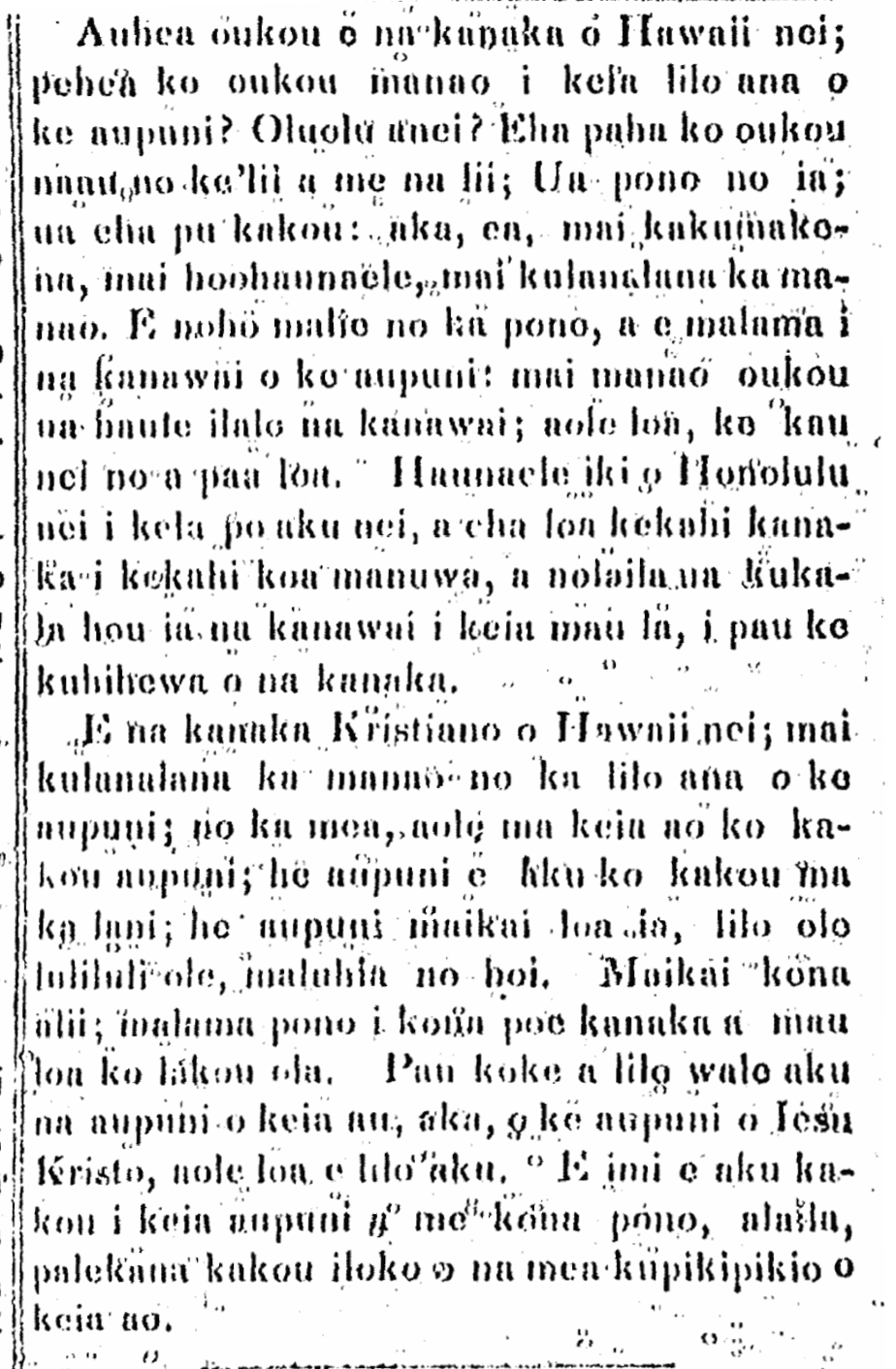
Question put out to the public, 1843.

Here me O People of Hawaii nei; what do you all think of this cession of the kingdom? Is it fine? Your heart probably aches for the king and all the alii; That is how it should be; we are all hurting; however, do not grieve, do not revolt, do not let your resolve waver. We must remain calm and abide by the laws; don’t think that the laws have fallen, not at all, they are still totally in effect. There was a small disturbance in Honolulu the other night, and some men severely injured some of the sailors from the warship, and therefore the laws are being announced once again these days, so that the confusion of the people will end.

O Christian people of Hawaii nei, do not feel uncertain over the cession of the nation; our kingdom does not lie in this world, we have a different kingdom in the heavens; it is a great kingdom which is permanent, and unshakeable, and peaceful. Its king is good; he watches over his people, and they live forever. The nations of this world end quickly and are gone forever, but the kingdom of Jesus Christ will never end. Let us search after this kingdom and its righteousness, and we will be saved from the turbulence of this world.

[This editorial is probably by Richard Armstrong (Limaikaika), missionary and editor of Ka Nonanona.]

(Nonanona, 3/7/1843, p. 100)

Auhea oukou e na kanaka o Hawaii nei...

Ka Nonanona, Buke 2, Pepa 20, Aoao 100. Maraki 7, 1843.

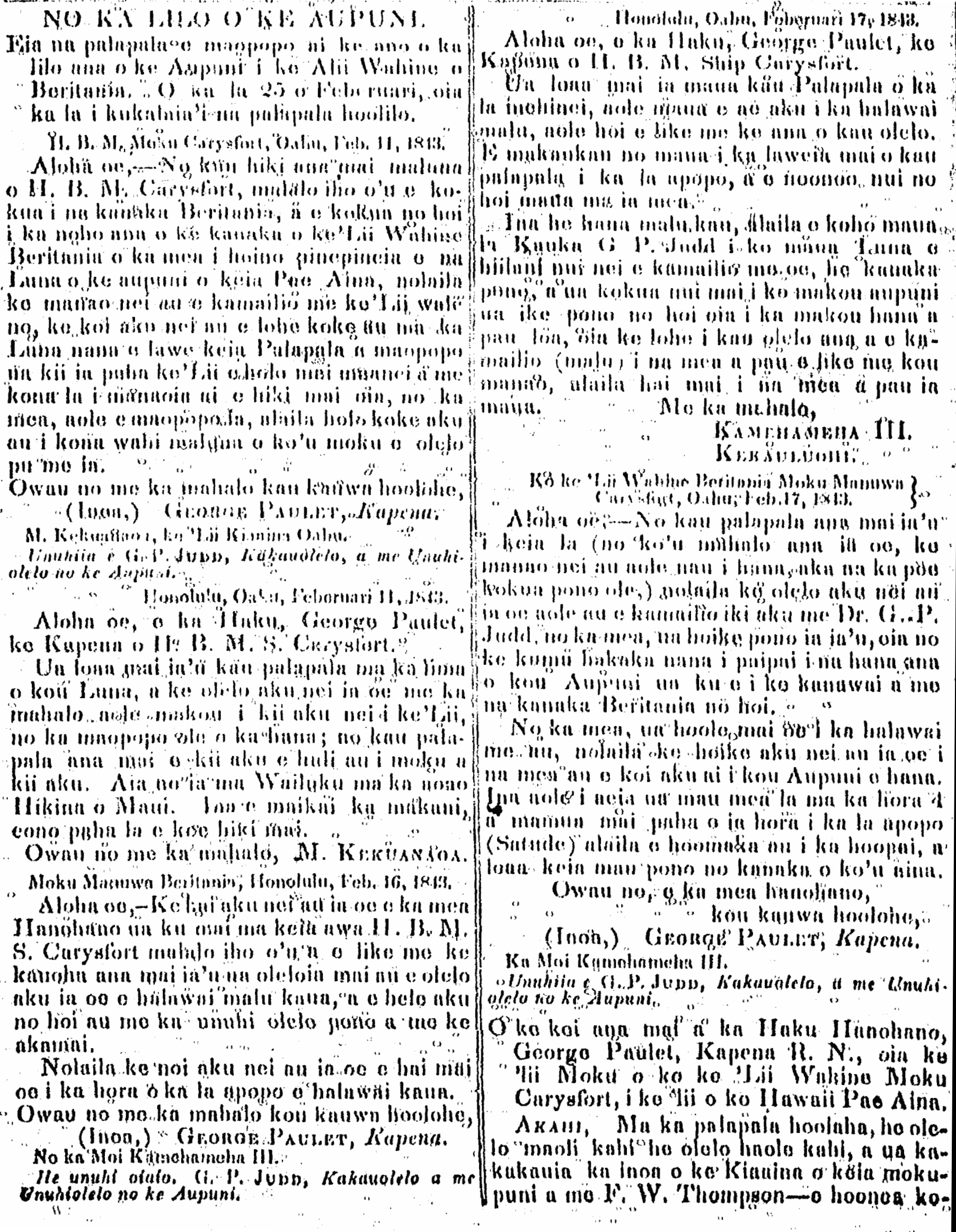
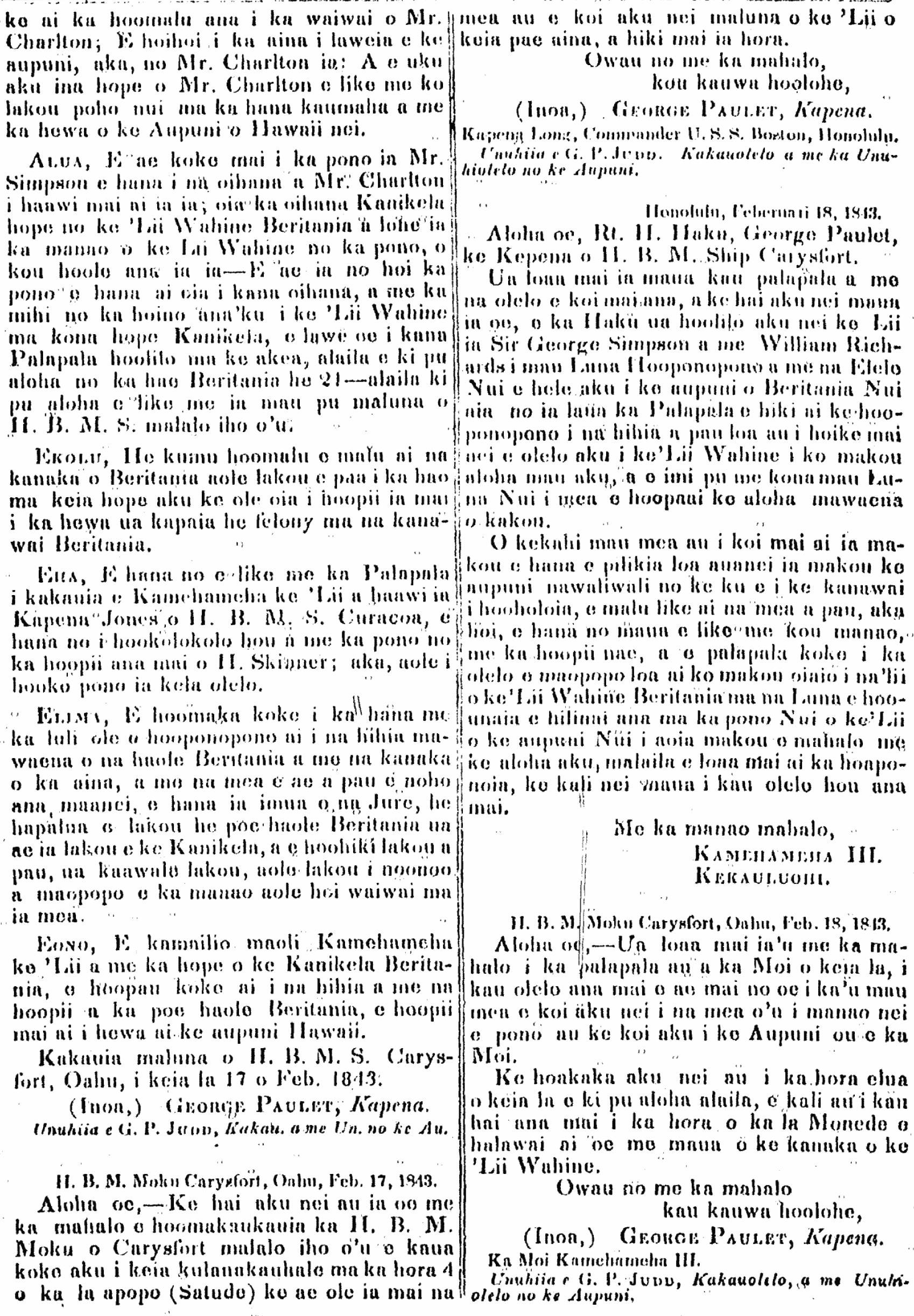
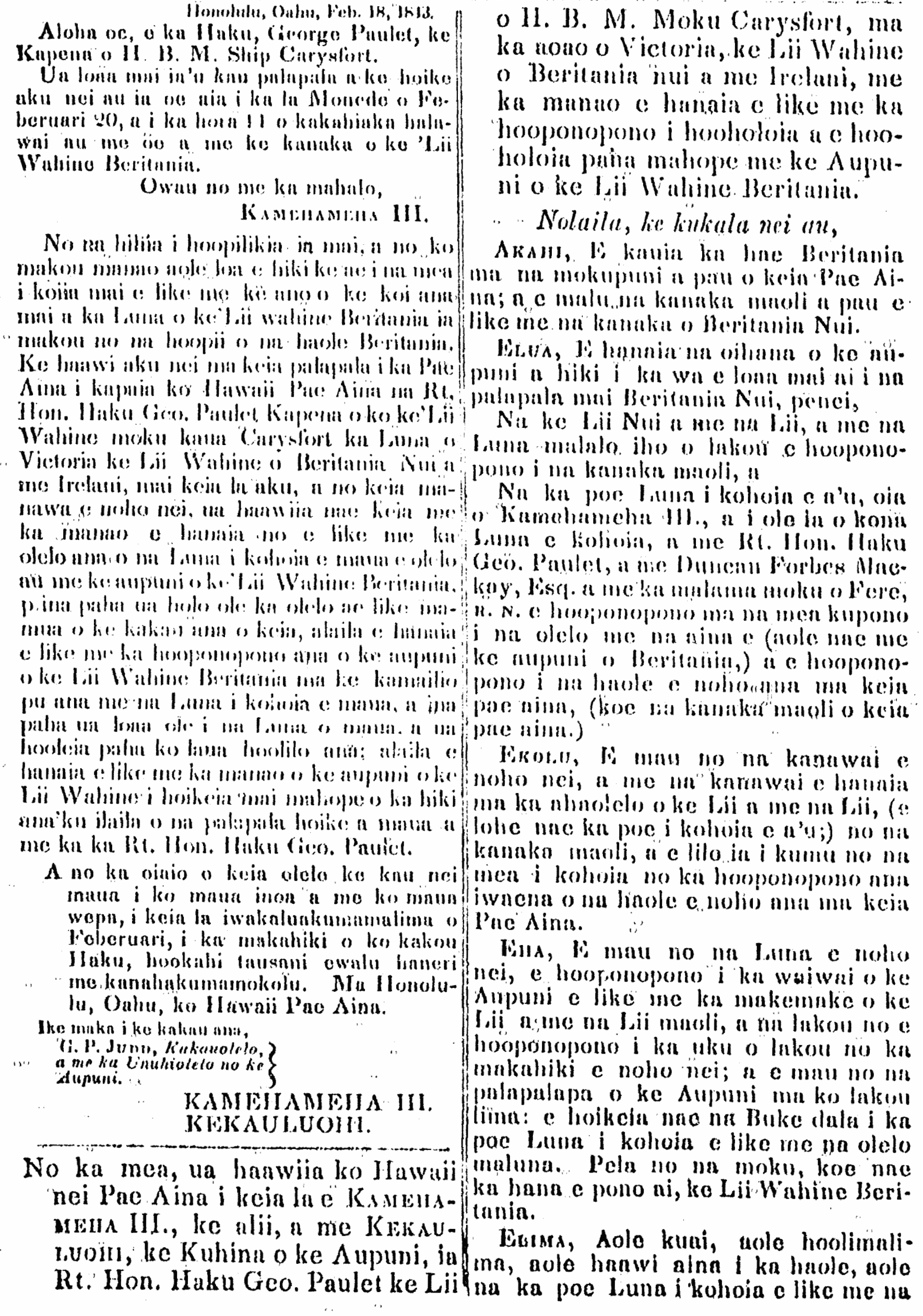
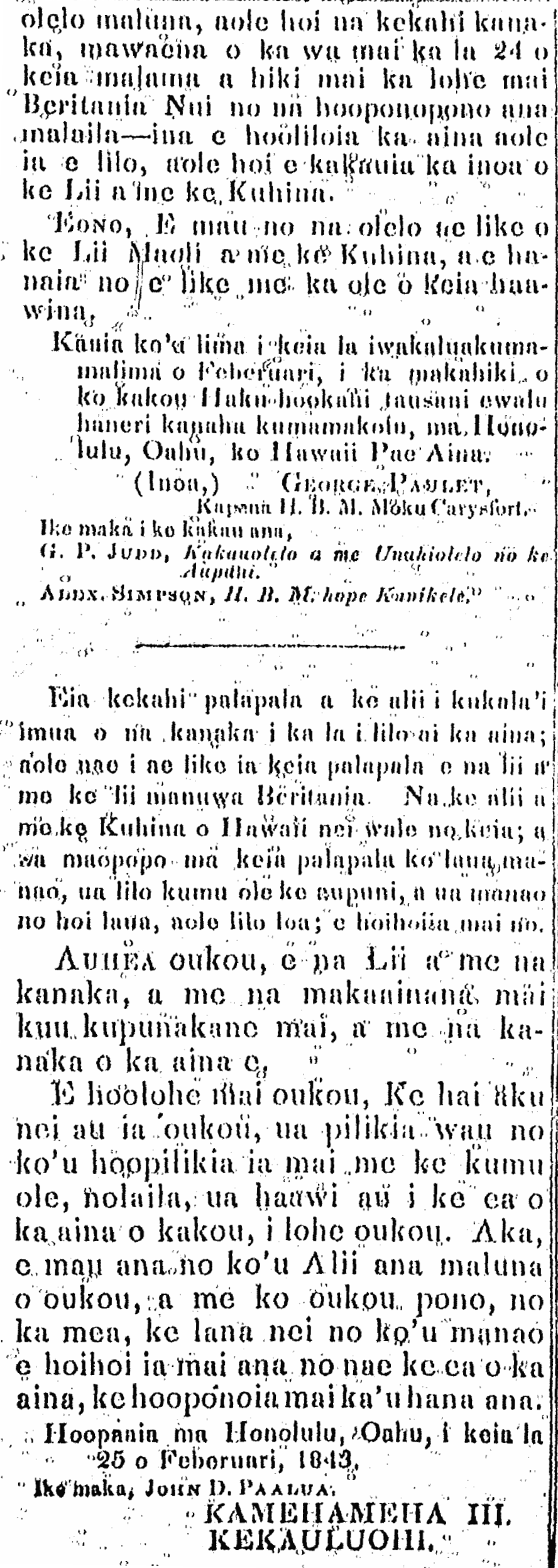
Correspondences between Paulet and the Hawaiian Government. 1843.

ON THE LOSS OF THE KINGDOM.

Here are the documents illuminating how the Kingdom was lost to the Queen of Britain. The 25th of February was the day the cession was proclaimed.

[See on Google Books: British and Foreign State Papers, starting on page 1023. These correspondences were translated from English into Hawaiian, and from Hawaiian into English by Gerrit Parmele Judd (Kauka), the Secretary and Translator of the Kingdom.]

(Nonanona, 3/7/1843, pp. 97–100.)

NO KA LILO O KE AUPUNI.

Ka Nonanona, Buke 2, Pepa 20, Aoao 97. Maraki 7, 1843.

ke ai ka hoomalu ana...

Ka Nonanona, Buke 2, Pepa 20, Aoao 98. Maraki 7, 1843.

Honolulu, Oahu, Feb. 18, 1843.

Ka Nonanona, Buke 2, Pepa 20, Aoao 99. Maraki 7, 1843.

olelo maluna, aole hoi na kekahi kanaka...

Ka Nonanona, Buke 2, Pepa 20, Aoao 100. Maraki 7, 1843.

Paulet arrives. 1843.

WARSHIPS.

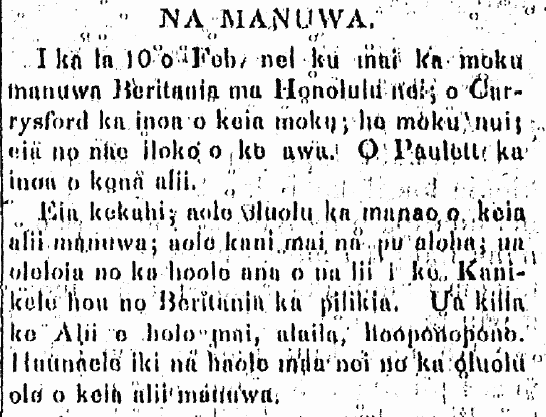
On the 10th of this Feb., the British man-of-war arrived here in Honolulu; the name of the ship is Carysfort; it is a large ship and yet is here in the harbor. Paulet is the name of its captain.

Here is another thing; the captain of this warship is not here with good intent; he did not fire his guns in salute; it is said that the problem is because of the denial of the new British Consul by the king. The King was sent for to come, and then they’d work it out. The haole here are having minor demonstrations in response to the ill will of the warship captain.

(Nonanona, 2/14/1843, p. 96)

NA MANUWA.

Ka Nonanona, Buke 2, Pepa 19, Aoao 96. Feberuari 14, 1843.