More on the Boston, in English, 1893.

Of What Are They Afraid?

Editor Bulletin:—

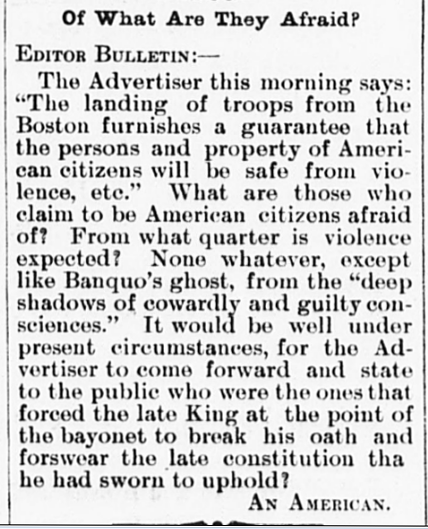
The Advertiser this morning says: “The landing of troops from the Boston furnishes a guarantee that the persons and property of American citizens will be safe from violence, etc.” What are those who claim to be American citizens afraid of? From what quarter is violence expected? None whatever, except like Banquo’s ghost, from the “deep shadows of cowardly and guilty consciences.” It would be well under present circumstances, for the Advertiser to come forward and state to the public who were the ones that forced the late King at the point of the bayonet to break his oath and forswear the late constitution tha he had sworn to uphold?

An American.

(Daily Bulletin, 1/17/1893, p. 3)

Of What Are They Afraid?

The Daily Bulletin, Volume 5, Number 626, Page 3. January 17, 1893.

More on the landing of the Boston, 1893.

OPPOSED.

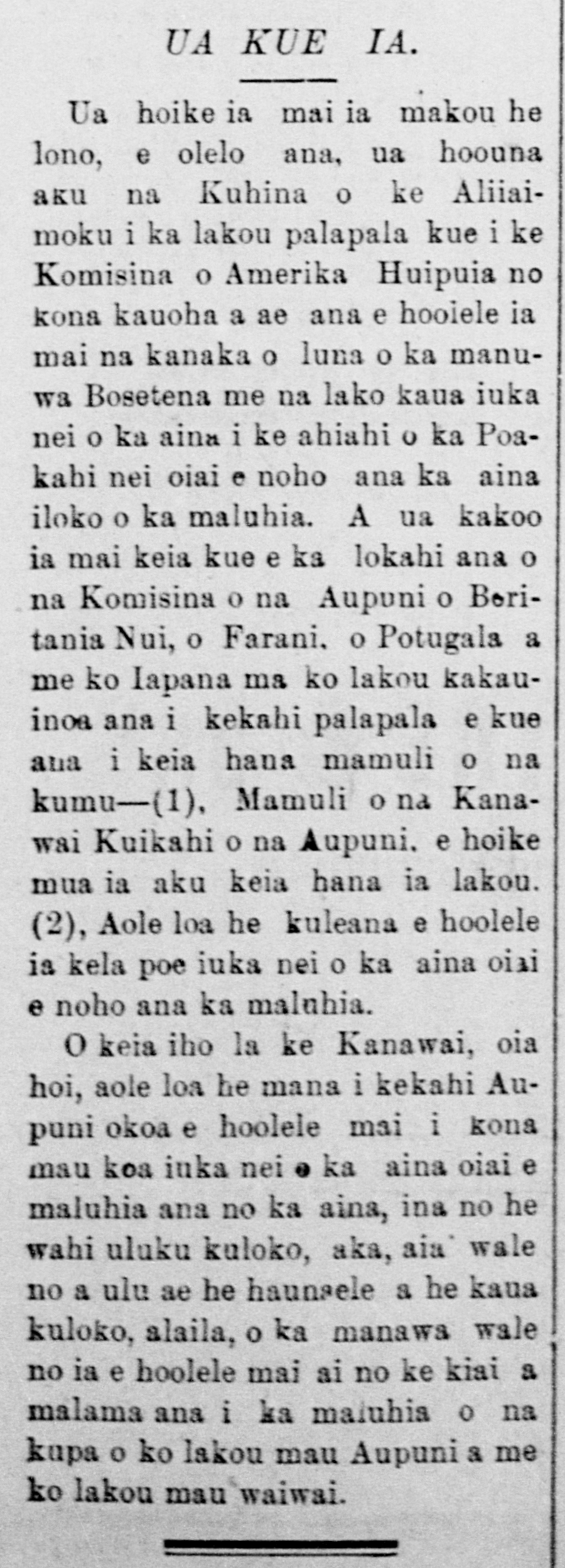
We have received news that the Ministers of the Queen sent their written protest to the Minister of the United States for his ordering the landing of the armed men from the man-of-war Boston on the evening of this Monday notwithstanding that there was peace on land. And this objection was jointly supported by the Commissioners of the Nations of Great Britain, France, Portugal, and Japan, by them signing a document opposing this action over these reasons—(1), Because of the agreement under law between the Nations to give prior notice. (2),  There was no cause to land the troops being that there was peace.

This is the Law, that being there is no other Nation that has any right to land its troops while there is peace; were there internal problems, but only if there was an uprising or a civil war, only then could there be troops landed to watch over and protect the safety of their citizens as well as their property.

(Hawaii Holomua, 1/18/1893, p. 3)

UA KUE IA.

Hawaii Holomua, Buke III, Helu 141, Aoao 3. Ianuari 18, 1893.

More on the Boston, 1893.

[Excerpt from the article: “OVERTHROW IN HAWAII NEI: The Queen Attempts to Push a New Constitution”]

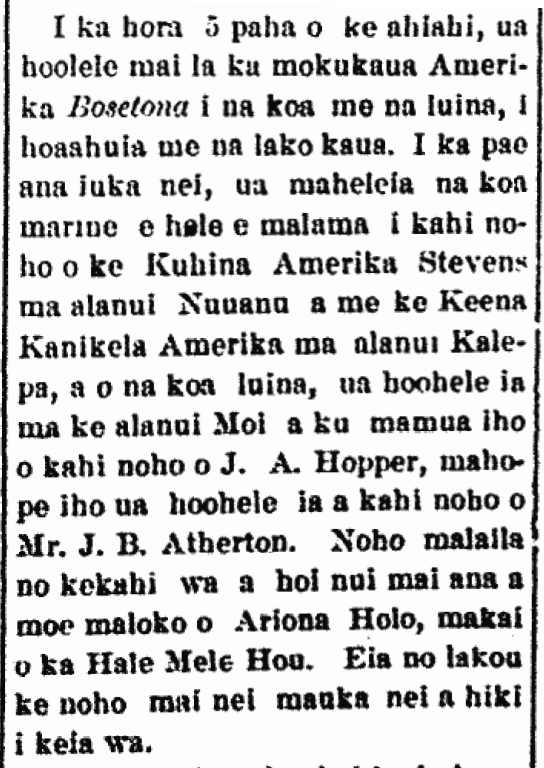
At perhaps 5 oʻclock in the afternoon, the American warship Boston [Bosetona] landed its officers and sailors who were armed. When they came ashore, the marines were split up to go and guard the residence of the American Minister Stevens on Nuuanu Avenue, and the American Consulate on Merchant Street, and the sailors were sent to King Street and stood before the residence of J. A. Hopper, and later they were sent to the residence of Mr. J. B. Atherton. They stayed there for some time, and then all came back and slept in Arion Hall [Ariona Holo] makai of the Opera House. They are still on shore to the present.

(Kuokoa, 1/21/1893, p. 2)

I ka hora 5 paha o ke ahiahi...

Ka Nupepa Kuokoa, Buke XXXII, Helu 3, Aoao 2. Ianuari 21, 1893.

Coverage of the landing of the USS Boston, 1893.

The American Troops Come Ashore.

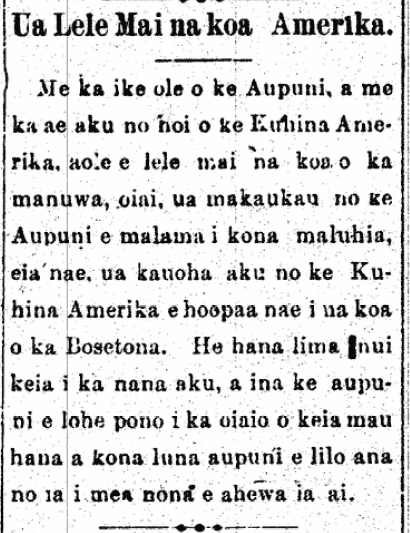
Without knowledge of the Government, and regardless of the agreement of the American Minister that the soldiers from the warship would not come ashore, being that the Government was prepared to uphold the peace; the American Minister ordered the soldiers of the Boston to to take control. This is an apparent act of aggression, and if that nation learns of the truth of this act by its official, it will be grounds for him to be condemned.

[This article and the following are coverage of the landing of the U. S. S. Boston 120 years ago today by different newspapers. Just as we see today, back then there was different coverage depending on what you read.]

(Leo o ka Lahui, 1/17/1893, p. 2)

Ua Lele Mai na koa Amerika.

Ka Leo o ka Lahui, Buke II, Helu 624, Aoao 2. Ianuari 17, 1893.

Competing rallies, 1893.

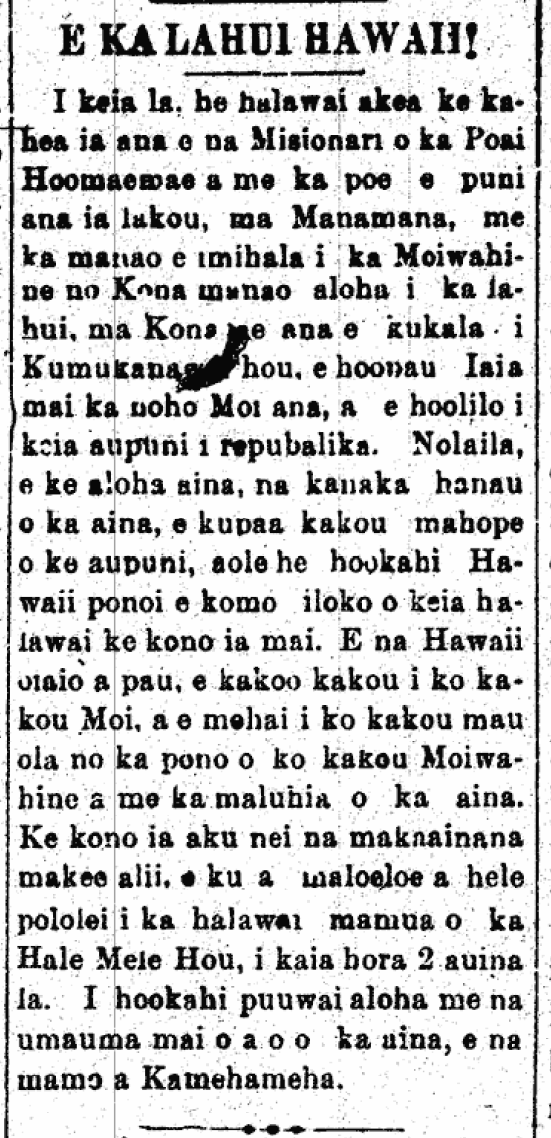
O HAWAIIAN LAHUI!

Today, there is a rally being called by the Missionaries of the Reformist Party [Poai Hoomaemae] and those who favor them, at Manamana, with the intent to bring harm to the Queen for Her aloha she has for the lahui, in Her proclaiming a new Constitution; by ending Her reign and making this nation a republic. Therefore, patriots, those born of this land, stand strong behind this nation; there shall not be a single true Hawaiian who will participate in this gathering, should they be invited. All of you true Hawaiians, let us stand behind our Sovereign and give our lives for the rights of our Queen and peace over the land. Those citizens who love their alii are called to join together to march straight to the rally fronting the Opera House [Hale Mele Hou] at 2 o’clock in the afternoon. With one heart of aloha and breasts side by side all across the land, you descendants of Kamehameha.

(Leo o ka Lahui, 1/16/1893, p. 2)

E KA LAHUI HAWAII!

Ka Leo o ka Lahui, Buke II, Helu 623, Aoao 2. Ianuari 16, 1893.

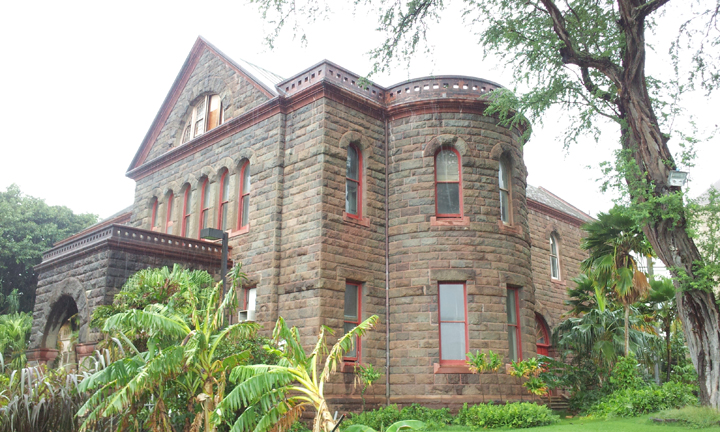
Bishop Hall as it stands today, 2013.

Here is Bishop Hall today on the campus of the Bernice Pauahi Bishop Museum. Although it is not open to the public, you still can see the beautiful stone facade! Please consider a membership at the Museum, and support a good cause. The Bishop Museum cares for one of the largest collections of Hawaiian-Language Newspapers in its archives!!

Bishop Hall 2013

Bishop Hall, Bernice Pauahi Bishop Museum, 2013.

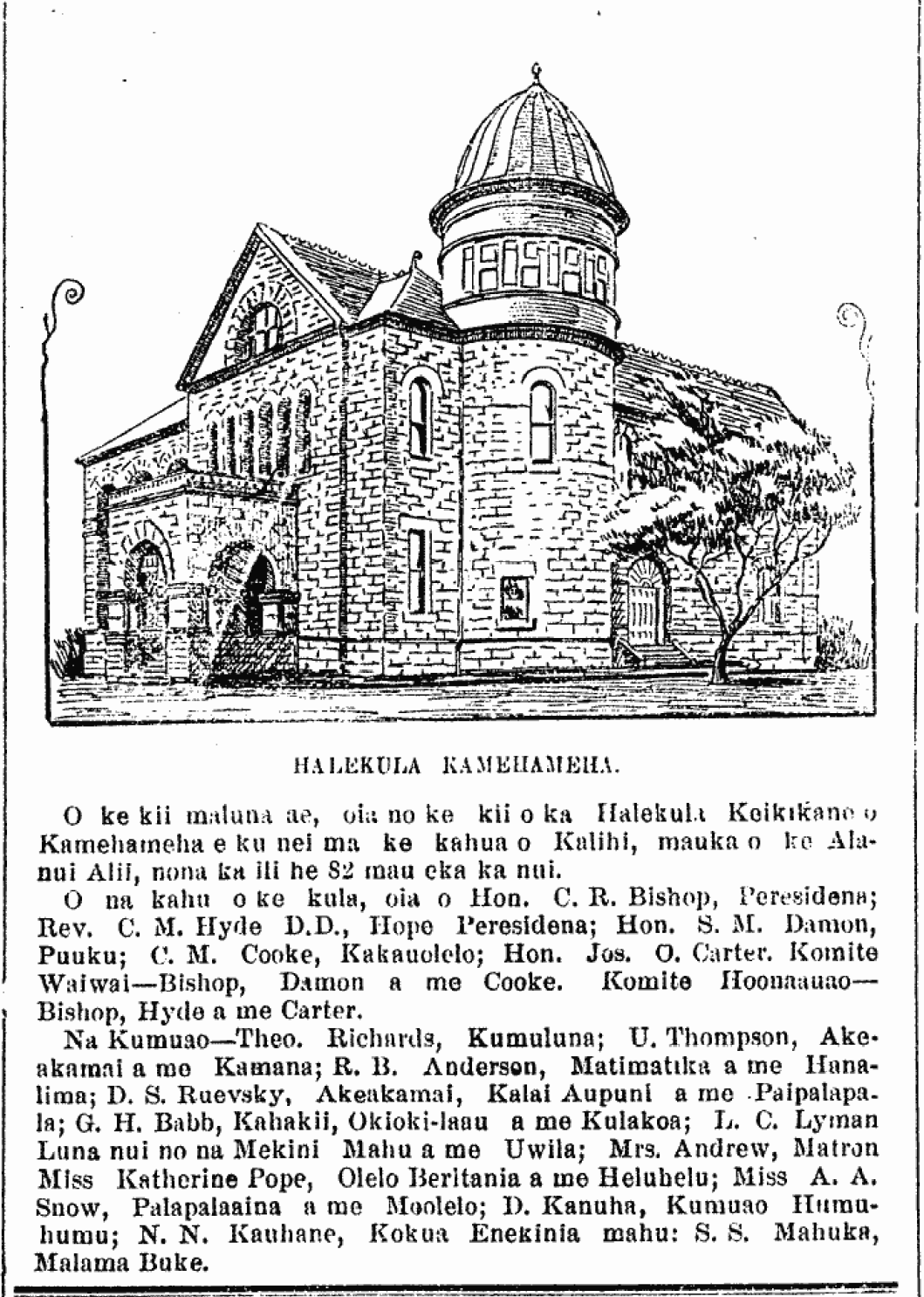
Kamehameha Boys’ School, Bishop Hall, 1894.

KAMEHAMEHA SCHOOLHOUSE.

The picture above is a picture of the Kamehameha Boys’ Schoolhouse, which stands on the grounds in Kalihi, upland of King Street [Alanui Alii], and its area is 82 acres.

The school supervisors are the Hon. C. R. Bishop, President; Rev. C. M. Hyde, D. D., Vice President; Hon. S. M. Damon, Treasurer; C. M. Cooke, Secretary; Hon. Joseph O. Carter. Financial Committee—Bishop, Damon, and Cooke. Education Committee—Bishop, Hyde, and Carter.

Instructors—Theodore Richards, Principal; U. Thompson, Science and Carpentry; R. B. Anderson, Mathematics and Manual Labor; D. S. Ruevsky, Science, Political Science, and Printing; G. H. Babb, Drawing, Wood Shop, and Military Education; L. C. Lyman, Head of the Steam and Electric Engines; Mrs. Andrews, Matron; Miss Katherine Pope, English Language and Reading; Miss A. A. Snow, Geography and History; D. Kanuha, Sewing Teacher; N. N. Kauhane, Assistant Steam Engineer; S. S. Mahuka, Librarian.

(Kuokoa, 6/2/1894, p. 1)

HALEKULA KAMEHAMEHA.

Ka Nupepa Kuokoa, Buke XXXIII, Helu 22, Aoao 1. Iune 2, 1894.

King Kalakaua gifts some 200 kii¹ to the National Academy of Sciences. 1887.

A Gift from the King.

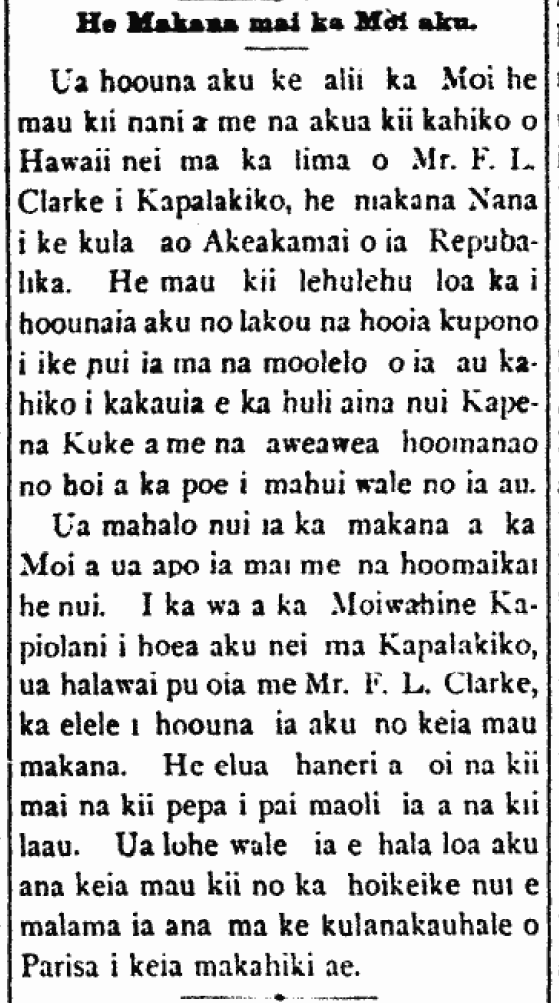
The alii, the King, sent a number of beautiful pictures [kii] and old godly images [akua kii] of Hawaii to the hands of Mr. F. L. Clarke² in San Francisco, a gift from Him to the National Academy of Sciences [? ke kula ao Akeakamai o ia Repubalika]. There were a great many images sent which are well attested to as seen in the old accounts written by the great explorer Captain Cook and the faint recollections of those who have slight knowledge of that era.

The gift of the King was greatly appreciated and it was accepted with much thanks. When Queen Kapiolani arrived in San Francisco, she met with Mr. F. L. Clarke, the representative sent for this gift. There were two hundred or more images, from images that were printed on paper, to wooden idols. It’s been heard that they will go all the way to the city of Paris for the great exposition to be held next year.³

¹”Kii” refers to any image or representation of something, whether it be printed on paper, painted on canvas, carved out of wood, or cast in metal.

²See Clarke’s short history of Hawaii, “Hawaii’s Real Story,” which appeared in The Forum, July 1900, pp. 555–565.

³Exposition Universelle, 1889. See “Catalogue of the Hawaiian Exhibits at the Exposition Universelle, Paris, 1889.” by John A. Hassinger, Department of the Interior.

[Does anyone know of what happens to all of this?]

(Kuokoa, 5/14/1887, p. 2)

He Makana mai ka Moi aku.

Ka Nupepa Kuokoa, Buke XXVI, Helu 20, Aoao 2. Mei 14, 1887.

A haole kamaaina’s advice on teaching English instead of Hawaiian, 1872.

Pertaining to the English Language.

O Kuokoa Newspaper: Aloha oe:—

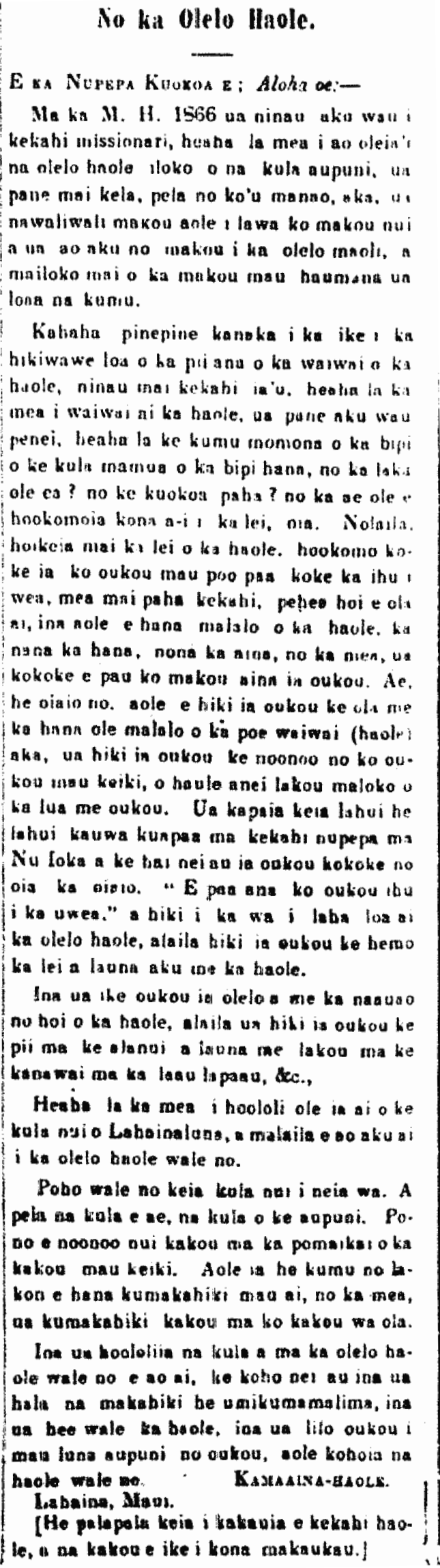
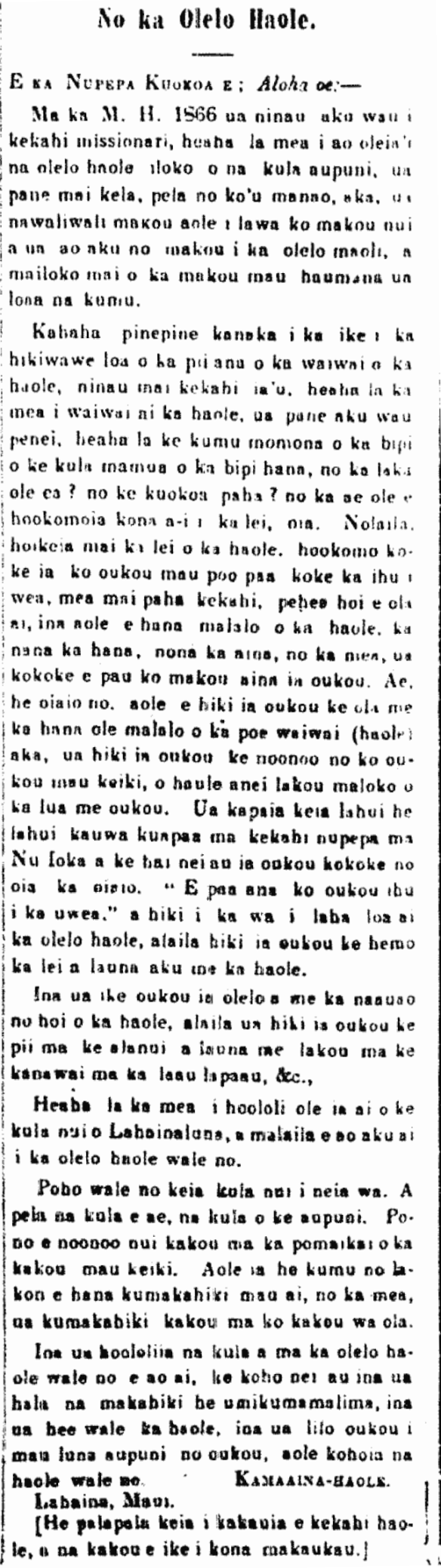
In the year 1866, I asked a missionary, “What is the reason English isn’t being taught in the government schools,” and he replied, “That is what I think as well, but we are weak, there are not enough of us, and we teach Hawaiian, and from amongst our students we find teachers.”

The Hawaiians are often astounded at seeing how quickly the haole gains wealth, and one asked me, “How does the haole get rich?” I answered this way, “Why is the cow in the fields fatter than the cow that works, isn’t it because it isn’t tamed? or because it is independent? or because it refuses to have it’s neck put in a yoke? That’s it. So when shown the yoke of the haole, your necks are put within it and your noses are soon wired; some may say, ‘How are we to live if we don’t work under the haole; they have the work, to them belongs the land, because soon our land will all be taken by you.’ It is true, you cannot survive without working for the rich (haole), but you can think about your children, lest they fall into the abyss with you. This race was called a race of slaves in a newspaper in New York, and I say to you that this will soon be true. ‘Your noses will be put through with a wire.’ until the day when the English language spreads amongst you, then you’ll will be able to remove your yokes and associate with the haole.

If you all understand the language and the knowledge of the haole, then you’d be able to climb the path and meet up with them in law, medicine, &c.

What is the reason that the college of Lahainaluna is not changed, having only English taught there?

This college is currently a waste. And so too the other schools, the government schools. We must all think carefully about the good of our children. That is no reason for them to forever more work under yearly contracts, for we’ve worked under yearly contracts during out lifetimes.

If the schools were changed so that just English was taught, I predict that after fifteen years, and if the haole leave, then you’d become your own leaders in the government, and not only haole would be appointed.

Kamaaina haole.

Lahaina, Maui.

{This is a letter written by a haole, and it is for us to determine his competence.}

[The argument over what language should be taught in schools is a heated topic that can be seen throughout the life of the Hawaiian-Language Newspapers. At first the argument is whether or not to teach English, and in later years when more and more schools are taught in English, the argument for teaching Hawaiian in schools will become prominent. Most everyone it seems were concerned with the future of the children (whether they were for English or Hawaiian-language education).]

(Kuokoa, 10/26/1872, p. 2)
No ka Olelo Haole.

Ka Nupepa Kuokoa, Buke XI, Helu 43, Aoao 2. Okatoba 26,1872.